Chapter 16 – The Digestive System
b.
False
False
46. The salivary center sends impulses via the intrinsic autonomic nerves to the tongue to promote increased salivation.
a.
True
b.
False
False
47. The upper esophageal sphincter is the pharyngoesophageal sphincter, and the lower esophageal sphincter is the
gastroesophageal sphincter.
a.
True
b.
False
True
48. The swallowing center triggers a secondary peristaltic wave that sweeps from the beginning to the end of the pharynx.
a.
True
b.
False
False
49. Parietal cells secrete the hormone gastrin into the blood in response to protein products in the stomach lumen and in
response to alcohol.
a.
True
b.
False
False
50. Stimuli acting on the stomach— namely protein, distension, caffeine, and alcohol—increase gastric secretion by
overlapping efferent pathways.
a.
True
b.
False
Chapter 16 – The Digestive System
True
51. The luminal membranes of the gastric mucosal cells are essentially impermeable to H+, so acid cannot penetrate into
the cells and damage them.
a.
True
b.
False
True
52. The two substances absorbed by the stomach are alcohol and aspirin.
a.
True
b.
False
True
53. Bile salts aid protein digestion through their detergent action and facilitate protein absorption by participating in the
formation of micelles.
a.
True
b.
False
False
54. Any substance that increases bile secretion is called a choleretic.
a.
True
b.
False
True
55. Bilirubin is the primary bile pigment derived from the breakdown of worn-out red blood cells.
a.
True
b.
False
True
56. Chronic or high exposure to aspirin impairs hepatocyte replacement such that the sturdier fibroblasts take advantage of
the situation and overproduce.
a.
True
b.
False
False
57. Dipping down into the mucosal surface between the villi are shallow invaginations known as the islets of Langerhans.
a.
True
b.
False
False
58. The disaccharidases located in the brush border membrane of the small intestine cells further reduce disaccharides and
polysaccharides into the absorbable monosaccharide units of glucose, galactose, and fructose.
a.
True
b.
False
True
59. The products of lipase digestion are monoglycerides and free peptides.
a.
True
b.
False
False
60. Iron is actively transported from the lumen into the epithelial cells, with women having about four times more active
transport sites for iron than men.
a.
True
b.
False
True
61. Excessive loss of intestinal contents causes dehydration, loss of nutrient material, and metabolic acidosis resulting
from loss of HCO3-.
a.
True
b.
False
True
62. Flatus is derived from two sources: swallowed air and gas produced by protein digestion.
a.
True
b.
False
False
63. Collectively, the community of microbes that coexist peacefully and usefully with their human host is called the
microbiometa, and the aggregate collection of genomes is known as the microbiota.
a.
True
b.
False
False
64. About 2,000 species of bacteria have been identified in the human large intestine.
a.
True
b.
False
True
65. HCl in the stomach stimulates the release of gastrin.
a.
True
b.
False
False
66. Two basic types of phasic digestive motility exist in the digestive tract: __________ movements and mixing
movements.
67. A cross section of the digestive tube reveals four major tissue layers: (from the innermost layer outward) the mucosa,
the __________, the muscularis externa, and the __________.
68. Located throughout the layers of the muscularis externa are pacemaker cells known as the ______.
69. Sensory neurons called intrinsic primary __________ neurons respond to specific local stimuli in the digestive tract.
70. Saliva is about 99.5% __________ and 0.5% __________ and protein.
71. The simple __________ reflex occurs when __________ and pressure receptors within the oral cavity respond to the
presence of food.
72. Swallowing is initiated when a(n) __________ is voluntarily forced by the tongue to the rear of the mouth and into the
pharynx.Swallowing is initiated when a(n) __________ is voluntarily forced by the tongue to the rear of the mouth and
into the pharynx.
73. Additional __________ peristaltic waves, which do not involve the swallowing center, function to clear a lodged
bolus.
74. Gastric mixing takes place in the __________ of the stomach.
75. Gastric emptying is largely controlled by factors in the __________.
76. The major force for expulsion of stomach contents during vomiting comes from contraction of the __________
muscles and the __________.
77. The cells that secrete gastric juice are located in the gastric mucosa, which is divided into two distinct areas: the
__________ mucosa and the __________ gland area.
78. The parietal (or oxyntic) cells secrete __________ and __________.
79. The exocrine pancreas secretes a pancreatic juice consisting of two components: pancreatic enzymes actively secreted
by the __________ cells and an aqueous alkaline solution actively secreted by the __________ cells.
Chapter 16 – The Digestive System
80. All three types of pancreatic digestive enzymes are packaged together in the __________ granules, so all the
pancreatic enzymes are released together during __________.
81. The only liver function not accomplished by hepatocytes is the phagocytic activity carried out by the resident
macrophages, which are known as __________ cells.
82. __________ displaces some bile salts and lodges at the surface of the fat droplets, where it binds to lipase, thus
anchoring this enzyme to its site of action amid the bile-salt coating.
83. Segmentation not only accomplishes mixing, but also slowly moves __________ through the small intestine.
84. Each day, the exocrine gland cells in the small-intestine mucosa secrete into the lumen about 1.5 liters of an aqueous
salt and mucus solution called __________.
85. Special hair-like projections on the luminal surface of the small intestine epithelial cells, the microvilli, form the
__________.
86. One of the most common causes of malabsorption is __________ enteropathy, also known as celiac disease.
87. The primary function of the large intestine is to store __________ before __________.
88. The large intestine consists of three separate, conspicuous, longitudinal bands of muscle called the __________, which
run the length of the large intestine.
89. When food enters the stomach, mass movements are triggered in the colon primarily by the __________ reflex.
90. The presence of acid in the duodenum stimulates the release of __________.
Chapter 16 – The Digestive System
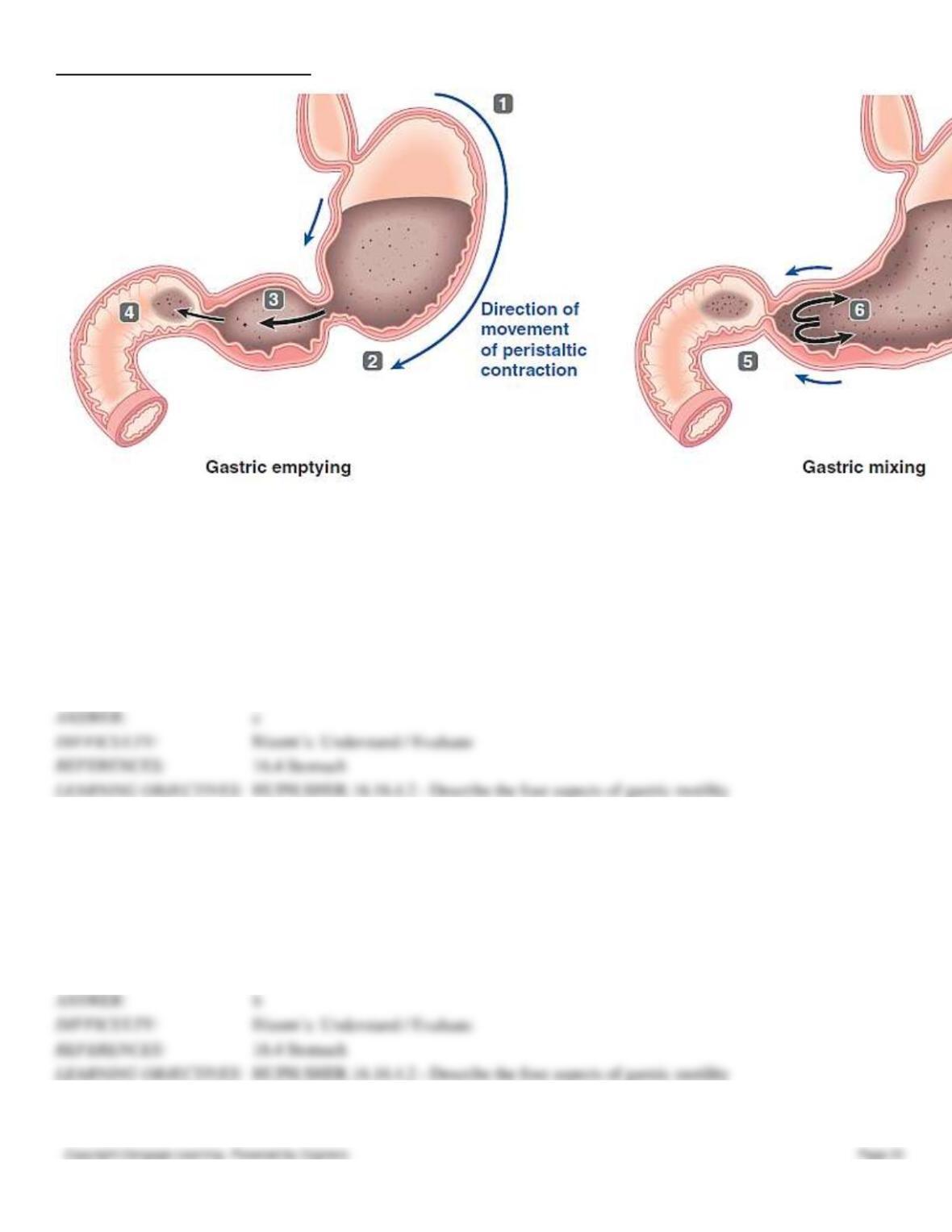
Use the figure above (Figure 16–7) to answer the corresponding questions.
91. Which number in the figure represents the pyloric sphincter?
a.
1
b.
2
c.
3
d.
4
e.
5
f.
6
92. Which number in the figure represents a contraction of the thick-muscled antrum?
a.
1
b.
2
c.
3
d.
4
e.
5
f.
6
b
93. Which number in the figure represents the initiation of peristaltic contraction?
Chapter 16 – The Digestive System
a.
1
b.
2
c.
3
d.
4
e.
5
f.
6
94. Which number in the figure represents retropulsion of chyme?
a.
1
b.
2
c.
3
d.
4
e.
5
f.
6
95. Which number in the figure represents chyme in the duodenum?
a.
1
b.
2
c.
3
d.
4
e.
5
f.
6
d
96. Describe the digestive tract wall.
97. Discuss the effects of excessive vomiting.
Chapter 16 – The Digestive System
98. Discuss the role of pancreatic amylase.
99. Explain malabsorption and give an example.
100. List the benefits of the beneficial bacteria in the large intestine.