
The Essential Cosmic Perspective, 8e (Bennett et al.)
Chapter 16 A Universe of Galaxies
16.1 Multiple Choice Questions
1) Based on counting the number of galaxies in a small patch of the sky and multiplying by the
number of such patches needed to cover the entire sky, the total number of galaxies in the
observable universe is estimated to be approximately
A) 100 million.
B) 1 billion.
C) 10 billion.
D) 100 billion.
E) 1 trillion.
2) Suppose that we look at a photograph of many galaxies. Assuming that all galaxies formed at
about the same time, which galaxy in the picture is the youngest?
A) the one that is reddest in color
B) the one that is bluest in color
C) the one that is farthest away
D) the one that is closest to us
E) the one that appears smallest in size
3) Which of the following types of galaxies have a disk and spheroidal component but lack spiral
arms?
A) ellipticals
B) lenticulars
C) irregulars
D) all of the above
4) Which of the following types of galaxies appear reddest in color?
A) spirals
B) ellipticals
C) lenticulars
D) irregulars
5) Which types of galaxies have a clearly defined spheroidal component?
A) spirals only
B) ellipticals only
C) lenticulars only
D) irregulars only
E) all but irregulars

6) Which types of galaxies have a clearly defined disk component?
A) spirals only
B) ellipticals only
C) lenticulars only
D) irregulars only
E) spirals and lenticulars
7) Compared to spiral galaxies, elliptical galaxies are
A) redder and more round.
B) redder and flatter.
C) bluer and more round.
D) bluer and flatter.
E) always much smaller.
8) The disk component of a spiral galaxy includes which of the following parts?
A) halo
B) bulge
C) spiral arms
D) globular clusters
E) all of the above
9) How does a lenticular galaxy differ from a normal spiral galaxy?
A) It has no bulge.
B) It has an elongated bulge resembling a bar more than a sphere.
C) It is flatter in shape.
D) It has no gas or dust.
E) It has no spiral arms.
10) What is the major difference between an elliptical galaxy and a spiral galaxy?
A) A spiral galaxy contains mostly younger stars.
B) A spiral galaxy has a spherical halo.
C) An elliptical galaxy lacks a disk component.
D) Elliptical galaxies are not as big as spiral galaxies.
E) Elliptical galaxies always contain more stars than spiral galaxies.
11) The most massive galaxies in the universe are
A) elliptical.
B) spiral.
C) irregular.
D) lenticular.

12) Why do spiral galaxies appear blue in color?
A) The longer wavelengths emitted by these galaxies are absorbed by insterstellar dust.
B) Their rapid rotation causes a blue-shift in the light they emit.
C) They contain many white dwarfs, which are usually hot enough to appear blue.
D) Their light output is dominated by hot, massive blue stars.
13) Which of the following is true about irregular galaxies?
A) They are composed solely of old stars.
B) They usually have a disk component.
C) They were more common when the universe was younger.
D) They usually have reddish colors.
E) They have well defined spiral arms.
14) Why do elliptical galaxies appear yellow or red in color?
A) They have very little dust or cool gas, and thus have little ongoing star formation.
B) Their population is dominated by old, cooler stars.
C) They contain no hot, young blue stars
D) all of the above
15) The orbits of stars in an elliptical galaxy are most similar to the orbits of the Milky Way’s
________.
A) disk stars
B) recently formed stars
C) molecular clouds
D) bulge stars
16) Why are Cepheid variables important?
A) Cepheid variables are stars that vary in brightness because they harbor a black hole.
Therefore, they provide direct evidence for black holes.
B) Cepheids variables are pulsating stars whose pulsation periods are directly related to their true
luminosities. Therefore they can be used as distance indicators.
C) Cepheids variables are a type of irregular galaxy, much more common in the early universe.
Therefore they help to understand how galaxies formed.
D) Cepheids variables are supermassive stars that are on the verge of becoming supernovae.
Therefore they allow us to choose candidates to watch if we hope to observe a supernova.
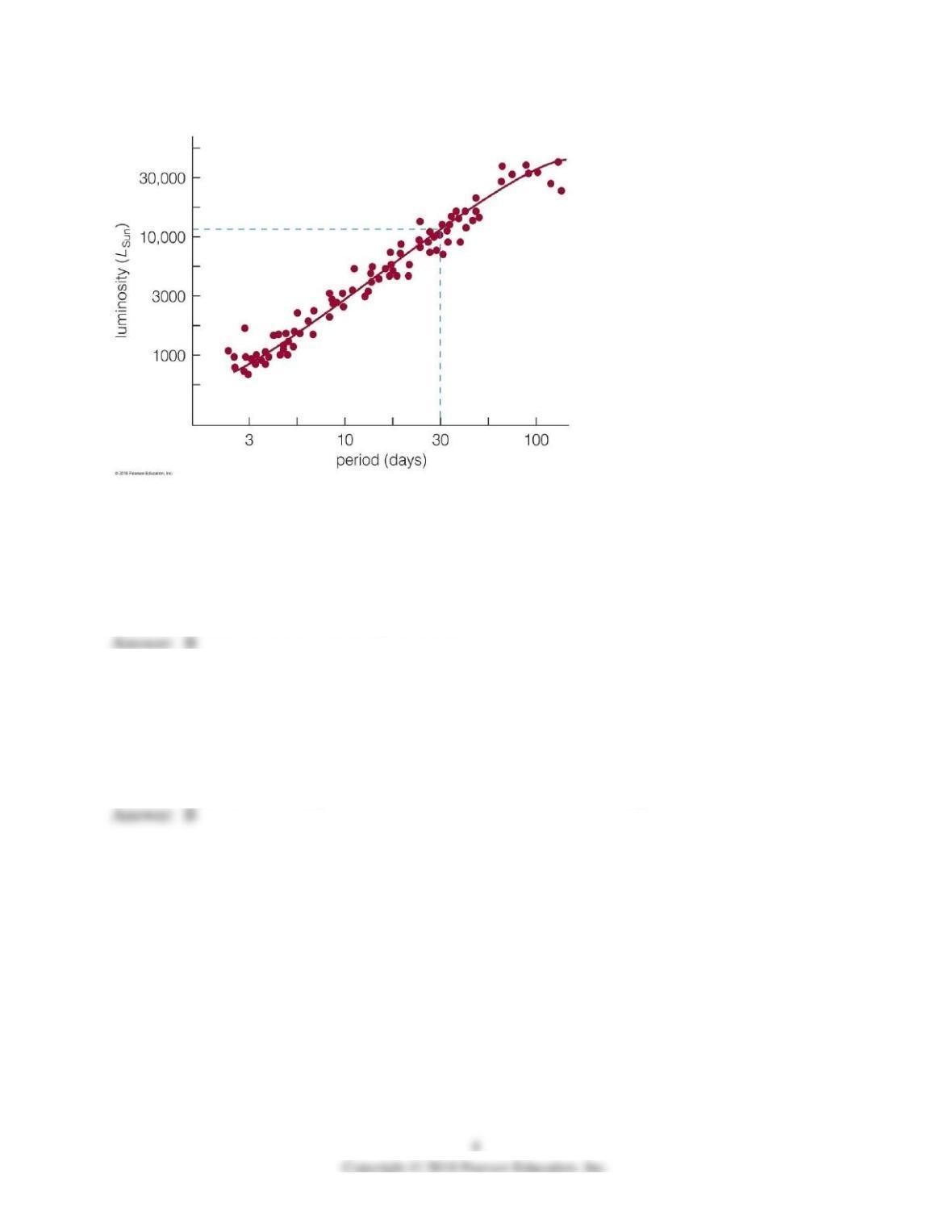
17)
This figure shows the Cepheid period-luminosity relation. What is the approximate luminosity of
a Cepheid star that varies in brightness on a 10 day cycle?
A) about 1000 times the luminosity of the sun
B) about 3000 times the luminosity of the sun
C) about 10,000 times the luminosity of the sun
D) about 30,000 times the luminosity of the sun
18) A star that is known to be 10,000 times brighter than the sun has the same apparent
brightness as a nearby G2 star. How many times further away is the bright star?
A) The bright star is 10 times further away than the nearby G2 star.
B) The bright star is 100 times further away than the nearby G2 star.
C) The bright star is 10,000 times further away than the nearby G2 star.
D) The bright star is actually a factor of 10 times closer than the nearby G2 star.
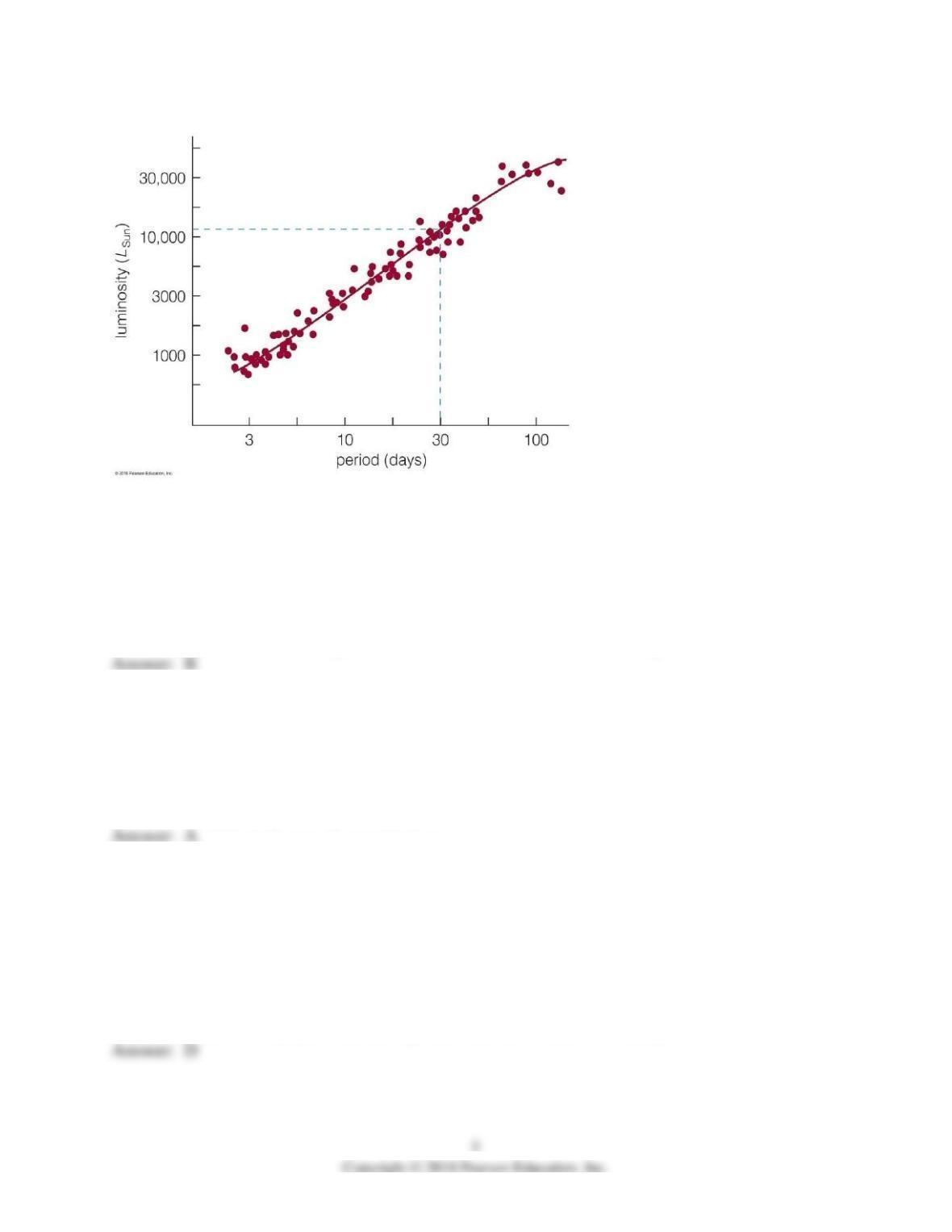
19)
This figure shows the Cepheid period-luminosity relation. A Cepheid star with a period of 30
days has the same apparent brightness as a nearby G2 star. How many times further away is the
Cepheid star?
A) The Cepheid star is 10 times further away than the nearby G2 star.
B) The Cepheid star is 100 times further away than the nearby G2 star.
C) The Cepheid star is 10,000 times further away than the nearby G2 star.
D) The Cepheid star is actually a factor of 10 times closer than the nearby G2 star.
20) What is a standard candle?
A) an object whose luminosity we know
B) an object for which we can easily measure its apparent brightness
C) a class of objects that we know all have exactly the same apparent brightness
D) any star for which we know its exact apparent brightness
E) a unit of luminosity used by astronomers
21) Suppose you measure the brightness and period of a number of Cepheid variable stars in
Galaxy A and Galaxy B. You find that all the Cepheid variables in Galaxy A are approximately
25 times brighter than Cepheid variables with similar periods in Galaxy B. What can you
conclude about the distances of these galaxies?
A) The distance to Galaxy A is 25 times greater than the distance to Galaxy B
B) The distance to Galaxy A is 5 times greater than the distance to Galaxy B.
C) The distance to Galaxy B is 25 times greater than the distance to Galaxy A.
D) The distance to Galaxy B is 5 times greater than the distance to Galaxy A.

22) What is the current limit to distances we can measure via parallax, until the results of the
new Gaia mission become available?
A) about 150 light-years
B) about 1500 light-years
C) about 15,000 light-years
D) about 150,000 light-years
23) How did Edwin Hubble measure the distance to the Andromeda Galaxy?
A) He measured its parallax.
B) He applied main-sequence fitting to star clusters in Andromeda.
C) He applied the period-luminosity relation to Cepheid variables in Andromeda.
D) He measured its redshift and applied Hubble’s law.
E) He detected white dwarf supernovae in Andromeda.
24) How was Edwin Hubble able to use his discovery of Cepheids in Andromeda to prove that
the “spiral nebulae” were actually galaxies external to the Milky Way?
A) There are no Cepheids in the Milky Way, so his discovery proved that Andromeda had to be
in another galaxy.
B) He measured the parallaxes of the Cepheids in Andromeda to determine their distances. He
showed that Andromeda was far outside the Milky Way Galaxy.
C) He used main-sequence fitting to determine the distances to the Cepheids. He showed that
Andromeda was far outside the Milky Way Galaxy.
D) From the period-luminosity relation for Cepheids, he was able to determine the distance to
Andromeda. He showed that it was far outside the Milky Way Galaxy.
E) As a Cepheid is a type of luminous galaxy, Hubble’s discovery of Cepheids in Andromeda
proved that it was a separate galaxy from the Milky Way.
25) What two quantities did Edwin Hubble compare for a sample of galaxies to discover the
expansion of the universe?
A) velocity and distance
B) luminosity and distance
C) velocity and temperature
D) luminosity and temperature
E) age and distance
26) In words, what does the equation for Hubble’s law state?
A) The luminosity of the Cepheid variable star is directly proportional to its pulsation period.
B) The recession velocity of a galaxy is directly proportional to its distance.
C) The recession velocity of a galaxy is inversely proportional to its distance.
D) The faster a spiral galaxy’s rotation speed, the more luminous it is.
E) The faster a spiral galaxy’s rotation speed, the less luminous it is.

27) Which of the following is a consequence of Hubble’s law?
A) The Big Bang
B) All galaxies are moving away from us equally fast.
C) The more distant a galaxy is from us, the faster it moves away from us.
D) The closer a galaxy is to us, the faster it moves away from us.
E) More distant galaxies appear younger.
28) Which of the following is not a good reason why white-dwarf supernovae are good standard
candles for distance measurements?
A) All white-dwarf supernovae involve the explosion of stars of nearly the same mass.
B) White-dwarf supernovae are so bright that they can be detected even in very distant galaxies.
C) White-dwarf supernovae occur only among young and extremely bright stars.
D) All white-dwarf supernovae have similar light curves, which makes them easy to distinguish
from massive-star supernovae.
29) What makes white-dwarf supernovae very good standard candles for distance
measurements?
A) They are all about the same distance from us, so when they explode they always achieve the
same apparent brightness.
B) They should all have approximately the same luminosity.
C) They occur so frequently that we can use them to measure the distances to virtually all
galaxies.
D) We have had several occur close to us in the Milky Way, so we have been able to determine
their luminosities very accurately.
30) What is the most accurate way to determine the distance to a nearby star?
A) radar ranging
B) stellar parallax
C) main-sequence fitting
D) Cepheid variables
E) Hubble’s law
31) What is the most accurate way to determine the distance to a nearby galaxy?
A) radar ranging
B) stellar parallax
C) main-sequence fitting
D) Cepheid variables
E) Hubble’s law

32) What is the most accurate way to determine the distance to a very distant galaxy?
A) main-sequence fitting
B) Stellar parallax
C) Cepheid variables
D) white dwarf supernova
33) How do astronomers use the Hubble constant (H) to estimate the age of the universe?
A) The age of the universe is about 22 times H.
B) The inverse of H is proportional to the age of the universe.
C) H is directly proportional to the age of the universe.
D) They do not. The age of the universe is unknowable.
34) Dr. X believes that the Hubble constant is 20 km/s/Mly while Dr. Y believes it is 24
km/s/Mly. Which statement below automatically follows?
A) Dr. X believes that the universe is expanding, but Dr. Y does not.
B) Dr. X believes that the Andromeda Galaxy (a member of our Local Group) is moving away
from us at a slower speed than Dr. Y believes.
C) Dr. X believes that the universe is older than Dr. Y believes.
D) Dr. X believes that the universe will someday stop expanding, while Dr. Y believes it will
expand forever.
E) Dr. X believes that the universe is younger than Dr. Y believes.
35) Recall that Hubble’s law is written v = Hd, where v is the recession velocity of a galaxy
located a distance d away from us, and H is Hubble’s constant. Suppose H = 20 km/s/Mly. How
fast would a galaxy 1000 Mly distant be receding from us?
A) 20 km/s
B) 20 Mly/s
C) 20,000 km/s
D) 50 km/s
E) 0.20 times the speed of light
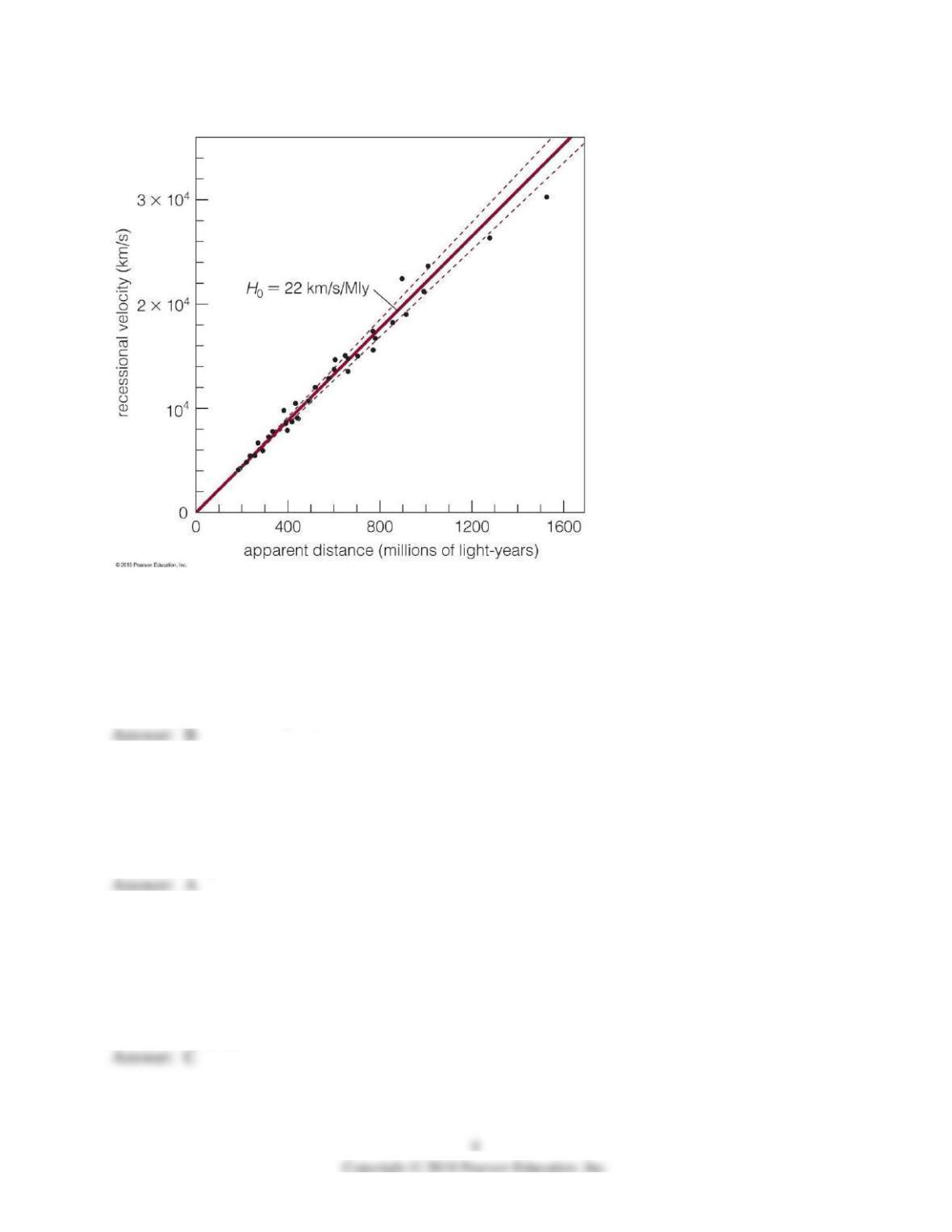
36)
This figure shows Hubble’s law. If a galaxy is observed to be moving away from us at 30,000
km/s, how far away is it?
A) about 30,000 light-years
B) about 1400 million light-years
C) about 5000 million light-years
D) about 900 million light-years
37) Hubble’s “constant” is not constant throughout
A) time.
B) space.
C) space and time.
D) our Galaxy.
38) Based on current estimates of the value of Hubble’s constant, about how old is the universe?
A) 10 billion years old
B) 12 billion years old
C) 14 billion years old
D) 18 billion years old
E) 20 billion years old

39) Why can’t we see past the cosmological horizon?
A) The universe extends only to this horizon.
B) Beyond the cosmological horizon, we are looking back to a time before the universe had
formed.
C) We do not have telescopes big enough.
D) We do not have detectors sensitive enough.
E) The cosmological horizon is infinitely far away, and we can’t see to infinity.
40) How do observations of galaxies at different distances help us learn about galaxy evolution?
A) Observations of different distances show galaxies of different ages and therefore different
stages of evolution.
B) We can see the primordial clouds of gas that formed the galaxies.
C) We can observe the evolution of a single galaxy over time.
D) We can observe galaxies at different distances merge, helping us learn how mergers affect
evolution.
E) We can see what our galaxy used to look like over time, helping us theorize about the
physical processes that led to its current appearance.
41) I observe a galaxy that is 100 million light-years away. Which of the following do I see?
A) the light from the galaxy as it is today, and it is blueshifted
B) the light from the galaxy as it is today, and it is redshifted
C) the light from the galaxy as it was 100 million years ago, and it is blueshifted
D) the light from the galaxy as it was 100 million years ago, and it is redshifted
E) Nothing: the galaxy lies beyond the cosmological horizon.
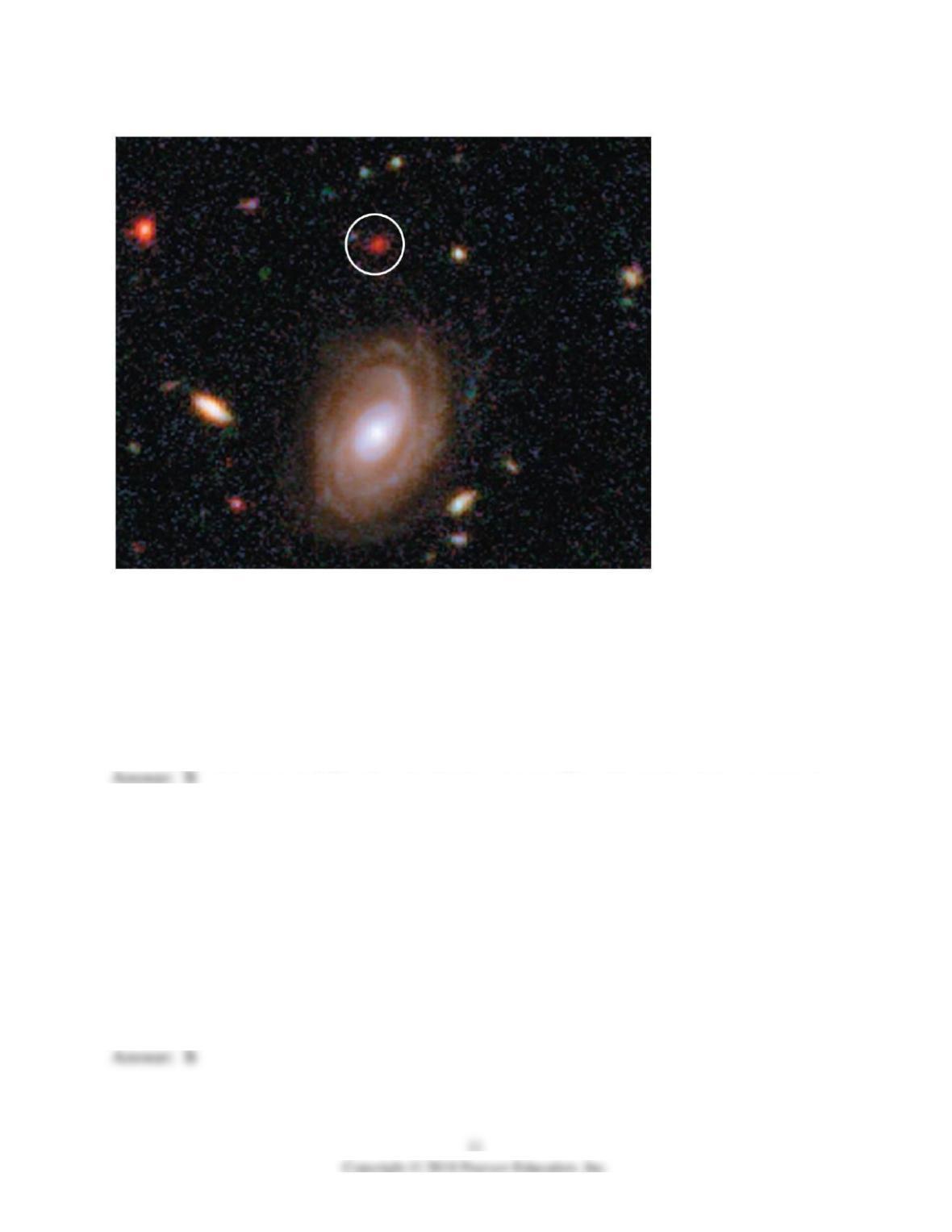
42)
In this picture, we are seeing light from the circled elliptical galaxy (HUDF-JD2) from when the
universe was only about 800 million years old. The spiral galaxy below it is much closer. Why
does HUDF-JD2 appear a deep red, compared to the whitish color of the nearby spiral?
A) Thick dust from active star formation in HUDF-JD2 blocks all the blue light, only letting red
light escape.
B) Even at this young age, HUDF-JD2 contains few high mass blue stars.
C) Galaxies in the early universe contained more hydrogen, so they appear redder.
D) The light from the nearby galaxy is blueshifted, and the light from HUDF-JD2 is redshifted.
43) Which of the following gives the two main assumptions of theoretical models of galaxy
evolution?
A) The beginning of the universe is modeled after a supernova explosion, and all elements were
produced by this exploding star.
B) Hydrogen and helium filled all of space, and certain regions of the universe were slightly
denser than others.
C) Hydrogen and helium filled all of space, and the entire universe had exactly the same density
everywhere.
D) The universe has always been expanding, and denser areas contracted to form the first stars.
E) The universe was composed originally only of hydrogen, and all the other elements came
from stars.

44) Which of the following processes slowed the collapse of protogalactic clouds?
A) the conversion of gravitational potential energy into kinetic and thermal energy as the cloud
collapsed
B) the shock waves from the exploding supernovae of the earliest stars
C) the pull of gravity of the mass of the cloud material
D) the radiating away of thermal energy
45) Which of the following types of protogalactic clouds is most likely to form an elliptical
galaxy?
A) a very low-density cloud with very little angular momentum
B) a dense cloud with very little angular momentum
C) a low-density cloud with quite a bit of angular momentum
D) a dense cloud with quite a bit of angular momentum
E) a very massive cloud with any density and a lot of angular momentum
46) Why is a dense cloud more likely to produce an elliptical galaxy than a spiral galaxy?
A) The higher density of gas has a stronger force of gravity, and therefore the cloud collapses
more quickly.
B) The force of gravity can pull the material into a more spherical shape.
C) The more frequent collisions between particles randomize the particle orbits.
D) The thickness of the dense cloud prevents a disk from forming.
E) The higher gas density forms stars more efficiently, so all the gas is converted into stars
before a disk can form.
47) Which of the following cannot be true of the very first stars formed in the universe?
A) Some may have exploded as supernovae by now.
B) Some may have formed in large clusters.
C) Some may have formed singly, in isolation from one another.
D) Some may still exist in the Milky Way today.
E) Some may have had rocky planets around them.
48) If we represent the Milky Way Galaxy as the size of a grapefruit, the distance to the
Andromeda Galaxy would be about
A) 3 cm.
B) 3 m.
C) 30 m.
D) 3 km.
E) 300 km.

49) Scale the Milky Way down to the size of a compact disc. Which of the following best
describes the size, shape, and distance of the Andromeda Galaxy on the same scale?
A) a compact disk a few meters away
B) a grapefruit a few meters away
C) a compact disk about the length of a football field away
D) a pecan nut about 1 centimeter away
E) a grapefruit about 1 kilometer away
50) Why should galaxy collisions have been more common in the past than they are today?
A) Galaxies were more active in the past.
B) Galaxies were much bigger in the past.
C) Galaxies were closer together in the past.
D) Gravity is thought to have been stronger in the past.
E) Galaxy collisions shouldn’t have been more common in the past than they are now.
51) What evidence supports the idea that a collision between two spiral galaxies might lead to
the formation of a single elliptical galaxy?
A) observations of some elliptical galaxies surrounded by shells of stars that probably formed
from stars stripped out of smaller galaxies
B) the fact that elliptical galaxies dominate the galaxy populations at the cores of dense clusters
of galaxies
C) observations of some elliptical galaxies with stars and gas clouds in their cores that orbit
differently from the other stars in the galaxy
D) observations of giant elliptical galaxies at the center of dense clusters that may have grown by
consuming other galaxies
E) all of the above
52) Which of the following is not a strong argument for the theory that some large elliptical
galaxies formed as the result of galaxy collisions?
A) Elliptical galaxies dominate the population in dense galaxy clusters.
B) Some ellipticals have stars and gas that orbit in the opposite direction from the rest of the
galaxy.
C) Some elliptical galaxies are surrounded by shells of stars.
D) Computer simulations predict that a collision between equal size spiral galaxies results in an
elliptical galaxy.
E) Galaxy collisions are common and most galaxies in the universe are elliptical.

53) What is a central dominant galaxy?
A) a galaxy around which many other smaller galaxies orbit
B) a giant spiral galaxy that exerts large tidal forces on other nearby galaxies
C) a spiral galaxy from which many smaller galaxies form when it is stripped apart by tidal
forces
D) a giant elliptical galaxy at the center of a dense cluster
E) a hypothesized galaxy type that no longer exists but once dominated the structure of the
universe
54) How many times more stars does a typical starburst galaxy form, in one year, than the Milky
Way?
A) a few
B) about ten
C) about a hundred
D) about a thousand
E) about the same, but it does so for much longer
55) Why do we believe that starburst galaxies represent a temporary stage in galaxy evolution?
A) We observe starbursts to last only a few years at a time.
B) Such galaxies form stars at such a high rate that they would have consumed all their gas long
ago if they had always been forming stars at this high rate.
C) We don’t see any nearby starburst galaxies.
D) All starburst galaxies look like normal spiral galaxies, aside from the starbursts.
56) In the 1960s, quasars were determined to be very distant objects by
A) determining how luminous they were.
B) determining how small the source of light was from its luminosity variations.
C) discovering that they were embedded in distant galaxies.
D) determining their redshifts.
E) determining their parallax angles.
57) What is a quasar?
A) a star-like object that actually represents a bright patch of gas in the Milky Way
B) a very large galaxy thought to be formed by the merger of several smaller galaxies, resulting
in a quick burst of star formation
C) the name given to the largest objects in the Kuiper Belt
D) the extremely bright center of a distant galaxy, thought to be powered by a supermassive
black hole
E) another name for very bright stars of spectral type O

58) Which of the following is not true of quasars?
A) Some quasars are more than a thousand times more luminous than the Milky Way.
B) Quasars were more common in the past.
C) The light produced by quasars is thought to come from an accretion disk surrounding a
supermassive black hole.
D) Quasars are powered by the birth of large numbers of stars that can only be sustained for a
relatively short time.
E) Some quasars can change their brightness on the timescale of hours.
59) What is the best evidence for supermassive black holes existing in the centers of other
galaxies?
A) Detailed observations of stars and gas clouds very near the centers of galaxies show that they
are rapidly orbiting a very massive object that we can’t see.
B) The orbits of stars show that the vast majority of a galaxy’s mass is concentrated at the very
center of the galaxy.
C) Stars at the centers of galaxies sometime disappear.
D) The centers of some galaxies appear unusually dark.
60) Most active galactic nuclei are at large distances from us; relatively few nearby galaxies
harbor active galactic nuclei. What does this imply?
A) Massive black holes existed only when the universe was young and no longer exist today.
B) Active galactic nuclei tend to become less active as they age.
C) Active galactic nuclei can form only at large distances from the Milky Way.
D) The jets seen in many active galactic nuclei must cause them to move far away from us.
61) If an object doubles its luminosity in 10 hours, how large can the emitting source of light be?
A) about 10 light-years across
B) about 10 parsecs across
C) about 10 light-hours across
D) varies depending on how luminous the object is
E) varies depending on how far away the object is
62) Suppose we observe a source of X-rays that varies substantially in brightness over a period
of a few days. What can we conclude?
A) The X-ray source must be a quasar.
B) The X-ray source must contain a black hole with an accretion disk.
C) The X-ray source can be no more than a few light-days in diameter.
D) The X-ray source must have a strong, rapidly varying magnetic field.
E) We must be seeing the rapid orbit of two stars in a binary system.