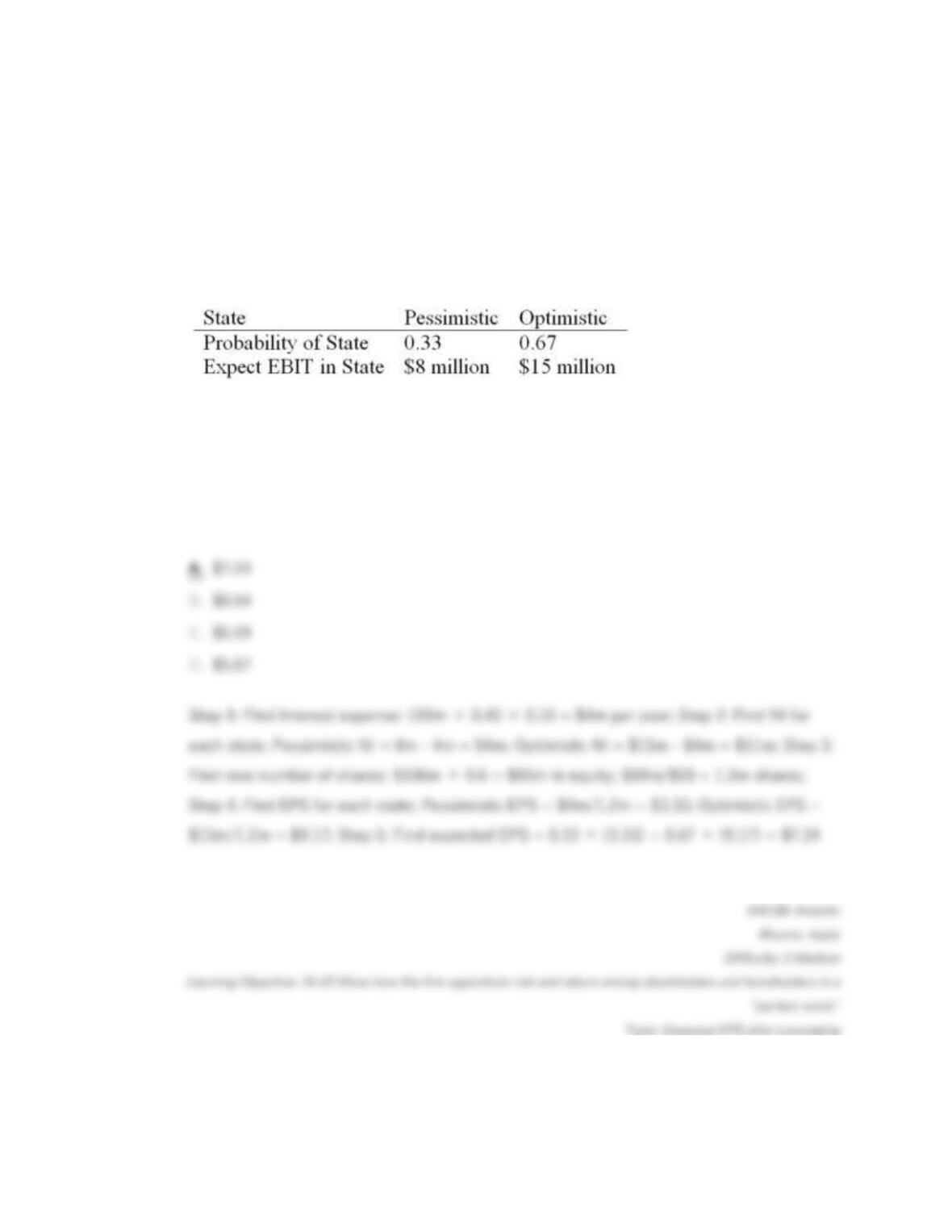
67.
HiLo, Inc., doesn’t face any taxes and has $100 million in assets, currently financed
entirely with equity. Equity is worth $50 per share, and book value of equity is equal to
market value of equity. Also, let’s assume that the firm’s expected values for EBIT depend
upon which state of the economy occurs this year, with the possible values of EBIT and
their associated probabilities shown as follows:
The firm is considering switching to a 40 percent debt capital structure, and has
determined that they would have to pay a 10 percent yield on perpetual debt. What will be
the level of expected EPS if they switch to the proposed capital structure?
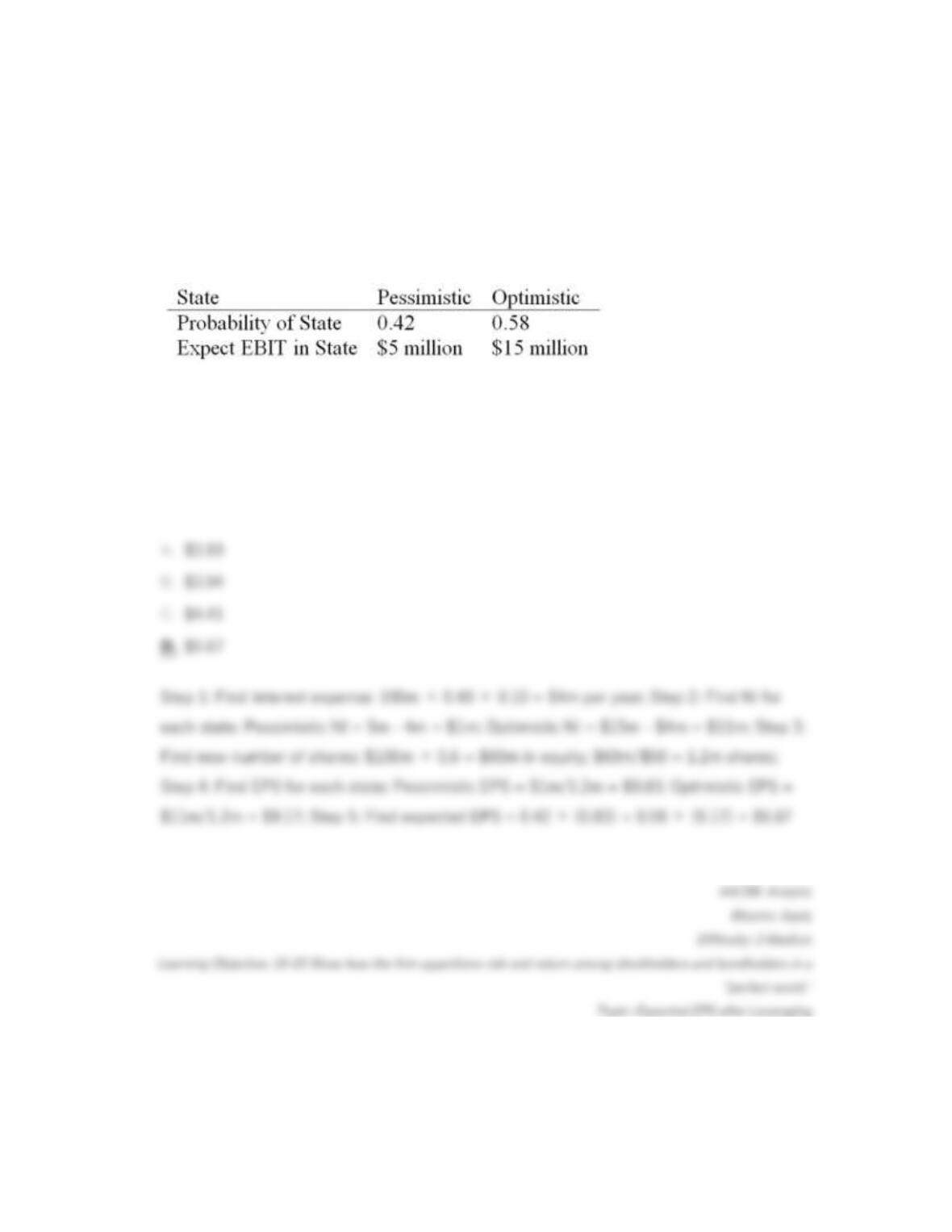
68.
HiLo, Inc., doesn’t face any taxes and has $100 million in assets, currently financed
entirely with equity. Equity is worth $50 per share, and book value of equity is equal to
market value of equity. Also, let’s assume that the firm’s expected values for EBIT depend
upon which state of the economy occurs this year, with the possible values of EBIT and
their associated probabilities shown as follows:
The firm is considering switching to a 40 percent debt capital structure, and has
determined that they would have to pay a 10 percent yield on perpetual debt. What will be
the level of expected EPS if they switch to the proposed capital structure?
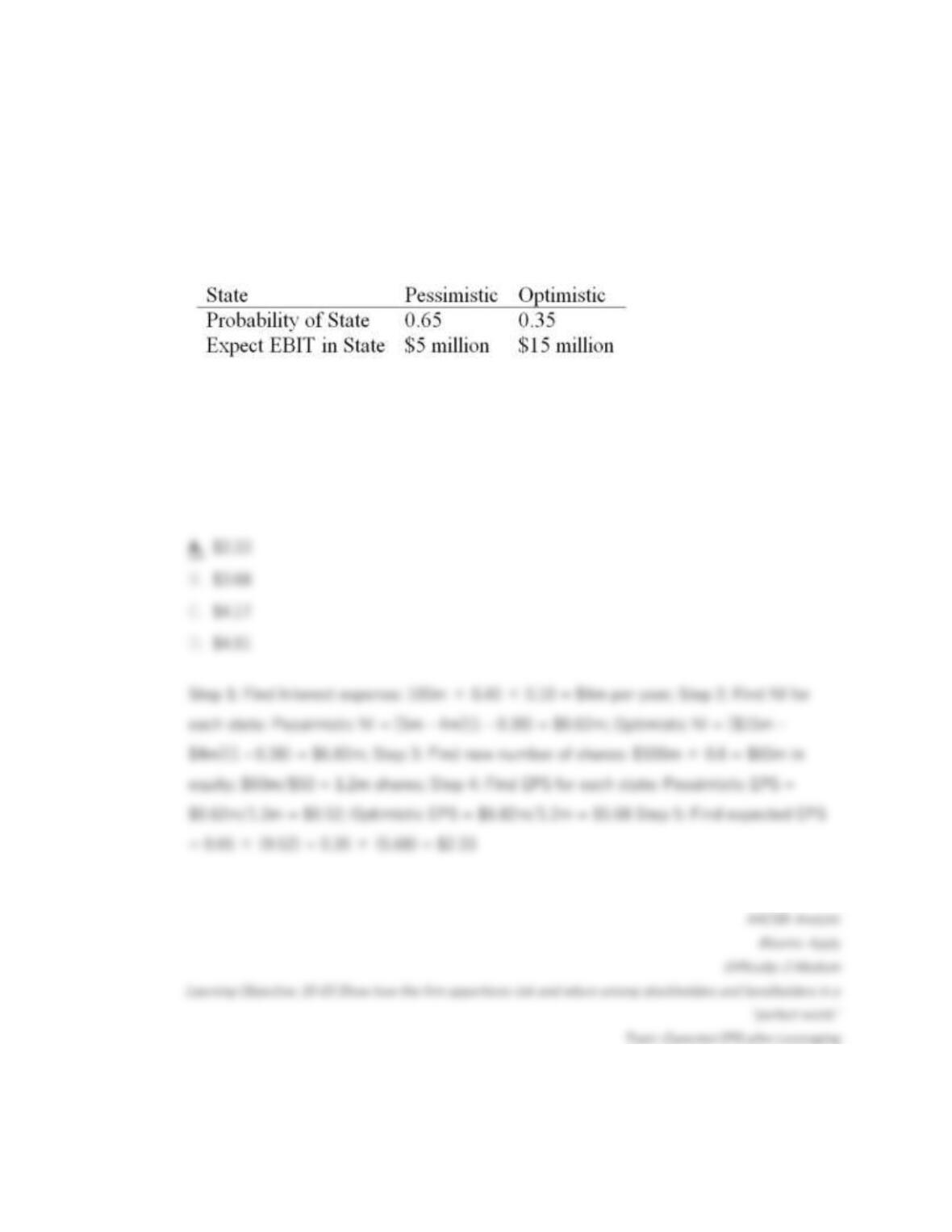
69.
HiLo, Inc., faces a 38 percent tax rate and has $100 million in assets, currently financed
entirely with equity. Equity is worth $50 per share, and book value of equity is equal to
market value of equity. Also, let’s assume that the firm’s expected values for EBIT depend
upon which state of the economy occurs this year, with the possible values of EBIT and
their associated probabilities as shown below:
The firm is considering switching to a 40 percent debt capital structure, and has
determined that they would have to pay a 10 percent yield on perpetual debt. What will be
the level of expected EPS if they switch to the proposed capital structure?
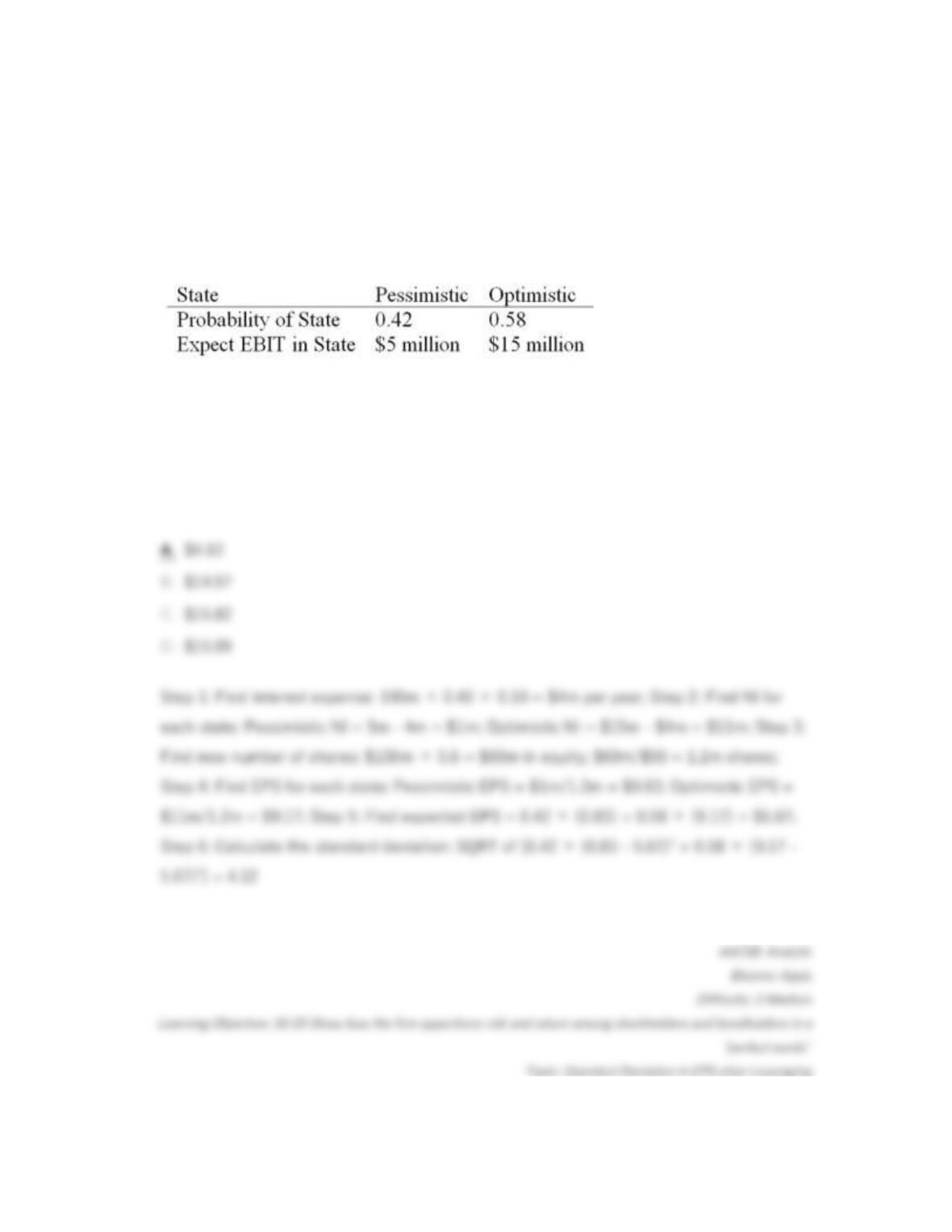
70.
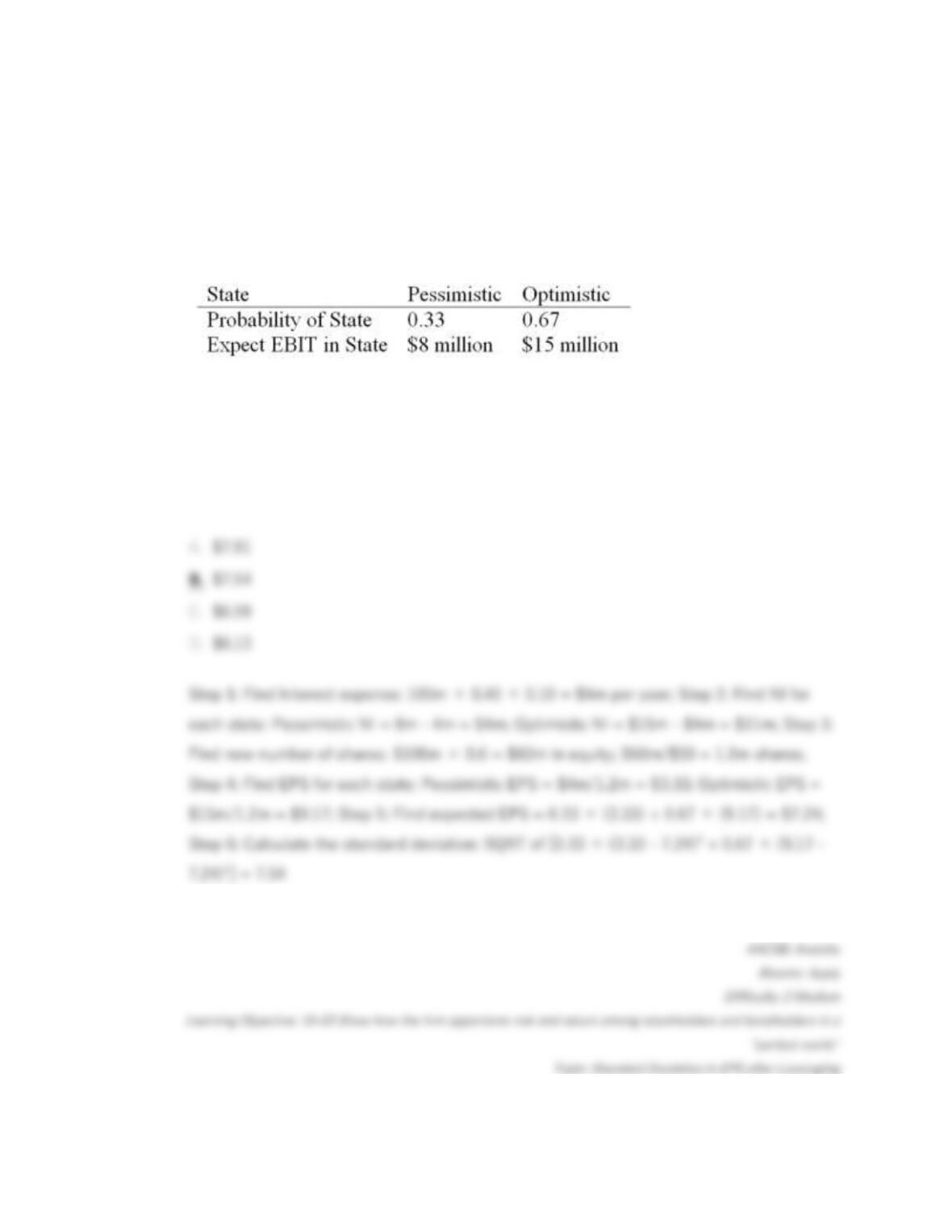
HiLo, Inc., doesn’t face any taxes and has $100 million in assets, currently financed
entirely with equity. Equity is worth $50 per share, and book value of equity is equal to
market value of equity. Also, let’s assume that the firm’s expected values for EBIT depend
upon which state of the economy occurs this year, with the possible values of EBIT and
their associated probabilities shown as follows:
The firm is considering switching to a 40 percent debt capital structure, and has
determined that they would have to pay a 10 percent yield on perpetual debt. What will be
the standard deviation in EPS if they switch to the proposed capital structure?
71.
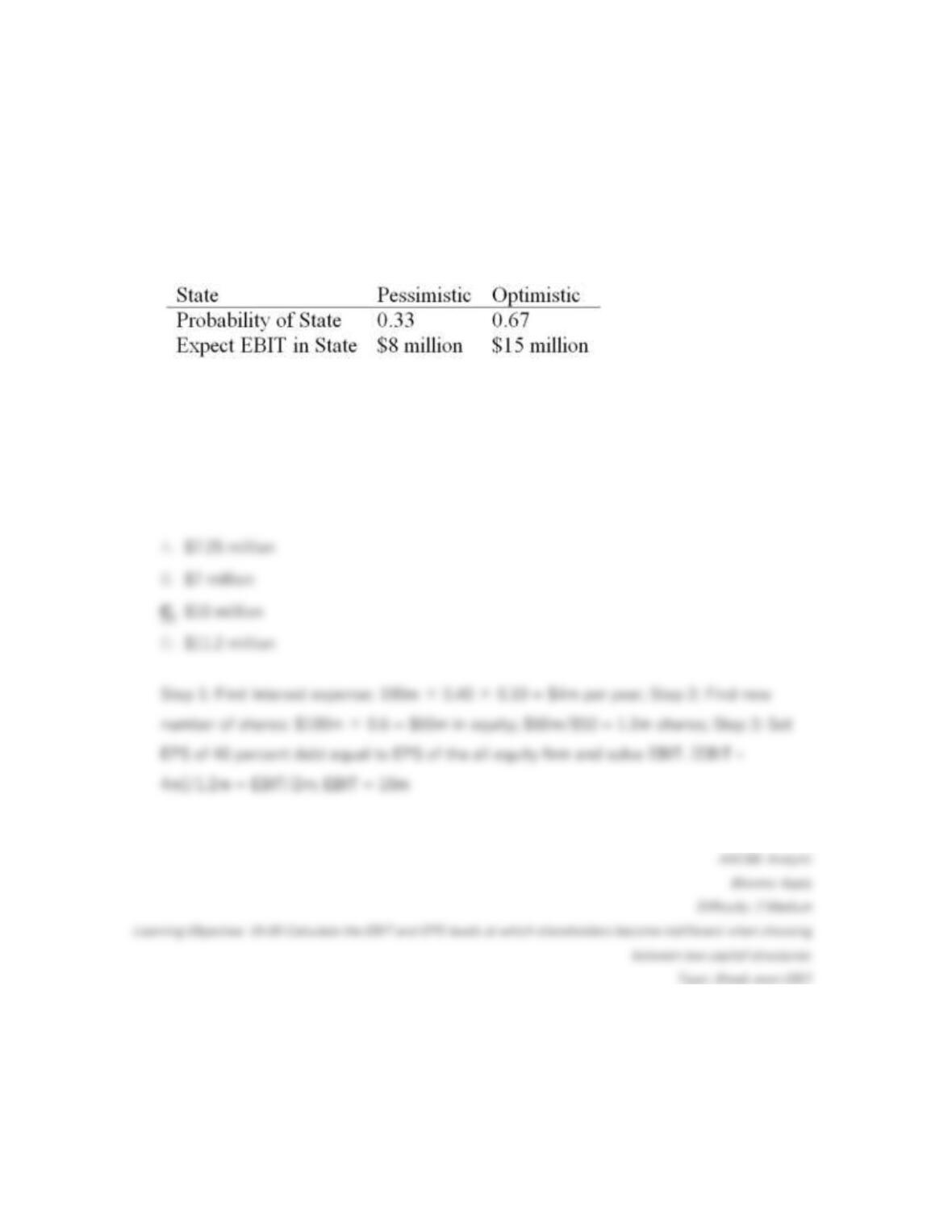
HiLo, Inc., doesn’t face any taxes and has $100 million in assets, currently financed
entirely with equity. Equity is worth $50 per share, and book value of equity is equal to
market value of equity. Also, let’s assume that the firm’s expected values for EBIT depend
upon which state of the economy occurs this year, with the possible values of EBIT and
their associated probabilities shown as follows:
The firm is considering switching to a 40 percent debt capital structure, and has
determined that they would have to pay a 10 percent yield on perpetual debt. What will be
the standard deviation in EPS if they switch to the proposed capital structure?
72.
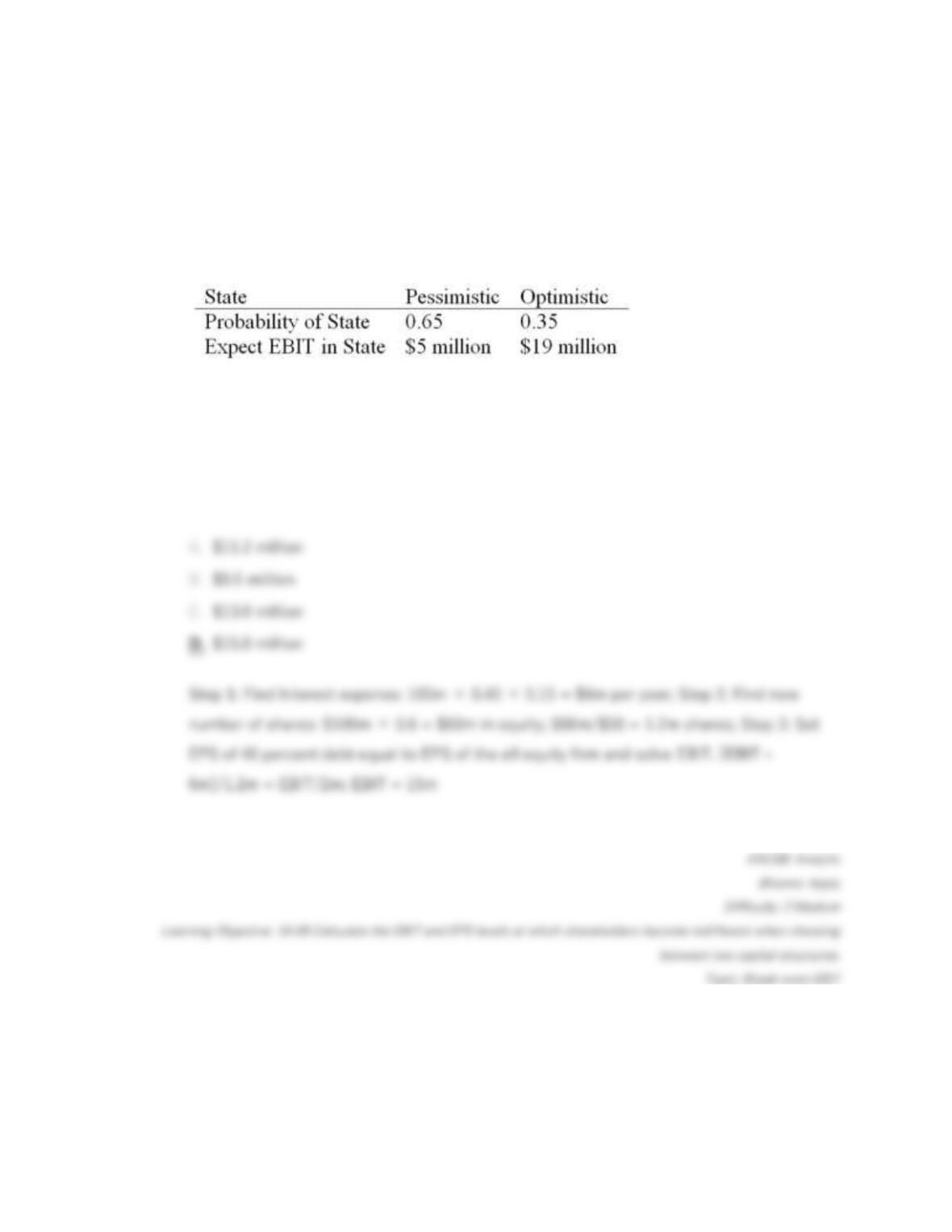
HiLo, Inc., doesn’t face any taxes and has $100 million in assets, currently financed
entirely with equity. Equity is worth $50 per share, and book value of equity is equal to
market value of equity. Also, let’s assume that the firm’s expected values for EBIT depend
upon which state of the economy occurs this year, with the possible values of EBIT and
their associated probabilities shown as follows:
The firm is considering switching to a 40 percent debt capital structure, and has
determined that they would have to pay a 10 percent yield on perpetual debt. What will be
the break-even level of EBIT?
73.
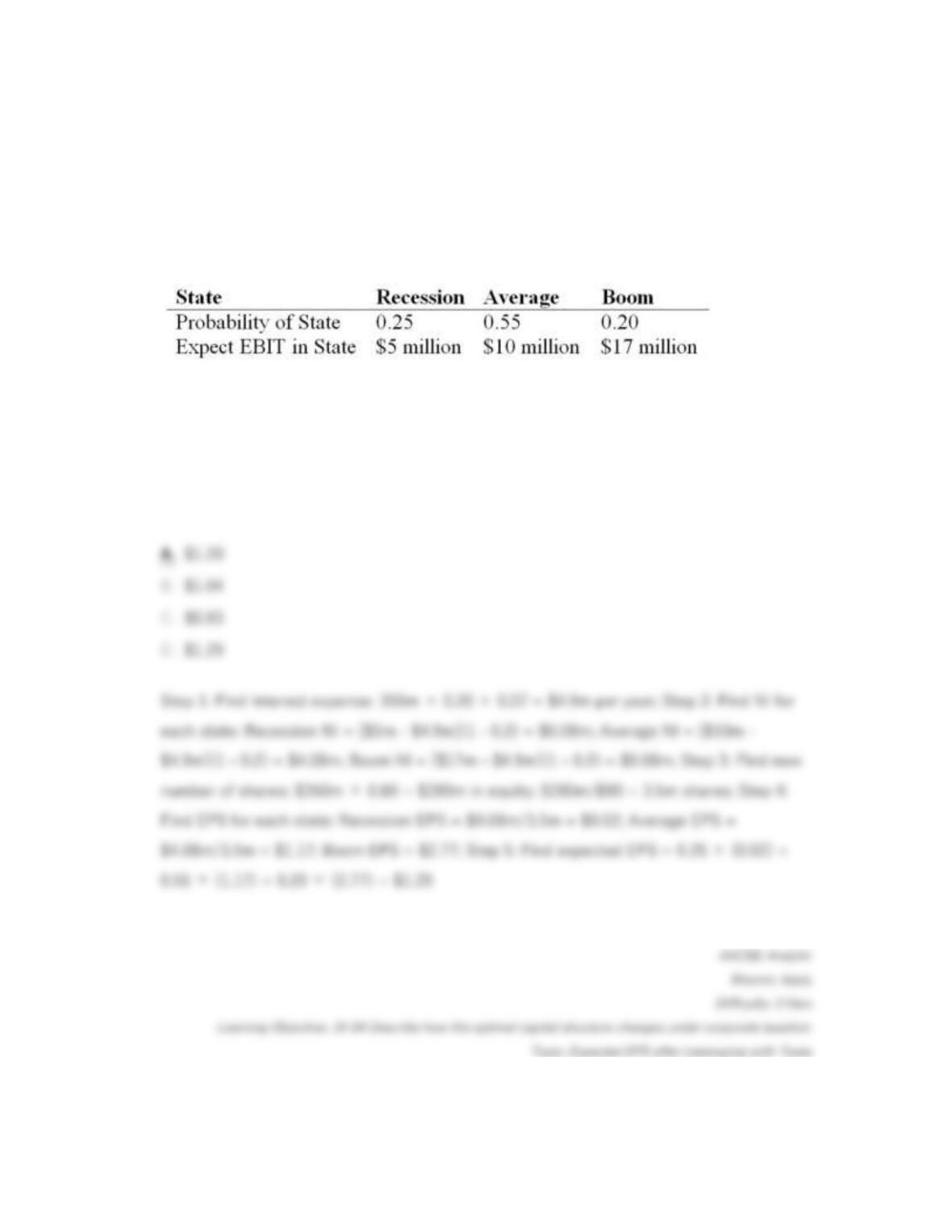
HiLo, Inc., doesn’t face any taxes and has $100 million in assets, currently financed
entirely with equity. Equity is worth $50 per share, and book value of equity is equal to
market value of equity. Also, let’s assume that the firm’s expected values for EBIT depend
upon which state of the economy occurs this year, with the possible values of EBIT and
their associated probabilities shown as follows:
The firm is considering switching to a 40 percent debt capital structure, and has
determined that they would have to pay a 15 percent yield on perpetual debt. What will be
the break-even level of EBIT?
74.
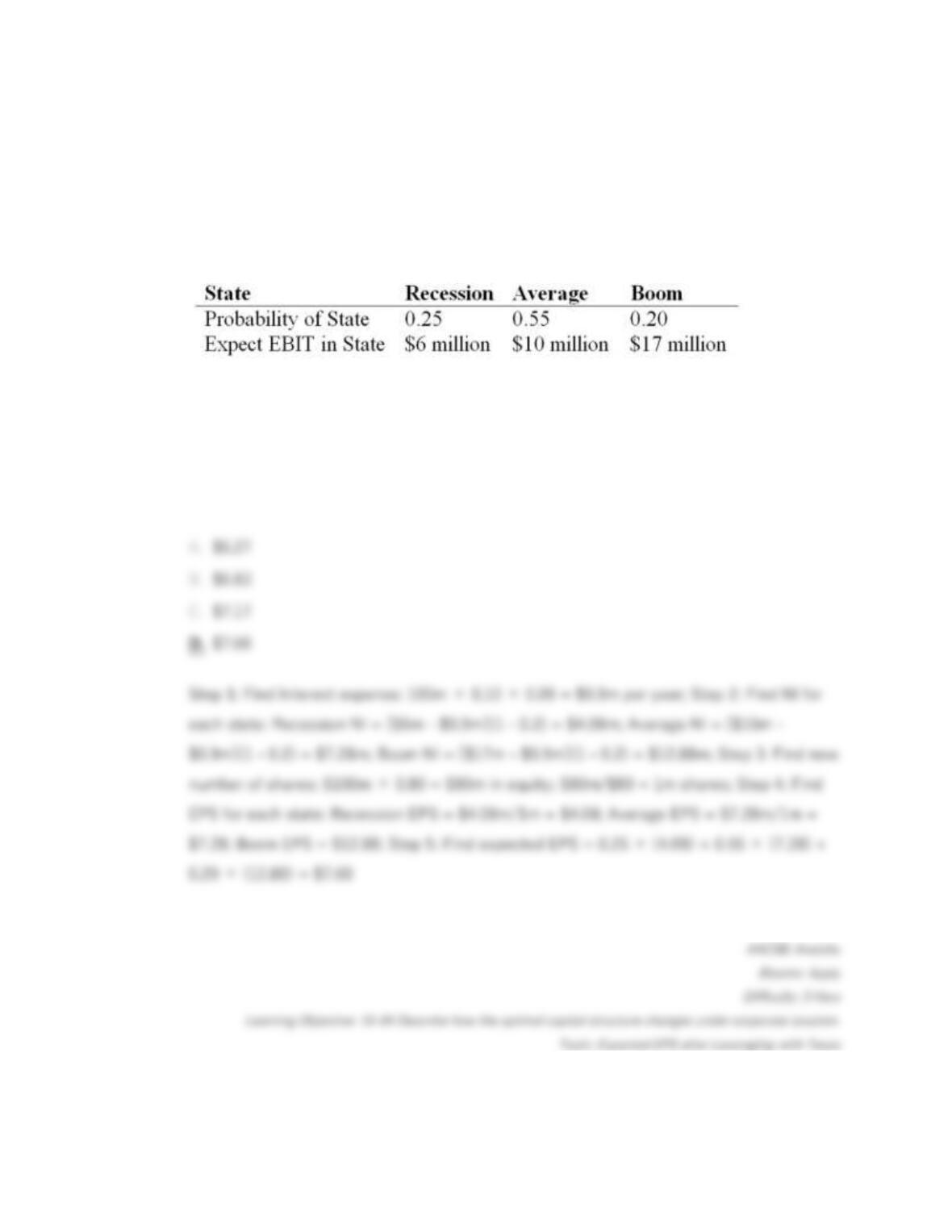
No Nuns Cos. has a 20 percent tax rate and has $350 million in assets, currently financed
entirely with equity. Equity is worth $80 per share, and book value of equity is equal to
market value of equity. Also, let’s assume that the firm’s expected values for EBIT depend
upon which state of the economy occurs this year, with the possible values of EBIT and
their associated probabilities shown as follows:
The firm is considering switching to a 20 percent debt capital structure, and has
determined that they would have to pay a 7 percent yield on perpetual debt in either event.
What will be the level of expected EPS if they switch to the proposed capital structure?
75.
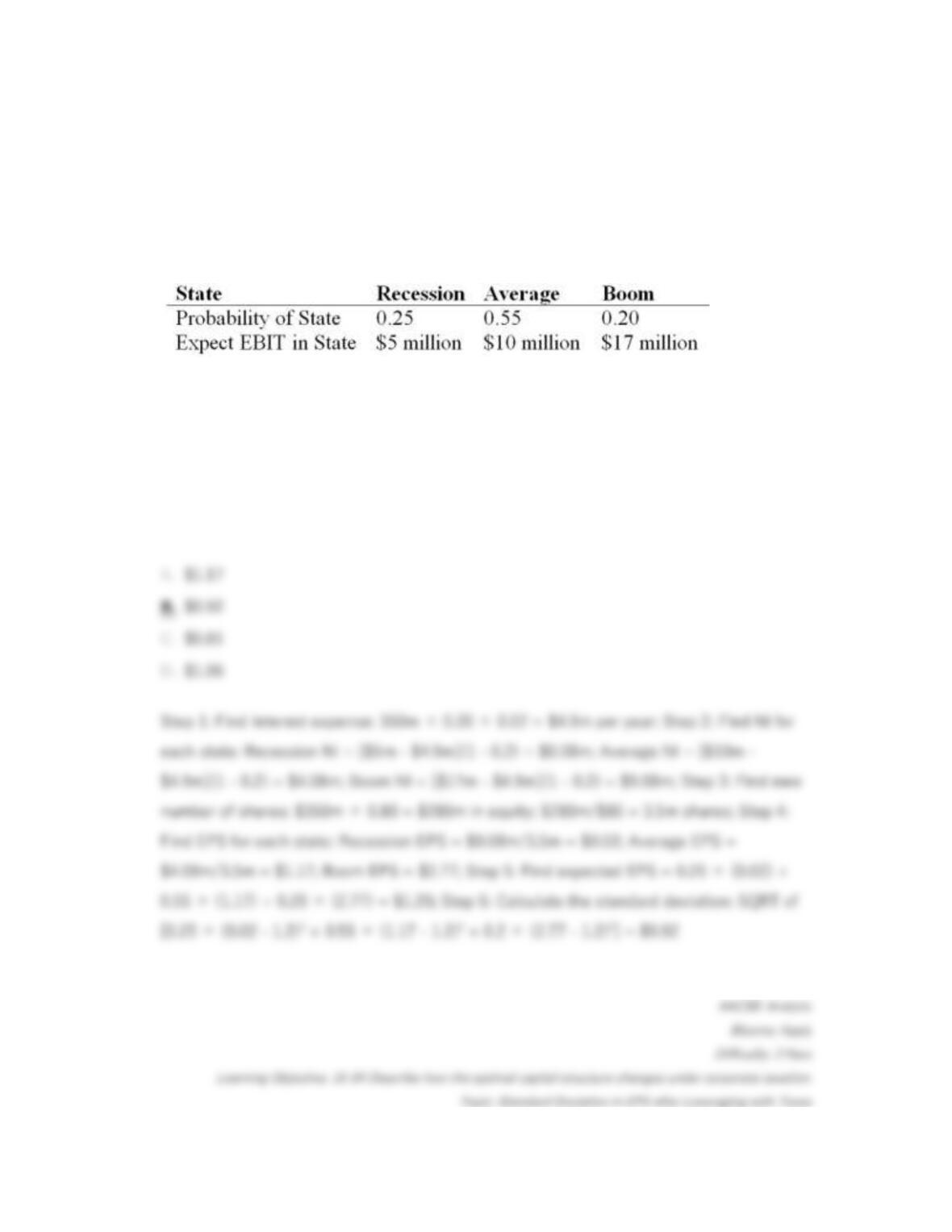
No Nuns Cos. has a 20 percent tax rate and has $100 million in assets, currently financed
entirely with equity. Equity is worth $80 per share, and book value of equity is equal to
market value of equity. Also, let’s assume that the firm’s expected values for EBIT depend
upon which state of the economy occurs this year, with the possible values of EBIT and
their associated probabilities shown as follows:
The firm is considering switching to a 10 percent debt capital structure, and has
determined that they would have to pay a 9 percent yield on perpetual debt in either event.
What will be the level of expected EPS if they switch to the proposed capital structure?
76.
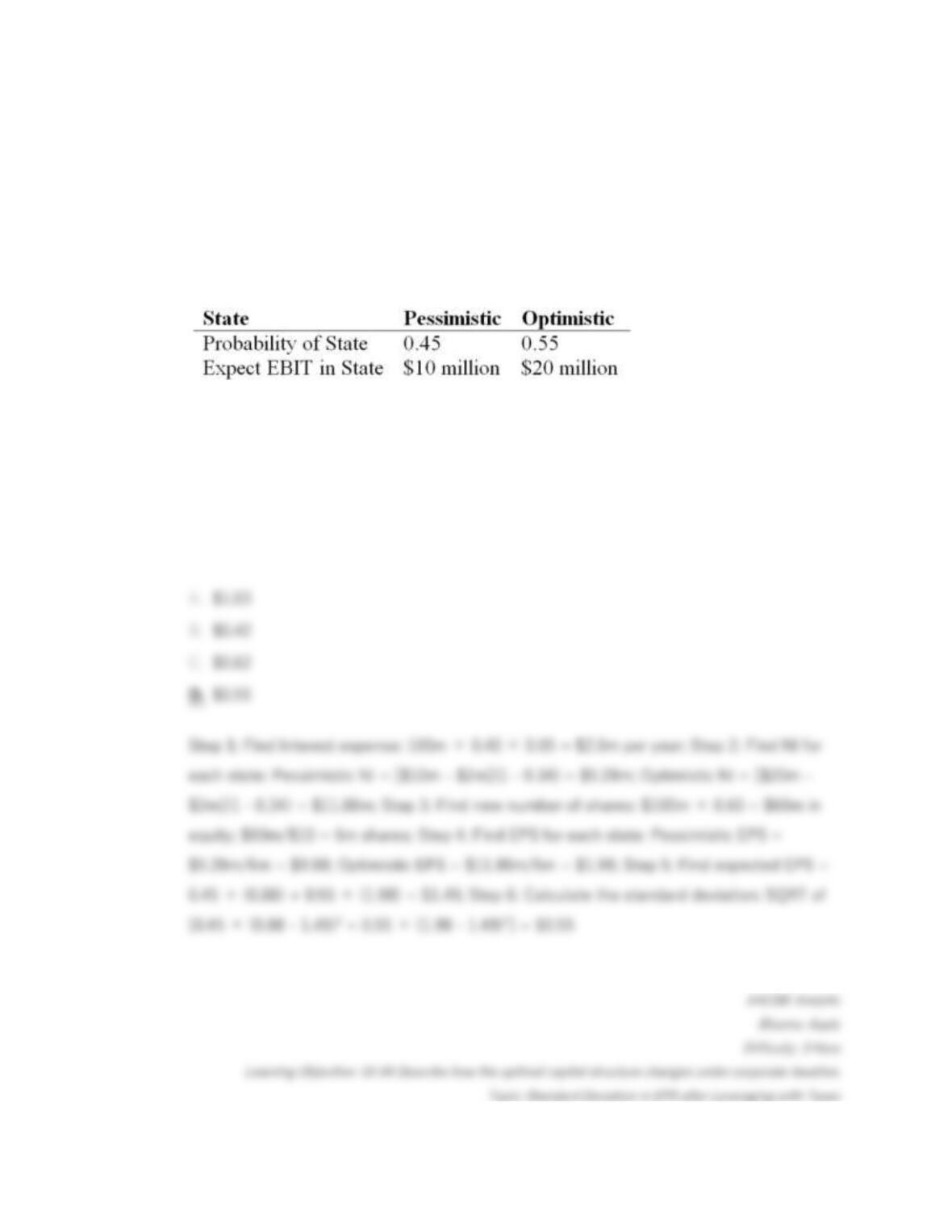
No Nuns Cos. has a 20 percent tax rate and has $350 million in assets, currently financed
entirely with equity. Equity is worth $80 per share, and book value of equity is equal to
market value of equity. Also, let’s assume that the firm’s expected values for EBIT depend
upon which state of the economy occurs this year, with the possible values of EBIT and
their associated probabilities shown as follows:
The firm is considering switching to a 20 percent debt capital structure, and has
determined that they would have to pay a 7 percent yield on perpetual debt in either event.
What will be the standard deviation in EPS if the firm switches to the proposed capital
structure?
77.
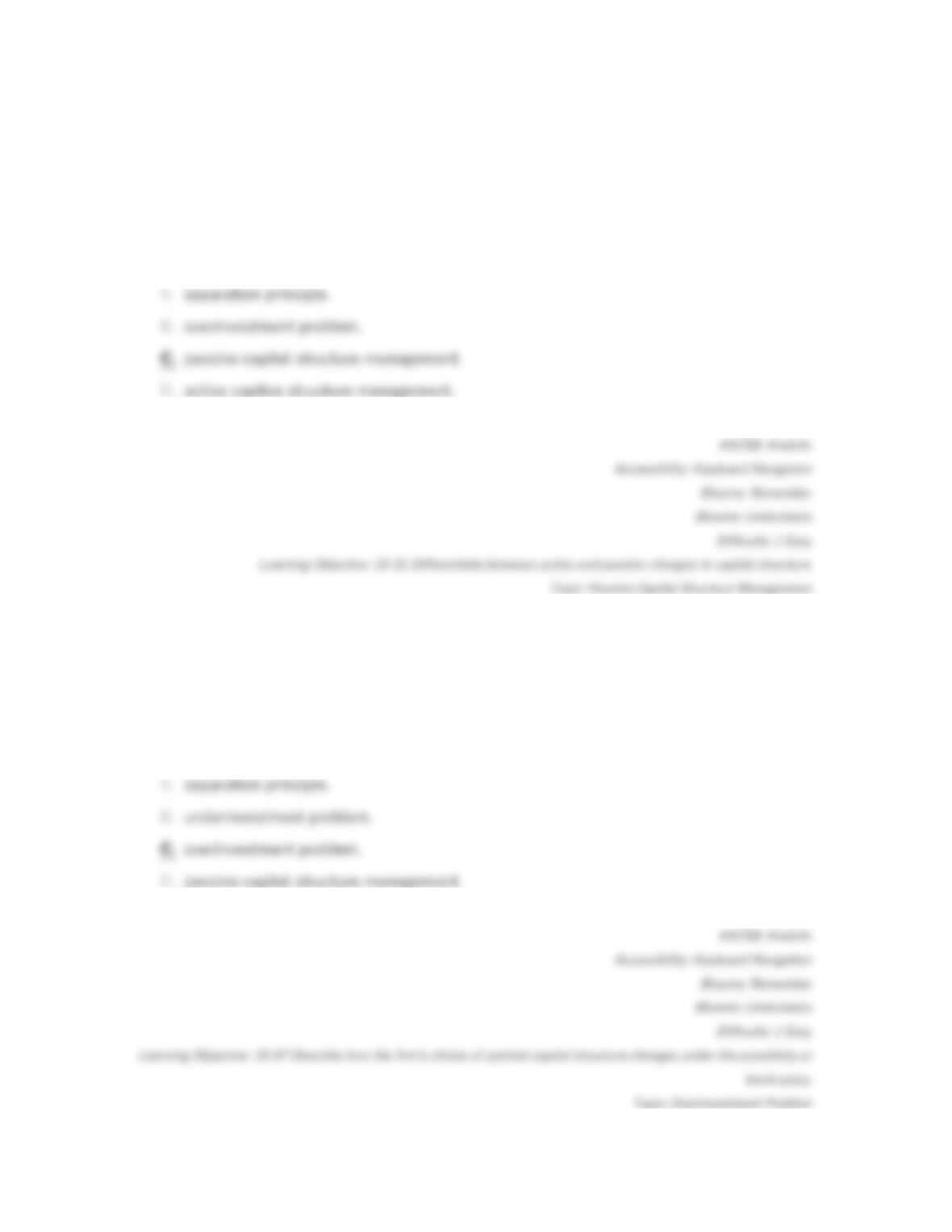
GTB, Inc., has a 34 percent tax rate and has $100 million in assets, currently financed
entirely with equity. Equity is worth $10 per share, and book value of equity is equal to
market value of equity. Also, let’s assume that the firm’s expected values for EBIT depend
upon which state of the economy occurs this year, with the possible values of EBIT and
their associated probabilities shown as follows:
The firm is considering switching to a 40 percent debt capital structure, and has
determined that they would have to pay a 5 percent yield on perpetual debt in either event.
What will be the standard deviation in EPS if they switch to the proposed capital
structure?
78.
The policy of changing the capital structure gradually over time by funding new capital
projects disproportionately with the type of capital you want to increase in the capital
structure is referred as:
79.
A situation that arises when a firm’s equity is close to worthless, and equity holders will
prefer to invest in overly risky projects with a small chance of success rather than simply
paying debt holders their regularly schedule payments is referred to as:
80.
Which of the following is incorrect with respect to leverage buyouts (LBOs)?
81.
When a stockholder’s stake is worthless the firm runs the risk of:
82.
All else the same, firms facing relatively high tax rates should:
83.
All else the same, firms with stable, predictable income streams will able to:
84.
All of the following are examples of the costs of financial distress EXCEPT:
85.
All of the following are examples of the costs of financial distress EXCEPT:
86.
The two main factors that determine a firm’s capital structure are:
87.
JJJ Corp. has $10 million in assets and is currently financed with 100 percent equity. The
firm decides to switch to a 60 percent equity/40 percent debt structure and decides to sell
$4 million of debt and use the proceeds to retire $4 million in equity today. This is an
example of:
88.
JJJ Corp. has $10 million in assets and is currently financed with 100 percent equity. The
firm decides to switch to a 60 percent equity/40 percent debt structure and decides to
fund the next $4 million of assets for future projects entirely with debt, resulting in the
desired capital structure at some point in the future. This is an example of:
89.
We use the term
leverage
to describe the use of debt in the firm’ capital structure
because:
90.
If the U.S. government completely eliminated taxation at the corporate level:
91.
If the U.S. government increased the corporate tax rates:
92.
If bondholders of a firm in financial distress felt that they could recoup more of their
investment by renegotiating their claims with the firm and allowing it to continue to
operate, what type of bankruptcy would they probably push for?