166. Refer to Apple iPhone. Apple and AT&T have several options available for competing with Samsung
and its Instinct phone. If Apple and AT&T choose to compete by pricing their product at a low price to
drive Samsung out of the market, this would be considered _____.
a.
price fixing
b.
retail price maintenance
c.
price discrimination
d.
predatory pricing
e.
fair competition
ESSAY
1. Define price and discuss the two roles price plays in the evaluation of product alternatives.
2. One of the most stressful and pressure-filled tasks of the marketing manager is attempting to set the
right price. Specify three aspects of the current pricing environment in consumer markets that have
contributed to the difficulty in setting correct prices.
3. List the three categories of pricing objectives and then two specific strategies in each category that a
marketer could implement to achieve those objectives.
4. Last quarter Abingdon Company sold 1,000 decorative decals for $1 each, Cedar Decaliania sold 200
decorative decals at $4 each, Creative Decals sold 500 decals at $2 each, and Donnelly, Inc. sold 300
decals for $4 apiece. Assuming the four companies are the only firms competing in the decorative
decal market, calculate unit and dollar market share for each company for last quarter. For each
company, which market share figure might be used in an advertisement for that company?
5. List the two primary determinants of price. What other factors can affect price setting?
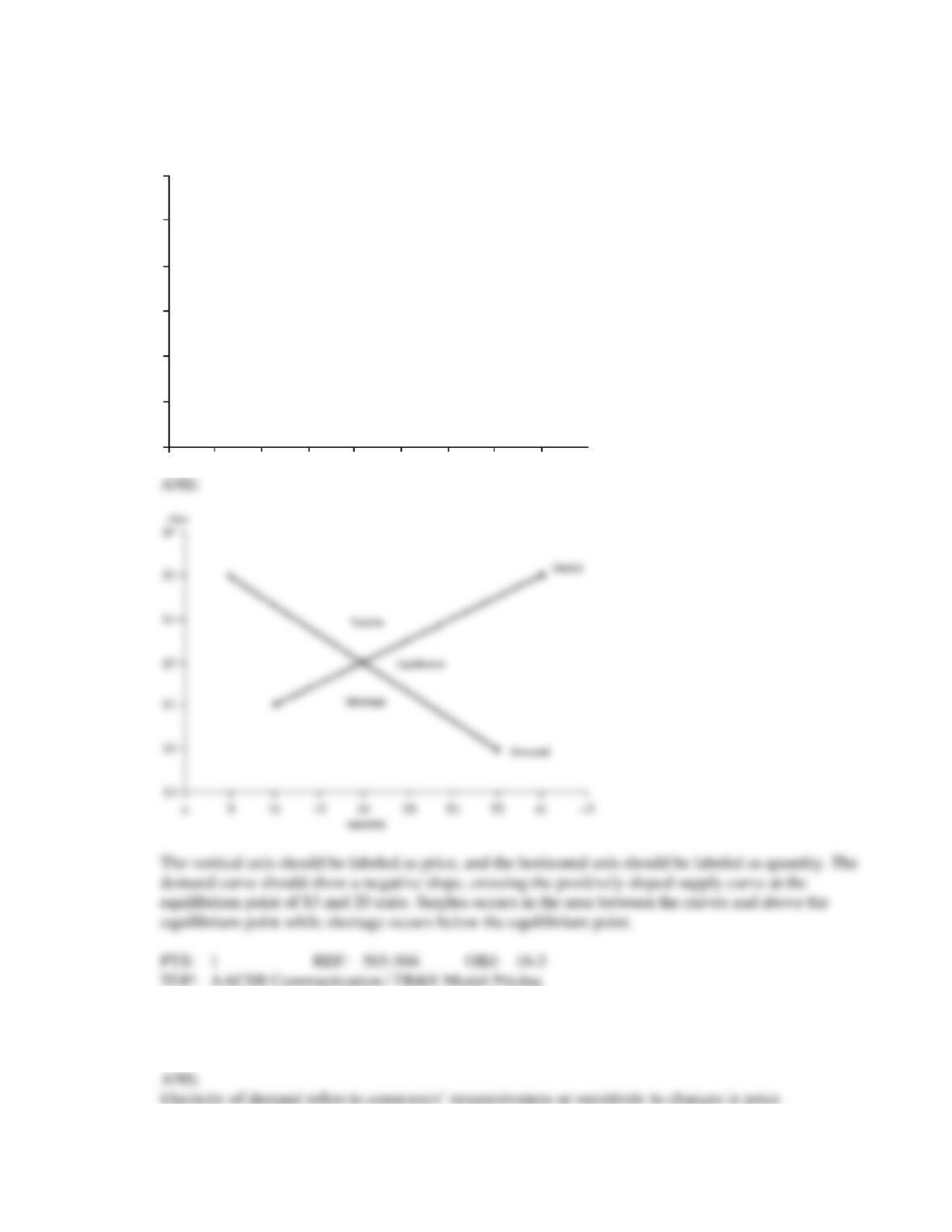
6. The daily demand for bottled water is 35 bottles when the price is set at $1. However, if the price is
raised to $5, the demand is only 5 bottles. The bottled water producer is willing to supply 40 bottles if
the price is set at $5 per bottle, but will only supply 10 bottles if the price is set at $2. Draw the supply
and demand curves for the water bottles on the graph below. Label each curve and each axis. At what
level does equilibrium occur? What are the areas of surplus and shortage?
7. Define elasticity of demand and compare and contrast the three types of demand: elastic, inelastic, and
unitary. What would the demand curve for elastic and inelastic demand look like when graphed?
8. List five factors that affect elasticity of demand and briefly describe how each affects demand.
9. Explain yield management systems (YMS) and discuss the types of industry were they are most
appropriate.
10. What are the problems associated with the use of a cost-based pricing strategy? What contribution
does cost make to the setting of prices?
11. What is the difference between fixed and variable costs? Give examples of each type of cost.
12. Calculate answers for the following scenarios if retailer markups are based on their selling price:
a)
A retailer sells a set of measuring cups for $2.50 after adding $.50 to the original cost. What
is the markup percentage?
b)
The cost of a food blender for the retailer is $40 and the retailer applies a markup of $60.
What is the retail markup percentage?
c)
A retailer marks up all products by 20 percent. If a set of glasses costs the retailer $10, what
will the final selling price be?
d)
A retailer marks up all products by 75 percent. If the selling price of a set of plastic bowls is
$4, what was the cost to the retailer?
Dollar markup selling price = percent markup
$0.50 $2.50 = 20%
b)
Selling price = (dollar markup + cost)
Dollar markup selling price = percent markup
$60 ($60 + $40) = 60%
Dollar markup = (selling price – cost)
(Selling price – cost) selling price = percent markup
(S – $10) S = .20
13. What is marginal revenue? Based on the provided schedule from the Chesapeake Bay Swing
Company, at which quantity should Chesapeake Bay stop producing additional swings?
Quantity
Marginal Revenue
Marginal Cost
Total Profit
1
$260
$160
$200
2
110
140
270
3
190
120
340
4
170
140
370
5
160
160
370
6
150
180
340
7
120
220
240
14. What is a break-even point? The Catera Company makes and sells cotton candy machines. What is the
break-even volume for Catera machines in units?
Catera Machines Financial Information
Salesperson salary
$ 40,000
Advertising
100,000
Research and development
20,000
Production equipment
20,000
Overhead allocation
20,000
Catera’s selling price
$600
Average variable cost
$350
15. Name two advantages and two disadvantages associated with the use of break-even analysis.
16. As a product moves through its life cycle, the demand for the product and the competitive conditions
tend to change. For each stage in the product life cycle, discuss pricing strategies appropriate for that
stage.
17. How does price interact with the other three Ps of the marketing mix?
18. What is the impact of the Internet on pricing strategies?
19. Discuss how consumers use the price-quality relationship to evaluate goods and explain how marketers
can take advantage of this consumer response.
20. List in order the four steps used to set the right price for a product.
21. What activities occur once the marketing manager has established pricing goals? Why are these
activities important?
22. Name and describe the three basic strategies for setting a price on a new good or service. Under what
conditions is each of the three basic pricing methods successful?
23. List the three basic pricing methods. Name one advantage and one disadvantage associated with using
each method.
24. Which pricing method (skimming, penetration, or status quo) would be most appropriate for each of
the following products: (1) a new kind of automatic vacuum cleaner; (2) brightly colored wooden
blocks to be used as a child’s toy; (3) a new, low-cost, no-calorie fat substitute; (4) a home computer;
and (5) a designer perfume. Briefly justify your answers.
25. Some pricing decisions are subject to government regulation. Name and define three pricing practices
that are illegal.