38) The balanced equation for the solubility equilibrium of Ba(OH)2 is shown below. What is the
equilibrium constant expression for the Ksp of Ba(OH)2?
Ba(OH)2(s) ⇌ Ba2+(aq) + 2 OH–(aq)
A) Ksp = {[Ba2+][OH–]2}/{[Ba(OH)2][H2O]}
B) Ksp = {[Ba2+][OH–]2}/[Ba(OH)2]
C) Ksp = [Ba2+][OH–]2
D) Ksp = 1/{[Ba2+][OH–]2}
39) What is the equilibrium constant expression for the Ksp of Sr3(PO4)2?
A) Ksp = [Sr2+]3[PO43–]2
B) Ksp = {[Sr2+]3[PO43-]2}/[Sr3PO4]
C) Ksp = {[Sr2+]3[PO43-]2}/{[Sr3PO4][H2O]}
D) Ksp = 1/{[Sr2+]3[PO43-]2}
40) Calculate the Ksp for silver sulfite if the solubility of Ag2SO3 in pure water is 4.6 × 10⁻³ g/L.
A) 3.8 × 10⁻¹⁵
B) 1.5 × 10⁻¹⁴
C) 2.4 × 10⁻¹⁰
D) 4.8 × 10⁻¹⁰
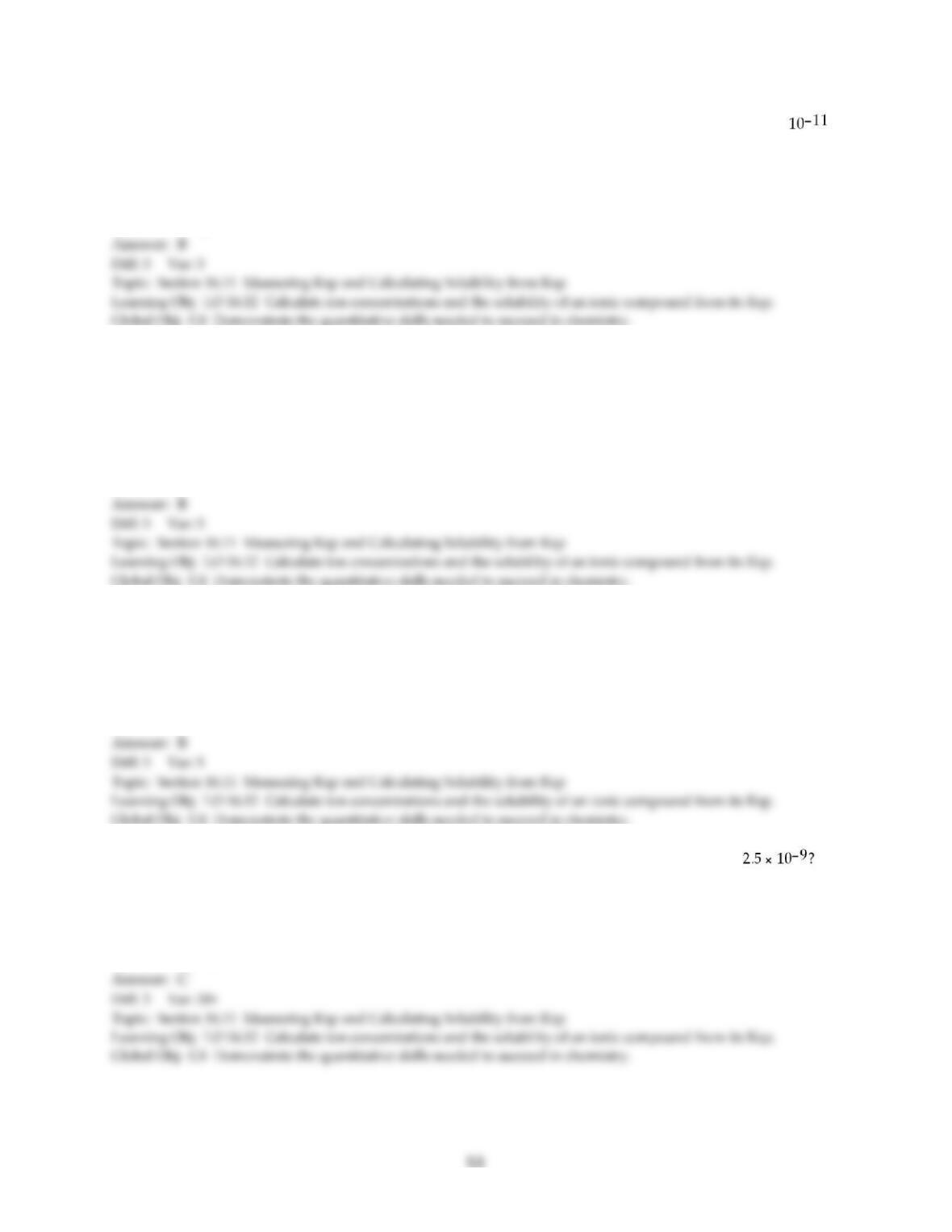
41) Calculate the solubility (in g/L) of calcium fluoride in water at 25°C if the Ksp for Ca F2 is 3.5 × .
A) 9.6 × 10⁻⁴ g/L
B) 2.1 × 10⁻⁴ g/L
C) 3.3 × 10⁻² g/L
D) 4.1 × 10⁻² g/L
42) What is the molar solubility of Mg(OH)2 in a basic solution with a pH of 12.00? Ksp for Mg(OH)2 is
5.6 × 10⁻¹².
A) 5.6 × 10⁻¹⁰ M
B) 5.6 × 10⁻⁸ M
C) 2.4 × 10⁻⁶ M
D) 1.1 × 10⁻⁴ M
43) Calculate the molar solubility of thallium(I) chloride in 0.20 M NaCl at 25°C. Ksp for TlCl is 1.7 × 10⁻⁴.
A) 3.4 × 10⁻⁵ M
B) 8.5 × 10⁻⁴ M
C) 5.8 × 10⁻³ M
D) 1.3 × 10⁻² M
44) What is the silver ion concentration for a saturated solution of SrF2 if the Ksp for SrF2 is
A) 9.3 × 10⁻⁷ M
B) 1.4 × 10⁻³ M
C) 8.5 × 10⁻⁴ M
D) 4.06 × 10⁻⁴ M
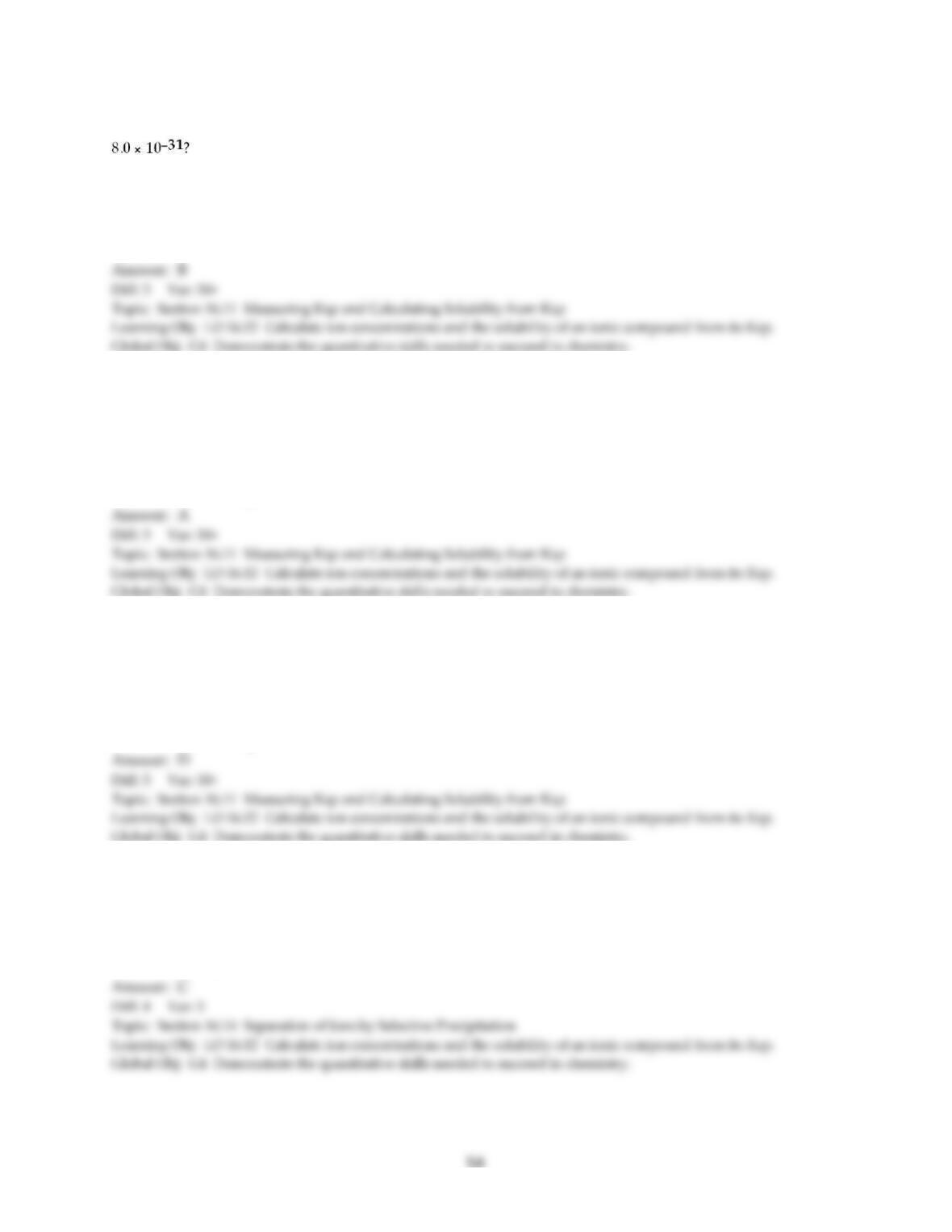
45) What is the scandium ion concentration for a saturated solution of Sc(OH)3 if the Ksp for Sc(OH)3 is
A) 3.00 × 10⁻⁸ M
B) 1.31 × 10⁻⁸ M
C) 3.22 × 10⁻¹⁰ M
D) 3.76 × 10⁻⁸ M
46) What is the most soluble salt of the following set?
A) Ca(OH)2 with Ksp = 4.7 × 10⁻⁶
B) Mg(OH)2 with Ksp = 5.6 × 10⁻¹²
C) Fe(OH)2 with Ksp = 4.9 × 10⁻¹⁷
D) Al(OH)2 with Ksp = 1.9 × 10⁻³³
47) What is the least soluble salt of the following set?
A) Ca(OH)2 with Ksp = 4.7 × 10⁻⁶
B) Cd(OH)2 with Ksp = 5.3 × 10⁻¹⁵
C) Fe(OH)2 with Ksp = 4.9 × 10⁻¹⁷
D) Cr(OH)2 with Ksp = 6.7 × 10⁻³¹
48) In which of the following solutions would solid AgCl be expected to be the least soluble at 25°C?
A) 0.1 M HCl
B) 0.1 M KCl
C) 0.1 M BaCl2
D) 0.1 M K NO3
49) What is the molar solubility of AgCl in 0.30 M NH3? Ksp for AgCl is 1.8 × 10⁻¹⁰ and Kf for Ag(NH3)2+
is 1.7 × 10⁷.
A) 1.3 × 10⁻⁵ M
B) 1.5 × 10⁻² M
C) 1.7 × 10⁻² M
D) 5.5 × 10⁻² M
50) What is the molar solubility of AgCl in 0.50 M NaCN if the colorless complex ion Ag(CN)2– forms?
Ksp for AgCl is 1.8 × 10⁻¹⁰ and Kf for Ag(CN)2– is 1.0 × 10²¹.
A) 0.25 M
B) 0.50 M
C) 1.0 M
D) 2.0 M
51) In which of the following solutions would solid PbBr2 be expected to be the least soluble at 25°C?
A) 0.1 M HBr
B) 0.1 M LiBr
C) 0.1 M CaBr2
D) 0.1 M LiNO3
52) 0.10 M potassium chromate is slowly added to a solution containing 0.10 M AgNO3 and 0.10 M
Ba(NO3)2. What is the Ag+ concentration when BaCrO4 just starts to precipitate? The Ksp for Ag2CrO4
and BaCrO4 are 1.1 × 10⁻¹² and 1.2 × 10⁻¹⁰, respectively.
A) 6.5 × 10⁻⁵ M
B) 1.3 × 10⁻⁴ M
C) 3.2 × 10⁻⁴ M
D) 3.0 × 10⁻² M
53) Which metal ions can be precipitated out of solution as chlorides?
A) Ag+, Hg2+, Zn2+
B) Cu2+, Cd2+, Bi3+
C) Ag+, Hg22+, Pb2+
D) Na+, Li+, Ca2+
54) Which set of ions precipitate as sulfides?
A) Ag+, Pb2+, Mn2+
B) Pb2+, Fe2+, Ca2+
C) Co2+, Ba2+, K+
D) NH4+, Na+, K+
55) Which pair of ions can be separated by the addition of chloride ion?
A) Ag+ and Zn2+
B) Ni2+ and Bi3+
C) Pb2+ and Hg22+
D) Ca+ and Li+
56) Which pair of ions can be separated by the addition of sulfide ion?
A) Na+ and Fe2+
B) Cu2+ and Bi3+
C) Pb2+ and Ba2+
D) Ca2+ and Ba2+
16.3 Short Answer Questions
1) The balanced net ionic equation for the neutralization reaction involving equal molar amounts of HI
and KOH is ________.
2) The balanced net ionic equation for the neutralization reaction involving equal molar amounts of
HCl and CH3CH2NH2 is ________.
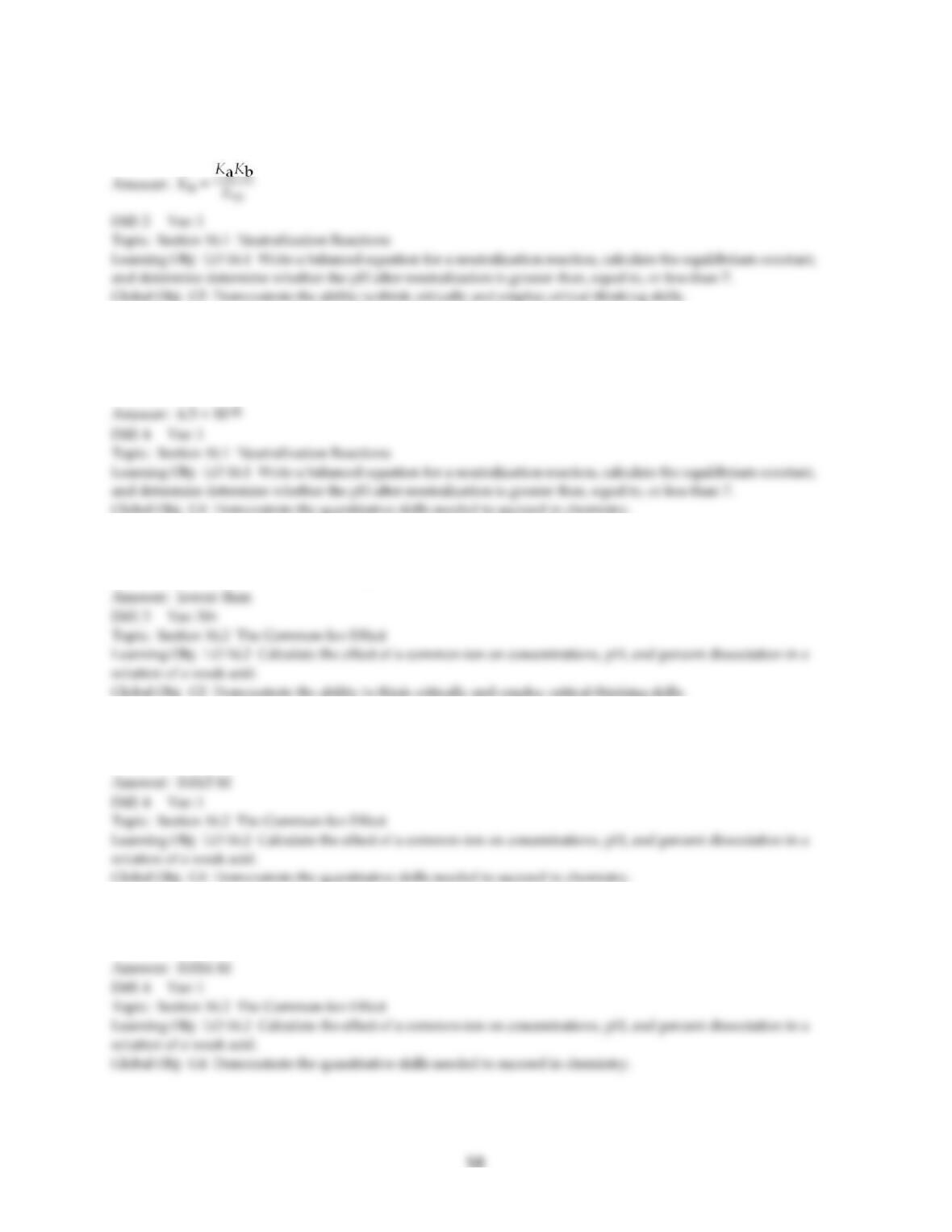
3) What is the equation relating the equilibrium constant Kn for the neutralization of a weak acid with a
weak base to the Ka of the acid, the Kb of the base and Kw?
4) The neutralization constant Kn for the neutralization of penicillin V (C16H18N2O5S) and erythromycin
(C37H67NO13) is 1.3 × 10⁶. The acid dissociation constant Ka for penicillin V is 2.0 × 10⁻³. What is the
base dissociation constant Kb for erythromycin?
5) The solution formed upon adding 80.00 mL of 0.50 M NH4Cl to 80.00 mL of 0.50 M NH3 will have a
pH that is ________ the pH of the original NH3 solution.
6) The pH of a solution of HIO3 (Ka = 1.7 × 10⁻¹) and KIO3 is 1.00. What is the molarity of KIO3 if the
molarity of HIO3 is 0.025 M?
7) The pH of a solution of ethylamine, C2H5NH2 (Kb = 6.4 × 10⁻⁴) and ethylammium bromide,
C2H5NH3Br is 11.00. What is the molarity of C2H5NH3Br if the molarity of C2H5NH2 is 0.025 M?
8) Identify the following solutions as acidic, basic, or inert.
NaNO2 _______
NaNO3 ________
C5H5NHClO4 ________
9) A buffer prepared by mixing 55.0 mL of 0.40 M HF with 55.0 mL of 0.40 M NaF will have a pH that is
________ 7.0.
10) A buffer prepared by mixing equal moles of an acid having Ka = 4.5 × 10⁻⁴ and a salt of its conjugate
base has a pH = ________.
11) The pH of a 0.150 M formic acid/0.250 M sodium formate buffer = ________? The Ka of formic acid is
1.8 × 10⁻⁴.
12) Addition of 0.0125 mol KOH to 150 mL of a 0.150 M formic acid/0.100 M sodium formate buffer
results in a pH = ________. The Ka of formic acid is 1.8 × 10⁻⁴.
13) Addition of 0.0125 mol HCl to 150 mL of a 0.150 M formic acid/0.100 M sodium formate buffer results
in a pH = ________. The Ka of formic acid is 1.8 × 10⁻⁴.
14) What is the Ka of the amino acid glycine if it is 75.0% dissociated at pH = 10.08?
15) What is the Ka of the amino acid glutamine if it is 33.0% dissociated at pH = 8.82?
16) The addition of ________ mL of 0.3000 M NaOH is required to titrate 60.00 mL of 0.2000 M HCl to the
equivalence point, which occurs at a pH of ________.
17) What is the pH of the solution formed when 50 mL of 0.250 M NaOH is added to 50 mL of 0.120 M
HCl?
18) What is the pH of the solution formed when 25 mL of 0.173 M NaOH is added to 35 mL of 0.342 M
HCl?
19) The half equivalence point in the titration of 0.100 M HCO2H (Ka = 1.8 × 10⁻⁴) with 0.250 M NaOH
occurs at pH = ________.
20) The half equivalence point in the titration of 0.100 M CH3NH2 (Kb = 3.7 × 10⁻⁴) with 0.250 M HCl
occurs at pH = ________.
21) Selenous acid, H2SeO3 has acid dissociation constants Ka1 = 3.5 × 10⁻² and Ka2 = 5 × 10⁻⁸. When 25.00
mL of 0.100 M selenous acid is titrated with 0.200 M NaOH the first equivalence point occurs at pH =
________.
22) At 25°C calcium fluoride has a solubility product constant Ksp = 3.5 × 10⁻¹¹. The solubility of CaF2 at
this temperature is ________ mol/L.
23) Silver oxalate, Ag2C2O4, has a molar solubility = 1.1 × 10⁻⁴ mol/L. Ag2C2O4 has a solubility product
Ksp = ________.
24) The artist’s pigment cadmium yellow, CdS, has a water solubility of 0.13 g/L. The solubility product of
CdS, Ksp = ________.
25) State whether the solubility of Mg(OH)2 will increase or decrease upon the addition of aqueous
solutions of a) HCl, b) LiOH, c) NH3.
26) CaF2 has Ksp = 3.5 × 10⁻¹¹. If 25 mL of 8.0 × 10⁻⁴ M Ca(NO3)2 is mixed with 75 mL of 4.0 × 10⁻⁴ M KF,
a precipitate of CaF2 ________ (will, will not) form.