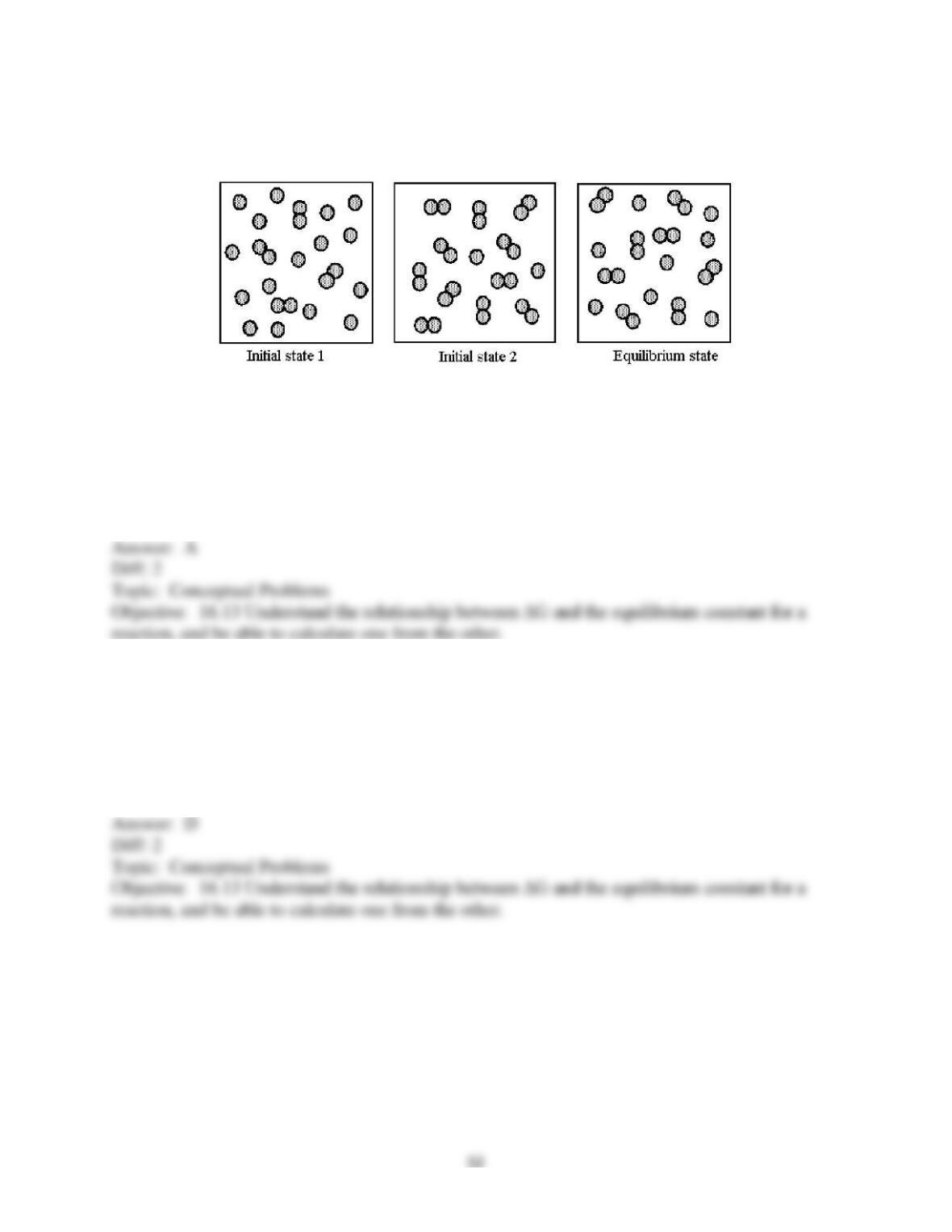
Consider the reaction 2A(g) ⇌ A2(g). The following pictures represent two possible initial states
and the equilibrium state of the system.
99) For initial state 1 what is the relationship between the reaction quotient, Qp, and the
equilibrium constant, Kp?
A) Qp < Kp
B) Qp = Kp = 1
C) Qp = Kp ≠ 1
D) Qp > Kp
100) For initial state 2 what is the relationship between the reaction quotient, Qp, and the
equilibrium constant, Kp?
A) Qp < Kp
B) Qp = Kp = 1
C) Qp = Kp ≠ 1
D) Qp > Kp
101) What are the signs (+ or –) of ΔH, ΔS, and ΔG when the system spontaneously goes from
initial state 1 to the equilibrium state?
A) ΔH = +, ΔS = +, ΔG = +
B) ΔH = +, ΔS = +, ΔG = –
C) ΔH = –, ΔS = –, ΔG = +
D) ΔH = –, ΔS = –, ΔG = –
102) What are the signs (+ or –) of ΔH, ΔS, and ΔG when the system spontaneously goes from
initial state 2 to the equilibrium state?
A) ΔH = +, ΔS = +, ΔG = +
B) ΔH = +, ΔS = +, ΔG = –
C) ΔH = –, ΔS = –, ΔG = +
D) ΔH = –, ΔS = –, ΔG = –
Consider the following gas-phase reaction of A2 (shaded spheres) and B2 (unshaded spheres):
A2(g) + B2(g) ⇌ 2 AB(g) ΔG ° = +25 kJ
103) Which of the above reaction mixtures has the least spontaneous forward reaction?
A) (1)
B) (2)
C) (3)
D) (4)
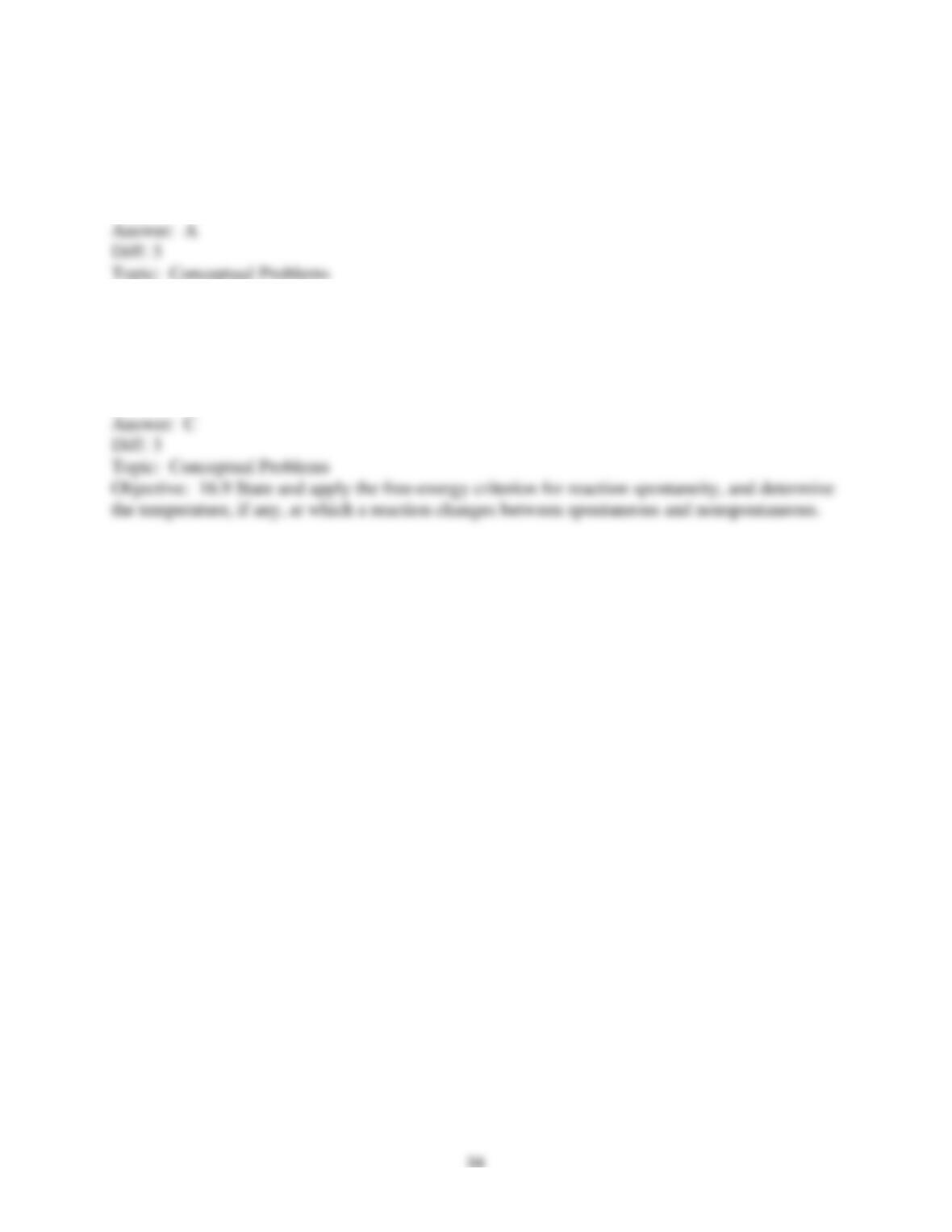
104) Which of the above reaction mixtures has the most spontaneous forward reaction?
A) (1)
B) (2)
C) (3)
D) (4)
105) Which of the above reaction mixtures is ΔG of reaction = ΔG ° ?
A) (1)
B) (2)
C) (3)
D) (4)
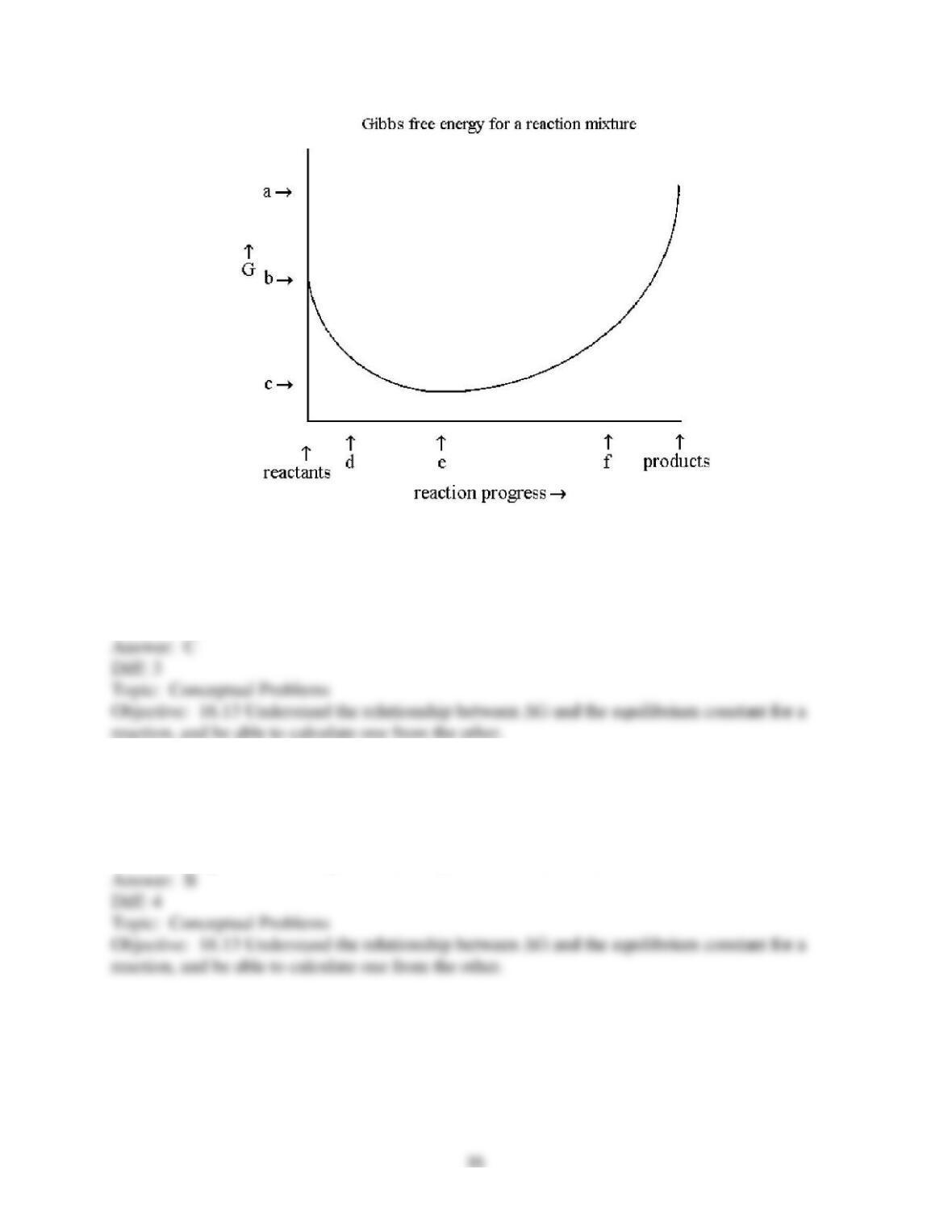
106) According to the diagram above, the forward reaction is
A) nonspontaneous at d and e, and spontaneous at f.
B) nonspontaneous at d, at equilibrium at e, and spontaneous at f.
C) spontaneous at d, at equilibrium at e, and nonspontaneous at f.
D) spontaneous at d, e, and f.
107) According to the diagram above,
A) ΔG° is positive and the equilibrium composition is rich in products.
B) ΔG° is positive and the equilibrium composition is rich in reactants.
C) ΔG° is negative and the equilibrium composition is rich in products.
D) ΔG° is negative and the equilibrium composition is rich is reactants.
108) According to this diagram,
A) ΔG° is positive and is equal to a – b.
B) ΔG° is positive and is equal to b – c.
C) ΔG° is negative and is equal to b – c.
D) ΔG° is negative and is equal to a – c.
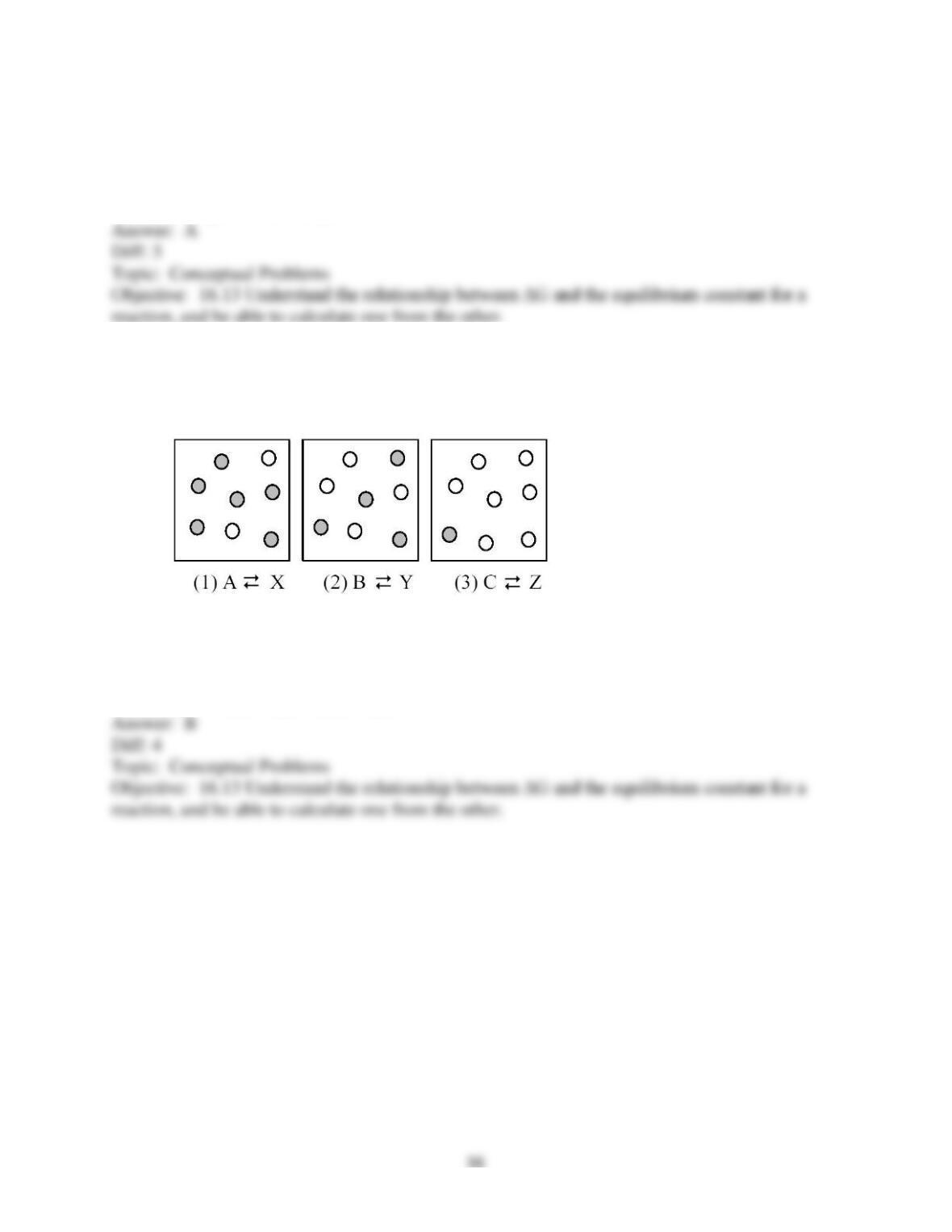
109) The following pictures represent three equilibrium mixtures for the interconversion of A, B,
and C molecules (unshaded spheres) into X, Y, and Z molecules (shaded spheres), respectively.
What is the sign of ΔG ° for each of the three reactions?
A) ΔG °(1) = –; ΔG °(2) = +; ΔG °(3) = 0
B) ΔG °(1) = –; ΔG °(2) = 0; ΔG °(3) = +
C) ΔG °(1) = 0; ΔG °(2) = –; ΔG °(3) = +
D) ΔG °(1) = +; ΔG °(2) = 0; ΔG °(3) = –
16.2 Algorithmic Questions
1) The entropy change associated with the expansion of one mole of an ideal gas from an initial
volume of Vi to a final volume of Vf at constant temperature is given by the equation, ΔS = R ln
(Vf/Vi). What is the entropy change associated with the expansion of three moles of an ideal gas
from an initial volume of Vi to a final volume of Vf at constant temperature?
A) ΔS = R ln (Vf/Vi)
B) ΔS = 3 mol × R ln (Vf/Vi)
C) ΔS = R ln (Vf × 23/Vi)
D) ΔS = R ln (Vf × 3!/Vi)
2) What is the entropy change associated with the expansion of one mole of an ideal gas from an
initial volume of V to a final volume of 4.50V at constant temperature?
A) ΔS = 4.50 R ln (Vf/Vi)
B) ΔS = -4.50 R ln (Vf/Vi)
C) ΔS = R ln 4.50
D) ΔS = –R ln 4.50
3) What would be an expression for the entropy change for 1.84 moles of an ideal gas that
undergoes a change in pressre from 6.00 atm to 1.00 atm at constant temperature?
A) 3.30 moles∙R
B) –3.30 moles∙R
C) 11.0 moles∙R
D) -11.0 moles∙R
4) Estimate the entropy change when the pressure on 10.0 g of He is increased from 1.00 atm to
10.0 atm at constant temperature. AssumeHe is an ideal gas.
A) -47.9 J/K
B) 47.9 J/K
C) -191 J/K
D) 191 J/K
5) Predict the sign of ΔS for each of the following systems, which occur at constant temperature
I. The volume of 2.0 moles of O2(g) increases from 44 L to 52 L.
II. The pressure of 2.0 moles of O2(g) increases from 1.0 atm to 1.2 atm.
A) I: ΔS = negative; II: ΔS = negative
B) I: ΔS = negative; II: ΔS = positive
C) I: ΔS = positive; II: ΔS = negative
D) I: ΔS = positive; II: ΔS = positive
6) Under which of the following conditions would one mole of He have the highest entropy, S?
A) 17°C and 15 L
B) 127°C and 15 L
C) 17°C and 25 L
D) 127°C and 25 L
7) Which one of the following would be expected to have the lowest standard molar entropy, S°,
at 25°C?
A) C10H22(s)
B) C10H22(l)
C) C14H30(s)
D) C14 OH(l)
8) At 298° K the value of ΔG for a reaction is -71.7 kJ. What is the value of , the total
entropy change?
A) 241 J/K
B) -241 J/K
C) 21.4 J/K
D) -18.1 J/K
9) At 298° K, the value of Δ , the total entropy change, for a reaction is – 841 J/K. What is
the value of ΔG?
A) 251 kJ
B) -251kJ
C) 354 kJ
D) -354 kJ
16.3 Short Answer Questions
1) Chemical and physical changes can be classified as spontaneous or nonspontaneous. At 25°C
and 1 atm pressure the decomposition of water into hydrogen and oxygen is classified as
________, and the melting of ice is classified as ________.
2) The sign (+ or –) of △H is ________ and the sign (+ or –) of △S is ________ for the
evaporation of water.
3) A 1.0 mole sample of gas at STP has a ________ entropy than 1.0 mole of gas at 273 K and
835 mm Hg.
4) The entropy of water at 25° is ________ than the entropy of water at 35°C.
5) Standard molar entropies, S°, in J/K∙mol, are given below each reactant and product in the
reaction shown below. The standard entropy of reaction, △S°, for this reaction is ________ J.
CH4(g) + 2 O2(g) → CO2(g) + 2 H2O(l)
186.2 205.0 213.6 69.9
6) A reaction for which △H° = + 98.8 kJ and △S° = + 141.5 J/K is ________ (spontaneous or
nonspontaneous) at low temperatures and ________ (spontaneous or nonspontaneous) at high
temperatures.
7) A reaction has △G° = + 21.5 kJ/mol, △H° = + 25.0 kJ/mol, and △S° = + 15.0 J/mol∙K can
become spontaneous at a temperature of ________ K.
8) Acetylene, C2H2, has a standard enthalpy of formation, △H° = 226.7 kJ/mol, and a standard
entropy change for its formation from its elements, △S° = 58.8 J/K∙mol. The standard free
energy of formation of acetylene is ________ kJ/mol.
9) Standard free energies of formation, △G°, in kJ/mol, are given below each reactant and
product in the reaction shown below. The standard free energy of reaction, △G°, for this
reaction is ________ kJ.
CH4(g) + 2 O2(g) → CO2(g) + 2 H2O(l)
– 50.8 0 – 394.4 – 237.2
10) The standard free energy for a reaction is △G° = – 33.0 kJ. At 25°C the equilibrium
constant for this reaction , Kp = ________.