Test Bank for Intermediate Accounting, Fifteenth Edition
16 – 40
DERIVATIONS — Earnings Per Share, Computational (cont.)
Dilutive Securities and Earnings per Share
16 – 41
DERIVATIONS — Earnings Per Share, Computational (cont.)
No. Answer Derivation
DERIVATIONS — Earnings Per Share, CPA Adapted
No. Answer Derivation
BRIEF EXERCISES
BE. 16-135—Convertible Bonds.
Garr Co. issued $4,000,000 of 12%, 5-year convertible bonds on December 1, 2014 for
$4,016,900 plus accrued interest. The bonds were dated April 1, 2014 with interest payable
April 1 and October 1. Bond premium is amortized each interest period on a straight-line basis.
Garr Co. has a fiscal year end of September 30.
On October 1, 2015, $2,000,000 of these bonds were converted into 28,000 shares of $15 par
common stock. Accrued interest was paid in cash at the time of conversion.
Test Bank for Intermediate Accounting, Fifteenth Edition
16 – 42
Instructions
(a) Prepare the entry to record the interest expense at April 1, 2015. Assume that interest
payable was credited when the bonds were issued (round to nearest dollar).
(b) Prepare the entry to record the conversion on October 1, 2015. Assume that the entry to
record amortization of the bond premium and interest payment has been made.
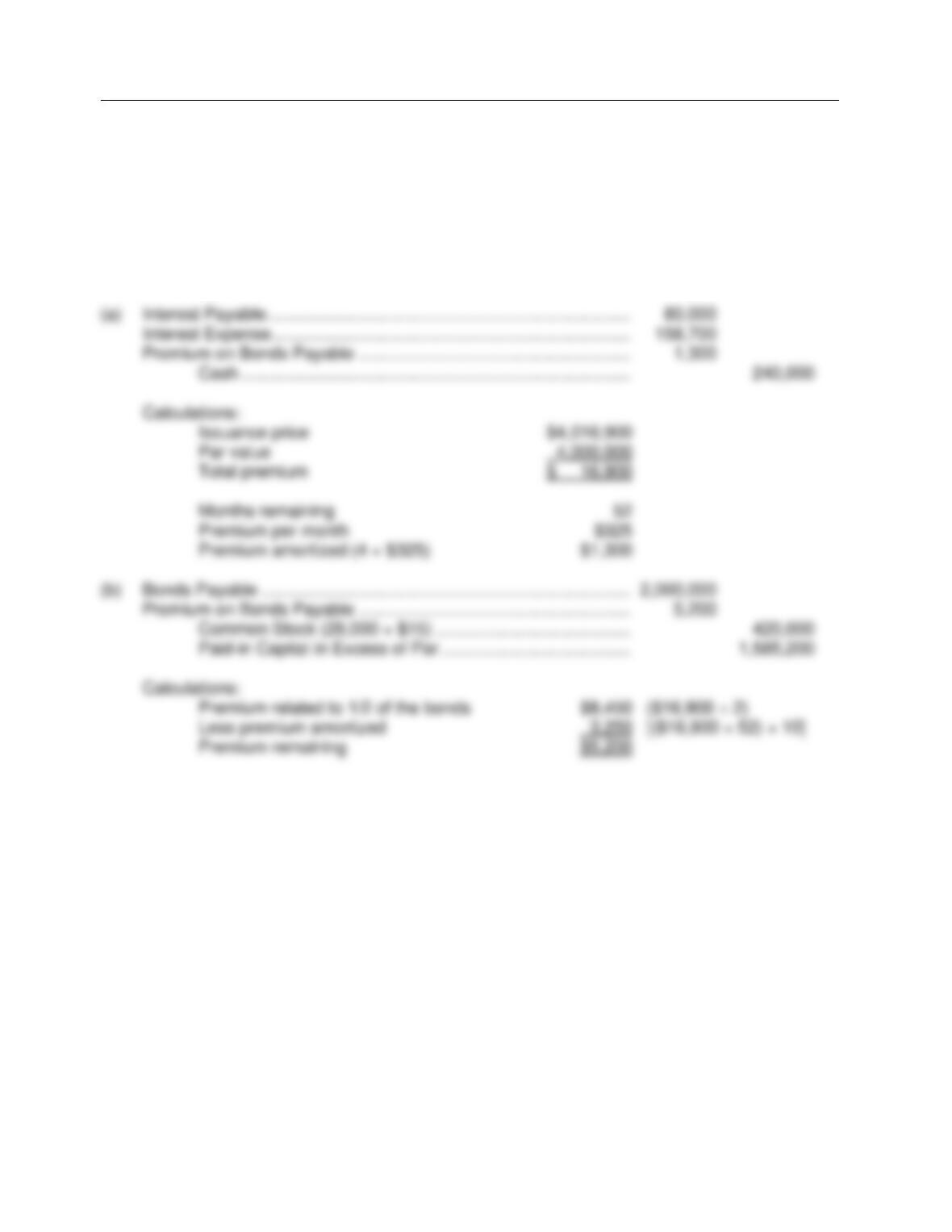
Solution 16-135
BE. 16-136—Convertible Bonds.
Koch Co. sold convertible bonds at a premium. Interest is paid on May 31 and November 30. On
May 31, after interest was paid, 100, $1,000 bonds are tendered for conversion into 3,000 shares
of $10 par value common stock that had a market price of $40 per share. How should Koch Co.
account for the conversion of the bonds into common stock under the book value method?
Discuss the rationale for this method.
Dilutive Securities and Earnings per Share
16 – 43
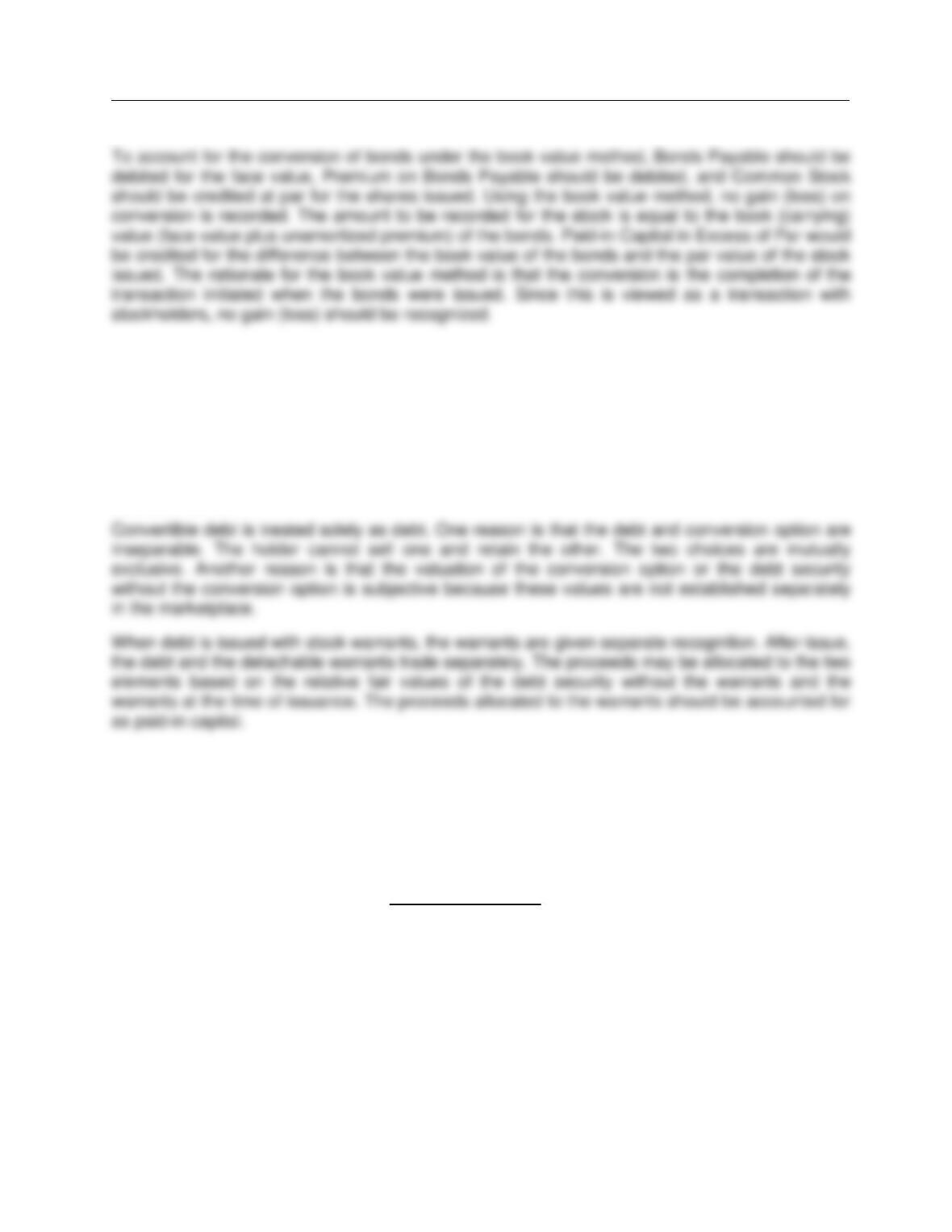
Solution 16-136
BE. 16-137—Convertible Debt and Debt with Warrants (Essay).
What accounting treatment is required for convertible debt and why? What accounting treatment
is required for debt issued with stock warrants and why?
Solution 16-137
EXERCISES
Ex. 16-138—Stock options.
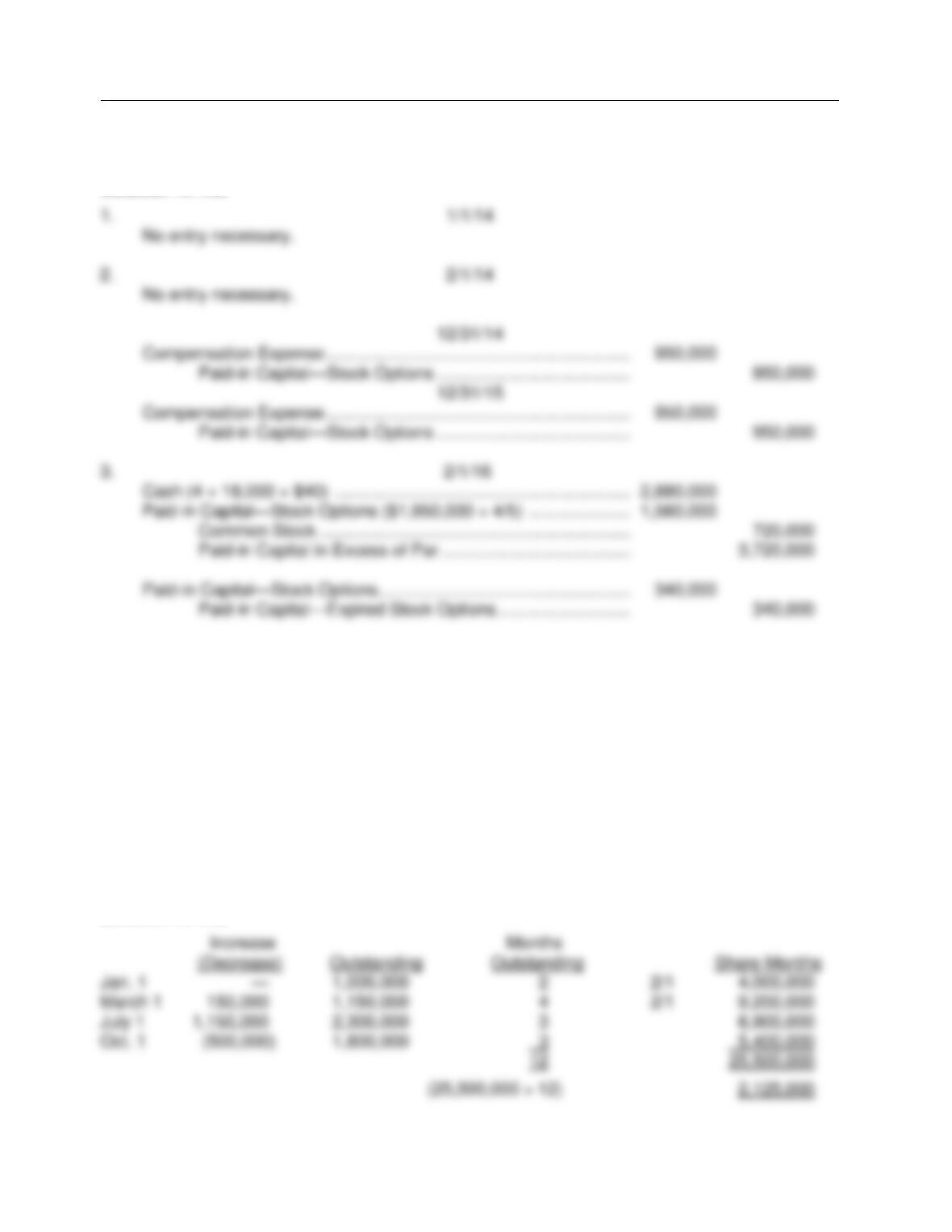
Prepare the necessary entries from 1/1/14-2/1/16 for the following events using the fair value
method. If no entry is needed, write “No Entry Necessary.”
1. On 1/1/14, the stockholders adopted a stock option plan for top executives whereby each
might receive rights to purchase up to 18,000 shares of common stock at $40 per share. The
par value is $10 per share.
2. On 2/1/14, options were granted to each of five executives to purchase 18,000 shares. The
options were non-transferable and the executive had to remain an employee of the company
to exercise the option. The options expire on 2/1/16. It is assumed that the options were for
services performed equally in 2014 and 2015. The Black-Scholes option pricing model
determines total compensation expense to be $1,900,000.
Test Bank for Intermediate Accounting, Fifteenth Edition
16 – 44
3. At 2/1/16, four executives exercised their options. The fifth executive chose not to exercise his
options, which therefore were forfeited.
Solution 16-138
Ex. 16-139—Weighted average shares outstanding.
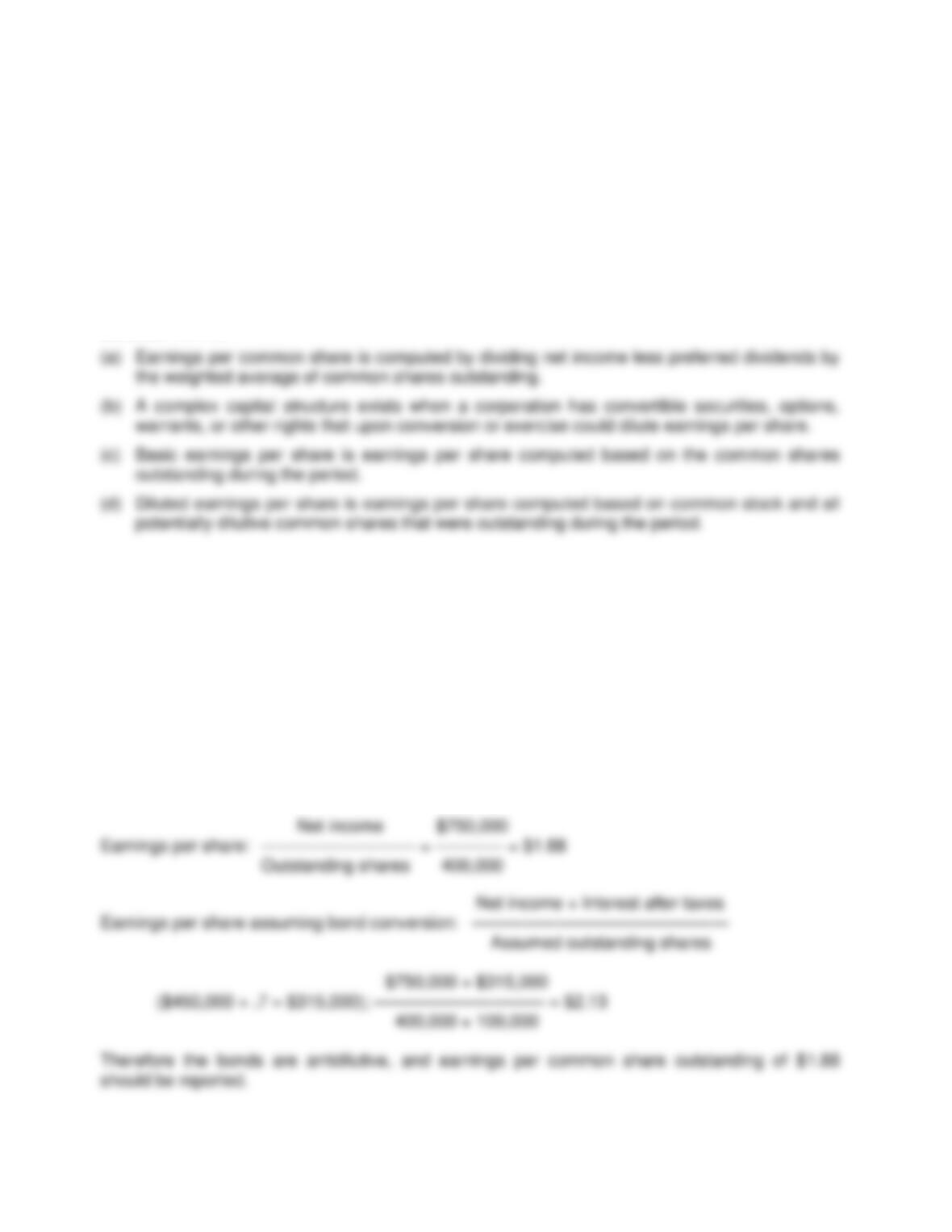
On January 1, 2015, Warren Corporation had 1,000,000 shares of common stock outstanding.
On March 1, the corporation issued 150,000 new shares to raise additional capital. On July 1, the
corporation declared and issued a 2-for-1 stock split. On October 1, the corporation purchased on
the market 500,000 of its own outstanding shares and retired them.
Instructions
Compute the weighted average number of shares to be used in computing earnings per share for
2015.
Solution 16-139

Dilutive Securities and Earnings per Share
16 – 45
Test Bank for Intermediate Accounting, Fifteenth Edition
16 – 46
Ex. 16-140—Earnings Per Share. (Essay)
Define the following:
(a) The computation of earnings per common share
(b) Complex capital structure
(c) Basic earnings per share
(d) Diluted earnings per share
Solution 16-140
Ex. 16-141—Earnings per share.
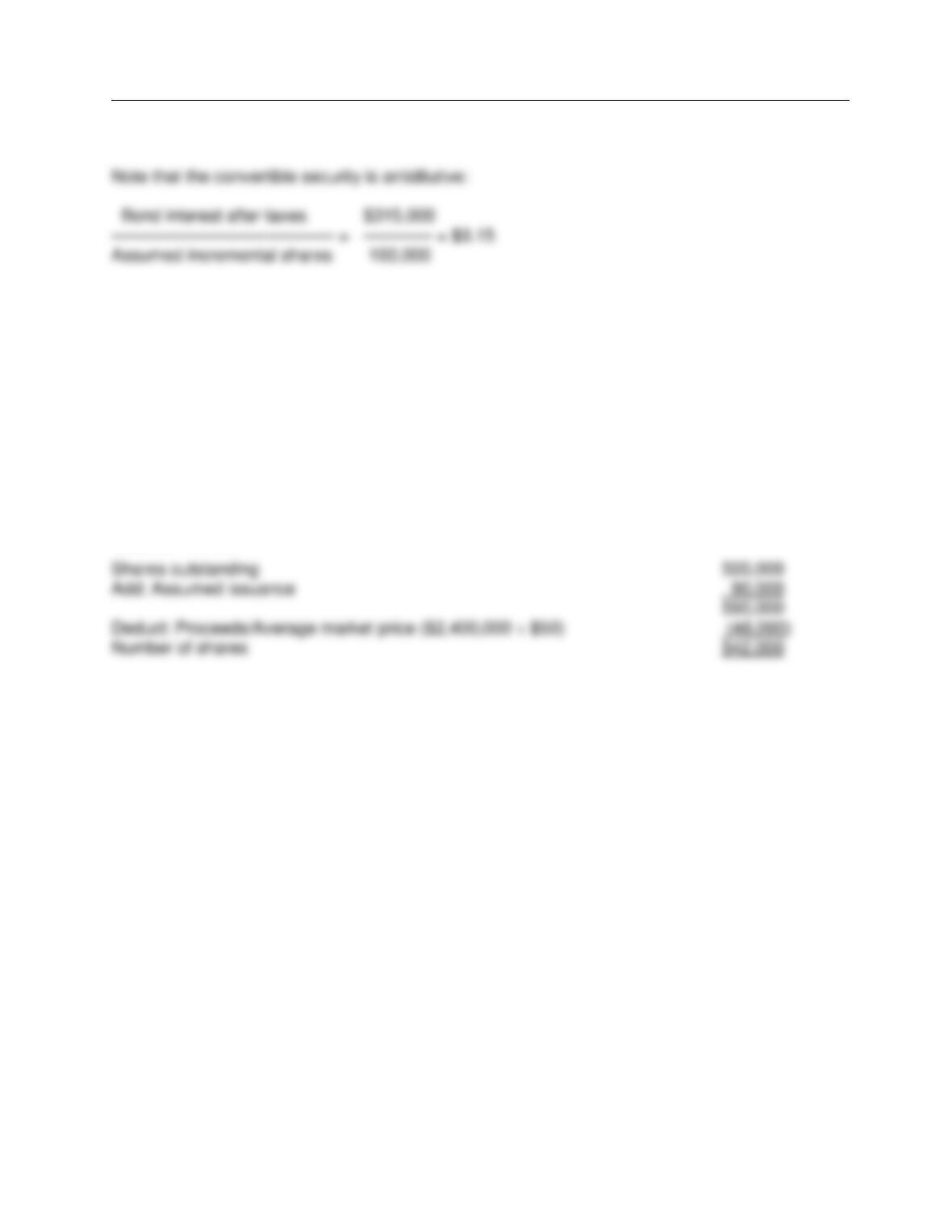
Santana Corporation has 400,000 shares of common stock outstanding throughout 2015. In
addition, the corporation has 5,000, 20-year, 9% bonds issued at par in 2013. Each $1,000 bond
is convertible into 20 shares of common stock after 9/23/16. During the year 2015, the
corporation earned $750,000 after deducting all expenses. The tax rate was 30%.
Instructions
Compute the proper earnings per share for 2015.
Solution 16-141
Dilutive Securities and Earnings per Share
16 – 47
Solution 16-141 (Cont.)
Ex. 16-142—Diluted earnings per share.
Dunbar Company had 500,000 shares of common stock outstanding during the year 2015. In
addition, at December 31, 2013, 90,000 shares were issuable upon exercise of executive stock
options which require a $40 cash payment upon exercise (options granted in 2013). The average
market price during 2015 was $50.
Instructions
Compute the number of shares to be used in determining diluted earnings per share for 2015.
Solution 16-142
*Ex. 16-143—Stock appreciation rights.
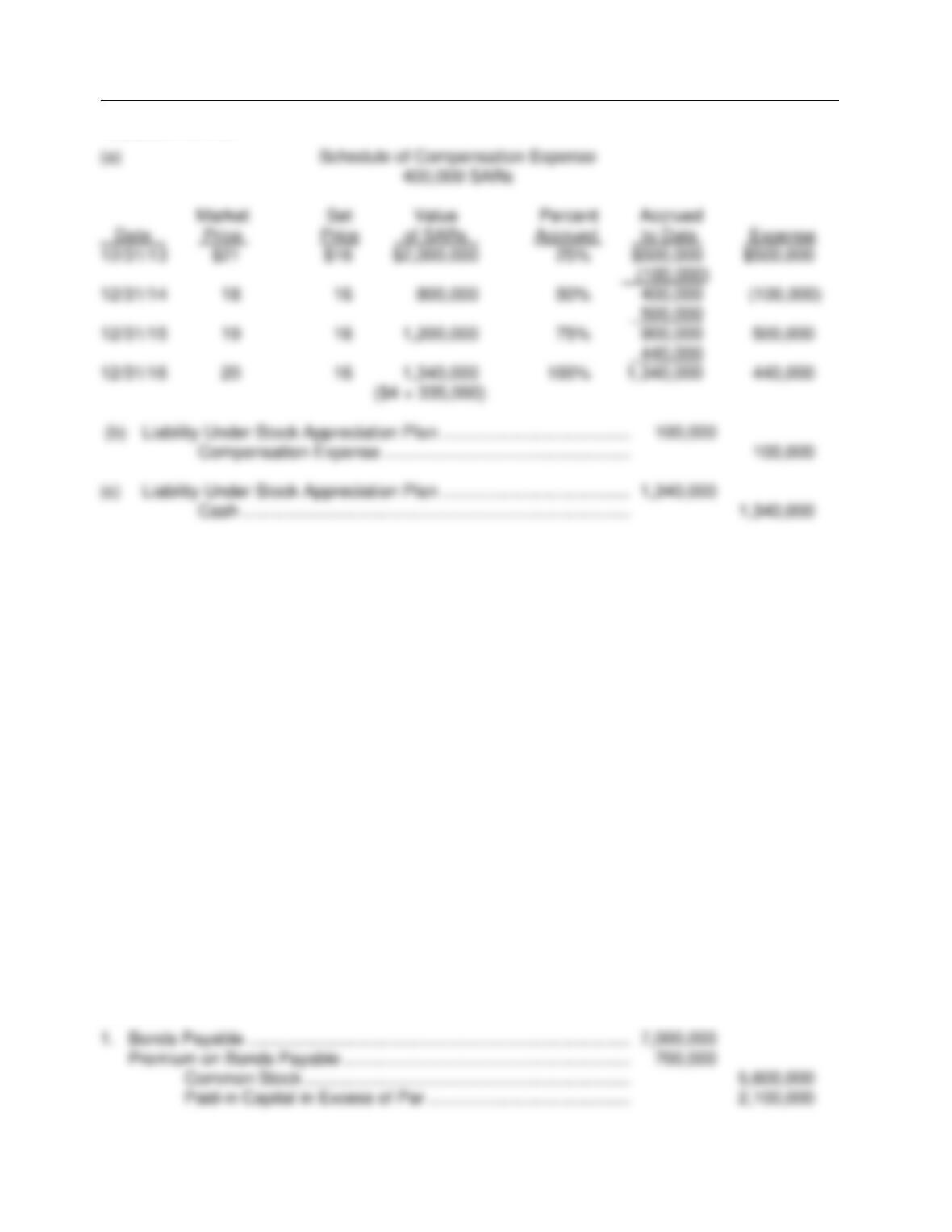
On January 1, 2013, Orr Co. established a stock appreciation rights plan for its executives. They
could receive cash at any time during the next four years equal to the difference between the
market price of the common stock and a preestablished price of $16 on 400,000 SARs. The
market price is as follows: 12/31/13—$21; 12/31/14—$18; 12/31/15—$19; 12/31/16—$20. On
December 31, 2015, 65,000 SARs are exercised, and the remaining SARs are exercised on
December 31, 2016.
Instructions
(a) Prepare a schedule that shows the amount of compensation expense for each of the four
years starting with 2013.
(b) Prepare the journal entry at 12/31/14 to record compensation expense.
(c) Prepare the journal entry at 12/31/16 to record the exercise of the remaining SARs.
Test Bank for Intermediate Accounting, Fifteenth Edition
16 – 48
*Solution 16-143
PROBLEMS
Pr. 16-144—Convertible bonds and stock warrants.
For each of the unrelated transactions described below, present the entry(ies) required to record
the bond transactions.
1. On August 1, 2015, Lane Corporation called its 10% convertible bonds for conversion. The
$7,000,000 par bonds were converted into 280,000 shares of $20 par common stock. On
August 1, there was $700,000 of unamortized premium applicable to the bonds. The fair value
of the common stock was $20 per share. Ignore all interest payments.
2. Packard, Inc. decides to issue convertible bonds instead of common stock. The company
issues 10% convertible bonds, par $3,000,000, at 97. The investment banker indicates that if
the bonds had not been convertible they would have sold at 94.
3. Gomez Company issues $8,000,000 of bonds with a coupon rate of 8%. To help the sale,
detachable stock warrants are issued at the rate of ten warrants for each $1,000 bond sold. It
is estimated that the value of the bonds without the warrants is $7,896,000 and the value of
the warrants is $504,000. The bonds with the warrants sold at 101.
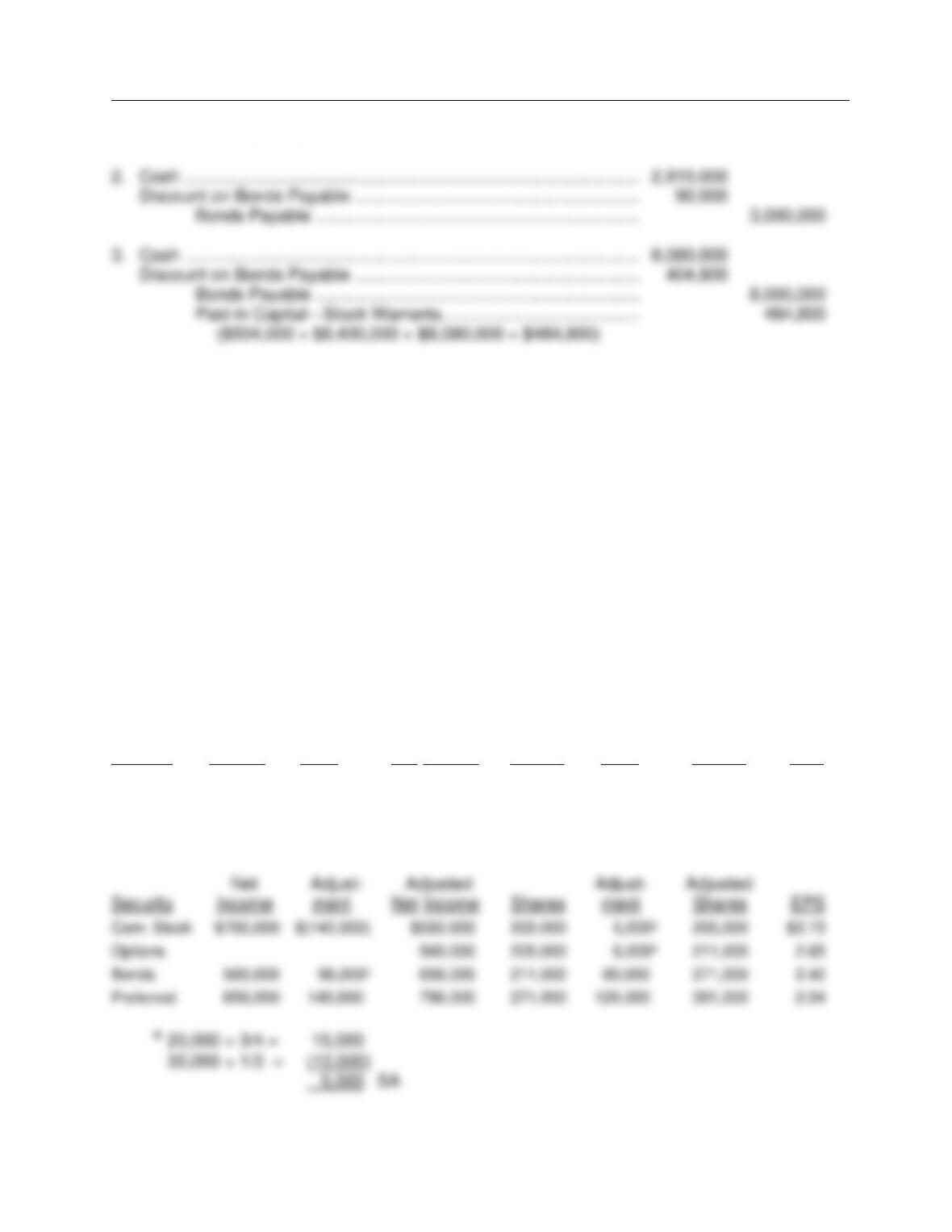
Solution 16-144
Dilutive Securities and Earnings per Share
16 – 49
Solution 16-144 (Cont.)
Pr. 16-145—Earnings per share.
Colson Corp. had $700,000 net income in 2015. On January 1, 2015 there were 200,000 shares
of common stock outstanding. On April 1, 20,000 shares were issued and on September 1,
Colson bought 30,000 shares of treasury stock. There are 30,000 options to buy common stock
at $40 a share outstanding. The market price of the common stock averaged $50 during 2015.
The tax rate is 40%.
During 2015, there were 40,000 shares of convertible preferred stock outstanding. The preferred
is $100 par, pays $3.50 a year dividend, and is convertible into three shares of common stock.
Colson issued $2,000,000 of 8% convertible bonds at face value during 2014. Each $1,000 bond
is convertible into 30 shares of common stock.
Instructions
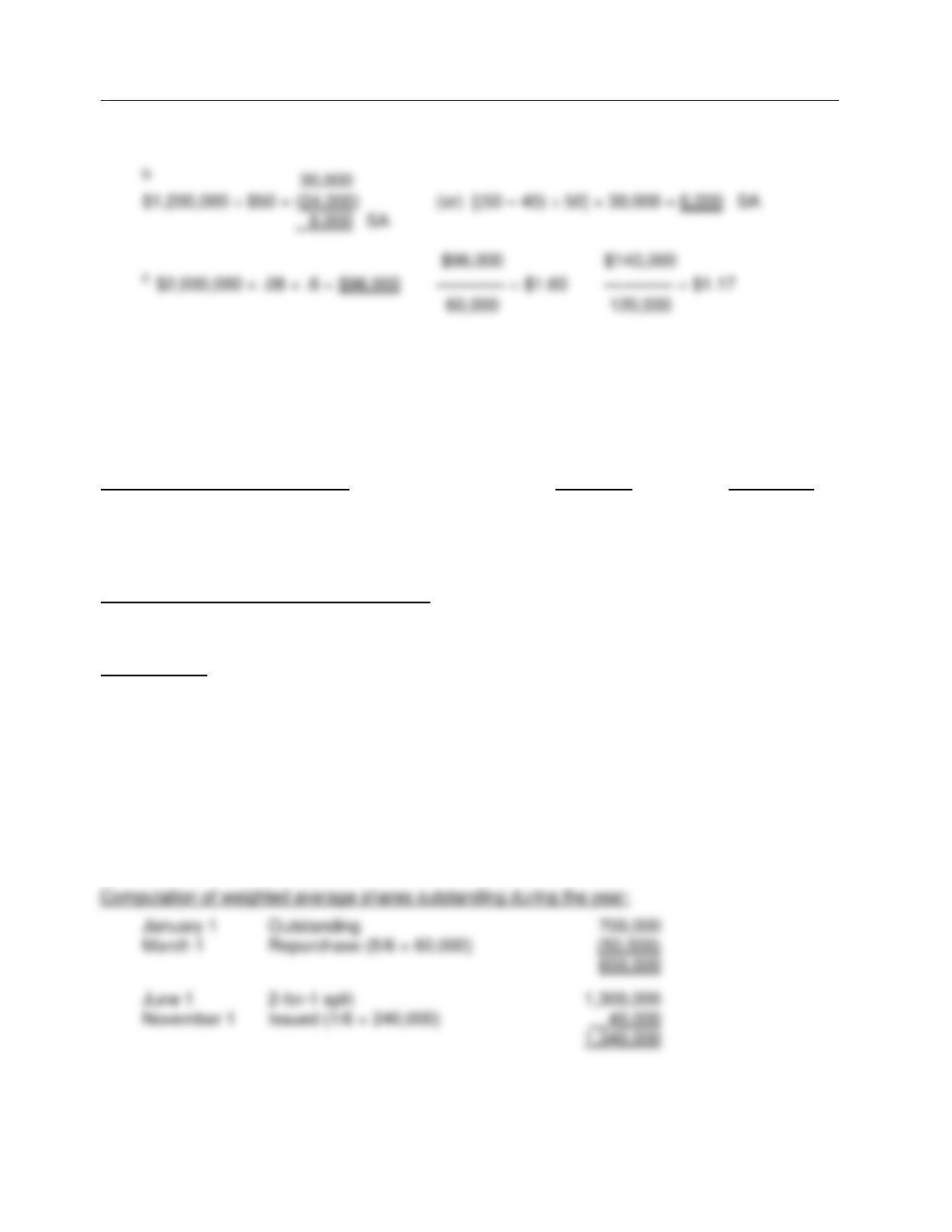
Compute diluted earnings per share for 2015. Complete the schedule and show all computations.
Net Adjust- Adjusted Adjust- Adjusted
Security Income ment Net Income Shares ment Shares EPS
Solution 16-145
Test Bank for Intermediate Accounting, Fifteenth Edition
16 – 50
Solution 16-145 (Cont.)
Pr. 16-146—Basic and diluted EPS.
Assume that the following data relative to Kane Company for 2015 is available:
Net Income $2,800,000
Transactions in Common Shares Change Cumulative
Jan. 1, 2015, Beginning number 700,000
Mar. 1, 2015, Purchase of treasury shares (60,000) 640,000
June 1, 2015, Stock split 2-1 640,000 1,280,000
Nov. 1, 2015, Issuance of shares 240,000 1,520,000
8% Cumulative Convertible Preferred Stock
Sold at par, convertible into 200,000 shares of common
(adjusted for split). $1,000,000
Stock Options
Exercisable at the option price of $25 per share. Average
market price in 2015, $30 (market price and option price
adjusted for split). 90,000 shares
Instructions
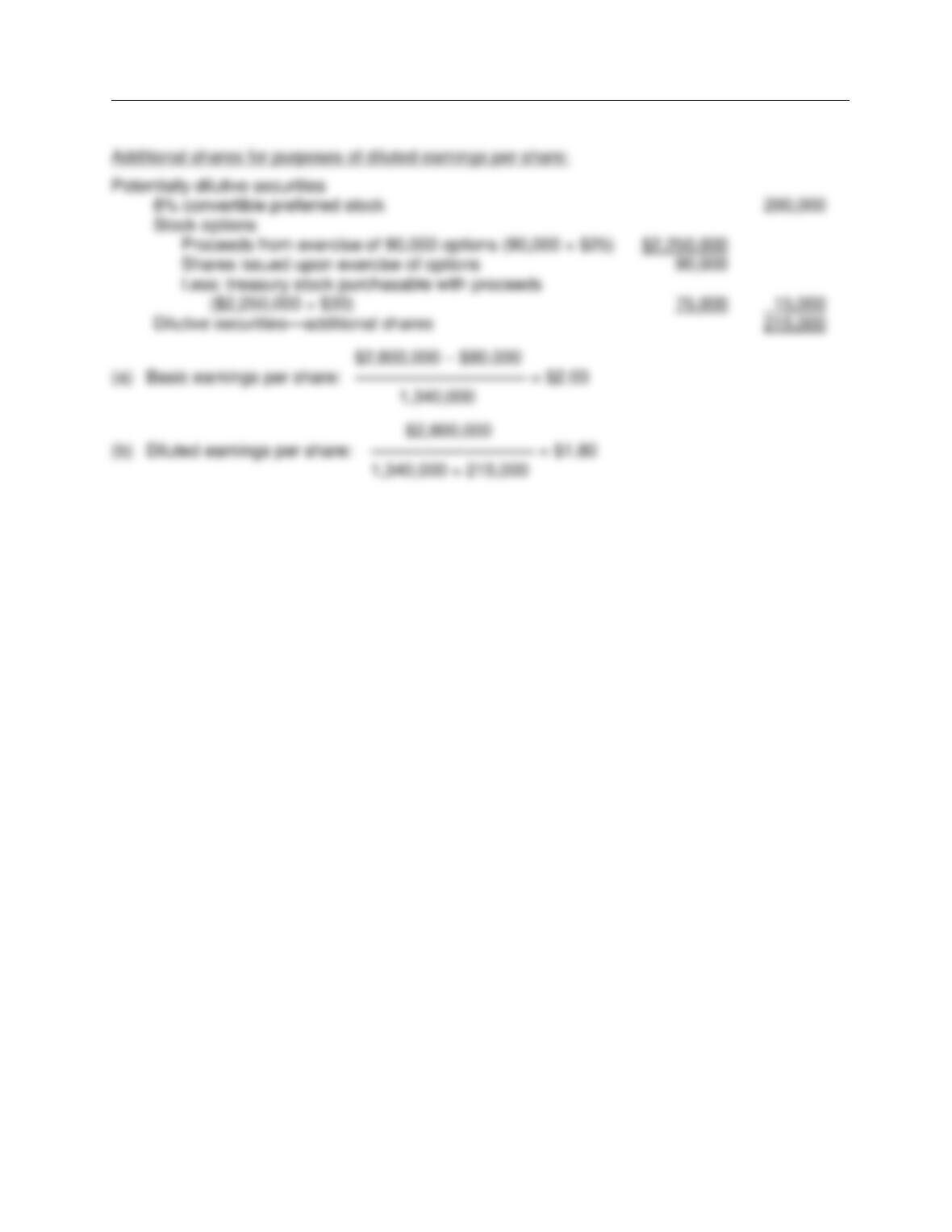
(a) Compute the basic earnings per share for 2015. (Round to the nearest penny.)
(b) Compute the diluted earnings per share for 2015. (Round to the nearest penny.)
Solution 16-146
Dilutive Securities and Earnings per Share
16 – 51
Solution 16-146 (Cont.)
Pr. 16-147—Basic and diluted EPS.
Presented below is information related to Starr Company.
1. Net Income [including an extraordinary gain (net of tax) of $70,000] $350,000
2. Capital Structure
a. Cumulative 8% preferred stock, $100 par,
6,000 shares issued and outstanding $600,000
b. $10 par common stock, 74,000 shares outstanding on January 1.
On April 1, 40,000 shares were issued for cash. On October 1,
16,000 shares were purchased and retired. $1,000,000
c. On January 2 of the current year, Starr purchased Oslo Corporation.
One of the terms of the purchase was that if Starr’s net income for the
following year is $2,400,000 or more, 50,000 additional shares would
be issued to Oslo stockholders next year.
3. Other Information
a. Average market price per share of common stock during entire year $30
b. Income tax rate 30%
Instructions
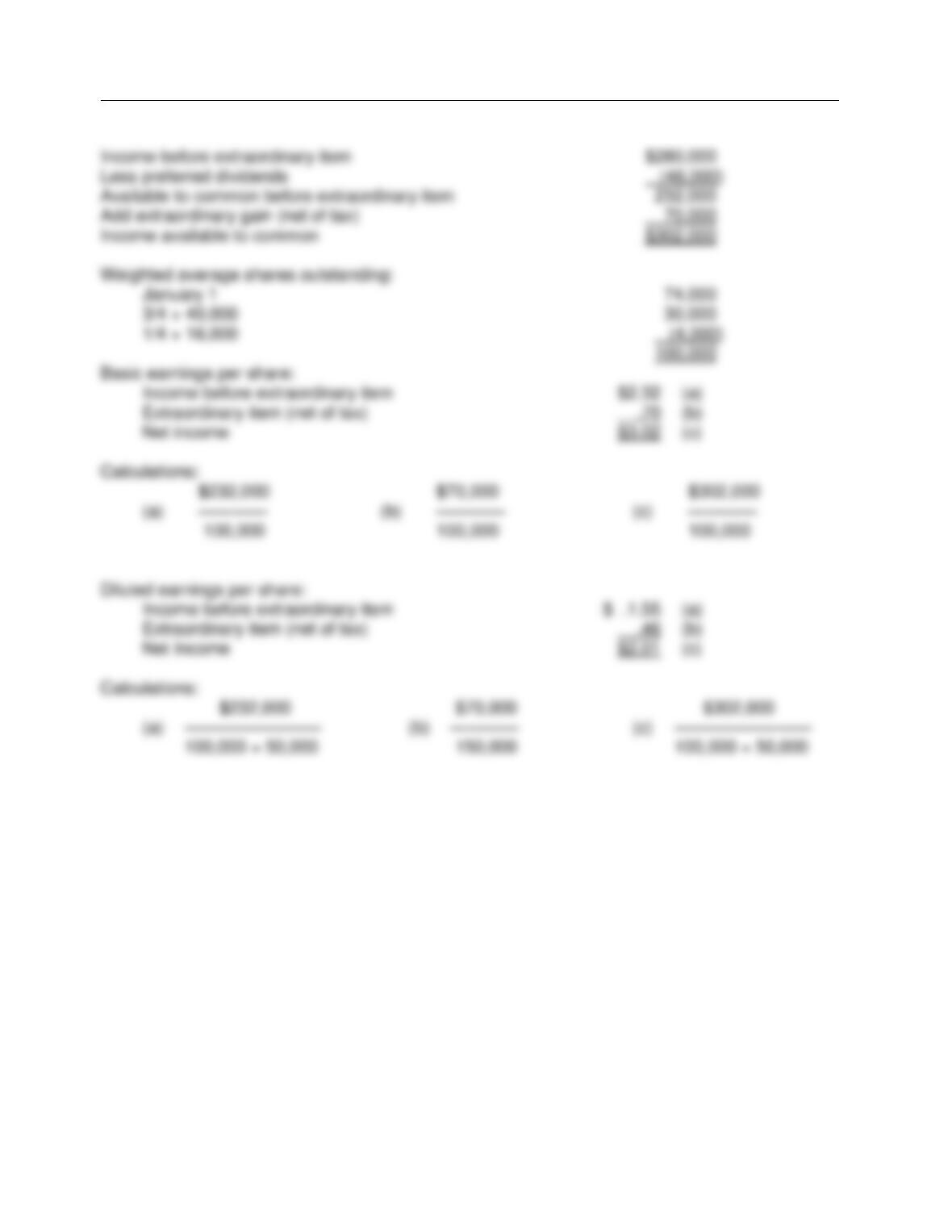
Compute earnings per share for the current year.
Test Bank for Intermediate Accounting, Fifteenth Edition
16 – 52
Solution 16-147
Pr. 16-148—Basic and diluted EPS.
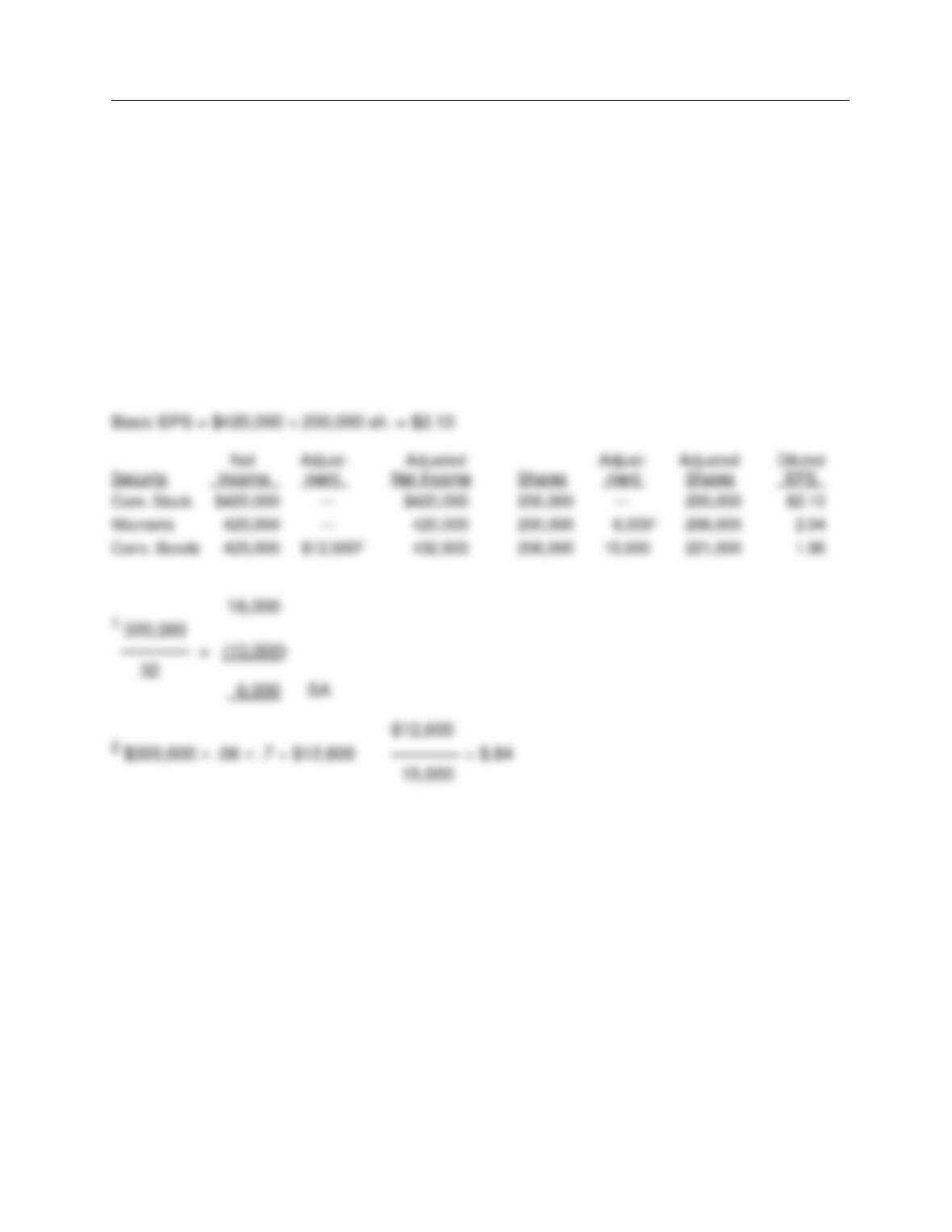
The following information was taken from the books and records of Ludwick, Inc.:
1. Net income $ 420,000
2. Capital structure:
a. Convertible 6% bonds. Each of the 300, $1,000 bonds is convertible
into 50 shares of common stock at the present date and for the next
10 years. 420,000
b. $10 par common stock, 200,000 shares issued and outstanding
during the entire year. 2,000,000
c. Stock warrants outstanding to buy 16,000 shares of common stock
at $20 per share.
Dilutive Securities and Earnings per Share
16 – 53
Pr. 16-148 (Cont.)
3. Other information:
a. Bonds converted during the year None
b. Income tax rate 30%
c. Convertible debt was outstanding the entire year
d. Average market price per share of common stock during the year $32
e. Warrants were outstanding the entire year
f. Warrants exercised during the year None
Instructions
Compute basic and diluted earnings per share.
Solution 16-148

Test Bank for Intermediate Accounting, Fifteenth Edition
16 – 54
IFRS QUESTIONS
True/False
1. IFRS and U.S. GAAP have significant differences in the reporting of securities with
characteristics of debt and equity, such as convertible debt.
2. Under IFRS, employee share-purchase plans must be recorded as an expense in the year it
was issued by a company.
3. Under IFRS, convertible bonds are “bifurcated” —separated into the equity component (the
value of the conversion option) of the bond issue and the debt component.
4. Under both U.S. GAAP and IFRS, the calculation of basic and diluted earnings per share is
identical.
5. Under IFRS recording for the issuance of Bonds Payable, the Discount on Bonds Payable
and the Paid-in Capital-Convertible Bonds could be utilized.
Answers to True/False:
Multiple Choice:
6. With regard to recognizing stock-based compensation
a. IFRS and U.S. GAAP follow the same model.
b. IFRS and U.S. GAAP standards are undergoing major reform on valuation issues.
c. it has been agreed that these standards will not be merged due to the differences in
currencies.
d. the reform of U.S. GAAP standards will not be addressed until IFRS standards have been
finalized.
7. Under IFRS, how are convertible debt recorded?
a. Convertible debt is separated into equity component and debt component.
b. Convertible debt is recorded under stockholders’ equity.
c. Convertible debt is recorded as long-term liability.
d. Convertible debt is added to current liability section, as it will be converted to equity.

Dilutive Securities and Earnings per Share
16 – 55
8. When $5,000,000 in convertible bonds are issued at par with $800,000 in value of the equity
option embedded in the bond, the IFRS journal entry will include a debit of
a. $800,000 to Paid-in Capital — Convertible Bonds and a credit to Bonds Payable.
b. $800,000 to Premium on Bonds Payable and a credit to Paid-in Capital — Convertible
Bonds.
c. $800,000 to Bonds Payable and a credit to Paid-in Capital — Convertible Bonds.
d. $4,200,000 to Cash along with a debit of $800,000 to Discount on Bonds Payable and a
credit to Bonds Payable and a credit to Paid-in Capital — Convertible Bonds.
9. With regard to contracts that can be settled in either cash or shares
a. IFRS requires that share settlement must be used.
b. IFRS gives companies a choice of either cash or shares.
c. U.S. GAAP requires that share settlement must be used.
d. the FASB project proposes that the IASB adopt the U.S. GAAP approach, requiring that
share settlement must be used.
10. Under IFRS, what is recorded as compensation expense for all employee share-purchase
plans?
a. Par value of shares
b. Amount paid by employees
c. Amount of discount
d. Amount transferred to share premium
11. Which of the following differs in GAAP and IFRS?
a. Calculation of EPS
b. Model for recognizing stock-based compensation
c. Accounting for convertible debt
d. Modification of a share option
Use the following information for questions 12 and 13
Florence Inc. issued 8,000, 5-year convertible bonds of $2,000 each for $4,000,000 at the
beginning of 2012. The bonds have a stated rate of interest of 9% and interest is payable
annually. Each bond can be convertible into 100 shares with a par value of $10. The market rate
of similar nonconvertible debt is 10%.
12. Determine the fair value of liability component using the “with–and–without” method.
a. $3,848,288
b. $2,483,600
c. $1,365,688
d. $ 151,712
Explanation: $3,848,288 (fair value of liability) = ($4,000,000 (lump-sum) 0.6209 (pv factor
for 5 years at 10%)) + (360,000 (annual interest expense) 3.7908)

Test Bank for Intermediate Accounting, Fifteenth Edition
16 – 56
13. Determine the fair value of equity component using the “with–and–without” method.
a. $3,848,288
b. $2,483,600
c. $1,365,688
d. $ 151,712
Explanation: $4,000,000 − $3,848,285 = $151,712
Use the following information for question 14 and 15
Swing High Inc. offers its 100 employees to participate in an employee share-purchase plan.
Under the terms of plan, employees are entitled to purchase 10 shares at 10% discount. The par
values of shares were $10. Overall, 60 employees accepted the offer and each employee
purchased six shares. The market price on purchase date was $100.
14. What is the compensation expense recorded by Swing High Inc.?
a. $32,400
b. $ 3,600
c. $36,000
d. $28,800
Explanation: $3,600 (Compensation expense) = 60 (number of employees) 6 (number of
shares) ($100 (market price) − (10% $100) (discount)
15. Swing High Inc. will credit Share Premium―Ordinary for:
a. $32,400
b. $ 3,600
c. $36,000
d. $28,800
Explanation: $32,400 (Share Premium―Ordinary) = 60 (number of employees) 6 (shares)
$100 (market price) − 60 6 $10 (par value)
Answers to Multiple Choice:
Dilutive Securities and Earnings per Share
16 – 57
Short Answer
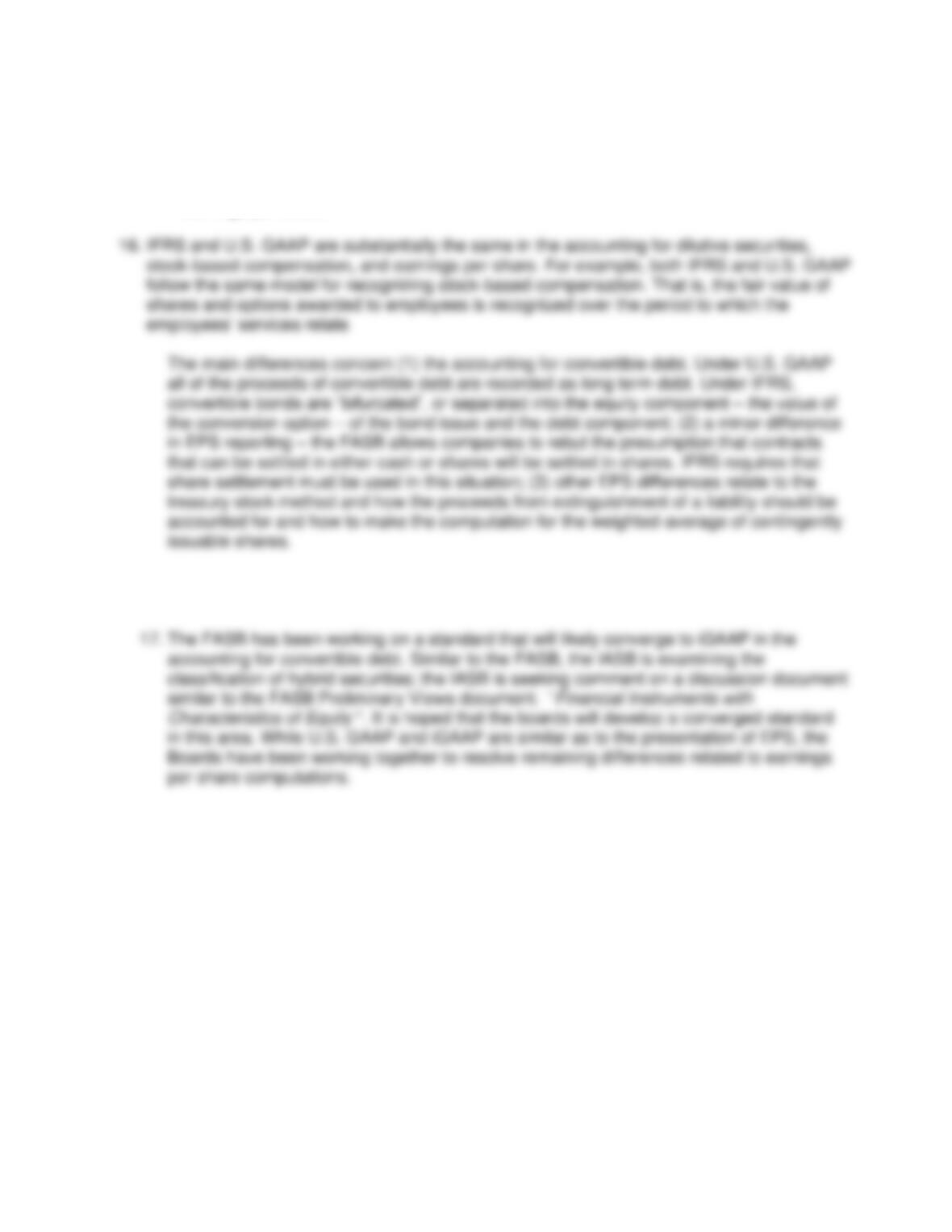
16. Briefly describe some of the similarities and differences between U.S. GAAP and IFRS
with respect to the accounting for dilutive securities, stock-based compensation, and
earnings per share.
17. Briefly discuss the convergence efforts that are under way by the IASB and FASB in the area
of dilutive securities and earnings per share.