16.3 Other Pricing Strategies
1) Some firms practice odd pricing because
A) they believe that customers will buy a larger quantity with an odd price.
B) it is a way to price discriminate.
C) it is too difficult for sellers to reeducate buyers into accepting even prices.
D) it lowers transactions costs.
2) Suppose the per-unit production cost of a book is $4.00 and the retail price is $32. If the book
publisher sells books to a bookstore at a 40 percent discount, what is the amount of the
publisher’s markup per book? Assume that bookstores sell books at the retail price.
A) $12.80
B) $15.20
C) $19.20
D) $21.60
3) One method of setting price using the cost-plus method is to add
A) a given percentage of marginal cost to marginal cost of production.
B) a given percentage of fixed cost to total fixed cost.
C) a given percentage of average total cost to average total cost.
D) a given percentage of average variable cost to average total cost.
4) Which of the following is not an advantage cost-plus pricing?
A) It leads to profit maximization.
B) It is an easy method to implement if a firm produces multiple products and has overhead costs
that are difficult to allocate to a particular good.
C) It could lead to price stability if the industry is made up of identical firms all using the same
method of pricing.
D) It is easy to justify price increases when total costs of production increase.
5) All of the following are disadvantages of cost-plus pricing except
A) It ignores the price elasticity of demand: for example, it may be possible to increase profits by
raising or lowering price.
B) If the industry comprises identical firms (with identical costs), markups could be consistent
among firms leading to no one firm having a competitive edge in terms of price.
C) Allocating and apportioning business overheads to individual products could be somewhat
arbitrary.
D) The business has less incentive to cut or control costs: if costs increase, then selling prices
increase. Consequently, this might further erode a firm’s competitiveness.
6) Cost-plus pricing is a reasonable way to determine the optimal price when
A) marginal cost and average cost are roughly equal.
B) fixed cost and variable costs are roughly equal.
C) fixed costs vary.
D) fixed costs are high.
7) If demand is taken into account, firms that use cost-plus pricing can adjust price by
A) letting sales fall, but hold the markup constant if demand falls.
B) lowering markups on price-elastic goods and raising markups on price-inelastic goods.
C) raising markups on price-elastic goods and lowering markups on price-inelastic goods.
D) letting sales rise, but hold the markup constant if demand rises.
8) Most supermarkets charge the same price for the majority of goods sold. This suggest that
A) the government regulates prices of most products sold in supermarkets.
B) supermarkets have colluded to fix prices on most of the goods sold.
C) mark-ups reflect the degree of competition in the supermarket industry.
D) the large supermarket chains are price leaders and smaller grocers take these prices as given.
9) Until the early 1980s, The Walt Disney Company used a pricing strategy in which visitors to
its theme parks paid a low admission fee and also paid for rides. This pricing strategy is an
example of
A) perfect price discrimination.
B) cost-plus pricing.
C) a two-part tariff.
D) monopoly pricing.
10) Which of the following describes two-part tariff pricing?
A) A firm charges two different prices for the same good.
B) An importer has to pay a tax at the nation’s borders, and a sales tax when the good is sold.
C) A buyer pays an initial price for entrance to the market and an additional fee for each unit of
the product purchased.
D) A buyer must pay a down payment and monthly payments to buy big-ticket items such as a
car, a plasma television or a suite of furniture.
11) Compared to monopoly pricing, an optimal two-part tariff
A) reduces economic efficiency.
B) eliminates the deadweight loss.
C) equates marginal revenue and average revenue.
D) increases consumer surplus.
12) A firm using a two-part tariff faces a tradeoff because
A) the only way to increase the fixed-fee portion of the price is to lower the per-unit portion of
the price.
B) the only way to increase total revenue is to lower per-unit profit.
C) any increase in consumer surplus must be offset by a decrease in producer surplus.
D) the smaller the variation between the parts of the price, the greater the deadweight loss
generated by the pricing scheme.
13) A firm using a two-part tariff can produce the economically efficient outcome by
A) making the fixed-fee portion of the price as low as possible.
B) setting the per-unit portion of the price equal to the marginal cost of production.
C) setting the per-unit portion of the price equal to the average cost of production.
D) setting the fixed-fee portion of the price at some proportion to the fixed cost of production.
14) With an optimal two-part tariff,
A) consumer surplus equals producer surplus.
B) all consumer surplus is transformed into profit.
C) consumers maximize consumer surplus.
D) the firm earns zero profit.
15) If marginal cost is zero, with an optimal two-part tariff,
A) total revenue is maximized.
B) consumers maximize their surplus
C) the firm does not have to charge a fixed-fee portion.
D) firms may not maximize profit.
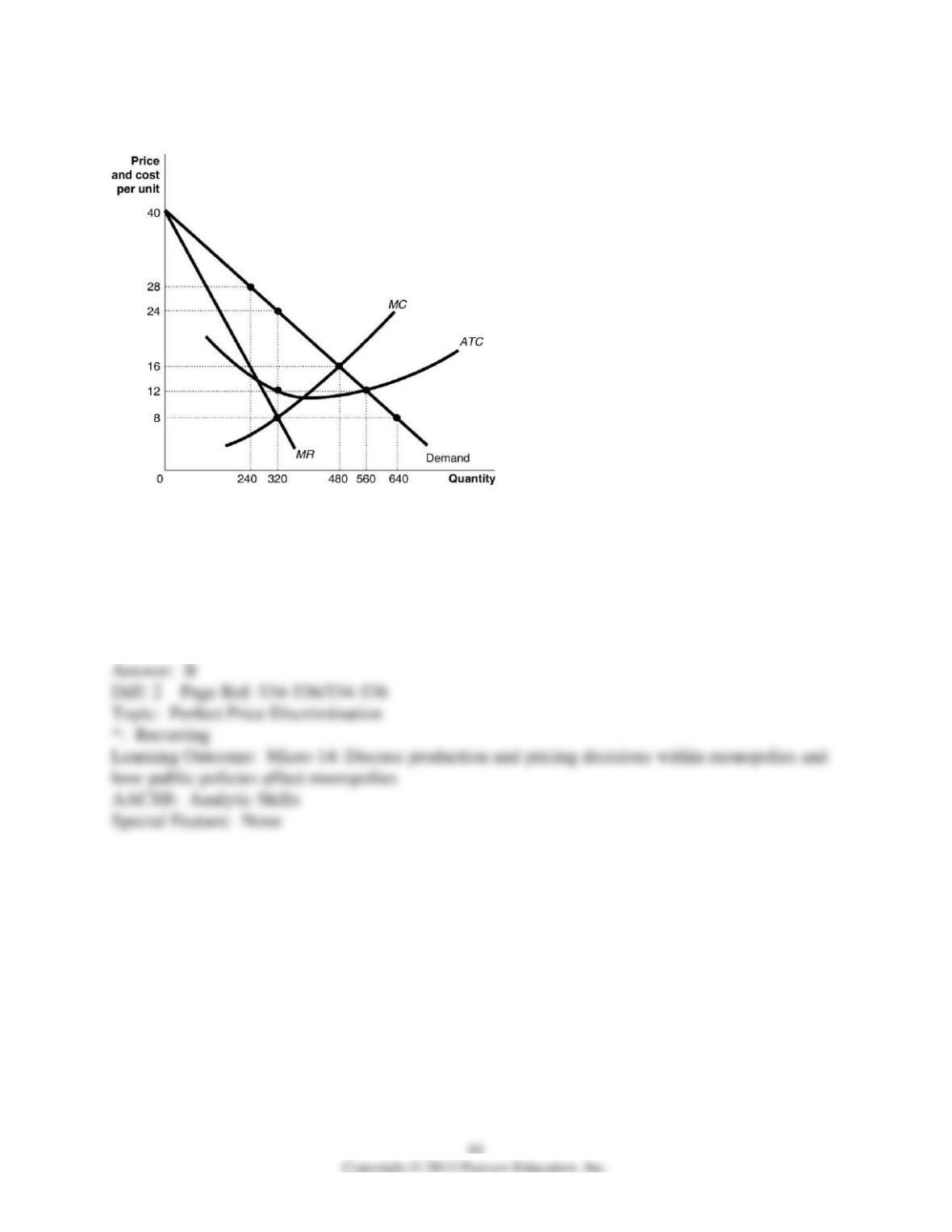
Figure 16-4
16) Refer to Figure 16-4. Suppose the firm represented in the diagram decides to use a two-part
pricing strategy such that it charges a fixed fee and a per-unit price equal to the monopoly price.
What is the quantity it should produce?
A) 240 units
B) 320 units
C) 480 units
D) 560 units
17) Refer to Figure 16-4. Suppose the firm represented in the diagram decides to use a two-part
pricing strategy such that it charges a fixed fee and a per-unit price equal to the monopoly price.
What is the per-unit price?
A) $28
B) $24
C) $12
D) $8
18) Refer to Figure 16-4. Suppose the firm represented in the diagram decides to use a two-part
pricing strategy such that it charges a fixed fee and a per-unit price equal to the monopoly price.
What is the revenue collected from the fixed fee portion of the price?
A) $10,240
B) $7,870
C) $2,560
D) $1,440
19) Refer to Figure 16-4. Suppose the firm represented in the diagram decides to use a two-part
pricing strategy such that it charges a fixed fee and a per-unit price equal to the monopoly price.
What is the profit earned under this pricing scheme?
A) $5,760
B) $6,400
C) $7,680
D) $7,870
20) Refer to Figure 16-4. Suppose the firm represented in the diagram decides to use a two-part
pricing strategy such that such that it charges a fixed fee and a per-unit price equal to the
competitive price. (This is also called an optimal two-part tariff.) What is the quantity it should
produce?
A) 240 units
B) 320 units
C) 480 units
D) 560 units
21) Refer to Figure 16-4. Suppose the firm represented in the diagram decides to use a two-part
pricing strategy such that it charges a fixed fee and a per-unit price equal to the competitive
price. (This is also called an optimal two-part tariff.) What is the per-unit price it should charge,
if any?
A) It should not charge a price per unit; just a flat fee to consume as much of the product as
desired.
B) It should charge a range of prices from $40 to $12.
C) $12
D) $16
22) Refer to Figure 16-4. Suppose the firm represented in the diagram decides to use a two-part
pricing strategy such that it charges a fixed fee and a per-unit price equal to the competitive
price. (This is also called an optimal two-part tariff.) What is the total revenue it can expect to
collect from the fixed fee portion of the price?
A) $2,560
B) $5,760
C) $7,870
D) $10,240
23) Refer to Figure 16-4. Suppose the firm represented in the diagram decides to use a two-part
pricing strategy such that it charges a fixed fee and a per-unit price equal to the competitive
price. (This is also called an optimal two-part tariff.) What is the value of the consumer surplus
from this pricing strategy?
A) $2,560
B) $5,760
C) $7,870
D) 0
24) Refer to Figure 16-4. Consider the following two pricing strategies:
a. a fixed fee and a per-unit price equal to the monopoly price
b. a fixed fee and a per-unit price equal to the competitive price
The firm represented in the diagram earns a higher profit under strategy ________ and
deadweight loss is eliminated under ________.
A) b; b
B) a; b
C) a; neither strategy
D) b; neither strategy
25) Refer to Figure 16-4. Suppose the firm represented in the diagram decides to practice perfect
price discrimination. What is the profit-maximizing quantity?
A) 320 units
B) 480 units
C) 560 units
D) 640 units
26) Refer to Figure 16-4. Suppose the firm represented in the diagram decides to practice perfect
price discrimination. What is the profit-maximizing price it will charge?
A) It should charge a range of prices from $40 to $16.
B) It should charge a range of prices from $40 to $12.
C) $2
D) $8
27) Refer to Figure 16-4. Suppose the firm represented in the diagram decides to practice perfect
price discrimination. What is the total revenue collected by the firm?
A) $6,720
B) $7,680
C) $10,240
D) $13,440
28) Refer to Figure 16-4. Suppose the firm represented in the diagram decides to act as a
monopolist and charge a single price. What is the profit maximizing quantity produced and what
is the price charged?
A) Q = 240 units; P = $28
B) Q = 320 units; P = $24
C) Q = 480 units; P = $16
D) Q = 560 units; P = $12
29) Which of the following statements is true?
A) Consumer surplus under perfect price discrimination is greater than under single-price
monopoly pricing.
B) Consumer surplus under an optimal two-part tariff is greater than that under single-price
monopoly pricing.
C) Although consumers reap some consumer surplus under a single-price monopoly, society is
better off with optimal two-part tariff pricing.
D) Of the three pricing schedules, single-price monopoly, an optimal two-part tariff and perfect
price discrimination, profit is highest under single-price monopoly pricing.
30) Consider three pricing strategies that the firm can pursue:
a. optimal two-part tariff pricing
b. perfect price discrimination
c. single-price monopoly pricing.
Of these three strategies, which is least likely to benefit society as a whole?
A) a two-part tariff pricing because consumers have to pay a fixed fee in addition to a per-unit
price
B) perfect price discrimination because those willing to pay higher prices are forced to subsidize
those who are not
C) Both perfect price discrimination and two-part tariff pricing do not benefit society because the
entire consumer surplus is extracted by the producer.
D) single-price monopoly pricing because there are mutually beneficial trades (between
consumers and seller) that are not exploited
31) Consider three pricing strategies that the firm can pursue:
a. optimal two-part tariff pricing;
b. perfect price discrimination
c. single-price monopoly pricing
Of these three strategies, which is most beneficial to society as a whole?
A) Both perfect price discrimination and a two-part tariff pricing are equally beneficial in that
the marginal benefit of the last unit sold equals the marginal cost of producing that unit.
B) only perfect price discrimination because this pricing method eliminates deadweight loss
C) single-price monopoly pricing because consumers enjoy at least some consumer surplus
D) only two-part tariff pricing because the per-unit portion of the price is set equal to marginal
cost
32) Which of the following statements is true about optimal two-part tariff and perfect price
discrimination for a given demand curve?
A) The total revenue received under the two pricing schedules is the same.
B) The total revenue received under an optimal two-part tariff exceeds that received under
perfect price discrimination.
C) The total revenue received under an optimal two-part tariff is less than that received under
perfect price discrimination.
D) The total revenue received under an optimal two-part tariff could be greater than, less than or
equal to that received under perfect price discrimination, depending on the fixed-fee portion of
the two-part tariff.
33) Consider three pricing strategies that the firm can pursue:
a. optimal two-part tariff pricing
b. perfect price discrimination
c. single-price monopoly pricing
Of these three strategies, which method gives the firm the highest profit?
A) optimal two-part tariff pricing
B) perfect price discrimination
C) single-price monopoly pricing
D) The profit is the same under optimal two-part tariff pricing and perfect price discrimination
and the profit is higher than under single-price monopoly pricing.
34) If, at the firm’s projected sales level, the marginal cost is $40, the average cost is $50 and the
markup is 30 percent, then its selling price is
A) $40.
B) $50.
C) $52.
D) $65.
35) If the selling price of a firm’s product is $200 and the estimated average cost of producing
this product is $150, what is the firm’s markup?
A) 75 percent
B) 33.33 percent
C) 25 percent
D) impossible to determine with the information given
36) The University of Kansas is offering football fans the chance to purchase equity seat rights in
order to guarantee season ticket seats and prices for home games for 30 years. This is an example
of
A) odd pricing.
B) cost-plus pricing.
C) two-part tariff pricing.
D) the law of one price.
37) Requiring those who have season tickets for a professional sports team to pay for equity seat
rights or personal seat licenses shifts more of the burden of paying for a new stadium to
A) the general public.
B) the season ticket holders.
C) the owners of the sports team.
D) the city in which the stadium is located.
38) A two-part tariff refers to a pricing schedule under which a buyer must pay a fixed fee for the
right to purchase the product, in addition to a per-unit price.
39) An optimal two-part tariff pricing schedule maximizes consumer surplus.
40) If marginal costs differ quite substantially from average total costs, then using a cost-plus
pricing schedule will not lead to the profit maximizing price.
41) What is odd pricing? Why do some merchants use odd pricing?
42) Many book publishers use cost-plus pricing to establish prices for some of their books.
Would you expect a publishing company to use a strict cost-plus pricing system for all its books?
How might you determine if a publishing company actually does use cost-plus pricing for all its
books?
43) Assume a firm is able to use an optimal two-part tariff.
a. Is the outcome economically efficient? Why or why not?
b. What happens to consumer surplus?
c. Does this represent perfect price discrimination? Why or why not?