Dilutive Securities and Earnings per Share
16 – 41
DERIVATIONS — Dilutive Securities, Computational
No. Answer Derivation
Test Bank for Intermediate Accounting, Sixteenth Edition
16 – 42
DERIVATIONS — Dilutive Securities, Computational (cont.)
Dilutive Securities and Earnings per Share
16 – 43
DERIVATIONS — Dilutive Securities, Computational (cont.)
No. Answer Derivation
DERIVATIONS — Dilutive Securities, CPA Adapted
No. Answer Derivation
DERIVATIONS — Earnings Per Share, Computational
No. Answer Derivation
Test Bank for Intermediate Accounting, Sixteenth Edition
16 – 44
DERIVATIONS — Earnings Per Share, Computational (cont.)
No. Answer Derivation
Dilutive Securities and Earnings per Share
16 – 45
DERIVATIONS — Earnings Per Share, Computational (cont.)
No. Answer Derivation
Test Bank for Intermediate Accounting, Sixteenth Edition
16 – 46
DERIVATIONS — Earnings Per Share, Computational (cont.)
No. Answer Derivation
DERIVATIONS — Earnings Per Share, CPA Adapted
No. Answer Derivation
Dilutive Securities and Earnings per Share
16 – 47
BRIEF EXERCISES
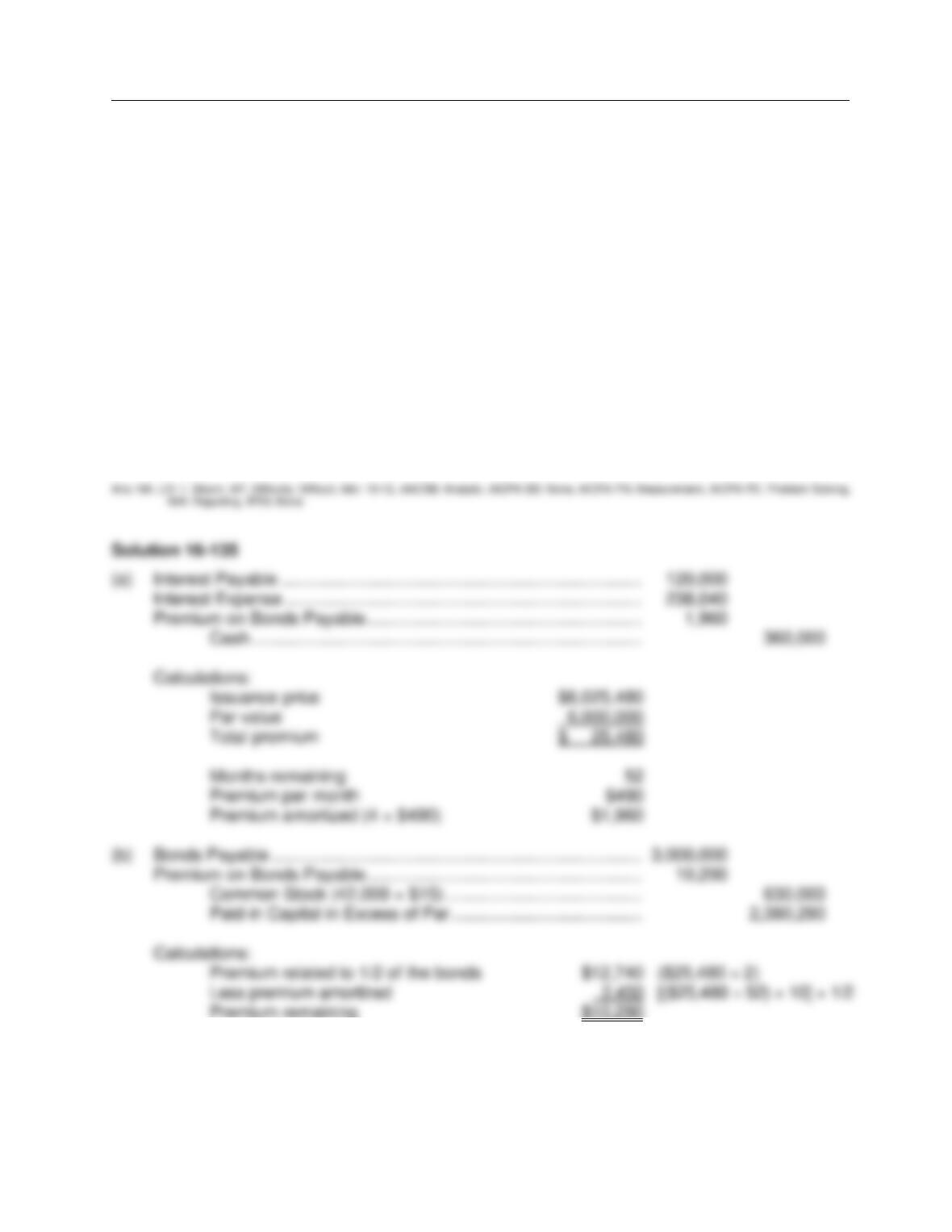
BE. 16-135—Convertible Bonds.
Garr Co. issued $6,000,000 of 12%, 5-year convertible bonds on December 1, 2017 for
$6,025,480 plus accrued interest. The bonds were dated April 1, 2017 with interest payable
April 1 and October 1. Bond premium is amortized each interest period on a straight-line basis.
Garr Co. has a fiscal year end of September 30.
On October 1, 2018, $3,000,000 of these bonds were converted into 42,000 shares of $15 par
common stock. Accrued interest was paid in cash at the time of conversion.
Instructions
(a) Prepare the entry to record the interest expense at April 1, 2018. Assume that interest
payable was credited when the bonds were issued (round to nearest dollar).
(b) Prepare the entry to record the conversion on October 1, 2018. Assume that the entry to
record amortization of the bond premium and interest payment has been made.
Test Bank for Intermediate Accounting, Sixteenth Edition
16 – 48
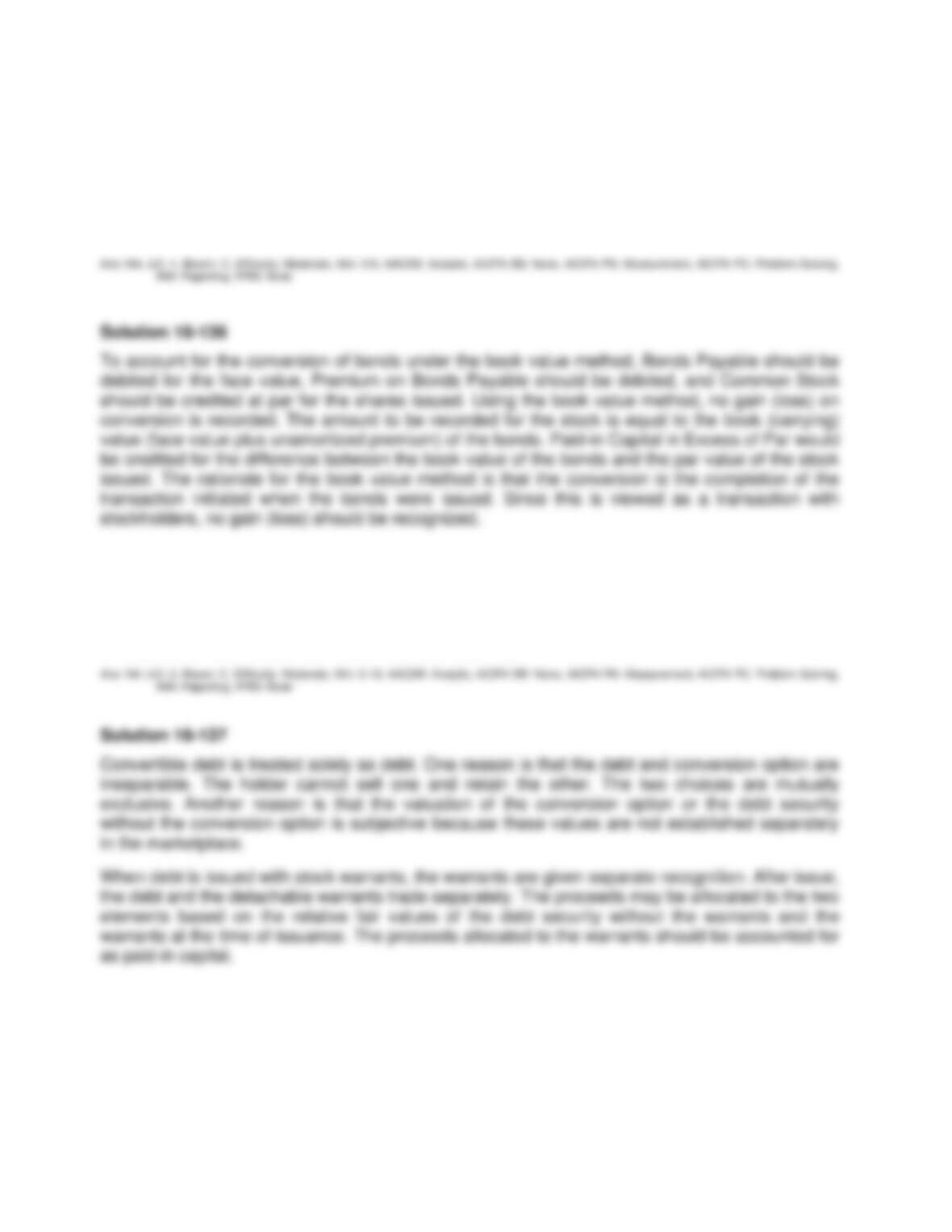
BE. 16-136—Convertible Bonds.
Koch Co. sold convertible bonds at a premium. Interest is paid on May 31 and November 30. On
May 31, after interest was paid, 100, $1,000 bonds are tendered for conversion into 3,000 shares
of $10 par value common stock that had a market price of $40 per share. How should Koch Co.
account for the conversion of the bonds into common stock under the book value method?
Discuss the rationale for this method.
BE. 16-137—Convertible Debt and Debt with Warrants (Essay).
What accounting treatment is required for convertible debt and why? What accounting treatment
is required for debt issued with stock warrants and why?
Dilutive Securities and Earnings per Share
16 – 49
EXERCISES
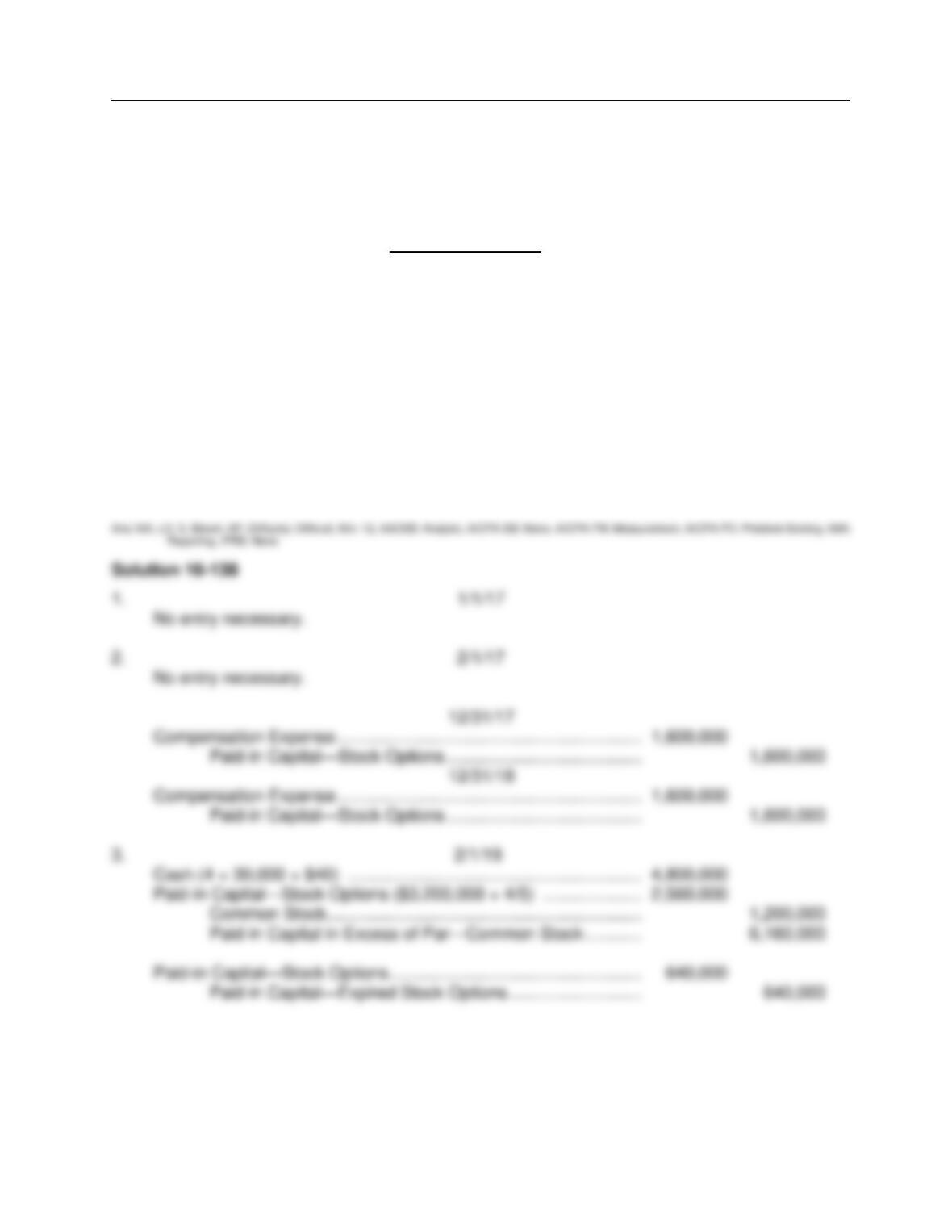
Ex. 16-138—Stock options.
Prepare the necessary entries from 1/1/17-2/1/19 for the following events using the fair value
method. If no entry is needed, write “No Entry Necessary.”
1. On 1/1/17, the stockholders adopted a stock option plan for top executives whereby each
might receive rights to purchase up to 30,000 shares of common stock at $40 per share. The
par value is $10 per share.
2. On 2/1/17, options were granted to each of five executives to purchase 30,000 shares. The
options were non-transferable and the executive had to remain an employee of the company
to exercise the option. The options expire on 2/1/19. It is assumed that the options were for
services performed equally in 2017 and 2018. The Black-Scholes option pricing model
determines total compensation expense to be $3,200,000.
3. At 2/1/19, four executives exercised their options. The fifth executive chose not to exercise his
options, which therefore were forfeited.
Test Bank for Intermediate Accounting, Sixteenth Edition
16 – 50
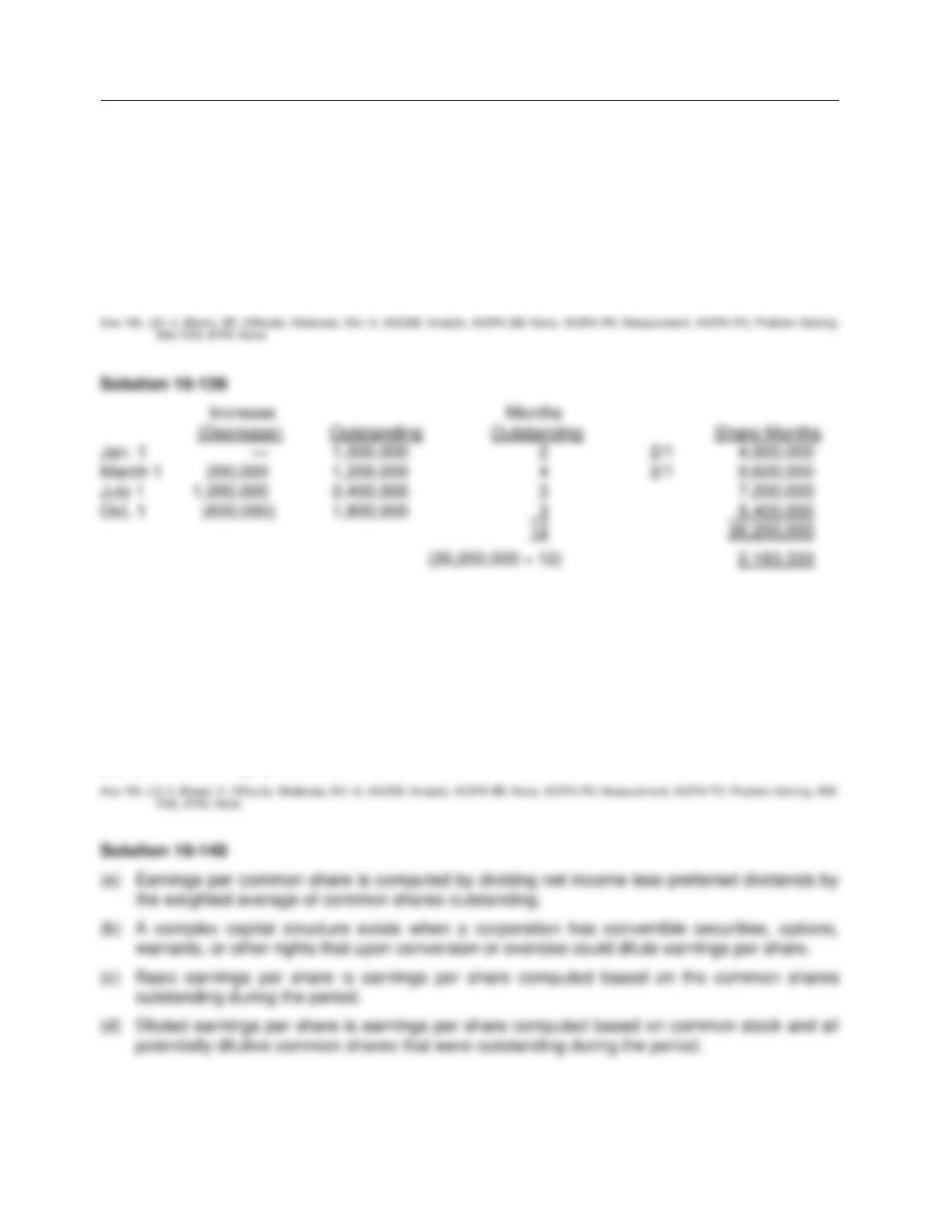
Ex. 16-139—Weighted average shares outstanding.
On January 1, 2018, Warren Corporation had 1,000,000 shares of common stock outstanding.
On March 1, the corporation issued 200,000 new shares to raise additional capital. On July 1, the
corporation declared and issued a 2–for-1 stock split. On October 1, the corporation purchased on
the market 600,000 of its own outstanding shares and retired them.
Instructions
Compute the weighted average number of shares to be used in computing earnings per share for
2018.
Ex. 16-140—Earnings Per Share. (Essay)
Define the following:
(a) The computation of earnings per common share
(b) Complex capital structure
(c) Basic earnings per share
(d) Diluted earnings per share
Dilutive Securities and Earnings per Share
16 – 51
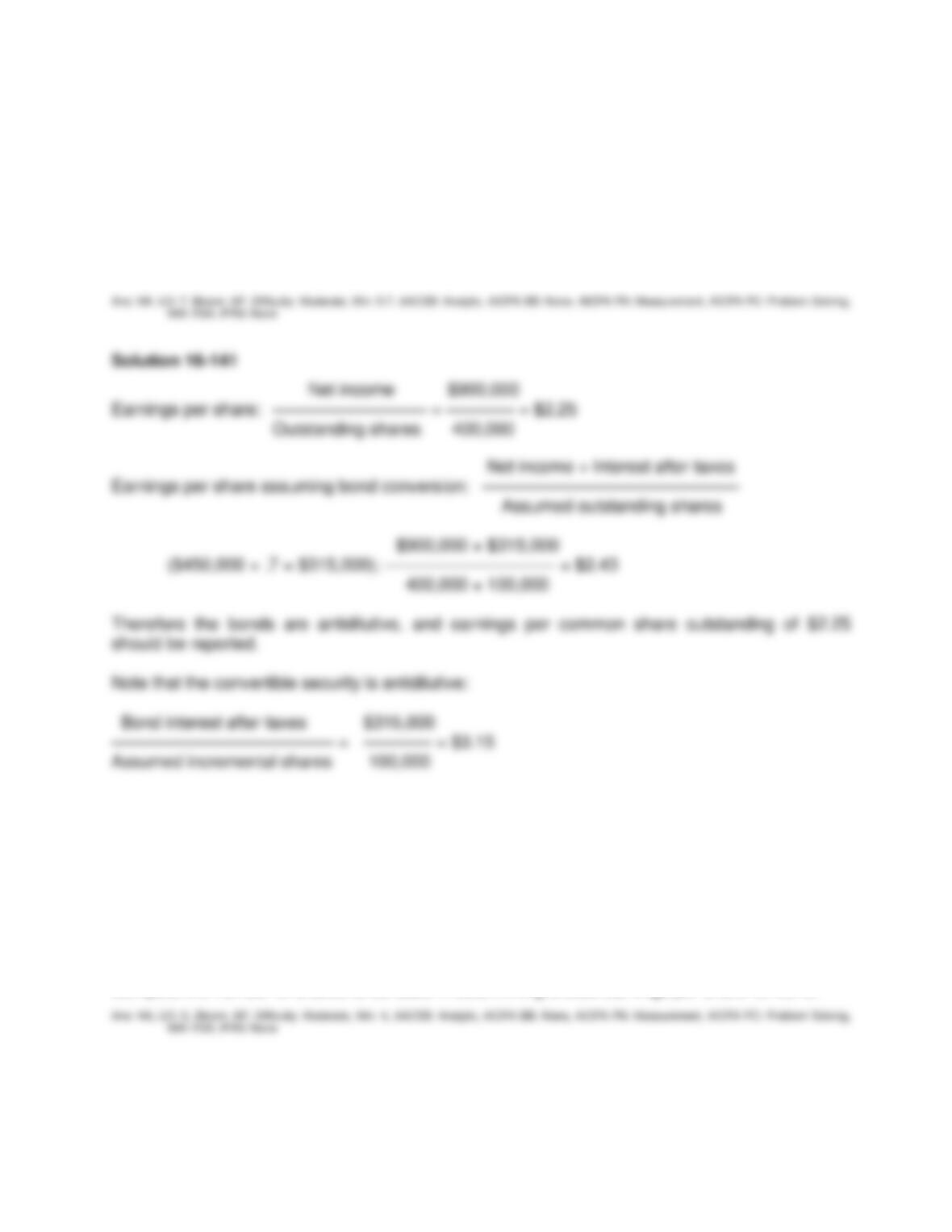
Ex. 16-141—Earnings per share.
Santana Corporation has 400,000 shares of common stock outstanding throughout 2018. In
addition, the corporation has 5,000, 20-year, 9% bonds issued at par in 2016. Each $1,000 bond
is convertible into 20 shares of common stock after 9/23/19. During the year 2018, the
corporation earned $900,000 after deducting all expenses. The tax rate was 30%.
Instructions
Compute the proper earnings per share for 2018.
Ex. 16-142—Diluted earnings per share.
Dunbar Company had 700,000 shares of common stock outstanding during the year 2018. In
addition, at December 31, 2018, 90,000 shares were issuable upon exercise of executive stock
options which require a $40 cash payment upon exercise (options granted in 2018). The average
market price during 2018 was $50.
Instructions
Compute the number of shares to be used in determining diluted earnings per share for 2018.