Use the information for the question(s) below.
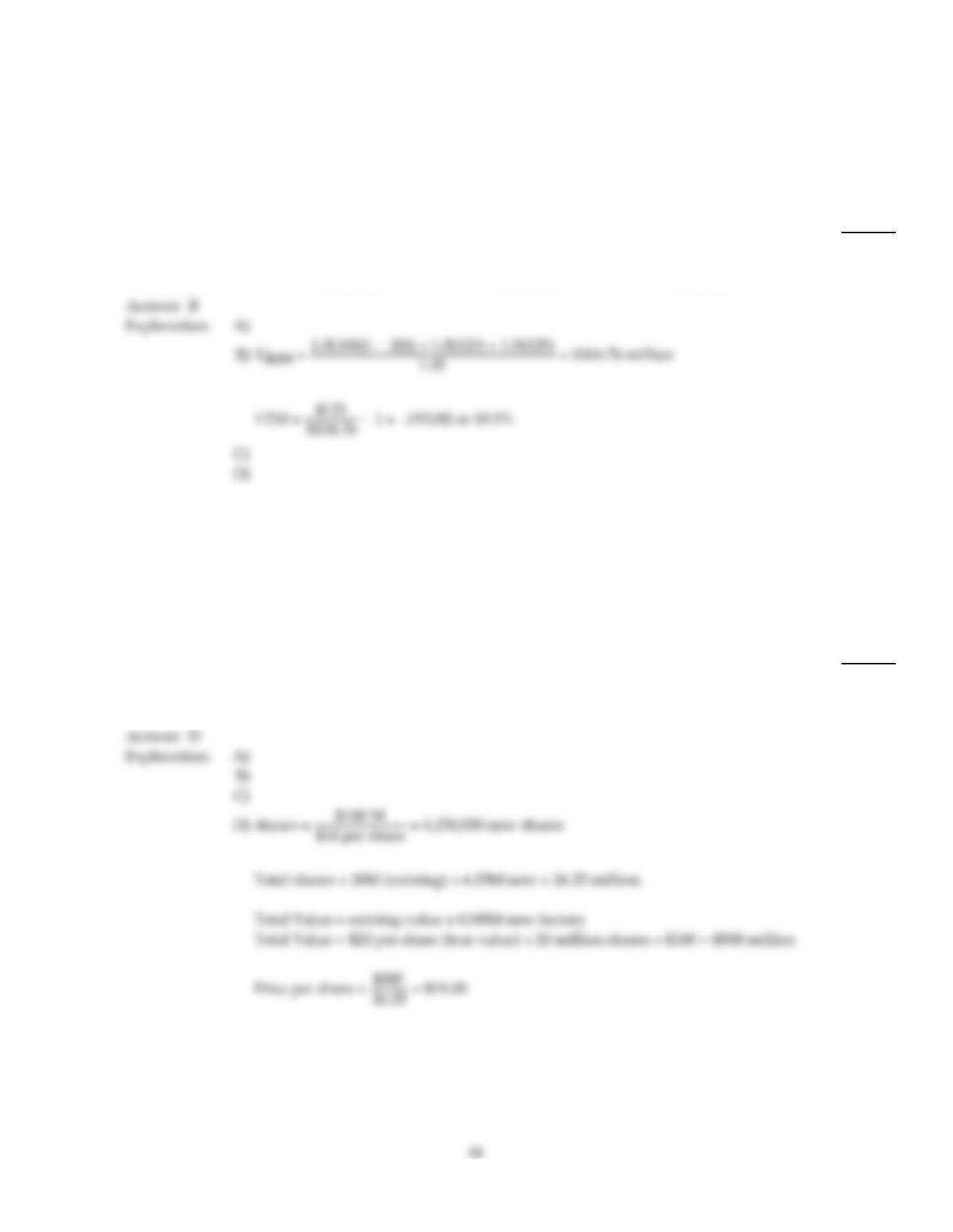
Monsters Incorporated (MI) in ready to launch a new product. Depending upon the success of this product, MI will have a
value of either $100 million, $150 million, or $191 million, with each outcome being equally likely. The cash flows are
unrelated to the state of the economy (i.e. risk from the project is diversifiable) so that the project has a beta of 0 and a cost of
capital equal to the risk–free rate, which is currently 5%. Assume that the capital markets are perfect.
45)
Assume that in the event of default, 20% of the value of MI’s assets will be lost in bankruptcy costs
and suppose that MI has zero–coupon debt with a $125 million face value due next year. The yield
to maturity of MI’s debt is closest to:
45)
A)
5.00%
B)
19.25%
C)
12.50%
D)
13.75%
Use the information for the question(s) below.
Electronic Gaming Incorporated (EGI) is a firm with no debt and its 20 million shares are currently trading for $16 per share.
Based on the prospects for EGI’s new hand held video game, management feels the true value of the firm is $20 per share.
Management believes that the share price will reflect this higher value after the video game is released next fall. EGI has
already announced plans to raise $100 million from investors to build a new factory.
46)
Assume that EGI decides to raise the $100 million through the issuance of new shares prior to the
release of the new video game. EGI’s share price following the release of the new video game will
be closest to:
46)
A)
$20.00
B)
$18.00
C)
$16.00
D)
$19.00
47)
Which of the following statements is false?
47)
A)
The Chapter 11 reorganization plan specifies the treatment of each creditor of the firm. In
addition to cash payment, creditors may receive new debt or equity securities of the firm. The
value of cash and securities is generally less than the amount each creditor is owed, but more
than the creditors would receive if the firm were shut down immediately and liquidated.
B)
While developing a Chapter 11 reorganization plan, management continues to operate the
business.
C)
In the more common form of bankruptcy for large corporations, Chapter 11 reorganization,
all pending collection attempts are automatically suspended, and the firm’s existing
management is given the opportunity to propose a reorganization plan.
D)
According to the provisions of the 1978 Bankruptcy Reform Act, U.S. firms can file for two
forms of bankruptcy protection: Chapter 11 or Chapter 13.
48)
The idea that when a seller has private information about the value of good, buyers will discount
the price they are willing to pay due to adverse selection is known as the
48)
A)
signaling theory of debt.
B)
credibility principle.
C)
pecking order hypothesis.
D)
lemons principle.
Use the information for the question(s) below.
Kinston Enterprises has no debt and a debt obligation of $47 million that is due now. The market value of Kinston’s assets is
$102 million, and the firm has no other liabilities. Assume that capital markets are perfect and that Kinston has 5 million
shares outstanding.
49)
Kinston’s current share price is closest to:
49)
A)
$10.00
B)
$11.00
C)
$9.40
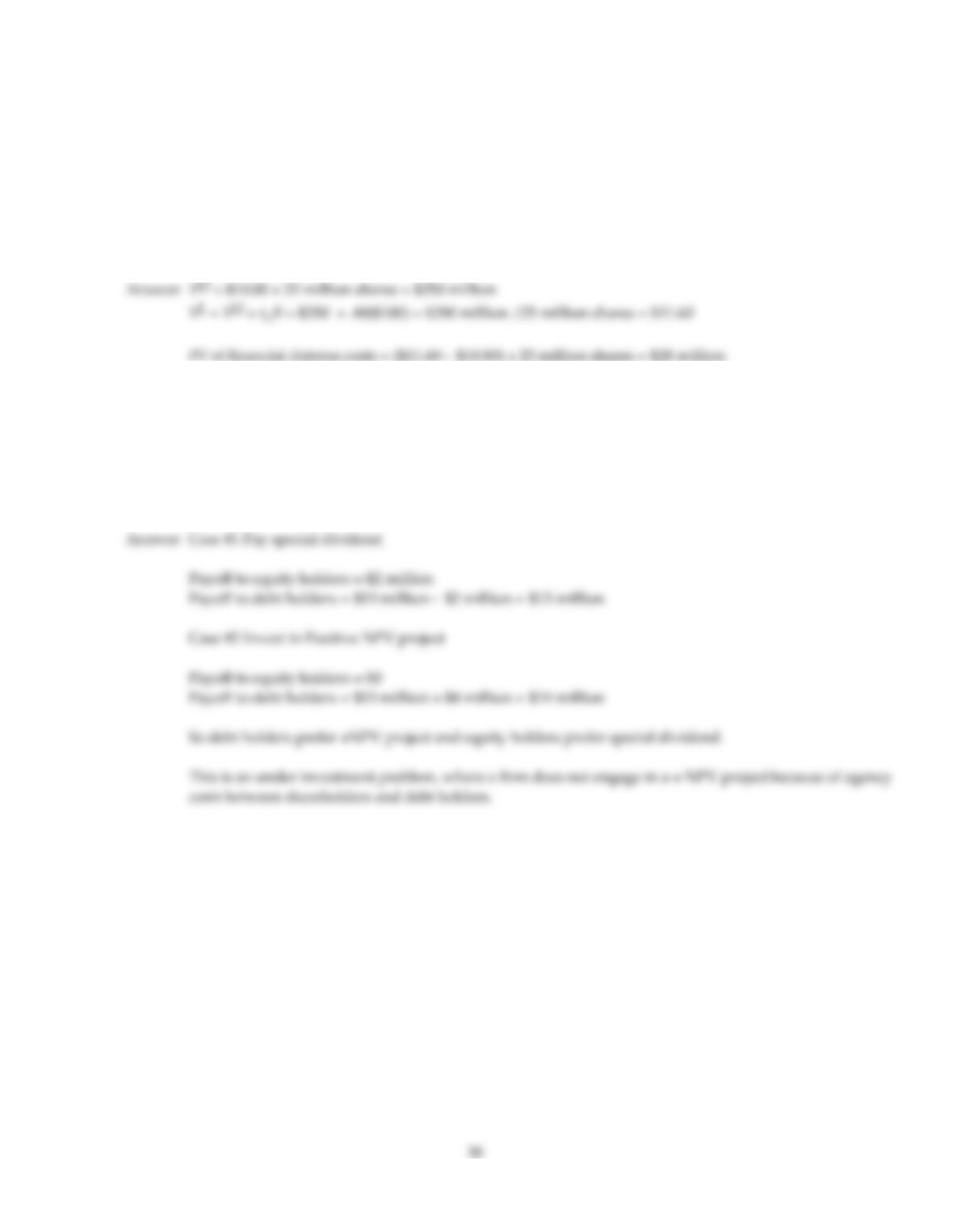
D)
$20.40
Use the information for the question(s) below.
Wildcat Drilling is an oil and gas exploration company that currently operating two active oil fields with a market value of
$200 million dollars each. Unfortunately, Wildcat Drilling has $500 million in debt coming due at the end of the year. A
large oil company has offered Wildcat drilling a highly speculative, but potentially very valuable, oil and gas lease in
exchange for one of their active oil fields. If Wildcat accepts the trade, there is a 10% chance that Wildcat will discover a
major new oil field that would be worth $1.2 billion, a 15% that Wildcat will discover a productive oil field that would be
worth $600 million, and a 75% chance that Wildcat will not discover oil at all.
50)
What is the overall expected payoff to Wildcat from the speculative oil lease deal?
50)
A)
$160 million
B)
$275 million
C)
$360 million
D)
$85 million
51)
Which of the following statements is false?
51)
A)
Aside from the direct legal and administrative costs of bankruptcy, many other indirect costs
are associated with financial distress (whether or not the firm has formally filed for
bankruptcy).
B)
Bankruptcy protection can be used by management to delay the liquidation of a firm that
should be shut down.
C)
Because many aspects of the bankruptcy process are independent of the size of the firm, the
costs are typically higher, in percentage terms, for smaller firms.
D)
Although indirect costs of bankruptcy are difficult to measure accurately, they are typically
much smaller than the direct costs of bankruptcy.
52)
Which of the following statements is false?
52)
A)
Debt holders can then take legal action against the firm to collect payment by seizing the firm
’s assets.
B)
The U.S. bankruptcy code was created to organize this process so that creditors are treated
fairly and the value of the assets is not needlessly destroyed.
C)
Because the assets of the firm might be more valuable if kept together, creditors seizing assets
in a piecemeal fashion might destroy much of the remaining value of the firm.
D)
Because most firms have multiple creditors, coordination makes it difficult to guarantee that
each creditor will be treated fairly.
Use the information for the question(s) below.
Monsters Incorporated (MI) in ready to launch a new product. Depending upon the success of this product, MI will have a
value of either $100 million, $150 million, or $191 million, with each outcome being equally likely. The cash flows are
unrelated to the state of the economy (i.e. risk from the project is diversifiable) so that the project has a beta of 0 and a cost of
capital equal to the risk–free rate, which is currently 5%. Assume that the capital markets are perfect.
53)
Suppose that MI has zero–coupon debt with a $125 million face value due next year. The initial
value of MI’s equity is closest to:
53)
A)
$29 million
B)
$30 million
C)
$24 million
D)
$15 million
54)
Assuming that in the event of default, 20% of the value of MI’s assets will be lost in bankruptcy
costs, the initial value of MI’s equity without leverage is closest to:
54)
A)
$133 million
B)
$140 million
C)
$150 million
D)
$147 million
55)
Which of the following statements is false?
55)
A)
Real estate firms are likely to have low costs of financial distress, as much of their value
derives from assets that can be sold relatively easily.
B)
Firms whose value and cash flows are very volatile (for example, semiconductor firms) must
have much higher levels of debt to avoid a significant risk of default.
C)
The probability of financial distress depends on the likelihood that a firm will be unable to
meet its debt commitments and therefore default.
D)
For low levels of debt, the risk of default remains low and the main effect of an increase in
leverage is an increase in the interest tax shield, which has present value *D, where * is the
effective tax advantage of debt.
56)
Which of the following is not an indirect cost of bankruptcy?
56)
A)
Legal Fees
B)
Costs to Creditors
C)
Loss of Customers
D)
Delayed Liquidation
57)
The idea that managers who perceive the firm’s equity is under–priced will have a preference to
fund investment using retained earnings, or debt, rather than equity is known as the
57)
A)
signaling theory of debt.
B)
pecking order hypothesis.
C)
lemons principle.
D)
credibility principle.
Use the information for the question(s) below.
Monsters Incorporated (MI) in ready to launch a new product. Depending upon the success of this product, MI will have a
value of either $100 million, $150 million, or $191 million, with each outcome being equally likely. The cash flows are
unrelated to the state of the economy (i.e. risk from the project is diversifiable) so that the project has a beta of 0 and a cost of
capital equal to the risk–free rate, which is currently 5%. Assume that the capital markets are perfect.
58)
Suppose that MI has zero–coupon debt with a $125 million face value due next year. The yield to
maturity of MI’s debt is closest to:
58)
A)
25.0%
B)
12.5%
C)
5.0%
D)
7.8%
59)
Which of the following statements is false?
59)
A)
Managers of large firms tend to earn higher salaries, and they may also have more prestige
and garner greater publicity than managers of small firms. As a result, managers may expand
(or fail to shut down) unprofitable divisions, pay too much for acquisitions, make
unnecessary capital expenditures, or hire unnecessary employees.
B)
When a firm is highly levered, creditors themselves will closely monitor the actions of
managers, providing an additional layer of management oversight.
C)
Leverage can reduce the degree of managerial entrenchment because managers are more
likely to be fired when a firm faces financial distress.
D)
According to the empire building hypothesis, leverage increases firm value because it
commits the firm to making future interest payments, thereby reducing excess cash flows and
wasteful investment by managers.
60)
Which of the following statements is false?
60)
A)
Two key qualitative factors determine the present value of financial distress costs: (1) the
probability of financial distress and (2) the magnitude of the costs after a firm is in distress.
B)
The magnitude of the financial distress costs will depend on the relative importance of the
sources of these costs and is likely to vary by industry.
C)
Technology firms are likely to incur high costs when they are in financial distress, due to the
potential for loss of customers and key personnel, as well as a lack of tangible assets that can
be easily liquidated.
D)
Calculating the precise present value of financial distress costs is a relatively straightforward
process.
61)
Which of the following statements is false?
61)
A)
Some financial economists explain a manager’s willingness to engage in negative–NPV
investments as empire building.
B)
A serious concern for large corporations is that managers may make large, unprofitable
investments.
C)
While overspending on personal perks may be a problem for large firms, these costs are likely
to be small relative to the overall value of the firm.
D)
While ownership is often diluted for small, young firms, ownership typically becomes
concentrated over time as a firm grows.
D
62)
The idea that claims in one’s self–interest are credible only if they are supported by actions that
would be too costly to take if the claims were untrue is known as the
62)
A)
pecking order hypothesis.
B)
credibility principle.
C)
signaling theory of debt.
D)
lemons principle.
B
63)
Which of the following industries likely to have the highest costs of financial distress?
63)
A)
Utilities
B)
Grocery store
C)
Real estate
D)
Semiconductors
D
D
64)
Which of the following statements is false?
64)
A)
Levered firms risk incurring financial distress costs that reduce the cash flows available to
investors.
B)
When securities are fairly priced, the original shareholders of a firm pay the future value of
the costs associated with bankruptcy and financial distress.
C)
Debt holders are not foolish—they recognize that when the firm defaults, they will not be able
to get the full value of the assets. As a result, they will pay less for the debt initially.
D)
The costs of financial distress represent an important departure from Modigliani and Miller’s
assumption of perfect capital markets.
65)
Which of the following statements is false?
65)
A)
The costs of reduced effort and excessive spending on perks are another form of agency cost.
B)
One disadvantage of using leverage is that it does not allow the original owners of the firm to
maintain their equity stake.
C)
Managers also have their own personal interests, which may differ from those of both equity
holders and debt holders.
D)
The separation of ownership and control creates the possibility of management entrenchment;
facing little threat of being fired and replaced, managers are free to run the firm in their own
best interests.
Use the information for the question(s) below.
Electronic Gaming Incorporated (EGI) is a firm with no debt and its 20 million shares are currently trading for $16 per share.
Based on the prospects for EGI’s new hand held video game, management feels the true value of the firm is $20 per share.
Management believes that the share price will reflect this higher value after the video game is released next fall. EGI has
already announced plans to raise $100 million from investors to build a new factory.
66)
Assume that EGI decides to wait until after the release of the new video game before they raise the
$100 million through the issuance of new shares. EGI’s share price following the release of the new
video game will be closest to:
66)
A)
$18.00
B)
$16.00
C)
$20.00
D)
$19.00
67)
Which of the following is not an indirect cost of bankruptcy?
67)
A)
Loss of Employees
B)
Loss of Suppliers
C)
Costs of Appraisers
D)
Fire Sales of Assets
Use the information for the question(s) below.
Monsters Incorporated (MI) in ready to launch a new product. Depending upon the success of this product, MI will have a
value of either $100 million, $150 million, or $191 million, with each outcome being equally likely. The cash flows are
unrelated to the state of the economy (i.e. risk from the project is diversifiable) so that the project has a beta of 0 and a cost of
capital equal to the risk–free rate, which is currently 5%. Assume that the capital markets are perfect.
68)
Suppose that MI has zero–coupon debt with a $125 million face value due next year. The total
value of MI with leverage is closest to:
68)
A)
$125 million
B)
$147 million
C)
$133 million
D)
$140 million
69)
Assume that in the event of default, 20% of the value of MI’s assets will be lost in bankruptcy costs.
Suppose that at the start of the year, MI has no debt outstanding, but has 5.6 million shares of stock
outstanding. If MI issues debt of $125 million due next year and uses the proceeds to repurchase
shares, the share price following the announcement of the repurchase will be closest to:
69)
A)
$23.90
B)
$5.15
C)
$23.75
D)
$25.00
70)
Which of the following statements is false?
70)
A)
The bankruptcy code is designed to provide an orderly process for settling a firm’s debts.
B)
In addition to the money spent by the firm, the creditors may incur costs during the
bankruptcy process.
C)
Whether paid by the firm or its creditors, the indirect costs of bankruptcy increase the value of
the assets that the firm’s investors will ultimately receive.
D)
To ensure that their rights and interests are respected, and to assist in valuing their claims in a
proposed reorganization, creditors may seek separate legal representation and professional
advice.
Use the information for the question(s) below.
Big Blue Banana (BBB) is a clothing retailer with a current share price of $10.00 and with 25 million shares outstanding.
Suppose that Big Blue Banana announces plans to lower its corporate taxes by borrowing $100 million and using the
proceeds to repurchase shares.
71)
Suppose that BBB pays corporate taxes of 35% and that shareholders expects the change in debt to
be permanent. Assume that capital markets are perfect except for the existence of corporate taxes
and financial distress costs. If the price of BBB’s stock rises to $10.85 per share following the
announcement , then the present value of BBB’s financial distress costs is closest to:
71)
A)
$35.00 million
B)
$13.75 million
C)
$11.40 million
D)
$21.25 million
72)
Which of the following statements is false?
72)
A)
Firms in financial distress tend to have difficulty collecting money that is owed to them.
B)
The loss of customers is likely to be large for producers of raw materials (such as sugar or
aluminum), as the value of these goods, once delivered, depends on the seller‘s continued
success.
C)
The costs of selling assets below their value are greatest for firms with assets that lack
competitive, liquid markets.
D)
Suppliers may be unwilling to provide a firm with inventory if they fear they will not be paid.
73)
Which of the following industries is likely to have the lowest costs of financial distress?
73)
A)
Airlines
B)
Electric Utilities
C)
Computer Software
D)
Biotechnology
ESSAY. Write your answer in the space provided or on a separate sheet of paper.
Use the information for the question(s) below.
You own your own firm and you need to raise $50 million to fund an expansion. Following the expansion, your firm will be
worth $75 million in its unlevered form. You want to go ahead with the expansion, but you are concerned that you may not
be able to maintain ownership of over 50% of your firm’s equity. In other words, you are concerned that if you use equity to
finance the expansion, you may loose control of your firm.
74)
Assume that capital markets are perfect except for the existence of corporate taxes and that your firm pays 35%
of earnings in taxes. If you want to maintain ownership of at least a 50%, then calculate the minimum amount
of debt that you must issue to fund the expansion.
Use the information for the question(s) below.
Monsters Incorporated (MI) in ready to launch a new product. Depending upon the success of this product, MI will have a
value of either $100 million, $150 million, or $191 million, with each outcome being equally likely. The cash flows are
unrelated to the state of the economy (i.e. risk from the project is diversifiable) so that the project has a beta of 0 and a cost of
capital equal to the risk–free rate, which is currently 5%. Assume that the capital markets are perfect.
75)
Assume that in the event of default, 20% of the value of MI’s assets will be lost in bankruptcy costs and suppose
that MI has zero–coupon debt with a $140 million face value due next year. Calculate the value of levered
equity, the value of debt, and the total value of MI with leverage.
76)
List five general categories of indirect costs associated with bankruptcy.
Use the information for the question(s) below.
Monsters Incorporated (MI) in ready to launch a new product. Depending upon the success of this product, MI will have a
value of either $100 million, $150 million, or $191 million, with each outcome being equally likely. The cash flows are
unrelated to the state of the economy (i.e. risk from the project is diversifiable) so that the project has a beta of 0 and a cost of
capital equal to the risk–free rate, which is currently 5%. Assume that the capital markets are perfect.
77)
Suppose that MI has zero–coupon debt with a $140 million face value due next year. Calculate the value of
levered equity, the value of debt, and the total value of MI with leverage.
29
Use the information for the question(s) below.
Big Blue Banana (BBB) is a clothing retailer with a current share price of $10.00 and with 25 million shares outstanding.
Suppose that Big Blue Banana announces plans to lower its corporate taxes by borrowing $100 million and using the
proceeds to repurchase shares.
78)
Suppose that BBB pays corporate taxes of 40% and that shareholders expects the change in debt to be
permanent. Assume that capital markets are perfect except for the existence of corporate taxes and financial
distress costs. If the price of BBB’s stock rises to $10.80 per share following the announcement, then the present
value of BBB’s financial distress costs is closest to:
79)
Rose Industries has a $20 million loan due at the end of the year and its assets will have a market value of only
$15 million when the loan comes due. Currently Rose has $2 million in cash. Rose is considering two possible
alternative uses for this cash. One possibility is to pay the $2 million out to shareholders in the form of a special
dividend. The second possibility is to invest the $2 million into a project that offers a $4 million NPV. What are
the payoffs to the debt and equity holders under each of the two alternatives? Which alternative would equity
holders prefer? Which alternative would debt holders prefer? What is the economic term that describes this
situation?
Answer Key
Testname: C16
Answer Key
Testname: C16
32
Answer Key
Testname: C16
33