A) ΔG°f for H2O (s)
B) ΔG°f for H2O (l)
C) ΔG°f for H2O (g)
D) 1/2ΔG°f for O2 (g) plus ΔG°f for H2O (g)
72) Which of the following is zero at 25°C?
A) ΔG°f for N2(g)
B) ΔG°f for H2O (l)
C) S° for N2 (g)
D) S° for H2O (l)
73) A positive value of ΔG°f for a solid compound at 25°C means the
A) compound cannot exist at 25°C and 1 atm.
B) compound must be a liquid or a gas at 25°C and 1 atm.
C) process of forming the compound from the elements is exothermic.
D) process of forming the compound from the stable elements at 25°C and 1 atm is nonspontaneous.
74) At 25°C, ΔG°f is -620 kJ/mol for SiCl4(g) and -592 kJ/mol for MgCl2(s). Calculate ΔG° for the
reaction, SiCl4(g) + 2 MG(s) → 2 MgCl2(s) + Si(s) and determine if the reaction is spontaneous at 25°C
if the pressure of SiCl4(g) is 1 atm.
A) ΔG° = 28 kJ; the process is spontaneous.
B) ΔG° = 28 kJ; the process is nonspontaneous.
C) ΔG° = -564 kJ; the process is spontaneous.
D) ΔG° = -564 kJ; the process is nonspontaneous.
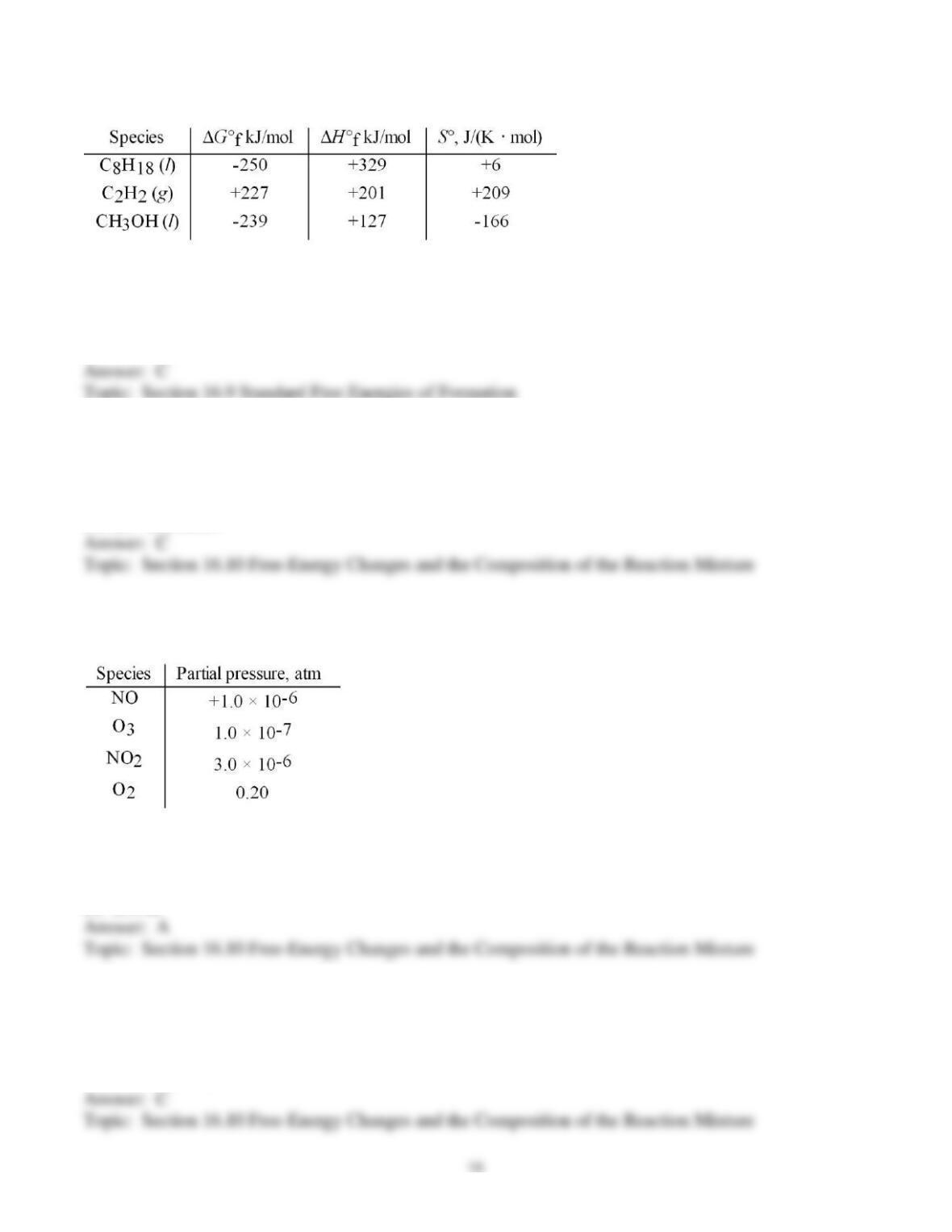
75) Which of the following are unstable with respect to their constituent elements at 25°C?
A) C8H18(l), CH3OH(l)
B) C8H18(l), C2H2(g)
C) C2H2(g)
D) CH3OH(l)
76) In general, as a reaction goes to equilibrium
A) ΔG decreases.
B) ΔG°f decreases.
C) ΔG goes to zero.
D) ΔG° decreases.
77) At 25°C, ΔG° = -198 kJ for the reaction, NO(g) + O3(g) ⇌ NO2(g) + O2(g).
Calculate ΔG under the following conditions:
A) -159 kJ
B) -167 kJ
C) -198 kJ
D) -236 kJ
78) For a reaction at constant temperature, as Q increases
A) ΔG and ΔG° increase.
B) ΔG and ΔG° decrease.
C) ΔG increases, but ΔG° remains constant.
D) ΔG decreases, but ΔG° remains constant.
19
79) At high temperatures boron carbide vaporizes according to the equation
B4C(s) ⇌ 4 B(g) + C(s)
Which equation describes the relationship between ΔG° and ΔG for this reaction?
A) ΔG = ΔG° + R T ln (pB ∙ [C]/[B4C])
B) ΔG = ΔG° + R T ln pB
C) ΔG = ΔG° + 4 R T ln pB
D) ΔG = ΔG° – 4 R T ln pB
80) At 2600 K, ΔG° = 775 kJ for the vaporization of boron carbide:
B4C(s) ⇌ 4 B(g) + C(s)
Find ΔG and determine if the process is spontaneous if the reaction vessel contains 4.00 mol B4C(s),
0.400 mol of C(s), and B(g) at a partial pressure of 1.0 × 10⁻⁵ atm. At this temperature, R T = 21.6 kJ.
A) ΔG = -270 kJ; spontaneous.
B) ΔG = -270 kJ; nonspontaneous.
C) ΔG = -220 kJ; spontaneous.
D) ΔG = -220 kJ; nonspontaneous.
81) ΔG = ΔG° for a reaction
A) if Q = K.
B) if Q = 1.
C) at STP.
D) at the start of the reaction.
82) What is the relationship between ΔG and the ΔG°F for the reaction below?
MgF2(s) → Mg2+(aq) + 2 F–(aq)
A) ΔG = {ΔG°f [Mg2+ (aq)] + 2 ΔG°f [F– (aq)] – ΔG°f [MgF2 (s)]} + RT ln ([Mg2+] [F–]2/[MgF2])
B) ΔG = {ΔG°f [Mg2+ (aq)] + 2 ΔG°f [F– (aq)] – ΔG°f [MgF2 (s)]} + RT ln ([Mg2+] [F–])2)
C) ΔG = {ΔG°f [Mg2+ (aq)] + 2 ΔG°f [F– (aq)]} + RT ln ([Mg2+] [F–]2)
D) ΔG = {ΔG°f [Mg2+ (aq)] + 2 ΔG°f [F– (aq)] – ΔG°f [MgF2 (s)]} + RT ln Ksp
83) If Q increases
A) ΔG increases and the reaction becomes more spontaneous.
B) ΔG increases and the reaction becomes less spontaneous.
C) ΔG decreases and the reaction becomes more spontaneous.
D) ΔG decreases and the reaction becomes less spontaneous.
84) What is the relationship between ΔG, Qp, and Kp for a reaction involving gases?
A) ΔG = Qp/Kp
B) ΔG = Kp/Qp
C) ΔG = RTln(Qp/Kp)
D) ΔG = RTln(Kp/Qp)
85) When equilibrium is reached at constant temperature and pressure,
A) Q = 1.
B) ΔG° = 0.
C) S is maximized.
D) G is minimized.
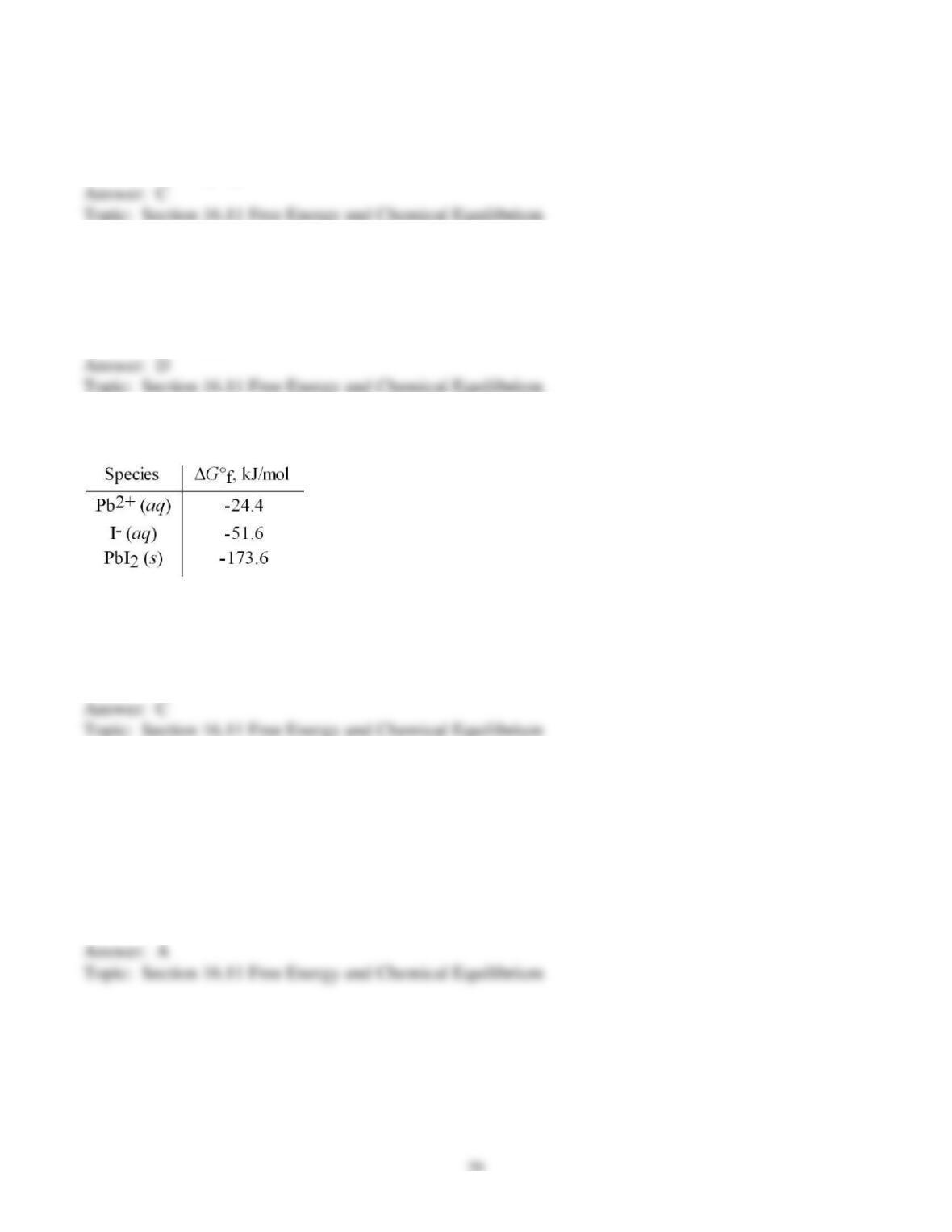
86) Calculate Ksp for PbI2 at 25°C based on the following data:
A) 4 × 10-31
B) 8 × 10-18
C) 9 × 10⁻⁹
D) 5 × 10⁻⁵
87) At high temperatures, boron carbide vaporizes according to
B4C(s) ⇌ 4 B(g) + C(s)
At 2500 K, the equilibrium pressure of B(g) is 0.0342 mm Hg over a mixture of 0.300 mol B4C(s) and
0.500 mol C(s). Calculate ΔG° for this process.
A) 832 kJ
B) 799 kJ
C) 281 kJ
D) 247 kJ
88) Solid NaHCO3 is heated to 90°C. At equilibrium the total pressure of the gases produced is 0.545
atm. Calculate ΔG° at 90°C for the reaction
2 NaHCO3(s) ⇌ Na2CO3(s) + H2O(g) + CO2(g).
A) -7.85 kJ
B) -3.67 kJ
C) +3.67 kJ
D) +7.85 kJ
89) What is K if ΔG° = -18.0 kJ for a reaction at 25°?
A) 1.4 × 10³
B) 1.2 × 10²
C) 8.1 × 10⁻³
D) 7.3 × 10⁻⁴
90) If ΔG° is negative for a reaction,
A) K < 0.
B) K = 0.
C) K is between 0 and 1.
D) K > 1.
91) If ΔG° is positive for a reaction,
A) K < 0.
B) K = 0.
C) K is between 0 and 1.
D) K > 1.
92) For the following reaction find Kp at 25°C and indicate whether Kp should increase or decrease as
the temperature rises.
NH4HS(s) ⇌ H2S(g) + NH3(g) ΔH° = 83.47 kJ and ΔG° = 17.5 kJ at 25°C.
A) Kp = 8.6 × 10⁻⁴ and Kp should increase as the temperature rises.
B) Kp = 8.6 × 10⁻⁴ and Kp should decrease as the temperature rises.
C) Kp = 1.2 × 10³ and Kp should increase as the temperature rises.
D) Kp = 1.2 × 10³ and Kp should decrease as the temperature rises.
93) If ΔG is small and positive,
A) the forward reaction is spontaneous and the system is far from equilibrium.
B) the forward reaction is spontaneous and the system is near equilibrium.
C) the reverse reaction is spontaneous and the system is far from equilibrium.
D) the reverse reaction is spontaneous and the system is near equilibrium.
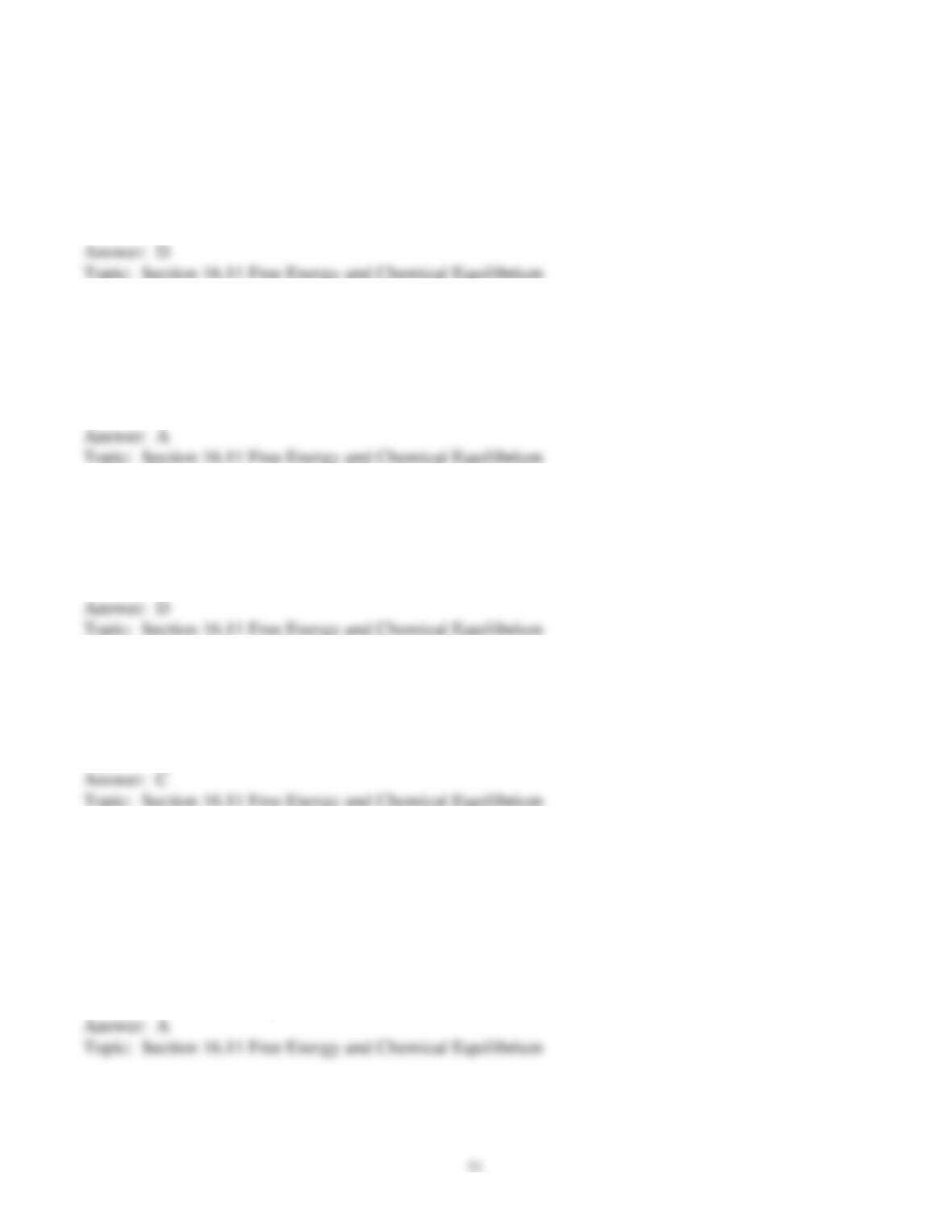
94) In figure (1) below argon atoms, represented by unshaded spheres, and neon atoms, represented by
shaded spheres, are in separate compartments. Figure (2) shows the equilibrium state of the system after
the stopcock separating the two compartments is opened. Assuming that argon and neon behave as ideal
gases, what are the signs (+, –, or 0) of ΔH, ΔS, and ΔG for this process?
A) ΔH = +, ΔS = –, ΔG = +
B) ΔH = 0, ΔS = +, ΔG = –
C) ΔH = 0, ΔS = –, ΔG = +
D) ΔH = –, ΔS = +, ΔG = –
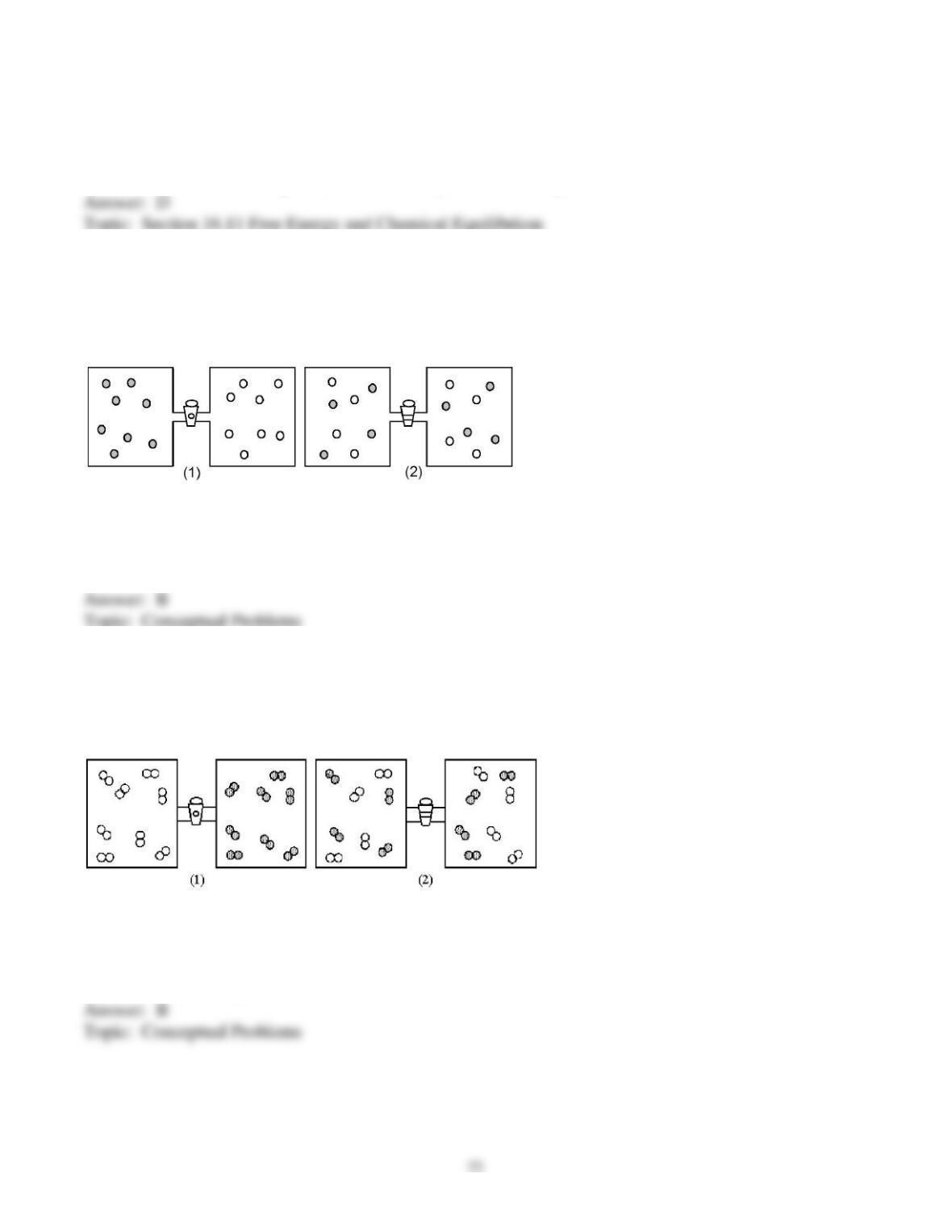
95) In figure (1) below oxygen molecules, represented by unshaded spheres, and chlorine molecules,
represented by shaded spheres, are in separate compartments. Figure (2) shows the equilibrium state of
the system after the stopcock separating the two compartments is opened. Assuming the oxygen and the
chlorine behave as ideal gases, what are the signs (+, –, or 0) of ΔH, ΔS, and ΔG for this process?
A) ΔH = +, ΔS = –, ΔG = +
B) ΔH = 0, ΔS = +, ΔG = –
C) ΔH = 0, ΔS = –, ΔG = +
D) ΔH = –, ΔS = +, ΔG = –
23
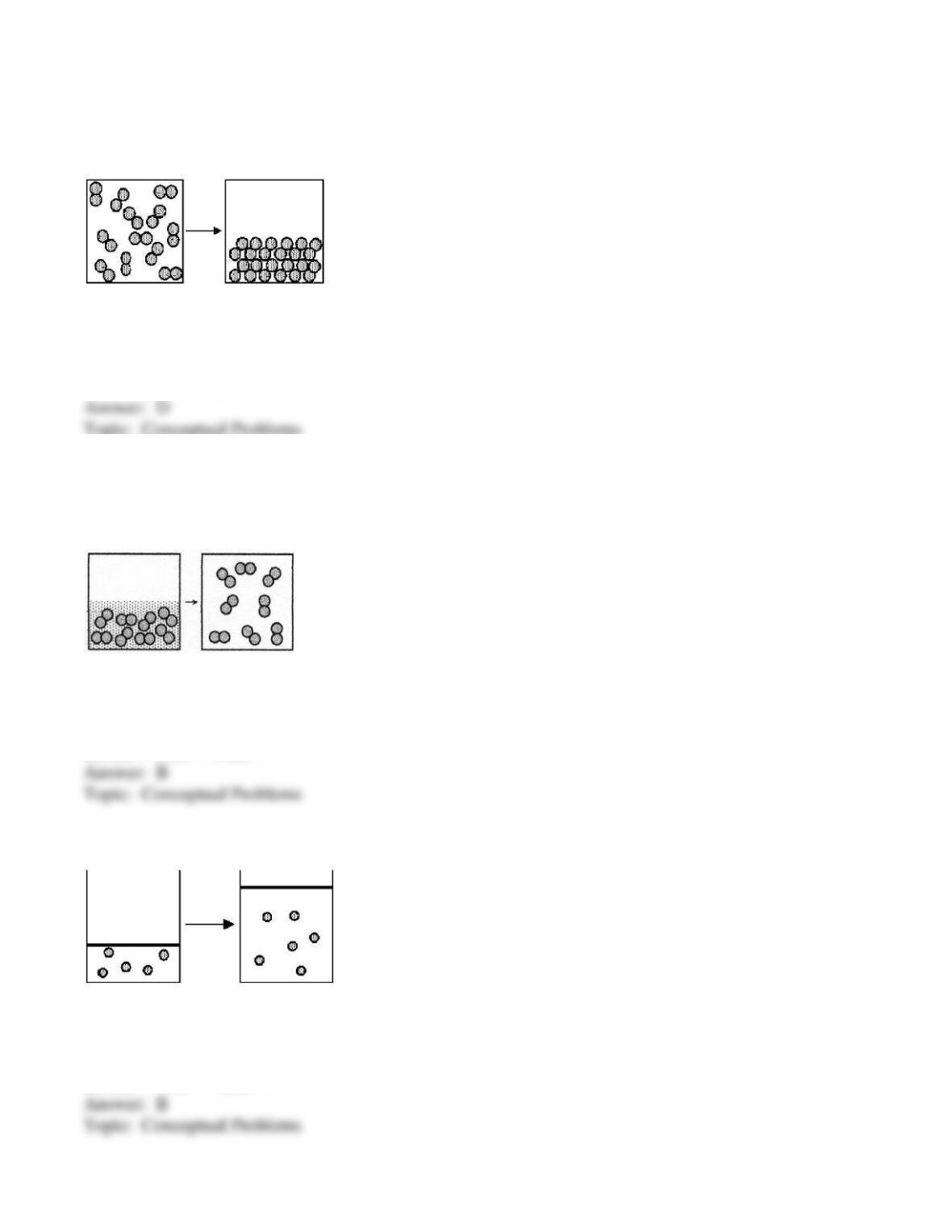
96) The figure represents the spontaneous deposition of iodine in which iodine vapor, I2(g), becomes
crystalline iodine solid I2(s): I2(g): → I2(s). What are the signs (+ or –) of ΔH, ΔS, and ΔG for this
process?
A) ΔH = +, ΔS = +, ΔG = +
B) ΔH = +, ΔS = +, ΔG = –
C) ΔH = –, ΔS = –, ΔG = +
D) ΔH = –, ΔS = –, ΔG = –
97) The figure represents the spontaneous evaporation of nitrogen in which liquid nitrogen, N2(l),
becomes gaseous nitrogen, N2(g): N2(l) → N2(g). What are the signs (+ or –) of ΔH, ΔS, and ΔG for
this process?
A) ΔH = +, ΔS = +, ΔG = +
B) ΔH = +, ΔS = +, ΔG = –
C) ΔH = –, ΔS = –, ΔG = +
D) ΔH = –, ΔS = –, ΔG = –
98) An ideal gas is expanded at constant temperature. What are the signs (+, –, or 0) of ΔH, ΔS, and ΔG
for this system?
A) ΔH = +, ΔS = –, ΔG = +
B) ΔH = 0, ΔS = +, ΔG = –
C) ΔH = 0, ΔS = –, ΔG = +
D) ΔH = –, ΔS = +, ΔG = –
24
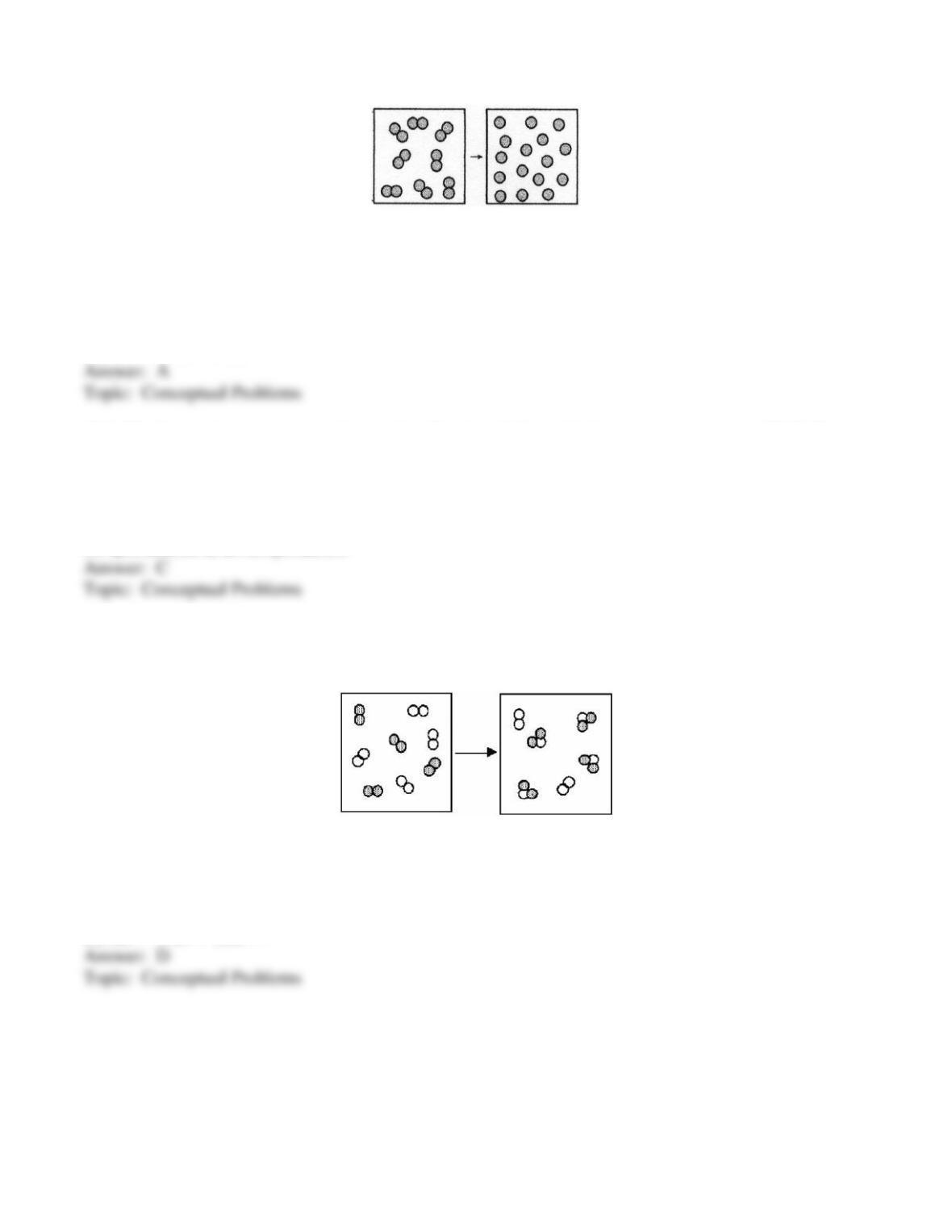
99) The figure above represents the nonspontaneous reaction O2(g) → 2O(g). What are the signs (+ or –)
of ΔH, ΔS, and ΔG for this process?
A) ΔH = +, ΔS = +, ΔG = +
B) ΔH = +, ΔS = +, ΔG = –
C) ΔH = –, ΔS = –, ΔG = +
D) ΔH = –, ΔS = –, ΔG = –
100) The figure above represents the reaction O2(g) → 2O(g), which is nonspontaneous at 25°C. How
will the spontaneity of this reaction vary with temperature? This reaction is
A) nonspontaneous at all temperatures.
B) nonspontaneous at high temperatures and spontaneous at low temperatures.
C) spontaneous at high temperatures and nonspontaneous at low temperatures.
D) spontaneous at all temperatures.
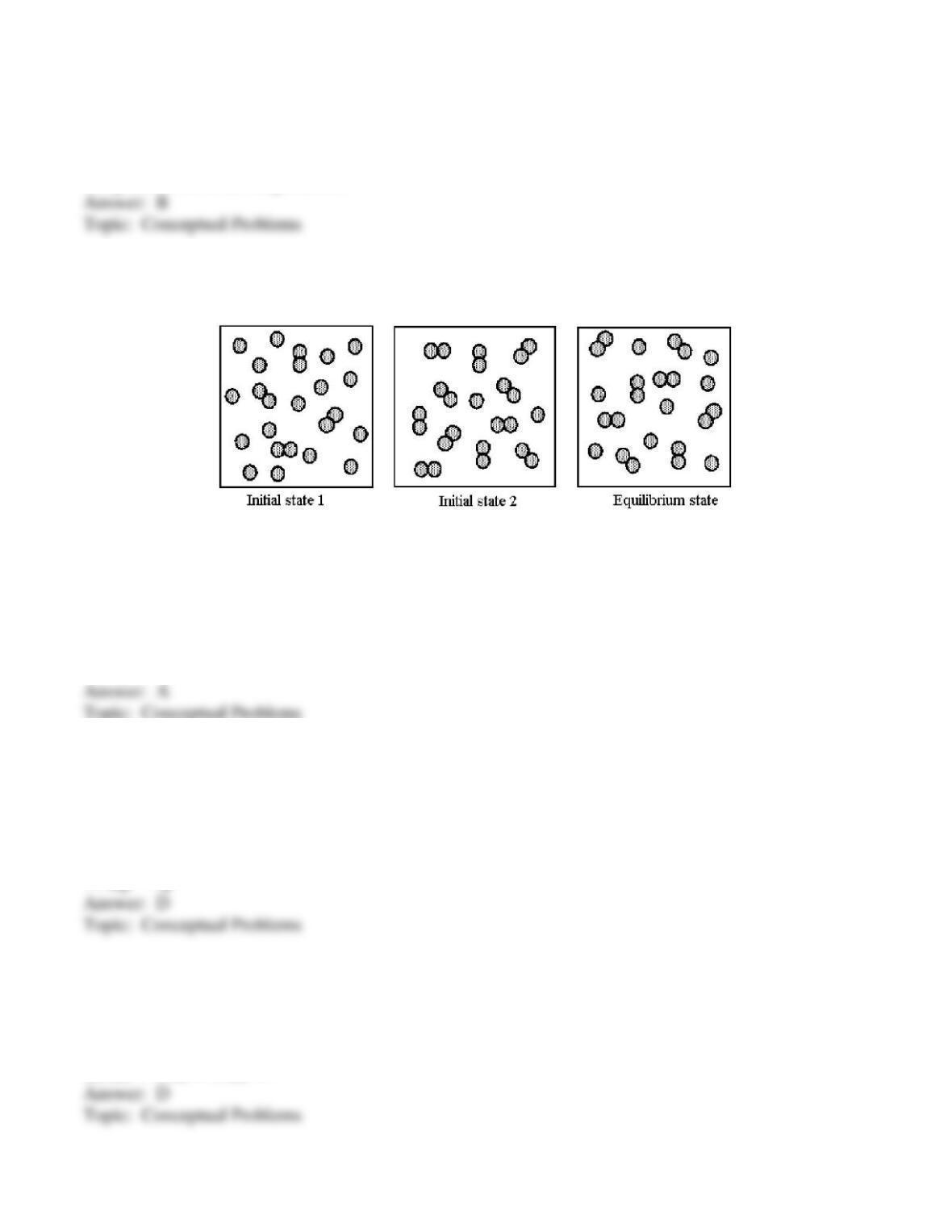
The figure below represents the spontaneous reaction of H2 (shaded spheres) with O2 (unshaded
spheres) to produce gaseous H2O.
101) What are the signs (+, or –) of ΔH, ΔS, and ΔG for this process?
A) ΔH = +, ΔS = +, ΔG = +
B) ΔH = +, ΔS = +, ΔG = –
C) ΔH = –, ΔS = -, ΔG = +
D) ΔH = –, ΔS = –,ΔG = –
25
102) How will the spontaneity of this reaction vary with temperature? This reaction is
A) nonspontaneous at all temperatures.
B) nonspontaneous at high temperatures and spontaneous at low temperatures.
C) spontaneous at high temperatures and nonspontaneous at low temperatures.
D) spontaneous at all temperatures.
Consider the reaction 2A(g) ⇌ A2(g). The following pictures represent two possible initial states and the
equilibrium state of the system.
103) For initial state 1 what is the relationship between the reaction quotient, Qp, and the equilibrium
constant, Kp?
A) Qp < Kp
B) Qp = Kp = 1
C) Qp = Kp ≠ 1
D) Qp > Kp
104) For initial state 2 what is the relationship between the reaction quotient, Qp, and the equilibrium
constant, Kp?
A) Qp < Kp
B) Qp = Kp = 1
C) Qp = Kp ≠ 1
D) Qp > Kp
105) What are the signs (+ or –) of ΔH, ΔS, and ΔG when the system spontaneously goes from initial
state 1 to the equilibrium state?
A) ΔH = +, ΔS = +, ΔG = +
B) ΔH = +, ΔS = +, ΔG = –
C) ΔH = –, ΔS = –, ΔG = +
D) ΔH = –, ΔS = –, ΔG = –
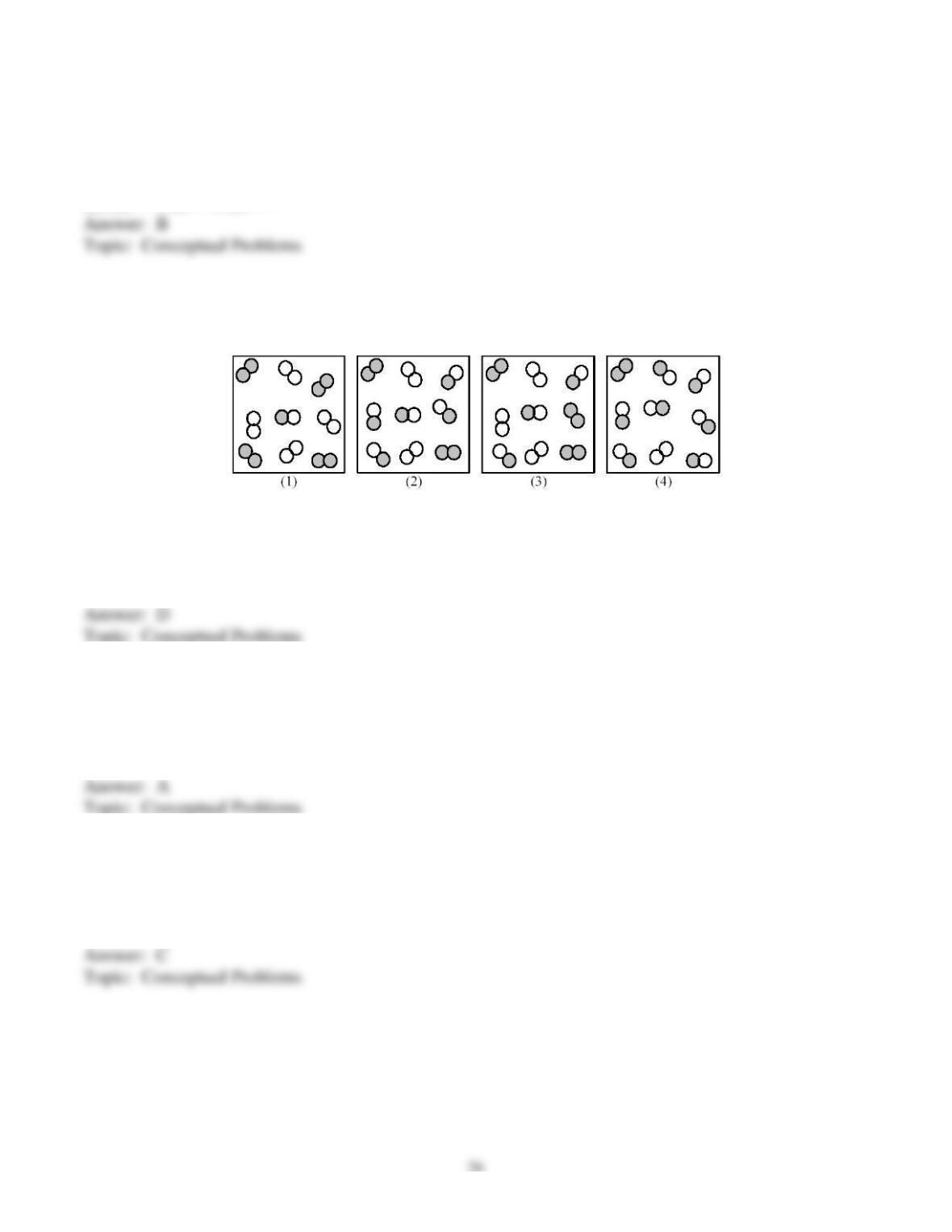
106) What are the signs (+ or –) of ΔH, ΔS, and ΔG when the system spontaneously goes from initial
state 2 to the equilibrium state?
A) ΔH = +, ΔS = +, ΔG = +
B) ΔH = +, ΔS = +, ΔG = –
C) ΔH = –, ΔS = –, ΔG = +
D) ΔH = –, ΔS = –, ΔG = –
Consider the following gas-phase reaction of A2 (shaded spheres) and B2 (unshaded spheres):
A2(g) + B2(g) ⇌ 2 AB(g) ΔG ° = +25 kJ
107) Which of the above reaction mixtures has the least spontaneous forward reaction?
A) (1)
B) (2)
C) (3)
D) (4)
108) Which of the above reaction mixtures has the most spontaneous forward reaction?
A) (1)
B) (2)
C) (3)
D) (4)
109) Which of the above reaction mixtures is ΔG of reaction = ΔG °?
A) (1)
B) (2)
C) (3)
D) (4)
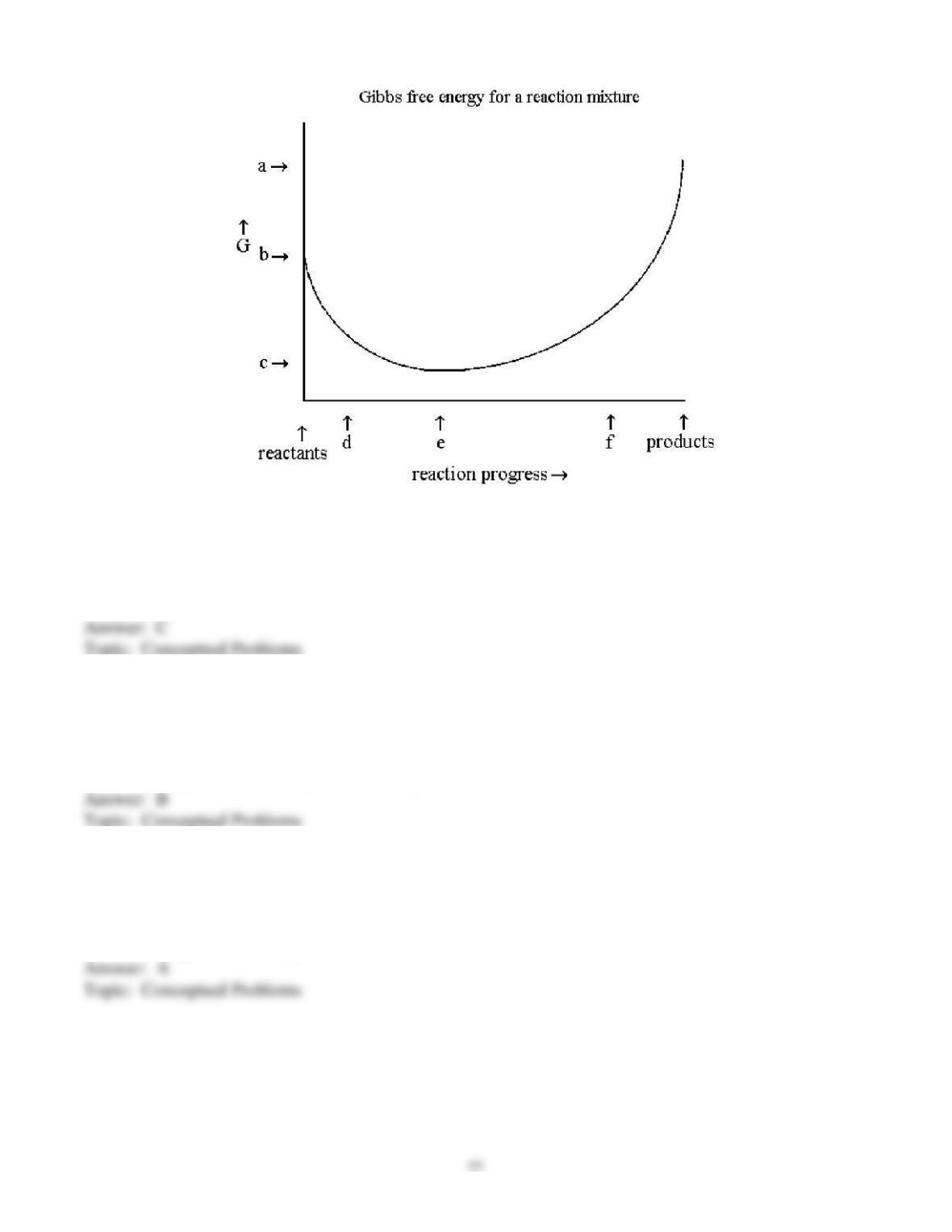
110) According to the diagram above, the forward reaction is
A) nonspontaneous at d and e, and spontaneous at f.
B) nonspontaneous at d, at equilibrium at e, and spontaneous at f.
C) spontaneous at d, at equilibrium at e, and nonspontaneous at f.
D) spontaneous at d, e, and f.
111) According to the diagram above,
A) ΔG° is positive and the equilibrium composition is rich in products.
B) ΔG° is positive and the equilibrium composition is rich in reactants.
C) ΔG° is negative and the equilibrium composition is rich in products.
D) ΔG° is negative and the equilibrium composition is rich is reactants.
112) According to the diagram above,
A) ΔG° is positive and is equal to a – b.
B) ΔG° is positive and is equal to b – c.
C) ΔG° is negative and is equal to b – c.
D) ΔG° is negative and is equal to a – c.
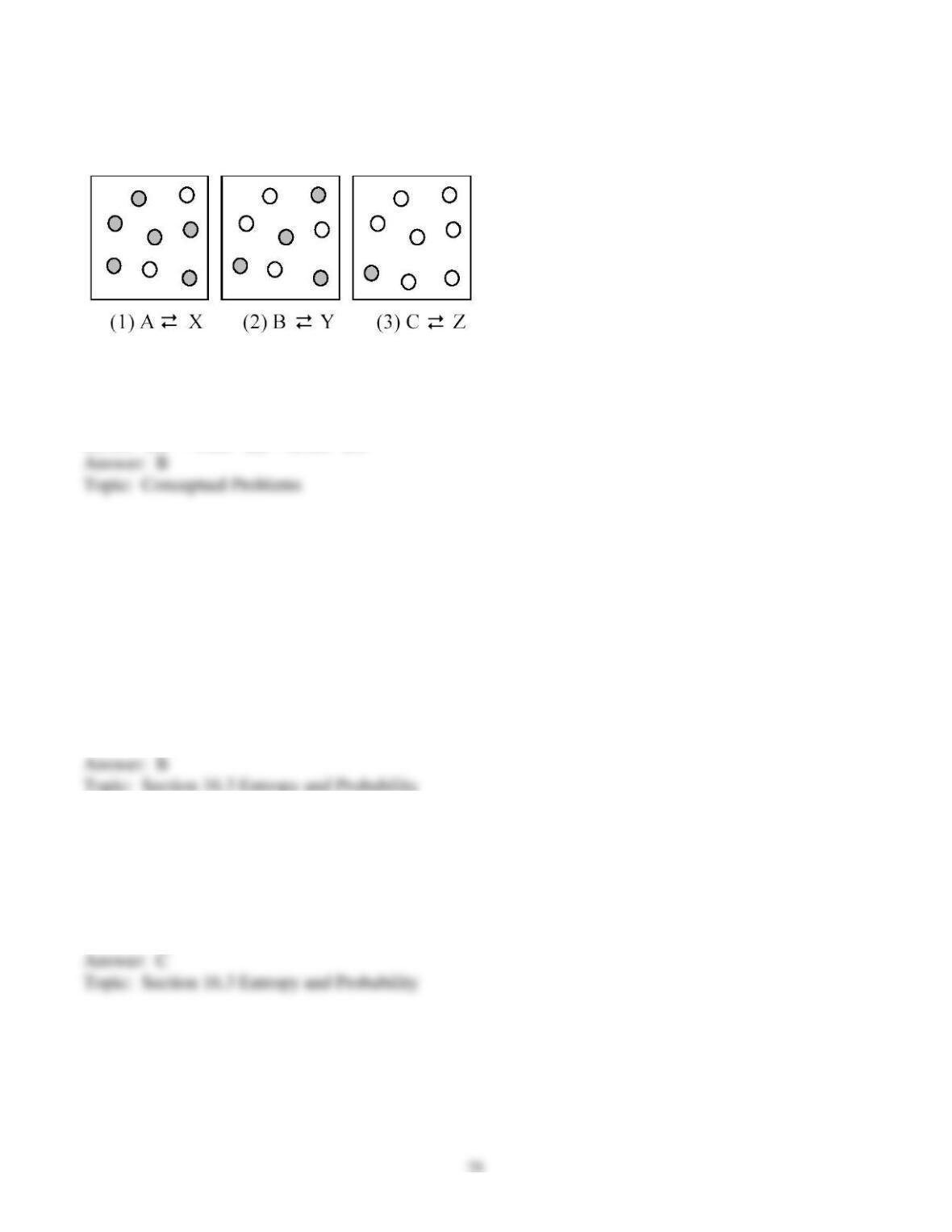
113) The following pictures represent three equilibrium mixtures for the interconversion of A, B, and C
molecules (unshaded spheres) into X, Y, and Z molecules (shaded spheres), respectively. What is the
sign of ΔG ° for each of the three reactions?
A) ΔG °(1) = –; ΔG °(2) = +; ΔG °(3) = 0
B) ΔG °(1) = –; ΔG °(2) = 0; ΔG °(3) = +
C) ΔG °(1) = 0; ΔG °(2) = –; ΔG °(3) = +
D) ΔG °(1) = +; ΔG °(2) = 0; ΔG °(3) = –
16.2 Algorithmic Questions
1) The entropy change associated with the expansion of one mole of an ideal gas from an initial volume
of Vi to a final volume of Vf at constant temperature is given by the equation, ΔS = R ln (Vf/Vi). What is
the entropy change associated with the expansion of three moles of an ideal gas from an initial volume
of Vi to a final volume of Vf at constant temperature?
A) ΔS = R ln (Vf/Vi)
B) ΔS = 3 mol × R ln (Vf/Vi)
C) ΔS = R ln (Vf × 23/Vi)
D) ΔS = R ln (Vf × 3!/Vi)
2) What is the entropy change associated with the expansion of one mole of an ideal gas from an initial
volume of V to a final volume of 4.50V at constant temperature?
A) ΔS = 4.50 R ln (Vf/Vi)
B) ΔS = – 4.50 R ln (Vf/Vi)
C) ΔS = R ln 4.50
D) ΔS = –R ln 4.50
3) Predict the sign of ΔS for each of the following systems, which occur at constant temperature
I. The volume of 2.0 moles of O2(g) increases from 44 L to 52 L.
II. The pressure of 2.0 moles of O2(g) increases from 1.0 atm to 1.2 atm.
A) I: ΔS = negative; II: ΔS = negative
B) I: ΔS = negative; II: ΔS = positive
C) I: ΔS = positive; II: ΔS = negative
D) I: ΔS = positive; II: ΔS = positive
4) Under which of the following conditions would one mole of He have the highest entropy, S?
A) 17°C and 15 L
B) 127°C and 15 L
C) 17°C and 25 L
D) 127°C and 25 L
5) Which one of the following would be expected to have the lowest standard molar entropy, S°, at
25°C?
A) C10H22(s)
B) C10H22(l)
C) C14H30(s)
D) C14H30OH(l)
16.3 Short Answer Questions
1) Chemical and physical changes can be classified as spontaneous or nonspontaneous. At 25°C and
1 atm pressure the decomposition of water into hydrogen and oxygen is classified as ________, and the
melting of ice is classified as ________.
2) The sign (+ or –) of ΔH is ________ and the sign (+ or –) of ΔS is ________ for the evaporation of
water.
3) What is the entropy of 10 molecules in a system of 100 boxes?
4) What is the entropy of 10 molecules in a system of 1000 boxes?
30
5) By what factor does the entropy increase for a collection of 100 molecules from a system of 1 × 10⁵
boxes to 1 × 10⁶ boxes?
6) If the entropy of a collection of molecules in 5000 boxes is 1.76 × 10⁻²⁰ J/K, how many molecules
are there?
7) A 1.0 mole sample of gas at STP has a ________ entropy than 1.0 mole of gas at 273 K and
835 mm Hg.
8) The entropy of water at 25° is ________ than the entropy of water at 35°C.
9) Standard molar entropies, S°, in J/K∙mol, are given below each reactant and product in the reaction
shown below. The standard entropy of reaction, ΔS°, for this reaction is ________ J/K.
CH4(g) + 2 O2(g) → CO2(g) + 2 H2O(l)
186.2 205.0 213.6 69.9
10) Standard molar entropies, S°, in J/Kmol, are given below each reactant and product in the reaction
shown below. The standard entropy of reaction, ΔS°, for this reaction is ________ J/K.
S(s, rhombic) + O2(g) → SO2(g)
31.8 205.0 248.1
11) Standard molar entropies, S°, in J/Kmol, are given below each reactant and product in the reaction
shown below. The standard entropy of reaction, ΔS°, for this reaction is ________ J/K.
2 SO2(g)+ O2(g) → 2 SO3(g)
248.1 205.0 256.6
12) The most commonly used white pigment is titanium white, which is titanium(IV) oxide, TiO2.
Titanium white can be formed from TiCl4 as shown in the reaction below.
TiCl4(l) + 2 H2O(l) → TiO2(s) + 4 HCl(g)
If ΔH° = 61.9 kJ/mol and ΔS° = 405.4 J/K, what are ΔSsurr and ΔStotal for this reaction at 25°C?
13) The most common white pigment until the 1880s was lead white, sometimes called basic lead
31
carbonate: (PbCO3)2Pb(OH)2. Paintings containing lead white turned black in the presence of moist
H2S from natural sources and polluted air due to the formation of PbS. The PbCO3 portion of this
reaction is shown below.
PbCO3(s) + H2S(aq) → PbS(s) + H2CO3(aq)
If ΔH° = –60.9 kJ/mol and ΔS° = 26.6 J/K, what are ΔSsurr and ΔStotal for this reaction at 25°C??
14) For the reaction N2(g) +O2(g) → 2 NO(g), ΔH° = 180.4 kJ/mol and ΔS° = 24.9 J/K. ΔStotal for this
reaction is ________ J/K, and the reaction is ________ (spontaneous, nonspontaneous) at 25°C
15) For the reaction N2(g) +2 O2(g) → 2 NO2(g), ΔH° = 66.4 kJ/mol and ΔS° = –121.5 J/K. ΔStotal for
this reaction is ________ J/K, and the reaction is ________ (spontaneous, nonspontaneous) at 25°C.
16) A reaction for which ΔH° = + 98.8 kJ and ΔS° = + 141.5 J/K is ________ (spontaneous or
nonspontaneous) at low temperatures and ________ (spontaneous or nonspontaneous) at high
temperatures.
17) A reaction has ΔG° = + 21.5 kJ/mol, ΔH° = + 25.0 kJ/mol, and ΔS° = + 15.0 J/mol∙K can become
spontaneous at a temperature of ________ K.
18) For the reaction N2(g) + O2(g) → 2NO(g), ΔH° = 180.4 kJ/mol and ΔS° = 24.9 J/K. Is there a
temperature at which the spontaneity of this reaction be changed, either from spontaneous to
nonspontaneous or nonspontaneous to spontaneous? If so, estimate the temperature.
19) For the reaction N2(g) + 2 O2(g) → 2 NO2(g), ΔH° = 66.4 kJ/mol and ΔS° = -121.5 J/K. Is there a
temperature at which the spontaneity of this reaction be changed, either from spontaneous to
nonspontaneous or nonspontaneous to spontaneous? If so, estimate the temperature.
20) Acetylene, C2H2, has a standard enthalpy of formation, ΔH° = 226.7 kJ/mol, and a standard entropy
change for its formation from its elements, ΔS° = 58.8 J/K∙mol. The standard free energy of formation of
acetylene is ________ kJ/mol.
21) Standard free energies of formation, ΔG°, in kJ/mol, are given below each reactant and product in
the reaction shown below. The standard free energy of reaction, ΔG°, for this reaction is ________ kJ.
CH4(g) + 2 O2(g) → CO2(g) + 2 H2O(l)
–50.8 0 –394.4 –237.2
22) The standard free energy for a reaction is ΔG° = -33.0 kJ. At 25°C the equilibrium constant for this
reaction, Kp = ________.
23) For the reaction N2(g) + 2 O2(g) → 2 NO2(g), ΔG° = 102.6 kJ. At 25°C the equilibrium constant
Kp = ________.
24) The reaction 2 H2(g) + O2(g) → 2 H2O(g) is spontaneous at 25°C. The addition of a catalyst will
________ (decrease, increase, not change) the rate of reaction and ________ (decrease, increase, not
change) the spontaneity of the reaction.
25) The reaction 2 H2O(g) + CO2(g) → CH4(g) + 2 CO2(g) is nonspontaneous at 25°C. The addition of
a catalyst will ________ (decrease, increase, not change) the rate of reaction and ________ (decrease,
increase, not change) the spontaneity of the reaction.
26) For the vaporization of solid rhombic sulfur, S(s, rhombic) ⇌ S(g), ΔG° = 236.7 kJ/mol. At 25 °C
the vapor pressure of rhombic sulfur is ________ atm.