27) Which of the following is a reason why airline yield management is an effective method to
increase revenue?
A) because airlines have invested heavily in developing computer models that identify optimal
pricing strategies in the various market segments
B) because airlines have successfully induced customers to reveal their resources and preferences
by offering them different versions of the product such as business class and coach plane tickets
C) because a ticket is a contract to transport a specific person, and is not transferable
D) because airlines have a monopoly in long-distance carriage.
28) When colleges use yield management techniques, they
A) rank students on the basis of academic merit and award higher financial aid offers to those at
the top of the ranking.
B) increase financial aid offers to students whose demand for college education is likely to be
more price elastic and reduce financial aid offers to students whose demand for college education
is likely to be less price elastic.
C) rank students on the basis of academic merit and award higher financial aid offers to those at
the bottom of the ranking.
D) increase financial aid offers to students whose demand for college education is likely to be
more price inelastic and reduce financial aid offers to students whose demand for college
education is likely to be less price inelastic.
29) If a firm could practice perfect price discrimination, it would
A) allow resale of its product.
B) charge every buyer a different price.
C) charge a price based on the quantity of a product bought.
D) use odd pricing.
30) With perfect price discrimination there is
A) no deadweight loss.
B) no producer surplus.
C) one single price.
D) an increase in consumer surplus.
31) Which of the following does not arise from price discrimination?
A) an increase in producer surplus
B) an increase in consumer surplus
C) an increase in quantity sold
D) an increase in profits
32) Joss is a marketing consultant. Iris and Daphne are potential customers interested in
commissioning Joss to undertake a market survey and compile the findings in a report. Iris is
willing to pay $500 for the service while Daphne is willing to pay $800. Suppose that the
opportunity cost of Joss’s time is $1,200. Assume that Iris and Daphne do not know each other. If
Joss charges the same price per copy to both Iris and Daphne,
A) the report will not get written.
B) only Daphne will commission the job and the report will be written.
C) both Iris and Daphne will commission the job and the report will be written.
D) no conclusion can be drawn without information on the price.
33) Joss is a marketing consultant. Iris and Daphne are potential customers interested in
commissioning Joss to undertake a market survey and compile the findings in a report. Iris is
willing to pay $500 for the service while Daphne is willing to pay $800. Suppose that the
opportunity cost of Joss’s time is $1,200. Assume that Iris and Daphne do not know each other. If
the price is $500 per copy,
A) only Iris will purchase Joss’s services and Joss will undertake the job for her.
B) only Daphne will purchase Joss’s services and Joss will undertake the job for her.
C) both Iris and Daphne will purchase Joss’s services and Joss will undertake the job.
D) both Iris and Daphne will want to purchase Joss’s services but Joss will not be willing to
undertake the job.
34) Joss is a marketing consultant. Iris and Daphne are potential customers interested in
commissioning Joss to undertake a market survey and compile the findings in a report. Iris is
willing to pay $500 for the service while Daphne is willing to pay $800. Suppose that the
opportunity cost of Joss’s time is $1,200. Assume that Iris and Daphne do not know each other. If
the price is $800 per copy,
A) both Iris and Daphne will purchase Joss’s services and Joss will undertake the job.
B) only Daphne will purchase Joss’s services and Joss will undertake the job for her.
C) only Daphne will want to purchase Joss’s services but Joss will not be willing to do the work.
D) neither Iris nor Daphne will commission the work.
35) Joss is a marketing consultant. Iris and Daphne are potential customers interested in
commissioning Joss to undertake a market survey and compile the findings in a report. Iris is
willing to pay $500 for the service while Daphne is willing to pay $800. Suppose that the
opportunity cost of Joss’s time is $1,200. Assume that Iris and Daphne do not know each other.
Which of the following statements is true?
A) Joss should charge each customer $600; that way he will earn his opportunity cost and it will
be fair to both Iris and Daphne.
B) Joss should charge Iris $500 and Daphne no more than $700; that way he earns his
opportunity cost and there is no loss in economic surplus.
C) Joss should charge Iris $500 and Daphne $800; that way economic surplus is maximized.
D) Joss should charge Iris $500 but charging Daphne $800 is unfair because it allows Joss to
earn more than his opportunity cost.
36) In 2009, Netflix was charging $16.99 per month to rent three DVDs at a time. Although all
subscribers under this plan pay the same rate, they do not receive the same quality of service.
Subscribers who rent the fewest movies per month have the best chance of receiving the latest
releases (for which there is usually a wait list) and will typically receive their DVDs faster.
Based on the information above, what can you conclude about the price elasticity of demand for
Netflix DVD rentals?
A) Subscribers who rent many DVDs per month are likely to have a more elastic demand than
subscribers who rent only a few DVDs per month.
B) Subscribers who rent many DVDs per month are likely to have less elastic demand than
subscribers who rent only a few DVDs per month.
C) Subscribers who rent many DVDs per month are likely view DVDs as complements to
movies at the theatre and therefore making this group wait longer for new releases will have a
relatively small impact on demand for Netflix DVDs.
D) Subscribers who rent many DVDs per month are likely view DVDs as substitutes to movies
at the theatre and therefore making this group wait longer for new releases will have a relatively
small impact on demand for Netflix DVDs.
37) In 2011, Netflix was charging $23.98 per month to rent three DVDs at a time as well as
receive unlimited streaming. Although all subscribers under this plan pay the same rate, they do
not receive the same quality of service. Subscribers who rent the fewest movies per month have
the best chance of receiving the latest releases (for which there is usually a wait list) and will
typically receive their DVDs faster. Is Netflix engaging in price discrimination, and if so, why?
A) No, it is not; it is merely differentiating its product by offering different levels of service.
B) No, it is not; as long as there is a wait list, Netflix must devise a rationing mechanism. Its
decision to give priority to those who rent only a few DVDs is a business strategy independent of
pricing.
C) Yes it is; Netflix is charging the same price for two different levels of service. It does this to
increase its profit.
D) Yes it is; Netflix wants to discourage those who rent many DVDs per month because they
lower the firm’s profits.
38) Some consumer electronic products such as plasma TVs, DVD players and digital cameras,
are introduced at very high prices but over time, their prices start falling (beyond what could be
attributed to falling costs as companies take advantage of economies of scale and cheaper
technologies). Which of the following is the best explanation for this observation?
A) More firms are likely to enter the consumer electronic market over time, forcing market
prices down.
B) Early adopters of these new products typically have a higher demand and higher income
compared to those who are willing to wait.
C) Early adopters are more quality conscious and are willing to pay higher prices for the initial
production of these goods.
D) After satisfying the demand for early adopters, firms lower price to attract the more price
sensitive consumers.
39) The antitrust law that prohibits price discrimination on grounds that it reduces competition is
A) the Clayton Act.
B) the Federal Trade Commission Act.
C) the Robinson-Patman Act.
D) the Sherman Act.
40) With a monopolist engages in perfect price discrimination, the quantity produced and sold
A) is lower than the quantity produced and sold if it adopted a single price.
B) is larger than the quantity produced and sold if it adopted a single price.
C) is the same level as that produced and sold if it adopted a single price.
D) could be lower, higher or the same as that produced and sold if it adopted a single price.
41) With perfect price discrimination, the marginal revenue curve
A) is below the demand curve.
B) is above the demand curve.
C) is equal to the demand curve.
D) is horizontal.
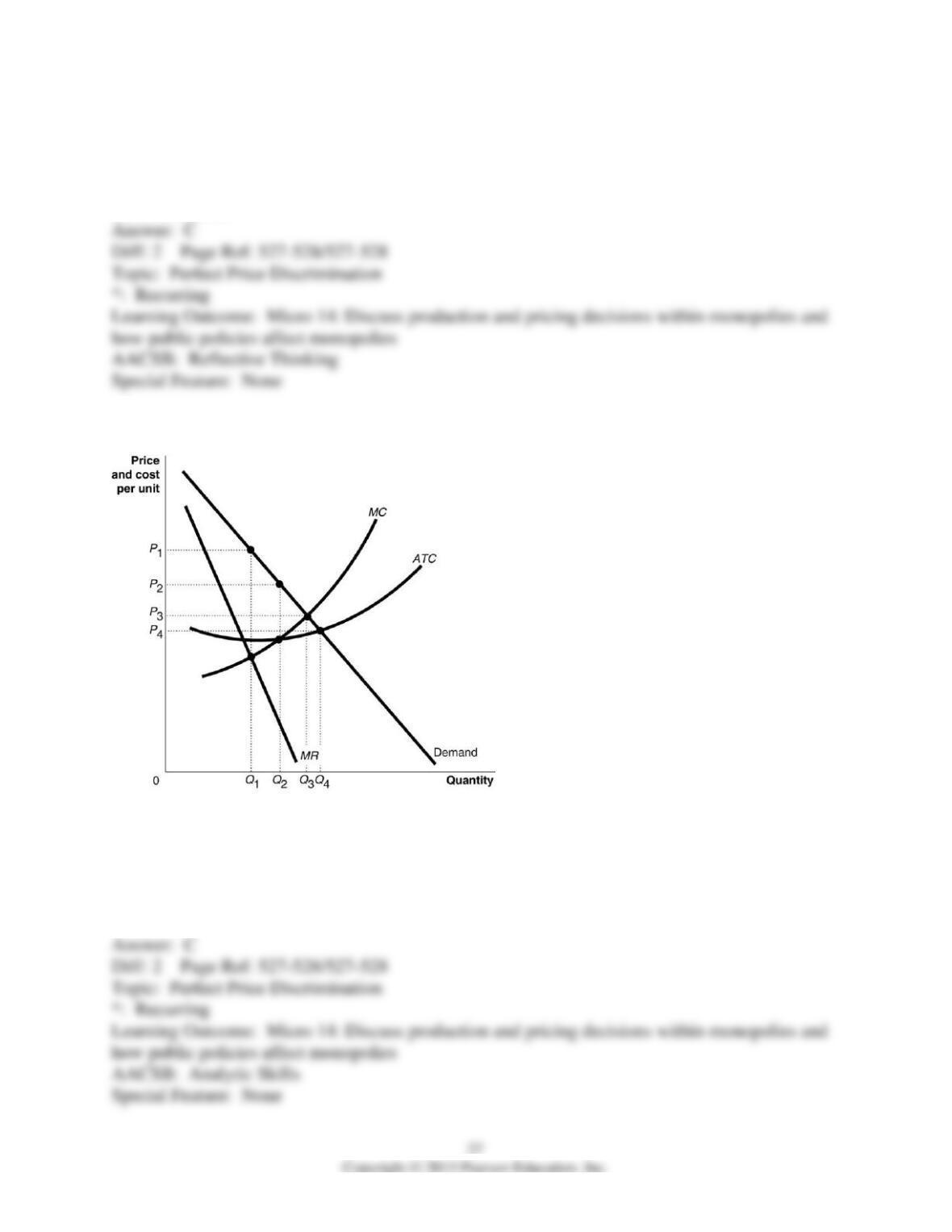
Figure 16-1
42) Refer to Figure 16-1. With perfect price discrimination, the firm will produce and sell
A) Q1 units.
B) Q2 units.
C) Q3 units.
D) Q4 units.
43) Refer to Figure 16-1. What is the price charged under perfect price discrimination?
A) P3
B) P4
C) a range of prices corresponding to the demand curve from P3 and above
D) a range of prices corresponding to the demand curve from P4 and above
44) Refer to Figure 16-1. What is the consumer surplus received under perfect price
discrimination?
A) the area under the demand curve above P1
B) the area under the demand curve above P3
C) the area under the demand curve above P4
D) zero
45) Refer to Figure 16-1. What is the economically efficient output level?
A) Q1 units
B) Q2 units
C) Q3 units
D) Q4 units
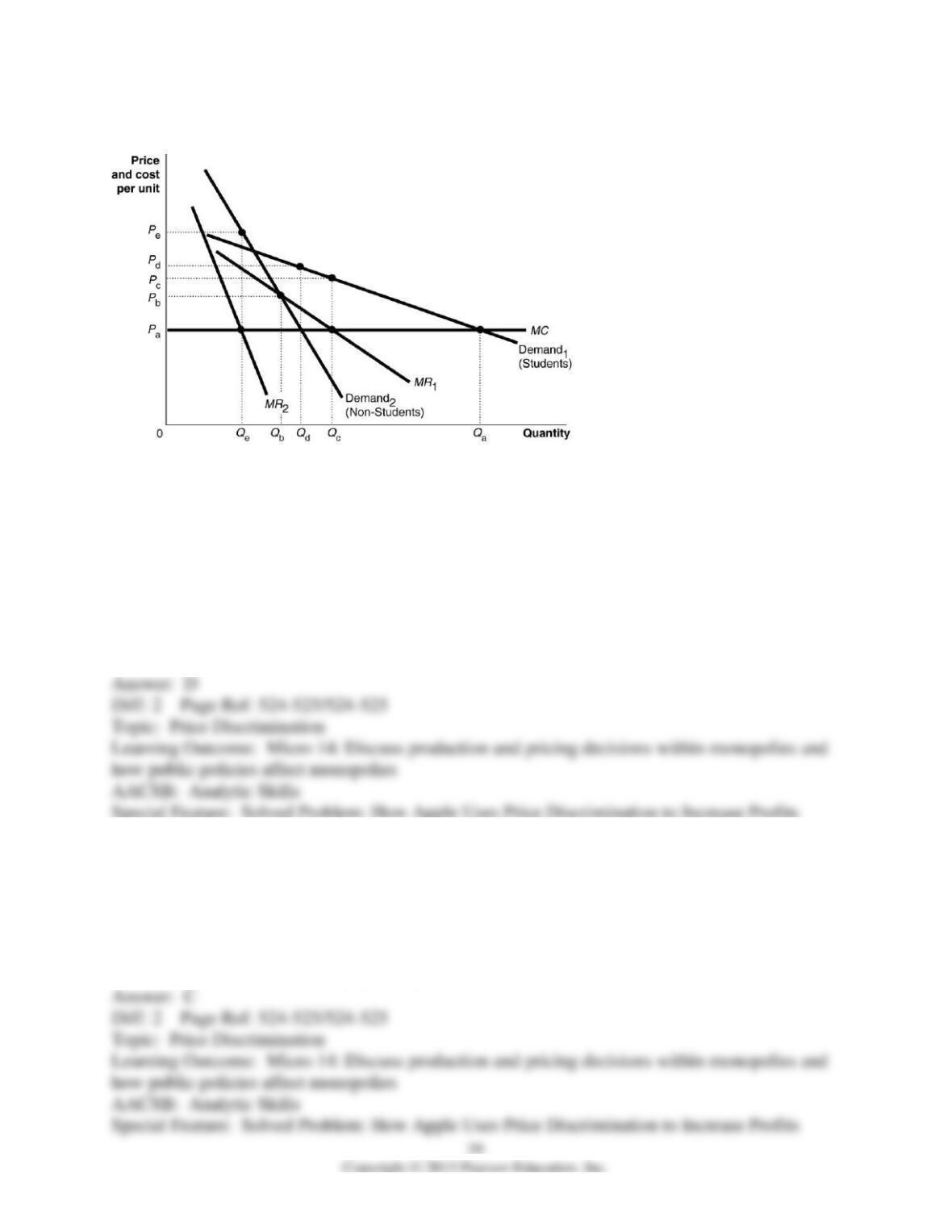
Figure 16-2
Plato Playhouse, a theatre company in the university town of Wegg, caters to two groups of
customers: students and the non-student population. Figure 16-2 shows the demand curves for
the two groups of customers.
46) Refer to Figure 16-2. What is the price charged in the two markets?
A) price in the student market = price in the non-student market = Pa
B) price in the student market = price in the non-student market = Pb
C) price in the student market = Pd; price in the non-student market = Pe
D) price in the student market = Pc; price in the non-student market = Pe
47) Refer to Figure 16-2. What is the quantity sold to each group of customer and what is the
total quantity sold?
A) quantity sold to students=Qb; quantity sold to non-students=Qb; total sales=Qa
B) quantity sold to students=Qc; quantity sold to non-students=Qb; total sales=Qb+Qc
C) quantity sold to students=Qc; quantity sold to non-students=Qe; total sales=Qe+Qc
D) quantity sold to students=Qc; quantity sold to non-students=Qd; total sales=Qd+Qc
48) Refer to Figure 16-2. Suppose Plato Playhouse price discriminates. Which of the following
statements is true?
A) By charging two different prices, the theatre company has redistributed some profits from
those who can pay higher prices to those who cannot, thereby increasing economic efficiency.
B) By charging two different prices, the theatre company essentially allows those willing to pay
higher prices to subsidize those who are not.
C) By charging two different prices, the theatre company has redistributed some profits from
those who can pay higher prices to those who cannot, thereby improving equity.
D) Plato Playhouse will earn higher profits if it charges a single price an average of the two
prices instead of charging two different prices to the two different groups of customers.
49) Refer to Figure 16-2. Suppose Plato Playhouse charges a single price of Pd for each
performance. Which of the following statements is true?
A) The company is selling more than the profit-maximizing quantity in the non-student market
and less than the profit-maximizing quantity in the student market.
B) The company is selling less than the profit-maximizing quantity in the non-student market
and more than the profit-maximizing quantity in the student market.
C) The company is selling less than the profit-maximizing quantity in both markets but it is
maximizing its revenue.
D) The company is selling less than the profit-maximizing quantity in both markets.
50) Consider the following pricing strategies:
a. perfect price discrimination
b. charging different prices to different groups of customers
c. optimal two-part tariff
d. single-price monopoly pricing
Which of the pricing strategies allows a producer to capture the entire consumer surplus that
would have gone to consumers under perfect competitive pricing?
A) a, b, c, and d
B) a, b, and c only
C) a and b only
D) a and c only
51) Consider the following pricing strategies:
a. perfect price discrimination
b. charging different prices to different groups of customers
c. optimal two-part tariff
d. single-price monopoly pricing
Which of the pricing strategies leads to the economically efficient output level?
A) a only
B) a and b only
C) a and c only
D) a, b, and c only
52) When colleges use yield management techniques, they increase financial aid offers to
students likely to be more price sensitive and they reduce financial aid offers to students likely to
be less price sensitive.
53) Colleges offer merit awards to students who ordinarily would not qualify for financial help.
Some have criticized this on grounds that merit awards disproportionately benefit students from
wealthier communities with better school systems, siphoning resources away from lower-income
students with greater financial need. A college’s decision to grant merit awards is motivated by
economic efficiency.
54) To successfully price discriminate, a firm must ensure that there are no opportunities for
arbitrage.
55) If a monopolist engages in first-degree price discrimination, it will produce the same output
level as a perfectly competitive industry.
56) Because each customer pays according to her willingness to pay, a consumer maximizes her
consumer surplus under first-degree price discrimination.
57) One reason why McDonald’s charges a single price for its products is that it is difficult and
costly for the company to determine each individual consumer’s willingness to pay.
58) Both first-degree price discrimination and optimal two-part tariff pricing maximize economic
surplus.
59) What is the difference between price discrimination and other forms of discrimination?
60) Why is it necessary for a firm that practices price discrimination be a price maker rather than
a price taker?
61) What three conditions must hold for a firm to successfully price discriminate?
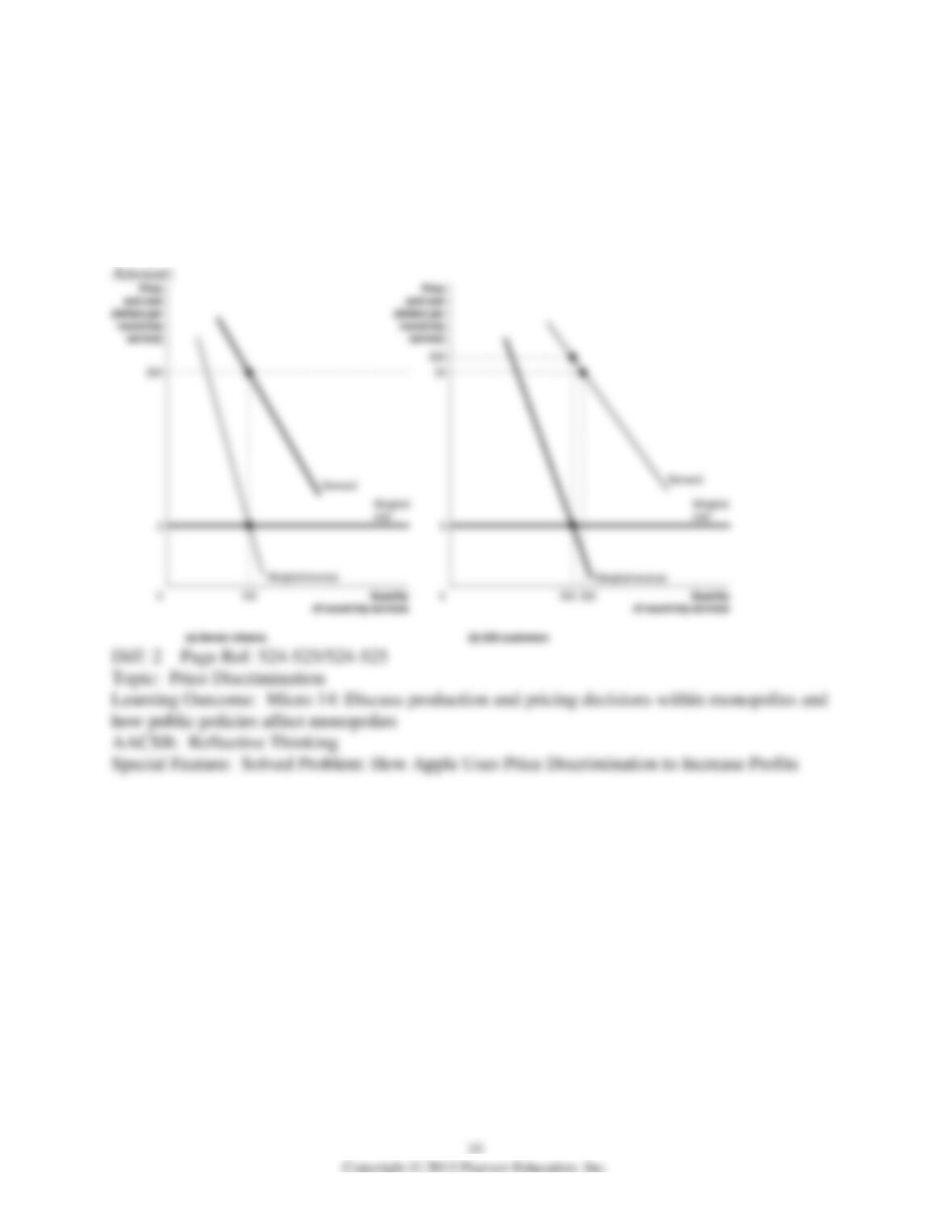
62) Arnold’s Airport Transport provides passenger transportation to and from the local airport.
Arnold charges a flat rate of $30 per person for round-trip service, and he gives a $5 discount to
senior citizens. Assume Arnold’s marginal cost is $3.00 per person. Draw two graphs, one
showing demand and marginal cost for his $30 customers, of which he has 300 per month, and
the other graph showing demand and marginal cost for his senior citizen customers, of which he
has 100 per month. If Arnold charged all of his customers $30, he would have 325 customers per
month.
63) What is perfect price discrimination and why do economists believe that no firm is able to
practice perfect price discrimination?
64) Suppose a restaurant is trying to determine how much to charge for a bowl of chili, and
decides to run an experiment to see how much its customers are willing to pay by allowing them
to set their own price for this menu item.
a. Is charging a customer the price he or she is willing to pay for the bowl of chili an example of
price discrimination? Briefly explain.
b. What is it called when a firm knows every consumer’s willingness to pay, and can charge
every consumer a different price? What happens to consumer surplus in this situation?
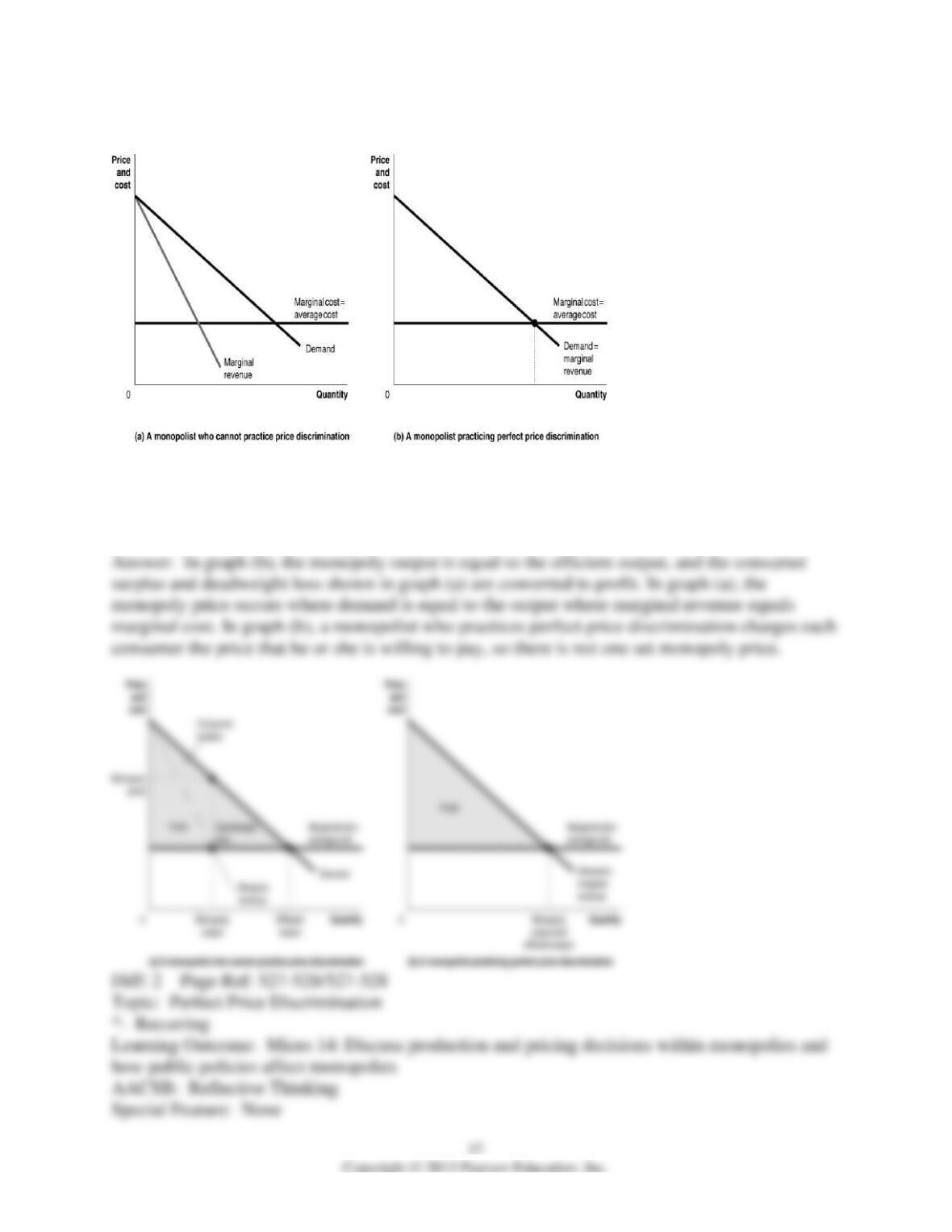
Figure 16-3
65) Refer to Figure 16-3. Graph (a) represents a monopolist who cannot price discriminate and
graph (b) represents a monopolist practicing perfect price discrimination. On each graph, identify
the monopoly price, the monopoly output, the efficient output, and the areas representing profit,
consumer surplus, and deadweight loss.
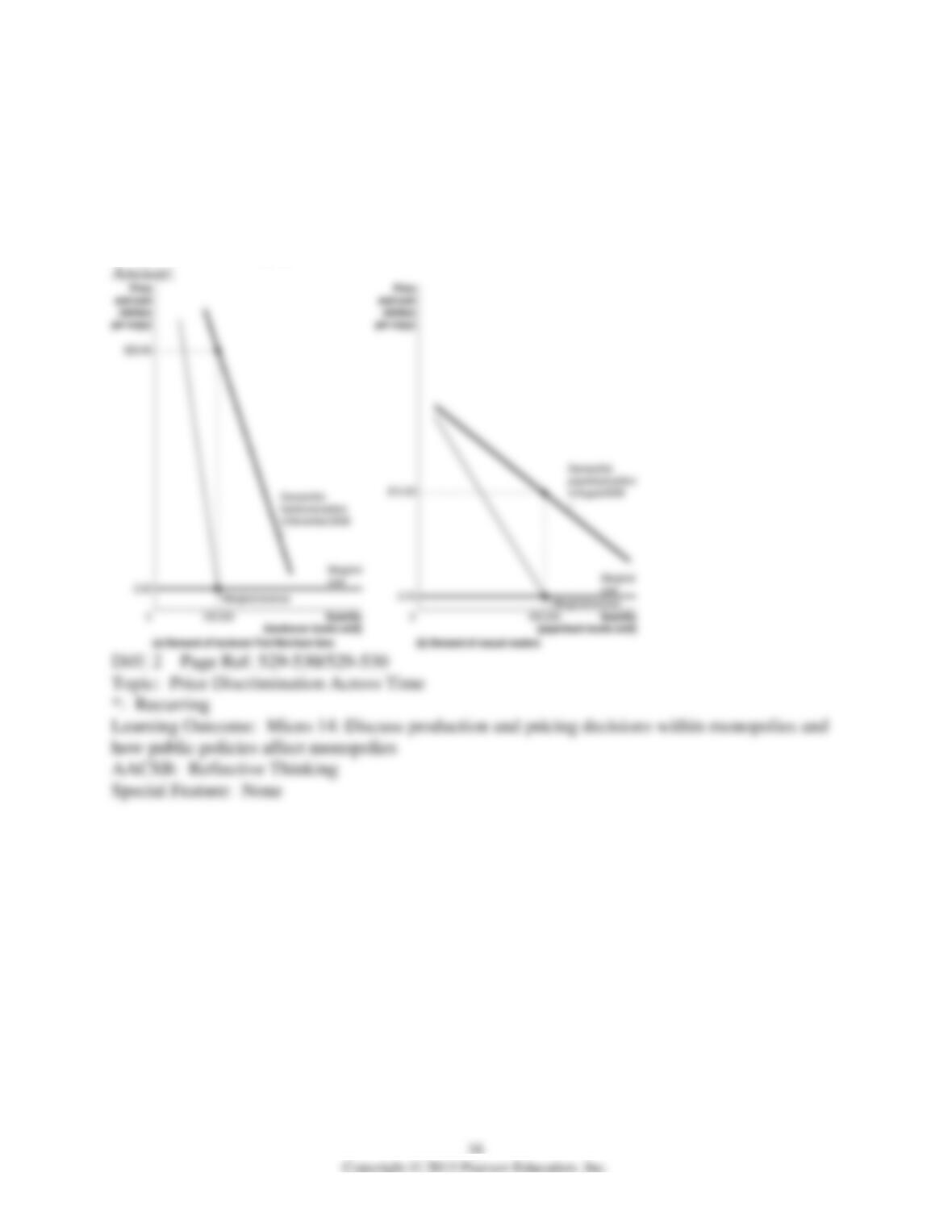
66) Book publishers often use price discrimination across time to increase profits. Toni
Morrison’s book, A Mercy, was published as a hardcover edition in November 2008 at a price of
$23.95. In August 2009, the paperback version was published at a price of $15.00. Assume that
100,000 hardcover books were sold to hard-core Toni Morrison fans in November 2008, and
400,000 paperback books were sold to casual readers in August 2009. Illustrate each of these
situations graphically. Assume that the marginal cost of the hardcover version is $2.00 and the
marginal cost of the paperback version is $0.75.