9) Calculate the percent ionization of nitrous acid in a solution that is 0.249 M in nitrous acid. The acid
dissociation constant of nitrous acid is 4.50 × 10⁻⁴.
A) 1.12 × 10⁻⁴
B) 0.0450
C) 4.25
D) 0.342
E) 5.53
10) What is the pH of a buffer solution that is 0.211 M in lactic acid and 0.111 M in sodium lactate? The
Ka of lactic acid is 1.4 × 10⁻⁴.
A) 14.28
B) 10.43
C) 5.48
D) 3.57
E) 4.13
11) What is the pH of a buffer solution that is 0.255 M in hypochlorous acid (HClO) and 0.333 M in
sodium hypochlorite? The Ka of hypochlorous acid is 3.8 × 10⁻⁸.
A) 13.88
B) 6.46
C) 8.49
D) 7.30
E) 7.54
12) What is the pH of a solution prepared by mixing 25.00 mL of 0.10 M CH3CO2H with 25.00 mL of
0.010 M CH3CO2Na? Assume that the volume of the solutions are additive and that Ka = 1.8 × 10⁻⁵ for
CH3CO2H.
A) 2.87
B) 3.74
C) 4.75
D) 5.74
13) What is the pH of a solution prepared by mixing 50.00 mL of 0.10 M NH3 with 5.00 mL of 0.10 M
NH4Cl? Assume that the volume of the solutions are additive and that Kb = 1.8 × 10⁻⁵ for NH3.
A) 8.25
B) 9.28
C) 10.26
D) 11.13
21
14) What is the pH of a solution prepared by mixing 50.00 mL of 0.10 M methylamine, CH3NH2, with
20.00 mL of 0.10 M methylammonium chloride, CH3NH3Cl? Assume that the volume of the solutions
are additive and that Kb = 3.70 × 10⁻⁴ for methylamine.
A) 10.17
B) 10.57
C) 10.97
D) 11.78
15) What is the pH of a buffer system prepared by dissolving 10.70 grams of NH4Cl and 25.00 mL of
12 M NH3 in enough water to make 1.000 L of solution? Kb = 1.80 × 10⁻⁵ for NH3.
A) 9.08
B) 9.26
C) 9.43
D) 11.32
16) What is the pH of a solution prepared by mixing 100.00 mL of 0.020 M Ca(OH)2 with 50.00 mL of
0.300 M NaOH? Assume that the volumes are additive.
A) 13.05
B) 13.10
C) 13.28
D) 13.58
17) What is the hydronium ion concentration in a solution prepared by mixing 50.00 mL of 0.10 M HCN
with 50.00 mL of 0.030 M NaCN? Assume that the volumes of the solutions are additive and that Ka =
4.9 × 10⁻¹⁰ for HCN.
A) 1.5 × 10⁻¹⁰ M
B) 4.9 × 10⁻¹⁰ M
C) 1.6 × 10⁻⁹ M
D) 7.0 × 10⁻⁶ M
18) What is the [CH3CO2-]/[CH3CO2H] ratio necessary to make a buffer solution with a pH of 4.34?
Ka = 1.8 × 10⁻⁵ for CH3CO2H.
A) 0.39:1
B) 0.91:1
C) 1.09:1
D) 2.5:1
19) You wish to prepare an HC2H3O2 buffer with a pH of 4.34. If the pKa of is 4.74, what ratio of
22
C2H3O2⁻/HC2H3O2 must you use?
A) 0.10
B) 0.40
C) 0.40
D) 2.51
E) 4.0
20) You wish to prepare an HC2H3O2 buffer with a pH of 5.14. If the pKa of is 4.74, what ratio of
C2H3O2⁻/HC2H3O2 must you use?
A) 0.10
B) 0.40
C) 0.40
D) 2.51
E) 6.0
21) A buffer solution is 0.100 M in both HC7H5O2 and KC7H5O2 and has a pH of 4.19. Which of the
following pH values would you expect from the addition of a small amount of a dilute solution of a
strong base?
A) 3.89
B) 3.69
C) 5.79
D) 4.49
E) There is not enough information to determine.
22) Calculate the pH of a buffer that is 0.032 M HF and 0.032 M NaF. The Ka for HF is 3.5 × 10⁻⁴.
A) 2.86
B) 9.31
C) 10.54
D) 3.46
E) 4.79
23) Calculate the pH of a buffer that is 0.020 M HF and 0.040 M NaF. The Ka for HF is 3.5 × 10⁻⁴.
A) 2.06
B) 4.86
C) 3.16
D) 3.36
E) 3.76
24) Calculate the pH of a buffer that is 0.060 M HF and 0.030 M KF. The Ka for HF is 3.5 × 10⁻⁴.
23
A) 2.06
B) 4.86
C) 3.16
D) 3.56
E) 3.76
25) Calculate the pH of a buffer that is 0.94 M HClO and 0.059 M NaClO. The Ka for HClO is 2.9 ×
10-8.
A) 7.54
B) 6.67
C) 7.74
D) 6.36
E) 7.34
26) Calculate the pH of a buffer that is 0.145 M HC2H3O2 and 0.202 M KC2H3O2. The Ka for
HC2H3O2 is 1.8 × 10⁻⁵.
A) 4.89
B) 9.01
C) 4.74
D) 5.05
E) 4.60
27) The highest pH for an effective buffer occurs when the base is how many times as concentrated as
the acid?
A) 8
B) 5
C) 10
D) 25
E) 40
28) Which of the following acids (listed with pKa values) and their conjugate base would form a buffer
with a pH of 8.10?
A) HC2H3O2, pKa = 4.74
B) H2SO3, pKa = 1.77
C) HClO, pKa = 7.54
D) HIO, pKa = 10.64
E) HNO2, pKa = 3.34
29) Which of the following acids (listed with Ka values) and their conjugate base would form a buffer
24
with a pH of 2.34?
A) C6H5COOH, Ka = 6.5 x 10⁻⁵
B) HIO3, Ka = 1.7 x 10⁻¹
C) HClO, Ka = 2.9 x 10⁻⁸
D) HF, Ka = 3.5 x 10⁻⁴
E) HClO2, Ka = 1.1 x 10⁻²
30) A 1.0 L buffer solution is 0.250 M HC2H3O2 and 0.050 M LiC2H3O2. Which of the following
actions will destroy the buffer?
A) adding 0.050 moles of LiC2H3O2
B) adding 0.050 moles of HC2H3O2
C) adding 0.050 moles of HCl
D) adding 0.050 moles of NaOH
E) None of the above will destroy the buffer.
31) A 1.0 L buffer solution is 0.050 M HC2H3O2 and 0.250 M NaC2H3O2. Which of the following
actions will destroy the buffer?
A) adding 0.050 moles of KOH
B) adding 0.050 moles of HCl
C) adding 0.050 moles of HC2H3O2
D) adding 0.050 moles of NaC2H3O2
E) All of the above will destroy the buffer.
32) Identify the pH of normal blood.
A) 6.9
B) 7.2
C) 7.4
D) 7.6
E) 7.8
33) Identify the most common indicator.
A) alizarin
B) thymol blue
C) crystal violet
D) phenolphthalein
E) thymolphthalein
34) Identify the indicator that can be used at the lowest pH.
A) phenol red
B) thymol blue
C) crystal violet
D) phenolphthalein
E) m-nitrophenol
35) Identify the indicator that has two endpoints.
A) phenol red
B) alizarin
C) crystal violet
D) phenolphthalein
E) alizarin yellow R
36) Identify the indicator that can be used at the highest pH.
A) alizarin
B) thymol blue
C) crystal violet
D) phenolphthalein
E) alizarin yellow R
37) What is the pH of a solution made by mixing 15.00 mL of 0.100 M HCl with 50.00 mL of 0.100 M
KOH? Assume that the volumes of the solutions are additive.
A) 11.73
B) 12.73
C) 1.27
D) 2.27
E) 7.00
38) What volume of 5.00 × 10⁻³ M HNO3 is needed to titrate 80.00 mL of 5.00 × 10⁻³ M Ca(OH)2 to
the equivalence point?
A) 10.0 mL
B) 40.0 mL
C) 80.0 mL
D) 160. mL
39) What is the pH of a solution made by mixing 25.00 mL of 0.100 M HCl with 40.00 mL of 0.100 M
KOH? Assume that the volumes of the solutions are additive.
A) 0.64
B) 1.64
C) 12.36
D) 13.36
40) How many milliliters of 0.0850 M NaOH are required to titrate 25.0 mL of 0.0720 M HBr to the
equivalence point?
A) 21.2
B) 0.245
C) 3.92
D) 0.153
E) 29.5
41) How many milliliters of 0.120 M NaOH are required to titrate 50.0 mL of 0.0998 M butanoic acid to
the equivalence point? The Ka of butanoic acid is 1.5 × 10⁻⁵.
A) 4.90
B) 50.0
C) 41.6
D) 60.1
E) 4.65
42) A 25.0 mL sample of 0.150 M hydrofluoric acid is titrated with a 0.150 M NaOH solution. What is
the pH at the equivalence point? The Ka of hydrofluoric acid is 3.5 × 10⁻⁴.
A) 10.17
B) 10.83
C) 3.17
D) 7.00
E) 8.17
43) A 25.0-mL sample of 0.150 M butanoic acid is titrated with a 0.150 M NaOH solution. What is the
pH before any base is added? The Ka of butanoic acid is 1.5 × 10⁻⁵.
A) 2.83
B) 1.5 × 10⁻³
C) 4.82
D) 4.00
E) 1.0 × 10⁴
44) A 25.0 mL sample of 0.150 M hypochlorous acid is titrated with a 0.150 M NaOH solution. What is
the pH after 26.0 mL of base is added? The Ka of hypochlorous acid is 3.0 × 10⁻⁸.
A) 2.54
B) 11.47
C) 7.00
D) 7.51
E) 7.54
45) What is the approximate pH at the equivalence point of a weak acid-strong base titration if 25 mL of
aqueous formic acid requires 29.80 mL of 0.3567 M NaOH? Ka =1.8 × 10⁻⁴ for formic acid.
A) 2.06
B) 5.48
C) 8.52
D) 11.94
46) What is the approximate pH at the equivalence point of a weak acid-strong base titration if 25 mL of
aqueous hydrofluoric acid requires 30.00 mL of 0.400 M NaOH? Ka = 6.76 × 10⁻⁴ for HF.
A) 1.74
B) 5.75
C) 8.25
D) 12.26
47) Formic acid (HCO2H, Ka = 1.8 × 10⁻⁴) is the principal component in the venom of stinging ants.
What is the molarity of a formic acid solution if 25.00 mL of the formic acid solution requires 29.80 mL
of 0.0567 M NaOH to reach the equivalence point?
A) 0.0134 M
B) 0.0476 M
C) 0.0567 M
D) 0.0676 M
48) Sodium hypochlorite, NaOCl, is the active ingredient in household bleach. What is the concentration
of hypochlorite ion if 20.00 mL of bleach requires 32.00 mL of 0.500 M HCl to reach the equivalence
point?
A) 0.300 M
B) 0.312 M
C) 0.800 M
D) 1.30 M
49) What is the pH of the resulting solution if 25.00 mL of 0.10 M acetic acid is added to 10.00 mL of
0.10 M NaOH? Assume that the volumes of the solutions are additive. Ka = 1.8 × 10⁻⁵ for CH3CO2H.
A) 9.43
B) 9.08
C) 4.92
D) 4.57
50) What is the pH of a solution made by mixing 10.00 mL of 0.10 M acetic acid with 10.00 mL of 0.10
M KOH? Assume that the volumes of the solutions are additive. Ka =1.8 × 10⁻⁵ for CH3CO2H.
A) 5.28
B) 7.00
C) 8.72
D) 10.02
51) What is the pH of a solution made by mixing 30.00 mL of 0.10 M acetic acid with 50.00 mL of
0.100 M KOH? Assume that the volumes of the solutions are additive. Ka = 1.8 × 10⁻⁵ for CH3CO2H.
A) 8.26
B) 9.26
C) 11.13
D) 12.40
52) What is the pH at the equivalence point of a weak base-strong acid titration if 20.00 mL of NaOCl
requires 28.30 mL of 0.50 M HCl? Ka = 3.0 × 10⁻⁸ for HOCl.
A) 0.30
B) 3.18
C) 3.76
D) 4.03
53) What is the pH of the resulting solution if 45 mL of 0.432 M methylamine, CH3NH2, is added to 15
mL of 0.234 M HCl? Assume that the volumes of the solutions are additive. Ka = 2.70 × 10⁻¹¹ for
CH3NH3+.
A) 2.77
B) 4.09
C) 9.91
D) 11.23
54) A 25.0-mL sample of 0.150 M hydrazoic acid is titrated with a 0.150 M NaOH solution. What is the
pH after 13.3 mL of base is added? The Ka of hydrazoic acid is 1.9 × 10⁻⁵.
A) 4.45
B) 1.34
C) 3.03
D) 4.78
E) 4.66
55) Calculate the solubility (in g/L) of calcium fluoride in water at 25°C if the Ksp for Ca F2 is
1.5 × 10⁻¹⁰.
A) 9.6 × 10⁻⁴ g/L
B) 2.6 × 10⁻² g/L
C) 3.3 × 10⁻² g/L
D) 4.1 × 10⁻² g/L
56) Calculate the Ksp for zinc hydroxide if the solubility of Zn (OH)2 in pure water is 2.1 × 10⁻⁴ g/L.
A) 9.9 × 10⁻¹⁸
B) 3.8 × 10⁻¹⁷
C) 1.5 × 10⁻³
D) 2.9 × 10⁻³
57) What is the molar solubility of Mg(OH)2 in a basic solution with a pH of 12.50? Ksp for Mg(OH)2
is 5.6 × 10⁻¹².
A) 1.8 × 10⁻¹⁰ M
B) 5.6 × 10⁻⁹ M
C) 2.4 × 10⁻⁶ M
D) 1.1 × 10⁻⁴ M
58) Calculate the molar solubility of thallium chloride in 0.40 M NaCl at 25°C. Ksp for TlCl is
1.7 × 10⁻⁴.
A) 6.8 × 10⁻⁵ M
B) 4.2 × 10⁻⁴ M
C) 8.2 × 10⁻³ M
D) 1.3 × 10⁻² M
59) In which of the following solutions would solid PbBr2 be expected to be the least soluble at 25°C?
A) 0.1 M HBr
B) 0.1 M NaBr
C) 0.1 M CaBr2
D) 0.1 M K NO3
60) What is the molar solubility of magnesium carbonate ( MgCO3 ) in water? The solubility-product
constant for MgCO3 is 3.5 × 10⁻⁸ at 25°C.
A) 1.8 × 10⁻⁸
B) 7.0 × 10⁻⁸
C) 7.46
D) 2.6 × 10⁻⁴
E) 1.9 × 10⁻⁴
61) What is the molar solubility of barium fluoride ( BaF2 ) in water? The solubility-product constant
for BaF2 is 1.7 × 10⁻⁶ at 25°C.
A) 6.5 × 10⁻⁴
B) 1.2 × 10⁻²
C) 1.8 × 10⁻³
D) 7.5 × 10⁻³
E) 5.7 × 10⁻⁷
62) What is the molar solubility of AgCl in 0.30 M NH3? Ksp for AgCl is 1.8 × 10⁻¹⁰ and Kf for
Ag(NH3)2+ is 1.7 × 10⁷.
A) 1.3 × 10⁻⁵ M
B) 1.6 × 10⁻² M
C) 1.7 × 10⁻² M
D) 5.5 × 10⁻² M
63) What is the molar solubility of AgCl in 0.10 M NaCN if the colorless complex ion Ag(CN)2– forms?
Ksp for AgCl is 1.8 × 10⁻¹⁰ and Kf for Ag(CN)2– is 1.0 × 10²¹.
A) 0.050 M
B) 0.10 M
C) 0.20 M
D) 0.40 M
31
64) Which of the following compounds will have the highest molar solubility in pure water?
A) PbSO4, Ksp = 1.82 × 10⁻⁸
B) MgCO3, Ksp = 6.82 × 10⁻⁶
C) AgCN, Ksp = 5.97 × 10⁻¹⁷
D) PbS, Ksp = 9.04 × 10⁻²⁹
E) NiS, Ksp = 3.00 × 10⁻²⁰
65) Which of the following compounds will be more soluble in acidic solution than in pure water?
A) PbBr2
B) FeS
C) Ca(ClO4)2
D) CuI
E) None of the above will be more soluble in acidic solution.
66) Identify the salts that are in hard water.
A) CaCO3 and MgCO3
B) MgSO4 and CaSO4
C) NaCl and KBr
D) KHSO4 and Na2SO4
E) NaOCl and HOCl
67) Which of the following compounds solubility will not be affected by a low pH in solution?
A) AgCl
B) Sr(OH)2
C) CaF2
D) CuS
E) SrCO3
68) Determine the molar solubility of CaSO4 in a solution containing 0.12 M Na2SO4.
Ksp (CaSO4) = 2.4 × 10⁻⁵.
A) 2.9 × 10⁻⁶ M
B) 2.0 × 10⁻⁴ M
C) 5.8 × 10⁻¹⁰ M
D) 4.9 × 10⁻³ M
E) 0.10 M
69) Determine the molar solubility of CuCl in a solution containing 0.060 M KCl.
Ksp (CuCl) = 1.0 × 10⁻⁶.
A) 1.0 × 10⁻¹² M
B) 6.0 × 10⁻⁸ M
C) 1.7 × 10⁻⁵ M
D) 1.0 × 10⁻³ M
E) 0.050 M
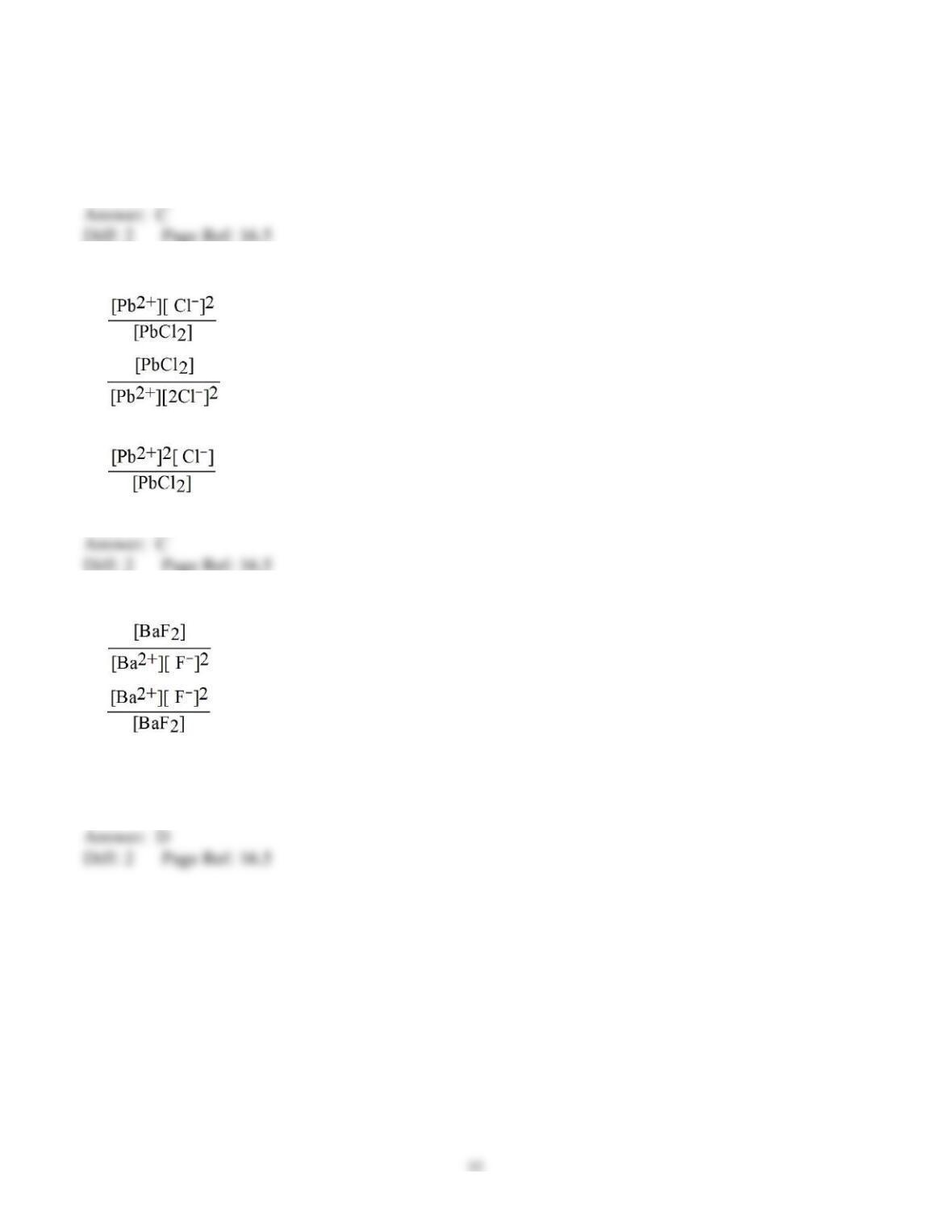
70) Give the expression for the solubility product constant for PbCl2.
A)
B)
C) [Pb2+][Cl⁻]2
D)
E) [Pb2+]2[2Cl⁻]
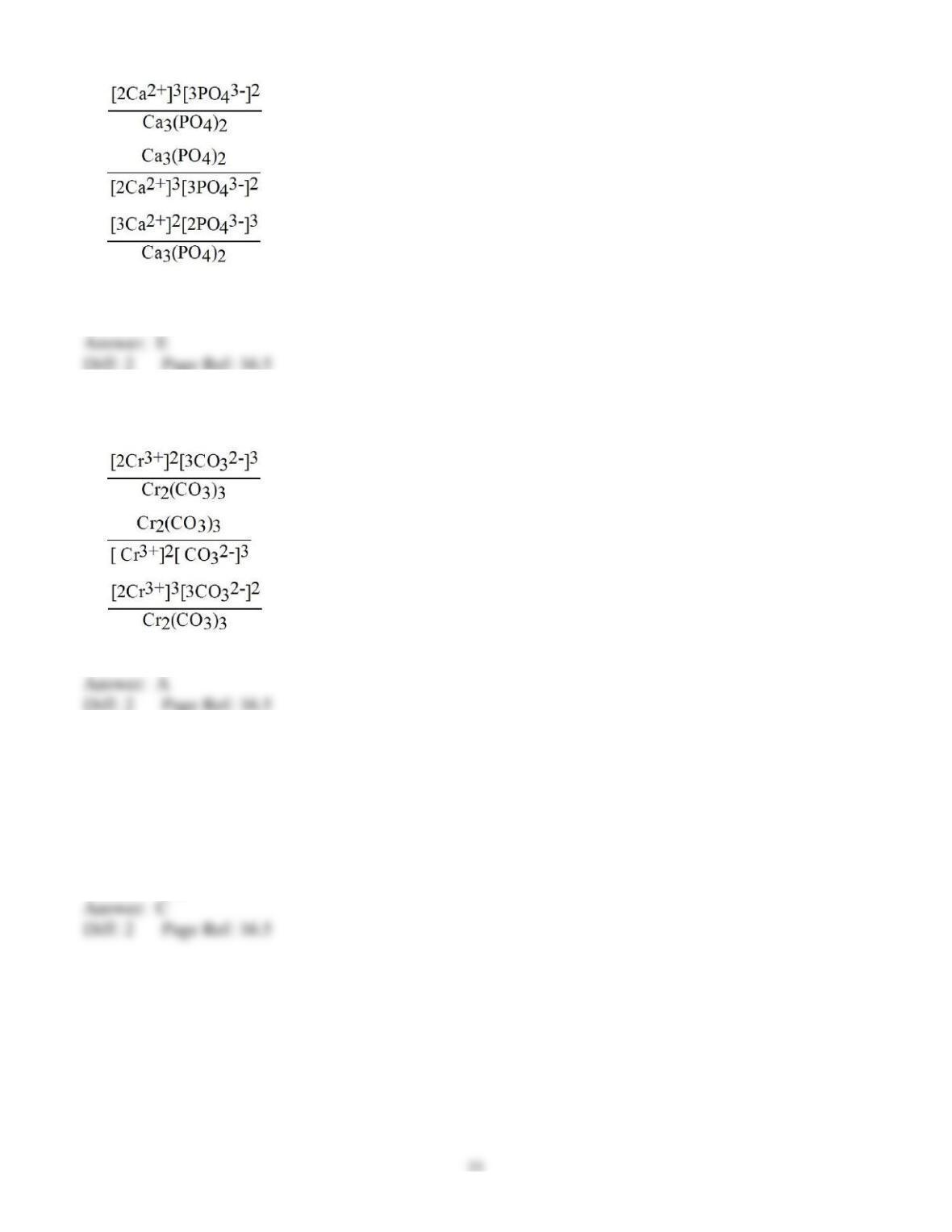
71) Give the expression for the solubility product constant for BaF2.
A)
B)
C) [Ba2+]2[ F⁻]
D) [Ba2+][F⁻]2
E) [Ba2+][2F⁻]
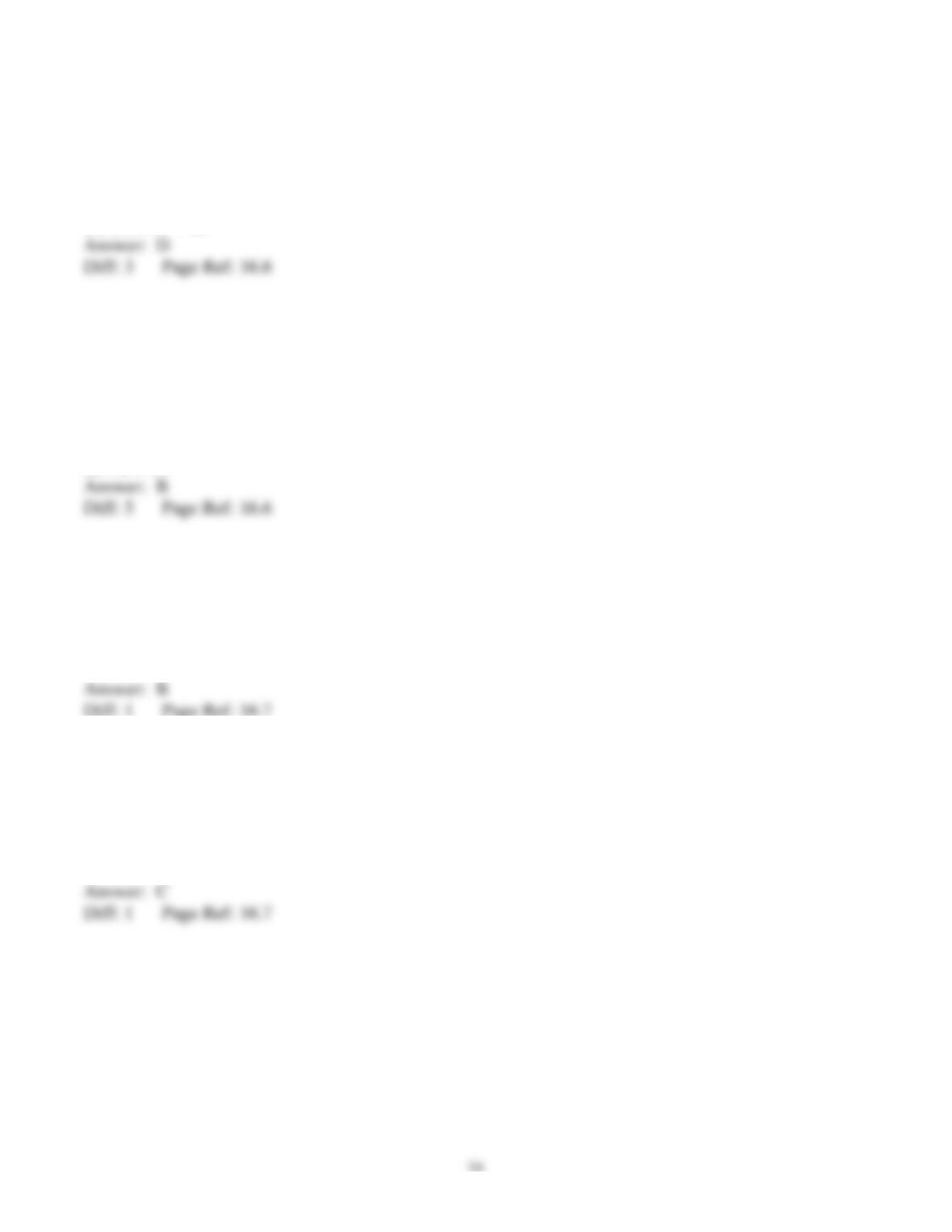
72) Give the expression for the solubility product constant for Ca3(PO4)2.
A)
B)
C)
D) [ Ca2+]2[ PO43-]3
E) [Ca2+]3[PO43-]2
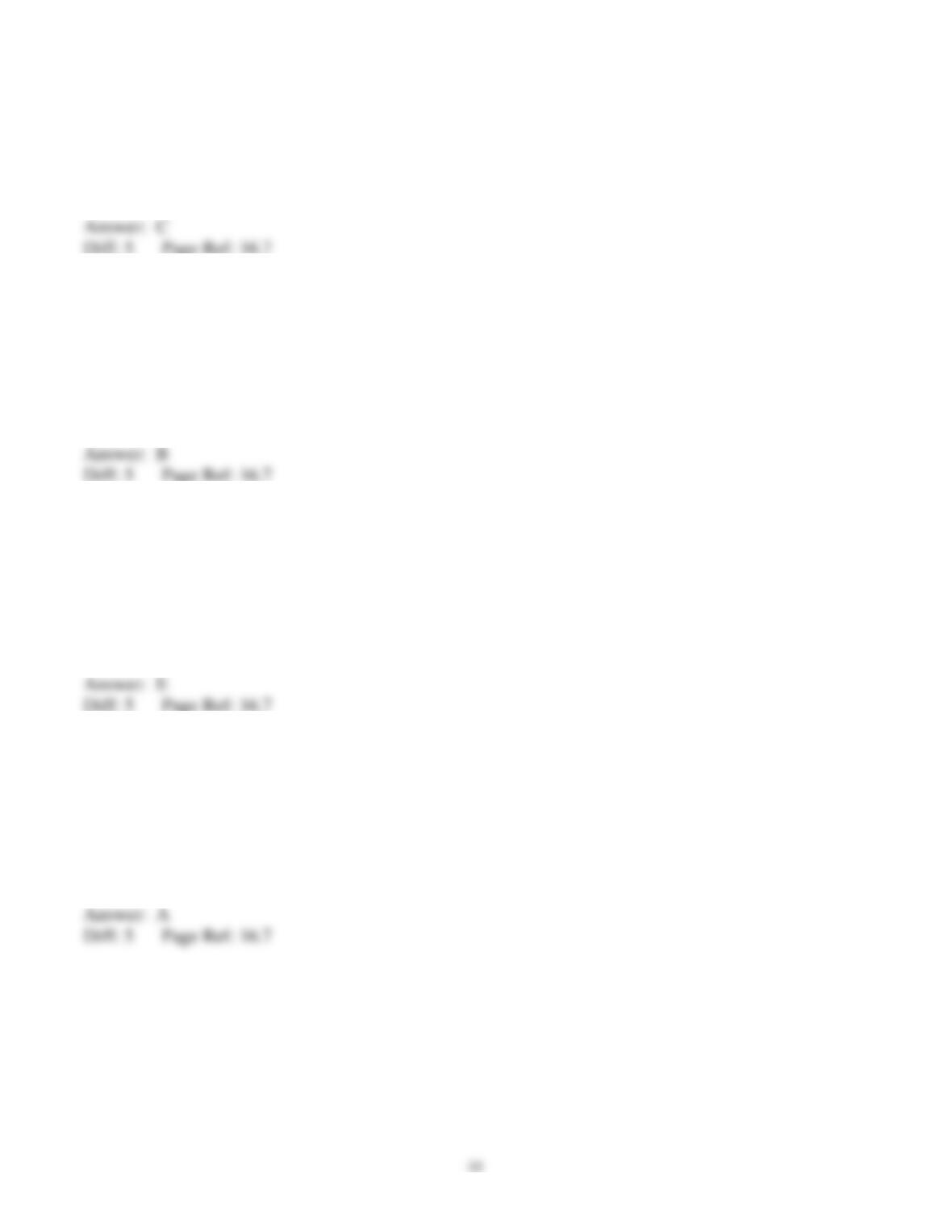
73) Give the expression for the solubility product constant for Cr2(CO3)3.
A) [Cr3+]2[CO32-]3
B)
C)
D)
E) [3Cr3+]3[2CO32-]2
74) Which of the following compounds will have the highest molar solubility in pure water?
A) HgS, Ksp = 1.6 × 10-54
B) CuS, Ksp = 1.27 × 10-36
C) Fe(OH)3, Ksp = 2.79 × 10-39
D) ZnS, Ksp = 2.0 × 10⁻²⁵
E) Ag2S, Ksp = 6.0 × 10-51
75) 0.10 M potassium chromate is slowly added to a solution containing 0.50 M AgNO3 and 0.50 M
Ba(NO3)2. What is the Ag+ concentration when BaCrO4 just starts to precipitate? The Ksp for
Ag2CrO4 and BaCrO4 are 1.1 × 10⁻¹² and 1.2 × 10⁻¹⁰, respectively.
A) 6.5 × 10⁻⁵ M
B) 1.3 × 10⁻⁴ M
C) 3.2 × 10⁻⁴ M
D) 6.8 × 10⁻² M
76) A solution of NaF is added dropwise to a solution that is 0.0144 M in Ba2+. When the concentration
of F– exceeds ________ M, BaF2 will precipitate. Neglect volume changes. For BaF2, Ksp = 1.7 × 10⁻⁶.
A) 5.9 × 10⁻⁵
B) 1.1 × 10⁻²
C) 2.4 × 10⁻⁸
D) 2.7 × 10⁻³
E) 1.2 × 10⁻⁴
77) Identify the compound that is acid-insoluble.
A) PbCl2
B) As2S3
C) NiS
D) Ca3(PO4)2
E) LiCl
78) Identify the compound that is base-insoluble.
A) PbCl2
B) As2S3
C) ZnS
D) Ca3(PO4)2
E) KCl
79) A sample contains Ba3(PO4)2, CdS, AgCl, NH4Cl, and ZnS. Identify the precipitate after the
addition of 6 M HCl.
A) Ca3(PO4)2
B) HgS
C) AgCl
D) NH4Cl
E) NiS
80) A sample contains Ba3(PO4)2, CdS, AgCl, NH4Cl, and ZnS. Identify the precipitate after the
addition of 6 M HCl, then H2S and 0.2 M HCl.
A) Ba3(PO4)2
B) CuS
C) AgCl
D) NH4Cl
E) MnS
81) A sample contains Ba3(PO4)2, CdS, AgCl, NH4Cl, and ZnS. Identify the precipitate after the
addition of 6 M HCl; H2S and 0.2 M HCl; and OH– to a pH of 8.
A) Ba3(PO4)2
B) HgS
C) AgCl
D) NH4Cl
E) MnS
82) A sample contains Ba3(PO4)2, CdS, AgCl, NH4Cl, and ZnS. Identify the precipitate after the
addition of 6 M HCl; H2S and 0.2 M HCl; OH– to a pH of 8; and (NH4)2HPO4 with NH3.
A) Ca3(PO4)2
B) HgS
C) AgCl
D) NH4Cl
E) ZnS
83) A sample contains Ba3(PO4)2, CdS, AgCl, NH4Cl, and ZnS. Identify the soluble ions after the
addition of 6 M HCl; H2S and 0.2 M HCl; OH– to a pH of 8; and (NH4)2HPO4 with NH3.
A) Ba3(PO4)2
B) HgS
C) AgCl
D) NH4Cl
E) FeS
84) A ligand is a molecule or ion that acts as a
A) Lewis acid
B) Brønsted-Lowry base
C) Arrhenius base
D) Lewis base
E) conjugate base
85) Describe the solubility of Al(OH)3 with respect to pH.
A) soluble at low pH, insoluble in pH-neutral solution, and soluble at high pH
B) soluble at low pH, insoluble in pH-neutral solution, and insoluble at high pH
C) insoluble at low pH,insoluble in pH-neutral solution, and soluble at high pH
D) insolubleinsoluble at low pH, in pH-neutral solution, and at high pH
E) pH has no effect on the solubility
86) Gives what happens at low pH for aluminum hydroxide.
A) Al(H2O)63+ dissolves
B) Al(H2O)4(OH)2– precipitates
C) Al(OH)3 precipitates
D) Al precipitates
E) Al dissolves
87) Gives what happens at neutral pH for aluminum hydroxide.
A) Al(H2O)63+ precipitates
B) Al(H2O)2(OH)4– dissolves
C) Al(OH)3 precipitates
D) Al precipitates
E) Al dissolves
88) Gives what happens at high pH for aluminum hydroxide.
A) Al(H2O)33+ precipitates
B) Al(H2O)2(OH)4– dissolves
C) Al(OH)5 dissolves
D) Al precipitates
E) Al dissolves
Matching Questions
Match the following.
A) 3/4 of the way to second equivalence point of a diprotic acid/strong base titration
B) half-way to equivalence point of a weak acid/strong base titration
C) equivalence point of a weak acid/strong base titration
D) equivalence point of a weak base/strong acid titration
E) equivalence point of a strong acid/strong base titration
1) pH = 7
Diff: 1 Page Ref: 16.4
2) pH = pKa
Diff: 1 Page Ref: 16.4
3) pH > 7
Diff: 1 Page Ref: 16.4
4) pH < 7
Diff: 1 Page Ref: 16.4
5) pH = pKa2
Diff: 1 Page Ref: 16.4
Short Answer Questions
1) Give the name of the compound that is in antifreeze and is toxic to pets.
2) Define a buffer.
3) Sketch the titration curve for a strong acid titrated with a strong base. Make sure to indicate the
equivalence point (and whether it is acidic, basic or neutral) and the buffer region.
4) Describe the information necessary (and why) to chose a good indicator for a weak acid/strong base
titration.
5) Sketch the titration curve for a monoprotic weak acid titrated with a strong base. Make sure to
indicate the equivalence point (and whether it is acidic, basic or neutral) and the buffer region.
6) Sketch the titration curve for a diprotic acid. Make sure to label the equivalence point(s) and the
relative amounts of base that were added to reach them.
7) Identify the compound that is in stalactites and stalagmites.
8) Consider the Ksp values for two compounds: MZ, Ksp = 1.5 × 10⁻²⁰ and MZ2, Ksp = 1.5 × 10⁻²⁰.
Why don’t these compounds have the same molar solubility?
9) Explain the common ion effect with respect to molar solubility.