
ch16 Key
1. Employee behavior may be adversely affected when standard cost variances are used as part of the employee
reward structure.
2. Perfection standards can be defined as standards that are “tight but attainable.”
3. Favorable variances need not be investigated because they do not cost the company money.
4. Standards should be determined only by the accounting staff.

5. The team involved in task analysis might include production engineers, production supervisors, cost
managers, and sales managers.
6. Perfection standards may encourage employees to sacrifice product quality to achieve lower costs.
7. Practical standards assume the process is as efficient as possible under normal operating conditions.
8. Standard costing systems provide information that can help managers reduce costs.
9. When computing the direct-material price variance, it is not important to distinguish between the quantity
purchased and the quantity used.

10. A manager will be interested in investigating material price variances where the price of the material is set
by an international market and tied into a long-term contract.
11. Statistical quality control charts plot cost variances across time and compare them with multiples of the
standard deviation.
12. Standard Costing is not appropriate in service-industry firms
13. Firms using standard costing systems do not use standards for product costing.

14. Bar codes are one of the ways by which standard costing systems can help link the use of information
technology to several business processes.
15. To compute the direct labor rate variance, you take the difference between the actual and standard rate and
multiply that amount by the standard hours allowed
16. A standard cost is a budget for the production of one unit of product or service.
17. When computing the direct material quantity variance, it is important to use the quantity actually used,
rather than the quantity purchased.

18. Because a key objective of cost management systems is the elimination of non–value-added costs, standards
need to be revised frequently in order to remain valid for cost control purposes.
19. Under management by exception all variances, regardless of size, are investigated.
20. A standard cost serves as a benchmark in the budgetary control system.
21. Kaizen costing is the process of cost reduction during the manufacturing phase of a product.
22. When manufacturing firms adopt advanced manufacturing methods, they totally discontinue their use of
standard costing.
23. Under kaizen costing the starting point for the kaizen goal cost reduction rate and amount for the current
year is the actual cost performance at the end of the preceding year.
24. [Appendix] Manufacturing processes using multiple types of direct material conduct additional analyses of
the quantity variance because of the assumption of some degree of substitutability among the materials in the
production process.
25. [Appendix] Service organizations using different types of labor might apply the concepts of the production
mix and yield variances to analyze the impact of substituting one type of labor for another.
26. Which of the following are not part of a control system?
27. Which of the following methods are not used to set standards?
28. Practical standards assume
29. During June, 90,000 units were produced. The standard quantity of material allowed per unit was 2 pounds
at a standard cost of $5 per pound. If there was an unfavorable quantity variance of $5,000 for June, the actual
quantity of materials used must have been
30. Perfection standards assume which of the following:
31. Generally a variance should be investigated if:
32. Unfavorable material quantity variances
Use the following to answer questions 33-34:
The following standard cost information is available for Leah Co.’s only product: Direct material 9 feet at $5.00
per foot. Actual information for July: 2,000 units were produced; 20,000 feet of direct material were purchased
at a cost of $92,000 and 19,000 feet of material were used.
Hilton – Chapter 16
33. What is the material purchase price variance for July?
34. What is the material quantity variance for July?
Use the following to answer questions 35-38:
Stanton Co. uses the following standards in the production of its only product:
Direct material 18 pounds at $25 per pound
Direct labor: 6 hours at $18 per hour.
During March company records showed the following:
Hilton – Chapter 16
35. The material purchase price variance is
36. The material quantity variance is
37. The direct labor rate variance is
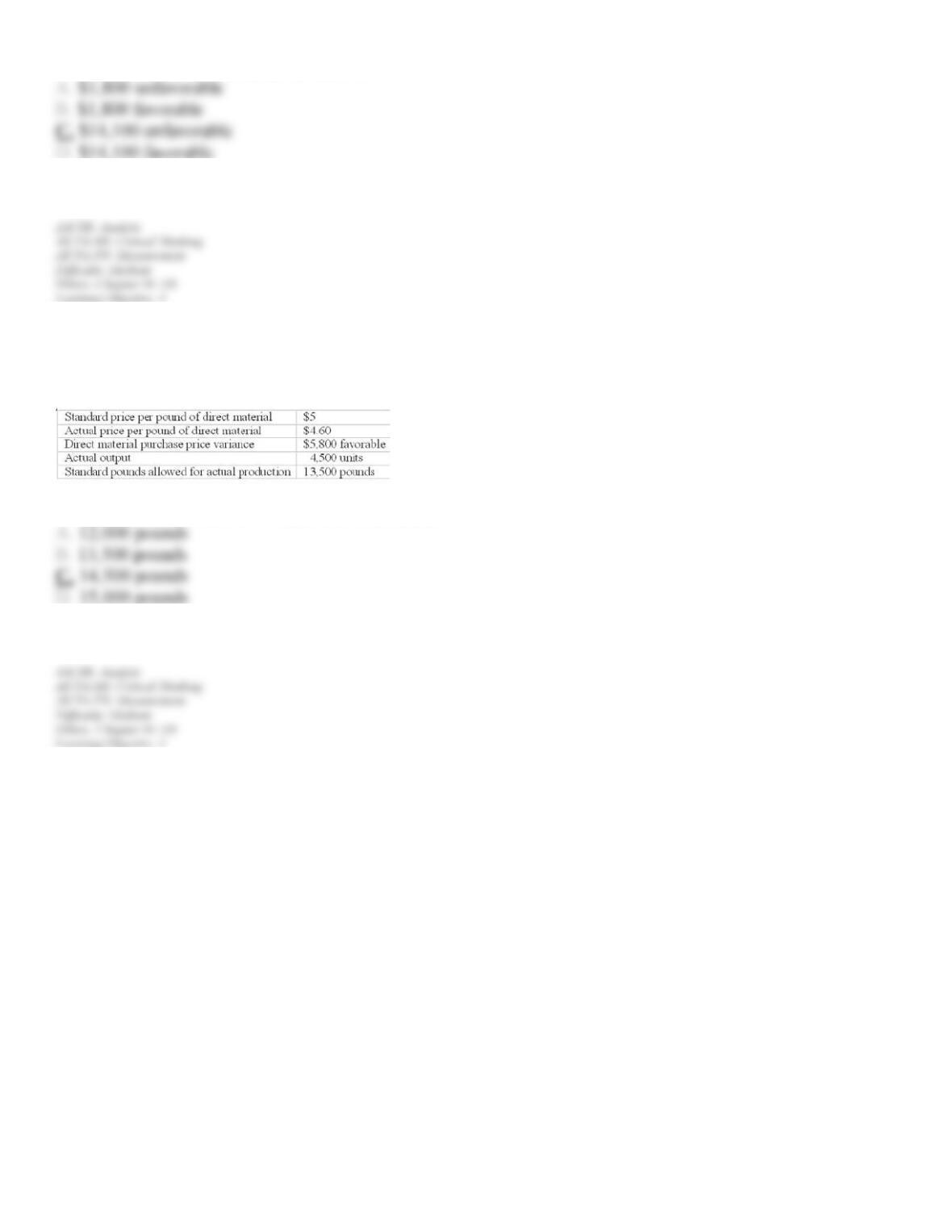
38. The direct labor efficiency variance is
39. Duffy‘s records for March show the following information from its standard costing system:
How much direct material was purchased in March?
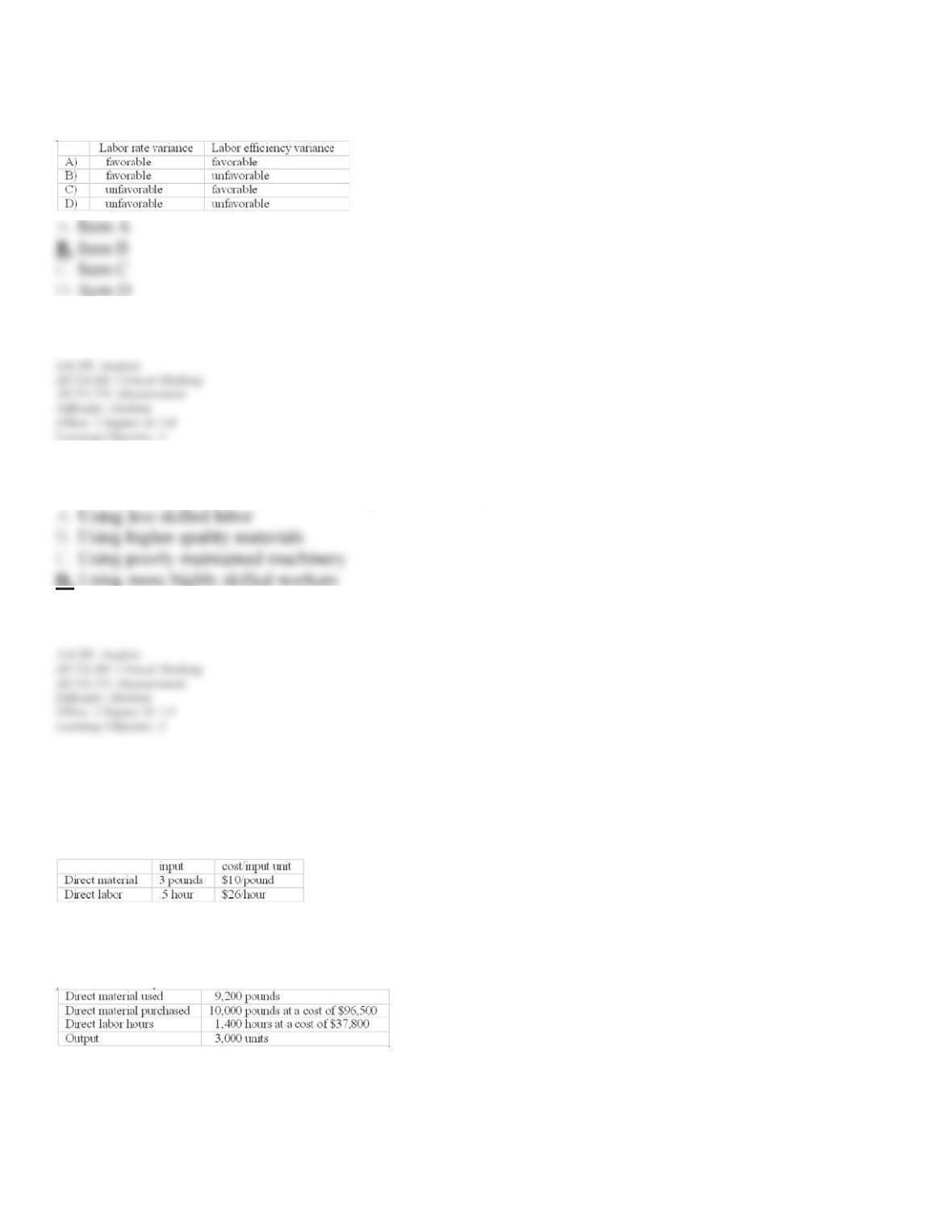
40. If the standard labor rate exceeds the actual labor rate and the actual labor hours exceed the standard number
of hours allowed, the labor rate variance and the labor efficiency variance will be
41. An unfavorable labor rate variance might be caused by
Use the following to answer questions 42-44:
Cabot Inc. uses a standard costing system for its only product. The standards are as follows:
Actual data for September are:
Hilton – Chapter 16
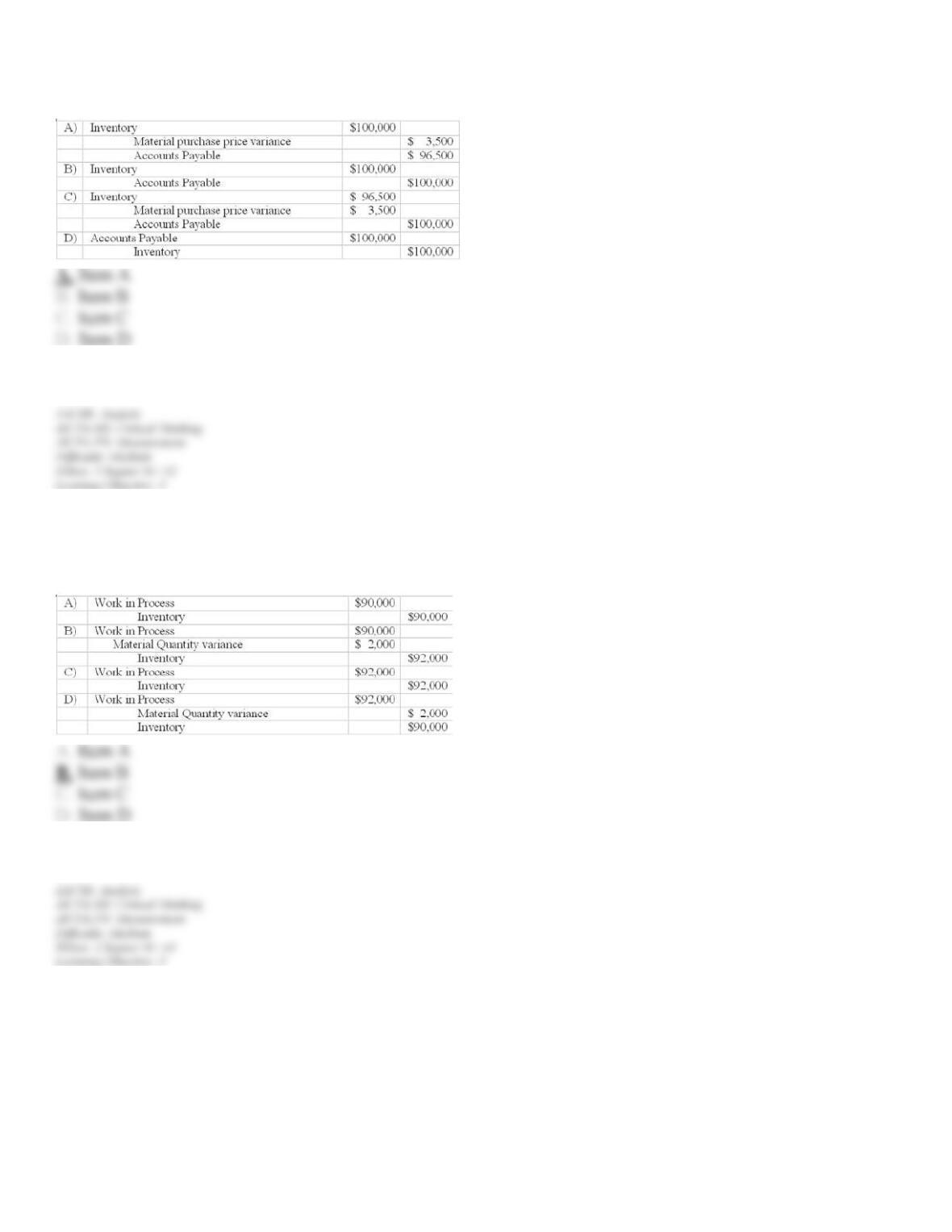
42. Which of the following is the journal entry that was made when the material was purchased?
43. Which of the following is the journal entry to record the use of direct material?
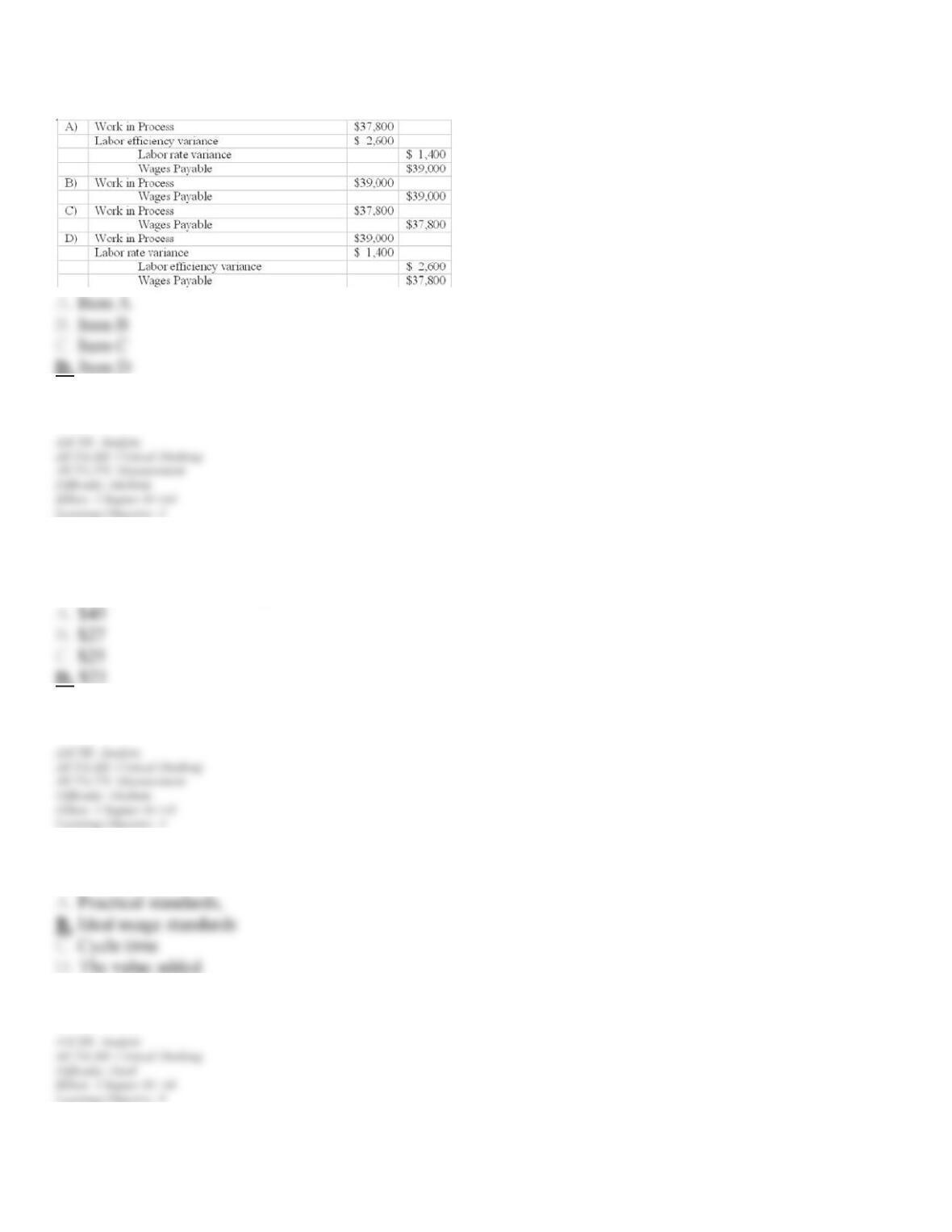
44. Which of the following journal entries would be used to record direct labor for September?
45. During March 20,000 direct labor hours were worked at a standard cost of $20per hour. The direct labor rate
variance for March was $60,000 unfavorable. The actual cost for direct labor in March was:
46. Value-added costs are standard costs based on
47. Which of the following is/are a signal that a variance should be investigated?
48. Which of the following does not affect a material purchase price variance?
49. Which of the following variances might be affected by the purchase of off-standard materials?
I favorable material purchase price variance
II unfavorable material quantity variance
III unfavorable labor rate variance
IV unfavorable labor efficiency variance
50. The following statements relate to standard costing systems:
I Computation of standard costs and cost variances enables managers to employ management by exception.
II Variances provide a means of performance evaluation and rewards for employees
III Short product life cycles mean that standards are relevant for only a short time
IV Use of standard costs in product costing results in more stable product costs than if actual product costs were
used
Which of these statements are considered advantages of standard costing?
51. The following statements relate to standard costing systems:
I Traditional standard costing systems focus too much on the cost and efficiency of direct labor which is rapidly
becoming a relatively unimportant factor of production
II Traditional standard cost variances are too aggregated in the sense that they are not tied to specific product
lines, production batches, or flexible manufacturing systems
III Traditional standard costing systems tend to focus too much on cost minimization rather than increasing
product quality or customer service
IV Traditional standard costing is not defined broadly enough to capture various important aspects of
performance
Which of these statements relate to disadvantages of standard costing under modern cost management systems?
52. Lopata Manufacturing uses a standard cost system for its guitar boxes. The standard labor rate per box is $1
per box. This standard was established on the basis of producing 8 boxes per hour. This month, Lopata
produced 1,500 boxes using 580 direct labor hours at an actual direct labor cost of $5,800. The direct labor rate
variance was
53. Variances indicate
Use the following to answer questions 54-57:
The Alperti Company manufactures surgical gowns for hospitals. Their controller, Ethell Hieken is preparing
the variance analysis report for October. Standard Costs are as follows:
Direct Material 2.0 yards at $6 per yard
Direct Labor 0.25 hours at $12 per hour
During October, Ms Hieken’s report shows:
100,000 gowns produced
175,000 yards of fabric purchased at a cost of $1,137,500
185,000 yards of fabric used
Employees worked 24,000 hours at a cost of $276,000
Hilton – Chapter 16
54. The material price variance is
55. The material quantity variance is
56. The direct labor rate variance is
57. The direct labor efficiency variance is
58. Efficiency (quantity) variances focus on the difference between
59. A material price variance would not be caused by