
College Physics: A Strategic Approach, 3e (Knight)
Chapter 16 Superposition and Standing Waves
16.1 Conceptual Questions
1) When a guitar is tuned to adjust it pitch, what is it that is changed?
A) The wavelength of the fundamental.
B) The frequency of the fundamental.
C) The amplitude of the fundamental.
2) If a guitar string has a fundamental frequency of 500 Hz, which one of the following
frequencies can set the string into resonant vibration?
A) 250 Hz
B) 750 Hz
C) 1500 Hz
D) 1750 Hz
3) A stretched string is observed to have four equal segments in a standing wave driven at a
frequency of 480 Hz. What driving frequency will set up a standing wave with five equal
segments?
A) 600 Hz
B) 360 Hz
C) 240 Hz
D) 120 Hz
4) If a string fixed at both ends resonates in its fundamental mode with a frequency of 150 Hz, at
which of the following frequencies will it not resonate? (There could be more than one correct
choice.)
A) 75 Hz
B) 300 Hz
C) 450 Hz
D) 500 Hz
E) 600 Hz

5) A string fixed at both ends is vibrating in one of its harmonics. If we now increase only the
frequency at which the string is vibrating, which of the following characteristics do we also
increase? (There could be more than one correct choice.)
A) the speed of the traveling waves on the string
B) the period of the traveling waves on the string
C) the wavelength of the traveling waves on the string
D) the amplitude of the traveling waves on the string
E) none of the above
6) An organ pipe of length L that is open at one end resonates in its third harmonic with a
wavelength of 2L/3. Is the other end of the pipe closed or open?
A) closed
B) open
C) We cannot tell from the information provided.
7) In a resonating pipe that is open at both ends, there
A) are displacement nodes at each end.
B) are displacement antinodes at each end.
C) is a displacement node at one end and a displacement antinode at the other end.
D) None of the above choices are correct.
8) In a resonating pipe that is open at one end and closed at the other end, there
A) are displacement nodes at each end.
B) are displacement antinodes at each end.
C) is a displacement node at the open end and a displacement antinode at the closed end.
D) is a displacement node at the closed end and a displacement antinode at the open end.
9) The lowest tone to resonate in pipe of length L that is open at both ends is 200 Hz. Which one
of the following frequencies will not resonate in the same pipe?
A) 200 Hz
B) 400 Hz
C) 600 Hz
D) 800 Hz
E) 900 Hz

10) The lowest tone to resonate in a pipe of length L that is closed at one end but open at the
other end is 200 Hz. Which one of the following frequencies will not resonate in that pipe?
A) 200 Hz
B) 400 Hz
C) 600 Hz
D) 1000 Hz
E) 1400 Hz
11) Consider the standing wave on a guitar string and the sound wave generated by the string as
a result of this vibration. What do these two waves have in common? (There may be more than
one correct choice.)
A) They have the same wavelength.
B) They have the same speed.
C) They have the same frequency.
D) They have the same amplitude.
E) They have the same period.
12) Consider a pipe of length L that is open at both ends. What are the wavelengths of the three
lowest-pitch tones produced by this pipe?
A) 4L, 2L, L
B) 2L, L, L/2
C) 2L, L, 2L/3
D) 4L, 4L/3, 4L/5
13) An pipe of length L that is open at both ends is resonating at its fundamental frequency.
Which statement about the sound is correct?
A) The wavelength is 2L and there is a displacement node at the pipe’s midpoint.
B) The wavelength is 2L and there is a displacement antinode at the pipe’s midpoint.
C) The wavelength is L and there is a displacement node at the pipe’s midpoint.
D) The wavelength is L and there is a displacement antinode at the pipe’s midpoint.
14) In a resonating pipe that is open at one end and closed at the other, there
A) are displacement nodes at each end.
B) are displacement antinodes at each end.
C) is a displacement node at the open end and a displacement antinode at the closed end.
D) is a displacement node at the closed end and a displacement antinode at the open end.

15) Consider a pipe of length L that is open at one end and closed at the other end. What are the
wavelengths of the three lowest-pitch tones produced by this pipe?
A) 4L, 2L, L
B) 2L, L, L/2
C) 2L, L, 2 L/3
D) 4L, 4L/3, 4L/5
16) A pipe of length L that is closed at one end and open at the other end is resonating at its
fundamental frequency. Which statement about the sound is correct?
A) The wavelength is 4L and there is a displacement node at the pipe’s open end.
B) The wavelength is 4L and there is a displacement antinode at the pipe’s open end.
C) The wavelength is L and there is a displacement node at the pipe’s open end.
D) The wavelength is L and there is a displacement antinode at the pipe’s open end.
17) Two tuning forks have frequencies of 440 and 522 Hz. What is the beat frequency if both are
sounding simultaneously?
A) 962 Hz
B) 481 Hz
C) 82 Hz
D) 55 Hz
E) 41 Hz
18) Two strings both vibrate at exactly 819 Hz. The tension in one of them is then increased
slightly. As a result, six beats per second are heard when both strings vibrate. What is the new
frequency of the string that was tightened?
A) 825 Hz
B) 813 Hz
C) 822 Hz
D) 816 Hz
19) Two pure tones are sounded together and a particular beat frequency is heard. What happens
to the beat frequency if the frequency of one of the tones is increased?
A) It increases.
B) It decreases.
C) It does not change.
D) It could either increase or decrease.

20) A music tuner uses a 554-Hz C# tuning fork to tune the frequency of a musical instrument.
If the tuner hears a beat frequency of 2 Hz, what is the frequency of the instrument?
A) It must be 556 Hz.
B) It must be 552 Hz.
C) It could be either 556 Hz or 552 Hz.
D) It could be either 553 Hz or 555 Hz.
E) It is neither 556 Hz or 552 Hz.
21) A person stands between two speakers driven by the same source. Each speaker produces a
tone with a frequency of 200 Hz on a day when the speed of sound is 330 m/s. The person is
1.65 m from one speaker and 4.95 m from the other. What type of interference does the person
perceive?
A) constructive
B) destructive
C) both constructive and destructive
D) neither constructive nor destructive
1) A guitar string 0.65 m long has a tension of 61 N and a mass per unit length of 3.0 g/m.
(a) What is the speed of waves on the string when it is plucked?
(b) What is the string’s fundamental frequency of vibration when plucked?
(c) At what other frequencies will this string vibrate?
2) Standing waves of frequency 17 Hz are produced on a string that has a mass per unit length of
To what tension must the string be stretched between two supports if adjacent nodes
in the standing wave are to be 0.87 m apart?
3) The speed of propagation of a transverse wave on a 2.0-m long string fixed at both ends is 200
m/s. Which one of the following is not a resonant frequency of this string?
A) 25 Hz
B) 50 Hz
C) 100 Hz
D) 200 Hz

4) A string of linear density 1.5 g/m is under a tension of 20 N. What should be its length if its
fundamental resonance frequency is 220 Hz?
A) 0.26 m
B) 0.96 m
C) 1.1 m
D) 1.2 m
5) Find the first three harmonics of a string of linear mass density 2.00 g/m and length 0.600 m
when the tension in it is 50.0 N.
A) 132 Hz, 264 Hz, 395 Hz
B) 66 Hz, 132 Hz, 198 Hz
C) 264 Hz, 528 Hz, 792 Hz
D) none of the above
6) A string of length 2.5 m is fixed at both ends. When the string vibrates at a frequency of 85
Hz, a standing wave with five loops is formed.
(a) Determine the distance between two adjacent nodes.
(b) Determine the wavelength of the waves that travel on the string.
(c) Determine the speed of traveling waves on this string.
(d) Determine the fundamental frequency of this string.
7) What is the frequency of the fundamental mode of vibration of a steel piano wire stretched to
a tension of 440 N? The wire is 0.600 m long and has a mass of 5.60 g.
A) 517 Hz
B) 234 Hz
C) 181 Hz
D) 312 Hz
E) 366 Hz
8) A 25-g string is stretched with a tension of 43 N between two fixed points 12 m apart. What is
the frequency of the second harmonic?
A) 6.0 Hz
B) 12 Hz
C) 18 Hz
D) 24 Hz
E) 36 Hz
9) A 0.588-m string is tightly clamped at both ends. If the lowest standing wave frequency of the
string is how fast do waves travel on this string?
A) 383 m/s
B) 475 m/s
C) 582 m/s
D) 724 m/s
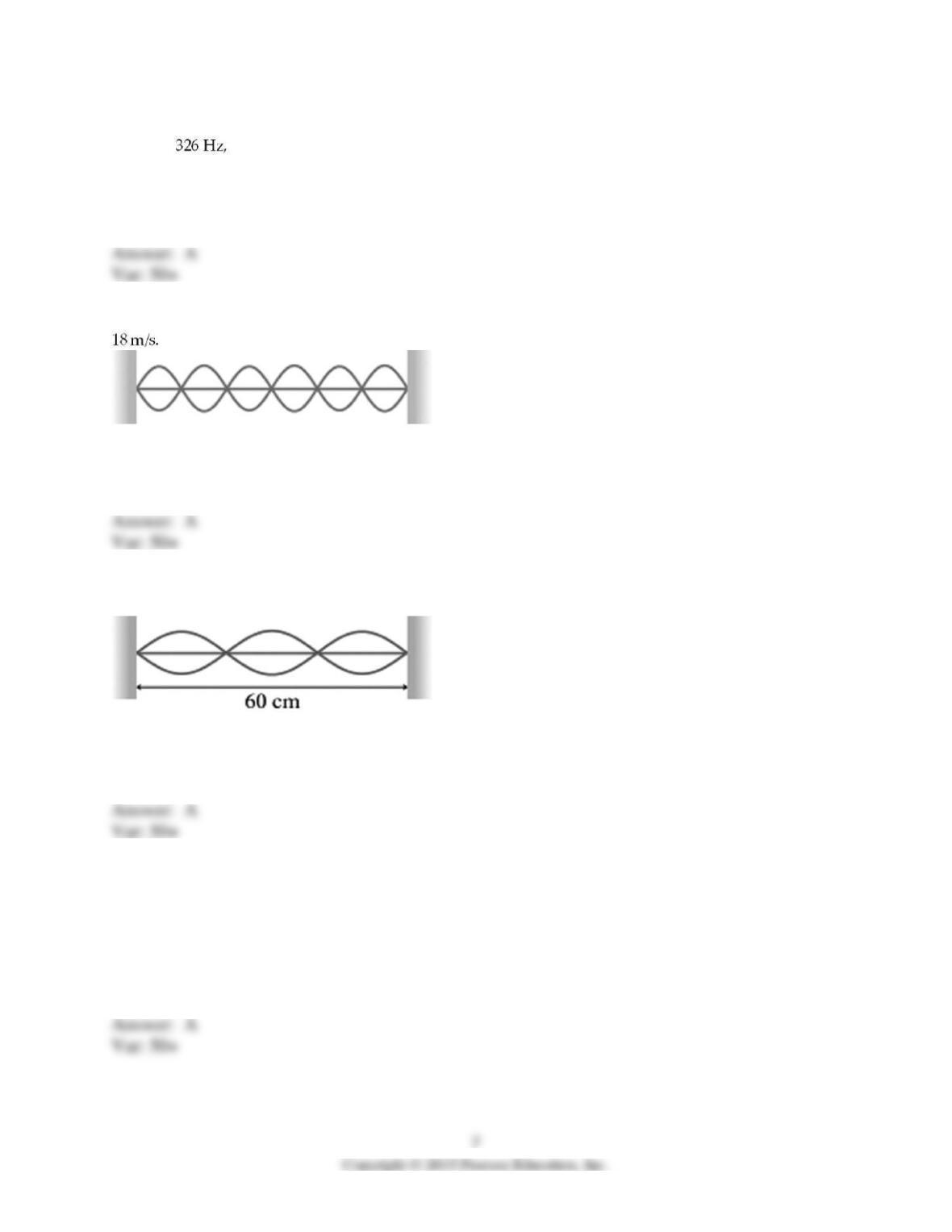
10) A string that is 2.0 meters long is fixed at both ends and tightened until the wave speed is
What is the frequency of the standing wave shown in the figure?
A) 27 Hz
B) 54 Hz
C) 81 Hz
D) 110 Hz
11) A standing wave is oscillating at 950 Hz on a string, as shown in the figure. What is the wave
speed?
A) 380 m/s
B) 570 m/s
C) 290 m/s
D) 190 m/s
12) A guitar-like stringed instrument has a string that is 16 cm long. It sounds the musical note
A (440 Hz) when played without fingering. By what distance should you shorten it to play the
note C (523 Hz)?
A) 2.5 cm
B) 1.7 cm
C) 3.4 cm
D) 4.2 cm

13) A 4.0-g string is 0.36 m long and is under tension. The string vibrates at 500 Hz in its third
harmonic. What is the wavelength of the standing wave in the string?
A) 0.24 m
B) 0.36 m
C) 0.54 m
D) 0.72 m
E) 0.90 m
14) A 4.0-g string is 0.39 m long and is under tension. The string vibrates at 600 Hz in its third
harmonic. What is the tension in this string?
A) 250 N
B) 200 N
C) 160 N
D) 290 N
E) 340 N
15) One of the harmonics of a string fixed at both ends has a frequency of 52.2 Hz and the next
higher harmonic has a frequency of 60.9 Hz. What is the fundamental frequency of the string?
A) 26.1 Hz
B) 8.7 Hz
C) 4.35 Hz
D) 30.4 Hz
E) 17.4 Hz
16) If the frequency of a violin string is to be increased by 20%, what change in tension must be
applied?
A) 44%
B) 20%
C) 4.5%
D) 10%
17) An organ pipe that is 1.75 m long and open at both ends produces sound of frequency 303 Hz
when resonating in its second overtone. What is the speed of sound in the room?

18) An organ pipe closed at one end and open at the other end has two successive harmonics
with frequencies of 2170 Hz and 2790 Hz. What is the fundamental frequency of the pipe?
19) A pipe that is 0.92 m long and open at both ends vibrates in the second overtone with a
frequency of What is the speed of sound in the air in this pipe?
A) 358 m/s
B) 349 m/s
C) 353 m/s
D) 344 m/s
E) 363 m/s
20) A standing wave of the third overtone is induced in a 1.2-m pipe that is open at one end and
closed at the other end. The speed of sound in the pipe is 340 m/s.
(a) How many antinodes are there in the standing wave pattern?
(b) What is the frequency of the sound produced by the pipe in this situation?
21) An organ pipe open at both ends has a length of 0.80 m. If the velocity of sound in air is
what is the frequency of the second harmonic of this pipe?
A) 213 Hz
B) 425 Hz
C) 638 Hz
D) 850 Hz
22) What is the length of the shortest pipe closed on one end and open at the other end that will
have a fundamental frequency of 0.060 kHz on a day when the speed of sound is 340 m/s?
A) 1.24 m
B) 1.42 m
C) 2.14 m
D) 4.12 m

23) Consider two pipes of the same length: one pipe is open at both ends and the other pipe is
closed on one end but open at the other end. If the fundamental frequency of the totally open
pipe is 300 Hz, what is the fundamental frequency of the other pipe?
A) 150 Hz
B) 300 Hz
C) 450 Hz
D) 600 Hz
24) One of the harmonics of a column of air in a tube that is open at one end and closed at the
other has a frequency of 448 Hz, and the next higher harmonic has a frequency of 576 Hz. What
is the fundamental frequency of the air column in this tube?
A) 32 Hz
B) 64 Hz
C) 88 Hz
D) 128 Hz
E) 256 Hz
25) One of the harmonics of a column of air in a tube that is open at both ends has a frequency of
448 Hz, and the next higher harmonic has a frequency of 576 Hz. What is the fundamental
frequency of the air column in this tube?
A) 32 Hz
B) 64 Hz
C) 88 Hz
D) 128 Hz
E) 256 Hz
26) One of the harmonics of a column of air in a tube that is open at one end and closed at the
other has a frequency of 448 Hz, and the next higher harmonic has a frequency of 576 Hz. How
long is the tube? The speed of sound in air is 343 m/s.
A) 1.34 m
B) 0.670 m
C) 0.335 m
D) 1.00 m
E) 2.68 m

27) A 2.0-g string that is 0.67 m long is under tension. The string vibrates at 700 Hz tone in its
third harmonic, and this vibration causes a sound wave. What is the wavelength of the sound?
The speed of sound in air is 344 m/s.
A) 0.49
B) 0.55
C) 0.61
D) 0.67
E) 0.45
28) A string that is 0.15 m long and fixed at both ends is vibrating in its n = 5 harmonic. The
sound from this string excites a pipe that is long and open at both ends into its second
overtone resonance. What is the distance between a node and an adjacent antinode, in the string?
The speed of sound in air is 345 m/s.
A) 15 mm
B) 7.5 mm
C) 23 mm
D) 30 mm
E) 150 mm
29) A string that is 0.26 m long is vibrating in its n = 6 harmonic. The sound from tthis string
excites a pipe that is long and open at both ends into its second overtone resonance. What
is the common resonant frequency of the string and the pipe? The speed of sound in air is 345
m/s.
A) 590 Hz
B) 390 Hz
C) 490 Hz
D) 690 Hz
E) 760 Hz
30) A 0.13-m string, fixed at both ends and vibrating in its n = 4 harmonic, excites a pipe that is
long and open at both ends, into its second overtone resonance. What is the speed of
transverse waves on the string? The speed of sound in air is 345 m/s.
A) 38 m/s
B) 36 m/s
C) 34 m/s
D) 32 m/s
E) 30 m/s

31) A violin with string length 32 cm and string density resonates in its fundamental with
the first overtone of a 2.0-m organ pipe with one end closed and one end open. What is the
tension in the string if the speed of sound in air is 344 m/s?
A) 1000 N
B) 110 N
C) 450 N
D) 4100 N
E) 56 N
32) Two police cars have identical sirens that produce sound of frequency of 570 Hz. A
stationary listener is standing between two cars. One car is parked and the other is approaching
the listener and both have their sirens on. The listener measures 9.0 beats per second. Find the
speed of the approaching police car. The speed of sound is 340 m/s.
33) The wavelengths of the sounds produced by two horns are 6.0 m and 7.0 m, respectively.
What beat frequency is heard when the horns are sounded on a day when the speed of sound is
340 m/s?
A) 5 Hz
B) 6 Hz
C) 7 Hz
D) 8 Hz
34) Two taut strings of identical mass per unit length are stretched with the same tension with
their ends fixed, but one string is 0.330 cm longer than the other. Waves on these strings
propagate at 34.0 m/s.The fundamental frequency of the shorter string is 258 Hz. What is the
beat frequency when each string is vibrating at its fundamental frequency?
A) 12.3 Hz
B) 9.00 Hz
C) 12.0 Hz
D) 12.7 Hz
E) 11.3 Hz

35) Two taut strings of identical mass and length are stretched with their ends fixed, but the
tension in one string is 1.10 times greater than in the other. Waves on the string with the lower
tension propagate at 35.2 m/s. The fundamental frequency of that string is 258 Hz. What is the
beat frequency when each string is vibrating at its fundamental frequency?
A) 11.0 Hz
B) 9.00 Hz
C) 13.7 Hz
D) 12.6 Hz
E) 17.1 Hz
36) A policeman in a stationary car measures the speed of approaching cars by means of an
ultrasonic device that emits a sound with a frequency of 39.6 kHz. A car is approaching him at a
speed of 35.0 m/s. The wave is reflected by the car and interferes with the emitted sound
producing beats. What is the frequency of the beats when the speed of sound in air is 343 m/s?
A) 5000 Hz
B) 4500 Hz
C) 8490 Hz
D) 9000 Hz
E) 4250 Hz
37) Two in-phase loudspeakers are 3.0 m apart. They emit sound with a frequency of 490 Hz. A
microphone is placed half-way between the speakers and then moved along the line joining the
two speakers until the first point of constructive interference is found. At what distance from that
midpoint is that first point? The speed of sound in air is 343 m/s.
A) 0.18 m
B) 0.35 m
C) 0.50 m
D) 0.70 m
E) There is no point in that line where constructive interference occurs.
38) Two in-phase loudspeakers are placed along a wall and are separated by a distance of 4.00
m. They emit sound with a frequency of 514 Hz. A person is standing away from the wall, in
front of one of the loudspeakers. What is the closest nonzero distance from the wall the person
can stand and hear constructive interference? The speed of sound in air is 343 m/s.
A) 0.34 m
B) 0.73 m
C) 1.2 m
D) 1.6 m

39) Two in-phase loudspeakers are placed along a wall and are separated by a distance of 4.00
m. They emit sound with a frequency of 514 Hz. A person is standing away from the wall, in
front of one of the loudspeakers. What is the closest distance from the wall the person can stand
and hear destructive interference? The speed of sound in air is 343 m/s.
A) 0.34 m
B) 0.37 m
C) 0.73 m
D) 1.2 m
E) 1.6 m
40) Two in-phase loudspeakers that emit sound with the same frequency are placed along a wall
and are separated by a distance of 5.00 m. A person is standing 12.0 m away from the wall,
equidistant from the loudspeakers. When the person moves 1.00 m parallel to the wall, she
experiences destructive interference for the first time. What is the frequency of the sound? The
speed of sound in air is 343 m/s.
A) 211 Hz
B) 256 Hz
C) 422 Hz
D) 512 Hz
E) 674 Hz
41) Two in-phase loudspeakers that emit sound with the same frequency are placed along a wall
and are separated by a distance of 8.00 m. A person is standing 12.0 m away from the wall,
equidistant from the loudspeakers. When the person moves 3.00 m parallel to the wall, she
experiences destructive interference for the second time. What is the frequency of the sound?
The speed of sound in air is 343 m/s.
A) 278 Hz
B) 422 Hz
C) 452 Hz
D) 562 Hz
E) 694 Hz

42) Two loudspeakers placed 6.00 m apart are driven in phase by an audio oscillator having a
frequency range from 1908 Hz to 2471 Hz. A point P is located 4.70 m from one loudspeaker
and 3.60 m from the other speaker. At what frequency of the oscillator does the sound reaching
point P interfere constructively? The speed of sound is 344 m/s.
A) 2190 Hz
B) 2420 Hz
C) 2110 Hz
D) 2340 Hz
E) 2270 Hz
43) Two loudspeakers placed 6.00 m apart are driven in phase by an audio oscillator having a
frequency range from 1595 Hz to 2158 Hz. A point P is located 4.70 m from one loudspeaker
and 3.60 m from the other speaker. The speed of sound in the room is 344 m/s. At what
frequency (or frequencies) of the oscillator does the sound reaching point P interfere
destructively? (There could be more than one correct choice.)
A) 2030 Hz
B) 2130 Hz
C) 2100 Hz
D) 1720 Hz
E) 1630 Hz
44) Two stereo speakers mounted 4.52 m apart on a wall emit identical sound waves. You are
standing at the opposite wall of the room at a point directly between the two speakers. You walk
2.11 m parallel to the wall, to a location where you first notice that the sound intensity is
essentially zero. If the wall along which you are walking is from the wall with the
speakers, what is the wavelength of the sound waves? The walls are cushioned to absorb sound
reflections.
A) 1.71 m
B) 2.05 m
C) 2.57 m
D) 2.91 m

45) Two speakers are placed side by side and driven by the same frequency of 0.50 kHz. If the
distance from a person to one speaker is 5.0 m and the person detects little or no sound, which of
the following is a possible the distance from the person to the other speaker? The sound speed in
the room is 340 m/s.
A) 7.7 m
B) 8.1 m
C) 8.4 m
D) 9.1 m