Chemistry, 7e (McMurry/Fay)
Chapter 16 Applications of Aqueous Equilibria
16.1 Multiple-Choice Questions
1) What is the approximate value of the equilibrium constant, Kn, for the neutralization of pyridine with
hydrochloric acid, shown in the equation below? The Kb for pyridine is 1.8 × 10⁻⁹.
HCl(aq) + C5H5N(aq) ⇌ C5H5NHCl(aq)
A) 5.6 × 10⁻¹⁰
B) 5.6 × 10⁻⁶
C) 1.8 × 10⁵
D) 5.6 × 10⁸
2) What is the approximate value of the equilibrium constant, Kn, for the neutralization of nitrous acid
with ammonia, shown in the equation below? The Ka for HNO2 is 4.5 × 10⁻⁴ and the Kb for NH3 is 1.8 ×
10-5.
HNO2(aq) + NH3(aq) ⇌ NH4NO2(aq)
A) 8.1 × 10⁵
B) 1.8 × 10⁹
C) 4.5 × 10¹⁰
D) 8.1 × 10¹⁹
3) The neutralization constant Kn for the neutralization of acetylsalicylic acid (C9H8O4) and codeine
(C18H21NO3) is 4.8 × 10⁴. The acid dissociation constant Ka for acetylsalicylic acid is 3.0 × 10⁻⁴. What is
the base dissociation constant Kb for codeine?
A) 4.8 × 10⁻²⁴
B) 6.3 × 10⁻²³
C) 1.6 × 10⁻⁶
D) 1.4 × 10¹⁵
4) The neutralization constant Kn for the neutralization of phenobarbital (C12H12N2O3) and morphine
(C17H19NO3) is 2.9. The acid dissociation constant Ka for phenobarbital is 3.9 × 10⁻⁸. What is the base
dissociation constant Kb for morphine?
A) 1.3 × 10⁻²²
B) 6.3 × 10⁻²³
C) 7.4 × 10⁻⁷
D) 1.1 × 10⁷
5) What is the hydronium ion concentration in a solution prepared by mixing 50.00 mL of 0.10 M HCN
with 50.00 mL of NaCN? Assume that the volumes of the solutions are additive and that Ka = 4.9
× 10–10 for HCN.
A) 2.4 × 10⁻¹⁰ M
B) 4.9 × 10⁻¹⁰ M
C) 9.8 × 10⁻¹⁰ M
D) 7.0 × 10⁻⁶ M
6) What is the pH of a solution prepared by mixing 25.00 mL of 0.10 M CH3CO2H with 25.00 mL of 0.050
M CH3CO2Na? Assume that the volume of the solutions are additive and that Ka = 1.8 × 10⁻⁵ for
CH3CO2H.
A) 2.87
B) 4.44
C) 4.74
D) 5.05
7) What is the pH of a solution prepared by mixing 50.00 mL of 0.10 M NH3 with 25.00 mL of 0.10 M
NH4Cl? Assume that the volume of the solutions are additive and that Kb = 1.8 × 10⁻⁵ for NH3.
A) 8.95
B) 9.26
C) 9.56
D) 11.13
8) What is the pH of a solution prepared by mixing 25.00 mL of 0.10 M methylamine, CH3NH2, with
25.00 mL of 0.10 M methylammonium chloride, CH3NH3Cl? Assume that the volume of the solutions are
additive and that Kb = 3.70 × 10⁻⁴ for methylamine.
A) 10.27
B) 10.57
C) 10.87
D) 11.78
9) Which statement about buffers is true?
A) Buffers have a pH = 7.
B) Buffers consist of a strong acid and its conjugate base.
C) A buffer does not change pH on addition of a strong acid or strong base.
D) Buffers resist change in pH upon addition of small amounts of strong acid or strong base.
10) What is the pH of a buffered system made by dissolving 17.42 g of KH2PO4 and 20.41 g of K2HPO4 in
water to give a volume of 200.0 mL? The Ka2 for dihydrogen phosphate is 6.2 × 10⁻⁸ and the equilibrium
reaction of interest is
H2PO4–(aq) + H2O(l) ⇌ H3O+(aq) + HPO4–(aq).
A) 7.03
B) 7.17
C) 7.38
D) 7.58
11) What is the pH of a buffer system made by dissolving 10.70 grams of NH4Cl and 20.00 mL of 12.0 M
NH3 in enough water to make 1.000 L of solution? Kb = 1.8 × 10⁻⁵ for NH3.
A) 9.18
B) 9.26
C) 9.34
D) 11.03
5
12) TRIS {(HOCH2)3CNH2} is one of the most common buffers used in biochemistry. A solution is
prepared by adding enough TRIS and 12 M HCl(aq) to give 1.00 L of solution with [TRIS] = 0.30 M and
[TRISH+] = 0.60 M. What is the pH of this buffered system if the pKb is 5.92?
A) 5.92
B) 6.22
C) 7.78
D) 8.08
13) A buffer solution is prepared by dissolving 0.200 mol of NaH2PO4 and 0.100 mol of NaOH in enough
water to make 1.00 L of solution. What is the pH of the H2PO4–/HPO42- buffer if the Ka2 = 6.2 × 10⁻⁸?
A) 6.91
B) 7.21
C) 7.51
D) 7.71
14) What is the pH of 1 L of 0.30 M TRIS, 0.60 M TRISH+ buffer to which one has added 5.0 mL of 12 M
HCl? The Kb for the TRIS/TRISH+ is 1.2 × 10⁻⁶.
A) 5.92
B) 6.36
C) 7.36
D) 7.64
15) A buffer solution is prepared by dissolving 27.22 g of KH2PO4 and 3.37 g of KOH in enough water to
make 0.100 L of solution. What is the pH of the H2PO4–/HPO42- buffer if the Ka2 = 6.2 × 10⁻⁸?
A) 6.84
B) 7.00
C) 7.21
D) 7.84
16) What is the [CH3CO2–]/[CH3CO2H] ratio necessary to make a buffer solution with a pH of 4.44? Ka =
1.8 × 10⁻⁵ for CH3CO2H.
A) 0.50:1
B) 0.94:1
C) 1.1:1
D) 2.0:1
17) What is the pH of a buffer solution made by mixing 50.0 mL of 0.100 M potassium hydrogen
phthalate with 13.6 mL of 0.100 M NaOH and diluting the mixture to 100.0 mL with water? The Ka2 for
hydrogen phthalate is 3.1 × 10⁻⁶.
A) 3.25
B) 5.08
C) 5.51
D) 5.94
18) What volume of 0.100 M NaOH is needed to make 100.0 mL of a buffer solution with a pH of 6.00 if
one starts with 50.0 mL of 0.100 M potassium hydrogen phthalate? The Ka2 for potassium hydrogen
phthalate is 3.1 × 10⁻⁶.
A) 22.4 mL
B) 27.6 mL
C) 30.2 mL
D) 37.8 mL
19) What is the magnitude of the change in pH when 0.005 moles of HCl is added to 0.100 L of a buffer
solution that is 0.100 M in CH3CO2H and 0.100 M NaCH3CO2? The Ka for acetic acid is 1.8 × 10⁻⁵.
A) 0.00
B) 0.20
C) 0.47
D) 1.30
20) What is the resulting pH when 0.005 moles of KOH is added to 0.100 L of a buffer solution that is
0.100 M in H2PO4– and 0.100 M HPO42- and the Ka2 = 6.2 × 10⁻⁸?
A) 5.21
B) 5.61
C) 6.73
D) 7.69
21) Which of the following mixtures would result in a buffered solution when 1.0 L of each of the two
solutions are mixed.
A) 0.2 M HNO3 and 0.2 M NaNO3
B) 0.2 M HNO3 and 0.4 M HF
C) 0.2 M HNO3 and 0.4 M NaF
D) 0.2 M HNO3 and 0.4 M NaOH
22) What is the Henderson-Hasselbalch equation for the acidic buffer HA/A–?
A) pH = –log[H3O+]
B) pH = 14 – pOH
C) pH = pKa + log{[A–]/[HA]}
D) pH = pKa – log{[A–]/[HA]}
23) What is not a correct expression for the weak acid HA?
A) Ka = [H3O+][A–]/[HA]
B) pKa = pH – log{[A–]/[HA]}
C) pKa = logKa
D) pKa = 14 – pKb
9
24) Which is the best acid to use in the preparation of a buffer with pH = 3.3?
A) HOI (Ka = 2.0 × 10⁻¹¹)
B) HNO2 (Ka = 4.5 × 10⁻⁴)
C) HNO3
D) HIO3 (Ka = 1.7 × 10⁻¹)
25) Which is the best acid to use in the preparation of a buffer with pH = 9.3?
A) CH3NH2 (Kb = 3.7 × 10⁻⁴)
B) NH3 (Kb = 1.8 × 10⁻⁵)
C) NH2OH (Kb = 9.1 × 10⁻⁹)
D) C6H5NH2 (Kb = 4.3 × 10⁻¹⁰)
26) What is the percent dissociation of glycine if the solution has a pH = 8.60 and a pKa = 9.60?
A) 50%
B) 9%
C) 5%
D) 1%
27) What is the percent dissociation of acetic acid if the solution has a pH = 4.74 and a pKa = 4.74?
A) 100%
B) 50%
C) 10%
D) 1%
28) What is the percent dissociation of ascorbic acid if the solution has a pH = 5.50 and a pKa = 4.10?
A) 96%
B) 10%
C) 5%
D) 1%
29) At what pH is the amino acid glycine with a Ka of 2.51 × 10⁻¹⁰ sixty-six (66%) percent dissociated?
A) 9.60
B) 9.89
C) 10.10
D) 10.60
30) Which of the following buffer solutions will exhibit the highest pH?
A) 0.100 M NH3 with 0.100 M NH4+
B) 0.200 M NH3 with 0.100 M NH4+
C) 0.200 M NH3 with 0.0400M NH4+
D) 0.800 M NH3 with 0.800 M NH4+
11
31) Consider a buffered solution consisting of H2CO3 and HCO3– where the pKa = 6.4. At pH = 6.4, which
of the following is true?
A) [H2CO3] > [HCO3–]
B) [H2CO3]< [HCO3–]
C) [H2CO3] = [HCO3–]
D) [H2CO3] < [CO3–2]
32) What volume of 5.00 × 10⁻³ M HNO3 is needed to titrate 100.00 mL of 5.00 × 10⁻³ M Ca(OH)2 to the
equivalence point?
A) 12.5 mL
B) 50.0 mL
C) 100. mL
D) 200. mL
33) What is the pH of a solution made by mixing 30.00 mL of 0.10 M HCl with 40.00 mL of 0.10 M KOH?
Assume that the volumes of the solutions are additive.
A) 0.85
B) 1.85
C) 12.15
D) 13.15
34) What is the pH at the equivalence point of a weak acid–strong base titration?
A) pH < 7
B) pH = 7
C) pH > 7
D) pH = 14.00
35) What is the approximate pH at the equivalence point of a weak acid-strong base titration if 25 mL of
12
aqueous formic acid requires 29.80 mL of 0.0567 M NaOH? Ka = 1.8 × 10⁻⁴ for formic acid.
A) 2.46
B) 5.88
C) 8.12
D) 11.54
36) What is the approximate pH at the equivalence point of a weak acid-strong base titration if 25 mL of
aqueous hydrofluoric acid requires 30.00 mL of 0.400 M NaOH? Ka = 6.76 × 10⁻⁴ for HF.
A) 1.74
B) 5.75
C) 8.25
D) 12.26
37) Formic acid (HCO2H, Ka = 1.8 × 10⁻⁴) is the principal component in the venom of stinging ants. What
is the molarity of a formic acid solution if 25.00 mL of the formic acid solution requires 29.80 mL of 0.0567
M NaOH to reach the equivalence point?
A) 0.0134 M
B) 0.0476 M
C) 0.0567 M
D) 0.0676 M
38) What is the pH of the resulting solution if 30.00 mL of 0.10 M acetic acid is added to 10.00 mL of 0.10
M NaOH? Assume that the volumes of the solutions are additive. Ka = 1.8 × 10⁻⁵ for CH3CO2H.
A) 9.56
B) 8.95
C) 5.05
D) 4.44
39) What is the pH of a solution made by mixing 30.00 mL of 0.10 M acetic acid with 30.00 mL of 0.10 M
KOH? Assume that the volumes of the solutions are additive. Ka = 1.8 × 10⁻⁵ for CH3CO2H.
A) 5.28
B) 7.00
C) 8.72
D) 10.02
40) What is the pH of a solution made by mixing 30.00 mL of 0.10 M acetic acid with 40.00 mL of 0.10 M
KOH? Assume that the volumes of the solutions are additive. Ka = 1.8 × 10⁻⁵ for CH3CO2H.
A) 8.26
B) 9.26
C) 11.13
D) 12.15
41) Sodium hypochlorite, NaOCl, is the active ingredient in household bleach. What is the concentration
of hypochlorite ion if 20.00 mL of bleach requires 28.30 mL of 0.500 M HCl to reach the equivalence point?
A) 0.208 M
B) 0.353 M
C) 0.708 M
D) 1.21 M
42) What is the pH at the equivalence point of a weak base-strong acid titration if 20.00 mL of NaOCl
requires 28.30 mL of 0.50 M HCl? Ka = 3.0 × 10⁻⁸ for HOCl.
A) 0.30
B) 3.18
C) 3.76
D) 4.03
43) What is the pH of the resulting solution if 25 mL of 0.432 M methylamine, CH3NH2, is added to 15
mL of 0.234 M HCl? Assume that the volumes of the solutions are additive. Ka = 2.70 × 10⁻¹¹ for
CH3NH3+.
A) 3.11
B) 3.74
C) 10.26
D) 10.89
44) Sulfurous acid, H2SO3 has acid dissociation constants Ka1 = 1.5 × 10⁻² and Ka2 = 6.3 × 10⁻⁸. What is
the pH after 10.00 mL of 0.1000 M NaOH is added to 10.00 mL of 0.1000 M H2SO3?
A) 1.82
B) 3.60
C) 4.25
D) 7.20
45) Oxalic acid, H2C2O4 has acid dissociation constants Ka1 = 5.9 × 10⁻² and Ka2 = 6.4 × 10⁻⁵. What is the
pH after 20.00 mL of 0.0500 M NaOH is added to 5.00 mL of 0.2000 M H2C2O4?
A) 1.23
B) 2.10
C) 2.80
D) 4.19
46) The dissociation equilibrium constants for the protonated form of alanine (a diprotic amino acid,
H2X+) are Ka1 = 4.6 × 10⁻³ and Ka2 = 2.0 × 10⁻¹⁰. What is the pH of 50.00 mL of a 0.0500 M solution of
alanine after 25.00 mL of 0.100 M NaOH has been added?
A) 2.34
B) 4.85
C) 5.59
D) 6.72
47) The dissociation equilibrium constants for the protonated form of alanine (a diprotic amino acid,
H2X+) are Ka1 = 4.6 × 10⁻³ and Ka2 = 2.0 × 10⁻¹⁰. What is the pH of 50.00 mL of a 0.050 M solution of
alanine after 37.50 mL of 0.100 M NaOH has been added?
A) 4.85
B) 6.02
C) 7.39
D) 9.70
48) The dissociation equilibrium constants for the protonated form of alanine (a diprotic amino acid
H2X+) are Ka1 = 4.6 × 10⁻³ and Ka2 = 2.0 × 10⁻¹⁰. What is the pH of 50.00 mL of a 0.100 M solution of
alanine after 100.00 mL of 0.100 M NaOH has been added?
A) 9.70
B) 10.69
C) 11.11
D) 12.70
16
49) Calculate the Ksp for silver sulfate if the solubility of Ag2SO4 in pure water is 4.5 g/L.
A) 3.0 × 10⁻⁶
B) 1.2 × 10⁻⁵
C) 2.1 × 10⁻⁴
D) 4.2 × 10⁻⁴
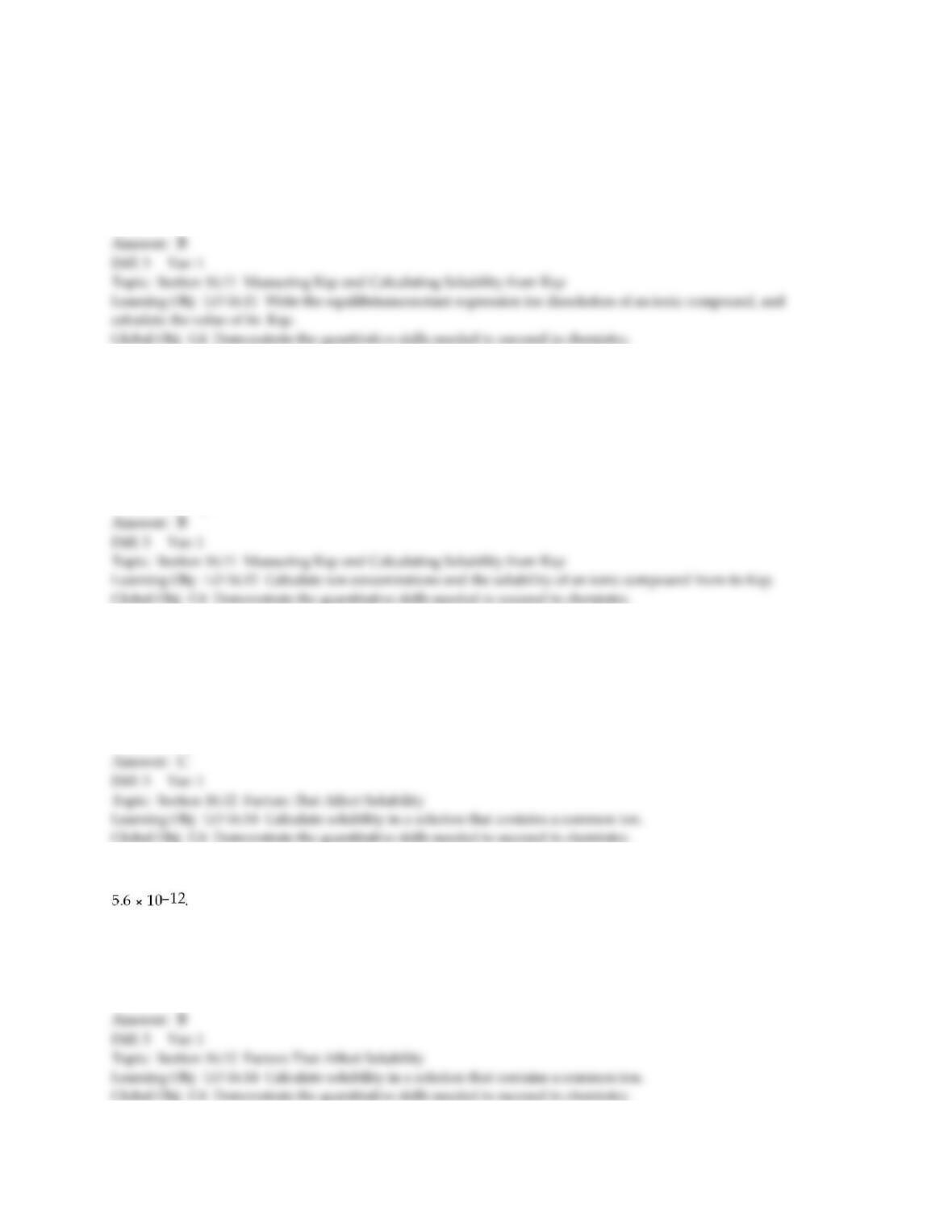
50) Calculate the solubility (in g/L) of silver carbonate in water at 25°C if the Ksp for Ag2CO3 is 8.4 ×
10–12.
A) 8.0 × 10⁻⁴ g/L
B) 3.5 × 10⁻² g/L
C) 4.4 × 10⁻² g/L
D) 5.6 × 10⁻² g/L
51) What is the molar solubility of CaF2 in 0.10 M NaF solution at 25°C? The Ksp for CaF2 is 3.4 × 10⁻¹¹.
A) 8.5 × 10⁻¹⁰ M
B) 3.4 × 10⁻¹⁰ M
C) 3.4 × 10⁻⁹ M
D) 2.0 × 10⁻⁴ M
52) What is the molar solubility of Mg(OH)2 in a basic solution with a pH of 12.00? Ksp for Mg(OH)2 is
A) 5.6 × 10⁻¹⁰ M
B) 5.6 × 10⁻⁸ M
C) 2.4 × 10⁻⁶ M
D) 1.1 × 10⁻⁴ M
53) Calculate the molar solubility of thallium(I) chloride in 0.30 M NaCl at 25°C. Ksp for TlCl is 1.7 × 10⁻⁴.
17
A) 5.1 × 10⁻⁵ M
B) 5.7 × 10⁻⁴ M
C) 7.1 × 10⁻³ M
D) 1.3 × 10⁻² M
54) What is the molar solubility of lead(II) chromate in 0.10 M HNO3 if the Ksp for PbCrO4 is 2.8 × 10⁻¹³
and the Ka2 for H2CrO4 is 3.0 × 10⁻⁷? Note that H2CrO4 is considered to be a strong acid.
A) 9.2 × 10⁻¹¹ M
B) 2.9 × 10⁻¹⁰ M
C) 9.3 × 10⁻⁷ M
D) 3.1 × 10⁻⁴ M
55) What is the molar solubility of AgCl in 0.10 M NH3? Ksp for AgCl is 1.8 × 10⁻¹⁰ and the Kf for
Ag(NH3)2+ is 1.7 × 10⁷.
A) 1.3 × 10⁻⁵ M
B) 5.0 × 10⁻³ M
C) 5.5 × 10⁻³ M
D) 5.5 × 10⁻² M
56) What is the molar solubility of AgCl in 1.0 M K2S2O3 if the complex ion Ag(S2O3)23- forms? The Ksp
for AgCl is 1.8 × 10⁻¹⁰ and the Kf for Ag(S2O3)23- is 2.9 × 10¹³.
A) 0.50 M
B) 1.0 M
C) 1.5 M
D) 2.0 M
57) What is the molar solubility of AgCl in 0.10 M NaCN if the colorless complex ion Ag(CN)2– forms?
Ksp for AgCl is 1.8 × 10⁻¹⁰ and Kf for Ag(CN)2– is 1.0 × 10²¹.
A) 0.050 M
B) 0.10 M
C) 0.20 M
D) 0.40 M
58) Which of the following metal hydroxides are amphoteric?
A) Al(OH)3, Zn(OH)2, Cr(OH)3, Sn(OH)2
B) Cu(OH)2, Mn(OH)2, Fe(OH)2, Fe(OH)3
C) Be(OH)2, Ca(OH)2, Ba(OH)2, Sr(OH)3
D) LiOH, NaOH, KOH, RbOH
59) Which of the following reactions are not consistent with the concept of acid base amphoterism?
A) Al(OH)3(s) + OH–(aq) → Al(OH)4–(aq)
B) Al(OH)3(s) + 3 H3O+(aq) → Al3+(aq) + 6 H2O(l)
C) H2O(l) + H2O(l) ⇌ H3O+(aq) + OH–(aq)
D) Al(OH)3(s) ⇌ Al3+(aq) + 3 OH–(aq)
60) Barium hydroxide is slightly soluble in water, with a Ksp of 5.00 × 10⁻⁴ at 298K. The dissolution of
barium hydroxide in water is an endothermic process.
Ba+2 (aq) + 2OH– (aq)
Which of the following will increase the solubility?
A) Barium hydroxide is added to the solution.
B) Sodium hydroxide (NaOH) is added to the solution.
C) The temperature is decreased.
D) HCl is added to the mixture. (HCl reacts with OH-, removing it from the system.)
61) Precipitation of an ionic compound will occur upon mixing of desired reagents if the initial ion
product is
A) greater than the Ksp.
B) equal to the pKsp.
C) equal to the Ksp.
D) less than the Ksp.
62) Potassium chromate is slowly added to a solution containing 0.20 M AgNO3 and 0.20 M Ba(NO3)2.
Describe what happens if the Ksp for Ag2CrO4 is 1.1 × 10⁻¹² and the Ksp of BaCrO4 is 1.2 × 10⁻¹⁰.
A) The BaCrO4 precipitates first out of solution.
B) The Ag2CrO4 precipitates first out of solution and then BaCrO4 precipitates.
C) Both BaCrO4 and Ag2CrO4 precipitate simultaneously out of solution.
D) Neither BaCrO4 nor Ag2CrO4 precipitates out of solution.
20
63) 0.10 M potassium chromate is slowly added to a solution containing 0.20 M AgNO3 and 0.20 M
Ba(NO3)2. What is the Ag+ concentration when BaCrO4 just starts to precipitate? Ksp for Ag2CrO4 and
BaCrO4 are 1.1 × 10⁻¹² and 1.2 × 10⁻¹⁰, respectively.
A) 6.5 × 10⁻⁵ M
B) 1.3 × 10⁻⁴ M
C) 3.2 × 10⁻⁴ M
D) 4.3 × 10⁻² M
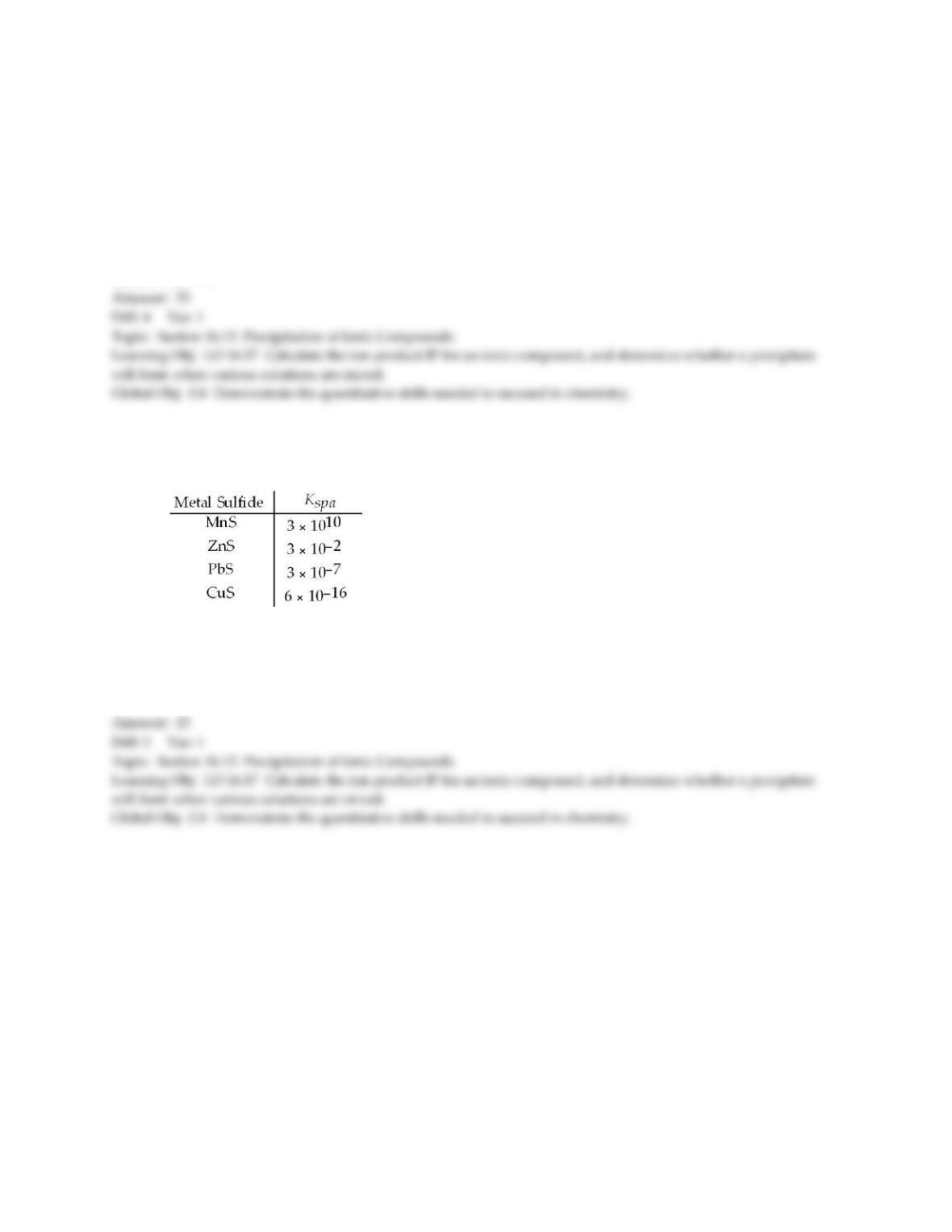
64) Which metal sulfides can be precipitated from a solution that is 0.01 M in Mn2+, Zn2+, Pb2+ and Cu2+
and 0.10 M in H2S at a pH of 1.0?
A) MnS
B) CuS
C) PbS, CuS
D) ZnS, PbS, CuS