Survey of Economics, 6e (O’Sullivan/Sheffrin/Perez)
Chapter 16 Money and the Banking System
16.1 What Is Money?
1) The supply of money in the U.S. economy is determined primarily by
A) decisions made by the Federal Reserve and the U.S. Treasury.
B) the actions of the Federal Reserve and the banking system.
C) consumers and the banking system.
D) the demand for money in the economy.
2) In the ________ increases in the supply of money will ________.
A) short run; raise total demand and output
B) long run; raise total demand and output
C) long run; lead to lower prices
D) short run; decrease total demand and output
3) Money is
A) anything that is regularly used and generally accepted in economic transactions or exchanges.
B) necessary to conduct economic transactions.
C) facilitates specialization in production.
D) anything the government declares to have value.
4) Which of the following can be used as money?
A) checks
B) cigarettes
C) precious stones
D) all of the above
5) When money is accepted as payment for a good or service, it is being used as a
A) medium of exchange.
B) store of value.
C) unit of account.
D) a mechanism for transforming current purchases into future purchases.
6) Money solves the dilemma of a double coincidence of wants by serving as a
A) medium of exchange.
B) store of value.
C) symbol of value.
D) unit of account.
7) When money is used to express the value of goods and services, it is functioning as a
A) medium of exchange.
B) store of value.
C) unit of account.
D) store of purchasing power.
8) If the prices of goods and services were expressed in terms of carved wooden beads, then the
carved wooden beads would be serving as a
A) medium of exchange.
B) store of value.
C) unit of account.
D) mechanism for transforming present purchases into future purchases.
9) If money is used as a mechanism to hold purchasing power for a period of time it is
functioning as a
A) standard of value.
B) store of value.
C) medium of exchange.
D) unit of account.
10) As inflation rates increase, money becomes less useful as a
A) unit of account.
B) store of value.
C) medium of exchange.
D) double coincidence of wants.
11) Suppose after the semester ends, you take a trip to a tropical island. Upon arriving at the
island, you make a stop at one of the markets and notice that everyone is carrying around jars full
of little turtles. You also notice the person in line in front of you just paid for a bottle of rum with
6 turtles. Someone else just bought a straw hat for two turtles. Thinking back to your economics
class (as painful as that may be), you would conclude that
A) this is a barter economy.
B) those little turtles are serving as money.
C) turtles are valueless.
D) turtle soup is a delicacy.
12) Which of the following are examples of “mediums of exchange“?
A) money used to buy goods
B) goods used to obtain other goods
C) pigs used to obtain chickens
D) all of the above
13) In order for a barter transaction to be successful, there must be a
A) market for the goods.
B) high demand for a certain item.
C) double coincidence of wants.
D) federal tax law in effect.
14) The stored value of money over time should not change significantly as long as the level of
inflation is
A) high.
B) low.
C) adjusted by the government.
D) less than your pay increases.
15) According to the U.S. Secret Service, approximately $2.6 billion of U.S. paper currency in
circulation is counterfeit. Undetected counterfeit currency which is spent and circulated in the
marketplace is an example of the counterfeit currency being used as a
A) medium of exchange.
B) commodity money.
C) store of value.
D) bank reserve.
16) According to the U.S. Secret Service, approximately $2.6 billion of U.S. paper currency in
circulation is counterfeit. As long as counterfeit U.S. currency remains undetected and in
circulation, an increase in the U.S. inflation rate would essentially
A) decrease the real value of the counterfeit currency.
B) increase the real value of the counterfeit currency.
C) decrease the nominal value of the counterfeit currency.
D) increase the nominal value of the counterfeit currency.
17) According to the U.S. Secret Service, approximately $2.6 billion of U.S. paper currency in
circulation is counterfeit. The U.S. government is continually adding security features to its
paper currency to help make counterfeit money easier to detect. If counterfeit currency remained
undetected, a vast increase in the supply of counterfeit U.S. currency would
A) decrease aggregate demand in the short run.
B) lead to inflation.
C) reduce the amount of M1.
D) lower the nominal income of the average U.S. worker.
18) Money that has no intrinsic value and is created by a government decree is called
A) barter money.
B) commodity money.
C) fiat money.
D) asset money.
19) What gives money value under a fiat system?
A) Fiat money is backed by gold.
B) The supply of fiat money is controlled by the government.
C) Fiat money is also a commodity.
D) Fiat money is the same as Treasury bonds.
20) M1
A) is the sum of currency plus traveler’s checks.
B) is the narrowest definition of the money supply.
C) includes small time deposits.
D) includes credit cards.
21) Checking account balances are included in
A) M1 only.
B) M2 only.
C) both M1 and M2.
D) neither M1 nor M2.
22) Currency is included in
A) M1 only.
B) M2 only.
C) neither M1 nor M2.
D) both M1 and M2.
23) Traveler’s checks are included in
A) M1 only.
B) M2 only.
C) both M1 and M2.
D) neither M1 nor M2.
24) Which of the following is NOT included in M1?
A) savings accounts
B) deposits in checking accounts
C) deposits in checking accounts that pay interest
D) traveler’s checks
25) About 46% of M1 is composed of
A) demand deposits.
B) savings deposits.
C) money market mutual funds.
D) currency held by the public.
26) The smallest single component of M1 is
A) demand deposits.
B) savings account balances.
C) other checkable deposits.
D) traveler’s checks.
27) The largest single component of M2 is
A) demand deposits.
B) savings deposits.
C) money market mutual funds.
D) currency held by the public.
28) In the 1980s, a new category entitled ________ was added to M1.
A) traveler’s checks
B) demand deposits
C) other checkable deposits
D) money market mutual fund deposits
29) Checking accounts that pay interest are included in the
A) “demand deposits” part of M1.
B) “other checkable deposits” part of M1.
C) “savings deposits” part of M2.
D) “money market mutual funds deposits” part of M2.
30) Deposits in savings accounts are included in
A) M1.
B) M2.
C) both M1 and M2.
D) neither M1 nor M2.
31) Money market mutual funds are included in
A) M1.
B) M2.
C) both M1 and M2.
D) neither M1 nor M2.
32) Which of the following is NOT included in M1 or M2?
A) checking account balances
B) currency in circulation outside of commercial banks
C) traveler’s checks
D) credit card balances
33) Which of the following is included in M2?
A) commercial paper
B) U.S. Treasury bonds
C) savings accounts
D) stocks
34) Which of the following appears in M2 and NOT M1?
A) currency
B) checking account balances
C) money market mutual funds
D) traveler’s checks
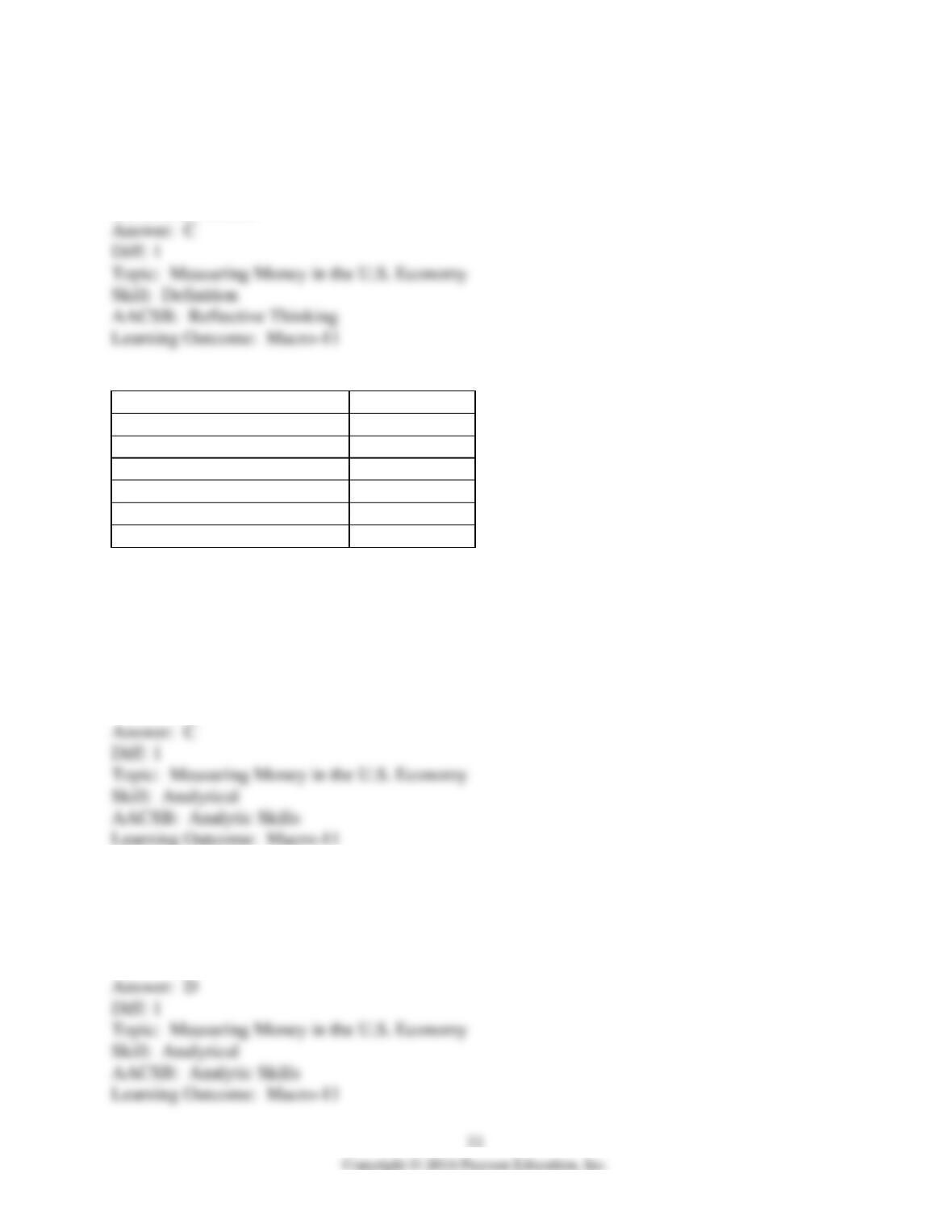
Currency held by the public
$450 billion
Demand deposits
220 billion
Other checkable deposits
170 billion
Traveler’s checks
2 billion
Savings deposits
800 billion
Small time deposits
50 billion
Money market mutual funds
170 billion
Table 16.1
35) According to the information in Table 16.1, M1 is equal to
A) $620 billion.
B) $672 billion.
C) $842 billion.
D) $1,012 billion.
36) According to the information in Table 16.1, M2 is equal to
A) $840 billion.
B) $1,062 billion.
C) $1,692 billion.
D) $1,862 billion.
37) Economists use different definitions of money because
A) there are differences in the frequency with which depositors use their accounts.
B) deposits can be domestic or international.
C) deposits may be held at banks or savings and loans.
D) it is not always clear which assets are used primarily as money.
38) A reason that economists keep an eye on both M2 and M1 is because
A) M2 is more accurate than M1.
B) both fluctuate widely and frequently in total dollar value.
C) money market accounts are sometimes used like checking accounts and sometimes like
savings accounts.
D) during a recession, M1 is meaningless.
39) In the United States economy, what is the basic measure of money?
A) wealth
B) M1
C) disposable income
D) commodities
40) Along with currency not in banks and deposits in checking accounts, what is another
component of the M1 measure of money?
A) credit cards
B) debit cards
C) traveler’s checks
D) prepaid accounts
41) Financial monetary assets which often cannot be readily used in commercial exchanges are
included in
A) M1.
B) M2.
C) credit cards.
D) prepaid accounts.
42) Small time deposits of $100,000 or less are classified as
A) part of M1.
B) part of M2.
C) FDIC insured.
D) highly liquid.
43) Before they can be used in regular exchanges, the assets that make up M2 must often
A) have their interest computed.
B) be converted to M1 assets.
C) be paid off if they are credit cards.
D) have reached term if they are insurance policies.
44) An example of money is
A) a dollar bill.
B) a checking account balance.
C) a traveler’s check.
D) all of the above
45) According to the U.S. Secret Service, approximately $2.6 billion of U.S. paper currency in
circulation is counterfeit. Undetected counterfeit U.S. currency being held by the public both at
home and abroad will impact the level of
A) the reserve ratio.
B) the money multiplier.
C) M1.
D) commodity money.
Recall the Application about the Brazilian city of Silva Jardim that has issued its own local
currency to answer the following question(s). In order to entice local residents to spend
their money on stores in town, the small city of Silva Jardim in Brazil, hatched a plan for
its own currency. The currency is called the capivari and features a picture of a local
rodent on the bills. The capivaris are issued by a local bank, which holds one unit of
official Brazilian currency for each capivari it issued. Local merchants, however, give
discounts for paying in capivaris so that local residents are therefore encouraged to make
local purchases.
46) Recall the application. The small city of Silva Jardim in Brazil has issued its own currency
called the capivari. When people use this currency to execute transactions, this currency is being
used as a
A) medium of exchange.
B) unit of account.
C) store of value.
D) commodity money.
47) Recall the application. The small city of Silva Jardim in Brazil has issued its own currency
called the capivari. If people using the currency have enough confidence in this locally-issued
scrip to hold onto it for use in future transactions, the currency will be acting as a
A) medium of exchange
B) unit of account.
C) store of value.
D) commodity money.
48) Recall the application. The small city of Silva Jardim in Brazil has issued its own currency
called the capivari. If this currency had nothing backing its value and was simply created by
decree of the issuing city government, the city-issued money would be considered
A) commodity money.
B) fiat money.
C) barter money.
D) gold standard money.
49) Money is the standard of exchange by which any type of goods can be purchased.
50) In order for money to be an effective medium of exchange, it is important to have it serve as
a unit of account.
51) Money solves the problem of double coincidence of wants that would regularly occur under
a system of credit.
52) Inflation makes money an imperfect store of value.
53) Fiat money refers to a monetary system in which gold backs up paper money.
54) In the United States today, the government will exchange gold or silver for paper money.
55) Credit cards are regularly used in economic exchanges, so credit card balances are included
in the definition of money.
56) Economists use M2 to measure the amount of money that is regularly used in transactions.
57) M1 is larger than M2.
58) Money market mutual funds are hard to classify because they are used both for making
transactions and savings.
59) Credits cards are NOT a part of the M1 or M2 money supply.
60) Define “money.”
61) What are the three properties of money?
62) What is a commodity money system?
63) What is a gold standard?
64) Distinguish M1 from M2.
65) What are the four components of M1?
66) What are the components of M2?
16.2 How Banks Create Money
1) One of the essential functions that a bank performs is
A) purchasing government bonds.
B) creating deposits by lending required reserves.
C) transferring money from savers to lenders.
D) owning assets like real estate.
2) Loans are examples of a bank’s
A) assets.
B) liabilities.
C) net worth.
D) balance sheet.
3) Deposits are examples of a bank’s
A) assets.
B) liabilities.
C) net worth.
D) balance sheet.