1
NEW YORK UNIVERSITY
ROBERT F. WAGNER GRADUATE SCHOOL OF PUBLIC SERVICE
P11.1021: Financial Management – Midterm Examination
Professors Calabrese and Finkler – Spring 2006
Your Name: ________________________________________________
Your Student ID: ____________________________________________
Circle the day and time your class meets
Tuesday 12:30 PM Tuesday 5:45 PM Thursday 5:45 PM
Directions:
For the time-value-of-money computations show what information you used to
calculate the answer. Do not just write down the final answer.
4) Hand in your exam plus all other papers (one page of notes).
5) The points for each question are indicated in parentheses next to the question.
6) Look through the exam before you begin.
Good Luck
=======================================================================
This section for graders: Points 1 _______
2 _______
3 _______
4 _______
5 _______
6 _______
7 _______
8 _______
9 _______
10 _______
11_______
SOLUTIONS
2
Numbers in Parentheses represent the possible points for that question
1. Select the best choice from the following to answer questions A through D: (8 Points)
i. Zero-Based
ii. Incremental
iii. Capital
iv. Flexible
v. Operating
vi. Cash
vi. Responsibility center
vii. Program
A. (2 points) If your boss at New York Assisted Living said “The budget seems
pretty good but what would happen if we don’t get an average of 200 residents

3
2. Doctors Beyond Borders (DBB) operates health programs around the world. It has a central
staff of 100 people who administer its world-wide programs. DBB’s central operation buys and
distributes all of the supplies used in its various country operations. DBB’s country director for
Nigeria and her staff runs 20 clinics around the country. At the clinic level, doctors and nurses
hired under two-year contracts, administer medical treatment free of charge to the local
population. They use supplies shipped to them by DBB’s central staff based on the number of
patients treated at each clinic. (10 points)
A. From the perspective of the program director for Nigeria, for the coming year which
of the five categories (underlined in bold above) of expenses are: (Write the general
category of the expenses next to the categories below.) (8 points)
B. Which of the direct expenses for Nigeria would be classified as indirect from the
perspective of a clinic director? (2 points)
3. When determining costs, which of the following factors should not be taken into account?
[Circle all that apply] (2 points)
4
4. Answer the following questions about break-even analysis: (14 points)
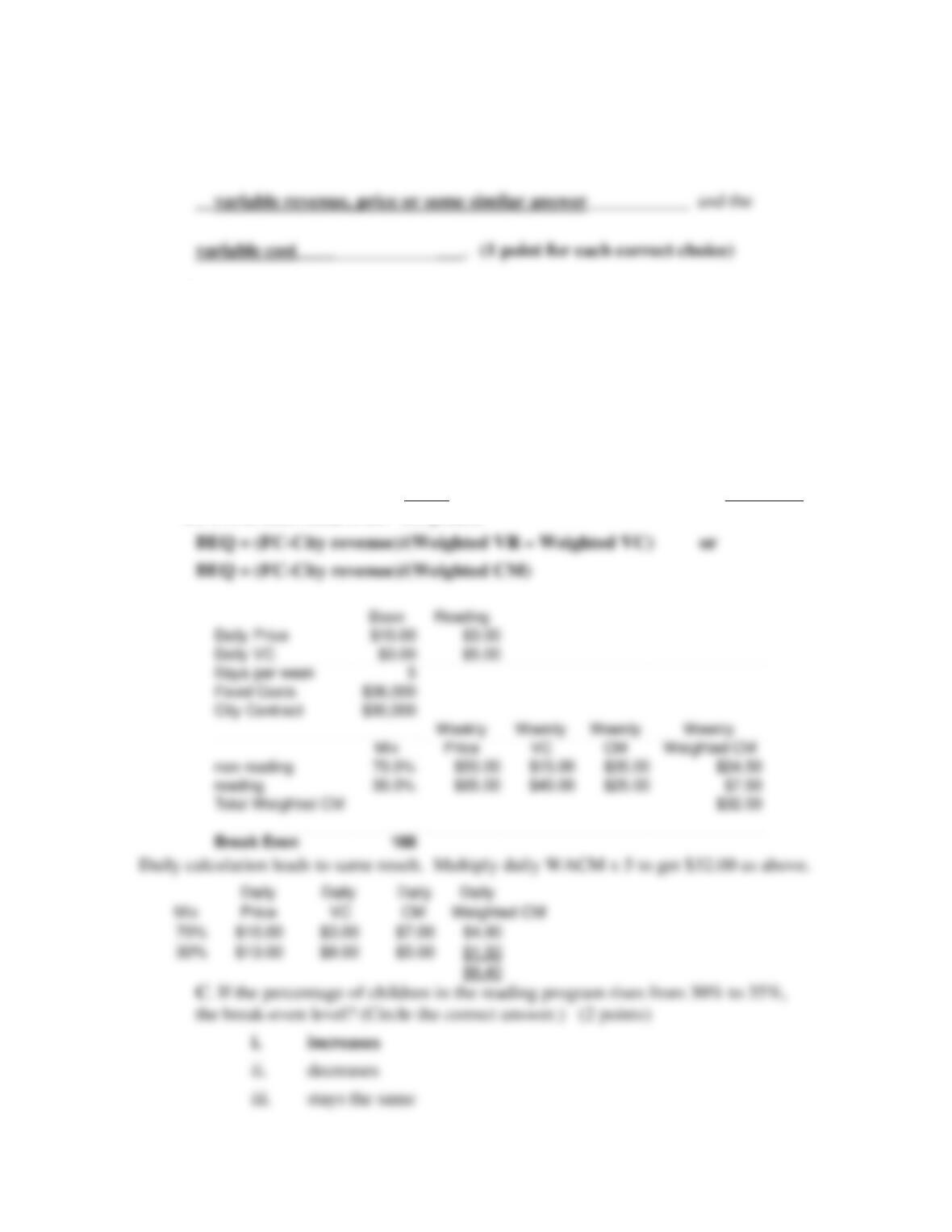
A. (2 points) The contribution margin is equal to the difference between the
B. Early-Development Child Center operates from Monday to Friday. The Center
provides childcare and educational services for inner-city kids between the ages of
three months and five years. It has fixed expenses of $36,000 per week and charges
parents $10 per day for each child that attends the program. A city contract pays the
center $30,000 per week. It costs the center $3 per day for supplies and snacks for
each child. The Center also offers an optional early-reading program for children
over the age of three. Parents pay an additional $3 per day to enroll a child in the
reading program. It costs the center an additional $5 per day for each child in the
program. Thirty percent of the children attending the center are enrolled in the
reading program. How many whole children have to come to the Center each week
for it to at least break even? (10 points)
5
5. Answer the following two questions about the time-value-of-money using the following choices:
(4 points) i. the net present value
ii. the net present cost
iii. the internal rate of return
iv. the annualized cost
v. an annuity
A. (2 points) The rate of return that sets the present value of a stream of cash inflows
equal to the present value of a stream of cash outflows is called?
B. (2 points) If you are asked to select between two alternative pieces of equipment
with different useful lives that the organization needs to carry on its operations
but do not generate any positive cash flows, you would compare their
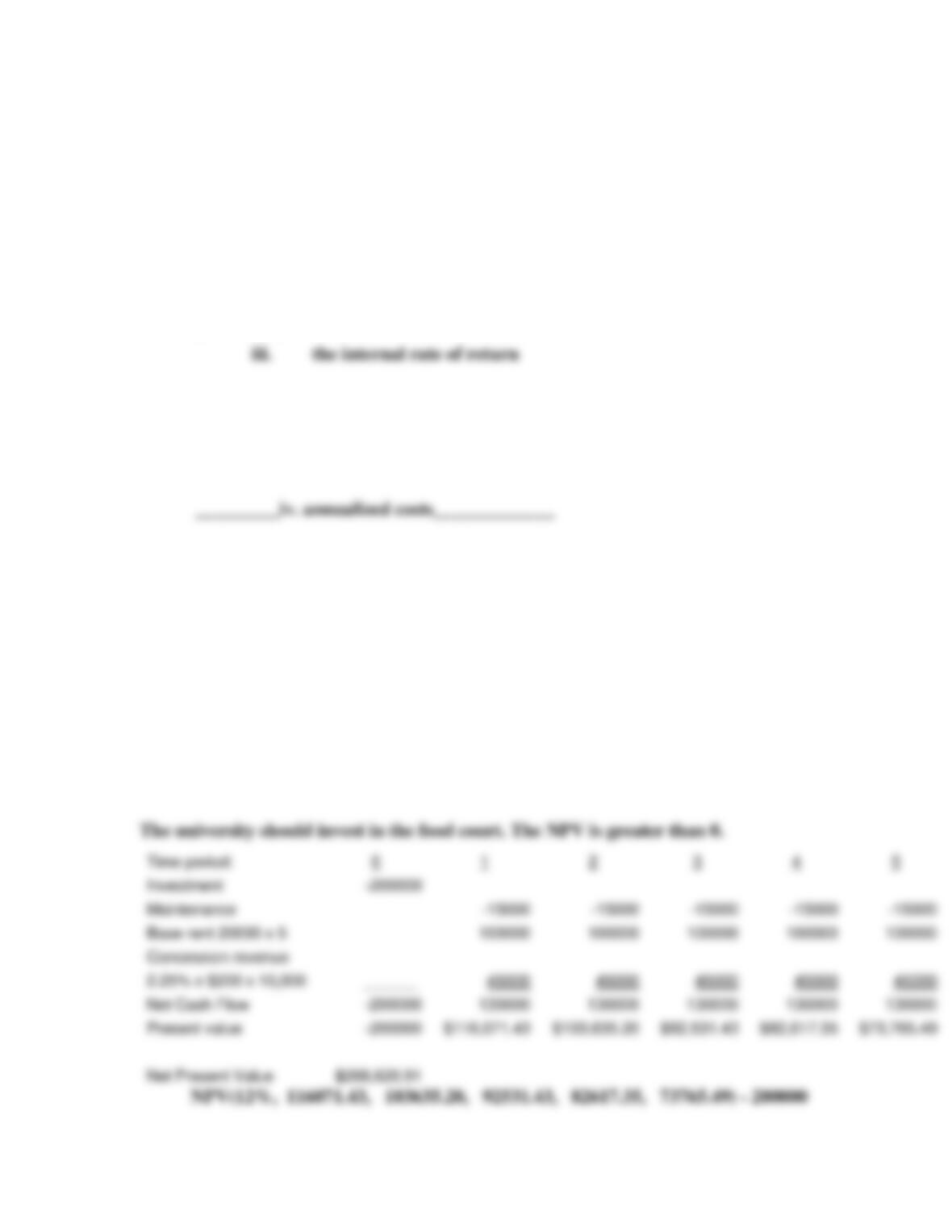
6. The University Center for Student Life is trying to decide whether it should invest in a fast-food court.
The cost of setting up the court and attracting nationally-known vendors is estimated at $200,000.
Annual maintenance and cleaning costs are estimated at $15,000
Each of the five vendors selected to operate concessions in the food court will pay the university
$20,000 per year plus 2.25% of their gross revenues. Gross revenues will depend on student use. Based
on what has happened at other schools with food courts, the director of the center thinks that each
enrolled student will spend an average of $200 per year in the food court.
On average, the university enrolls 10,000 students. The managers of the Student Life Center expect the
food court to last five years before they will have to start the whole process over again. If the university
has a cost of capital of 12%, should they build the food court? (12 points)
6
7. Answer the following questions about managing short-term resources and obligations: (6 points)
A. (2 points) Which of the following information is typically included on an accounts-
receivable aging schedule?
B. (2 points) Amounts that an organization owes to its suppliers, but has not yet paid,
are referred to as: (circle the correct answer)
C. (2 points) An inventory management system that continuously tracks inventory is
said to be using the _______________________? (Circle the correct answer)
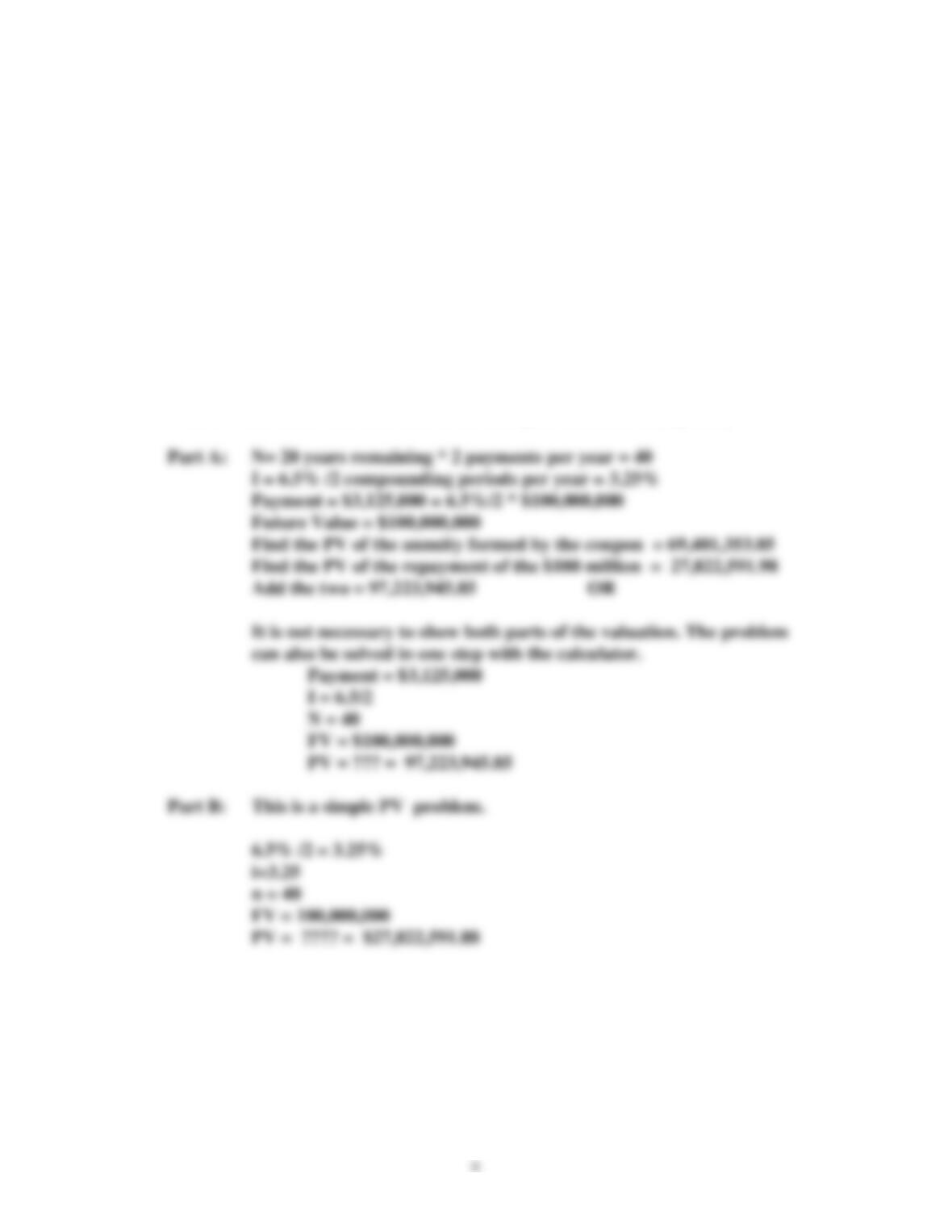
8. Kids Hospital’s (Kids) outpatient clinics expected to treat 3,000 different children during 2006
and expected to receive $112 per visit. It expected each child to make three visits during the year.
Their budget calls for the use of $68 in supplies per visit. Supplies are Kids’ only variable
expense. The activity reports for 2006 showed that 3,400 children visited the clinics an average of
2.9 times each. Per- visit revenues averaged $120 and supply costs were $70 per visit. (9 points)
i. What is their total revenue variance? Is the variance favorable or
unfavorable? Why? (4 points)
ii. What is their total expense variance? Is the total expense variance
favorable or unfavorable? Why? (4 points)
iii. Was the net impact of the two variances helpful or harmful to the
economic health of the organization? Why? (1 point)
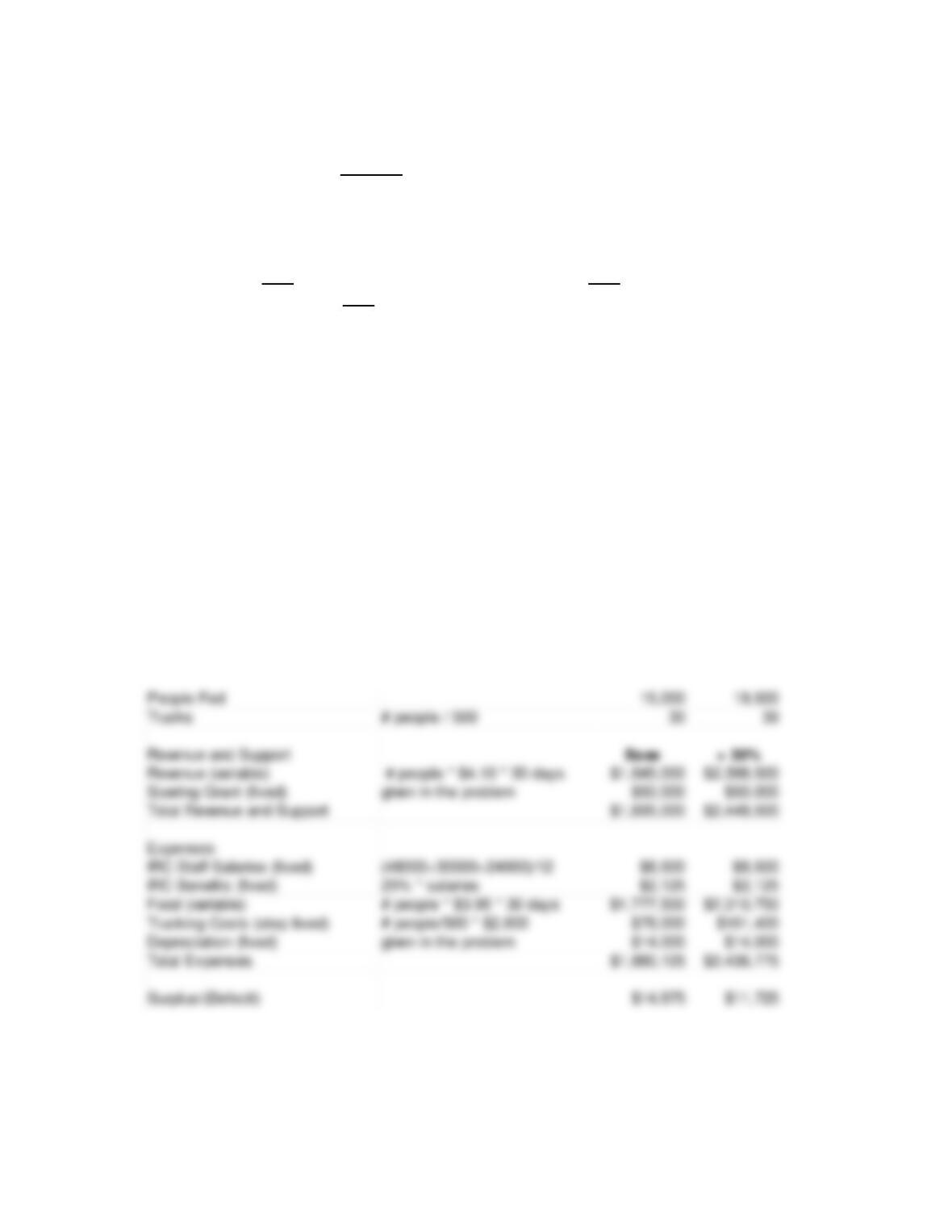
9. Kids Hospital needs to raise $100 million to pay for a new addition to its children’s
rehabilitation unit. Kids planned to sell an issue of 20-year bonds that will pay
interest twice each year with a coupon rate of interest of 6.25%. Between the time
they printed the bonds with the 6.25% coupon rate and the date they were sold,
interest rates rose from 6.25% to 6.5%. (10 points)
A. How much will they receive when they issue the bonds? (8 points)
B. Suppose there were no coupon rate at all. With a zero coupon bond, no interest
payments are made during the life of the bond, although out of tradition, interest is
assumed to compound twice a year. The face value of the bond is paid at maturity.
Let’s say this is a $100,000,000 zero coupon bond, issued when the market rate is
6.5%. How much will Kids receive when they issue the bond? (2 points)
9
10. (20 points) You are the Field Director for the International Rescue Committee’s
(IRC) West African food-relief effort. IRC’s executive director in New York has
asked you to prepare a monthly operating budget based on feeding 15,000 people per
day as well as a flexible budget based on a 30% increase in the number of people that
will have to feed each day.
Your field operation has three full-time employees. A Field Director, who earns
$48,000 per year, a Security Chief, earning $30,000 per year, and a Field Manager,
who earns $24,000 per year. IRC spends an additional 25% of each IRC employee’s
annual salary to pay for the cost of health insurance and retirement benefits.
To operate the ten feeding sites under your control, you have a fleet of trucks. The
trucks deliver food and cooking fuel to the remote feeding sites. You estimate it takes
one truck to service every 500 people you feed each month. It costs you $2,600 to
pay for the fuel, drivers, rental and maintenance it takes to operate one truck for one
month. Depreciation on your building and other equipment adds an additional
$14,000 to your monthly expenses.
Direct costs for food are $3.95 per person per day. The Western Nations Alliance has
agreed to pay you $4.10 per day for each person you feed. For budgeting purposes,
assume there are 30 days in a month. Finally, the Soaring Foundation has pledged
$50,000 per month to support the West African Relief effort.
Prepare an operating budget for one month and also a flexible budget for that month
reflecting an increase of 30% in the number of people you feed.
11. (5 points) You are the executive director of a community service agency in the south
Bronx. You operation is funded through a combination of cash contributions, federal
government grants and city contracts. Your revenue budget for fiscal year 2006 is as
shown below.
You know from past experience that not all of your revenue and support is collected
when you earn it. Cash contributions are collected in the quarter they are pledged.
Federal government grants are collected one quarter after you send the granting
agency a bill. The city pays 25% of what it owes you one quarter after you send in the
bill. An additional 25% is collected from the city in two quarters and the remaining
fifty-percent takes three quarters to collect.
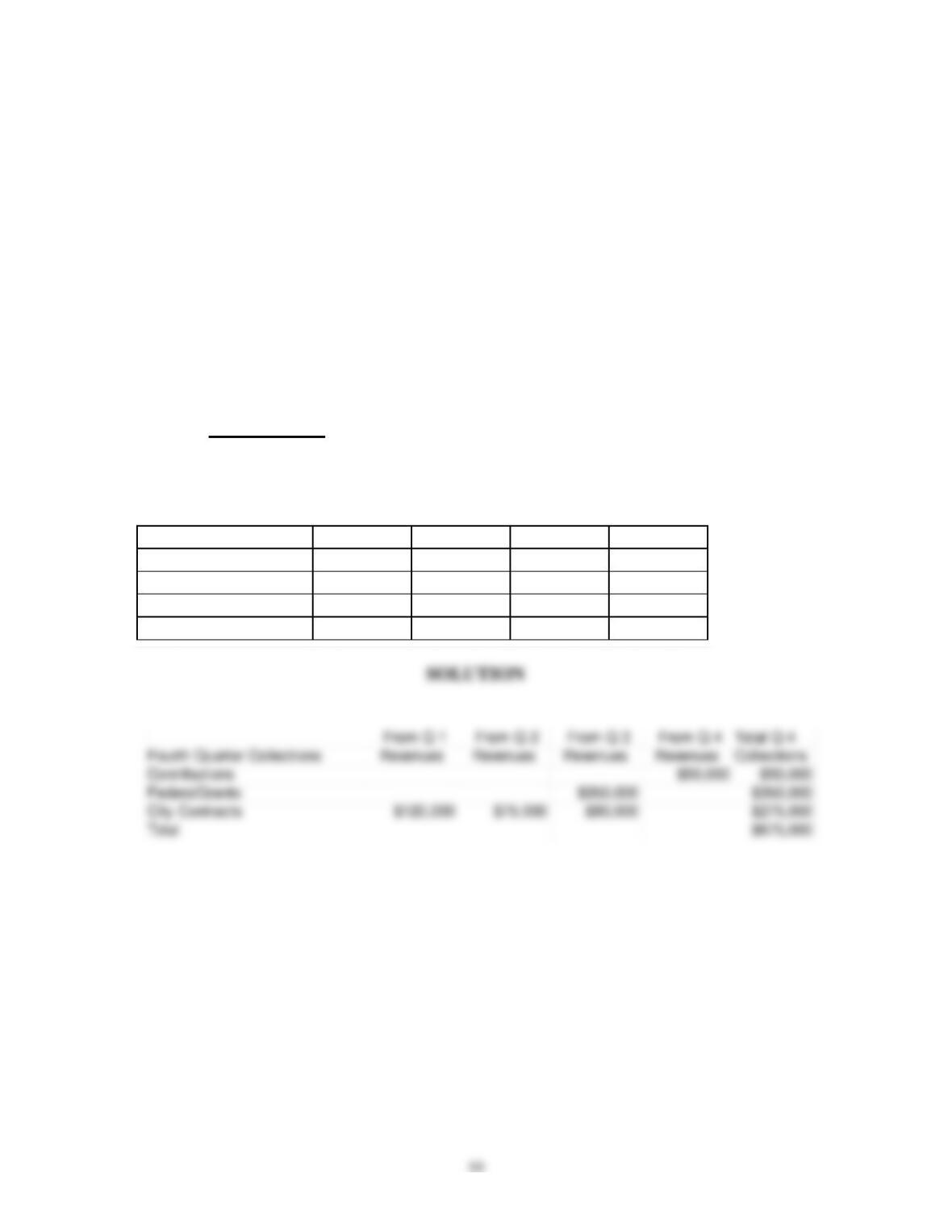
Starting with the revenue budget below, calculate the amount you can expect to collect
in the fourth quarter of fiscal year 2006.
Revenue Budget for Fiscal Year 2006
Source of Revenue Q 1 Q 2 Q 3 Q 4
Contributions $25,000 $35,000 $35,000 $50,000
Federal Grants $250,000 $375,000 $350,000 $250,000
City Contracts $240,000 $300,000 $320,000 $360,000
Total $515,000 $710,000 $705,000 $660,000