Environment: Science Behind the Stories, 2e Cdn. Ed. (Withgott)
Chapter 16 Fossil Fuels: Energy Use and Impacts
16.1 Graph and Figure Interpretation Questions
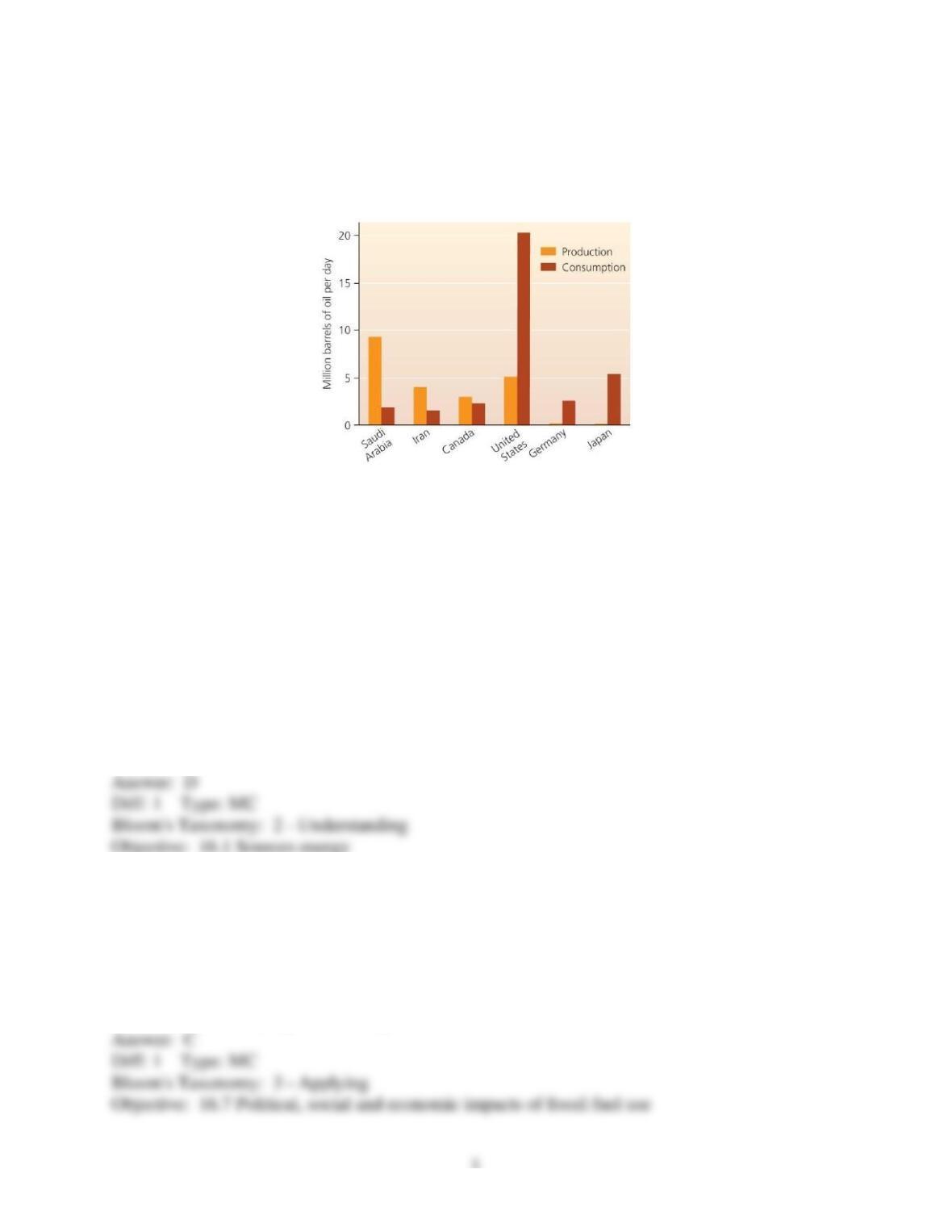
Figure 16.1
Population data: Saudi Arabia: 27 mln; Iran: 76 mln; Canada: 34 mln; Germany: 81 mln;
Japan: 127 mln.
Use Figure 16.1 to answer the following questions.
1) Refer to Figure 16.1. Of the six countries shown, which have essentially no domestic oil
production?
A) Canada and the United States
B) Japan
C) United States and Germany
D) Japan and Germany
E) Japan and the United States
2) Refer to Figure 16.1. List the countries that would benefit proportionally (i.e., per capita)
from rising oil prices, in descending order (i.e., starting with the country that will benefit most).
A) Saudi Arabia, the United States, Iran
B) Saudi Arabia, Canada, Iran
C) Saudi Arabia, Iran, Canada
D) Saudi Arabia, the United States, Canada
E) the United States, Japan, Germany
3) Refer to Figure 16.1. List the countries according to their per capita oil consumption, in
descending order, (i.e., starting with the heaviest per capita user first).
A) the United States, Iran, Germany
B) Saudi Arabia, Germany, Japan
C) Canada, Germany, Japan
D) Canada, Iran, Germany
E) Canada, Germany, Iran
4) Refer to Figure 16.1. From this figure one can conclude that ________.
A) if EROI applied to nations, Iran would have the highest national EROI
B) if EROI applied to nations, the United States would have the highest national EROI
C) Japan, by not having much domestic oil, has to import more oil per capita than the United
States, which has substantial domestic production
D) thanks to their advanced technology, an average Japanese consumes less oil than an average
German
E) an average Canadian uses approximately as much oil as a Saudi or an American

16.2 Matching Questions
Match the following.
A) coal
B) hydrogen fuel
C) anaerobic
D) geothermal
E) aerobic
F) mulch
G) carbon dioxide
H) peat
I) biogenic
J) natural gas
K) petroleum
L) thermogenic
M) crude oil
N) nuclear
1) An environment that has little or no oxygen
2) Organic matter compressed under high pressure to form solid carbon structures
3) A gaseous by–product of microbial decomposition in aerobic conditions
4) Organic material being broken down anaerobically, but remains wet and near the surface
5) Energy from processed uranium
4
6) A renewable resource
7) The gas formed in a landfill
Diff: 2 Type: MA
Bloom’s Taxonomy: 3 – Applying
Objective: 16.3 Nature, origin of natural gas: extraction and use
16.3 Short Answer Questions
1) Briefly explain acid drainage.
2) What are the three main sources of energy that Earth receives?
3) Why did humans switch from using wood as a primary energy source to using fossil fuels?
4) Discuss the general worldwide pattern of distribution of fossil fuels.
5) Describe the differences in how fuel energy is used in developing and developed countries.
6) What are some of the alternative, unconventional resources for oil and natural gas?
7) The amount of a given fossil fuel in a deposit that is technologically and economically feasible
to remove under current conditions is termed the ________ of that fuel.
8) Hurricanes Katrina and Rita in 2005 disrupted U.S. oil supplies because of the importance of
________ to our total supply.
9) As much as two–thirds of a total oil deposit may remain in the ground after its ________, the
initial drilling and pumping of the available oil.
6
10) The tar sands industry has proposed to reduce its large carbon footprint through sequestration
of carbon in rocks. However, one of the methods used to extract tar sands petroleum may
interfere with this solution. Name this extraction method and briefly explain why this method
interferes with carbon sequestration.
11) What are some criticisms of carbon capture and underwater storage?
12) What is an EROI?
13) One of the reasons for the haze hanging over many parts of China is ________.
14) ________ is the name of a controversial proposed pipeline from Alberta to the refineries in
Texas.
15) ________ is to oil what peat is to coal.
16.4 Multiple-Choice Questions
7
1) The world’s most abundant fossil fuel is ________.
A) biodiesel
B) coal
C) oil
D) natural gas
E) methane
2) Before mining techniques improved in the 1700s, the resource that provided the greatest
amount of energy for heating and cooking was ________.
A) dung
B) wood
C) coal
D) oil
E) water
3) Which of the following lists is in order of decreasing moisture content?
A) peat, lignite, bituminous, anthracite
B) peat, anthracite, lignite, bituminous
C) peat, bituminous, lignite, anthracite
D) anthracite, bituminous, lignite, peat
E) lignite, peat, bituminous, anthracite
4) Which of the following energy sources is considered nonrenewable?
A) fossil fuel energy
B) sunlight (solar) energy
C) geothermal energy
D) tidal energy
E) wind energy
5) Solar radiation makes several other energy sources possible, including ________.
A) wind energy
B) tidal energy
C) geothermal energy
D) hydrothermal energy
E) nuclear energy
6) For Canada, the primary fuel that we use for our energy is ________.
A) wood
B) natural gas
C) coal
D) oil
E) nuclear
7) Scientists search for fossil fuels in many ways. Sending a sound wave into the ground (by
exploding dynamite, thumping the ground with a large weight, or using an electric vibrating
machine) and measuring its return to the surface at receiving stations is called ________.
A) dynamite surveying
B) destructive surveying
C) seismic surveying
D) sonar surveying
E) geologic surveying
8) The entire pool of oil is NOT extracted from a well because ________.
A) it is too destructive to the environment
B) it is not cost effective
C) in some areas it is too liquid to extract
D) only a strip-mine could fully extract it
E) This is not correct; we often are able to extract the entire pool.
9) In deciding whether to extract oil from a site and how much of the total to extract, an oil
company considers ________.
A) the distance the oil must be transported, current market price of oil, potential environmental
damage
B) the amount of greenhouse gases the oil will release when burned
C) the current price of gasoline at the pump
D) which nation will make the largest purchases
E) the fraction of the oil that will go to fuels, plastics, synthetic fibres, and lubricants
10) Secondary extraction of petroleum ________.
A) occurs immediately after primary extraction
B) is less expensive than primary extraction
C) uses solvents, water, or steam
D) allows the oil to be extracted to the last drop
E) causes less environmental damage than tertiary extraction
11) Water continues to be the main fuel used to generate electricity in Canada. This is because
________.
A) the country has such large potential for hydroelectric power
B) the number of hydroelectric dams is uniform across Canada
C) it does not take much time to build a dam for the generation of hydroelectricity
D) the cost of building a hydroelectric dam is lower than the cost of building a coal-fired
generating plant
E) there is no ecological impact from building a dam on a river
12) Crude oil is ________.
A) composed of just a few types of hydrocarbon molecules
B) fully usable in its raw form
C) formed less than 100 metres below the surface; in deeper places with more pressure, coal is
formed
D) formed in a wide range of temperature and pressure circumstances
E) fractionated to obtain the chemicals used for gasoline, lubricants, plastics, and other products
13) Natural gas ________.
A) includes octane as its primary component
B) produces fewer greenhouse gases per energy unit than coal
C) was discovered by Bunsen in 1885
D) will be depleted by 2030 at current usage rates
E) is transported primarily by truck and rail
14) Deposits of natural gas are most numerous in ________.
A) Russia and the Middle East
B) Russia and the United States
C) South America
D) Panama
E) Spain and Portugal
15) Natural gas is ________.
A) trapped over some cities for commercial use
B) produced only by bacteria during decomposition
C) more damaging to the environment than coal
D) still much more expensive than other fossil fuels
E) often associated with coal and petroleum deposits
16) One of the problems with finding new fossil fuel deposits in developing countries is that
________.
A) it is very expensive to transport the deposit elsewhere
B) those countries tend to keep the resource for themselves, not sharing with other countries
C) international companies move in to harvest the new deposit, and very little money or resource
remains in the country
D) their governments seldom allow extraction of the deposit without meeting expensive
environmental regulations
E) their governments seldom allow extraction of the deposit without imposing huge taxes to fund
new social benefits for the country
17) Of the available policy options regarding eventual conversion to renewable energy sources,
environmentalists would probably prefer that we ________.
A) pass laws immediately banning the use of fossil fuels
B) pass laws immediately banning the exploration and development of further fossil fuel
resources
C) encourage, with subsidies, tax rebates, and grants, the rapid development and widespread use
of renewable alternative energy resources
D) prepare for a gradual changeover by slowly increasing funding and putting alternative energy
resources into place over the next 100 years
E) plan for the switch to renewable energy sources, but not implement any plans until most fossil
fuels have been depleted
18) The greatest damage to the environment caused by oil extraction is likely from ________.
A) the drilling
B) road construction and infrastructure development
C) the development of the market in a new country
D) the remediation and relocation
E) the initial logging