Chapter 16 Assessing Long-Term Debt, Equity, and Capital Structure
Answer Key
Multiple Choice Questions
1.
The mix of debt and equity that a firm uses to finance its operations is known as:
2.
If a firm changes their capital structure by immediately selling additional claims of one
type of capital and using the proceeds to retire another kind of claims, they are using
which type of capital structure change?
3.
If a firm changes their capital structure by waiting until the firm requires additional capital
to cover capital budgeting needs and then selling more of the type of claims they wish to
increase, they are using which type of capital structure change?
4.
Which of the following is NOT a factor for determining whether to use the active or passive
approach to capital structure changes?
5.
Another name for debt in the capital structure is:
6.
Which of the following is NOT a feature of the “perfect world” in M&M’s theorem for
optimal capital structure?
7.
Which of the following is a feature of the “perfect world” in M&M’s theorem for optimal
capital structure?
8.
In M&M’s perfect world, their theorem’s two main propositions are referred to as which of
the following?
9.
Which of these is the assumption that decisions about which projects to fund are separate
from the decisions about how to fund them?
10.
Which of the following is a true statement?
11.
Which of the following makes this a true statement? In this slightly more realistic world
with corporate taxes, managers can:
12.
What causes the change in optimal strategy when taxes are added back to the M&M
theorem?
13.
Which of the following is a true statement regarding Proposition I?
14.
How can an investor leverage itself more than the firm?
15.
Which of the following is one of the most extreme examples of firm re-leveraging that
occurs when someone uses a firm’s debt capacity to buy out the majority of the firm’s
equity holders?
16.
The level of EBIT at which EPS will be equal for two different capital structures is known
as:
17.
Which of the following allows for two types of bankruptcy for which most businesses can
file?
18.
Which type of bankruptcy involves a business liquidating their assets?
19.
Which type of bankruptcy involves an attempt to allow the firm to reorganize the business
under court supervision?
20.
Which of these is the rule under which claimants are paid in a Chapter 7 bankruptcy?
21.
Which of the following is the condition in which a firm is near bankruptcy?
22.
A situation that arises when a firm’s equity is close to worthless, and equity holders will
prefer to invest in overly risky projects with a small chance of success rather than simply
paying debt holders their regularly scheduled payments is known as a(n):
23.
Which of these is a situation that arises when a firm’s equity is close to worthless, and
equity holders will prefer to not invest in safe projects?
24.
Which of the following is a true statement?
25.
Suppose that a company’s equity is currently selling for $22 per share and that there are 4
million shares outstanding and 30 thousand bonds outstanding, which are selling at 101
percent of par ($1,000). If the firm was considering an active change to their capital
structure so that the firm would have a D/E of 0.9, which type of security (stocks or
bonds) would they need to sell to accomplish this, and how much would they have to sell?
26.
Suppose that a company’s equity is currently selling for $19 per share and that there are 3
million shares outstanding and 10 thousand bonds outstanding, which are selling at 100
percent of par ($1,000). If the firm was considering an active change to their capital
structure so that the firm would have a D/E of 0.5, which type of security (stocks or
bonds) would they need to sell to accomplish this, and how much would they have to sell?
27.
Suppose that a company’s equity is currently selling for $45 per share and that there are 1
million shares outstanding. If the firm also has 7 thousand bonds outstanding, which are
selling at 97 percent of par ($1,000), what are the firm’s current capital structure weights
for equity and debt respectively?
28.
Suppose that a company’s equity is currently selling for $30 per share and that there are 5
million shares outstanding. If the firm also has 20 thousand bonds outstanding, which are
selling at 98 percent of par ($1,000), what are the firm’s current capital structure weights
for equity and debt respectively?
29.
Suppose that a company’s equity is currently selling for $20 per share and that there are 2
million shares outstanding. If the firm also has 8 thousand bonds outstanding, which are
selling at 99 percent of par ($1,000), what are the firm’s current capital structure weights
for equity and debt respectively?
30.
Suppose that a company’s equity is currently selling for $55 per share and that there are 1
million shares outstanding. If the firm also has 50 thousand bonds outstanding, which are
selling at 95 percent of par ($1,000), what are the firm’s current capital structure weights
for equity and debt respectively?
31.
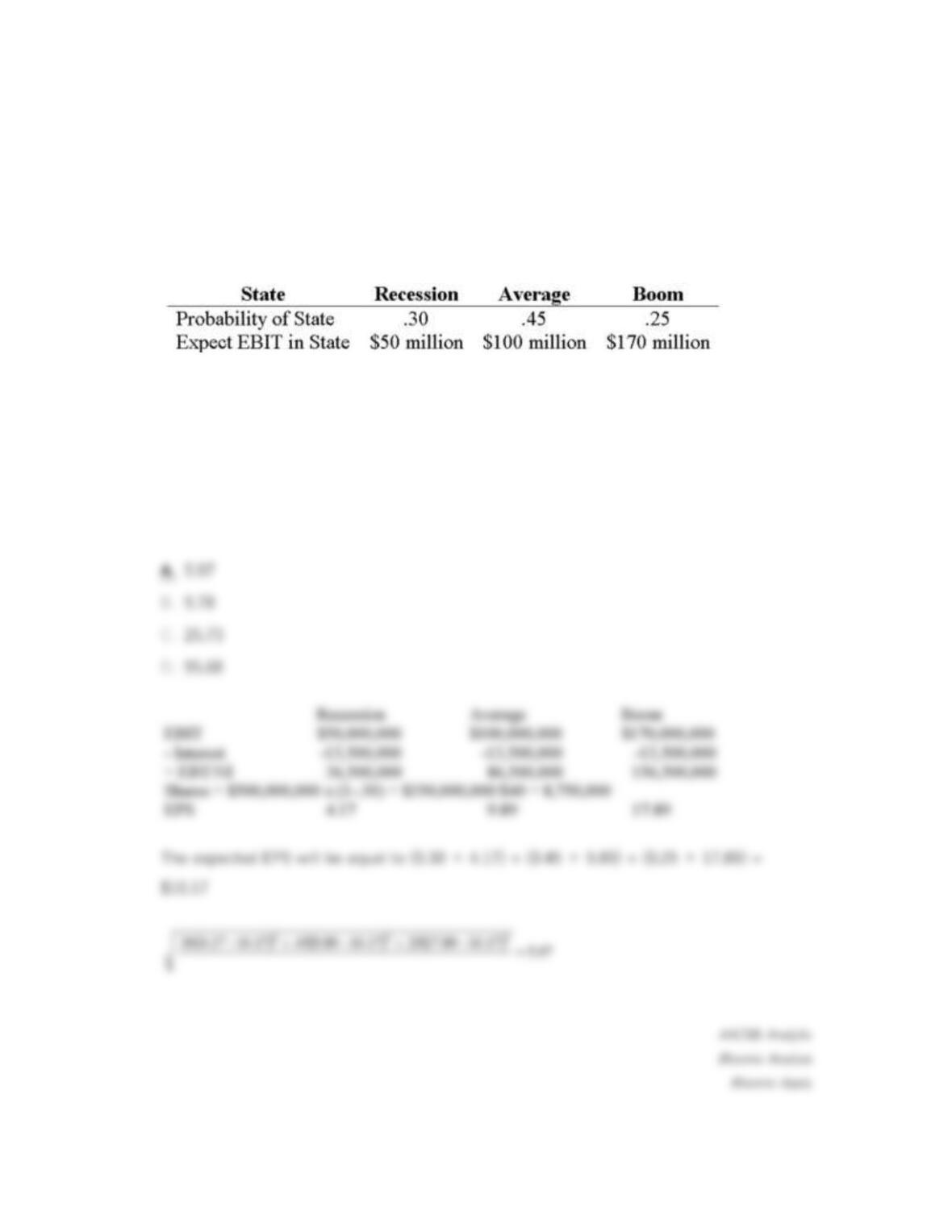
Your company doesn’t face any taxes and has $500 million in assets, currently financed
entirely with equity. Equity is worth $40 per share, and book value of equity is equal to
market value of equity. Also, let’s assume that the firm’s expected values for EBIT depend
upon which state of the economy occurs this year, with the possible values of EBIT and
their associated probabilities as shown as follows:
The firm is considering switching to a 30 percent debt capital structure, and has
determined that they would have to pay a 9 percent yield on perpetual debt in either event.
What will be the standard deviation in EPS if they switch to the proposed capital
structure?