Chapter 16 – Cost information and decision making
TRUE/FALSE
1. In multi-product firms, it is necessary to set up a system to account for costs and to identify direct
and indirect costs.
2. The selling price of products is determined by market forces but can also be dependent on the price
of the product, particularly where there is little or no competition.
3. The basic difference between management and financial accounting is that the financial accounting
system relies on accounting information whereas management accounting does not.
4. Direct costs are sometimes referred to as prime costs, and indirect costs as overhead costs.
5. Product costs are held as assets until sold, whereas period costs are expensed in the period in which
they are incurred.
6. Costs that change in response to changes in the level of activities are referred to as fixed costs.
7. Absorption costing is a method of allocating direct and indirect costs of production to a cost object.
8. The overhead costs for product Y are estimated to be $160,000 and the activity level is estimated
to be 80,000 machine hours. The actual costs are found to be $180,000 and the actual machine
hours are 85,000. Under absorption costing this will necessitate an entry to the statement of
comprehensive income to record a period cost of $10,000.
9. Indirect costs are not included in the calculation of the overhead absorption rate as it is generally
thought to be too complex to share these costs equitably.
10. In traditional-based costing, overheads are apportioned based on one volume measure, whereas in
activity-based costing, overheads are apportioned according to cost drivers.
11. With advanced manufacturing technology, indirect costs tend to predominate over direct costs.
12. Absorption costing includes a proportion of fixed costs in the inventory value, whereas variable
costing does not.
13. When production exceeds sales, absorption costing shows a higher profit than variable costing
because a portion of fixed costs are charged to inventories and thereby deferred to future periods.
14. When sales exceeds production, absorption costing shows a higher profit than variable costing
because a portion of fixed costs are charged to inventories and thereby deferred to future periods.
MULTIPLE CHOICE
1. Management requires information about the cost of products for all of the following reasons except
to:
A.
ascertain the relative profitability of products.
B.
control costs.
C.
estimate rate of depreciation for equipment.
D.
aid planning.
2. Management accounting is concerned with:
A.
the company as a whole, rather than with its segments.
B.
providing information to internal decision makers.
C.
meeting the requirements of generally accepted accounting principles.
D.
recording the financial history of an organisation.
3. Costs that would be included in the factory overhead account would normally not include:
A.
depreciation on plant and equipment.
B.
indirect materials.
C.
direct materials.
D.
factory gas and electricity.
4. Indirect costs for an electrician would not include:
A.
factory rent.
B.
protective clothing.
C.
depreciation of tools.
D.
the electrician’s salary.
5. Period costs are:
A.
costs that are unlikely to represent future benefits.
B.
costs that are recognised in the accounting period in which they are incurred.
C.
costs for which the future benefits cannot be reliably measured.
D.
All of the above are period costs.
6. Which of the following are not production costs?
A.
Direct materials
B.
Indirect labour
C.
Selling expenses
D.
Indirect materials
7. Costs directly associated with specific goods are:
A.
product costs.
B.
period costs.
C.
prepaid costs.
D.
past period costs.
8. Work-in-progress includes all of the items below except:
A.
cost of materials.
B.
cost of labour.
C.
selling costs.
D.
overhead costs.
9. The primary difference between a product cost and a period cost is that:
A.
product costs are associated with specific goods, and period costs are not.
B.
product costs are incurred by manufacturers, and period costs by service providers.
C.
only product costs are recorded as expenses.
D.
period costs become part of cost of goods sold but product costs do not.
10. Service departments often provide service to:
A.
revenue-producing departments only.
B.
other service departments only.
C.
both revenue-producing and service departments.
D.
shareholders.
11. Adel Department Store incurred $8000 of indirect advertising costs for its operations.
The following 20X1 data were collected for its three departments:
Shoe
Clothing
Automotive
Direct advertising costs
$7000
$10,000
$3000
Newspaper ad space
62%
20%
18%
Sales
$160,000
$120,000
$120,000
How much of the indirect advertising costs would have been allocated to the Shoe Department if
newspaper ad space were the allocation base?
A.
$4340
B.
$4960
C.
$5600
D.
$7000
12. Adel Department Store incurred $8000 of indirect advertising costs for its operations.
The following 20X1 data were collected for its three departments:
Shoe
Clothing
Automotive
Direct advertising costs
$7000
$10,000
$3000
Newspaper ad space
62%
20%
18%
Sales
$160,000
$120,000
$120,000
How much of the indirect advertising costs would have been allocated to the Clothing Department
if direct advertising costs were the allocation base?
A.
$1600
B.
$2000
C.
$4000
D.
$8000
13. Adel Department Store incurred $8000 of indirect advertising costs for its operations.
The following 20X1 data were collected for its three departments:
Shoe
Clothing
Automotive
Direct advertising costs
$7000
$10,000
$3000
Newspaper ad space
62%
20%
18%
Sales
$160,000
$120,000
$120,000
How much of the indirect advertising costs would have been allocated to the Automotive
Department if sales were the allocation base?
A.
$1200
B.
$1600
C.
$2400
D.
$8000
14. Which of the following is not normally a method of allocating overhead costs to products?
A.
Cost per machine hour
B.
Cost per direct labour dollar
C.
Cost per direct labour hour
D.
Cost per unit sold
15. The overhead absorption rate is determined by using:
A.
estimated costs.
B.
marginal costs.
C.
average costs.
D.
historical costs.
16. The application of overhead costs to products involves the use of:
A.
exact figures.
B.
fixed costs only.
C.
variable costs only.
D.
estimates.
17. If the allocated overhead using a predetermined overhead rate is less than the actual overhead
costs, the difference is:
A.
expensed to the statement of comprehensive income.
B.
recognised as income in the statement of comprehensive income.
C.
recognised as part of inventory on the balance sheet.
D.
expensed to the cost of goods sold.
18. Brumpy Ltd uses a predetermined overhead rate in applying overhead costs to product, using direct
labour costs for cost centre A and machine hours for cost centre B. The estimates for 20X6 are:
Cost centre A
Cost centre B
Direct labour costs
$100,000
$ 35,000
Production overheads
140,000
150,000
Direct labour hours
16,000
5000
Machine hours
1000
20,000
What are the predetermined overhead rates for cost centres A and B?
A.
$140 and $7.50
B.
$1.40 and $7.50
C.
$8.75 and $30
D.
$1.40 and $4.29
19. Java Ltd manufactures two products, A and B. The manufacturing processes for the two products
are very similar. The following are excerpts from the product data for these two products for 20X6:
Product A
Product B
Units produced
5000
7000
Direct labour hours per unit
1
2
Number of set-ups
10
40
Number of orders
15
60
Machine hours
3
1
Overhead costs total $285,000.
What is the cost per unit for each of A and B in respect of overhead costs using absorption costing,
if costs are absorbed on the basis of direct labour hours?
A.
$15 and $30
B.
$1 and $2
C.
$16.96 and $23.75
D.
$38.86 and $12.95
20. Which of the following is true of activity-based costing?
A.
Overhead is allocated using direct labour hours.
B.
Record keeping is less than under functional-based costing.
C.
Overhead is allocated using only activity measures.
D.
Overhead may be allocated using activity and volume-based measures.
21. The Blizzard Company manufactures skiing equipment. They make six different types of skis and
this requires reconfiguring the machinery to new settings for the production of each of the six
models. Under activity-based costing, which of the following would be the most appropriate basis
on which to apportion the set-up costs for each model?
A.
Direct labour hours
B.
Direct machine hours
C.
Number of set ups
D.
Number of orders
22. Silver Streak Ltd manufactures two products, P and Q. The following data have been collected for
the 20X2 period:
P
Q
Units produced
5000
7000
Machine hours per unit
6
2
Number of set ups
15
25
Direct labour costs per unit
$20
$25
Direct material cost per unit
$25
$15
Overhead costs for both products are as follows:
Setting-up
$50,000
Machine costs
$100,000
Total
$150,000
Calculate the total unit cost for both products using the traditional-based cost system and the
activity-based cost system. Assume both products use machine hours under the traditional-based
system. Based on your calculations, which of the following statements is incorrect?
A.
Total unit cost under the traditional-based system are $46.82 for Q.
B.
Under the traditional-based cost system, product P would be under-priced compared to the
activity-based system.
C.
Set-up costs are $1250 per set-up and machine costs are $2.27 per machine hour.
D.
Total production costs are $311,850 for 5000 units of P as per the activity-based system.
23. Absorption costing would be based on which of the following?
A.
Both fixed and variable costs of production.
B.
Fixed portion of production costs only.
C.
Variable portion of production costs only.
D.
None of the above.
24. In a manufacturing operation that produces more than one product, the method of cost allocation
chosen can have a major impact on which of the following?
A.
The total cost of raw materials.
B.
The unit cost of each product.
C.
Conversion costs.
D.
The method of allocation has no impact because the total manufacturing costs will still be
the same.
25. Which of the following statements is not true of absorption costing?
A.
When sales equal production, absorption costing yields the same profit as variable costing.
B.
When production exceeds sales, absorption costing shows a lower profit than variable
costing does.
C.
When sales exceed production, absorption costing shows a lower profit than variable
costing does.
D.
Absorption costing allocated both fixed and variable overheads to product cost.
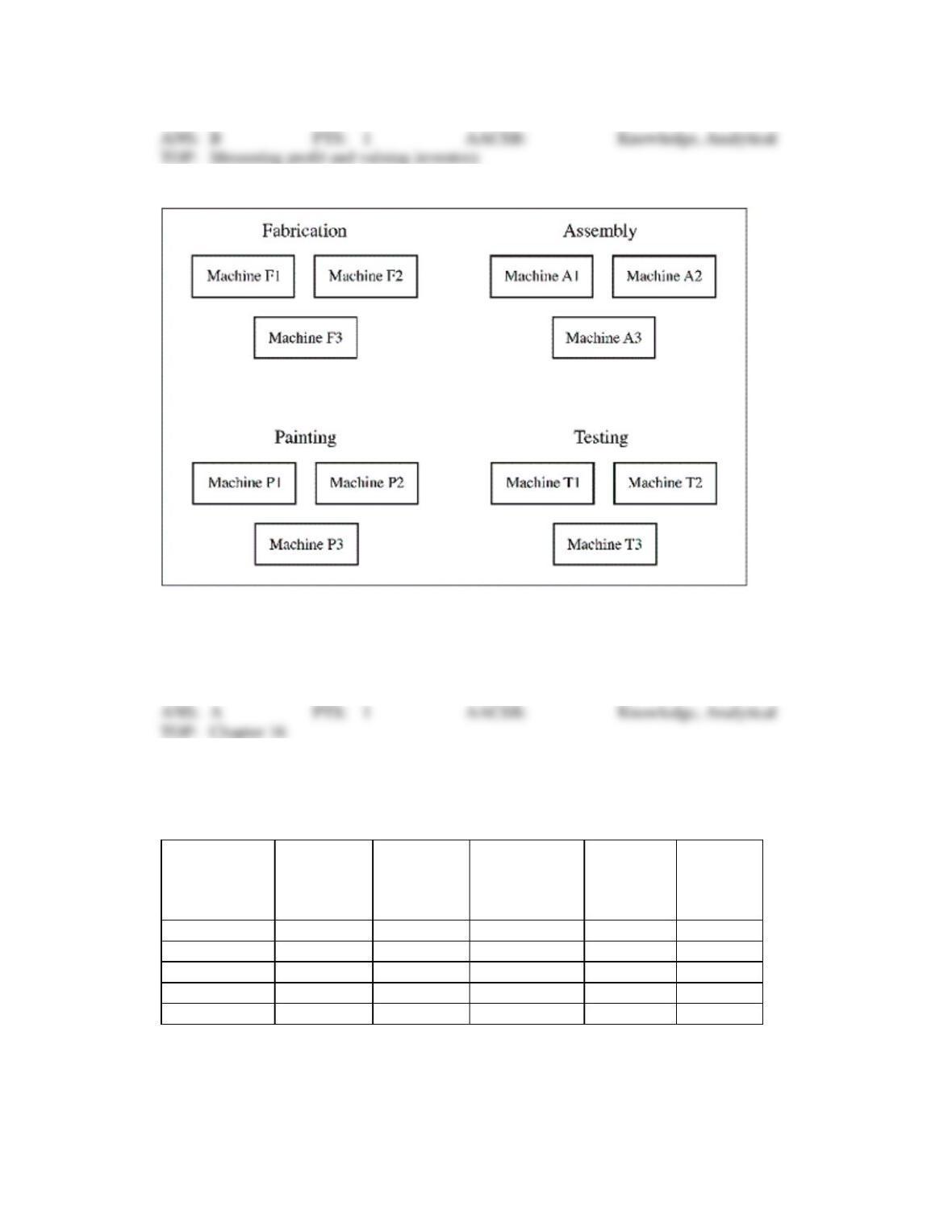
26. Consider the plant layout shown below:
This layout would likely encourage manufacturing personnel to:
A.
specialise in one process.
B.
be cross-trained in more than one process.
C.
act in the best interests of shareholders.
D.
act in the best interests of customers.
27. PVMC
PVMC is a small local hospital in southern Sydney. It has four divisions: family medicine,
emergency medicine, medical testing, and the pharmacy. PVMC employs five physicians; their
names and details of their work are shown below:
Name
Salary
% of time
spent
in family
medicine
% of time
spent
in emergency
medicine
% of time
spent
in medical
testing
% of time
spent
in the
pharmacy
R. Montalban
$60,000
50%
30%
15%
5%
J. Lawrence
80,000
10%
40%
30%
20%
B. Grief
75,000
10%
10%
10%
70%
C. Brown
90,000
40%
60%
0%
0%
S. Braxton
40,000
0%
20%
80%
0%
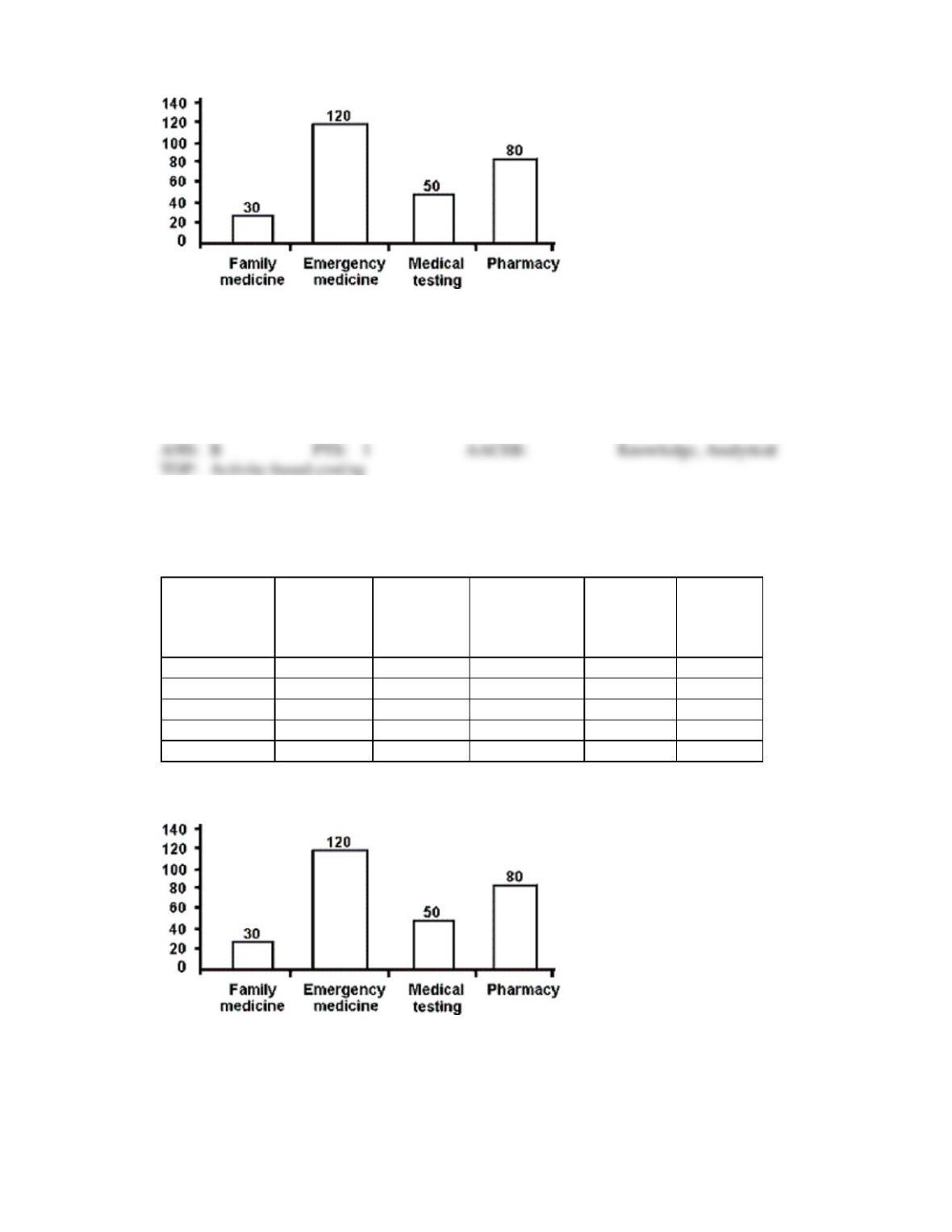
The graph below shows the breakdown of patients treated in each area:
PVMC uses activity-based costing to allocate physician salary costs to the four divisions. Each
division is a cost pool; the cost driver is the percentage of time spent in each division.
Of PVMC’s four divisions, which will have the greatest total allocation of salaries?
A.
Family medicine
B.
Emergency medicine
C.
Medical testing
D.
Pharmacy
28. PVMC
PVMC is a small local hospital in southern Sydney. It has four divisions: family medicine,
emergency medicine, medical testing, and the pharmacy. PVMC employs five physicians; their
names and details of their work are shown below:
Name
Salary
% of time
spent
in family
medicine
% of time
spent
in emergency
medicine
% of time
spent
in medical
testing
% of time
spent
in the
pharmacy
R. Montalban
$60,000
50%
30%
15%
5%
J. Lawrence
80,000
10%
40%
30%
20%
B. Grief
75,000
10%
10%
10%
70%
C. Brown
90,000
40%
60%
0%
0%
S. Braxton
40,000
0%
20%
80%
0%
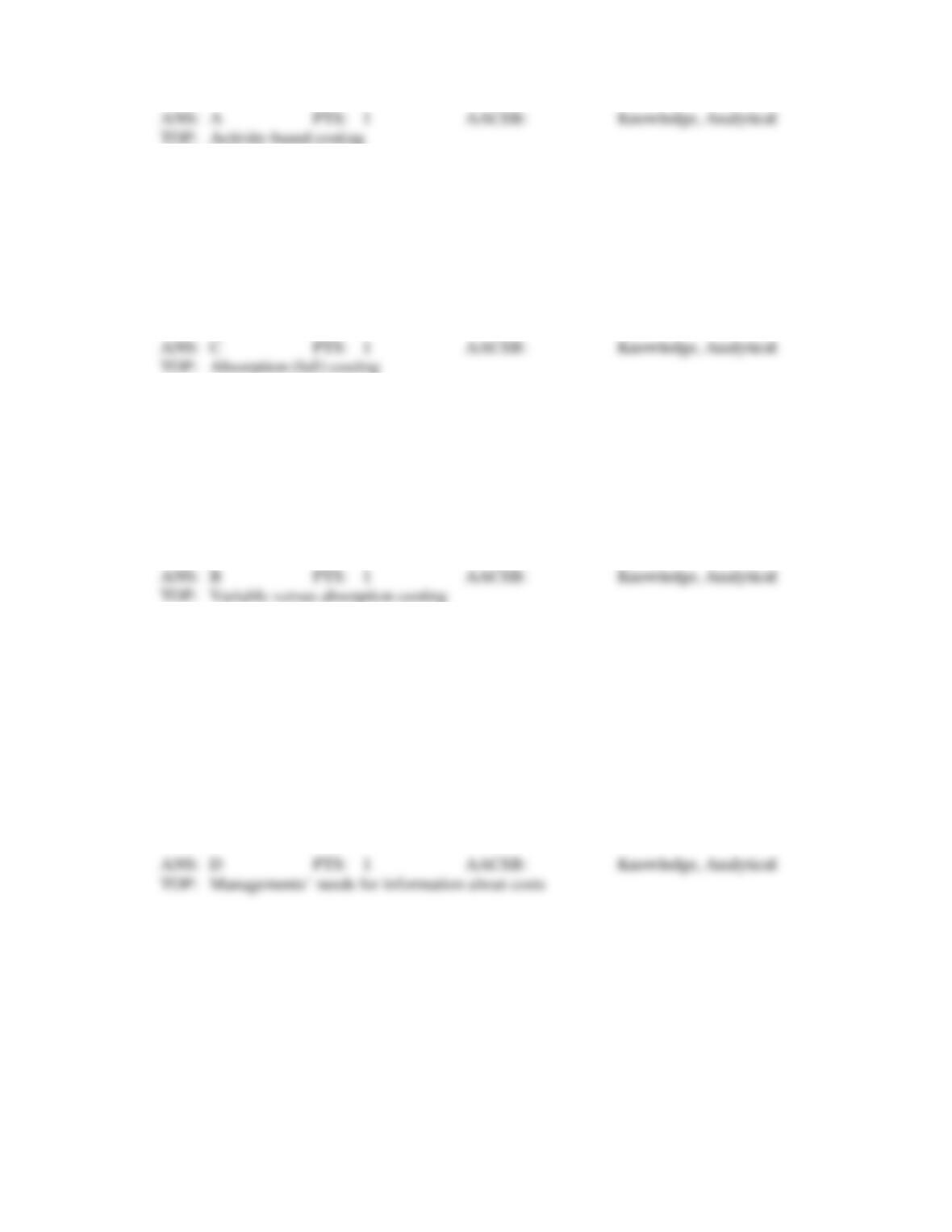
The graph below shows the breakdown of patients treated in each area:
PVMC uses activity-based costing to allocate physician salary costs to the four divisions. Each
division is a cost pool; the cost driver is the percentage of time spent in each division.
Of PVMC’s four divisions, which will have the greatest salary cost per patient?
A.
Family medicine
B.
Emergency medicine
C.
Medical testing
D.
Pharmacy
29. Veronica’s Clothing Manufacturers supplies the following information. Direct materials cost is
$3.00 per unit; direct labour is $4.50 per unit. Variable overhead is $1.50 per unit; fixed overhead
is $2.00 per unit. Secretarial salaries are $7.00 per unit and advertising amounts to $4.00 per unit.
What is the total manufacturing cost per unit under absorption costing?
A.
$7.50
B.
$9
C.
$11
D.
$22
30. Veronica’s Clothing Manufacturers supplies the following information. Direct materials cost is
$3.00 per unit; direct labour is $4.50 per unit. Variable overhead is $1.50 per unit; fixed overhead
is $2.00 per unit. Secretarial salaries are $7.00 per unit and advertising amounts to $4.00 per unit.
What is the total manufacturing cost per unit under variable costing?
A.
$7.50
B.
$9
C.
$11
D.
$22
31. Knowledge of unit costs is necessary to companies for many reasons. Which of the following are
uses of unit cost information?
I. Valuation of inventories
II. Controlling costs
III. Setting selling prices
A.
I only
B.
I and II only
C.
I and III only
D.
I, II, and III
SHORT ANSWER
1. In a manufacturing operation, costs can be divided into product costs and period expenses.
(a) Explain the difference between product costs and period expenses.
(b) Give two examples of costs classified as product costs.
(c) Give two examples of costs classified as period expenses.
2. How is the variable cost approach used in managerial accounting? What are the advantages and
disadvantages of this method?
3. Manufacturing costs flow through an accounting system as products physically move through a
factory.
(a)
Describe the movement of costs from raw materials to costs of goods sold in relation
to the physical movement through the factors.
(b)
Explain how manufacturing costs can sometimes be classified as assets rather than
expenses.
goods is transferred to cost of goods sold when the units are sold.
expenses until the units are sold.
4. Your friend, Bumble Beasley, just graduated from State University with a degree in business. He is
planning to start his own consulting firm, and has asked you for accounting advice. Specifically, he
has the following questions:
(a)
What kinds of overhead costs will I likely incur in my operation?
(b)
Should my general ledger contain a ‘work in process’ account?
(c)
Would you recommend a large, expensive office to impress my clients?
Respond to Bumble’s questions.
units at the end of each accounting period.
likely to run into financial difficulty.
5. Explain the difference in the way that fixed manufacturing overhead is treated under variable
costing and absorption costing.
PROBLEM
1. Opulent Baked Goods, Inc. makes two kinds of breads, Plain and Fancy. The owner has asked you
to determine the cost of the two products so that he may know how to reasonably price his baked
goods. The plain bread can be prepared and baked in large batches, while the fancy bread is made
one loaf at a time. He has provided the following information about the manufacturing (baking)
process for the 200,000 loaves of each of the two products for the year.
Plain Bread
Fancy Bread
Ingredients (materials)
$140,000
$250,000
Direct labour hours
5000 hours
4000 hours
Labour cost @ $ 9.00/hour
$45,000
$36,000
Baking time
10,000 hours
11,000 hours
Number of mixes
400
10,000
Recipe alterations
1
3
Overhead costs (annual budget amounts):
Estimated
Cost
Estimated Activity
Indirect labour (unit)
$36,000
9000 direct labour hours
Mixing of batches (batch)
$94,000
10,400 mixes
Recipe alterations (product)
$40,000
4 alterations
Building expenses (facility)
$640,000
allocated as a percentage of
total overhead
(a)
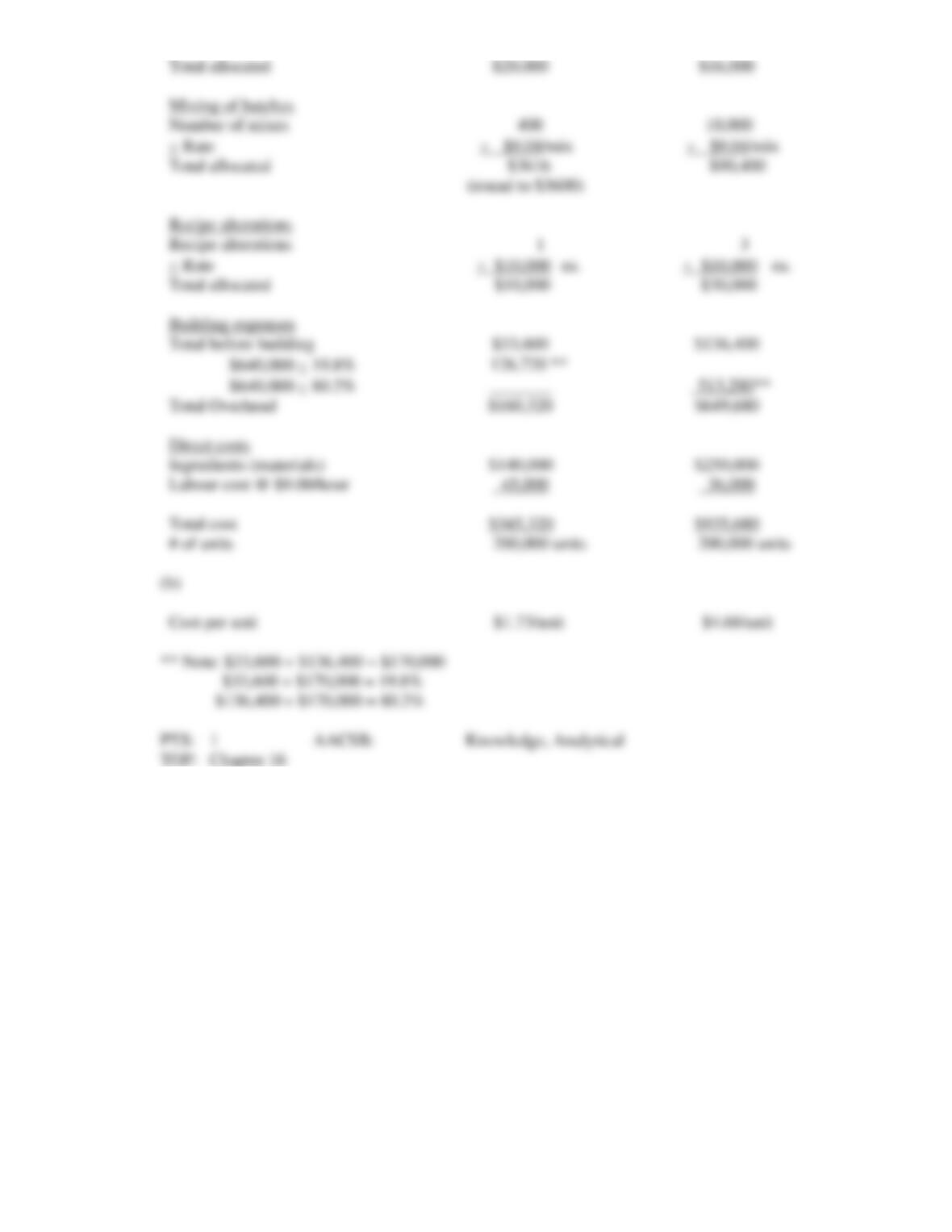
Calculate the predetermined overhead rate per unit using ABC allocation methods.
Calculate the rate for each separate activity and then calculate the total. The facility level
overhead is calculated after other levels, with allocation in proportion to the total of
other overhead allocations to each product.
(b)
Calculate product cost per unit for each of the two products (Plain and Fancy).
Estimated
Estimated
Activity
Indirect labour
9000 hours
$4/hr.
Mixing of batches
10,400 mixes
$9.04/mix
Recipe alterations
4 times
$10,000 ea.
Building expenses
% of total OH
percent
Indirect labour
2. Hardware Products manufactures a wide variety of products in its plant located in Boston,
Massachusetts. Listed below are some of the manufacturing and administrative activities identified
by management.
1.
Employees who will be working on a particular product line go through a week-long
training program either when they are first hired or when they change positions.
2.
The warehouse workers count and shelve all incoming raw materials in the warehouse
when they are received.
3.
Small, high-priced parts are kept in a special fire-proof and theft-proof vault.
4.
Depreciation is calculated monthly for each machine used in the factory.
5.
Certain sensitive products are inspected by the receiving department upon receipt.
Others are inspected on a random basis as a group.
6.
Products are packaged in the finishing department with a shrink-wrap machine.
7.
A specialised cleaning service has been hired for their ability to clean factory areas for
companies with non-stop processes.
8.
Machine setups are performed each time production is begun for a new product.
9.
The shop foreman’s cost associated with approving overtime and reviewing weekly
timecards for each factory employee.
10.
Engineers design new products.
(a)
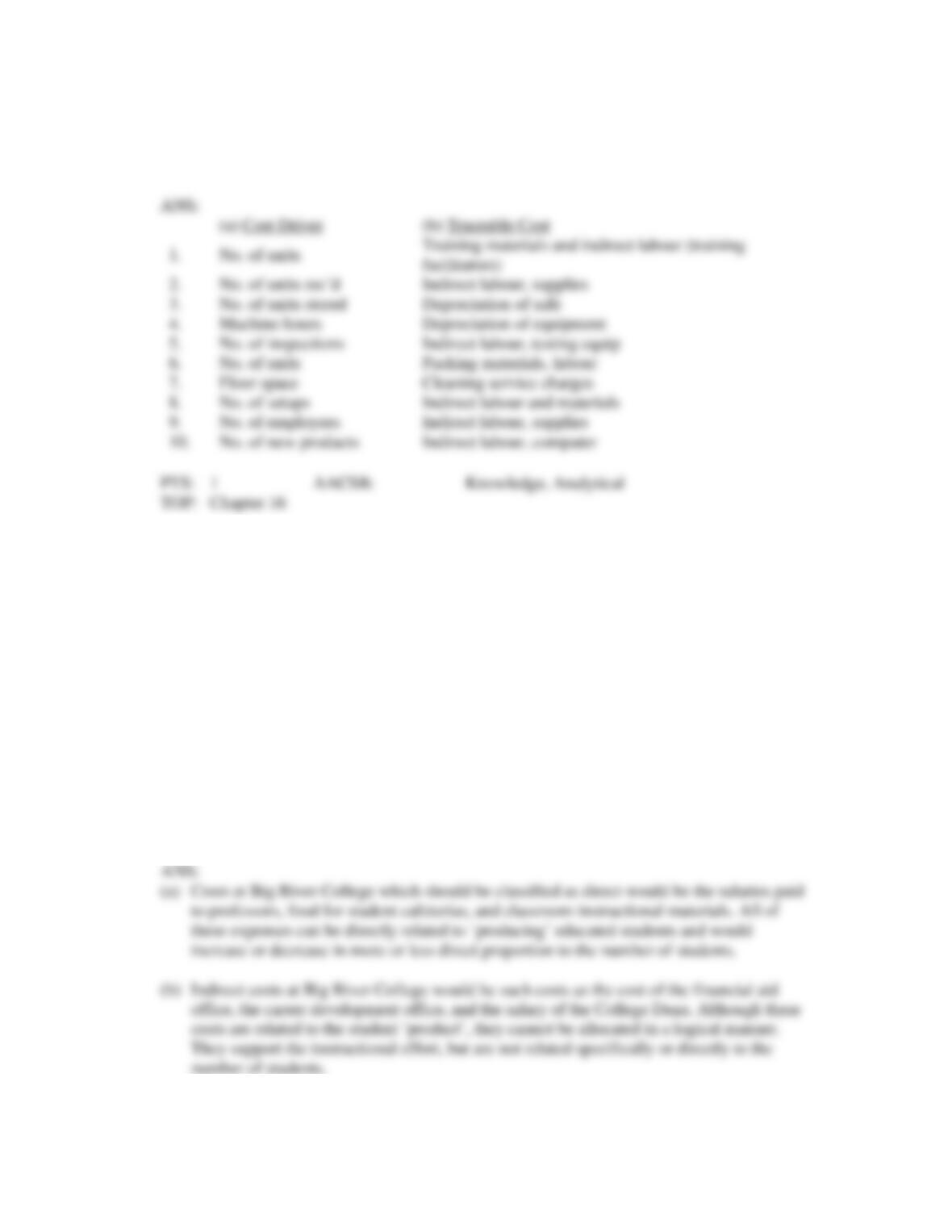
Identify a cost driver for each of the activities to be used to apply costs to the products.
(b)
Name one traceable cost that would be applied using the cost driver identified in Part a.
ESSAY
1. Big River College, a small, private college, is trying to categorise its costs in an effort to reduce the
overall costs of running the college. The students who attend the college are considered its
‘product’.
Required:
(a)
What are some of the costs which should be classified as direct? Name at least three
direct costs and explain the reason for the classification.
(b)
What are some of the costs which should be classified as indirect? Name at least three
indirect costs and explain the reason for the classification.
(c)
If the college is trying to decide whether or not to offer a particular course in summer
school, what are some of the relevant costs which should be considered?
(d)
Discuss some of the non-financial issues which should be considered in relation to the
summer school course.
increase or decrease in more or less direct proportion to the number of students.
2. How is the absorption cost method used in managerial decisions? What are the advantages and
disadvantages of this method?