22) Equilibrium in a perfectly competitive market results in the greatest amount of economic
surplus, or total benefit to society, from the production of a good. Why, then, did Joseph
Schumpeter argue that an economy may benefit more from firms that have market power than
from firms that are perfectly competitive?
23) Explain why market power leads to a deadweight loss. Is the total deadweight loss from
market power in the United States large or small?
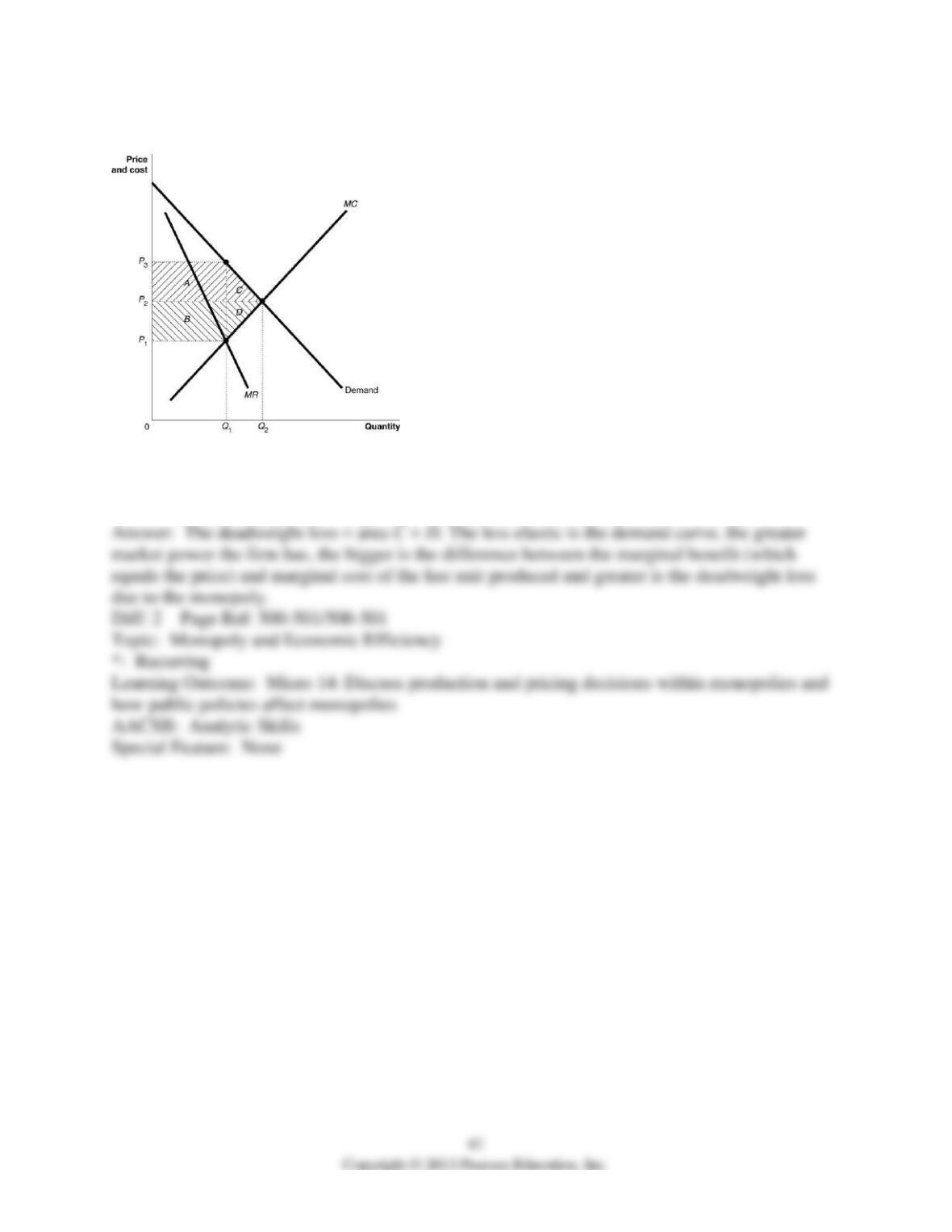
Figure 15-6
24) Refer to Figure 15-6. From the monopoly graph above, identify the area representing the
deadweight loss.
Would the deadweight loss be larger if the demand curve was more elastic or less elastic?
15.5 Government Policy toward Monopoly
1) Collusion is
A) common among monopoly firms.
B) an agreement among firms to charge the same price or otherwise not to compete.
C) necessary for firms to raise money by borrowing from investors or from banks in order to
fund research and development required to develop new products.
D) legal under U.S. antitrust laws if the intent is to increase competition.
2) In the United States, government policies with respect to monopolies and collusion are
embodied in
A) the U.S. Constitution.
B) common law, which the United States adopted from English law.
C) the Supreme Court.
D) antitrust laws.
3) The first important law regulating monopolies in the United States was
A) the Grant Act, which was passed in 1890.
B) the Clayton Act, which was passed in 1890.
C) the Sherman Act, which was passed in 1890.
D) the Federal Trade Commission Act, which was passed in 1914.
4) Which antitrust law prohibited firms from buying stock in competitors and from having
directors serve on the boards of competing firms?
A) the Clayton Act
B) the Securities and Exchange Act
C) the Sherman Act
D) the Robinson-Patman Act
5) The Clayton Act is an antitrust law that was passed to
A) outlaw monopolization.
B) address loopholes in the Sherman Act.
C) prohibit charging buyers different prices if the result would reduce competition.
D) toughen restrictions on mergers by prohibiting mergers that reduce competition.
6) Why are laws aimed at regulating monopolies called “antitrust” laws?
A) The rise of large firms (e.g., Standard Oil) in the late 1800s in the United States caused
consumers to lose trust in private business.
B) “Trust” was a word in Old English that meant monopoly in the Middle Ages. Therefore,
“antitrust” is a term that means “against monopoly.”
C) In the late 1800s, firms in several industries formed trusts; the firms were independent but
gave voting control to a board of trustees. Antitrust laws were passed to regulate these trusts.
D) In the late 1800s, firms in several industries formed trusts; they were called “trusts” because
when corporate officials were questioned about their business they would clam that business was
good for the country and that they should trusted.
7) The U.S. Congress has given two government entities the authority to police mergers. These
two entities are
A) the antitrust division of the Department of State and the Securities and Exchange
Commission.
B) the Federal Trade Commission and the Internal Revenue Service.
C) the Antitrust Division of the U.S. Department of Justice and the Council of Economic
Advisors.
D) the Federal Trade Commission and the Antitrust Division of the U.S. Department of Justice.
8) A merger between firms at different stages of production of a good
A) is a vertical merger.
B) was made illegal by the Sherman Act.
C) was made legal by the Clayton Act.
D) is a horizontal merger.
9) A horizontal merger
A) is a merger between firms in the same industry.
B) results in a trust (for example, the Standard Oil Company).
C) is a merger between firms at different stages of production of a good.
D) was illegal in the United States until the Federal Trade Commission Act was passed by
Congress in 1914.
10) Baxter International, a manufacturer of hospital supplies, acquired American Hospital
Supply, a distributor of hospital supplies. This is an example of
A) a conglomerate merger.
B) a horizontal merger.
C) a vertical merger.
D) a two-dimensional merger.
11) Congress has divided the authority to police mergers between the Antitrust Division of the
U.S. Department of Justice (AD) and the Federal Trade Commission (FTC). How is this
authority divided?
A) The AD decides whether proposed horizontal mergers will be challenged; the FTC decides
whether proposed vertical mergers will be challenged.
B) Both the AD and the FTC are responsible for merger policy.
C) The AD always renders its opinion on any proposed merger first. If the AD approves the
merger, the case then goes to the FTC for final approval. If the AD disallows the merger, the
decision stands and the FTC does not become involved.
D) The AD establishes the guidelines that are used to evaluate proposed mergers; the FTC uses
these guidelines to decide whether a proposed merger will be allowed to take place.
12) Which two factors make regulating mergers complicated?
A) First, firms may lobby government officials to influence their decision to approve the merger.
Second, by the time the government officials reach a decision regarding the merger, the firms
often decide not to merge.
B) First, the time it takes to reach a decision to approve a merger is so long that the firms often
have new owners and mangers. Second, by law, government officials are not allowed to consider
the impact of foreign trade (exports and imports) on the degree of competition in the markets of
the merged firms.
C) First, the Federal Trade Commission and the Antitrust Division of the U.S. Department of
Justice must both approve mergers. Second, the concentration ratios that are used to evaluate the
degree of competition the merged firms face are flawed.
D) First, it is not always clear what market firms are in. Second, the newly merged firm might be
more efficient than the merging firms were individually.
13) Beginning in 1965, the head of the Antitrust Division of the U.S. Department of Justice
began to change antitrust policy. How did antitrust policy change?
A) For the first time horizontal mergers were allowed – with government approval – and vertical
mergers were allowed without need for approval from the government.
B) For the first time concentration ratios were used to evaluate the degree of competition in the
industries of firms that proposed mergers.
C) The Division began to systematically consider the economic consequences of proposed
mergers.
D) Proposed mergers no longer needed the approval of the Federal Trade Commission or the
court system.
14) Economists played a key role in the development of merger guidelines by the Department of
Justice and the Federal Trade Commission in 1982. These guidelines have three main parts.
What are these parts?
A) concentration ratios; the Herfindahl-Hirschman Index; market standards
B) concentration standards; concentration ratios; competitive analysis
C) economic analysis; political analysis; dynamic analysis
D) market definition; measure of concentration; merger standards
15) Merger guidelines developed by the U.S. Department of Justice and the Federal Trade
Commission use the Herfindahl-Hirschman Index as a measure of concentration. This index
measures concentration in an industry by
A) adding up the market shares of all firms in the industry, squaring this number and then
dividing by the number of firms in the industry.
B) squaring the market shares of each firm in an industry and then adding up the values of the
squares.
C) squaring the four-firm concentration ratio of the industry and dividing this number by the
total number of firms in the industry.
D) determining the market shares of the four largest firms in the industry, but unlike the
concentration ratio, the Index includes sales in the United States by foreign firms.
16) The Herfindahl-Hirschman Index is one factor used to determine whether a merger between
two firms should be allowed. Which of the following statements regarding the value of the Index
for a given industry is true?
A) If a merger would result in an Index value less than 1,000, the merger would not be
challenged.
B) If a merger would result in an Index value of 1,000 or more, the industry would be considered
a monopoly and the merger would be challenged.
C) If a merger resulted in an Index of between 1,000 and 1,800, the industry would be considered
competitive and the merger would not be challenged.
D) If a merger would increase the Index by 100, the industry would be considered a monopoly
and the merger would be challenged.
17) According to the Department of Justice merger guidelines, a proposed merger between two
firms may be challenged if the post-merger Herfindahl-Hirschman Index
A) lies between 1,000 and 1,800 and the merger raises the Index by 50 points.
B) lies between 1,000 and 1,800 and the merger raises the Index by more than 100 points.
C) lies above 1,800 and the merger raises the Index by less than 50 points.
D) lies below 1,000 and the merger raises the Index by 100 points.
18) Consider an industry that is made up of six firms with the following market shares: Firm A –
50%, Firm B – 20%, Firms C and D – 10% each, and Firms E and F – 5% each. What is the value
of the Herfindahl-Hirschman Index and how will the industry be categorized?
A) 2,500; mildly concentrated
B) 3,150; highly concentrated
C) 8,100; highly concentrated
D) 10,000; effectively competitive
19) If a firm is a natural monopoly, competition from other firms cannot be counted on to force
price down to the level where the company earns zero economic profit. How are prices usually
set in natural monopoly markets in the United States?
A) Each natural monopoly is made a public franchise. The public franchise is then required to set
its price equal to its marginal cost.
B) Natural monopolies are privately owned, but prices proposed by the firms must be approved
by the Antitrust Division of the Department of Justice.
C) Natural monopolies are privately owned and allowed to set their own prices. Government
regulation of the firms would result in greater deadweight losses.
D) Local or state regulatory commissions usually set prices for natural monopolies.
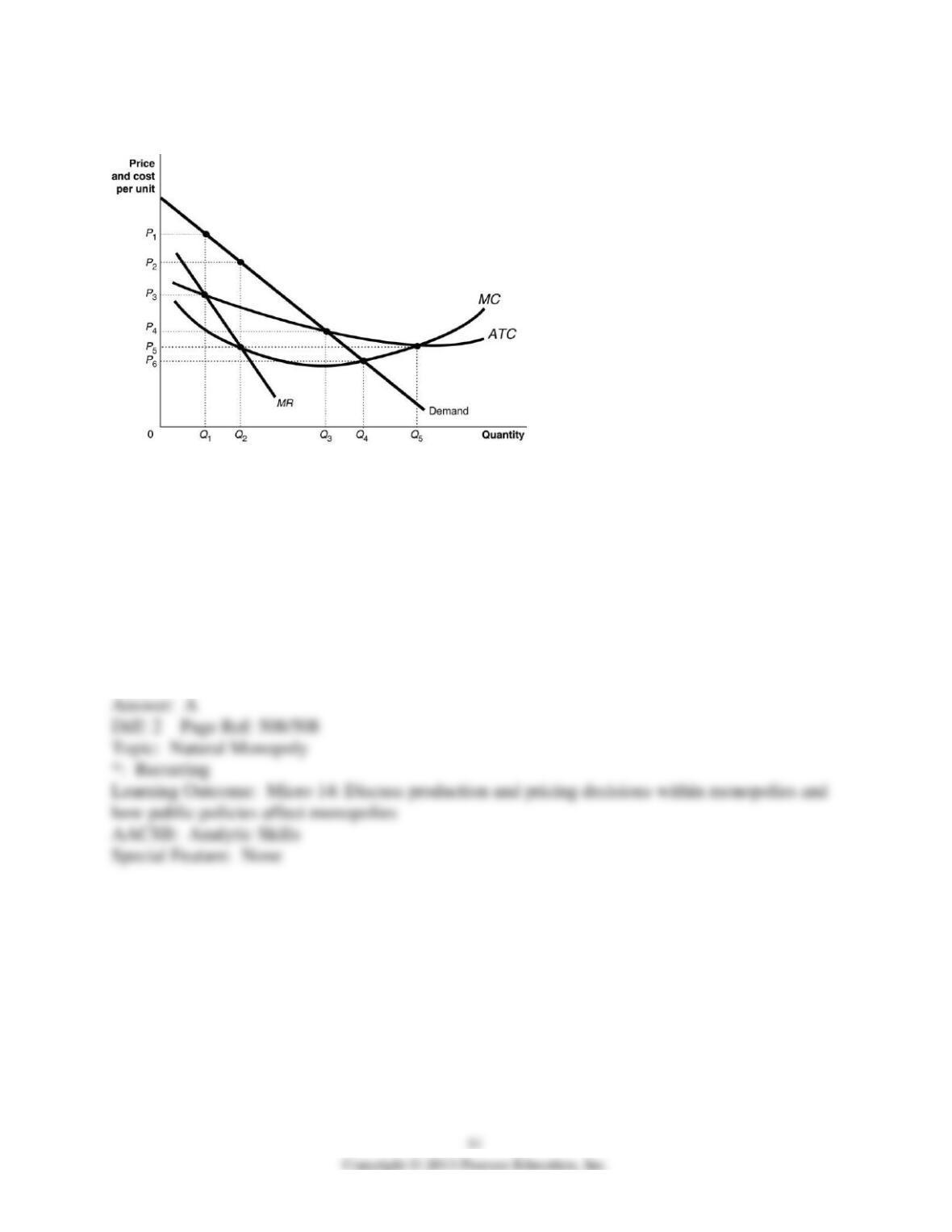
Figure 15-7
Figure 15-7 shows the market demand and cost curves facing a natural monopoly.
20) Refer to Figure 15-7. Suppose the government regulates this industry in order to remove the
inefficiency implied by the behavior of the profit maximizing owners. If regulators require that
the firm produces the economically efficient output level, what is this level and what price will
be charged?
A) Q4 units; P4
B) Q1 units; P4
C) Q1 units; P1
D) Q3 units; P3
21) Refer to Figure 15-7. Which of the following would be true if government regulators require
the natural monopoly to produce at the economically efficient output level?
A) This results in a misallocation of resources.
B) The marginal cost of producing the last unit sold exceeds the marginal benefit.
C) The firm will sustain persistent losses and will not continue in business in the long run.
D) The firm will break even.
22) Refer to Figure 15-7. If the regulators of the natural monopoly allow the owners of the firm
to break even on their investment the firm will produce an output of ________ and charge a price
of ________.
A) Q1 units; P4
B) Q1 units; P1
C) Q5 units; P3
D) Q3 units; P3
23) Refer to figure 15-7. In the absence of any government regulation, the profit-maximizing
owners of this firm will produce ________ units and charge a price of ________.
A) Q0 units; P0
B) Q1 units; P1
C) Q1 units; P4
D) Q3 units; P3
24) The proposed merger between AT&T and T-Mobile wold be classified as a ________
merger.
A) vertical
B) horizontal
C) conglomerate
D) diagonal
25) The government estimated that by allowing the merger between AT&T and T-Mobile to go
through, the Herfindahl Hirschman Index for the national market would increase by nearly 700
points to about 3,100. According to the merger standards of the Department of Justice and the
FTC, a Herfindahl Hirschman index of 3,100 indicates that the market is ________ concentrated,
and the increase of nearly 700 points indicates that the merger ________ be challenged.
A) moderately; may
B) moderately; will
C) highly; may
D) highly; will likely
26) Despite the popularity of the National Football League, many cable television systems do not
offer their customers the NFL Network. In most cities, cable systems are monopolies so their
customers cannot switch to another system that carries the NFL Network. One reason why cable
systems don’t offer the NFL Network is
A) it would violate antitrust laws.
B) cable systems can make greater profits by not offering the NFL network as part of its normal
package, but by forcing consumers to upgrade their service in order to watch it.
C) the marginal cost of adding the NFL Network to their programming packages would exceed
the marginal revenue cable systems would receive.
D) consumer surveys convinced cable systems that the NFL Network is not as popular as NFL
games that are not carried on the NFL network.
27) Several states have passed laws that allowed greater competition in the cable television
market. A likely outcome of these laws is
A) an increase in the number of state laws that allow for greater competition in the satellite
television market.
B) an increase in campaign contributions from cable television company officials to state
legislators.
C) lower prices for cable television and an improvement in the services cable companies offer to
their customers.
D) higher cable prices but an increase in the number of stations offered by cable television
companies to their customers.
28) As more cities allow competition in the market for cable television,
A) more cable television providers will exit the market.
B) producer surplus in the market will increase.
C) deadweight loss in the market will be reduced.
D) economic profits in the market will increase.
29) Merger guidelines developed by the Antitrust Division of the U.S. Department of Justice use
four-firm concentration ratios as measures of concentration.
30) Local or state offices of the Department of Justice usually set prices for natural monopolies
in their jurisdictions.
31) The term “trust” in antitrust refers to a board of trustees that has collusive control over
different companies.
32) Economic efficiency requires that a natural monopoly’s price be set corresponding to the
quantity where marginal revenue equals marginal cost.
33) Identify the type of merger in each of the following situations and indicate how the post-
merger concentration ratio for the industry is affected.
a. A steel company merges with a coal and iron ore mining company.b. Staples, a retailer of
office supplies, acquires Office Depot, another retailer of office supplies.c. An oil company
merges with pipeline, shipping, and railroad companies as well as refineries and gas stations.
34)
a. What is the defining characteristic of a natural monopoly?
b. Should the government break up a natural monopoly into two or more firms to make the
industry more competitive?
c. Suppose the government wants to ensure that some of the benefits of declining average total
cost are passed on to consumers. To achieve this goal, it requires that the natural monopoly set
its price equal to marginal cost. Is this a feasible goal? Explain.
d. What is an alternative to marginal cost pricing that ensures that consumers reap some of the
benefits of declining average total cost?
35) Consider two industries, industry W and industry X. In industry W there are five companies,
each with a market share of 20% of total sales. In industry X, there are six companies. One
company has a 50% market share and each of the other five firms has a market share of 10%.
a. Calculate the four-firm concentration ratio for each industry.
b. Calculate the Herfindahl-Hirschman Index (HHI) for each industry.
c. What do the values of the two concentration measures imply about the degree of market
power in the two industries?
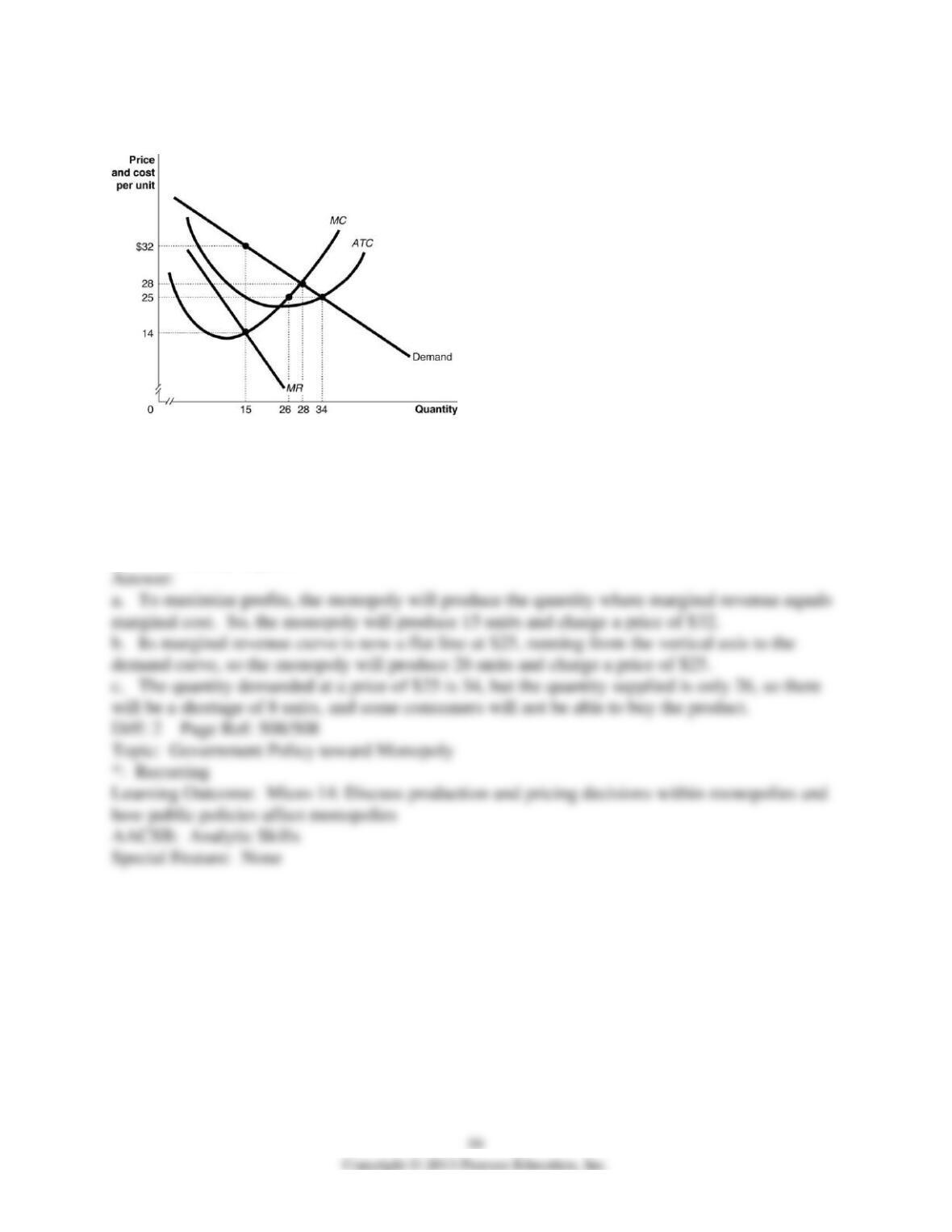
Figure 15-8
36) Refer to Figure 15-8 to answer the following questions.
a. What quantity will this monopoly produce and what price will it charge?
b. Suppose the government decides to regulate this monopoly and imposes a price ceiling of
$25. Now what quantity will the monopoly produce and what price will it charge?
c. Will every consumer who is willing to pay the ceiling price of $25 be able to buy the
product? Briefly explain.