Microeconomics, 4e – Testbank 2 (Hubbard)
Chapter 15 Monopoly and Antitrust Policy
15.1 Is Any Firm Ever Really a Monopoly?
1) By 1970, few households in the United States had cable television but two developments
would lead to a substantial increase in the growth of the cable television industry. One of these
developments was satellite relay technology that made it feasible for local systems to receive
signals from distant broadcast stations. What was the second development?
A) the introduction of Home Box Office (HBO) and other premium cable channels
B) The U.S. Congress relaxed restrictions on rebroadcasting distant stations and premium
channels.
C) Ted Turner purchased WTBS, which became the first cable “superstation.”
D) The U.S. Congress granted an antitrust exemption that enabled cable stations to merge. As a
result, several “superstations” were able to take advantage of economies of scale to lower their
average costs and prices.
2) Few firms in the United States are monopolies because
A) few firms experience economies of scale.
B) of antitrust laws.
C) when a firm earns profits, other firms will enter its market.
D) most products that firms produce have substitutes.
3) A monopoly is a firm that is the only seller of a good or service that does not have
A) a patent.
B) a close complement.
C) a barrier to entry.
D) a close substitute.
4) A narrow definition of monopoly is that a firm is a monopoly if it can ignore
A) government antitrust laws.
B) the pricing decisions of its suppliers.
C) the pricing decisions of firms that produce complementary products.
D) the actions of all other firms.
5) Using a broad definition, a firm would have a monopoly if
A) it produced a product that has no close substitutes.
B) it does not have to collude with any other producer to earn an economic profit.
C) there is no other firm selling a substitute for its product close enough that its economic profits
are competed away in the long run.
D) it can make decisions regarding price and output without violating antitrust laws.
6) The Google search engine has a market share of ________ in the United States and ________
in Europe.
A) 90 percent; 25 percent
B) 50 percent; 50 percent
C) 70 percent; 90 percent
D) 45 percent; 15 percent
7) A monopoly firm is the only seller of a good or service that
A) has a perfectly elastic demand.
B) has no close complements.
C) does not need to be advertised.
D) does not have a close substitute.
8) A firm that is the only seller of a good or service that does not have a close substitute is called
A) a monopoly.
B) an oligopolist.
C) a market maker.
D) a price maker.
9) A monopoly is a firm that is the only seller of a good or service that does not have a close
substitute.
10) Unlike a perfect competitor, a monopolist faces the market demand curve.
11) Andrea Wong owns the only Chinese restaurant in a small town that is also home to a Burger
King, an Applebee’s and a Popeye’s. Using a broad definition of a monopoly, Andrea has a
monopoly.
12) If you own the only bookstore in a small town, do you have a monopoly?
15.2 Where Do Monopolies Come From?
1) To have a monopoly in an industry there must be
A) barriers to entry so high that no other firms can enter the industry.
B) a patent or copyright giving the firm exclusive rights to sell a product for 20 years.
C) an inelastic demand for the industry’s product.
D) a public franchise, making the monopoly the exclusive legal provider of a good or service.
2) Which one of the following is not a possible barrier to entry high enough to keep competing
firms out of a monopoly industry?
A) The monopoly firm has control of a key resource necessary to produce a good.
B) There are important network externalities in supplying a good or service.
C) large economies of scale that result in a natural monopoly
D) a high concentration ratio
3) When the government wants to give an exclusive right to one firm to produce a product, it
A) imposes a tariff on imports of the product.
B) imposes a quota on imports of the product.
C) grants a patent or copyright to an individual or firm.
D) uses antitrust laws to keep other firms from entering the market.
4) There are several types of barriers to entry that can create a monopoly. Which of the following
barriers is the result of government action?
A) network externalities
B) public franchise
C) economies of scale
D) control of a key resource
5) When the government makes a firm the exclusive legal provider of a good or service, it grants
the firm
A) a copyright.
B) a network externality.
C) a quota.
D) a public franchise.
6) A patent
A) grants the creator of a book, film, or piece of music the exclusive right to use the creation for
20 years.
B) grants the creator of a book, film, or piece of music the exclusive right to use the creation
during the creator’s lifetime.
C) gives a firm the exclusive right to a new product for 20 years from the date the product is
invented.
D) gives the firm the exclusive right to a new product during the product inventor’s lifetime.
7) Ordinarily, governments attempt to promote competition in markets. Why do governments use
patents to block entry into some markets when this prohibits competition?
A) Patents encourage firms to spend money on research necessary to create new products.
B) Politicians sometimes succumb to pressure from lobbyists to grant favors to businesses for
political reasons.
C) Patents are an important source of government revenue.
D) Patents are justified because they are an important means for creating network externalities.
8) Experience with patents in the pharmaceutical industry shows that when patents on drugs
expire,
A) most patients will continue to buy the drugs from the same firms because their doctors
recommend they buy brand-name drugs.
B) prices remain high without patent protection because of a lack of competition. Firms that are
not granted patents cannot compete with firms that are granted patents.
C) other firms are free to produce chemically identical drugs. Competition reduces the profits
that had been earned by the firms that received patents.
D) firms will find ways to obtain additional patent protection – often by making cosmetic
changes in drugs that were patented – so that they can continue charging high prices.
9) Many biologic drug manufacturers are pushing for patent protection to be extended to 12
years before generics are allowed to be introduced to the market. This reflects which of the
following barriers to entry?
A) control of a key resource
B) network externalities
C) entry blocked by government action
D) economies of scale creating a natural monopoly
10) The 10-year protection period from generic competition for drug manufacturers is a form of
A) copyright.
B) trademark.
C) hallmark.
D) patent.
11) For years the Paul Ecke Ranch had a monopoly on poinsettias. What was the reason for the
monopoly the Ranch had on poinsettia sales?
A) The Paul Ecke Ranch was granted a public franchise which made it the sole legal provider of
poinsettias.
B) Paul Ecke discovered a technique for growing poinsettias that had more leaves and were more
colorful than other poinsettias.
C) The Paul Ecke Ranch was granted a patent that gave it the exclusive right to produce and sell
poinsettias.
D) The Paul Ecke Ranch was able to take advantage of network externalities in supplying
poinsettias.
12) For years the Paul Ecke Ranch had a monopoly on poinsettias. What event was responsible
for the end of this monopoly?
A) A university researcher discovered the special technique the Ecke Ranch used for growing
poinsettias. After the researcher published the technique other firms were able to compete with
the Ecke Ranch.
B) Other poinsettia sellers were finally able to take advantage of the network externalities that
had given the Ecke Ranch its monopoly.
C) After 20 years, the patent the Ecke Ranch had been granted for its poinsettias expired.
D) The government took away the public franchise it had earlier given to the Ecke Ranch to be
the sole legal provider of poinsettias.
13) Network externalities
A) can only exist when there are economies of scale.
B) prevent the dominance of a market by one firm.
C) exist when the usefulness of a product increases with the number of consumers who use it.
D) are created when celebrity endorsements of products lead to a surge in the demand for those
products.
14) What type of protection does U.S. law grant the creator of a book, film or piece of music?
A) A public franchise, which grants the exclusive right to use the creation during the author’s
lifetime and to his or her heirs for 70 years after the author’s death.
B) A copyright, which grants exclusive rights to the creation’s author for 20 years after the work
is created.
C) A patent, which grants the exclusive right to use the creation during the author’s lifetime and
to his or her heirs for 70 years after the author’s death.
D) A copyright, which grants the exclusive right to use the creation during the author’s lifetime
and to his or her heirs for 70 years after the author’s death.
15) The International Nickel Company of Canada is often cited as an example of monopoly.
What was the source of the barrier to entry that gave this firm monopoly power?
A) It was a public enterprise; therefore, the Canadian government blocked entry into the market
for nickel.
B) There were important network externalities in the production of nickel.
C) Economies of scale resulted in the company becoming a natural monopoly.
D) control of a key resource
16) The International Nickel Company of Canada is often cited as an example of monopoly, but
International Nickel eventually lost its monopoly. What event was responsible for this?
A) New technology allowed other firms to achieve network externalities after World War II.
B) The Canadian government, which had owned International Nickel, sold the company after
World War II. The government no longer blocked entry into the market for nickel.
C) Competition in the market for nickel increased after nickel fields were developed in Russia
after World War II.
D) Competition in the market for nickel increased after Canada signed the North American Free
Trade Agreement with the United States and Mexico in 1994.
17) In the United States, barriers to entry in professional team sports (for example, football and
baseball) result from
A) the draft of college players, which grants teams exclusive signing rights to individual players.
B) long-term leases teams sign for stadiums and ballparks in major cities.
C) television contracts, which give networks the exclusive rights to broadcast games.
D) the reserve clause, which is a provision in contracts of professional athletes that require them
to play for specific teams over the length of their contracts.
18) The De Beers diamond mining and marketing company of South Africa became one of the
most profitable and longest-lived monopolies in history. Which of the following has always
threatened De Beers’ control of the diamond market?
A) Since few diamonds are ever destroyed, De Beers has constantly faced possible competition
from other firms reselling diamonds.
B) Competition from imitation diamonds. Technology has made it possible to make fake
diamonds look exactly like real diamonds.
C) Competition from other gemstones, including rubies and emeralds, that have become more
popular over time.
D) At different times in the past some countries have banned the importation of diamonds from
South Africa for political reasons.
19) BHP Billiton is a Canadian company that owns mines in Canada that
A) produce nickel. After World War II, BHP Billiton began to compete with another Canadian
firm, the International Nickel Company. This competition eventually ended International
Nickel’s monopoly in this market.
B) produces bauxite, the mineral needed to produce aluminum. BHP Billiton began to mine
bauxite after World War II. This competition eventually ended the Aluminum Company of
America (ALCOA)’s monopoly in this market.
C) produces coal. Until World War II, BHP Billiton had a monopoly on coal in Canada.
D) produce diamonds.
20) After having a monopoly in the diamond market for many years, by 2000 the De Beers
company faced competition from other companies. To maintain its market share, De Beers
A) began buying so-called “blood diamonds” in order to keep these diamonds out of the control
of other diamond companies.
B) adopted a strategy of differentiating its diamonds. Each of its diamonds is now marked with a
microscopic brand.
C) bought diamond mines in Canada and Russia that had been its competitors.
D) lowered the prices of its diamonds to make the market appear less profitable to potential
competitors.
21) Some economists argue that Microsoft become a monopoly in the market for computer
software by developing MS-DOS, an operating system used for the first IBM personal
computers. The more people who used MS-DOS-based programs, the greater the usefulness of a
using a computer with an MS-DOS operating system. The explanation for Microsoft’s monopoly
is
A) the development of new technology that other firms could not copy.
B) control of a key resource which, in this case, is the MS-DOS operating system.
C) network externalities.
D) patents Microsoft obtained when it developed the MS-DOS operating system.
22) Although some economists believe network externalities are important barriers to entry,
other economists disagree because
A) they believe that the dominant positions of firms that are supposedly due to network
externalities are to a greater extent the result of the efficiency of firms in offering products that
satisfy consumer preferences.
B) they believe that most examples of network externalities are really barriers to entry caused by
the control of a key resource.
C) network externalities are really negative externalities.
D) they believe that the dominant positions of firms that are supposedly due to network
externalities are to a greater extent the result of economies of scale.
23) In discussions of barriers to entry, what is meant by the term “virtuous cycle”?
A) A virtuous cycle refers to successful research and development that leads to information that
is used to develop other new products.
B) A virtuous cycle refers to a firm using the profits from a monopoly in one market to establish
a monopoly in another market.
C) A virtuous cycle refers to the situation where the pursuit of self-interest in establishing an
entry barrier leads to an increase in social welfare (the “invisible hand”).
D) A virtuous cycle refers to a situation where if a firm can attract enough customers initially, it
can attract additional customers because its product’s value has been increased by other
customers using it, which attracts even more customers.
24) To be a natural monopoly a firm must
A) control a key resource input.
B) have economies of scale that are so large that it can supply the entire market at a lower cost
than two or more firms.
C) have significant network externalities.
D) be very large relative to the total market.
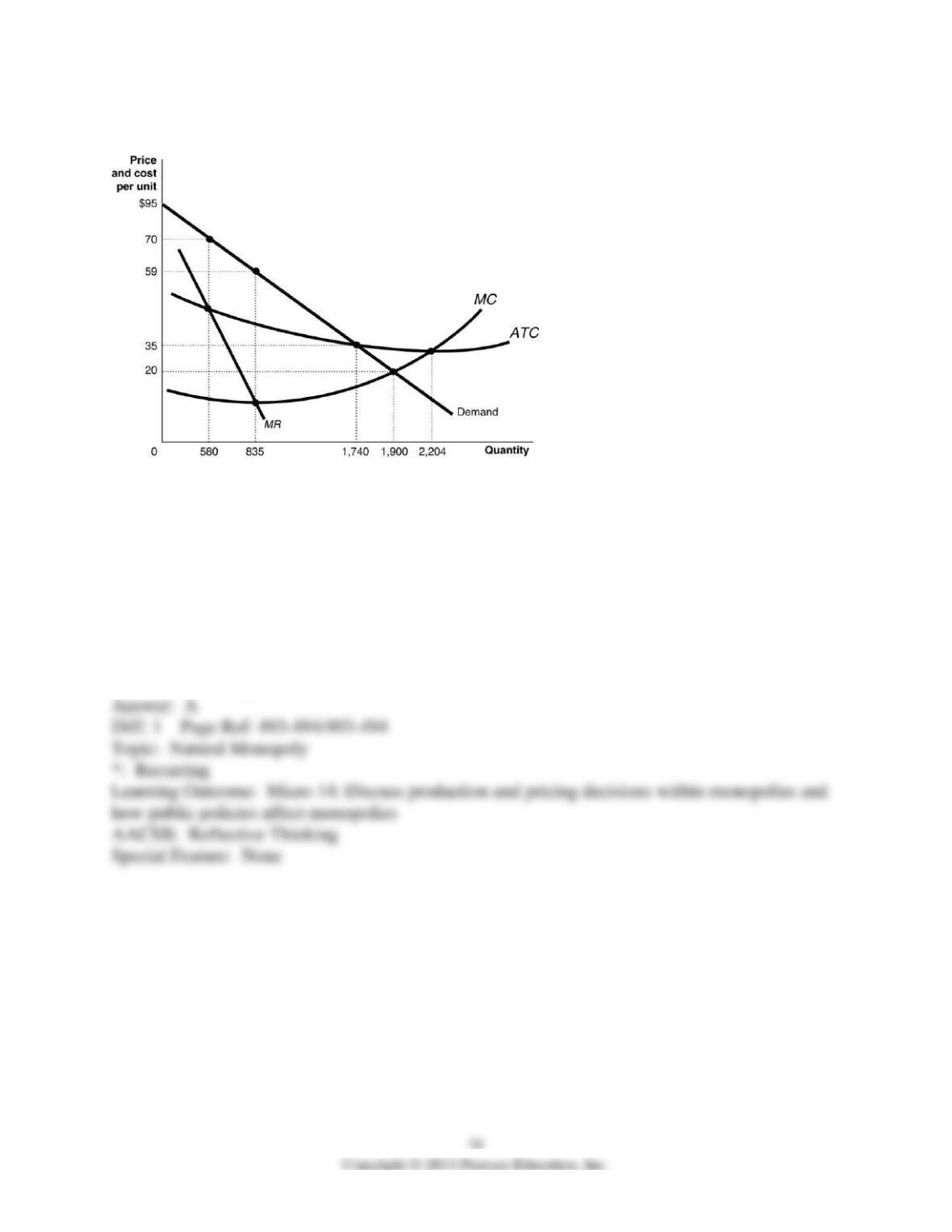
Figure 15-1
25) Refer to Figure 15-1. Which of the following statements about the firm depicted in the
diagram is true?
A) The fact that this firm is a natural monopoly is shown by the continually declining long-run
average total cost as output rises.
B) The fact that this firm is a natural monopoly is shown by the continually declining market
demand curve as output rises.
C) The fact that this firm is a natural monopoly is shown by the continually declining marginal
revenue curve as output rises.
D) The fact that this firm is a natural monopoly is shown by the fact that marginal cost lies below
the long-run average total cost where the firm maximizes its profits.
26) A natural monopoly is most likely to occur in which of the following industries?
A) the pharmaceutical industry because the development and approval of new drugs through the
Food and Drug Administration can take more than 10 years
B) the diamond mining and marketing industry because one firm can control a key resource
C) the software industry because of the importance of network externalities
D) an industry where fixed costs are very large relative to variable costs
27) If the OpenTable Website was a natural monopoly, its
A) marginal cost curve would still be declining when it crossed the demand curve.
B) average total cost curve would still be declining when it crossed the demand curve.
C) marginal revenue curve wold be the same as its demand curve.
D) marginal revenue curve would be horizontal.
28) If the OpenTable Website was a natural monopoly, dividing the business equally between
two firms that each supplied the same number of online reservations would
A) decrease marginal cost.
B) raise average total cost.
C) increase total revenue.
D) make marginal revenue less elastic.
29) Network externalities refer to the situation where the usefulness of a product increases with
the number of consumers who use it.
30) A public franchise gives the exclusive right to produce a product for 20 years from the date
the product is invented.
31) A virtuous cycle refers to the development of new products that follows when a monopoly
earns economic profits.
32) Natural monopolies are most likely to occur in markets where fixed costs are very large
relative to variable costs.
33) What is a public franchise? Are all public franchises natural monopolies?
34) U.S. antitrust laws are designed to prohibit monopolization and encourage competition. Why,
then, does the government erect barriers to entry and create monopoly power by granting firms
patents?
35) Identify four reasons for high entry barriers? Briefly explain each reason.