
66. Which of the following statements is false?
a.
Ozone in the lower stratosphere shields the earth from about 95% of the sun’s harmful
ultraviolet rays.
b.
CFCs are odorless and stable.
c.
CFCs are nonflammable, nontoxic, and noncorrosive.
d.
Fluorine atoms are most responsible for the breakdown of ozone to molecular oxygen.
e.
CFCs are cheap to produce.
67. Chlorofluorocarbons are
a.
nontoxic
b.
corrosive
c.
odorous
d.
flammable
e.
expensive
68. Between the first warnings about CFCs from the scientific community and a response to reduce CFCs
from the political community there was a ____-year lag.
a.
one
b.
five
c.
ten
d.
fourteen
e.
twenty-five
69. CFCs take ____ years to reach the stratosphere.
a.
1-2
b.
5-10
c.
11-20
d.
21-30
e.
31-50

70. We can slow the rate of ozone hole-creation by
a.
stopping production of ozone-depleting chemicals
b.
recovering and reusing ozone-depleting chemicals
c.
finding substitutes for CFCs
d.
all of these answers
e.
none of these answers
71. In 1987, 36 nations meeting in Montreal, Canada, developed the Montreal Protocol to reduce
production of
a.
carbon dioxide
b.
nitrous oxide
c.
CFCs
d.
toxic wastes
e.
halons
72. Which of the following are effects of ozone depletion?
a.
increased photochemical smog
b.
reduced crop yields
c.
immune system suppression
d.
reduced phytoplankton populations
e.
all of these answers
73. With immediate and sustained action to stop production of all ozone-depleting chemicals:
a.
The ozone-hole problem will be solved immediately.
b.
It will take about 5 years for the earth’s ozone layer to recover to 1980 levels.
c.
It will take about 30 years for the earth’s ozone layer to recover to pre-1950 levels.
d.
It will take about 60 years for the earth’s ozone layer to recover to pre-1950 levels.
e.
It will take about 60 years for the earth’s ozone layer to recover to 1980 levels.

TRUE/FALSE
1. Chlorofluorocarbons are compounds that were not appreciably present in the atmosphere before 1950
and have a significant role in catalyzing decomposition of stratospheric ozone.
2. Most of the carbon dioxide in the atmosphere is the result of human activities.
3. Nitrogen oxides can combine with water in the atmosphere and form nitric acid, one of the
components of harmful acid deposition.
4. Ozone is only toxic in the form that it takes in the stratosphere.
5. The molecular structure of stratospheric ozone is identical to ozone that is toxic in the troposphere.
6. Today, the use of other fossil fuels, nuclear power, and hydroelectricity instead of coal has greatly
reduced the occurrence of industrial smog.
7. Cow belching results in the release of methane, a greenhouse gas.
8. Chinese automobile fuel efficiency standards are higher than those in the United States.
9. Climate change affects the entire planet and will be long-term.

10. The world’s economies are not affected by climate change.
11. It has been hypothesized that climate change helped to lead nomadic hunter-gatherers to settle down
and invent agriculture.
12. China’s per capita carbon dioxide emissions rate will soon be greater than that of the U.S.
13. China has passed the U.S. in terms of becoming the largest carbon dioxide emitting country.
14. A warmer atmosphere is beneficial to wildlife habitats and plant species because of the increased
temperature and productivity.
15. The United States, China, and Russia—three of the world’s major emitters—agreed in 2001 to
participate in a cap-and-trade program to slow global warming.
16. In 2007, the Intergovernmental Panel on Climate Change concluded that human activities are the
primary cause of recent global warming.
17. An increase in thick and continuous clouds at low altitudes could warm the lower atmosphere and
increase surface warming.
18. The Kyoto Protocol requires that developing nations reduce their greenhouse gas emissions to a level
below their 1990 levels.

19. President George W. Bush withdrew U.S. participation from the Kyoto Protocol, arguing that
participation would harm the U.S. economy.
20. Drier conditions have led to more frequent and intense forest fires in the western United States.
21. The Montreal Protocol addresses global CO2 emissions.
22. Soot generated in Europe is darkening arctic ice and lessening its ability to reflect sunlight, thereby
hastening the disappearance of ice in the Arctic.
23. Global warming will cause flooding and increased precipitation in some areas, and yet severe droughts
in other areas.
24. While climate change is a serious threat to natural ecosystems, it is not a threat to human health.
25. Carbon capture and storage (CCS) involves restoring degraded wetlands so that they will absorb
massive amounts of carbon from the atmosphere.
26. Actions you can take at home to help with the problem of climate change include insulating your hot
water heater and setting the temperature no higher than 49 oC. These actions greatly reduce heat
released into the atmosphere, and thus help with global warming.
27. If participating nations continue to follow the Montreal Protocol recommendations, ozone levels
should return to 1980 levels by the year 2071.

COMPLETION
1. ____________________ are manmade compounds that have been widely used as refrigerants and in
spray propellants and foam blowing.
2. The ____________________ is the layer of the atmosphere that contains the protective ozone layer.
3. ____________________ are harmful chemicals emitted directly into the air from natural processes and
human activities.
4. ____________________ is a mixture of primary and secondary pollutants formed under the influence
of UV radiation from the sun.
5. The most dangerous type of skin cancer is ____________________.
6. ____________________ is a colorless gas used in foam insulation and can cause irritation of the eyes,
throat, skin, and lungs.

7. Life as we know it could not exist without ____________________ in the stratosphere.
8. Air pollution comes from ____________________ and ____________________ sources.
9. The Environmental Protection Agency’s classification of fine and ultra-fine particles refers to
____________________.
10. The type of air pollution that is currently leading the list of 18 sources of cancer risk
is____________________.
11. Removing your shoes before entering your house can help to reduce indoor pollution because it can
help to reduce inputs of ____________________, ____________________, and
____________________.
12. The estimated tipping point of carbon dioxide levels in the atmosphere is ____________________
ppm.

13. The United States emits about five times more carbon dioxide ____________________ than China
emits.
14. _____________________ has been referred to as a methane time bomb because it could release such a
high level of methane into the atmosphere.
15. ____________________ aims to be the first country to become carbon neutral.
336
MATCHING
Match the items listed below with the appropriate choice
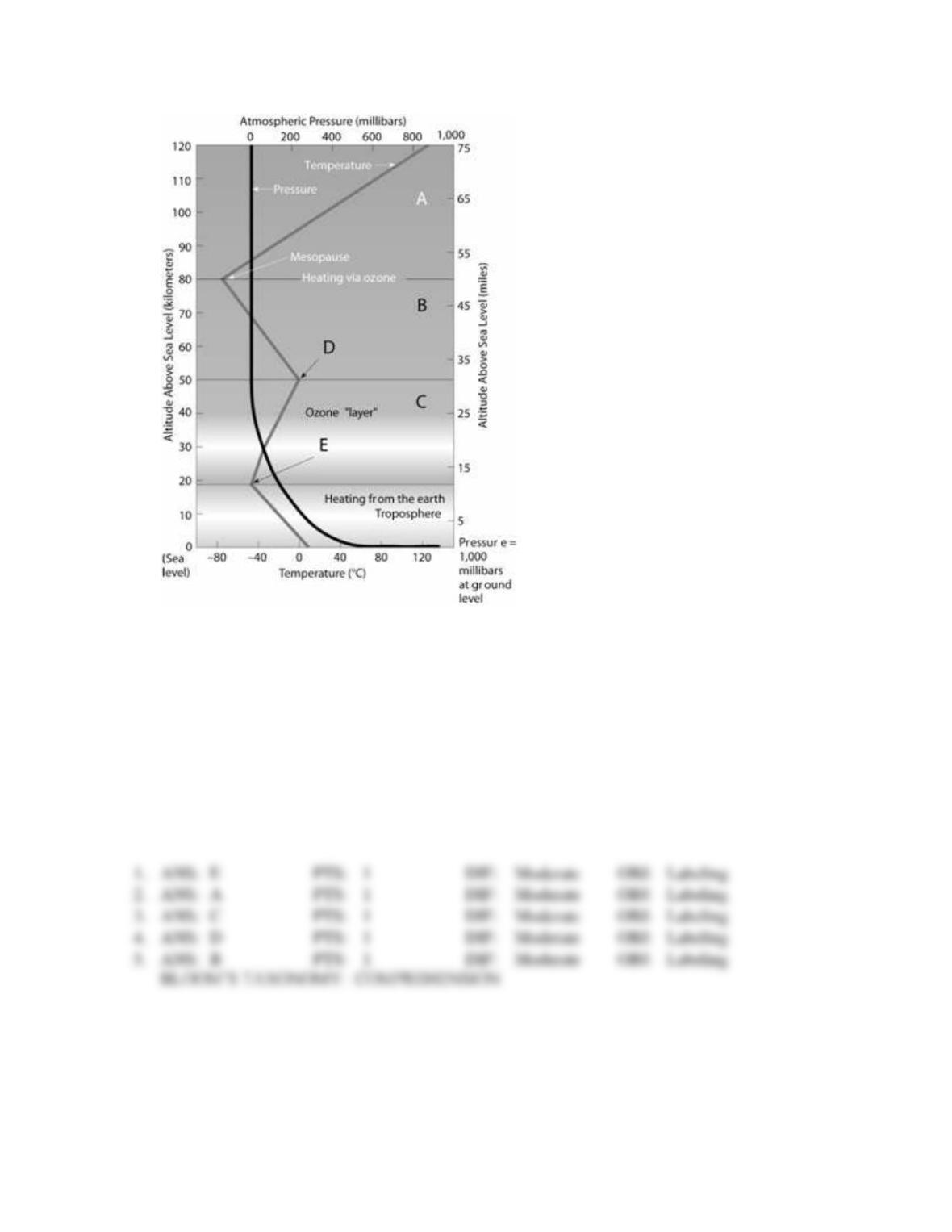
1. On the atmospheric layers figure, choose the letter that represents the boundary in the atmosphere
between the troposphere and the stratosphere.
2. On the atmospheric layers figure, choose the letter that represents the area where air would be thin and
temperatures vary greatly with solar activity.
3. On the atmospheric layers figure, choose the layer that contains ozone, which keeps approximately
95% of the sun’s ultraviolet radiation from reaching the Earth’s surface.
4. On the atmospheric layers figure, choose the layer that represents the separation of the mesosphere and
stratosphere.
5. On the atmospheric layers figure, choose the layer that represents part of the middle atmosphere in
which temperatures vary greatly with altitude.
Match the items listed below with the appropriate choice
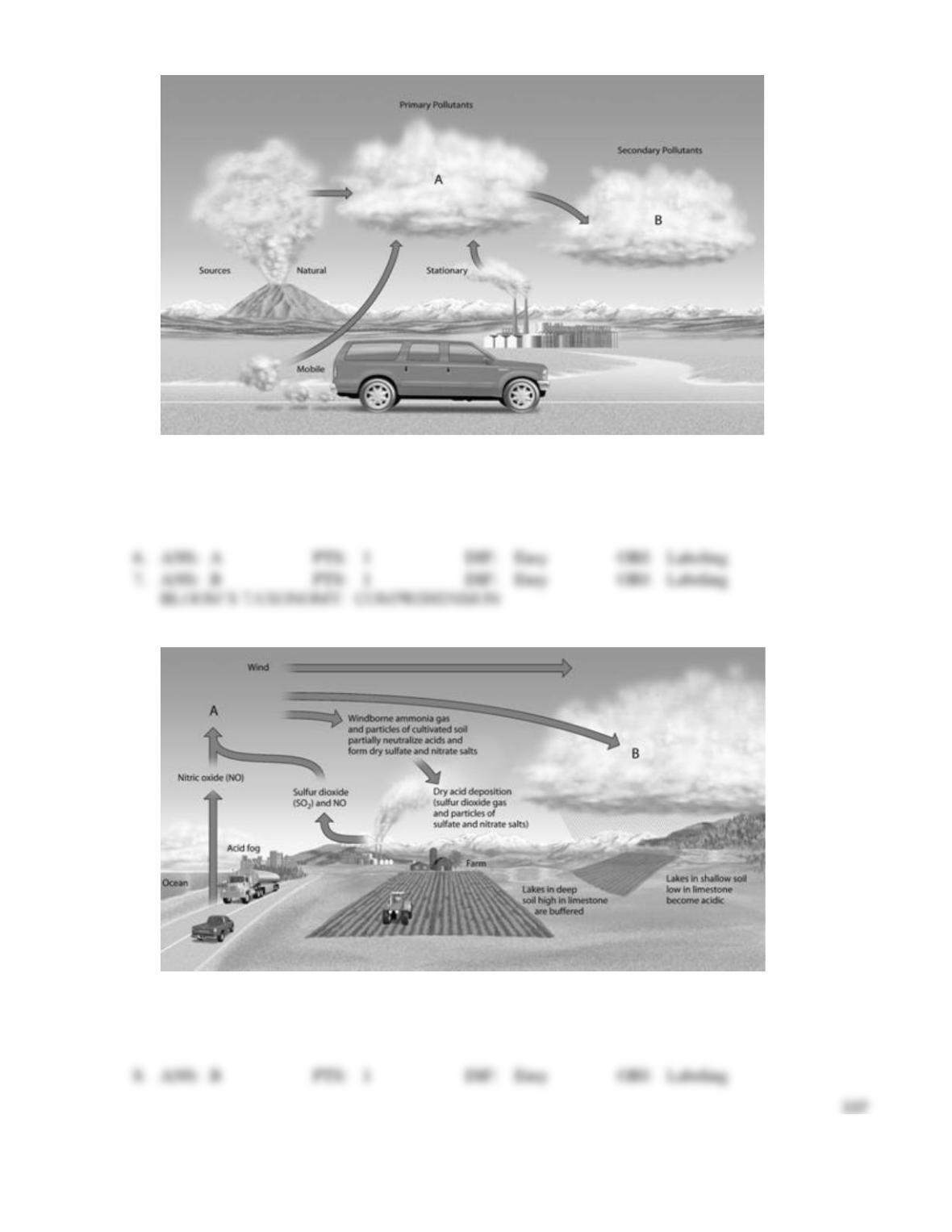
6. On the sources and types of air pollutants figure, choose the letter that represents CO, CO2, SO2, NO,
NO2, most hydrocarbons, and most suspended particles.
7. On the sources and types of air pollutants figure, choose the letter that represents SO3, HNO3, H3SO4,
H2O2, O3, PANs, and most NO3– and SO42- salts.
Match the items listed below with the appropriate choice
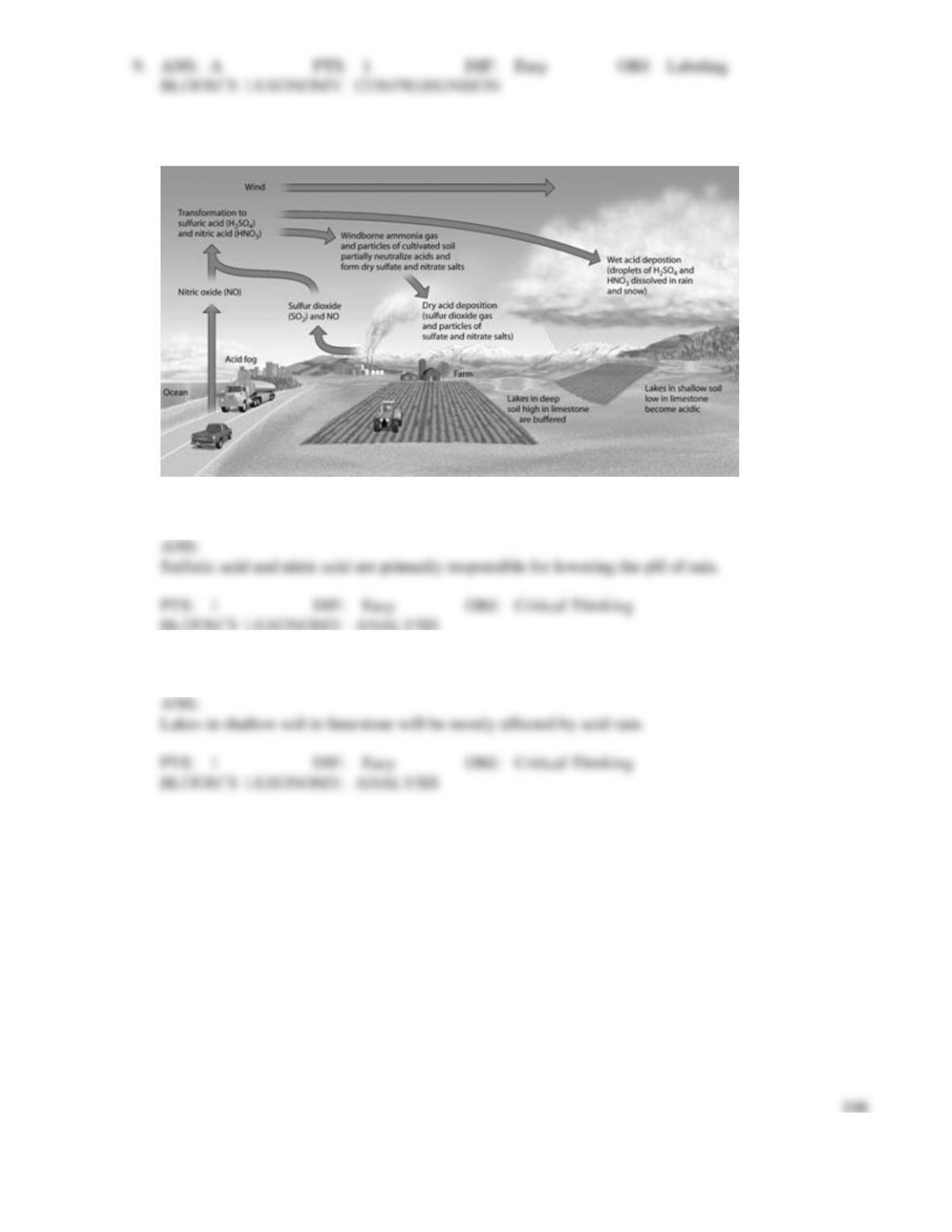
8. On the acid deposition figure, choose the letter that represents the wet acid deposition.
9. On the acid deposition figure, choose the letter that represents the transformation to sulfuric acid and
nitric acid.
SHORT ANSWER
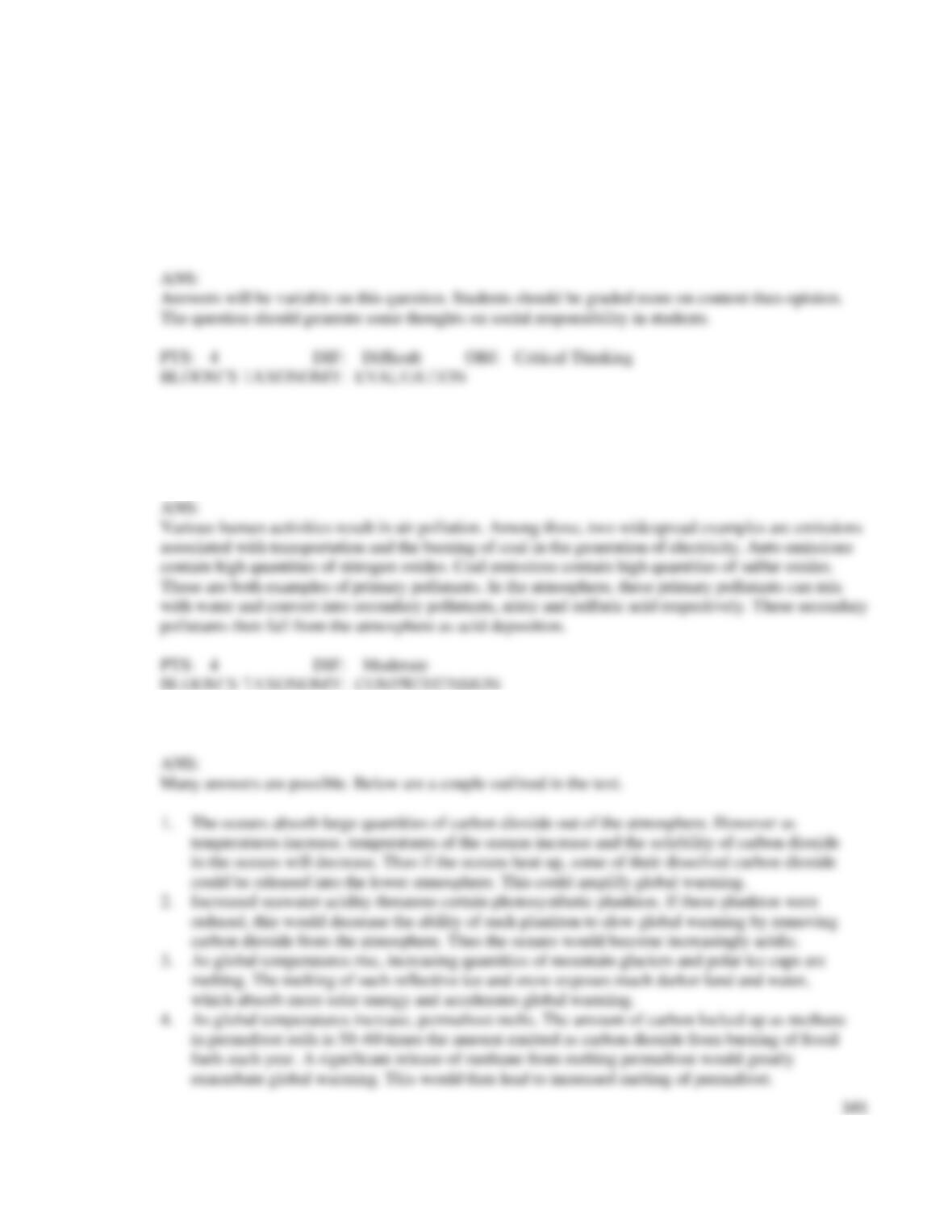
1. Based on the image, which chemicals are primarily responsible for lowering the pH of rain?
2. Based on the figure, which lakes will be mostly affected by acid rain?

3. Before 150,000 years ago, when did the Earth have high average surface temperature?
4. In the last 10,000 years, when did the temperature reach a maximum?

5. How much did the surface temperature of the Earth change from 1950 to 2004?
6. What change of the surface temperature of the Earth is projected for 2025?
7. Is the projected change of the surface temperature of the Earth worrisome? Why?
8. Consider the Individuals Matter essay for this chapter about the scientists Sherwood Rowland and
Mario Molina. These two scientists brought the problem with CFCs to the attention of the entire world,
and in doing so shocked not only the scientific community, but the $28 billion per-year CFC industry
by calling for an immediate ban of CFCs in spray cans.
Comment on what this experience must have been like for Rowland and Molina, what has happened
because of their work and decisive mandate for action, and what might have occurred if they had
chosen not to take such decisive action.
Do all scientists have the integrity of these two? Why or why not?
ESSAY
1. Clearly describe the major mechanisms by which “acid rain” is produced.
2. Clearly describe a positive feedback loop associated with global warming.

3. Explain why indoor air pollution is considered the most serious air pollution problem by some experts.
In your answer, utilize recent facts about indoor air pollution that stem from EPA studies.
4. Explain what our options are for dealing with the projected harmful effects of global warming.
5. This chapter refers to actions taken by Oberlin College students to help address the global warming
issue. Many colleges today are involved in similar projects and activities. What, if any, actions has
your college taken to participate in this student movement? If your college does not have a program
that you are aware of, what could it do (in your opinion) to start the process of becoming a “carbon
neutral” campus.