Cost Accounting: A Managerial Emphasis, 6e
Chapter 15 – Cost Allocation: Joint Products and Byproducts
Answer the following question(s) using the information below:
The Morton Company processes unprocessed goat milk up to the splitoff point where two products,
condensed goat milk and skim goat milk result. The following information was collected for the month of
October:
Production:
condensed goat milk
26,100 litres
skim goat milk
32,400 litres
Sales:
condensed goat milk
$3.50 per litre
skim goat milk
$2.50 per litre
The costs of purchasing the 65,000 litres of unprocessed goat milk and processing it up to the splitoff
point to yield a total of 58,500 litres of salable product was $72,240. There were no inventory balances of
either product.
Condensed goat milk may be processed further to yield 19,500 litres (the remainder is shrinkage) of a
medicinal milk product, Xyla, for an additional processing cost of $3 per usable litre. Xyla can be sold for
$18 per litre.
Skim goat milk can be processed further to yield 28,100 litres of skim goat ice cream, for an additional
processing cost per usable litre of $2.50. The product can be sold for $9 per litre.
There are no beginning and ending inventory balances.
19) What is the estimated net realizable value of Xyla at the splitoff point?
A) $182,650
B) $252,900
C) $292,500
D) $351,000
E) $280,750
Less: Sep cost
Est. NRValue
Weighting
Jt costs allocated
Cost Accounting: A Managerial Emphasis, 6e
Chapter 15 – Cost Allocation: Joint Products and Byproducts
20) What is the estimated net realizable value of the skim goat ice cream at the splitoff point?
A) $182,650
B) $252,900
C) $110,200
D) $85,450
E) $194,400
21) Using estimated net realizable value, what amount of the $72,240 of joint costs would be allocated
Xyla and the skim goat ice cream?
A) $41,971 and $30,269
B) $44,471 and $27,769
C) $32,796 and $39,444
D) $36,120 and $36,120
E) $39,444 and $32,796
Cost Accounting: A Managerial Emphasis, 6e
Chapter 15 – Cost Allocation: Joint Products and Byproducts
22) How much (if any) extra income would Morton earn if it produced and sold all of the Xyla from the
condensed goat milk? Allocate joint processing costs based upon relative sales value on the splitoff.
(Extra income means income in excess of what Morton would have earned from selling condensed goat
milk.)
A) $53,063
B) $254,213
C) $201,150
D) $96,787
E) $259,650
23) How much (if any) extra income would Morton earn if it produced and sold skim milk ice cream from
goats rather than goat skim milk? Allocate joint processing costs based upon the relative sales value at the
splitoff point.
A) $47,047
B) $117,297
C) $101,650
D) $70,250
E) $171,900
Cost Accounting: A Managerial Emphasis, 6e
Chapter 15 – Cost Allocation: Joint Products and Byproducts
24) The constant gross-margin percentage NRV method of joint cost allocation
A) involves allocating costs in such a way that maintaining the same gross margin percentage for each
product that was obtained in prior years.
B) involves allocating costs in such a way that the overall gross margin percentage is identical for the
individual products.
C) is the same as the estimated NRV method.
D) is the same as the sales-value at splitoff method.
E) will result in different gross margins for each product.
25) Which method of allocating costs would be used if the selling prices of all products at the splitoff
point are unavailable?
A) sales value at splitoff method
B) NRV method
C) physical measures method
D) constant gross-margin percentage method
E) reciprocal method
26) What is the reason that accountants do not like to carry inventory at net realizable value?
A) NRV is the most difficult costing method.
B) NRV recognizes income after the sale is complete.
C) NRV recognizes income before sales are made.
D) NRV is acceptable to the taxing authorities.
E) NRV is normally known.
27) When a product is the result of a joint process, the decision to process the product past the splitoff
point further should be influenced by the
A) total amount of the joint costs.
B) portion of the joint costs allocated to the individual products.
C) extra revenue earned past the splitoff point.
D) extra operating income earned past the splitoff point.
E) joint costs allocated under the NRV method.
Cost Accounting: A Managerial Emphasis, 6e
Chapter 15 – Cost Allocation: Joint Products and Byproducts
Cranbrook Chemical Ltd. manufactures two industrial compounds. In the month of May, 15,000 litres of
direct material costing $160,000 were processed at a cost of $400,000. The joint process yielded 16,000
containers of a compound known as Jarlon and 4,000 containers of a compound known as Kharton. The
respective selling prices of Jarlon and Kharton are $38 and $58. Both products may be processed further.
Jarlon may be processed into Jaxton at an incremental cost of $8 per jar of the final product while Kharton
may be processed into Kraxton at an additional cost of $32 per jar of the final product. The volume of jars
of the final product are: 12,000 and 3,000 for Jaxton and Kraxton respectively. The selling price of Jaxton is
$48 per jar. The selling price of Kraxton is $102 per jar.
28) Using the NRV method, the amount of joint costs allocated to Jaxton is:
A) $170,408
B) $278,280
C) $121,720
D) $389,592
E) $111,312
29) Using the NRV method, the amount of joint costs allocated to Kraxton is:
A) $170,408
B) $278,280
C) $121,720
D) $389,592
E) $111,312
Cost Accounting: A Managerial Emphasis, 6e
Chapter 15 – Cost Allocation: Joint Products and Byproducts
30) The incremental benefit or (loss) of processing Jarlon into Jaxton is:
A) $480,000
B) ($128,000)
C) $64,000
D) ($96,000)
E) ($32,000)
31) The incremental benefit or (loss) of processing Kharton into Kraxton is:
A) $74,000
B) $22,000
C) ($22,000)
D) ($96,000)
E) $170,000
Cost Accounting: A Managerial Emphasis, 6e
Chapter 15 – Cost Allocation: Joint Products and Byproducts
32) Green Paper Company processes wood pulp into two products. During January the joint costs of
processing were $144,000. Production and sales value information for the month were as follows:
Sales Value at
Product Kilograms Produced Split off Point Separable Costs
Paper 130,000 $80,000 $224,000
Cardboard 108,000 70,000 264,000
Paper sells for $2.75 a kilogram and cardboard sells for $3.50 a kilogram.
There were no beginning inventories for April but ending inventories totalled 10,000 kilograms for paper
and 12,000 kilograms for cardboard.
Required:
Prepare a product line income statement without allocation of joint costs.
Cost Accounting: A Managerial Emphasis, 6e
Chapter 15 – Cost Allocation: Joint Products and Byproducts
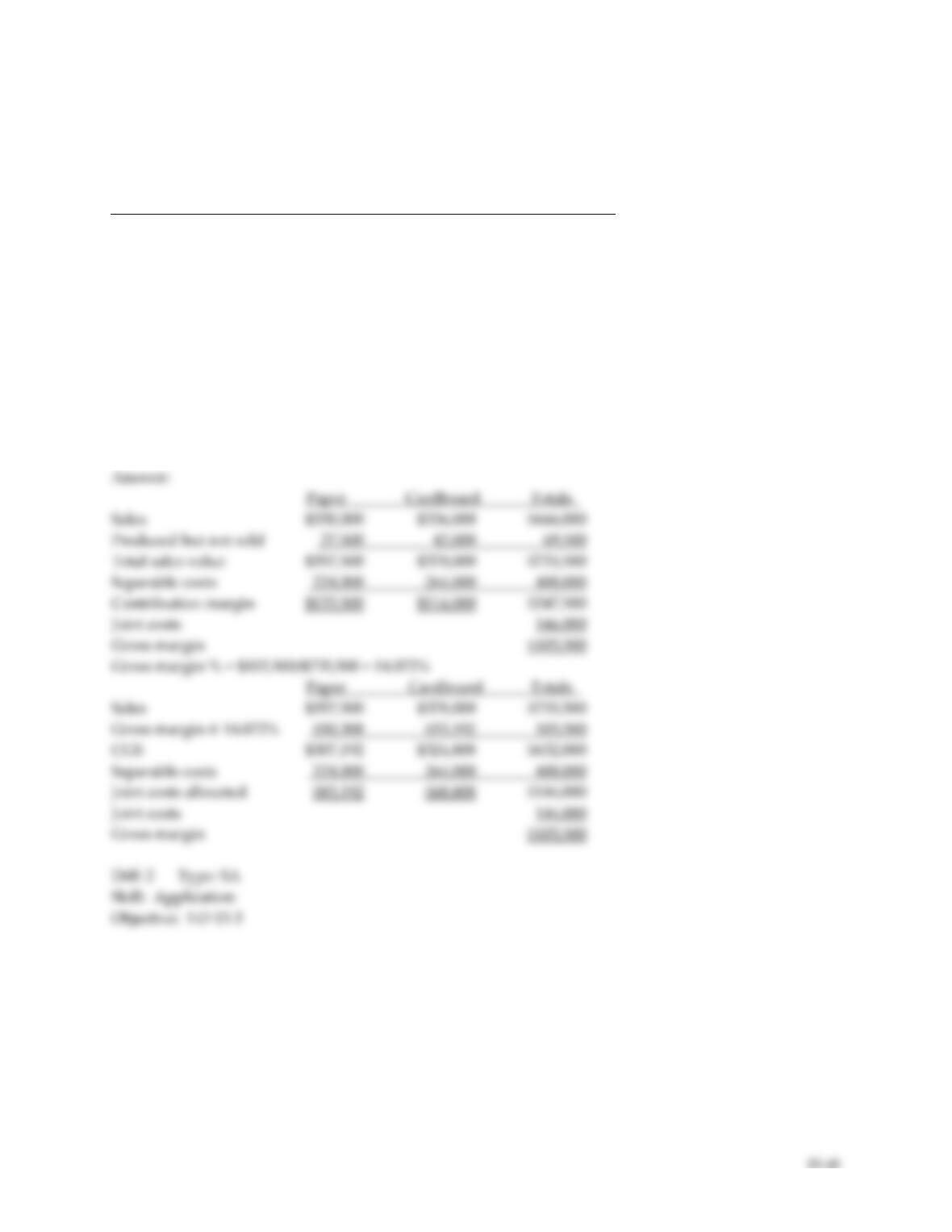
33) Green Paper Company processes wood pulp into two products. During January the joint costs of
processing were $144,000. Production and sales value information for the month were as follows:
Sales Value at
Product Kilograms Produced Split off Point Separable Costs
Paper 130,000 $80,000 $224,000
Cardboard 108,000 70,000 264,000
Paper sells for $2.75 a kilogram and cardboard sells for $3.50 a kilogram.
There were no beginning inventories for April but ending inventories totalled 10,000 kilograms for paper
and 12,000 kilograms for cardboard.
Required:
Prepare a product line income statement assuming that joint costs are allocated on the constant gross
margin percentage method.
Cost Accounting: A Managerial Emphasis, 6e
Chapter 15 – Cost Allocation: Joint Products and Byproducts
34) North York Statue Company makes miniature Mountie statues from cast iron. Sales total 40,000 units
a year. The statues are finished either rough or polished, with an average demand of 60 percent rough
and 40 percent polished. Iron ingots, the direct material, costs $6 per kilogram. Processing costs are $200
to convert 20 kilograms into 40 statues. Rough statues are sold for $15 each and polished statues can be
sold for $18 or engraved for an additional cost of $5. Polished statues can then be sold for $30.
Required:
Determine the product mix for statues that allows maximization of the company’s operating margin.
Cost Accounting: A Managerial Emphasis, 6e
Chapter 15 – Cost Allocation: Joint Products and Byproducts
35) Red Sauce Canning Company processes tomatoes into catsup, tomato juice, and canned tomatoes.
During the summer the joint costs of processing the tomatoes were $420,000. There was no beginning or
ending inventories for the summer. Production and sales value information for the summer were as
follows:
Sales Value at
Product Cases Split off Point Separable Costs Selling Price
Catsup 100,000 $6 per case $3.00 per case $28 per case
Juice 150,000 8 per case 5.00 per case 25 per case
Canned 200,000 5 per case 2.50 per case 10 per case
Required:
Determine the amount allocated to each product if the estimated net realizable value method is used and
compute the cost per case for each product.
Cost Accounting: A Managerial Emphasis, 6e
Chapter 15 – Cost Allocation: Joint Products and Byproducts
36) AllCanada Wire Products processes copper into wire. It makes 12 gauge and 14 gauge wire. During
April the joint costs of processing the aluminium were $365,000. There were no beginning or ending
inventories for the month. Production and sales value information for the month were as follows:
Product Feet Separable Costs Selling Price
14 gauge 200,000 $0.20 per metre $0.90 per metre
16 gauge 600,000 0.30 per metre 1.00 per metre
Required:
Determine the amount of joint costs allocated to each product if the constant gross-margin percentage
method is used.
Cost Accounting: A Managerial Emphasis, 6e
Chapter 15 – Cost Allocation: Joint Products and Byproducts
37) Favata Corporation processes a single material into three separate products A, B, and C . During
September, the joint costs of processing were $600,000. Production and sales value information for the
month were as follows:
Product
Units Produced
Final Sales
Value per Unit
Separable
Costs
A
20,000
$25
$250,000
B
30,000
30
500,000
C
25,000
24
250,000
Required:
Determine the amount of joint cost allocated to each product if the constant gross–margin percentage
NRV method is used.
Cost Accounting: A Managerial Emphasis, 6e
Chapter 15 – Cost Allocation: Joint Products and Byproducts
38) Juno Ltd. manufactures three separate products Q, R, and S from a joint production process . During
March, the joint costs of processing were $875,000. Production and sales value information for the month
were as follows:
Product
Units Produced
Final Sales
Value per Unit
Separable
Costs
Q
42,000
$18
$190,000
R
68,000
32
720,000
S
35,000
26
210,000
Required:
Determine the amount of joint cost allocated to each product if the constant gross-margin percentage
NRV method is used.
39) What are the four methods of allocating joint costs to individual products? Which of these methods is
preferred, and what are two advantages of this method?