
Biology: A Guide to the Natural World, 5e (Krogh)
Chapter 15 The Future Isn’t What It Used to Be: Biotechnology
1) Biotechnology can be defined as the:
A) production of new mammals through cell reprogramming.
B) use of technology to identify criminals.
C) ability to reprogram cells by splicing DNA from one species into another.
D) use of technology to control biological processes as a means of meeting societal needs.
2) What is one of the advantages of producing human growth hormone (HGH) from a cloned
gene in a bacterial cell?
A) The product can be administered by infecting a person with the recombinant bacteria.
B) A gene cloned from mice, rather than from humans, can be used.
C) The bacterial protein has a different amino acid sequence that is more effective.
D) Larger quantities are available.
E) As the protein is introduced therapeutically, it transfers the HGH gene as well.
3) What property of restriction enzymes allows DNA from different organisms to be combined?
A) Restriction enzymes cut DNA randomly, so any DNAs might be combined.
B) Restriction enzymes cut only small transformable fragments, not large chromosomal DNA.
C) Because restriction enzymes are naturally found in bacteria, they cut all transformed DNA.
D) If the same restriction enzyme cuts two different DNAs, the ends are complementary.
4) What is the most common way of introducing recombinant DNA into bacterial cells?
A) viral vectors
B) PCR
C) transformation
D) gel electrophoresis

2
5) “Bacterial transformation” is a bacterium’s ability to:
A) take up DNA from its surroundings.
B) connect DNA fragments once they are cut with restriction enzymes.
C) produce restriction enzymes.
D) produce proteins from another organism’s genes.
6) Which statement is a characteristic of plasmids?
A) They are very difficult to move out of and into bacterial cells.
B) They do not replicate independently of the bacterial chromosome.
C) They are attached to bacterial chromosomes.
D) They can be used to create recombinant DNA.
7) If a restriction enzyme leaves a sticky end on a DNA fragment, it means the fragment:
A) has a protruding end of a small number of unpaired bases.
B) will stick only to DNA from the same organism.
C) can attach to any other sticky end produced by any other restriction enzyme.
D) can transform bacteria without the need for a cloning vector.
8) Why are restriction enzymes that produce sticky ends valuable?
A) Sticky-ended DNA is easier to amplify by PCR.
B) The ends produced will stick to any complementary DNA from any source.
C) Sticky-ended DNA is easier to replicate in cells.
D) They produce ends that stick only to plasmid DNA.
9) The restriction enzyme EcoRI cuts between the G and the A of the sequence GAATTC.
Which statement is true about this enzyme?
A) It will cut this sequence only in bacteriophage DNA.
B) It leaves sticky ends of sequence CTTA.
C) It will cut this sequence only in bacterial DNA.
D) It leaves sticky ends of sequence AATT.
10) Tobacco plants have had a gene from fireflies inserted into them which makes them glow.

3
These tobacco plants would be considered:
A) mutants.
B) transgenic organisms.
C) clones.
D) vectors.
11) Restriction enzymes are mainly derived from:
A) yeast.
B) fungi.
C) bacteria.
D) animal cells.
12) What is used to cut DNA in generating recombinant DNA?
A) bacteriophage
B) plasmids
C) primers
D) restriction enzymes
13) What is the function of restriction enzymes in bacteria?
A) They are used to repair DNA mutations.
B) They function in protein production.
C) They cut the bacterial cell’s chromosome so that it is more easily transformed.
D) They cut foreign DNA, for example, the DNA of invading viruses.
14) What is a “cloning vector”?
A) an enzyme used to cut or combine DNA
B) a cell that is producing protein from a recombinant plasmid
C) a DNA vehicle that carries recombinant DNA into cells
D) a protein such as HGH that is produced by biotechnology
15) One advantage of using bacteria in recombinant DNA technology is that they have a ring of
DNA that is not part of their chromosome called a:

A) plasmid.
B) virus.
C) bacteriophage.
D) restriction fragment.
16) Which choice is an example of “recombinant DNA”?
A) DNA that has been amplified by PCR
B) any DNA that has been removed from a cell
C) DNA that has been cut with a restriction enzyme
D) a bacterial plasmid combined with a human gene
17) What roles do plasmids play in biotechnology?
A) Plasmids are used to provide nutrients to bacterial cells.
B) Plasmids are used to break open the cell wall of bacterial cells.
C) Plasmids are used to infect and destroy bacterial cells.
D) Plasmids are used as a vector to transfer genes between organisms.
18) Much of the food crops in the United States are transgenic. This primarily has been done to
give the crops what properties?
A) a decrease in the need for chemical fertilizers
B) the ability to produce human growth hormone
C) the ability to resist insects and herbicides
D) the need for greater irrigation

19) “Golden rice” is a transgenic form of rice because it:
A) produces omega-3 fatty acids.
B) contains genes from a bacterium and a daffodil.
C) produces insulin.
D) produces cancer-fighting drugs.
20) It is beneficial for children in underdeveloped countries to eat genetically modified “golden
rice,” rather than regular rice, because golden rice:
A) tastes better.
B) produces a vitamin A precursor, which helps prevent blindness in children.
C) does not cost as much as regular rice.
D) prevents diarrhea in children.
21) DNA fragments cut by most restriction enzymes have:
A) double-stranded complementary ends.
B) either only sequences of Gs or only sequences of Cs.
C) cuts made at random points along one of the strands.
D) protruding sticky ends.
22) What is a clone?
A) any cell that contains recombinant DNA
B) a protein produced by a recombinant bacterium
C) an exact copy of a DNA, cell, or organism
D) any animal that contains recombinant DNA

23) In reproductive cloning, cells are subjected to an electric current under special
circumstances. What effect does this have?
A) It removes an udder cell from an adult.
B) It removes DNA from an egg.
C) It mimics fertilization and begins embryonic development.
D) It introduces recombinant DNA.
24) In reproductive cloning:
A) an embryo from two parents is genetically modified.
B) bacteria are transformed with recombinant DNA.
C) many copies of a single gene are made.
D) adult mammals of a defined genotype are produced.
25) The combination of a somatic cell with an enucleated egg cell is:
A) transformation.
B) cell reprogramming.
C) somatic cell nuclear transfer.
D) transgenic biotechnology.
26) Dolly, the cloned sheep, is the product of which technique?
A) reproductive cloning
B) transformation
C) human gene transfer
D) gene therapy

7
27) In producing Dolly, the first cloned sheep, how many different sheep were involved, either
contributing cells or acting as a surrogate mother?
A) two
B) four
C) three
D) six
28) In reproductive cloning, a sperm is not used, but an egg is still required. Why?
A) Udder cells will fuse only with egg cells.
B) Egg chromosomes are required for embryonic development.
C) Egg proteins are required for embryonic development.
D) Surrogate mother animals will develop only embryos derived from their own eggs.
29) How similar to the donor would a cloned human be?
A) They would be identical in looks and personalities.
B) They would be no more alike than identical twins.
C) They would look different but have the exact same personalities.
D) They would have the same genes, but everything else about them would be different.
30) “Dolly” or another reproductively cloned animal is a clone of:
A) bacteria that were used to generate the recombinant DNA in the animal.
B) an adult animal that contributed DNA to an enucleated egg.
C) the animal that donated the egg from which the clone developed.
D) a human that contributed genes to the recombinant DNA in the animal.
31) Pigs rich in omega-3 fatty acids:
A) would not be healthier to eat than regular pigs.
B) have never been produced using biotechnology.
C) are examples of transgenic animals.
D) were produced using the PCR technique.
32) Which is an example of clones that already are produced by nature?

A) identical twins
B) fraternal twins
C) golden corn
D) two plants of the same species
33) Embryonic stem cells are taken from:
A) blastocysts.
B) adult tissues.
C) eggs.
D) iPS cells.
34) Cells that can give rise to more of its kind along with at least one variety of specialized cell
are known as:
A) somatic cells.
B) blastocysts.
C) nerve cells.
D) stem cells.
E) egg cells.
35) What distinguishes an embryonic stem cell from a somatic cell of an adult organism?
A) Embryonic stem cells can produce more of themselves as well as produce specialized cells,
but somatic cells are already specialized.
B) Somatic cells can change into specialized cells, while stem cells can only produce more of
themselves.
C) Somatic cells can produce more of themselves and produce stem cells.
D) Embryonic stem cells cannot be reprogrammed, but somatic cells can be reprogrammed.

36) By inserting four developmental genes into ordinary cells such as skin cells, Shinya
Yamanaka and James Thomson were able to convert them into:
A) nerve cells.
B) embryonic stem cells.
C) induced pluripotent stem cells.
D) egg cells.
37) Stem cells are said to be pluripotent. This means they have the ability to:
A) form blastocysts.
B) be reprogrammed through recombinant DNA technology.
C) make more of themselves in culture.
D) specialize into any other type of cell.
E) specialize into only a few different types of cells such as nerves and muscle cells.
38) What is the advantage of implanting iPS cells derived from the patient’s own body rather
than ESCs?
A) iPS cells can differentiate into the needed cell types, but ESCs cannot.
B) ESCs could be rejected by the patient’s body because they are seen as foreign.
C) ESCs have the potential to migrate to the wrong part of the body, but iPS cells will not.
D) ESCs have HLA markers, but iPS cells from the patient do not.
39) Why is PCR useful?
A) It allows fragments of DNA to be separated by size.
B) It is essential for making many copies of a transgenic animal.
C) It is required for the introduction of DNA into reproductively cloned animals.
D) It allows for making many copies of DNA when the starting sample is small.

40) In PCR, heating of the DNA is necessary because:
A) it cuts the DNA into fragments small enough to be replicated.
B) it causes the primers to bind DNA.
C) DNA polymerases require high heat to work.
D) it separates the two strands of DNA.
41) Which of the following need to be included in a PCR reaction?
A) chromosomes, DNA polymerase, amino acids
B) DNA, nucleotides, DNA polymerase, primers
C) primers, DNA, restriction enzymes, plasmids
D) eggs, sperm, DNA donor cells
42) On what basis does forensic biotechnology distinguish one individual from another?
A) Different people will have different mutations in their short tandem repeats.
B) Different people will have a different number of tandem repeats at the same location in their
genomes.
C) Different people will have completely different genomes.
D) A small tandem repeat in one person will be in a different location in the genome of another
person.
43) Why is forensic DNA analysis an important part of biotechnology?
A) It is used to amplify small samples of DNA.
B) It is used to match two samples of DNA.
C) It is used to produce transgenic organisms.
D) It substitutes for restriction enzymes.

44) You are a crime scene investigator, and the only evidence you are able to gather at the crime
scene are some strands of hair. You want to see whether a suspect in custody was at the crime
scene. What technique would you use to try and connect the suspect to the crime scene?
A) PCR followed by cloning
B) cloning and transgenics
C) PCR followed by analyzing small tandem repeats
D) recombinant DNA techniques
45) Kary Mullis was awarded the Nobel Prize in chemistry for inventing:
A) restriction enzymes.
B) DNA fingerprinting.
C) therapeutic stem cell applications.
D) the polymerase chain reaction.
46) To identify an individual through DNA analysis of his or her blood at crime scenes,
investigators look for patterns based on:
A) transgenic fragments.
B) short tandem repeats in the DNA.
C) primers.
D) probes.
47) Why are short tandem repeats (STRs) used in DNA fingerprinting?
A) They are the only human genes that can be cut by restriction enzymes.
B) It is unlikely two unrelated people will have an identical number of repeats at the same
location in their genomes.
C) They are exactly the same in all individuals.
D) Some individuals have them and some don’t.

48) If you found the same number of short tandem repeats at three different locations in two
samples of DNA, what would you conclude?
A) The two samples were from different individuals.
B) The two samples were most likely from the same individual.
C) Both samples were from females.
D) Both samples were from males.
49) If you compared two samples of DNA at three different locations in the genome and found
they had different lengths of short tandem repeats at each location, what could you conclude?
A) The two samples came from different individuals.
B) The two samples came from the same individual.
C) The two samples came from females.
D) The two samples came from males.
50) Genetically modified crops have been produced mainly to benefit:
A) consumers.
B) farmers.
C) the scientific community.
D) the United State’s ability to export agricultural products.
51) “Bt cotton” refers to cotton that:
A) has been infested with insect pests.
B) is resistant to Bacillus thuringeniensis.
C) is resistant to herbicides.
D) is resistant to insect pests.

52) What is the advantage of genetically modifying crops such as corn, cotton, and potatoes with
Bt genes?
A) to reduce the need for fertilizers
B) to stop Bacillus thuringiensis from damaging the crops
C) to improve the resistance of insect pests to Bt toxins
D) to make the crops more resistant to insect pests
53) One of the main problems with growing Bt cotton and other Bt-enhanced crops is the Bt
toxin:
A) can produce populations of insects resistant to it.
B) can create Bt refuges near the fields that harbor bugs not resistant to Bt.
C) reduces the need for insecticides.
D) can be harmful to humans.
54) The enzyme EcoRI cuts between the G and the A in the sequence GAATTC. The enzyme
BamHI cuts between adjacent G nucleotides in the sequence GGATCC. The sticky ends that are
generated by the two enzymes are complementary and will stick together.
55) Restriction enzymes occur naturally in bacteria.
56) It is not possible for a human gene to work in any other organism.
57) A human clone would be as much like the person from whom it was cloned as “identical”
twins are like each other.

14
58) Reproductive cloning has been used to clone humans.
59) Forensic DNA typing can prove the innocence of a crime suspect.
Match the following.
A) Samples of DNA are compared with respect to short tandem repeats.
B) All nuclear DNA is removed from an egg.
C) Stem cells can be coaxed to become many different types of cells
D) Many copies of a DNA sequence are produced.
E) Restriction enzymes are used to cut plasmid DNA and insert a foreign gene.
60) Produces recombinant DNA
Topic: Section 15.2
Skill: Knowledge/Comprehension
61) Reproductive cloning
Topic: Section 15.3
Skill: Knowledge/Comprehension
62) Cell reprogramming
Topic: Section 15.4
Skill: Knowledge/Comprehension
63) PCR
Topic: Section 15.5
Skill: Knowledge/Comprehension
64) Forensic DNA typing
Topic: Section 15.5
Skill: Knowledge/Comprehension
65) Define recombinant DNA.
66) Next to plasmids, the most common type of cloning vector is a ________.

67) Through the process of ________, a cell will incorporate genetic material from outside itself.
68) ________ involves the fusion of a somatic cell with an enucleated egg cell.
69) The study of matching different sets of DNA based on the number of short tandem repeats is
called ________.
70) What is the purpose of introducing recombinant DNA plasmids into bacterial cells?
71) Write an explanation for why a bacteriophage, a virus that infects bacterial cells, would be a
good cloning vector.
72) In muscular dystrophy, muscle cells lack a protein called dystrophin, which leads to
weakening of the muscles. As a biomedical researcher, your goal is to create a gene therapy
approach to treating muscular dystrophy. You have a sequence of DNA that contains the
dystrophin gene and a virus that infects human cells. You want to combine the dystrophin gene
with the viral DNA so that the virus can infect and insert the gene into the muscle cells as a way
to treat the disease. Explain how you would get the dystrophin gene into the viral DNA.
73) You are the owner of Jurassic Park, and you want to set about populating your park with
extinct animals. The first animal you want to have in your park is a wooly mammoth, and you
have a remarkably well-preserved specimen that was frozen in the Arctic ice 20,000 years ago.
Design a method for populating your park with many living wooly mammoths.
74) How might stem cells be used to treat disease?
75) These days many of our food crops are genetically modified. To some people this
“frankenfood” poses many dangers and should not be used. Do you agree? Why or why not?
76) A farmer wants to reduce his need to use insecticides on his corn crop to save money. He
plants 80 percent of his field with Bt corn but has to plant the remaining 20 percent with corn
that has not been genetically modified. What is the reason for planting only 80 percent of his
field with Bt corn if planting 100 percent Bt corn would reduce his need for insecticide even
further?
Refer to the figure below, and then answer the question that follows.
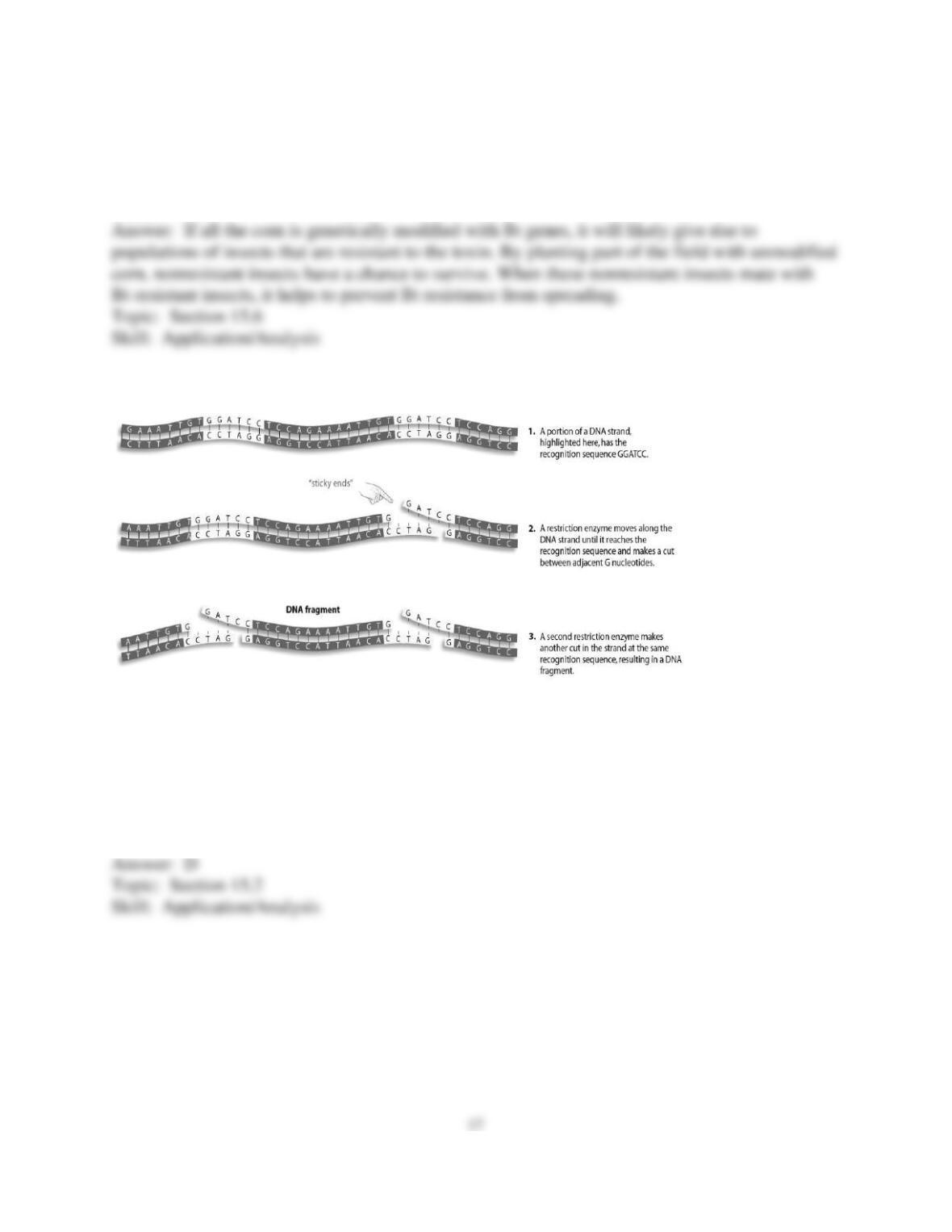
77) More than one restriction enzyme can be used to cut a piece of DNA at a time. If you used
the restriction enzyme BamHI, which recognizes the sequence GGATCC (shown in the figure),
as well as another enzyme that recognizes the sequence AATT, how many DNA fragments
would be produced from the DNA strand shown?
A) two
B) three
C) four
D) five
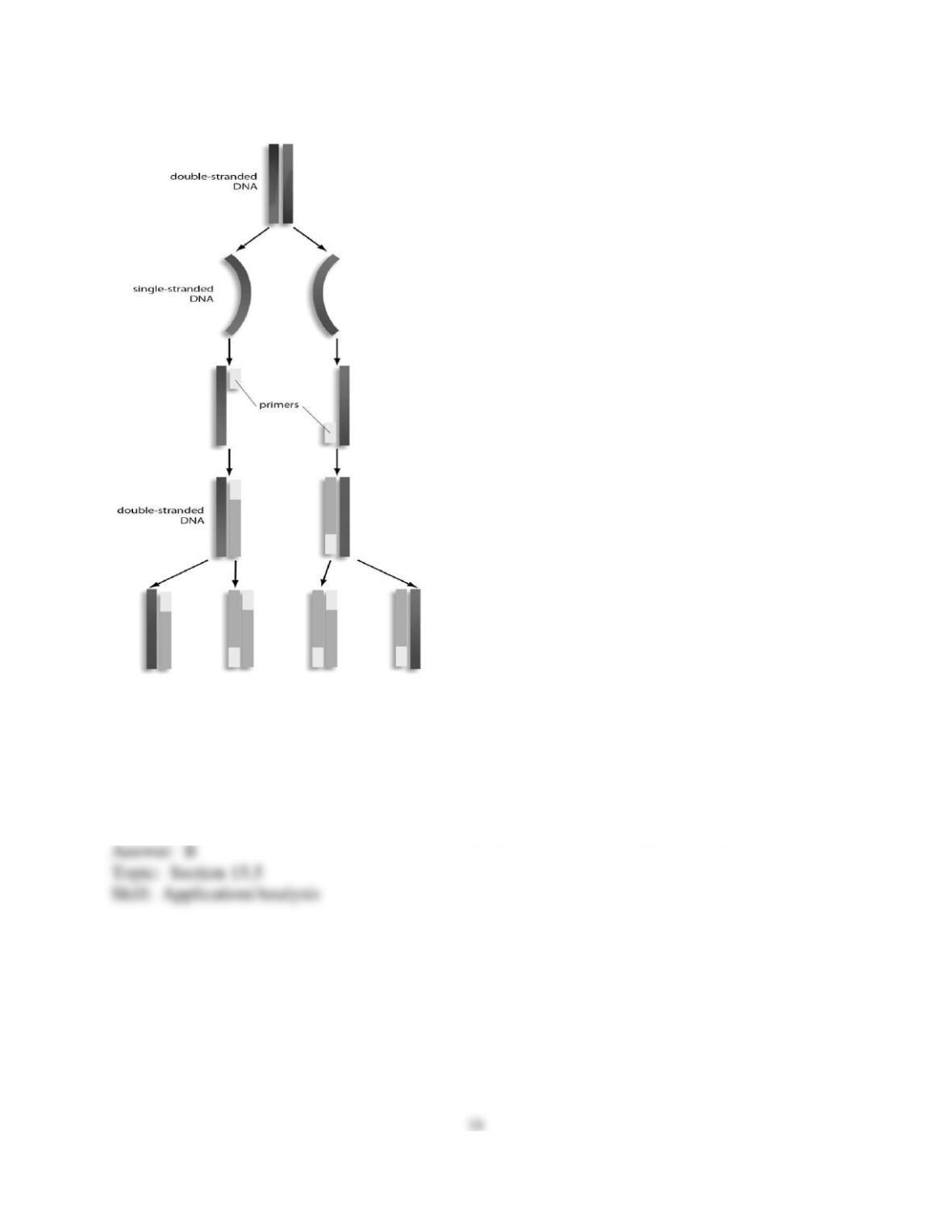
Refer to the figure below, and then answer the question that follows.
78) In PCR, what is the function of the primers?
A) They separate DNA strands.
B) They are the starting point for DNA polymerase to work on synthesizing complementary
DNA strands.
C) They tell DNA polymerase where to stop copying the template.
D) They are the source of nucleotides that DNA polymerase uses to copy the template.