Chapter 15: Lean Accounting and Productivity Measurement
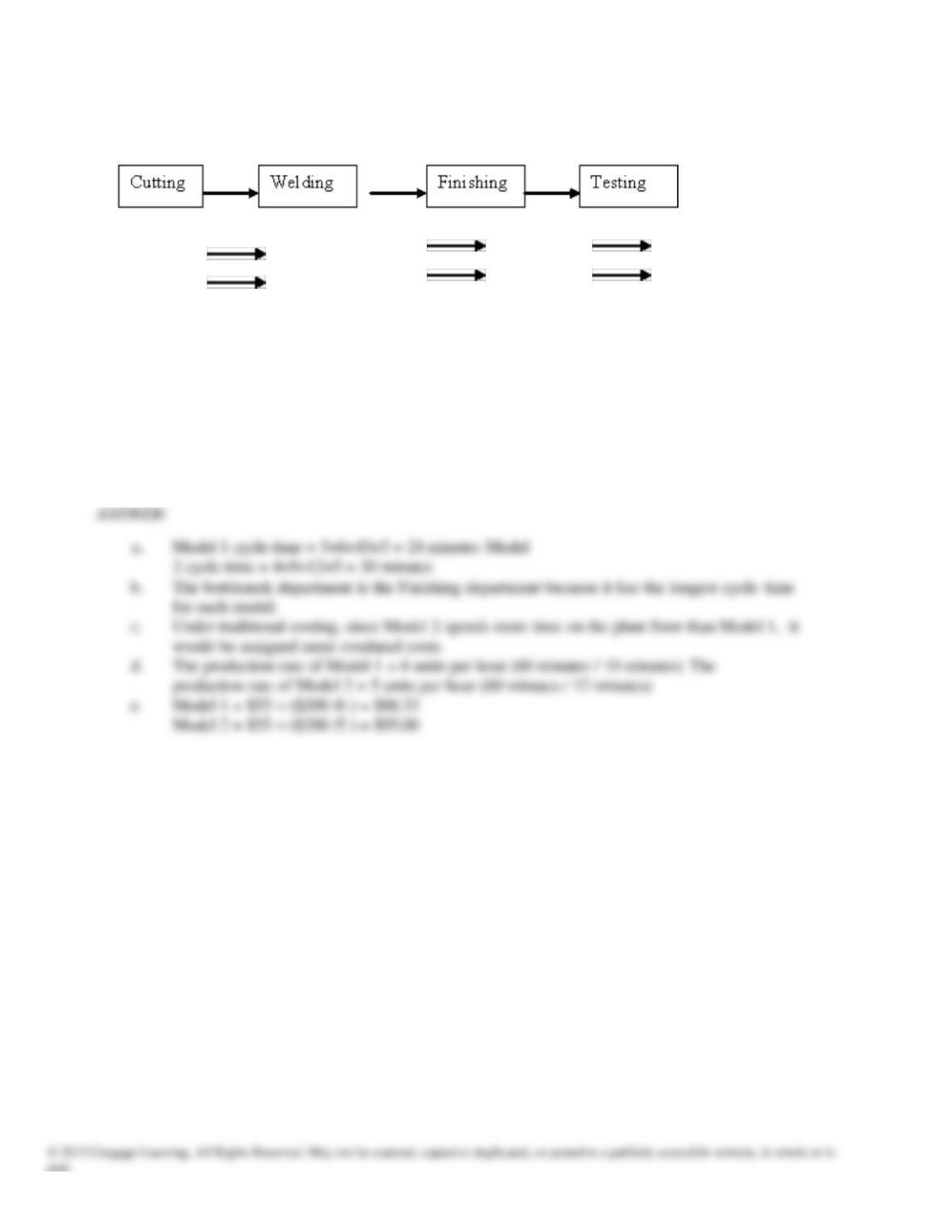
Model 1 3 minutes
6 minutes
10 minutes
5 minutes
Model 2 4 minutes
Required:
9 minutes
12 minutes
5 minutes
160.
a. What are the cycle times for each model?
b. What is the bottleneck department and why?
c. Under traditional costing, which model would be allocated more overhead expenses?
Does this change under the features and characteristics approach?
d. What are the production rates of Model 1 and Model 2?
e. Assuming materials costs of $55 per unit for both Model 1 and Model 2 and conversion
costs of $200 per hour, what is the unit cost of each model?
Chapter 15: Lean Accounting and Productivity Measurement
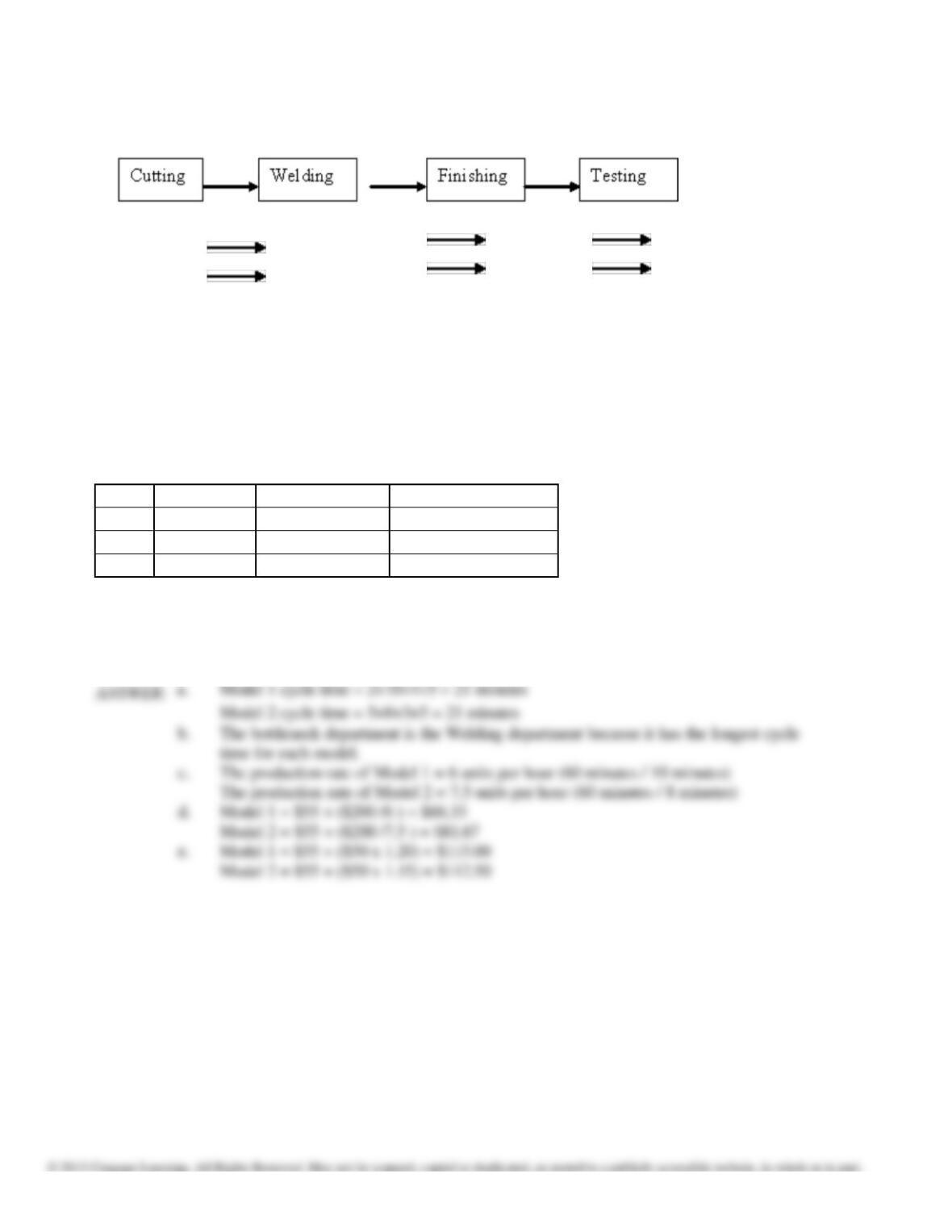
Model 1 2 minutes
10 minutes
4 minutes
5 minutes
Model 2 5 minutes
Required:
8 minutes
3 minutes
5 minutes
161.
a. What are the cycle times for each model?
b. What is the bottleneck department and why?
c. What are the production rates of Model 1 and Model 2?
d. Assuming materials costs of $55 per unit for both Model 1 and Model 2 and conversion costs of $200 per hour,
what is the unit cost of each model?
e. If the company uses a Product Cost Conversion Cost Chart as follows:
Materials
Steel
Titanium
2.5 kg
.75
.90
Size
5.0 kg
1.00
1.20
7.5 kg
1.15
1.50
and the average conversion cost = $50, what is the product cost of
Model 1, a 5.0kg unit made of Titanium and Model 2, a 7.5 kg unit
made of steel? (Assume materials cost remains at $55 per unit.)
Chapter 15: Lean Accounting and Productivity Measurement
162. Serendipity Manufacturing implemented lean manufacturing in its Wheeling plant as a pilot program. During the
most recent three weeks, the following data pertaining to a specific product line value stream was collected:
Week 1:
Sales = 500 units @ $50 per unit selling price
Beginning inventory = 80 units @ $15 ($5 materials, $10 conversion)
Production = 500 units @ $15 ($5 materials, $10 conversion)
Week 2:
Sales = 675 units at $50 per unit selling price
Beginning inventory = 80 units at $15 ($5 materials, $10 conversion) Production
= 595 units at $15 ($5 materials, $10 conversion)
Week 3:
Sales = 650 units at $50 per unit selling price Beginning
Inventory = 0
Production = 700 units at $15 ($5 materials, $10 conversion)
Required:
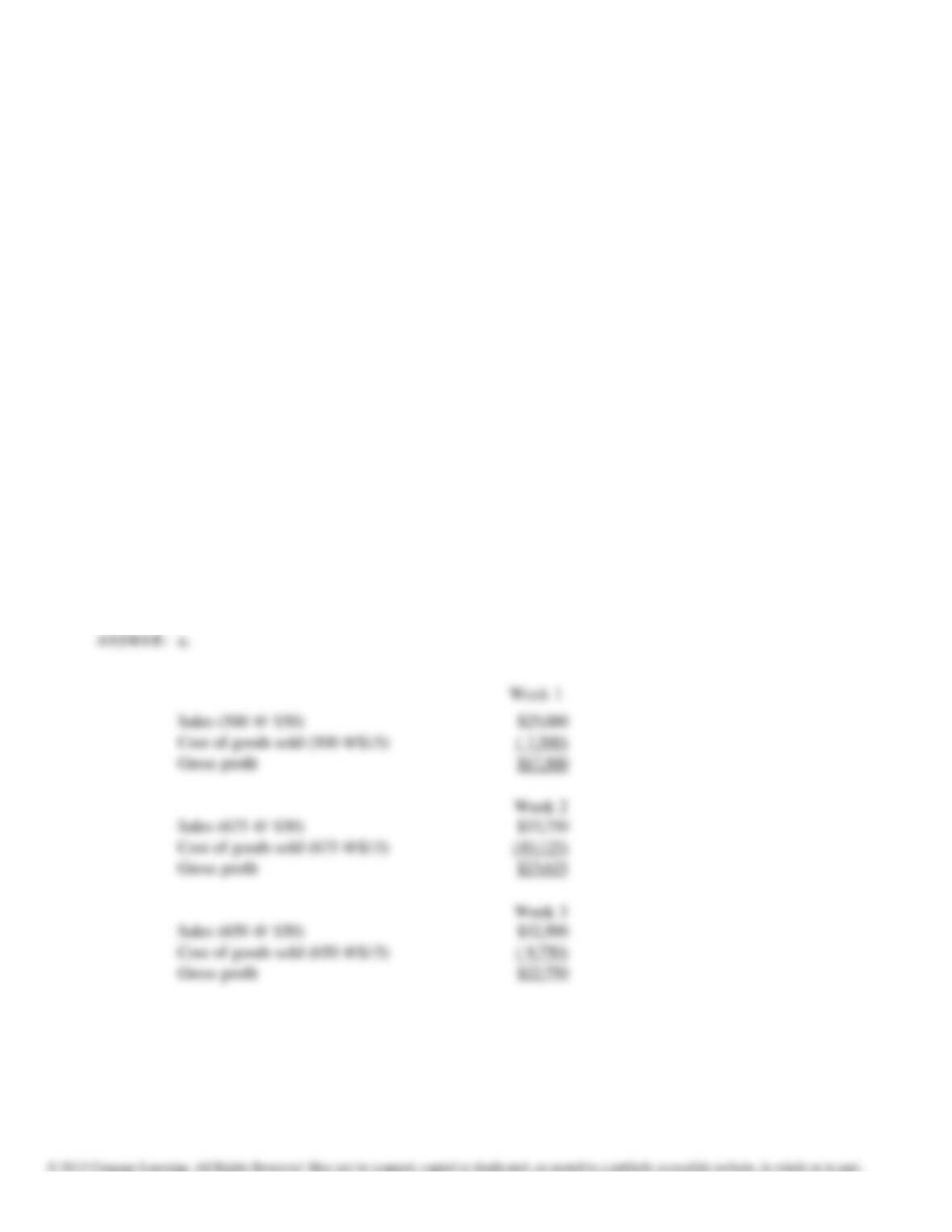
a. Prepare a traditional income statement for each week.
b. Calculate the average value stream product cost for each week. What does this cost
signal, if anything?
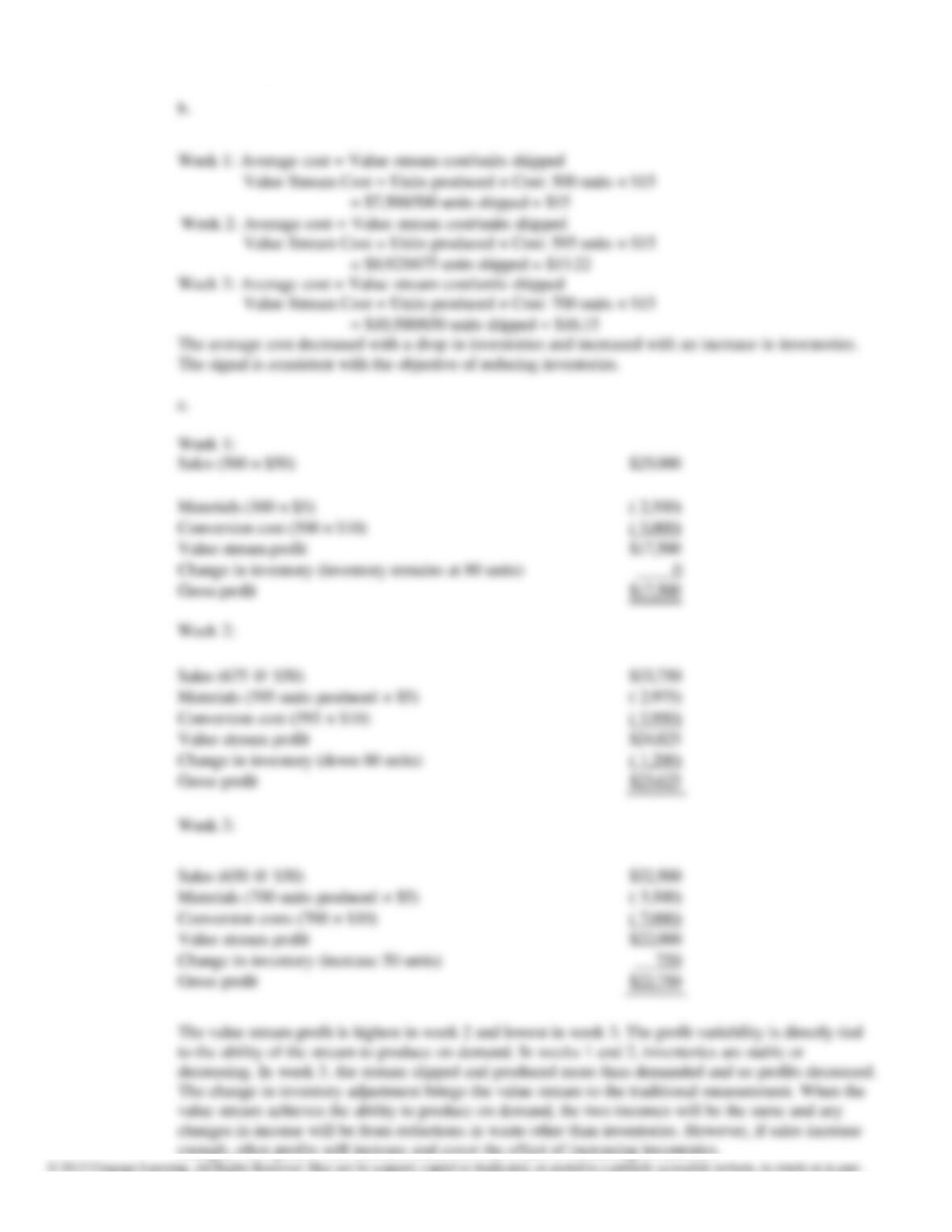
c. Prepare a value stream income statement for each week. Assume that any increase in
inventory is valued at average cost. Comment on the financial performance of the value
stream and its relationship to traditional income measurement.
Chapter 15: Lean Accounting and Productivity Measurement
enough, often profits will increase and cover the effect of increasing inventories.
Chapter 15: Lean Accounting and Productivity Measurement
163. The following Box Scorecard template was prepared for a value stream at Compton Company:
Last
This Week
Desired Future
Week
(1/5/2014)
State
Operational ‘
Units per Person
On-Time Delivery
Dock-to-Dock Days
First-time Through
Average Product Cost
Capacity
Productive
Non–Productive
Available
Financial
Weekly Sales
Weekly Material Cost
Weekly Conversion Cost
Weekly Value-Stream Profit
ROS
Required:
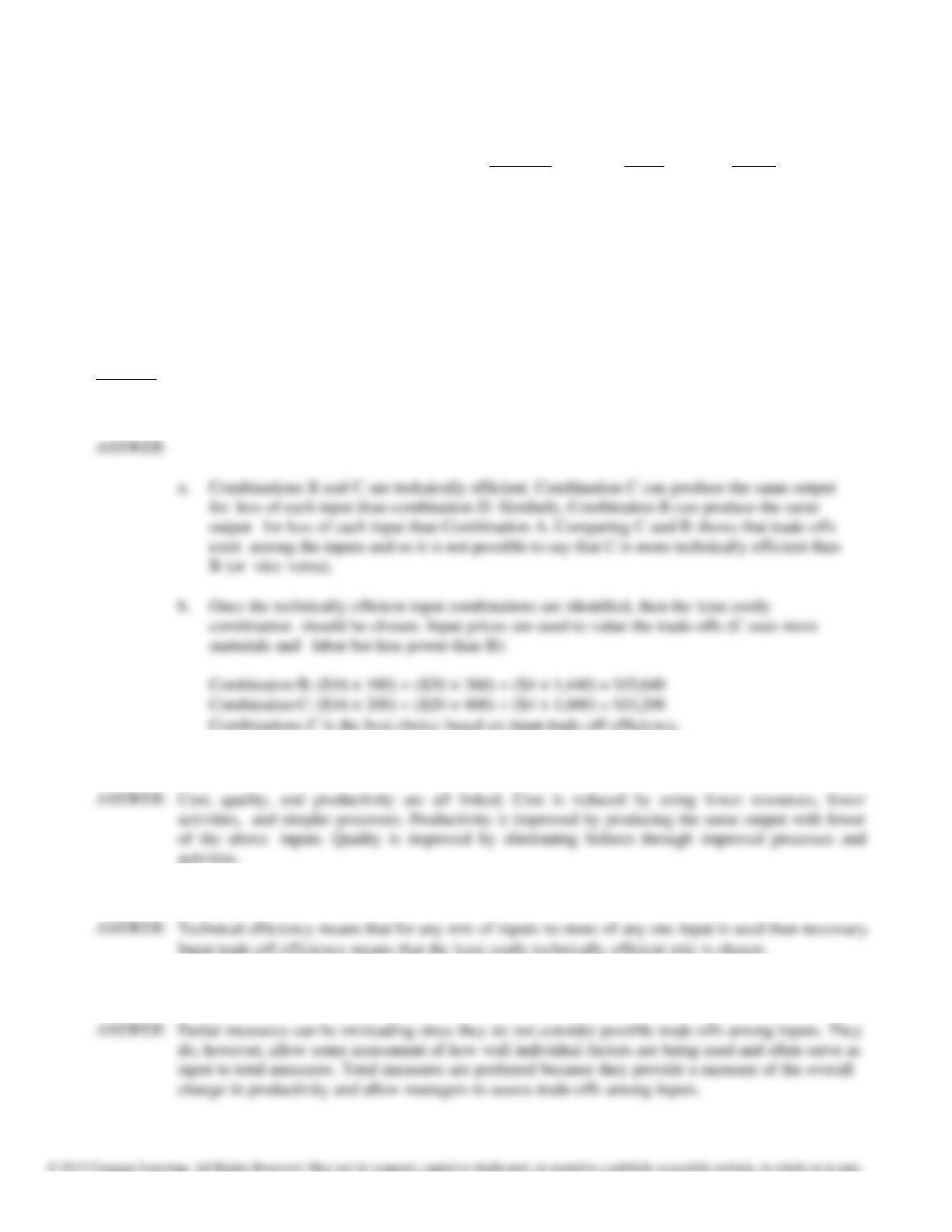
1. How many nonfinancial measures are there?
2. What are the three dimensions of a Lean Firm? Give an example of each.
3. What targets could be set for the planned state?
4. What role does capacity play in a value stream? Contrast value-added and non-value-
added activities.
5. What is the financial impact of becoming lean?
Chapter 15: Lean Accounting and Productivity Measurement
164. Listed below are several possible combinations for producing 10,000 units of a product:
Materials
Labor
Power
Unit input prices
$16 per lb.
$20 per hr.
$4 per kwh
Input combinations:
A
190 lbs.
380 hrs.
1,520 kwh
B
180 lbs.
360 hrs.
1,440 kwh
C
200 lbs.
400 hrs.
1,000 kwh
D
220 lbs.
440 hrs.
1,100 kwh
Required:
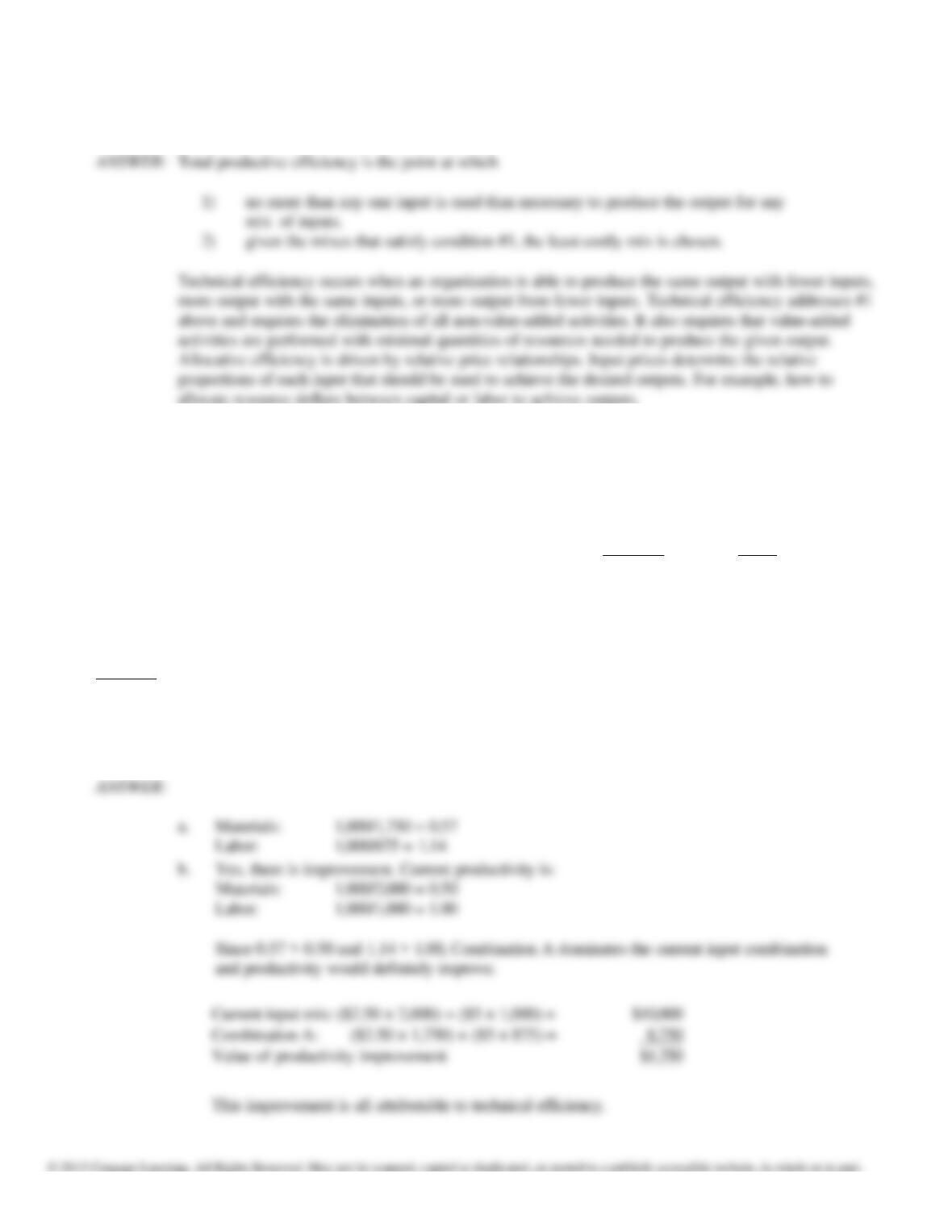
a. Identify the technically efficient input combinations. Explain your choices.
b. Which of the technically efficient input combinations should be used? Explain.
165. Discuss the linkage between quality and productivity.
166. Explain the difference between technical and input trade-off efficiency.
167. Discuss the advantages and disadvantages of partial productivity measures.
Chapter 15: Lean Accounting and Productivity Measurement
168. Define what constitutes total productive efficiency, including a definition of technical efficiency and
allocative efficiency.
169. Holstein Company produces pants that use two inputs—materials and labor. During the past quarter, 1,000 units
were produced, requiring 2,000 pounds of material and 1,000 hours of labor. An engineering efficiency study
commissioned by the local university revealed that Holstein Company can produce the same output of 1,000 units
using either of the following two combinations of inputs:
Materials Labor
Combination A 1,750 875
Combination B 2,000 750
The cost of materials is $2.50 per pound; the cost of labor is $5 per hour.
Required:
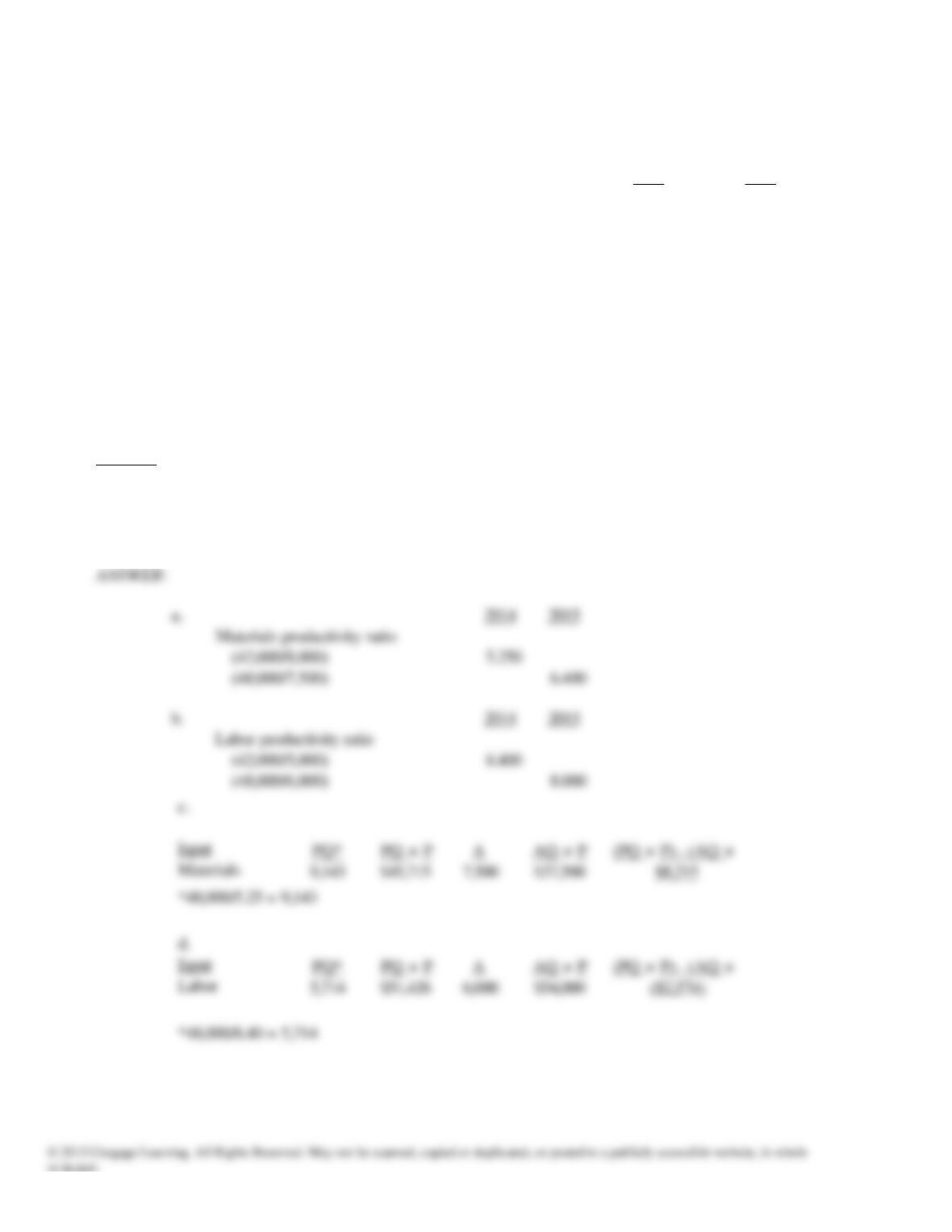
a. Compute the productivity ratio for each input of Combination A.
b. Does this represent a productivity improvement over the current use of inputs?
c. What is the total dollar value of the combination A improvement? Classify this as a technical or
input trade-off efficiency improvement.
Chapter 15: Lean Accounting and Productivity Measurement
170. The Monterrey Company has recorded the following data:
2014
2015
Output (units)
42,000
48,000
Selling price per unit
$12
$12
Input quantities:
Materials (pounds)
8,000
7,500
Labor (hours)
5,000
6,000
Input prices:
Materials (per pound)
$4.00
$5.00
Labor (per hour)
$8.00
$9.00
Required:
a. Calculate the materials productivity ratios for 2014 and 2015.
b. Calculate the labor productivity ratios for 2014 and 2015.
c. How much did profits change as a result of changes in productivity related to materials?
d. How much did profits change as a result of changes in productivity related to labor?

Chapter 15: Lean Accounting and Productivity Measurement
171. Explain the difference between partial and total measures of productivity.
172. The following data is from the records of the Mendelsohn Corporation:
2014
2015
Output (units)
300,000
270,000
Selling price per unit
$30
$30
Input quantities:
Materials (pounds)
75,000
60,000
Labor (hours)
48,000
50,000
Input prices:
Materials (per pound)
$8.00
$9.00
Labor (per hour)
$11.00
$12.00
Required:
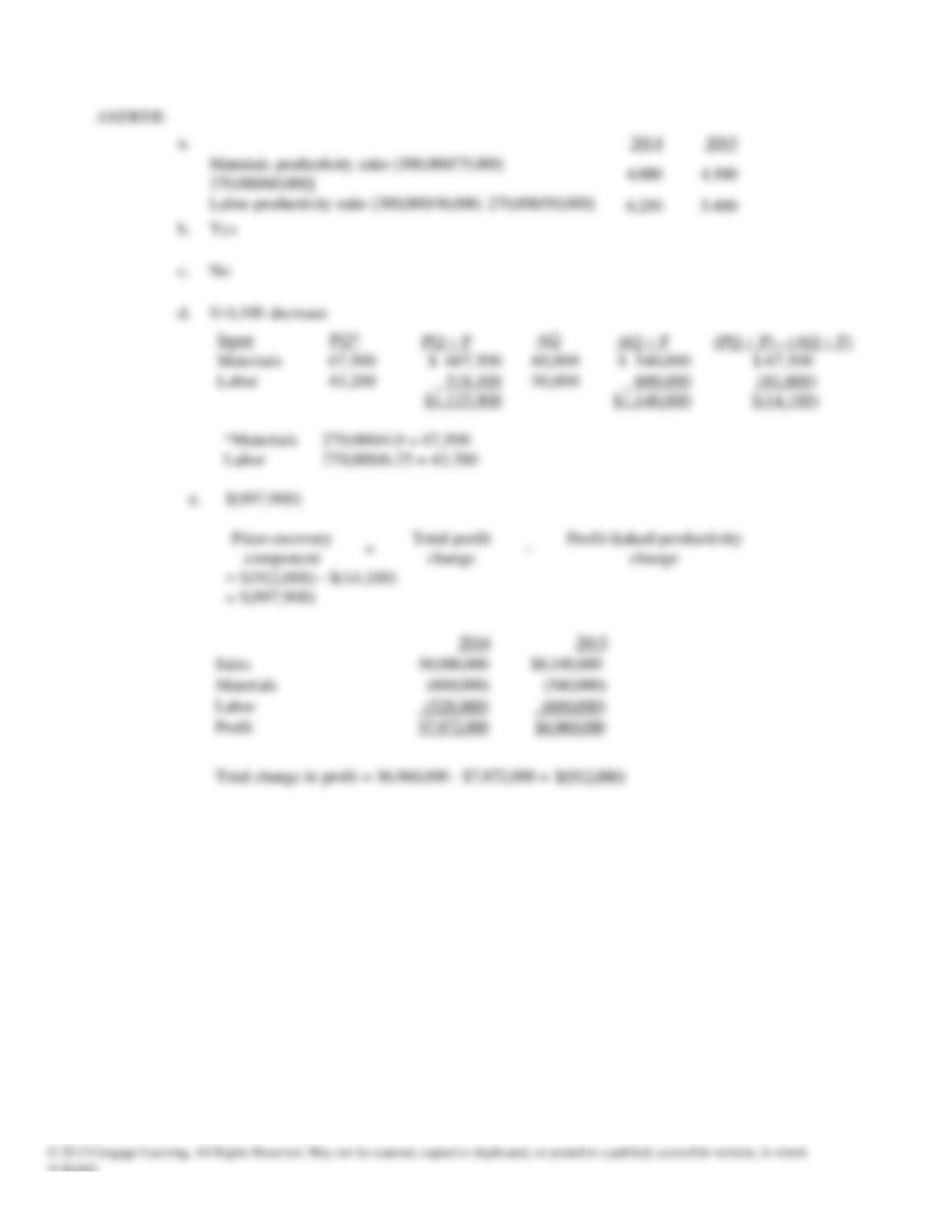
a. Calculate the materials and labor productivity ratios for 2014 and 2015.
b. Did materials productivity improve?
c. Did labor productivity improve?
d. By how much did profits change as a result of changes in productivity?
e. How much of the profit change is attributable to price recovery?
Chapter 15: Lean Accounting and Productivity Measurement
Chapter 15: Lean Accounting and Productivity Measurement
Materials (per pound)
$4.00
$5.00
Labor (per hour)
$9.00
$10.00
173. The Kristofferson Company provides the following information:
2014
2015
Output (units)
25,000
27,000
Selling price per unit
$25
$25
Input quantities:
Materials (pounds)
8,000
7,500
Labor (hours)
5,500
7,000
Input prices:
Required:
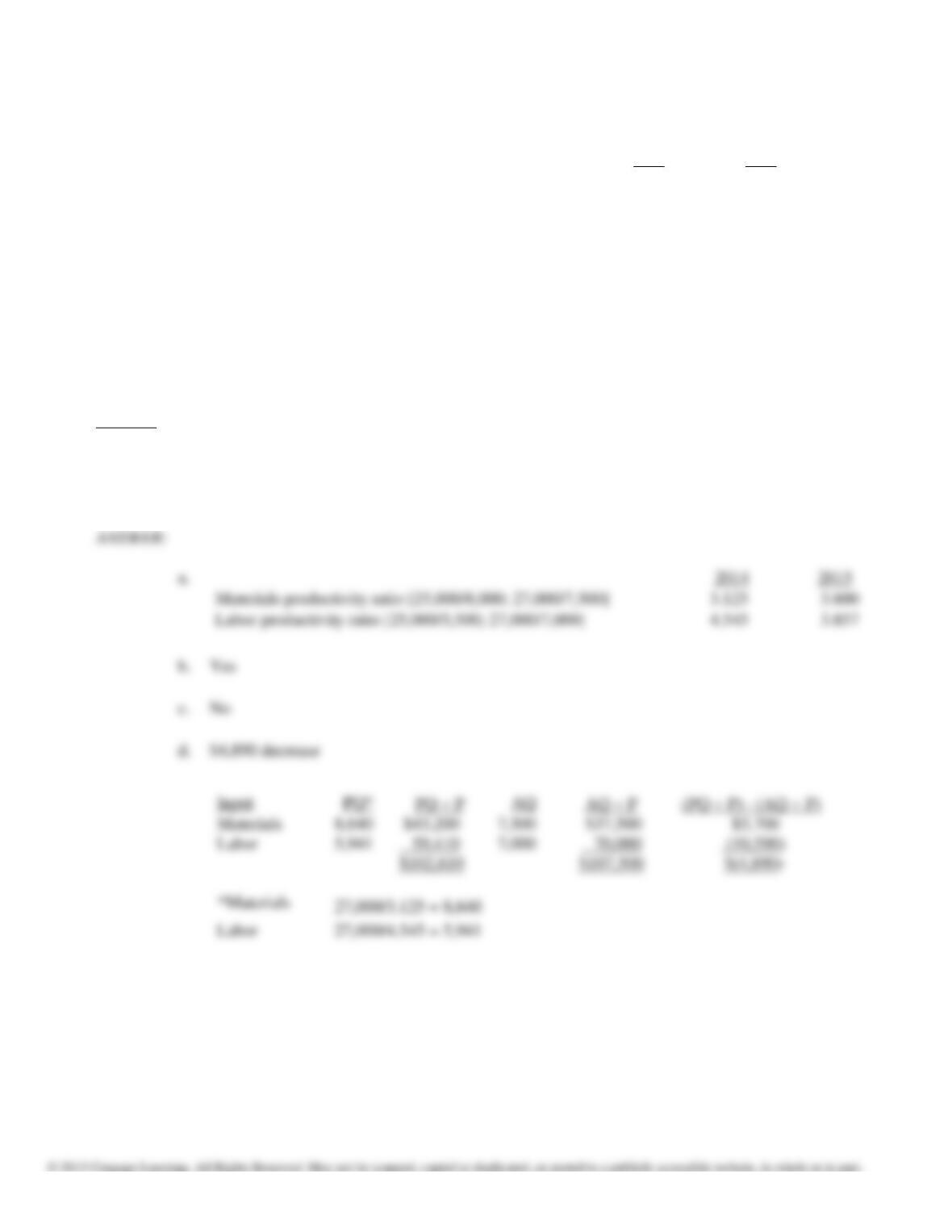
a. Calculate the materials and labor productivity ratios for 2014 and 2015.
b. Did materials productivity improve?
c. Did labor productivity improve?
d. By how much did profits change as a result of changes in productivity?
Chapter 15: Lean Accounting and Productivity Measurement
174. At the end of 2014, Immaculate Productions implemented a new labor process and redesigned its product with
the expectation that input usage efficiency would increase. Now, at the end of 2015, the president of the
company wants an assessment of the changes on the company’s productivity. The data needed for the
assessment are as follows:
2014
2015
Output
20,000
24,000
Output prices
$20
$20
Materials (lbs.)
16,000
16,800
Materials unit price
$6
$8
Labor (hrs.)
10,000
9,600
Labor rate per hour
$10
$10
Power (kwh)
4,000
6,000
Price per kwh
$2
$3
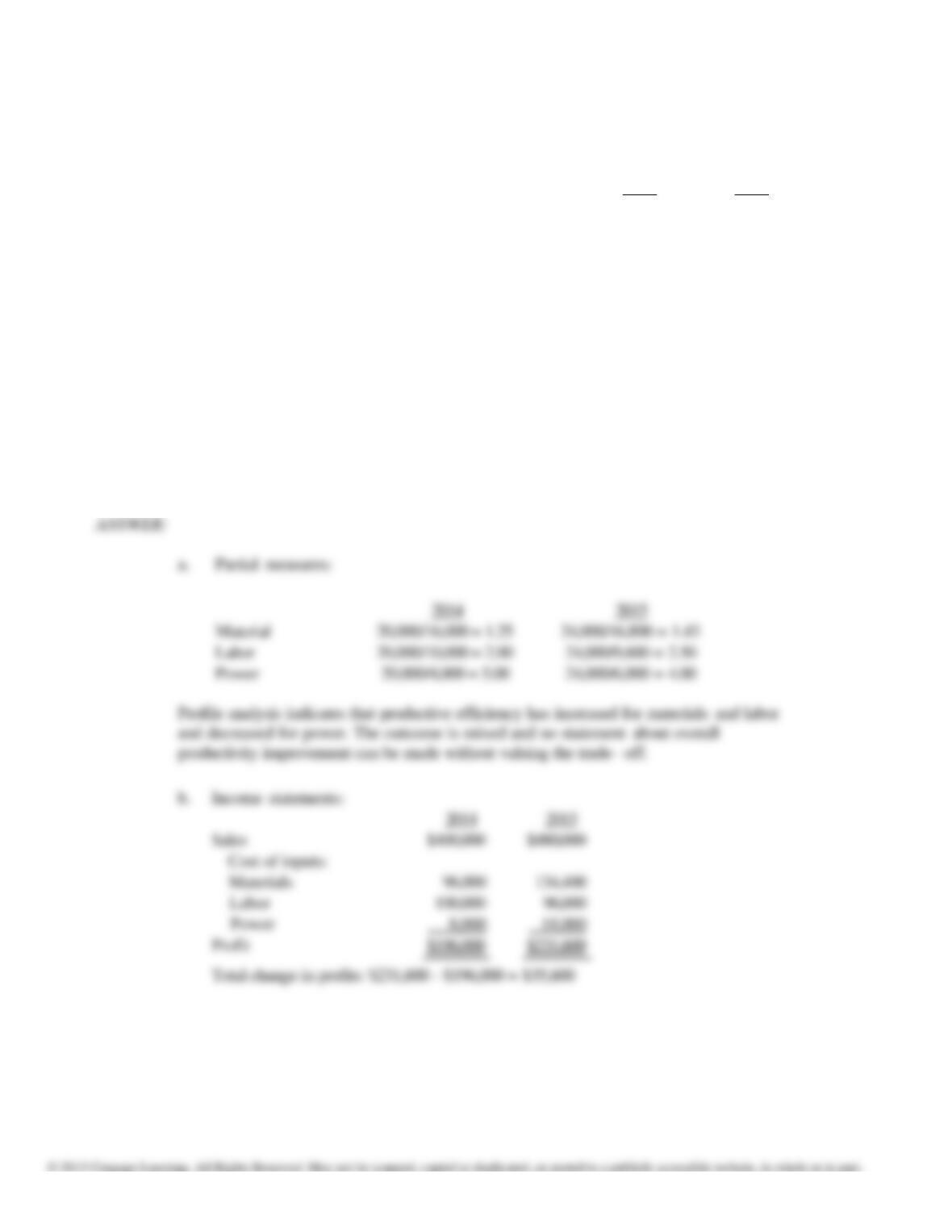
a. Compute the partial operational measures for each input for both 2014 and 2015. What can be said
about productivity improvement?
b. Prepare an income statement for each year and calculate the total change in profits.
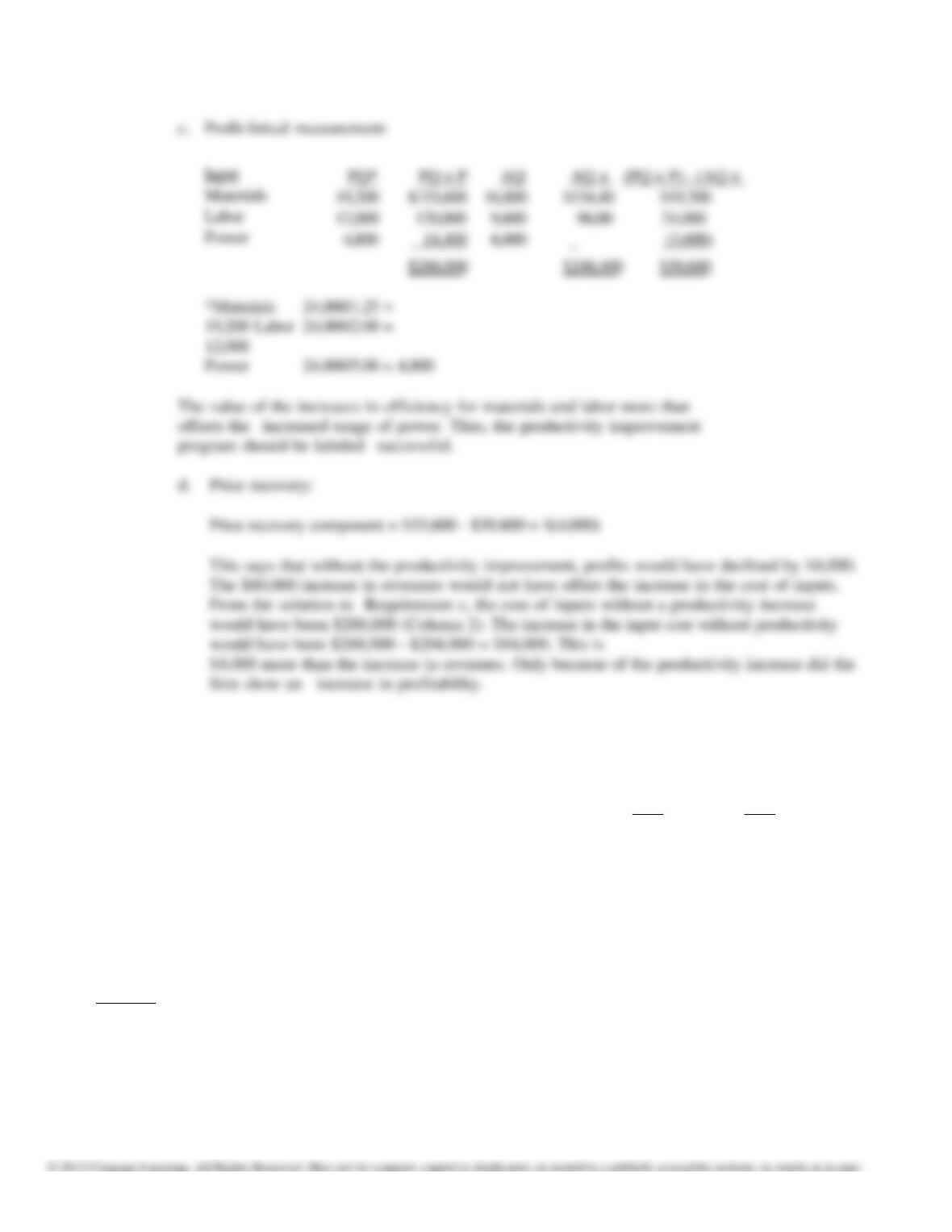
c. Calculate the profit-linked productivity measure for 2015. What can be said about the
productivity program?
d. Calculate the price-recovery component. What does this tell you?
Chapter 15: Lean Accounting and Productivity Measurement
Materials
Labor
175. At the end of 2014, San Leandro Company implemented a new labor process and redesigned its product with the
expectation that input usage efficiency would increase. Now, at the end of 2015, the president of the company
wants an assessment of the changes on the company’s productivity. The data needed for the assessment are as
follows:
2014
2015
Output
20,000
24,000
Output prices
$10
$10
Materials (lbs.)
10,000
10,200
Materials unit price
$3
$4
Labor (hrs.)
8,000
7,500
Labor rate per hour
$5
$5
Power (kwh)
5,000
6,500
Price per kwh
$2
$3
Required:
a. Compute the partial operational measures for each input for both 2014 and 2015. What can be
said about productivity improvement?
b. Prepare an income statement for each year and calculate the total change in profits.
c. Calculate the profit-linked productivity measure for 2015. What can be said about the
productivity program?
d. Calculate the price-recovery component. What does this tell you?
Chapter 15: Lean Accounting and Productivity Measurement