949
Chapter 15: Vector Analysis
____
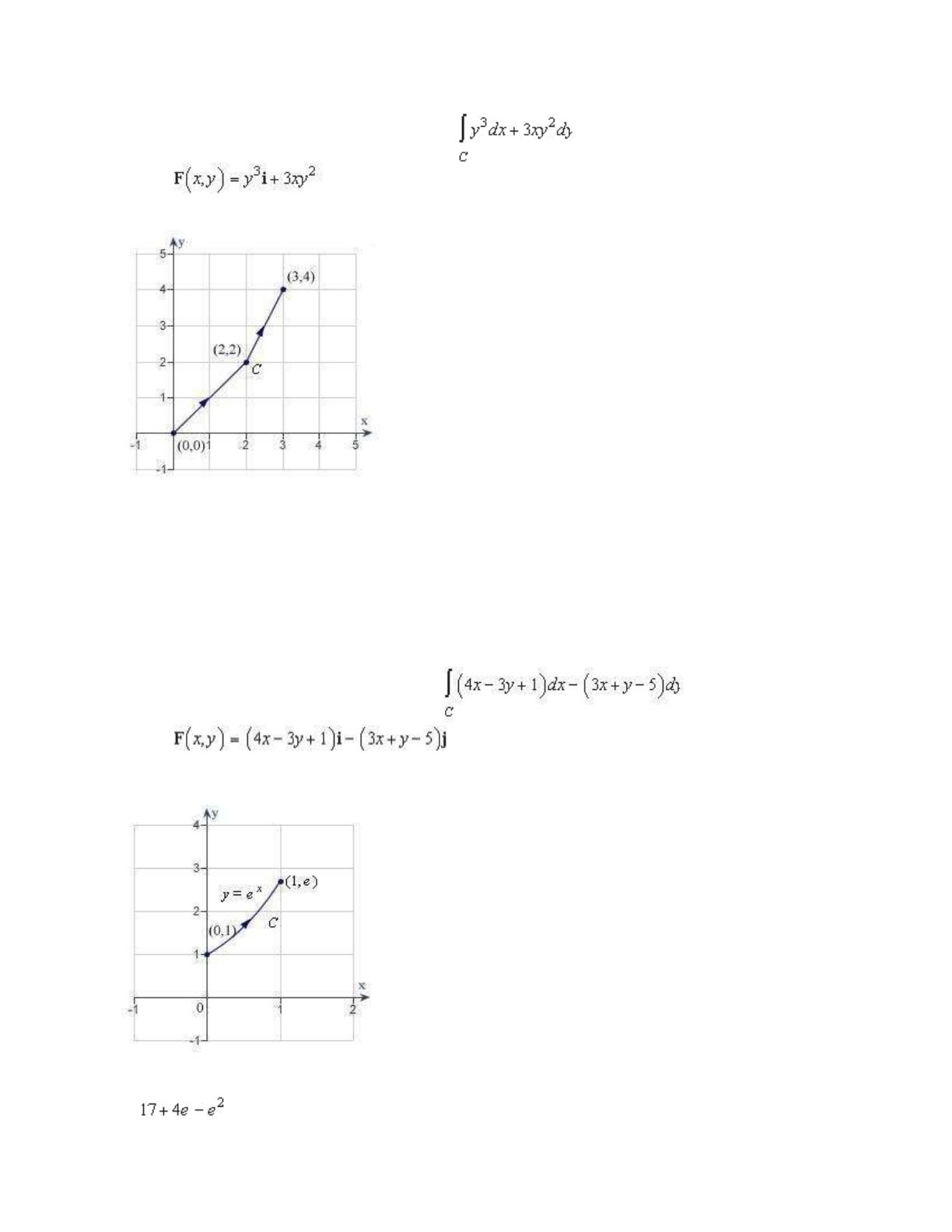
7.
Find the value of the line integral
.
(Hint: If is conservative, the integration may be easier on an alternate path.)
a.
243
b.
192
c.
108
d.
0
e.
12
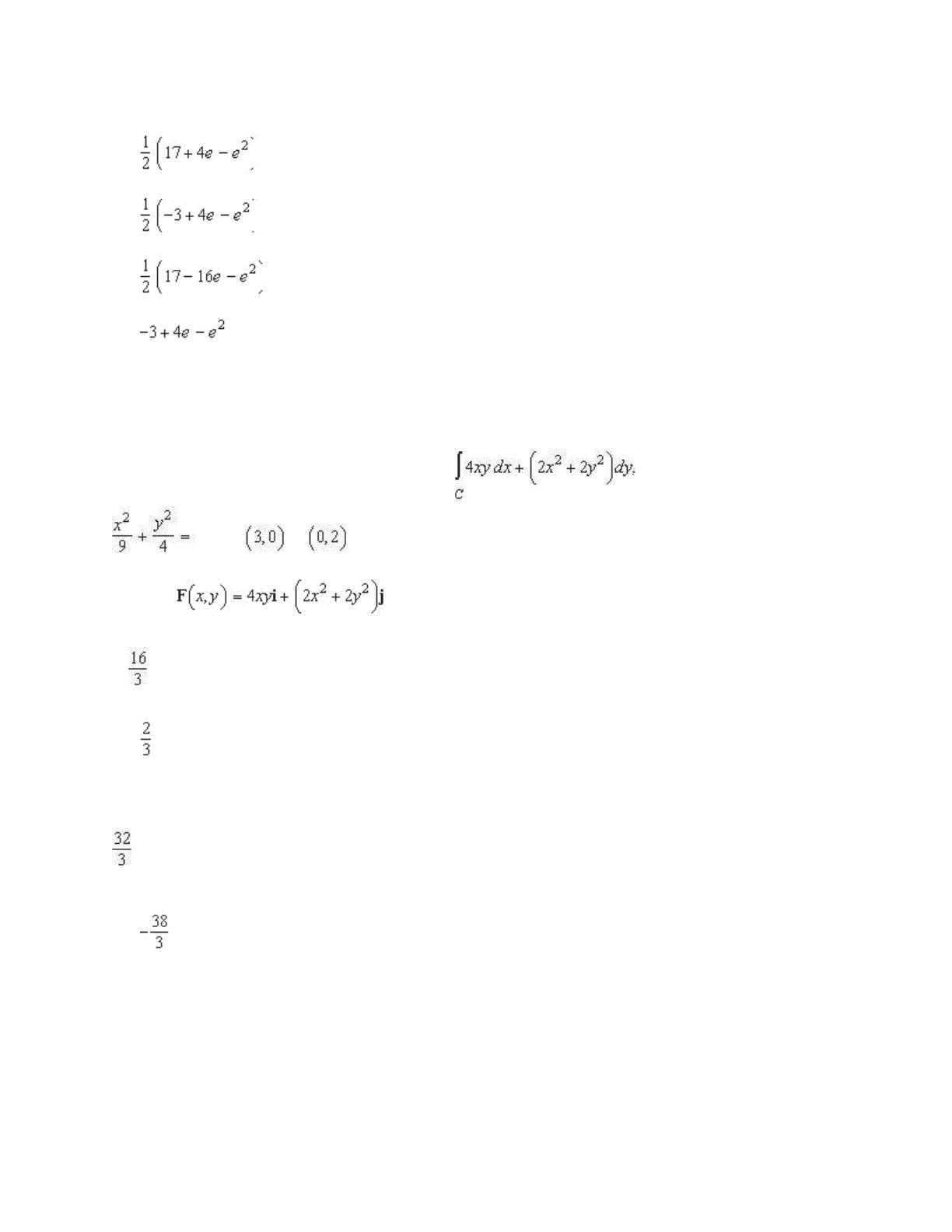
____ 8. Find the value of the line integral .
(Hint: If is conservative, the integration may be easier on an
alternate path.)
a.
15.3 Conservative Vector Fields and Independence of Path
950
b.
c.
d.
e.
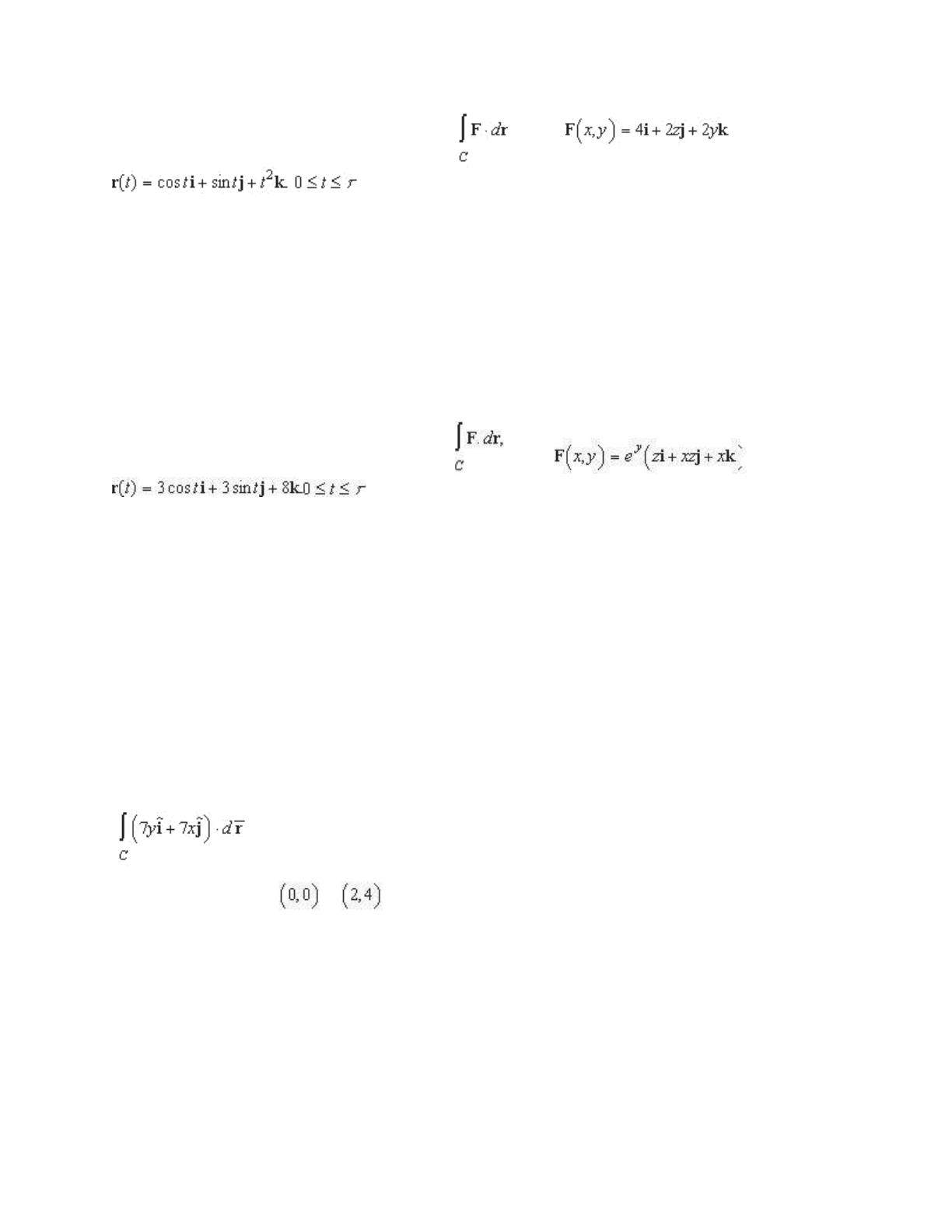
____ 9. Find the value of the line integral where C is an ellipse
from to .
(Hint: If is conservative, the integration may be easier on an alternate
path.)
a.
b.
c. 8 d.
e.
951
Chapter 15: Vector Analysis
____
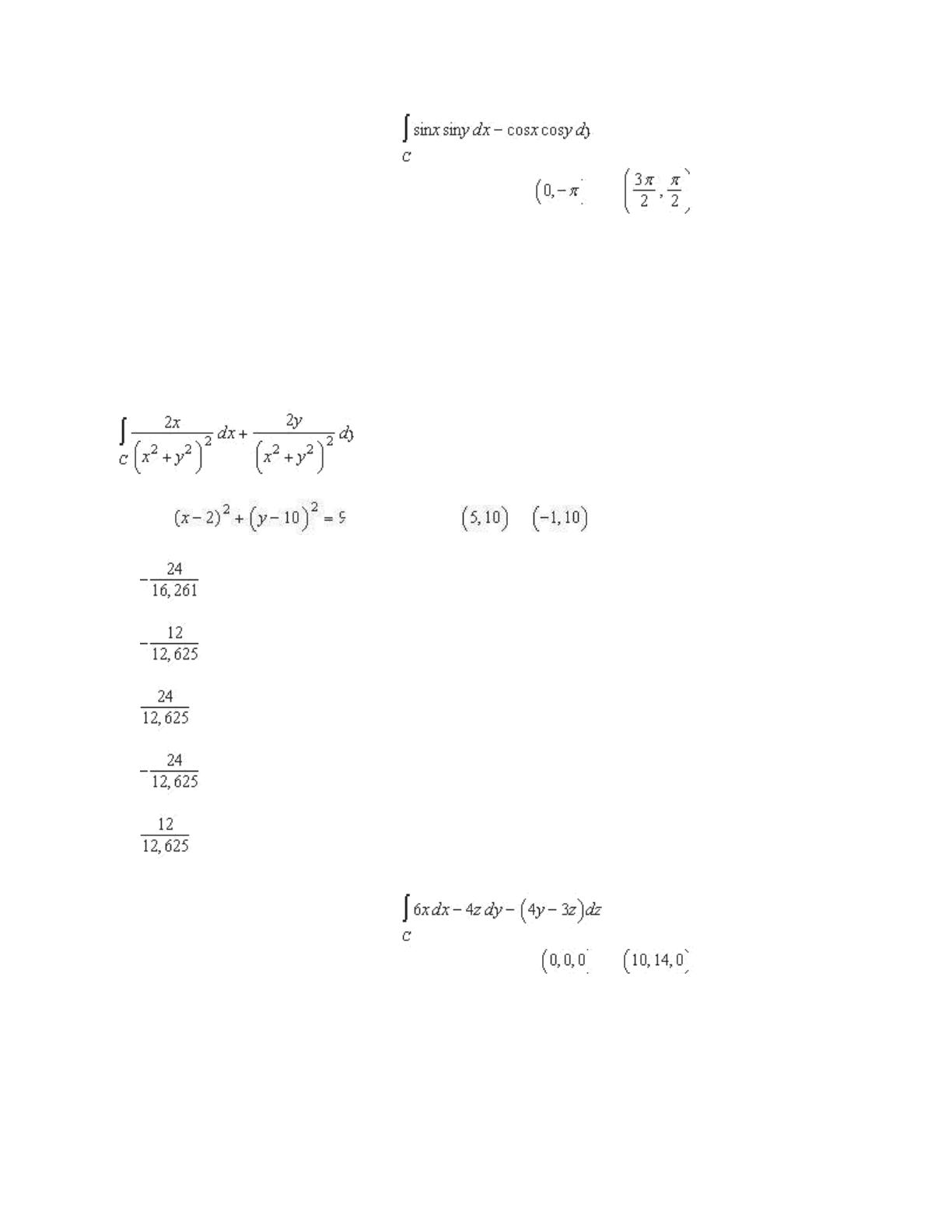
10.
Find the value of the line integral
, where
and
.
(Hint: If F is conservative, the integration may be easier on an alternate path.)
4
8
4
–4
–8
____ 11. Find the value of the line integral where and
.
(Hint: If F is conservative, the integration may be easier on an alternate path.)
–24
48
–48
24
0
____ 12. Evaluate the line integral using the Fundamental Theorem of Line Integrals. Use a
computer algebra system to verify your results.
C: a smooth curve from to
30
15
13
56
169
15.3 Conservative Vector Fields and Independence of Path
952
____ 13.
Evaluate the line integral
using the Fundamental
Theorem of Line Integrals, where C is the line segment from
to
.
a.
–2
b.
–1
c.
2
d.
1
e.
0
____ 14. Evaluate the line integral using the Fundamental Theorem of Line Integrals. Use a
computer algebra system to verify your results.
C: circle clockwise from to
a.
b.
c.
d.
e.
____ 15.
Evaluate the line integral
using the Fundamental
Theorem of Line Integrals, where C is the smooth curve from
to
.
a.
274
b.
298
c.
300
d.
30
e.
272
953 Chapter 15: Vector Analysis
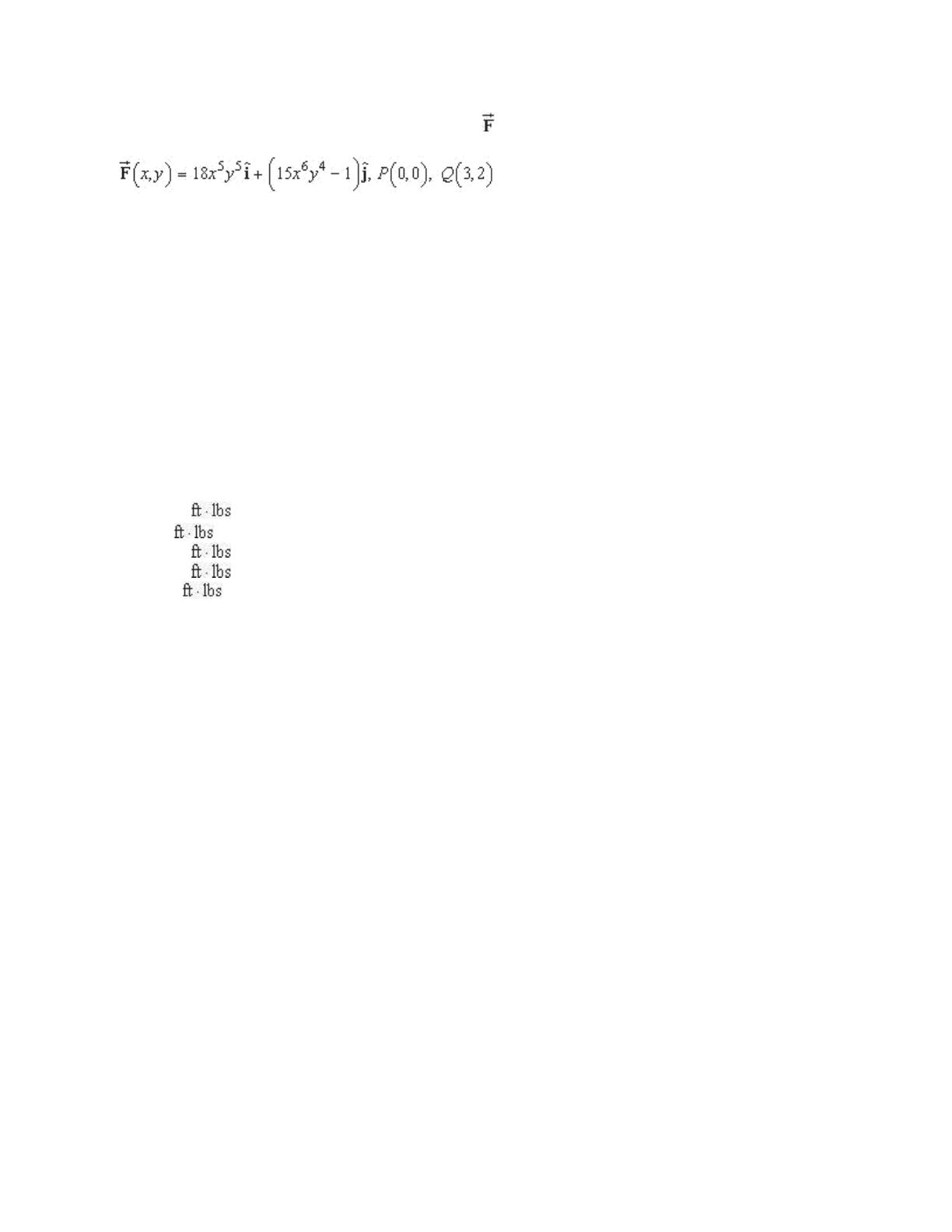
____ 16. Find the work done by the force field in moving an object from P to Q.
27,992
55,985
83,978
41,989
69,982
____ 17. A stone weighing 2 pounds is attached to the end of a four-foot string and is whirled
horizontally with one end held fixed. It makes 1 revolution per second. Find the work done by the
force F that keeps the stone moving in a circular path. [Hint: Use Force = (mass)(centripetal
acceleration).] Round your answer to two decimal places, if required.
201.06
0.00
804.25
256.00
12.57
15.3 Conservative Vector Fields and Independence of Path
954
15.3 Conservative Vector Fields and Independence of Path
Answer Section
955 Chapter 15: Vector Analysis
15.4 Green’s Theorem
Multiple Choice
Identify the choice that best completes the statement or answers the question.
____ 1. Verify Green’s Theorem by evaluating both integrals
for the path C defined as the boundary of the region
lying between the graphs of and .
a.
b.
c.
d.
e.
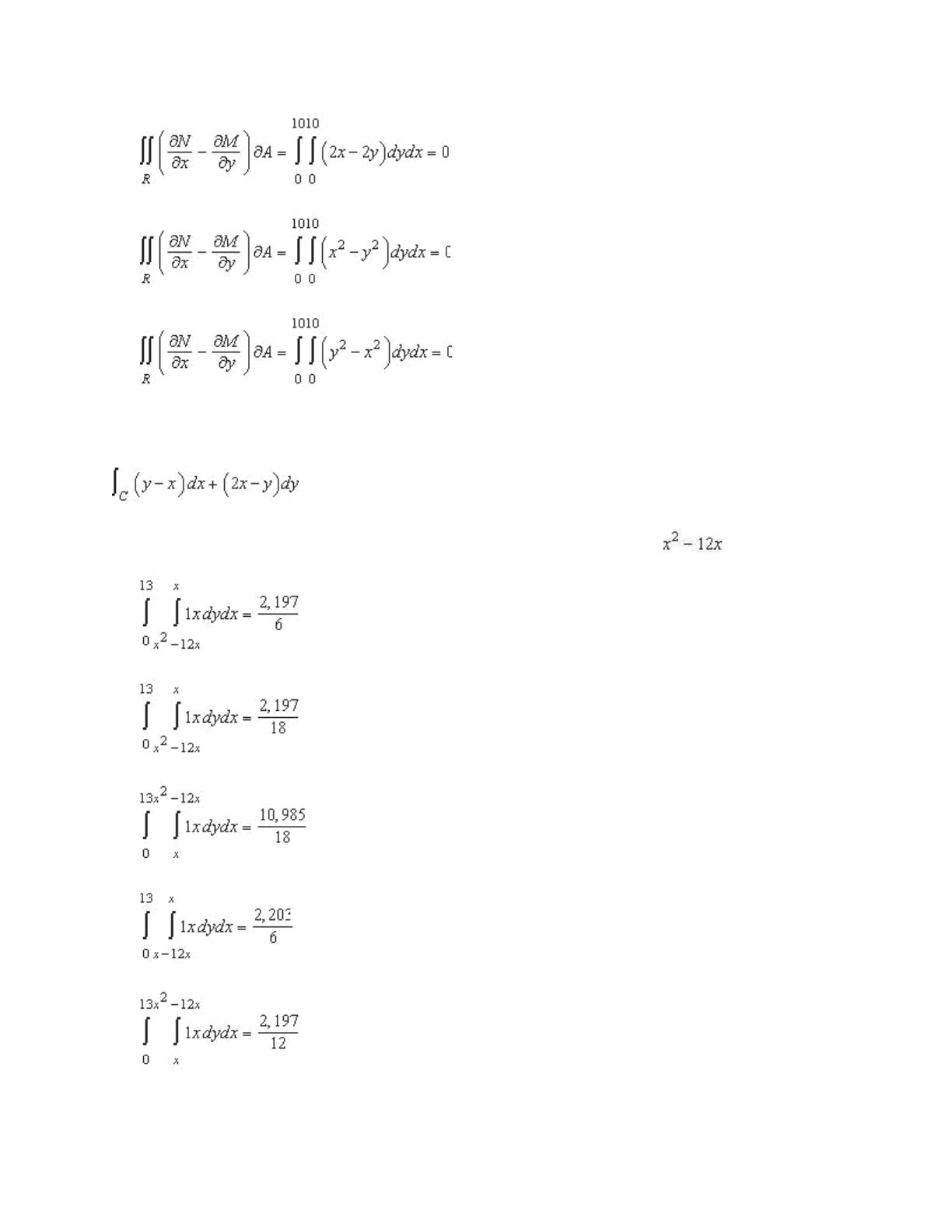
____ 2. Verify Green’s Theorem by setting up and evaluating both integrals
for the path C: square with vertices (0,0), (10,0), (10,10), (0,10).
a.
b.
15.4 Green’s Theorem
956
c.
d.
e.
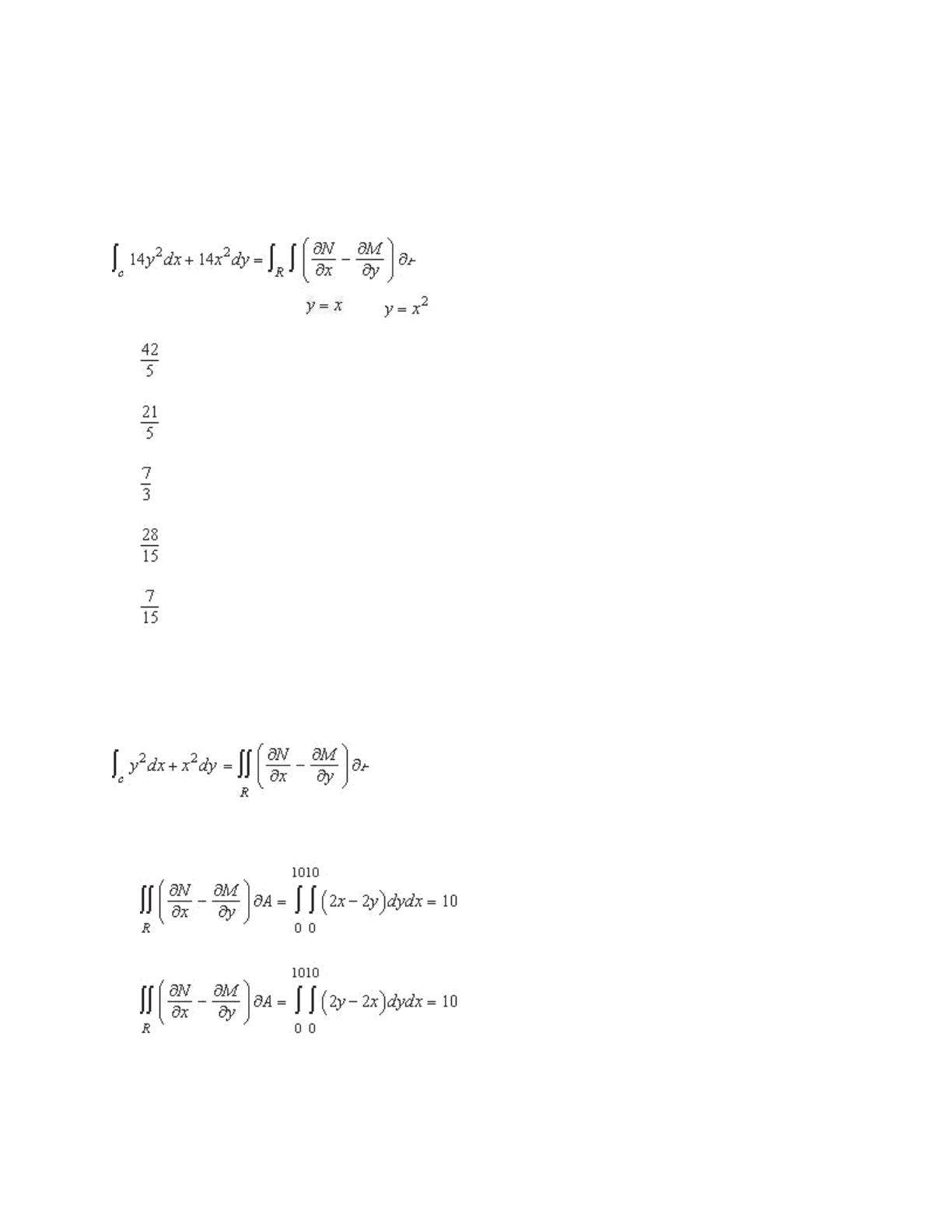
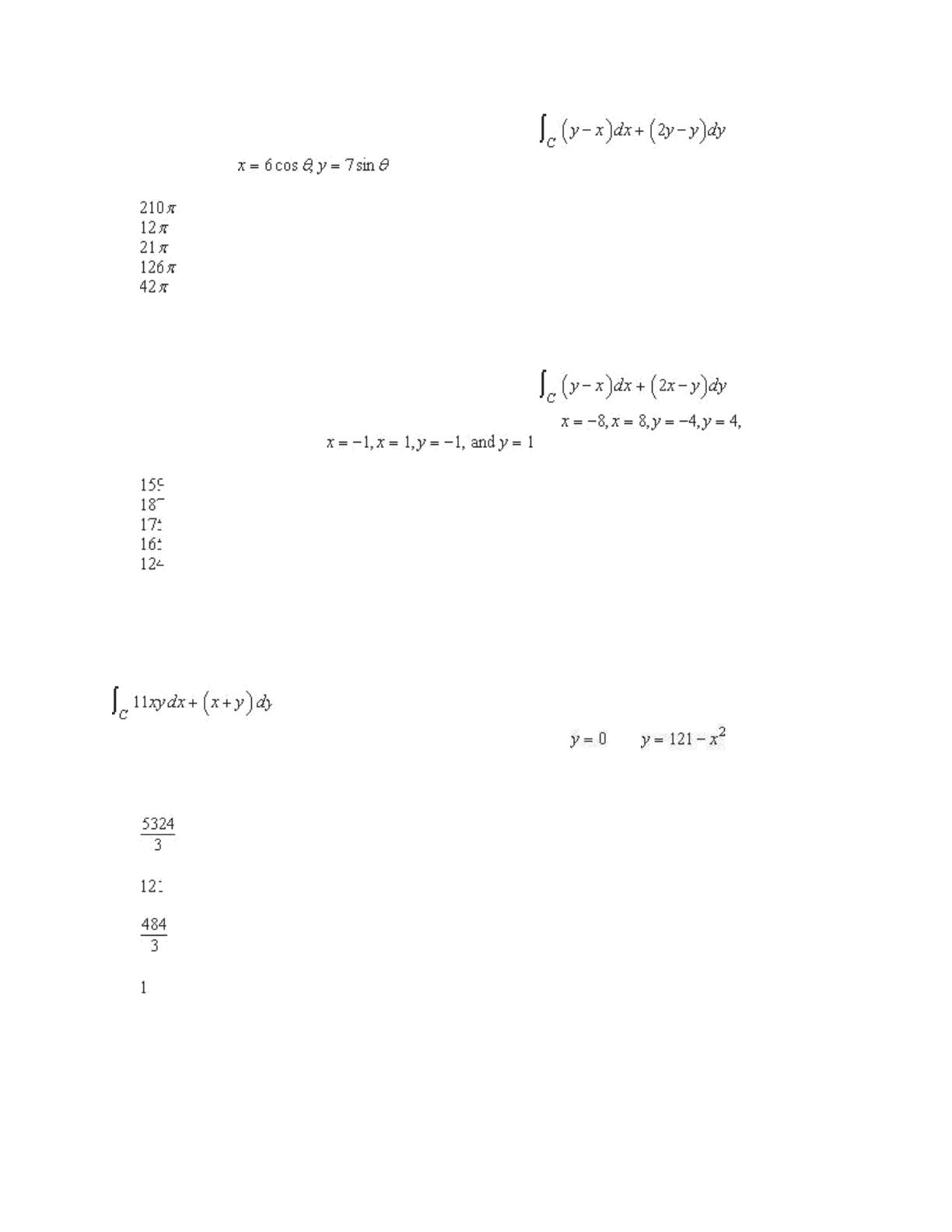
____ 3. Use Green’s Theorem to evaluate the integral
for the path C: boundary of the region lying between the graphs of y = x and y = .
a.
b.
c.
d.
e.
957
Chapter 15: Vector Analysis
____
4.
Use Green’s Theorem to evaluate the integral
for the
path C defined as
.
a.
b.
c.
d.
e.
____ 5.
Use Green’s Theorem to evaluate the integral
where C is
the boundary of the region lying inside the rectangle bounded by
and
outside the square bounded by
.
a.
b.
c.
d.
e.
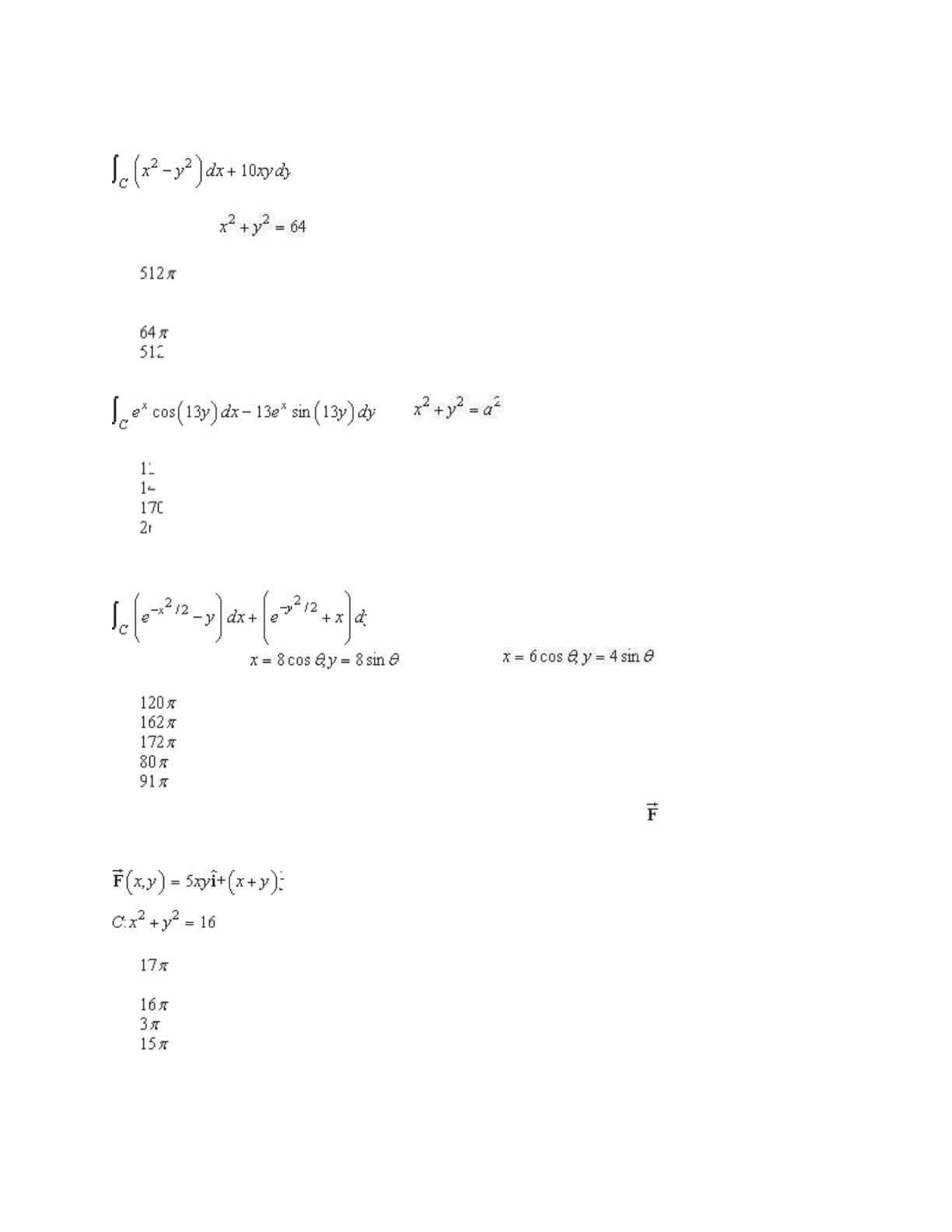
____ 6. Use Green’s Theorem to evaluate the integral
for the path C: boundary of the region lying between the graphs of and .
a.
b.
c.
d.
e.
15.4 Green’s Theorem
958
____ 7. Use Green’s Theorem to evaluate the integral
for the path C: .
a.
b.
c.
d.
e.
____ 8. Use Green’s Theorem to evaluate the line integral where
C is .
a.
b.
c.
d.
e.
____ 9. Use Green’s Theorem to evaluate the line integral
where C is the boundary of the region lying between the
graphs of the circle and the ellipse .
a.
b.
c.
d.
e.
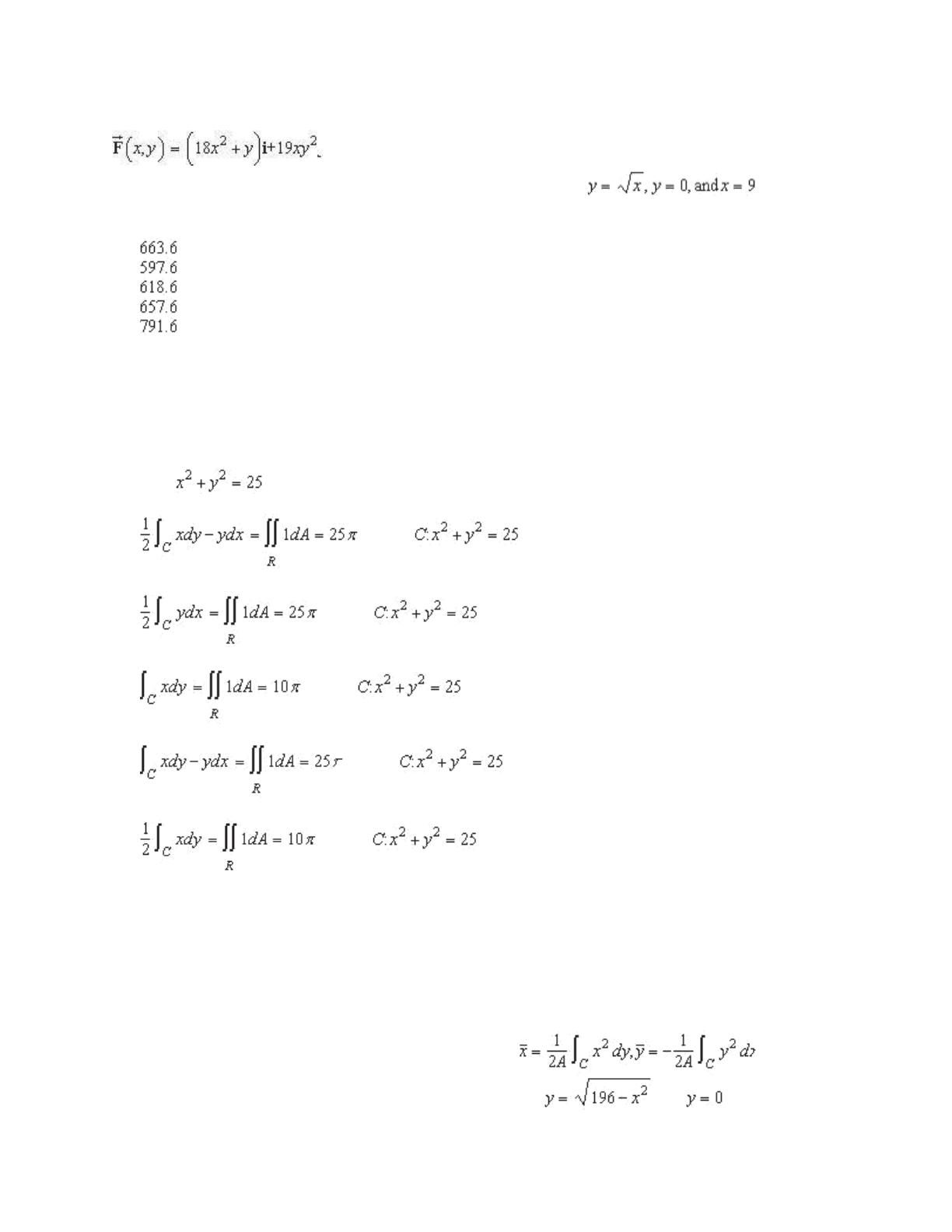
____ 10. Use Green’s Theorem to calculate the work done by the force on a particle that is
moving counterclockwise around the closed path C.
a.
b.
c.
d.
e.
959 Chapter 15: Vector Analysis
____ 11. Use Green’s Theorem to calculate the work done by the force
on a particle that is moving counterclockwise around the closed path
C where C is the boundary of the region lying between the graphs of . Round your answer to two
decimal places.
a.
b.
c.
d.
e.
____ 12.
Set up and evaluate a line integral to find the area of the region R bounded by the
graph of
.
a.
where
b.
where
c.
where
d.
where
e.
where
____ 13.
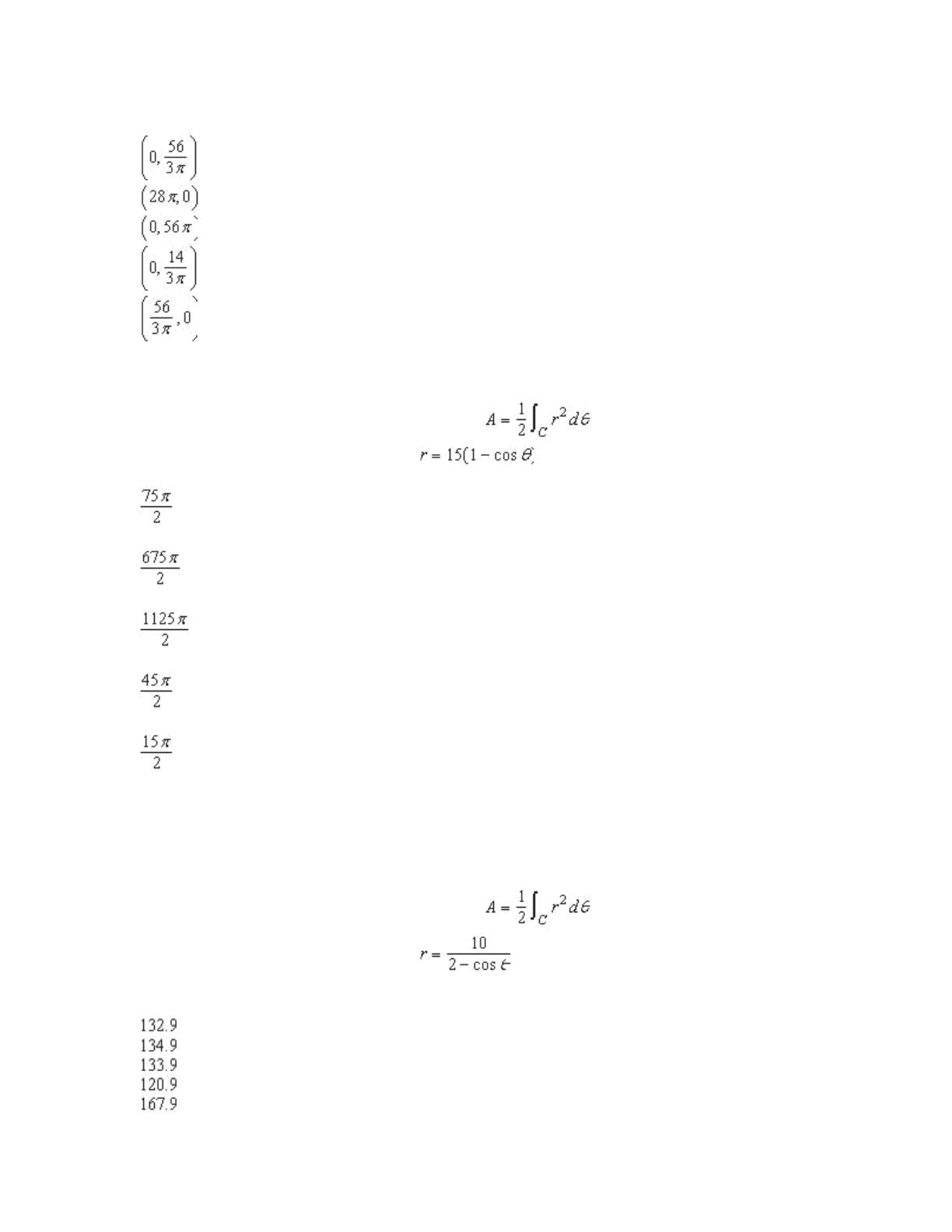
Use a computer algebra system and the result “The centroid of the region
having area A bounded by the simple closed path C is
” to
find the centroid of the region bounded by the graphs of
and
.
15.4 Green’s Theorem
960
a.
b.
c.
d.
e.
____ 14.
Use a computer algebra system and the result “The area of a plane region bounded by
the simple closed path C given in polar coordinates is
” to find the area of the region
bounded by the graphs of the polar equation
.
a.
b.
c.
d.
e.
___
15.
Use a computer algebra system and the result “The area of a plane region bounded by
the simple closed path C given in polar coordinates is
” to find the area of the region
bounded by the graphs of the polar equation
. Round your answer to two decimal
places.
a.
b.
c.
d.
e.
961 Chapter 15: Vector Analysis
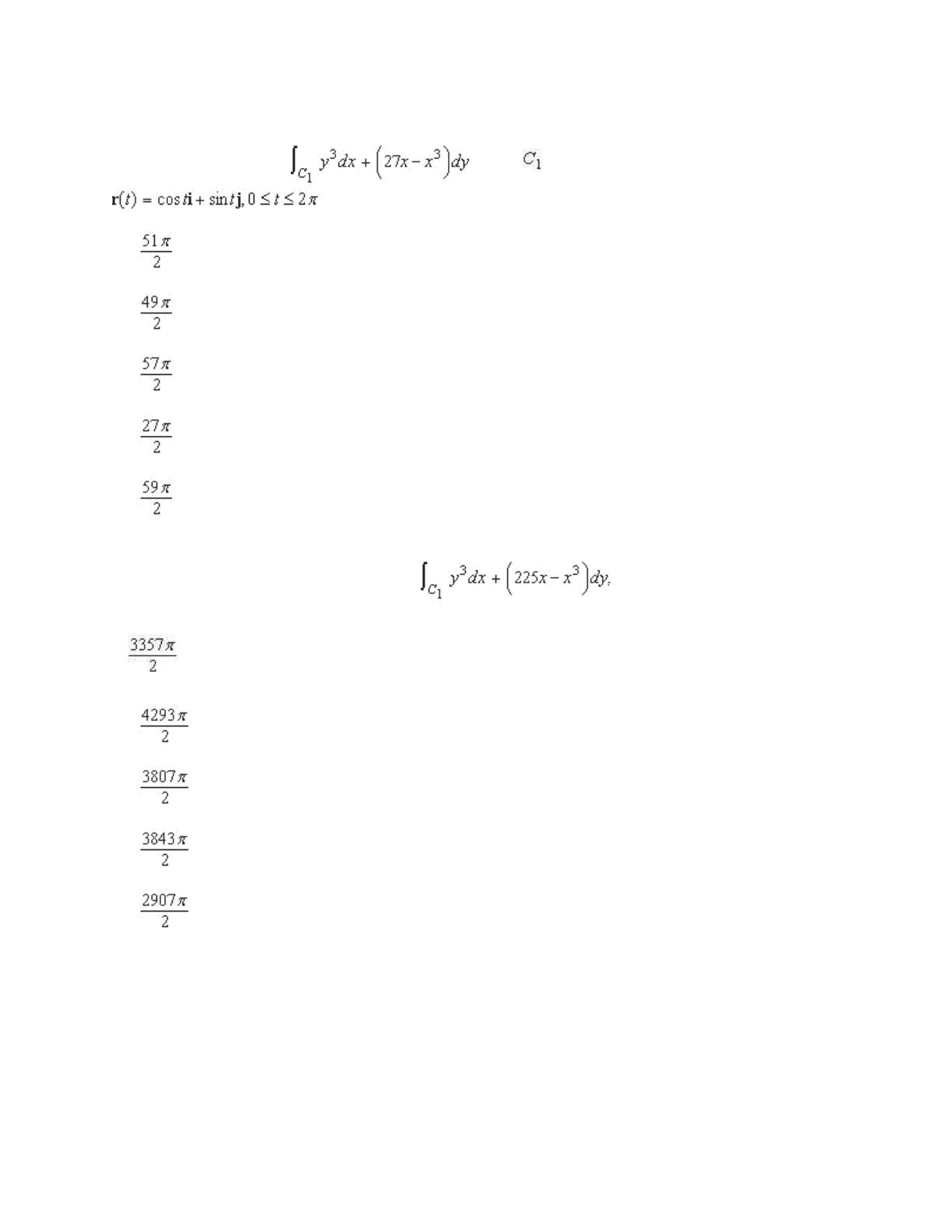
____ 16. Evaluate , where is the unit circle given by
.
a.
b.
c.
d.
e.
____ 17. Find the maximum value of where C is any closed curve
in the xy–plane, oriented counterclockwise.
a.
b.
c.
d.
e.
15.4 Green’s Theorem
962
15.4 Green’s Theorem
Answer Section
963 Chapter 15: Vector Analysis
15.5 Parametric Surfaces
Multiple Choice
Identify the choice that best completes the statement or answers the question.
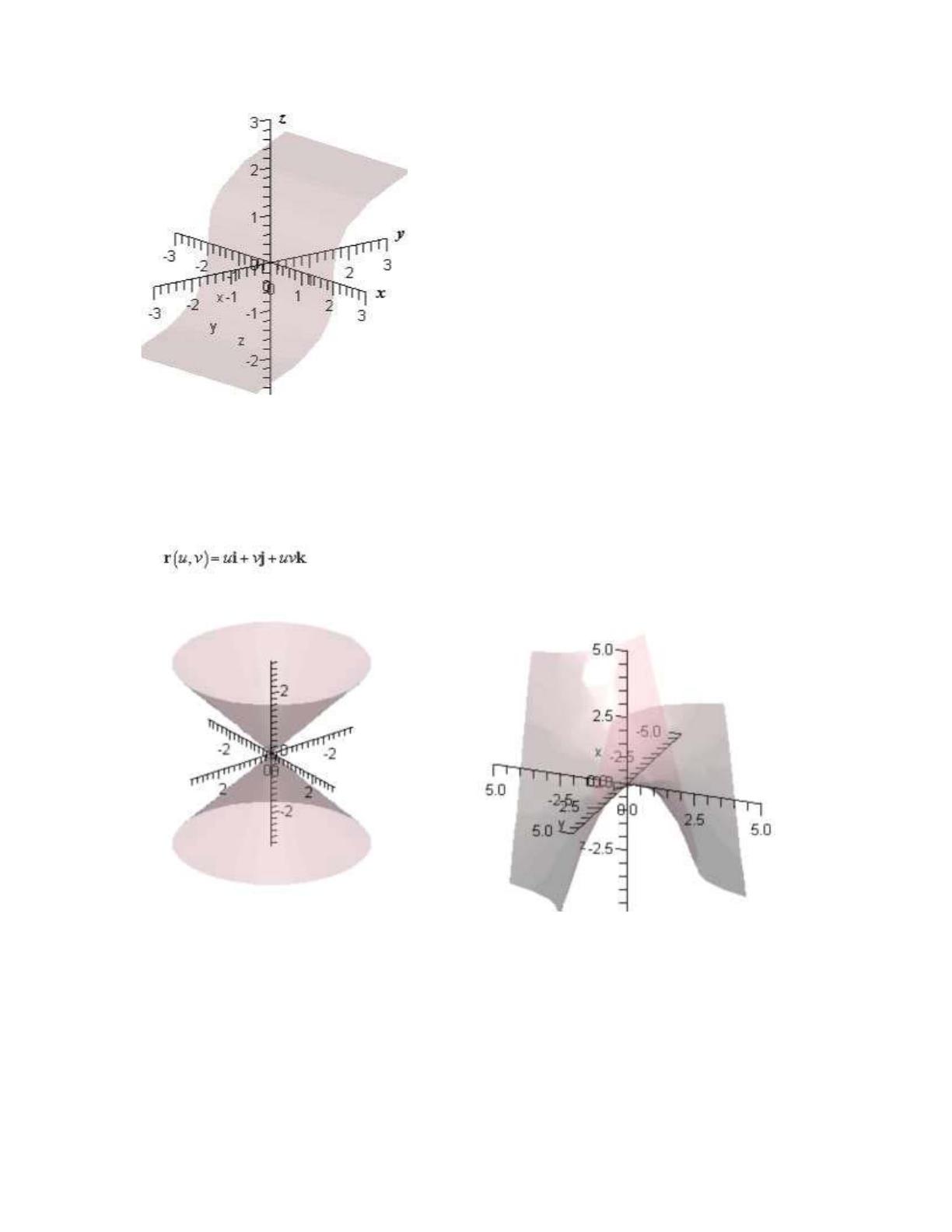
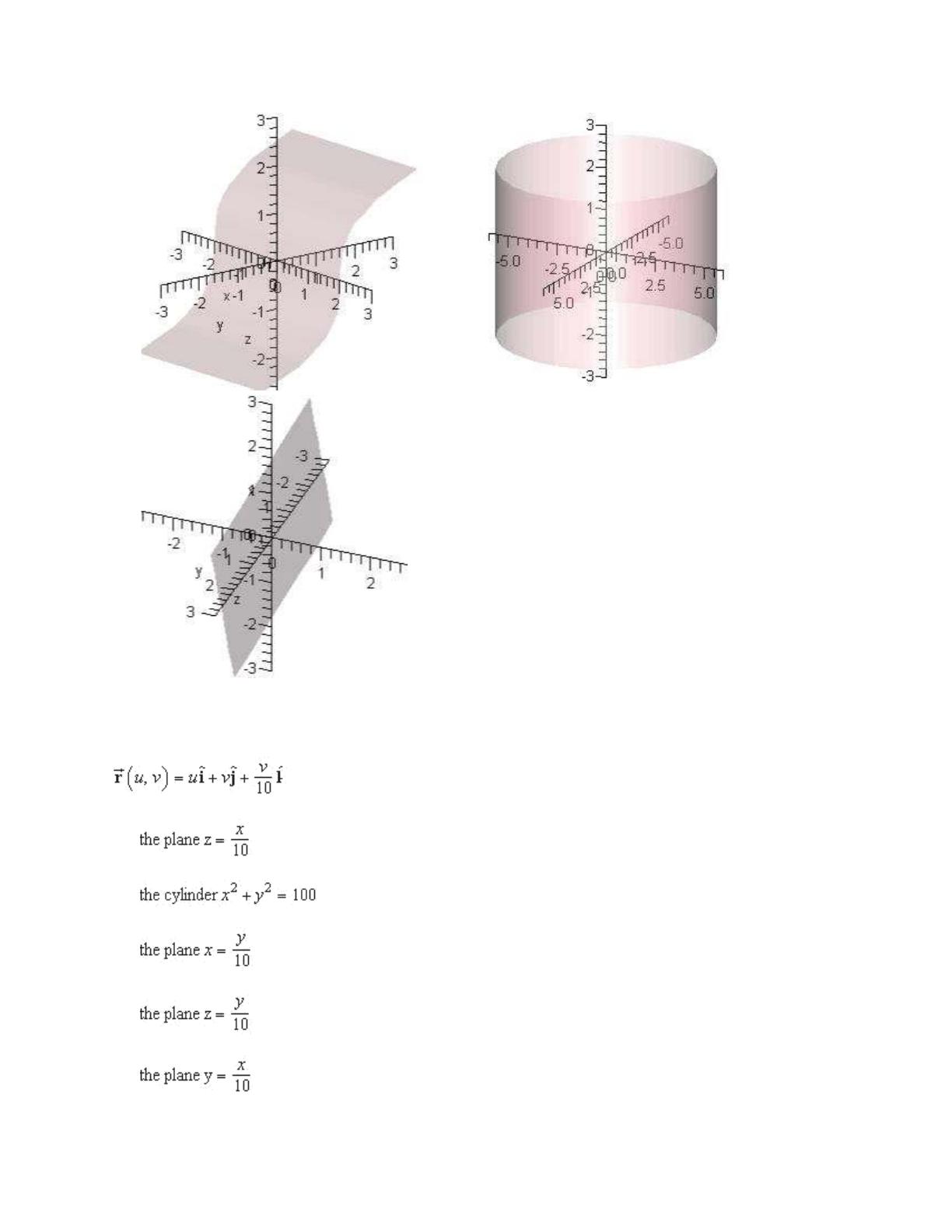
____ 1. Match the following vector-valued function with its graph.
a. d.
b. e.
15.5 Parametric Surfaces
964
c.
____ 2. Match the following vector-valued function with its graph.
a. d.
965 Chapter 15: Vector Analysis
b. e.
c.
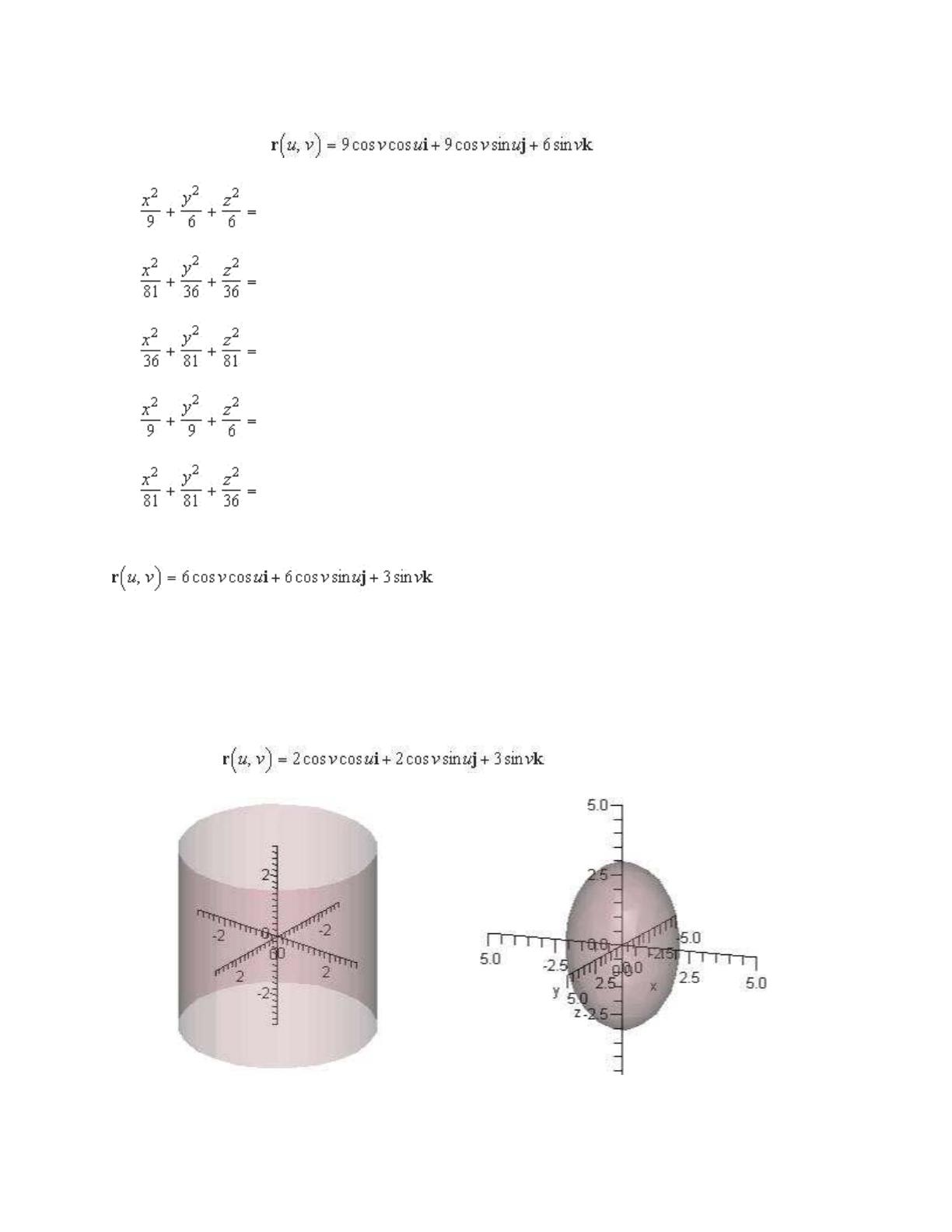
____ 3. Find the rectangular equation for the surface by eliminating parameters from the vector-
valued function. Identify the surface.
a.
b.
c.
d.
e.
15.5 Parametric Surfaces
966
____ 4.
Find the rectangular equation for the surface by eliminating the parameters from the
vector-valued function .
a.
b.
c.
d.
e.
____ 5. Identify the surface by eliminating the parameters from the vector-valued function
.
plane
sphere
paraboloid
cylinder
ellipsoid
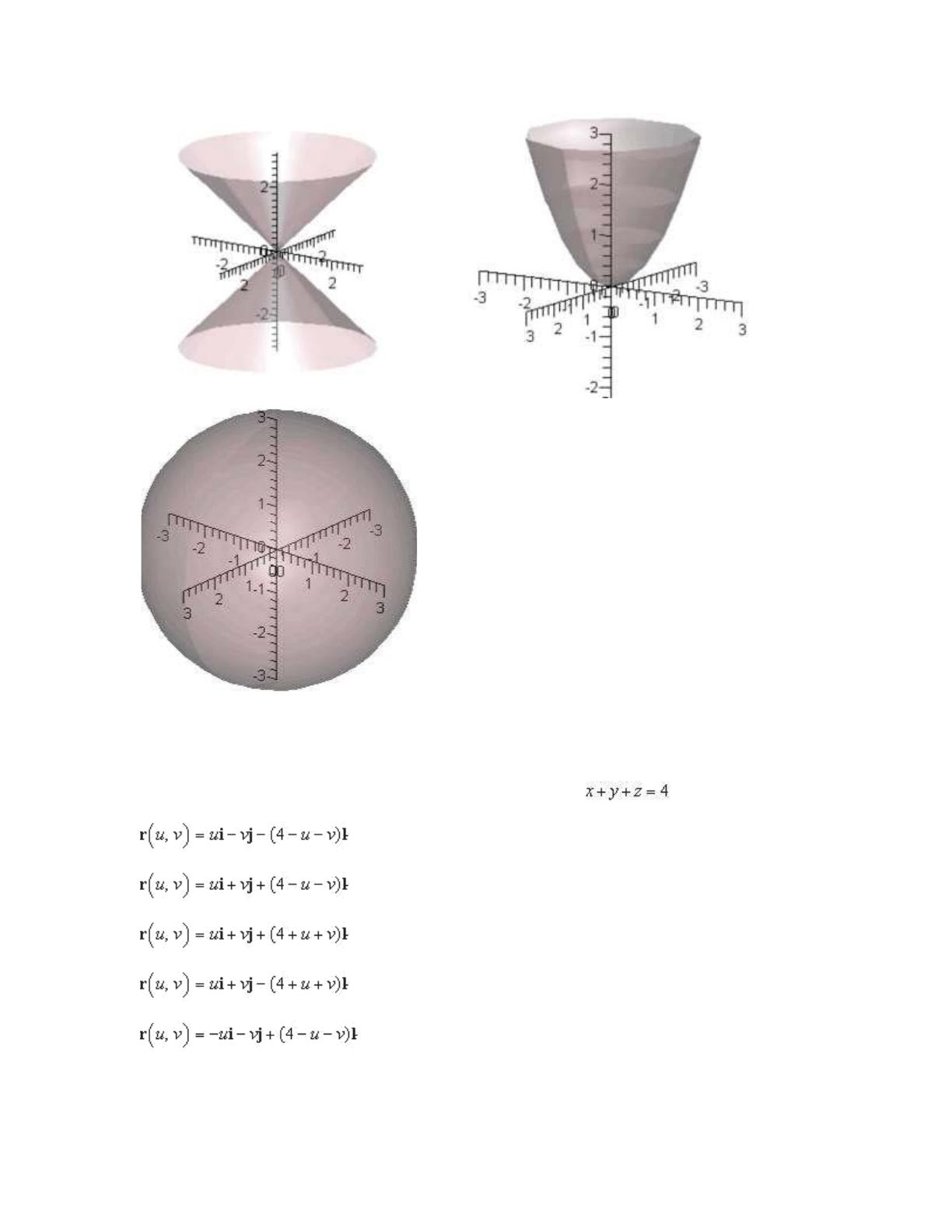
____ 6. Find the rectangular equation for the surface by eliminating the parameters from the vector-
valued function and sketch the graph.
a. d.
967 Chapter 15: Vector Analysis
b. e.
c.
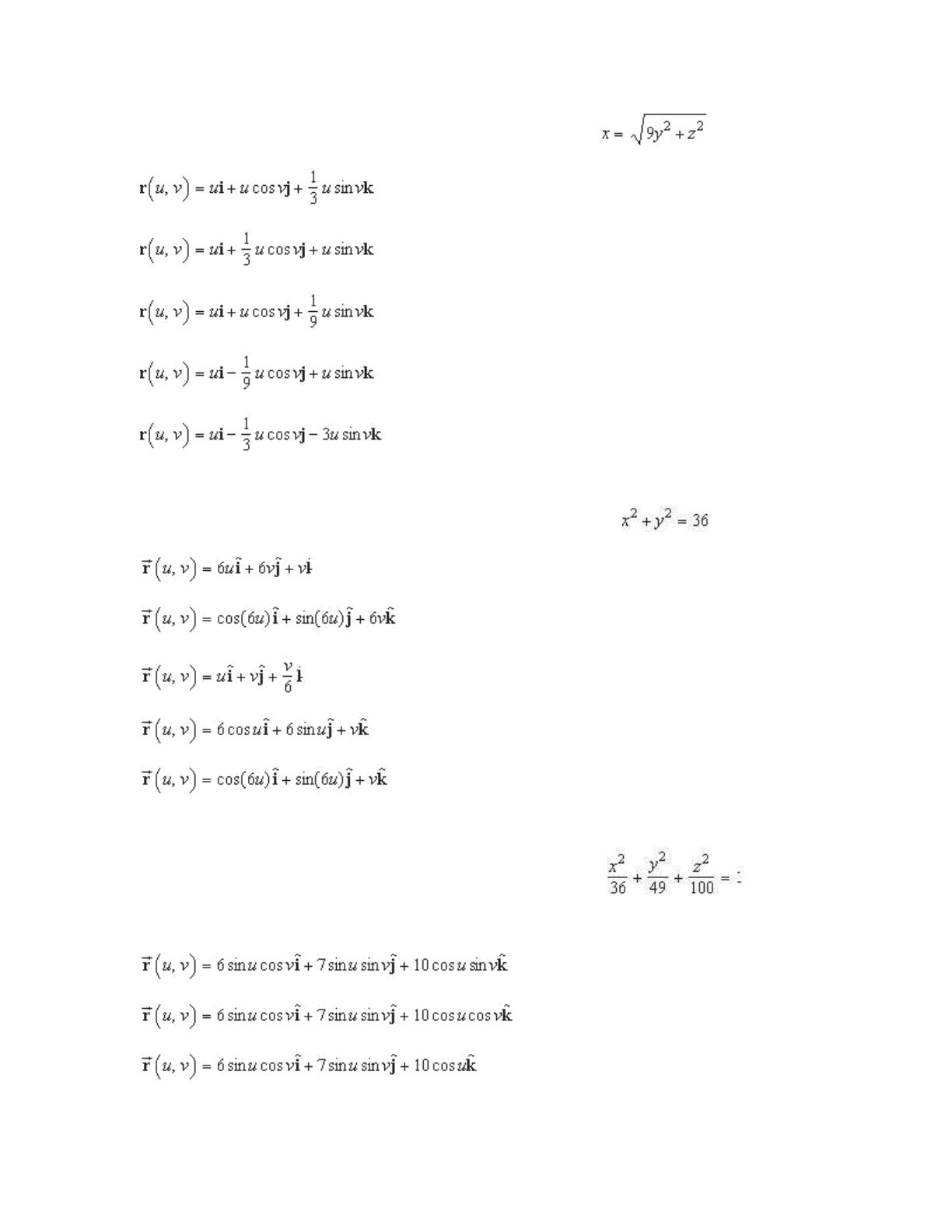
____ 7. Find a vector-valued function whose graph is the plane .
a.
b.
c.
d.
e.
15.5 Parametric Surfaces
968
____ 8.
Find a vector-valued function whose graph is the cone
.
a.
b.
c.
d.
e.
____ 9. Find a vector-valued function whose graph is the cylinder .
a.
b.
c.
d.
e.
____ 10. Find a vector-valued function whose graph is the ellipsoid .
a.
b.
c.