65. The Zig-Zag Company manufactures zippers for many clothing manufacturers. Costs for the year were
direct materials, $5,000; indirect materials, $1,600; direct labor, $12,000; and indirect labor, $4,000. Additional
expenses for the year were factory utilities $3,500; depreciation of factory equipment, $1,300; advertising
expense, $900; delivery expense on sales to customers, $1,700; and property taxes on factory buildings, $5,200.
Which amount is the company’s manufacturing overhead for the year?
66. The Zig-Zag Company manufactures zippers for many clothing manufacturers. Costs for the year were
direct materials, $5,000; indirect materials, $1,600; direct labor, $12,000; and indirect labor, $4,000. Additional
expenses for the year were factory utilities $3,500; depreciation of factory equipment, $1,300; advertising
expense, $900; delivery expense on sales to customers, $1,700; and property taxes on factory buildings, $5,200.
Which amount is total manufacturing costs for the year?
67. Cherry Company manufactures electronic yard tools. Costs for May were direct labor, $84,000; indirect
labor, $51,000; direct materials, $69,000; indirect materials, $9,000; factory utilities, $6,900; and insurance on
manufacturing equipment, $2,100. Cherry Company’s manufacturing overhead for May is:
68. Cherry Company manufactures electronic yard tools. Costs for May were direct labor, $84,000; indirect
labor, $51,000; direct materials, $69,000; indirect materials, $9,000; factory utilities, $6,900; and insurance on
manufacturing equipment, $2,100. Cherry Company’s total manufacturing costs for May are:
69. Mackie Co. manufactures hunting clothing. The standard variable costs to produce one batch of the Big Mac
vests are as follows: direct material average cost is $6 per yard; average yards per batch is 20; direct labor
average rate per hour is $12; average hours per batch is 4; variable overhead average rate per hour is $8;
average hours per batch is 4. The standard monthly fixed costs are as follows: manufacturing overhead is
$3,200; selling and administrative costs are $1,900. Mackie Co. produces 100 batches per month. (Ten vests are
produced in each batch.) What is the manufacturing cost per vest?
70. Janet’s Jewelry makes sterling silver jewelry. One of the most popular rings, the Love Knot, is produced in
batches of 10. The standard variable costs to produce one batch are as follows: direct material average cost is
$13 per ounce; average ounces per batch is 20; direct labor average rate per hour is $22; average hours per batch
is 10; variable overhead average rate per hour is $10; average hours per batch is 10. The standard monthly fixed
costs are as follows: fixed manufacturing overhead is $1,400; selling and administrative costs are $1,500.
Janet’s Jewelry produces 10 batches per month. What is the manufacturing cost per batch?
71. Costs that are directly traceable to a unit of business or segment being analyzed are called:
72. Another name for joint costs is:
73. Costs incurred for the benefit of more than one segment of the business are called:
74. Which of the following types of costs would be allocated among segments rather than directly attributable to
a segment?
75. You are thinking about taking a trip to Asia. The cost of the airplane ticket you have yet to purchase is a(n):
76. You want to go skiing for the day. However, you realize you are scheduled to work. If you call in sick and
do not go to work, the wages you will not earn (assuming you are an hourly employee) are considered a(n):
77. You want to go skiing for the day. The cost of the lift ticket would be considered a(n):
78. The most important costs to consider when making a decision involving future action are:
79. Future costs that change as a result of a decision are:
80. The only kind of costs that do NOT involve any outlay of cash are:
81. Which of the following costs would NOT be reported on a financial statement?
82. Which of the following costs should NOT be considered when making a future decision?
83. Costs that are specifically traceable to a unit of business are known as which of the following costs to that
unit?
84. Costs that do NOT change as the result of a future decision are known as:
85. Which of the following is NOT used in the evaluation of a business segment?
86. Which of the following would most likely be an indirect cost?
87. When considering the purchase of a new truck, the depreciation expense on the old truck is considered a(n):
88. You currently work as a machinist in a factory. Your salary is $45,000 per year. You are thinking about
quitting your job and going back to college. It will take you two years to obtain your college degree. Tuition and
other costs of the education will total $60,000. The $60,000 cost of the education is a(n):
89. You currently work as a machinist in a factory. Your salary is $15 per hour. You are thinking about quitting
your job and going back to college. It will take you two years to obtain your college degree. Tuition and other
costs of the education will total $21,000. You spent $9,000 preparing to be a machinist. In considering whether
to go back to school, the $9,000 of prior training is a(n):
90. You currently work as a school bus driver. Your salary is $28,000 per year. You are thinking about quitting
your job and going back to college. It will take you two years to obtain your college degree. Tuition and other
costs of the education will total $24,000. You also intend to keep your car by making the $250 per month
payments out of your savings. How much is the opportunity cost of going to college?
91. Segment A had sales revenue of $900,000 and the following costs: direct materials, $252,000; direct labor,
$36,000; variable manufacturing overhead, $72,000; and fixed manufacturing overhead, $315,000. If segment A
is dropped, 25% of the fixed manufacturing overhead costs would be avoided. Calculate the segment profit.
92. Mega Manufacturing has defective inventory on hand, which cost $27,000 to manufacture. The company
can sell the defective inventory as is for $18,000 or rework the units at a cost of $12,000 and sell the inventory
for $26,000. The sunk cost and the opportunity cost of selling the inventory as is (rather than rework the units)
are:
Sunk Cost Opportunity Cost
93. The top accountant in most large organizations is usually called the:
94. Which one of the following is NOT an ethical guideline that the Institute of Management Accountants
(IMA) requires its members to follow?
95. What is the first step a business professional should take when confronted with a situation that may involve
an ethical conflict?
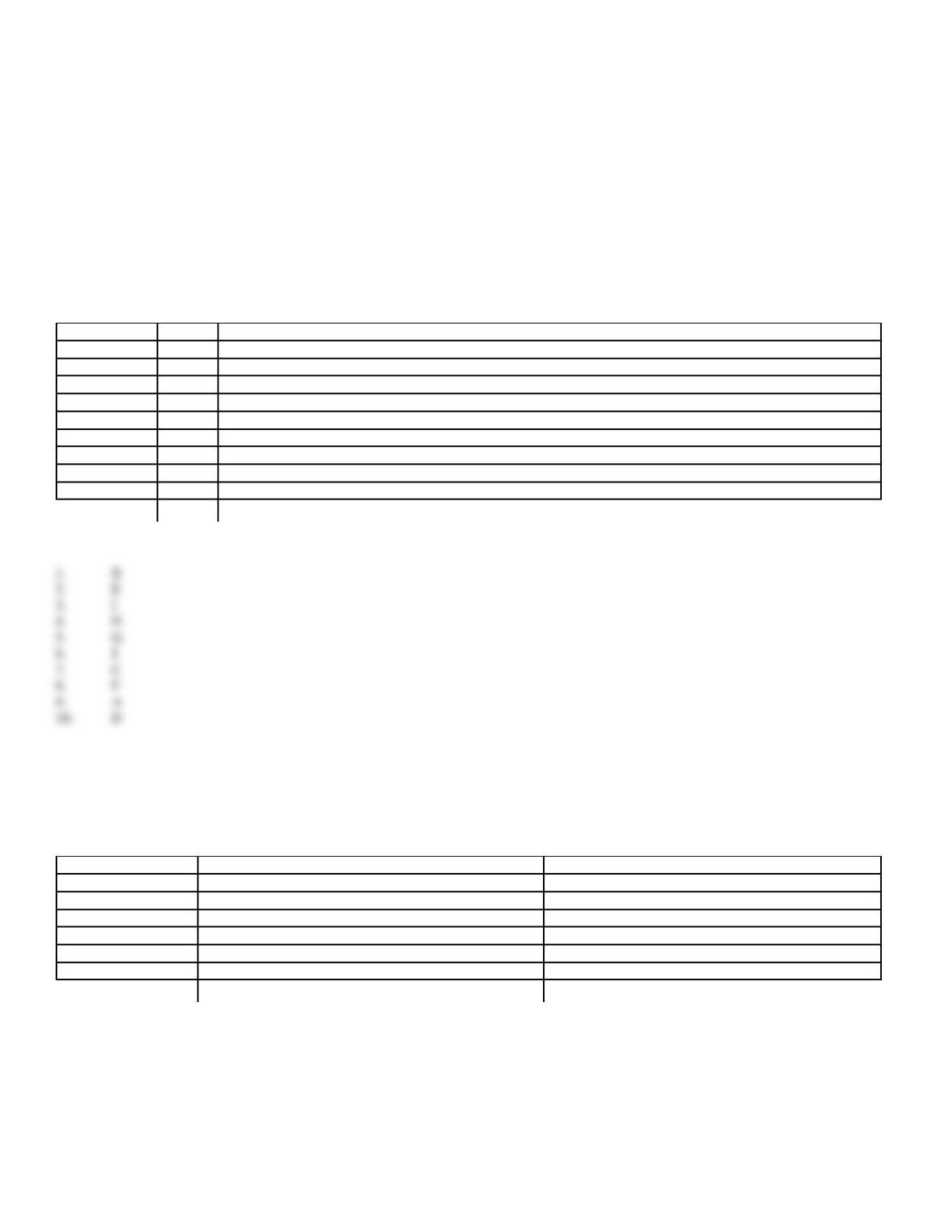
96. In the spaces provided, write the letter of the definition for each of the following terms:
A.
Costs that change in total in direct proportion to changes in activity level.
B.
Costs that remain constant in total, regardless of activity level.
C.
Outlining the activities that need to be performed for an organization to meet its objectives.
D.
Broad, long-range planning usually developed by top management.
E.
Systematic planning for long-term investments in operating assets.
F.
Management’s continual evaluation of profitability of various product lines to identify problems and potential solutions.
G.
Managerial planning decisions regarding current operations that are characterized by regularity and frequency.
H.
Analyzing results, rewarding performance, and identifying problems.
I.
Implementing management plans and identifying how plans compare with actual performance.
J.
Techniques for determining how changes in revenues, costs, and level of activity affect the profitability of an organization.
1.
Fixed costs
2.
Capital budgeting
3.
Controlling
4.
Evaluating
5.
Operational budgeting
6.
C-V-P analysis
7.
Planning
8.
Production prioritizing
9.
Variable costs
10.
Strategic planning
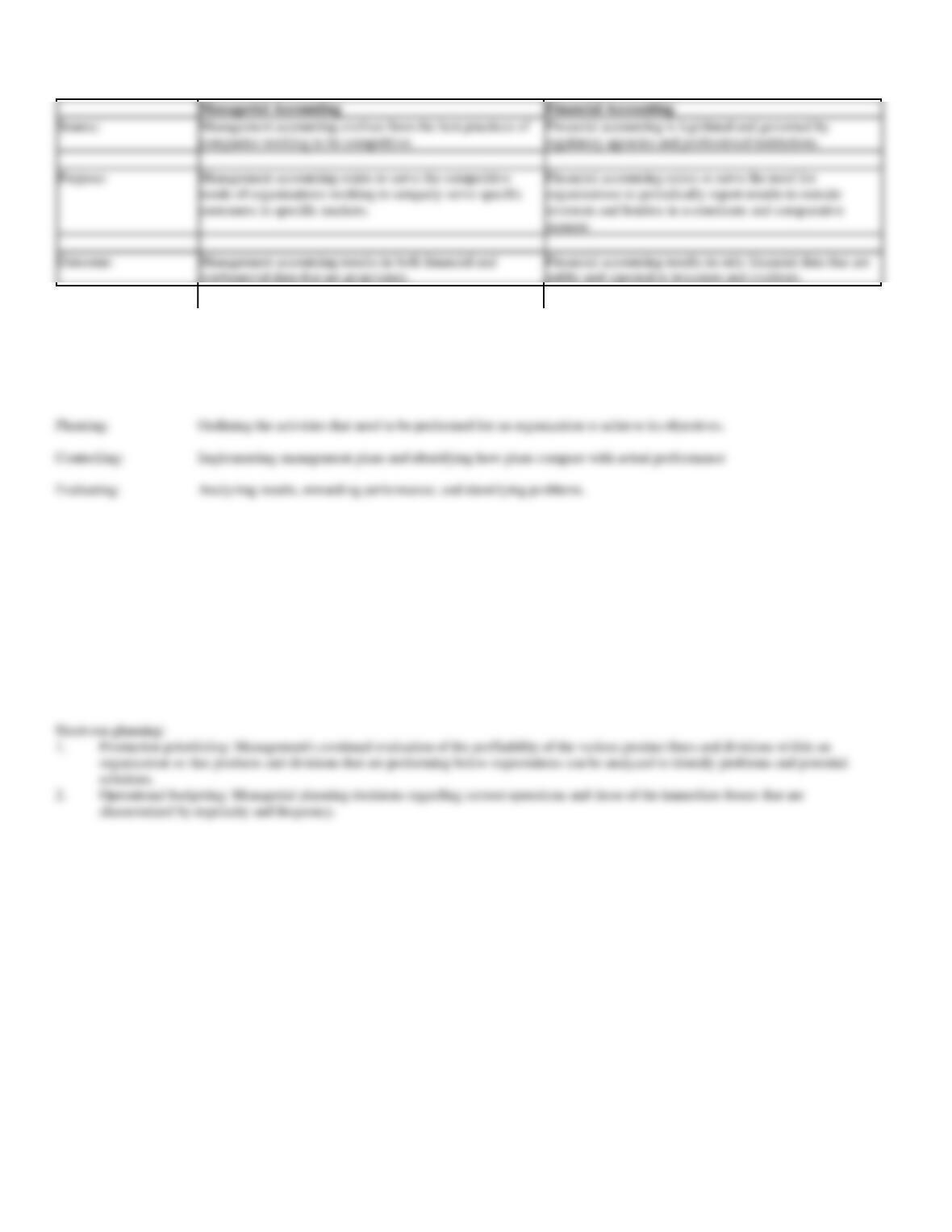
97. In the chart below, list the three main differences between managerial accounting and financial accounting.
Managerial Accounting
Financial Accounting
Source:
Purpose:
Outcome:
1.
B
2.
E
3.
I
4.
H
5.
G
6.
J
7.
C
8.
F
9.
A
10.
D
98. List and describe the three management functions.
Planning:
Outlining the activities that need to be performed for an organization to achieve its objectives.
Controlling:
Implementing management plans and identifying how plans compare with actual performance
Evaluating:
Analyzing results, rewarding performance, and identifying problems.
99. List and describe the two types of long-run planning and the two types of short-run planning.
Long-run planning:
1.
Strategic planning: Broad, long-range planning usually conducted by top management.
2.
Capital budgeting: Systematic planning for long-term investments in operating assets.
solutions.
100. In the spaces provided, write the letter of the definition for each of the following terms:
A.
A future cost that can be changed by a decision made now.
B.
Labor that is necessary in manufacturing a product or service but is not directly related to the actual production or service.
C.
Costs associated with products or services offered.
D.
Costs not directly related to a product, service, or asset that are charged as expenses as they are incurred.
E.
Materials that become part of the product and are traceable to it.
F.
Materials that are necessary in manufacturing a product or service, but are not directly included in the actual product.
G.
Wages paid to those who physically work on a product or service.
H.
All costs incurred in the manufacturing process other than direct labor and direct materials.
I.
Costs that are specifically traceable to a unit of business.
J.
Costs normally incurred for the benefit of several segments.
1.
Direct costs
2.
Direct labor
3.
Direct materials
4.
Indirect labor
5.
Indirect costs
6.
Indirect materials
7.
Manufacturing overhead
8.
Period costs
9.
Product costs
10.
Differential cost
101. Complete the following phrases by inserting the appropriate cost term.
a.
is a management technique developed by DuPont to
measure operating performance and efficiency in using assets.
b.
costs often involve the outlay of cash.
c.
costs never involve an outlay of cash.
d.
costs, often referred to as manufacturing costs, are all
costs necessary to create finished goods.
e.
costs are usually charged to the income statement in the
period in which they are incurred.
f.
costs that usually include indirect materials and indirect labor.
g.
costs remain constant in total over a relevant range of activity.
h.
costs are specifically traceable to a unit or segment
being analyzed.
i.
costs do not change as the result of a decision.
j.
costs are future costs that change as the result of a decision.
1.
I
2.
G
3.
E
4.
B
6.
F
7.
H
8.
D
9.
C
10.
A
102. Tulip Company is a tulip bulb distributor. Every year, Tulip Company plants an outdoor show garden
where visitors can see all the varieties of tulips. The garden is open only during the month of April. The original
cost to design and landscape the tulip garden is $300,000. Five employees work each day the garden is open.
Each employee is paid hourly at a rate of $10 per hour and works for 8 hours each day. Tulip Company pays
annual expenses of $1,000 for utilities on the garden property, $800 for property taxes, and $1,200 for insurance
on the property. Tulip Company has found that it generally costs $50 per every 100 visitors to upkeep, repair,
and maintain the gardens.
a.
Tulip Garden hopes to have 5,000 visitors each day. How much should Tulip Garden charge as an entrance fee per visitor in order to break
even?
b.
If Tulip Garden charges each visitor a $3 entrance fee, how many visitors would need to come during the month of April in order for Tulip
to break-even?
a.
Fixed costs: $300,000 + (5 ´ 8 ´ $10 ´ 30) + $1,000 + $800 + $1,200 = $315,000
Variable costs: $50 / 100 ´ 5,000 ´ 30 = $75,000
150,000x – $75,000 – $315,000 = $0
Fixed costs: $300,000 + (5 ´ 8 ´ $10 ´ 30) + $1,000 + $800 + $1,200 = $315,000
$3x – $.50x – $315,000 = $0
103. Tulip Company is a tulip bulb distributor. Every year, Tulip Company plants an outdoor show garden
where visitors can see all the varieties of tulips. The garden is open only during the month of April. The original
cost to design and landscape the tulip garden is $300,000. Five employees work each day the garden is open.
Each employee is paid hourly at a rate of $10 per hour and works for 8 hours each day. Tulip Company pays
annual expenses of $1,000 for utilities on the garden property, $800 for property taxes, and $1,200 for insurance
on the property. Tulip Company has found that it generally costs $50 per every 100 visitors to upkeep, repair,
and maintain the gardens.
a.
On April 1, 10,000 visitors came. Calculate the product cost of being open on April 1.
b.
Calculate the product cost of being open for all of April if there were 150,000 visitors during the month.
c.
Opportunity
costs never involve an outlay of cash.
Product
costs, often referred to as manufacturing costs, are all costs necessary to create finished goods.
e.
Period
costs are usually charged to the income statement in the period in which they are incurred.
Fixed
costs remain constant in total over a relevant range of activity.
Direct
costs are specifically traceable to a unit or segment being analyzed.
Sunk
costs do not change as the result of a decision.

104. After graduating from college, Mary found what seemed to be an ideal job. However, after a few months
she began to notice that some unethical practices were occurring within the company. What three steps should
Mary take to resolve these unethical issues?
1.
Mary should discuss the issues with her immediate supervisor.
2.
Mary should confidentially use an objective advisor to help clarify the issues.
3.
Finally, if the issue cannot be resolved, Mary should resign from the corporation and submit an informative memo to an appropriate
member of the organization
[($300,000 + $1,000 + $800 + $1,200) / 30] + (5 ´ 8 ´ $10) + (10,000 ´ $.50) = $15,500