149.
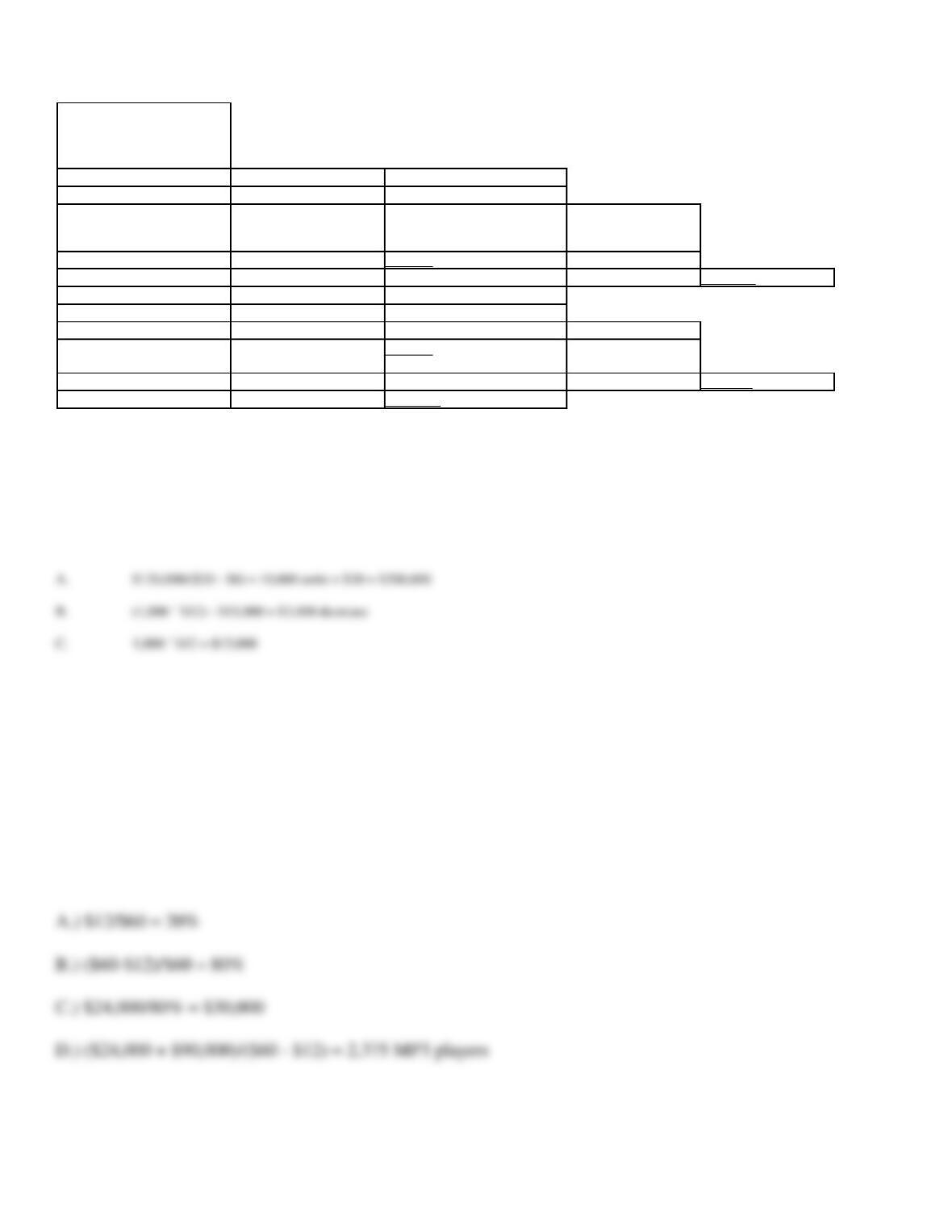
Fry Company
Projected Income Statement
For the Current Year Ending
December 31
Sales (12,000 units)
$240,000
Less variable costs:
Variable manufacturing
costs
$60,000
Variable selling costs
36,000
Total variable costs
96,000
Contribution margin
$144,000
Less fixed costs:
Fixed manufacturing costs
$85,000
Fixed selling and
administrative costs
35,000
Total fixed costs
120,000
Operating income
$ 24,000
Required:
A.
Determine the break-even point in sales dollars.
B.
The sales manager believed the company could increase sales by 1,000 units if advertising expenditures were increased by $15,000.
By how much will operating income increase or decrease if the advertising is increased as suggested?
C.
What is the maximum amount the company could pay for advertising if the advertising would increase sales by 1,000 units?
150. Music Now plans to sell 6,000 MP3 players at $60 each in the coming year. Variable cost per unit is $12
and total fixed cost is $24,000.
Required:
A.) Calculate the variable cost ratio.
B.) Calculate the contribution margin ratio.
C.) Calculate the break-even point in sales dollars.
D.) If Music Now has a target profit of $90,000, how many MP3 players will they have to sell?
A.
$120,000/($20 – $8) = 10,000 units x $20 = $200,000
B.
(1,000 ´ $12) – $15,000 = $3,000 decrease
C.
1,000 ´ $12 = $12,000
151. A company provided the following information:
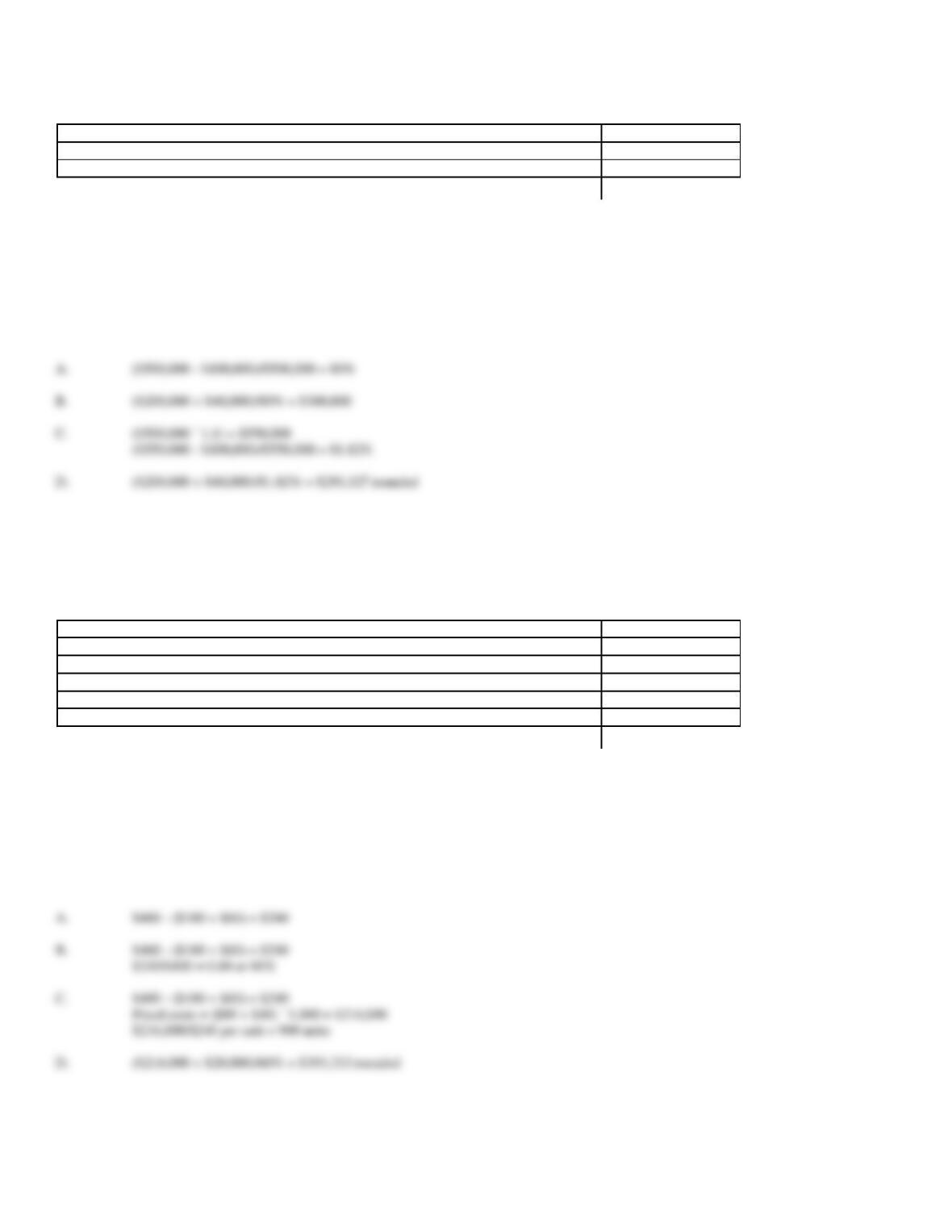
Sales
$500,000
Variable costs
$100,000
Fixed costs
$200,000
Required:
A.
What is the contribution margin ratio?
B.
What is the level of sales in dollars necessary to generate a profit of $40,000?
C.
What is the contribution margin ratio is the sales price is increased by 10%?
D.
Using the information in part C, what level of sales in dollars is necessary to generate a profit of $40,000?
152. Aaron Company provided the following data for next month:
Selling price per unit
$400
Variable manufacturing costs per unit
$100
Fixed manufacturing costs per unit
$ 80
Variable selling costs per unit
$ 60
Fixed selling costs per unit
$ 40
Expected production and sales
1,800 units
Required:
A.
What is contribution margin per unit?
B.
What is the contribution margin ratio?
C.
What is the break-even point in units?
D.
What are the sales in dollars needed to obtain an operating income of $20,000?
A.
$400 – ($100 + $60) = $240
B.
$400 – ($100 + $60) = $240
$240/$400 = 0.60 or 60%
C.
$400 – ($100 + $60) = $240
Fixed costs = ($80 + $40) ´ 1,800 = $216,000
$216,000/$240 per unit = 900 units
D.
($216,000 + $20,000)/60% = $393,333 rounded
A.
($500,000 – $100,000)/$500,000 = 80%
B.
($200,000 + $40,000)/80% = $300,000
($500,000 ´ 1.1) = $550,000
($550,000 – $100,000)/$550,000 = 81.82%
D.
($200,000 + $40,000)/81.82% = $293,327 rounded
153. Thomas Corporation developed the following income statement using a contribution margin approach:
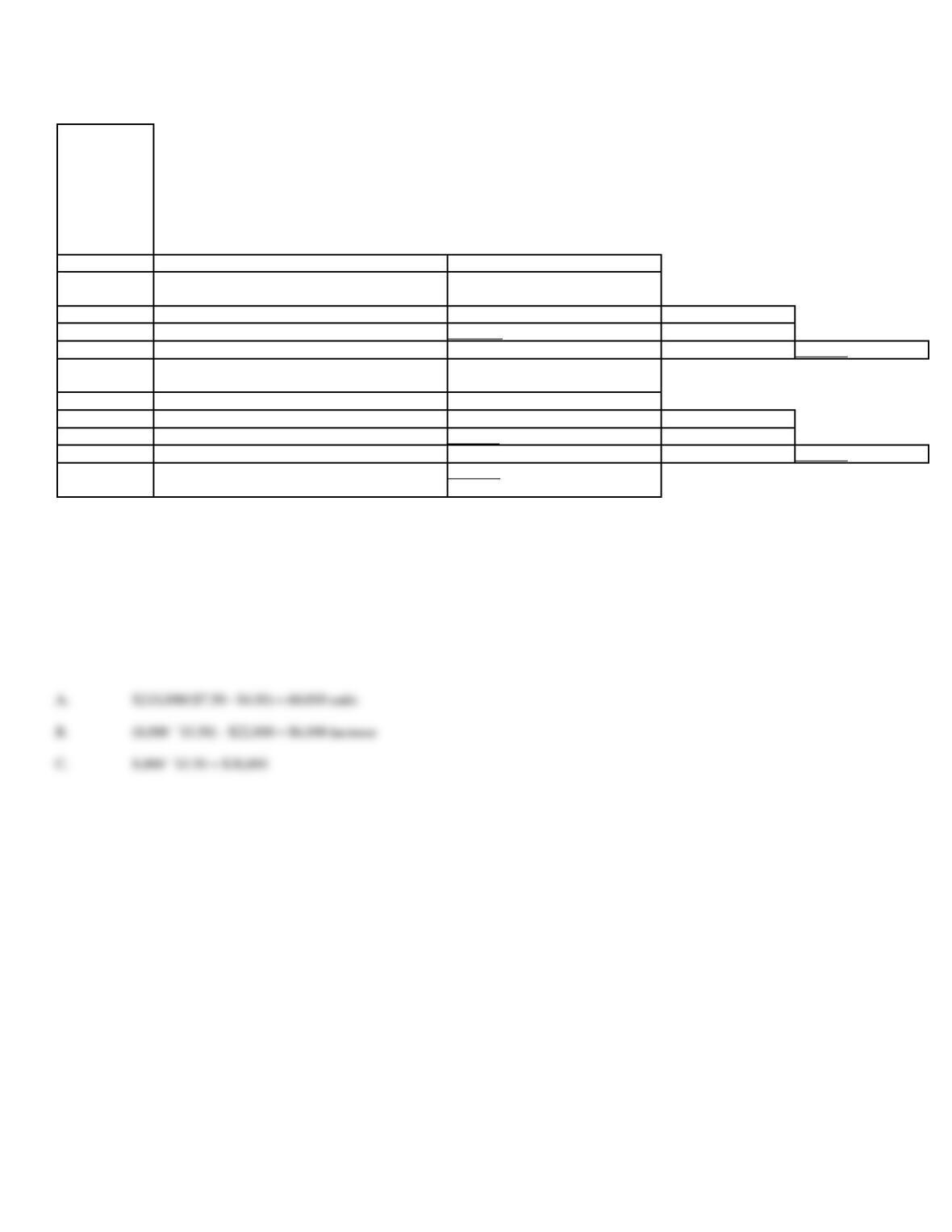
Thomas
Corporation
Projected
Income
Statement
For the Current
Year Ending
December 31
Sales
$750,000
Less variable
costs:
Variable manufacturing costs
$280,000
Variable selling costs
120,000
Total variable costs
$400,000
Contribution
margin
$350,000
Less fixed costs:
Fixed manufacturing costs
$130,000
Fixed selling and administrative costs
80,000
Total fixed costs
$210,000
Operating
income
$140,000
The projected income statement was based on sales of 100,000 units. Thomas has the capacity to produce 120,000 units during the year.
Required:
A.
Determine the break-even point in units.
B.
The sales manager believes the company could increase sales by 8,000 units if advertising expenditures were increased by $22,000.
By how much will income increase or decrease if this plan is put into effect?
C.
What is the maximum amount the company could pay for advertising if the sales would really increase by 8,000 units?
$210,000/($7.50 – $4.00) = 60,000 units
(8,000 ´ $3.50) – $22,000 = $6,000 increase
C.
8,000 ´ $3.50 = $28,000
154. The following information was extracted from the accounting records of MVP Corporation:
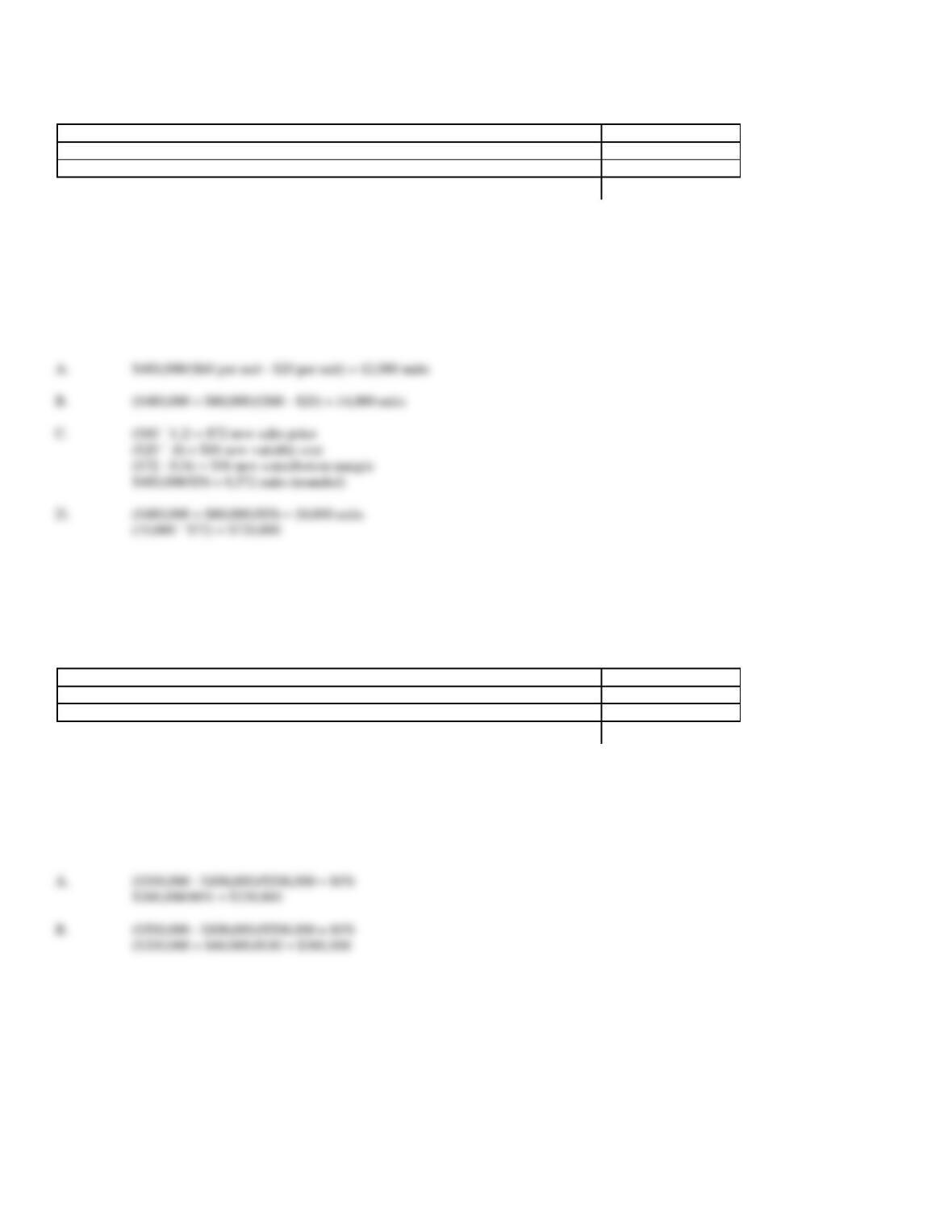
Selling price per unit
$60
Variable cost per unit
$20
Total fixed costs
$480,000
Required:
A.
What is MVP’s break-even point in units?
B.
How many units must be sold to earn operating income of $80,000?
C.
What is MVP’s break-even point in units if the selling price increases by 20% and the variable costs decrease by 20%?
D.
Using the information in part C, what sales level in dollars is needed to earn an operating income of $80,000?
155. Information for Crisby Company is as follows:
Sales
$500,000
Variable costs
$100,000
Fixed costs
$200,000
Required:
A.
What is the break-even point in sales dollars?
B.
What sales (in dollars) are needed to generate operating income of $40,000?
A.
($500,000 – $100,000)/$500,000 = 80%
$200,000/80% = $250,000
B.
($500,000 – $100,000)/$500,000 = 80%
($200,000 + $40,000)/0.80 = $300,000
A.
$480,000/($60 per unit – $20 per unit) = 12,000 units
B.
($480,000 + $80,000)/($60 – $20) = 14,000 units
($60 ´ 1.2) = $72 new sales price
($20 ´ .8) = $16 new variable cost
($72 – $16) = $56 new contribution margin
$480,000/$56 = 8,572 units (rounded)
D.
($480,000 + $80,000)/$56 = 10,000 units
(10,000 ´ $72) = $720,000
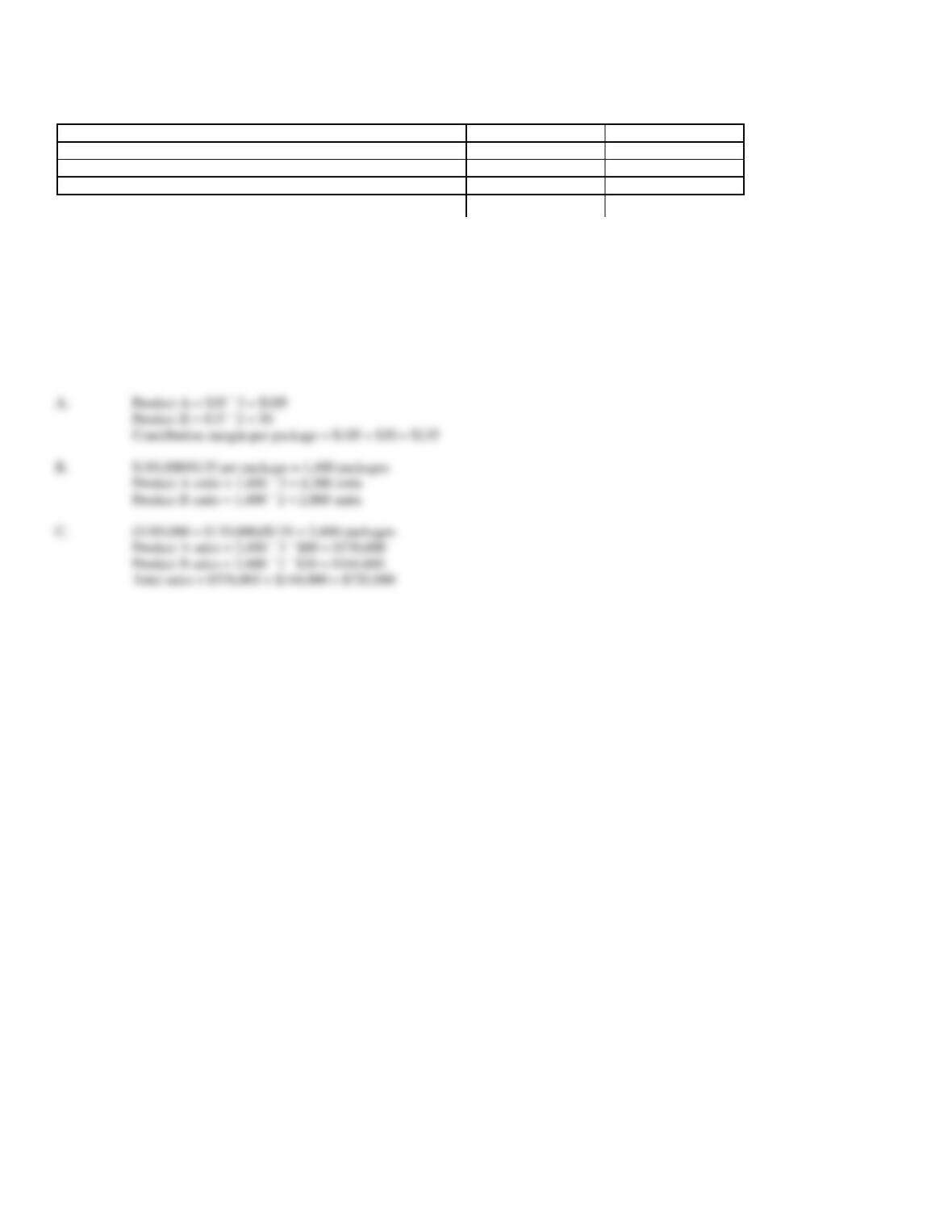
156. The Noble Company manufactures two products. Information about the two products are as follows:
Product A
Product B
Selling price per unit
$80
$30
Variable costs per unit
$45
$15
Contribution margin per unit
$35
$15
The company expects fixed costs to be $189,000. The firm expects 60 percent of its sales (in units) to be Product A (a sales mix of 3:2).
Required:
A.
Calculate the contribution margin per package.
B.
Determine the break-even point in units for Products A and B.
C.
Determine the level of sales (in dollars) necessary to generate operating income of $135,000.
Product A = $35 ´ 3 = $105
Product B = $15 ´ 2 = 30
Contribution margin per package = $105 + $30 = $135
B.
$189,000/$135 per package = 1,400 packages
Product A units = 1,400 ´ 3 = 4,200 units
Product B units = 1,400 ´ 2 = 2,800 units
C.
($189,000 + $135,000)/$135 = 2,400 packages
Product A sales = 2,400 ´ 3 ´ $80 = $576,000
Product B sales = 2,400 ´ 2 ´ $30 = $144,000
Total sales = $576,000 + $144,000 = $720,000
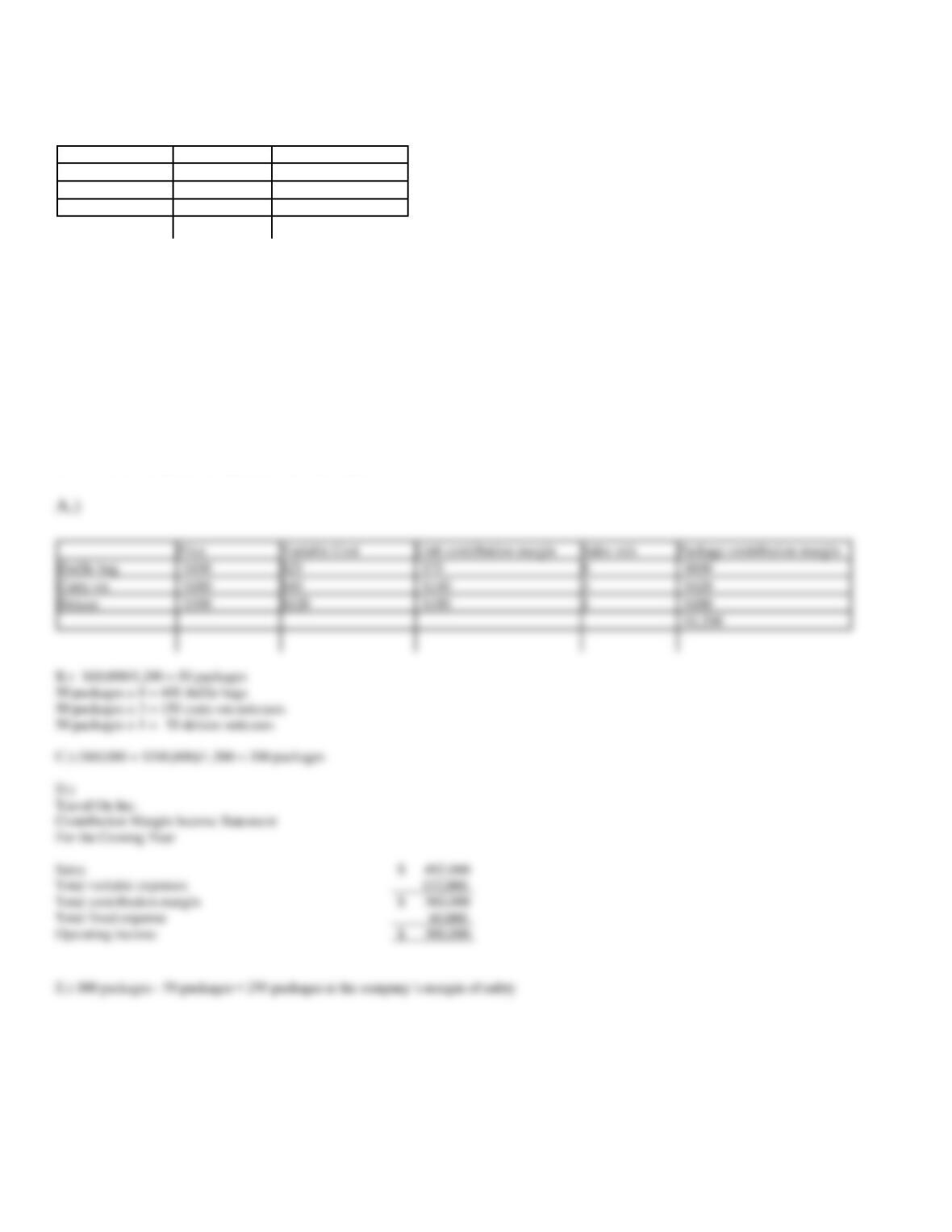
157. Travel On Inc. sells luggage. They sell a duffle bag, a carry-on suitcase and a deluxe suitcase. The price
and variable cost for each type of luggage is listed below.
Price
Variable Cost
Duffle bag
$100
$25
Carry-on
$180
$40
Deluxe
$300
$120
The total fixed costs for Travel On Inc. equals $60,000. For every 8 duffle bags Travel On Inc sells it sells 3 carry–on suitcases and 1 deluxe
suitcase.
Required:
A.) Calculate the package contribution margin.
B.) Calculate the break-even point in units for duffle bags, carry-on suitcases and deluxe suitcases.
C.) If Travel On Inc. has a target income for the coming year of $300,000, how many packages will company have to sell?
D.) Based on your answer in Part C, prepare a contribution margin income statement for the coming year.
E.) What is the company’s margin of safety in packages?
Price
Variable Cost
Unit contribution margin
Sales mix
Package contribution margin
Duffle bag
$100
$25
8
$600
$180
$40
$140
3
$420
Deluxe
$300
$120
$180
1
$180
$1,200
Sales
$ 492,000
Total variable expenses
132,000
Total contribution margin
$ 360,000
Total fixed expense
60,000
Operating income
$ 300,000
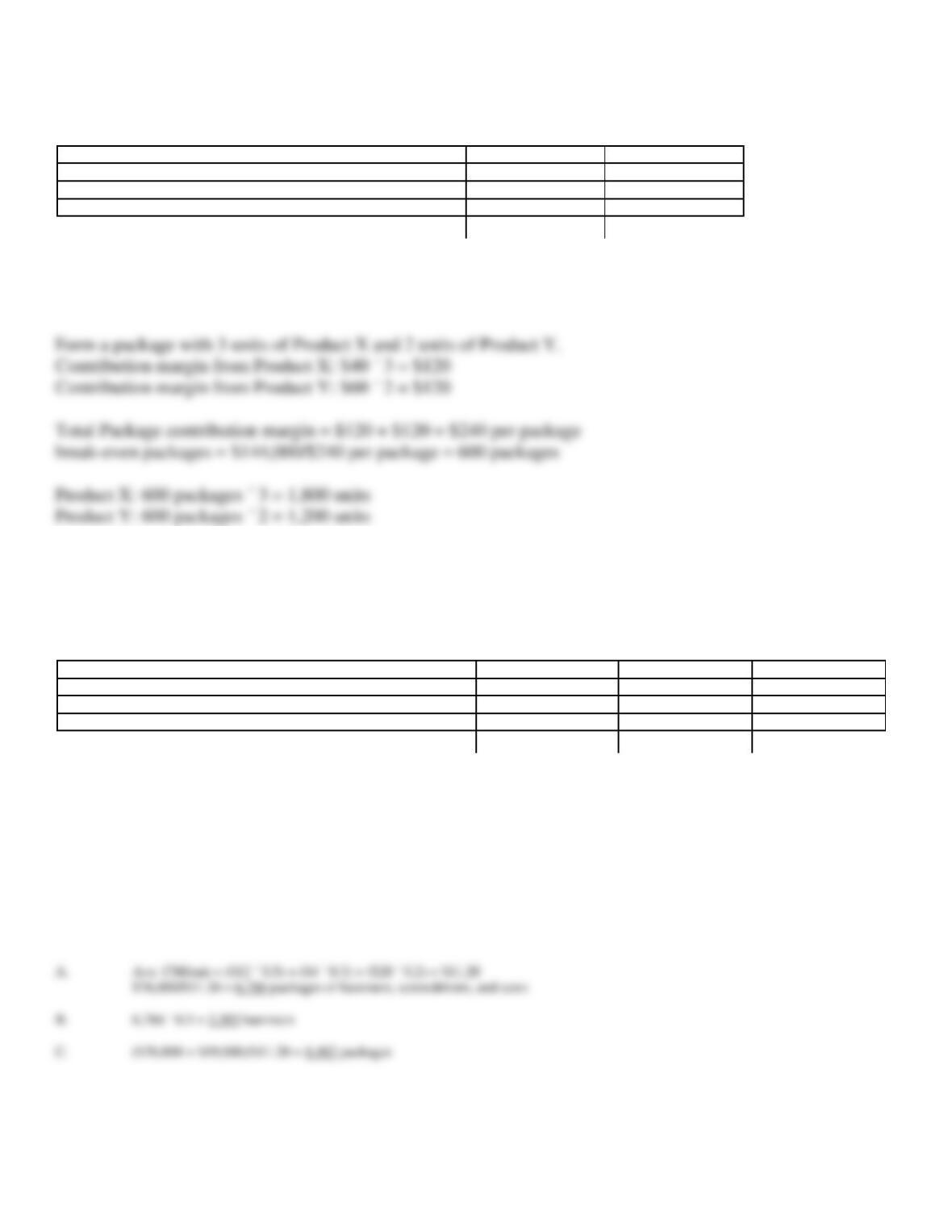
158. The Lauren Company manufactures two products. Information about the two product lines for the year is
as follows:
Product X
Product Y
Selling price per unit
$70
$100
Variable costs per unit
$30
$40
Contribution margin per unit
$40
$ 60
The company expects fixed costs to be $144,000. The firm expects 60 percent of its sales (in units) to be Product X.
Required: Determine the break-even point in units for both Product X and Product Y.
159. The Young Manufacturing Company produces the following three products:
Hammers
Screwdrivers
Saws
Selling price per unit
$40
$16
$50
Variable costs per unit
$28
$12
$30
Contribution per unit
$12
$ 4
$20
Fixed costs are $76,000 per year.
50 percent of all sales in units are hammers, 30 percent are screwdrivers, and 20 percent are saws.
Required: Calculate the following values:
A.
break-even point in total units.
B.
Number of hammers that will be sold at break-even.
C.
Total sales in units to obtain a target income of $19,000.
A.
Ave. CM/unit = ($12 ´ 0.5) + ($4 ´ 0.3) + ($20 ´ 0.2) = $11.20
$76,000/$11.20 = 6,786 packages of hammers, screwdrivers, and saws
B.
6,786 ´ 0.5 = 3,393 hammers
C.
($76,000 + $19,000)/$11.20 = 8,482 packages
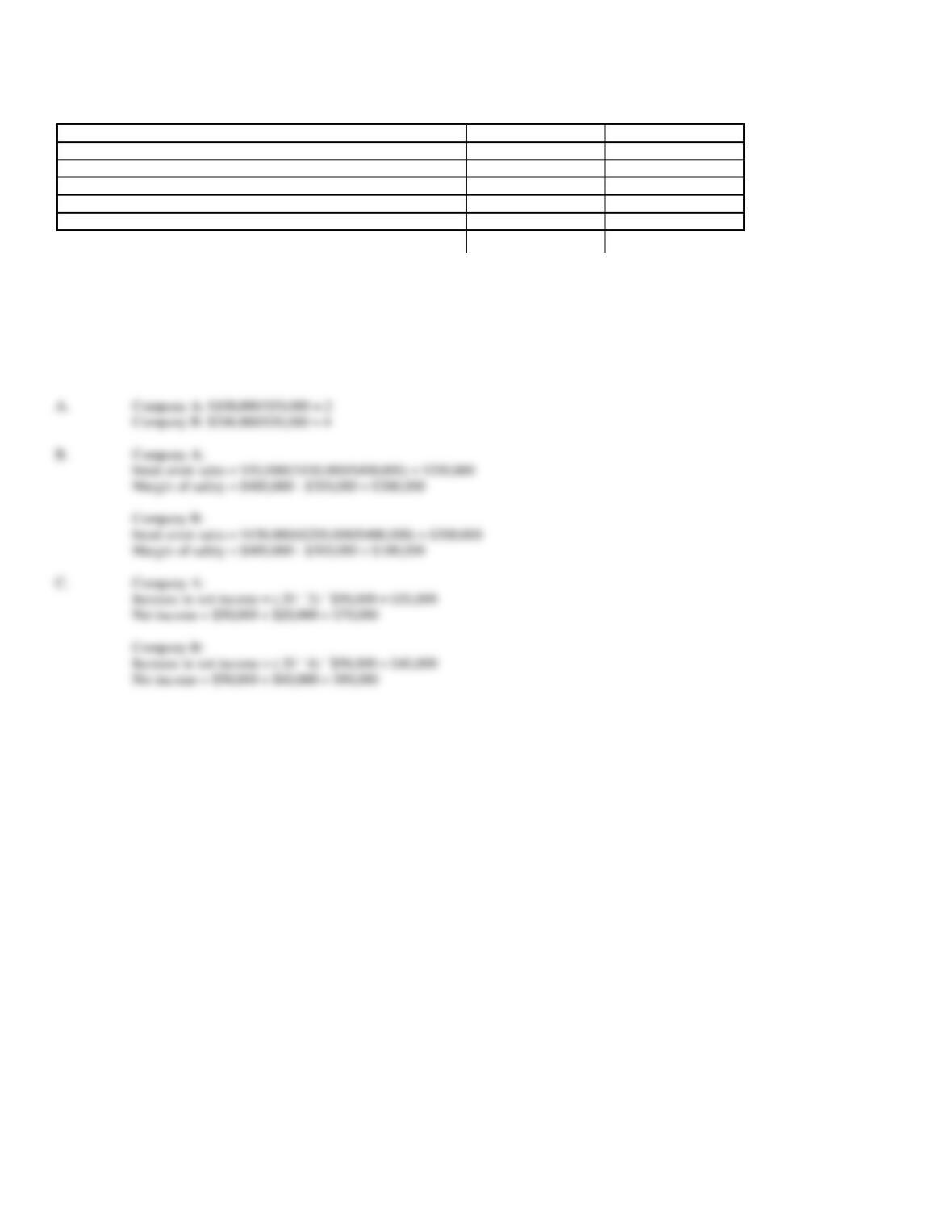
160. Income statements for two different companies in the same industry are as follows:
Company A
Company B
Sales
$400,000
$400,000
Less: Variable costs
300,000
200,000
Contribution margin
$100,000
$200,000
Less: Fixed costs
50,000
150,000
Operating income
$ 50,000
$ 50,000
Required:
A.
Calculate the degree of operating leverage for each firm.
B.
Calculate the margin of safety in dollars for each firm.
C.
Determine the operating income for each firm if sales increase by 20%.
A.
Company A: $100,000/$50,000 = 2
Company B: $200,000/$50,000 = 4
B.
Company A:
break-even sales = $50,000/($100,000/$400,000) = $200,000
Margin of safety = $400,000 – $200,000 = $200,000
Company B:
break-even sales = $150,000/($200,000/$400,000) = $300,000
Margin of safety = $400,000 – $300,000 = $100,000
C.
Company A:
Increase in net income = (.20 ´ 2) ´ $50,000 = $20,000
Net income = $50,000 + $20,000 = $70,000
Increase in net income = (.20 ´ 4) ´ $50,000 = $40,000
Net income = $50,000 + $40,000 = $90,000
161. Newman Company expects to produce and sell 2,000 units next month. Data on costs follows:
Per unit costs:
Selling price
$40
Variable manufacturing costs
$10
Variable selling costs
$ 6
Total costs:
Fixed manufacturing costs
$16,000
Fixed selling costs
$ 8,000
Required:
A.
What is the break-even point in units?
B.
What is the break-even point in sales dollars?
C.
What is the expected operating income for next month?
D.
What is the margin of safety in dollars?
A.
break-even units = ($16,000 + $8,000)/$24 = 1,000 units
B.
break-even sales dollars = 1,000 ´ $40 = $40,000
OR
break-even sales dollars = $24,000/0.6 = $40,000
C.
Expected operating income = $80,000 – $32,000 – $24,000 = $24,000
D.
Margin of safety = $80,000 – $40,000 = $40,000
162. McCallen Company expects to produce and sell 500 units next month. Data on costs follows:
Per unit costs:
Selling price
$8
Variable manufacturing costs
$2.75
Variable selling costs
$0.25
Total costs:
Fixed manufacturing costs
$1,000
Fixed selling costs
$ 125
Required:
A.
What is the break-even point in units?
B.
What is the break-even point in sales dollars?
C.
What is the expected operating income for next month?
D.
What is the margin of safety in dollars?
E.
What is the break-even point in units if fixed manufacturing costs increase by $500?
F.
What is the break-even point in units if variable manufacturing costs decrease by $.75?
163. At a monthly sales volume of $25,000, a company incurs variable costs of $19,000 and fixed costs of
$6,000.
Required: Determine each of the following values:
A.
Variable cost ratio
B.
Contribution margin ratio
C.
Monthly break-even dollar sales volume
D.
Monthly margin of safety in dollars
A.
Variable cost ratio = $19,000/$25,000 = 0.76
B.
Contribution margin ratio = 1.00 – 0.76 = 0.24
C.
Monthly break-even dollar sales volume = $6,000/0.24 = $25,000
A.
break-even units = $1,125/$5 = 225 units
B.
break-even sales dollars = $8 ´ 225 = $1,800
OR
break-even sales dollars = $1,125/0.625 = $1,800
C.
Expected operating income = $4,000 – $1,500 – $1,125 = $1,375
D.
Margin of safety in dollars = $4,000 – $1,800 = $2,200
($1,000 + $500 + $125)/$5 = 325 units
F.
($1,000 + $125)/($8 – $2 – $.25) = $1,125/$5.75 = 196 units (rounded)
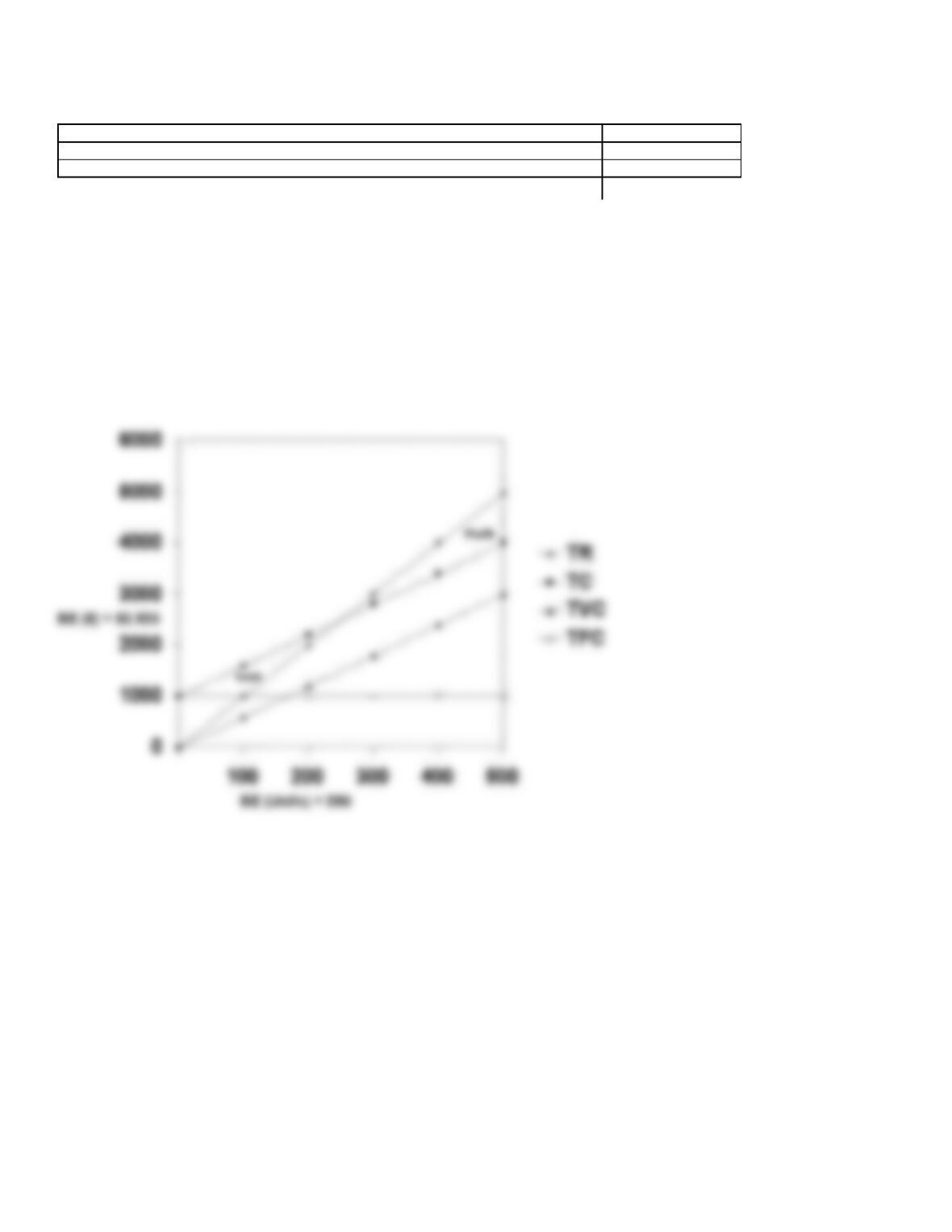
164. Arnold Corporation has the following information for the current year:
Selling price per unit
$10
Variable costs per unit
$ 6
Fixed costs
$1,000
Required: Prepare a cost-volume-profit graph identifying the following items:
A.
Total costs line
B.
Total fixed costs line
C.
Total variable costs line
D.
Total revenues line
E.
break-even point in sales dollars
F.
break-even point in units
G.
Profit area
H.
Loss area
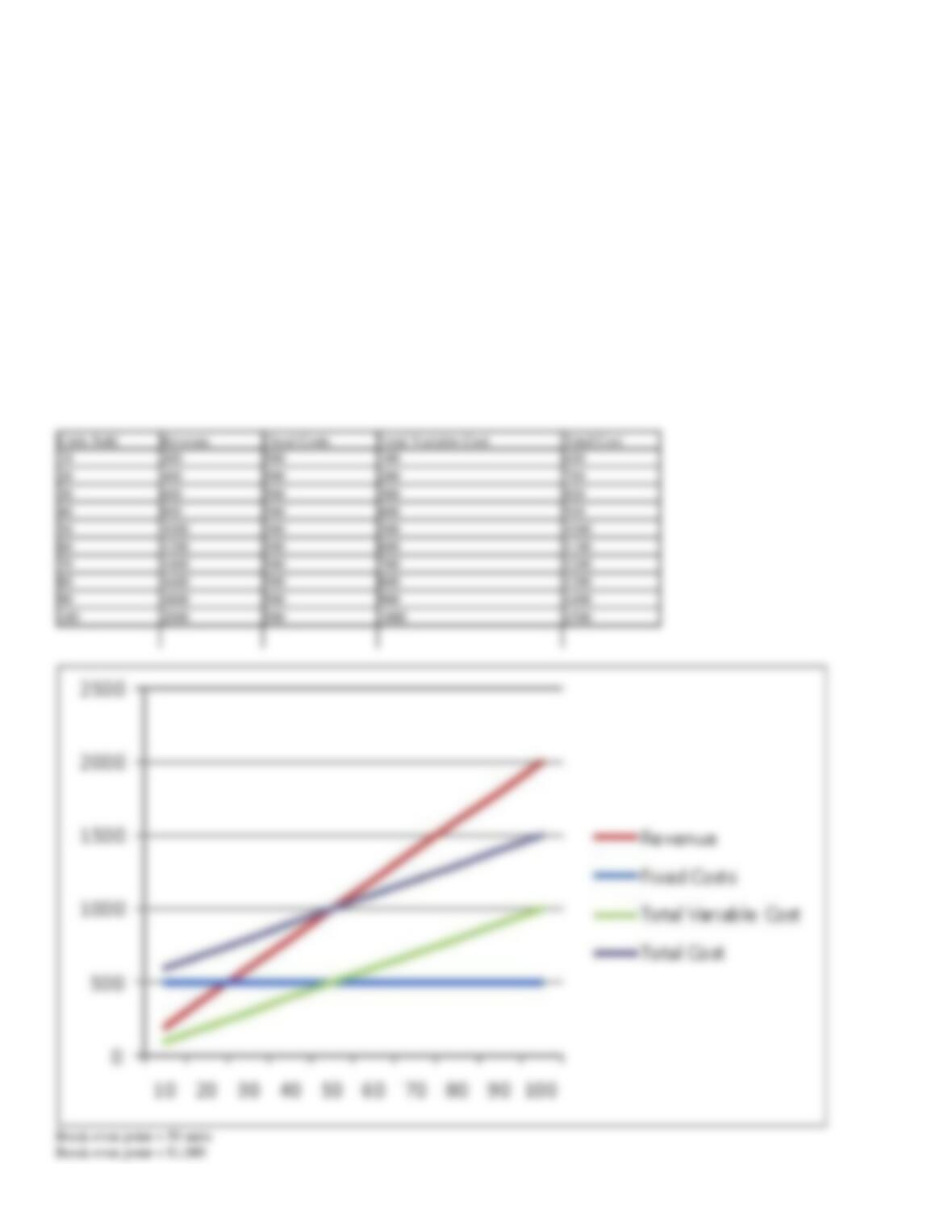
165. The following information has been provided for Walsh Corporation:
Sales price per unit
$20
Variable costs per unit
$10
Fixed costs
$500
Required: Prepare a cost-volume-profit graph identifying the following items:
A.) Total cost line
B.) Total fixed cost line
C.) Total variable cost line
D.) Total revenue line
E.) Loss area
F.) Profit area
G.) Break-even point in units
H.) Break-even point in sales dollars
Units Sold
Revenue
Fixed Costs
Total Variable Cost
Total Cost
1000
1000
1200
1100
1400
1200
1600
1300
1800
1400
2000
1000
1500
166. Place Corporation had the following income statement for the current year:
Sales
$25,000
Variable expenses
15,000
Contribution margin
$10,000
Fixed expenses
4,000
Operating income
$ 6,000
Required:
A.
Calculate the operating leverage ratio.
B.
If sales increase by 20 percent, what will be the percentage change in income?
C.
If sales increase by $15,000, how much will income increase?
167. Explain why cost-volume-profit analysis can be useful to managers.
168. What are the assumptions underlying cost-volume-profit analysis?
Some of the assumptions are as follows:
The analysis assumes a linear revenue function and a linear cost function.
The analysis assumes that what is produced is actually sold.
For multiple-product analysis, the sales mix is assumed to be known.
The selling prices and costs are assumed to be known with certainty.
$10,000/$6,000 = 1.6667
B.
1.6667 ´ 0.2 = 0.33333, or 33.33% increase
$15,000 ´ .4 = $6,000
169. How can a multi-product firm determine its break-even point?
170. You Decide
As a cost accountant at A&E Company you have been given a set of data and have been asked to perform a
break-even analysis as well as a sensitivity analysis. Why are these analyses important?