Introduction to General, Organic & Biological Chemistry, 12e (Timberlake)
Chapter 15 Lipids
15.1 Multiple-Choice Questions
1) Which statement is not true?
A) Lipids are found in cell membranes.
B) Lipids are soluble in organic solvents.
C) There are many different types of lipids.
D) All lipids contain fatty acids.
E) Some hormones are lipids.
2) Lipids are compounds that are soluble in ________.
A) distilled water
B) normal saline solution
C) glucose solution
D) chloroform
E) oxygen
3) Which of the following is not a function of lipids in the human body?
A) energy storage
B) insulation
C) protection
D) chemical messengers
E) pH regulation
4) Which of the following is a lipid?
A) cholesterol
B) nicotine
C) aniline
D) lactose
E) collagen
5) A polyunsaturated fatty acid contains more than one ________.
A) carboxyl group
B) hydroxyl group
C) carbonyl group
D) long carbon chain
E) carbon-carbon double bond
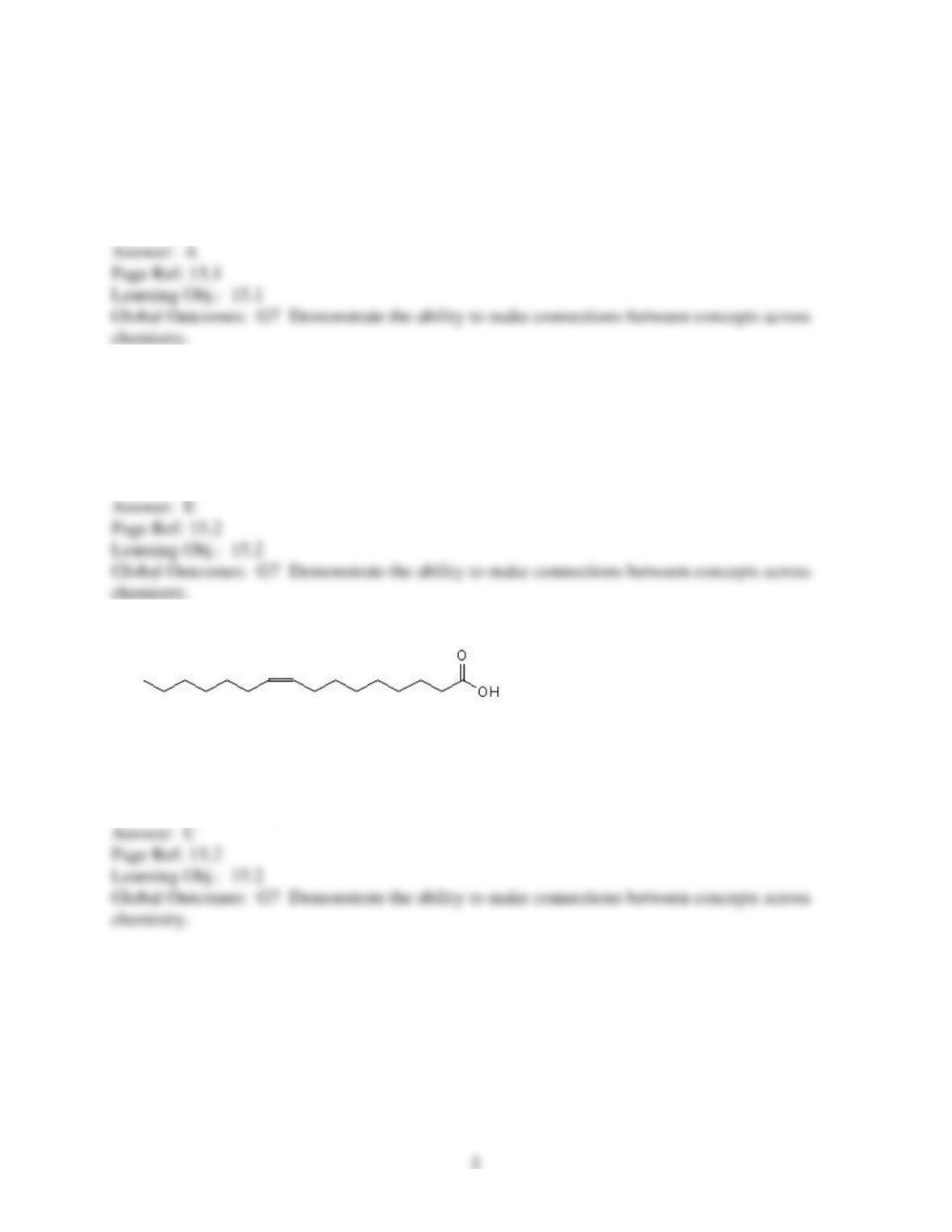
6) The skeletal structure of palmitoleic acid is shown below. Palmitoleic acid is a ________.
A) saturated fatty acid
B) polyunsaturated fatty acid
C) monounsaturated fatty acid
D) strong acid
E) monosaturated fatty acid
7) Unsaturated fatty acids have lower melting points than saturated fatty acids because
________.
A) they have fewer hydrogen atoms
B) they have more hydrogen atoms
C) their molecules fit closely together
D) the cis double bonds give them an irregular shape
E) the trans double bonds give them an irregular shape
8) Which of the following is an unsaturated fatty acid?
A) myristic
B) oleic
C) palmitic
D) stearic
E) lauric
9) Which of the following fatty acids is most likely to be a solid at room temperature?
A) palmitoleic
B) oleic
C) stearic
D) linoleic
E) linolenic
10) Compared to saturated fatty acids, unsaturated fatty acids have ________.
A) longer carbon chains
B) shorter carbon chains
C) higher melting points
D) lower melting points
E) greater intermolecular attraction
11) Waxes are lipids derived from ________.
A) a long-chain alcohol and a long-chain fatty acid
B) glycerol and three fatty acids
C) glycerol, fatty acids, phosphate, and an amino alcohol
D) fatty acids, phosphate, and an amino alcohol
E) steroids
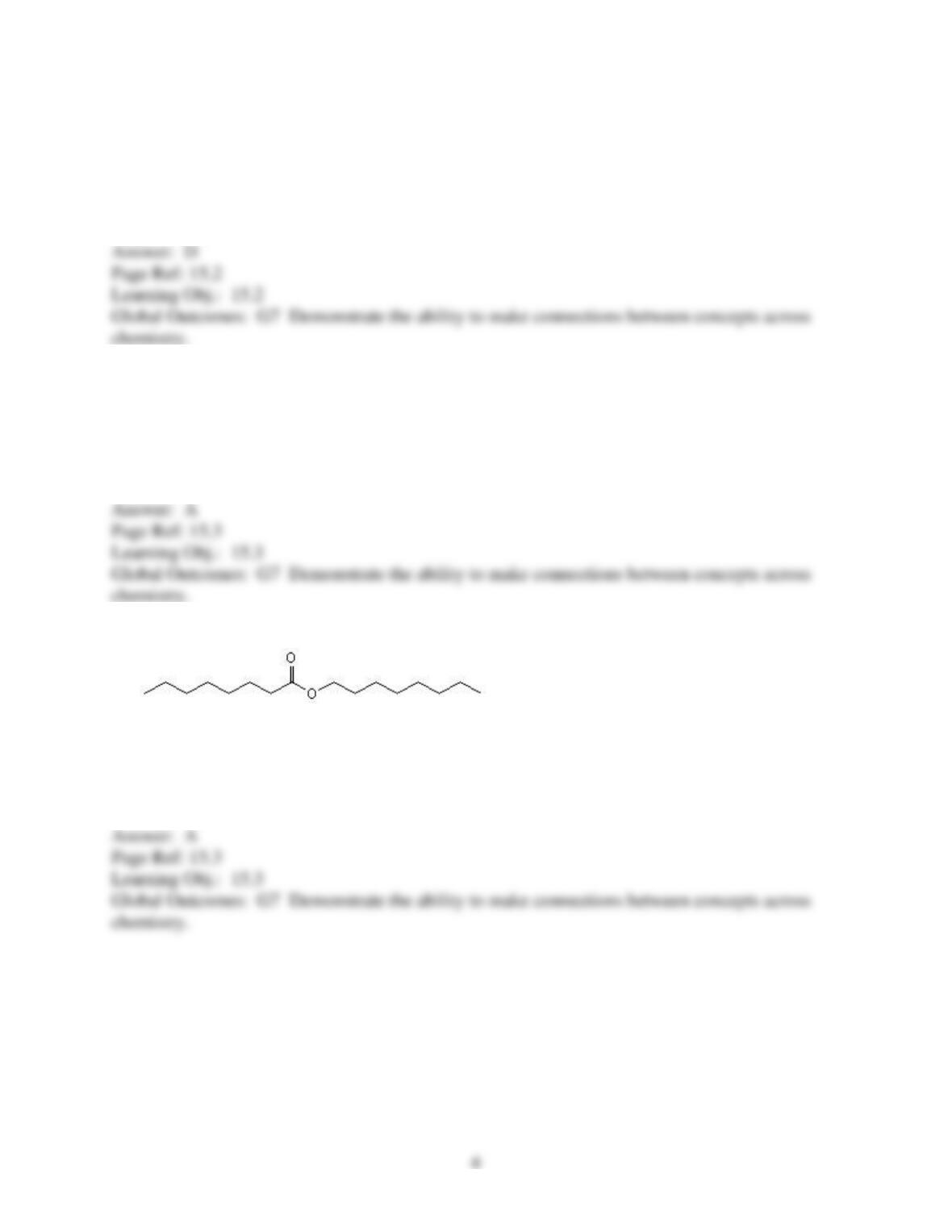
12) The skeletal structure below is that of a ________.
A) wax
B) fat
C) glycerophospholipid
D) steroid
E) fatty acid
13) A triacylglycerol that is solid at room temperature is called a(n) ________.
A) cephalin
B) lecithin
C) oil
D) wax
E) fat
14) Which of the following lipids will give a single molecule of fatty acid when hydrolyzed?
A) wax
B) fat
C) glycerophospholipid
D) steroid
E) petroleum
15) Commercially, liquid vegetable oils are converted to solid fats such as margarine by
________.
A) hydrogenation
B) hydrolysis
C) hydration
D) oxidation
E) saponification
16) Margarine containing partially hydrogenated soybean oil is solid because ________.
A) it contains only saturated fats
B) it contains only trans fatty acids
C) some of its double bonds have been converted to single bonds
D) it contains only cis carbon-carbon double bonds
E) it contains only polyunsaturated fatty acids
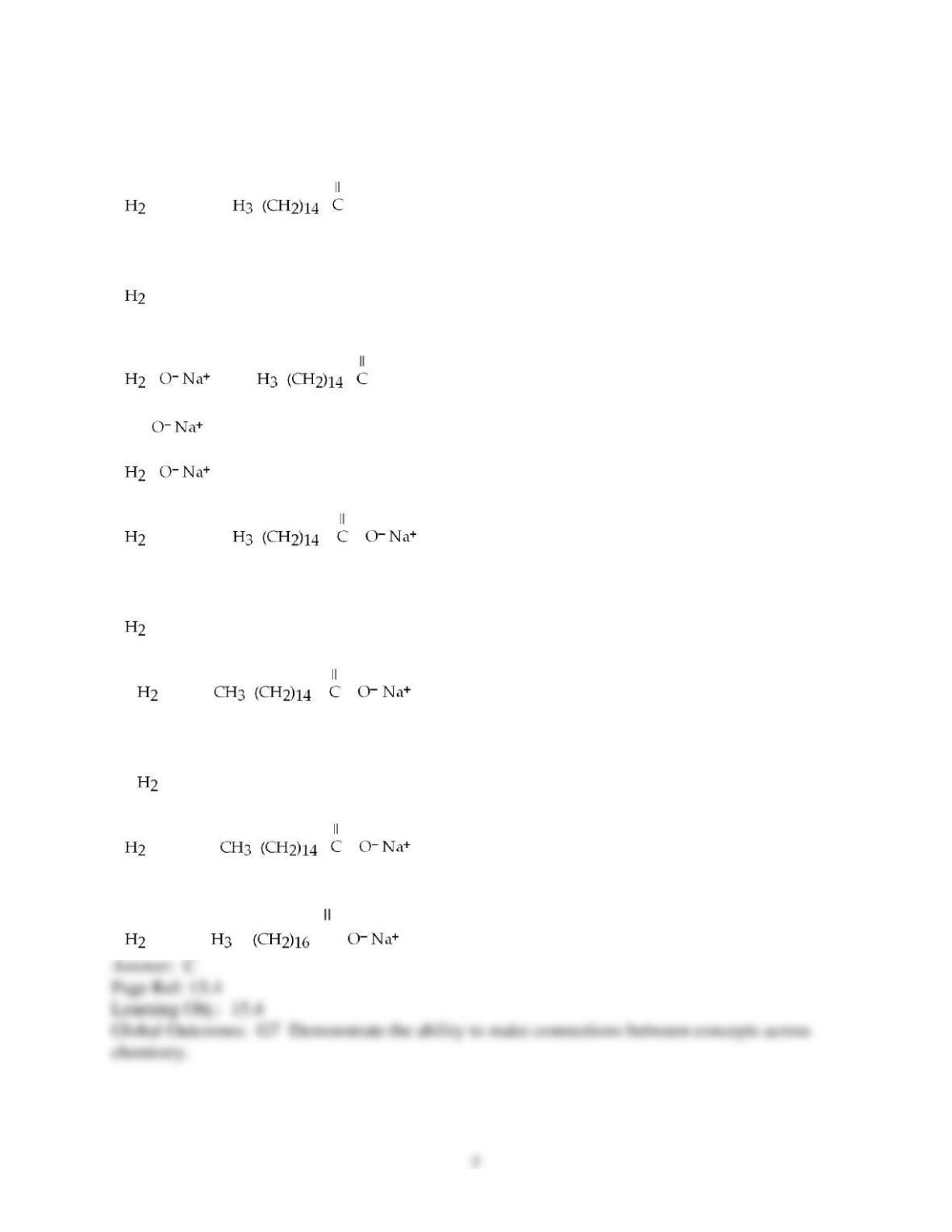
17) Palmitic acid is a 16 carbon acid. In a balanced equation, the products of the saponification
of tripalmitin (glyceryl tripalmitate) are ________.
A) O
C –OH + 3 C – – –OH
|
CH–OH
|
C–OH
B) O
C– + 3 C – – –OH
|
CH–
|
C–
C) O
C –OH + 3 C – – –
|
CHOH
|
C–OH
D) O
C –OH + – – –
|
3 CHOH
|
C –OH
E) O
C– OH + 2 – – –
|
CHOH O
|
C –OH + C– –C –
18) The products of the acid catalyzed hydrolysis of a fat are ________.
A) the esters of fatty acids
B) fatty acids and glycerol
C) salts of fatty acids
D) salts of fatty acids and glycerol
E) glycerophospholipids
19) A double cheeseburger with bacon contains 39 g of fat. Calculate the number of kilocalories
from fat. (1 gram of fat = 9 kcal)
A) 4.3 kcal from fat
B) 39 kcal from fat
C) 71 kcal from fat
D) 350 kcal from fat
E) 640 kcal from fat
20) Glycerophospholipids can interact both with other lipids and water because they contain
________.
A) double bonds
B) polar regions and nonpolar regions
C) glycerol
D) saturated fatty acids
E) cholesterol
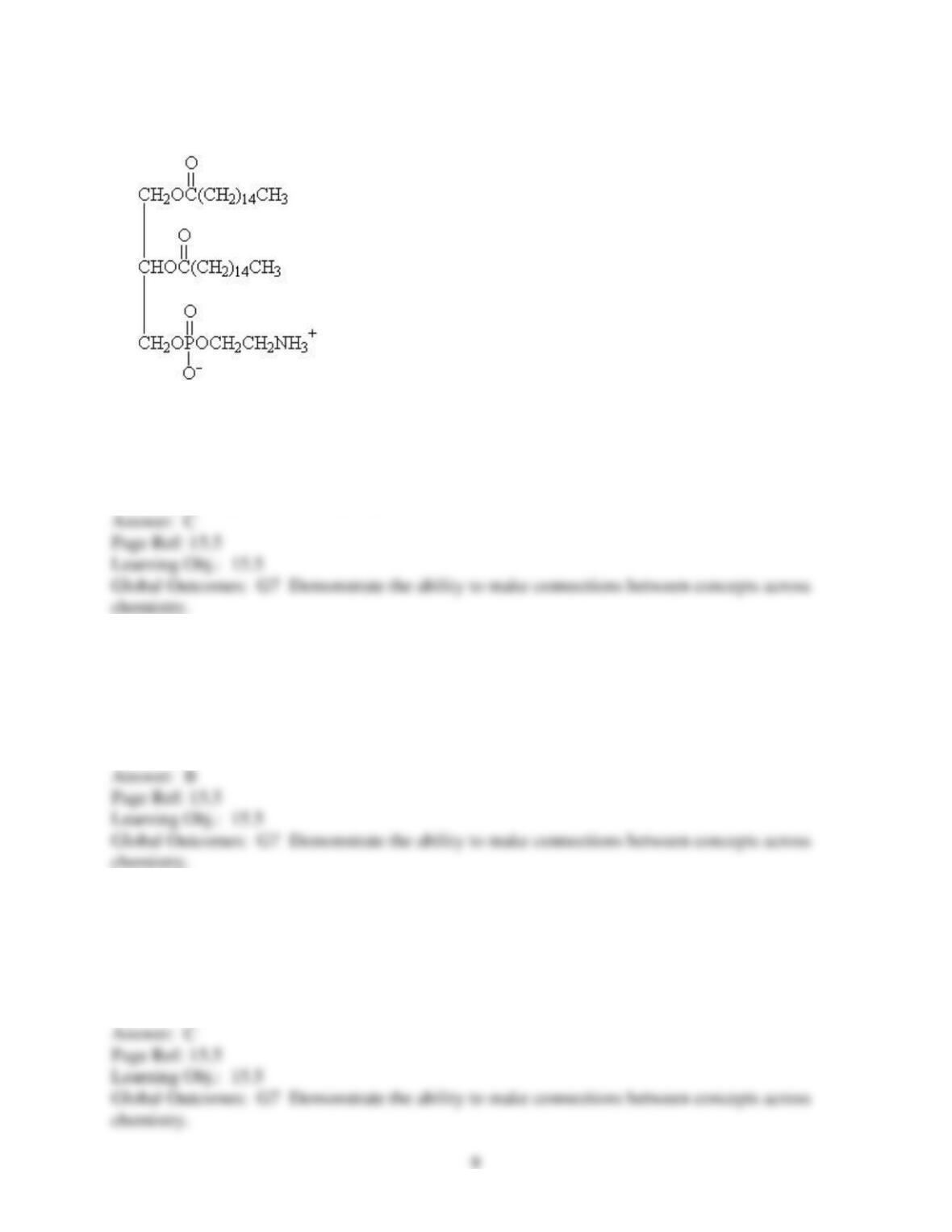
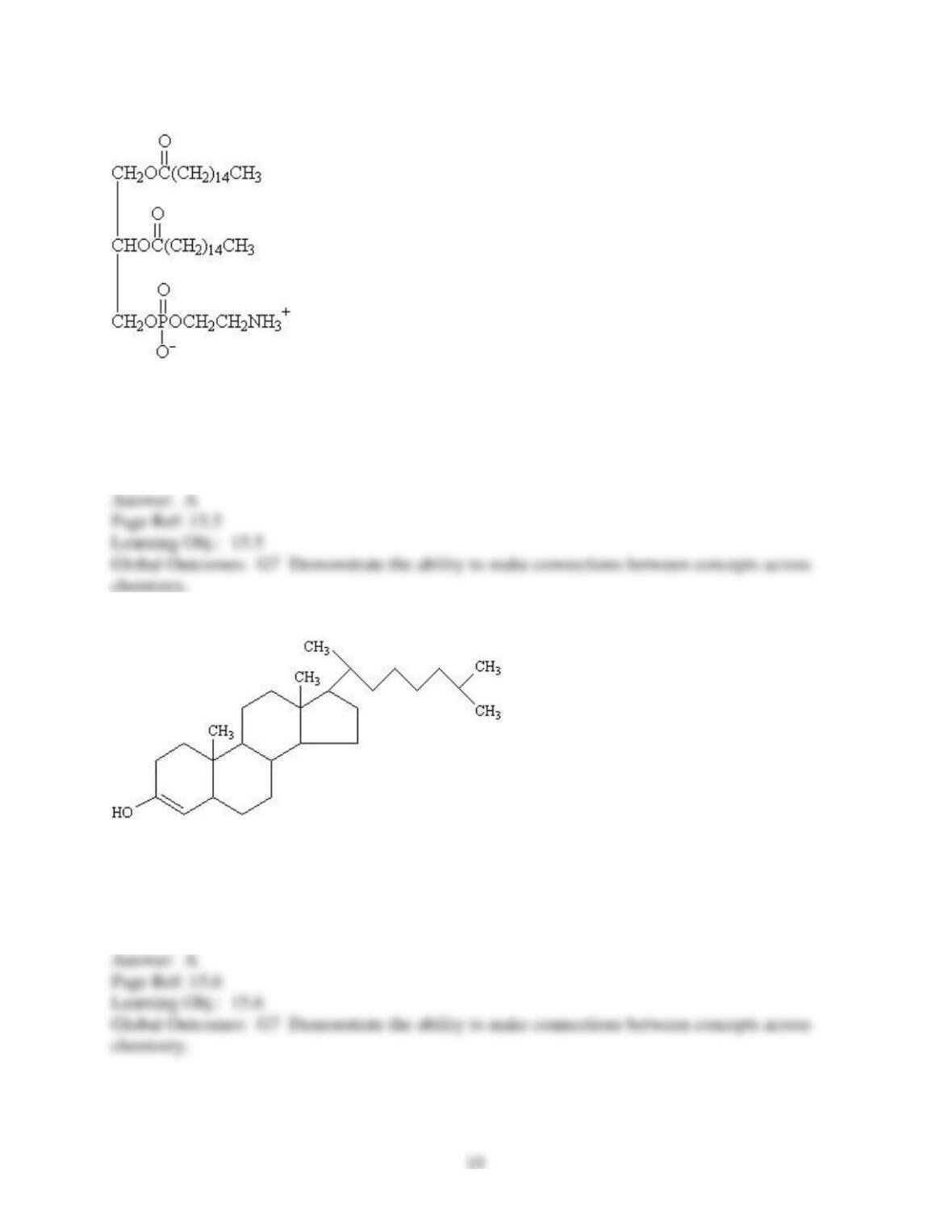
21) The components in the following glycerophospholipid are ________.
A) sphingosine, palmitic acid, phosphate, and choline.
B) sphingosine, palmitic acid, phosphate, and serine.
C) glycerol, palmitic acid, phosphate, and ethanolamine.
D) glycerol, palmitic acid, phosphate, and galactose.
E) sphingosine, palmitic acid, phosphate, and ethanolamine.
22) Which of the lipid types listed below is most soluble in water?
A) triacylglycerols
B) glycerolphospholipids
C) oils
D) steroids
E) waxes
23) Which of the following compounds is a glycerophospholipid?
A) jojoba wax
B) estrogen
C) lecithin
D) triolein
E) stearic acid
24) Which of the following is not a function of glycerophospholipids?
A) transport of triacylglycerols
B) regulation of cellular permeability
C) protect nerve cells
D) aid in digestion
E) transport of cholesterol
25) The main lipid components in cellular membranes are ________.
A) glycerolphospholipids
B) fatty acids
C) steroids
D) triacylglycerols
E) waxes
26) The most common type of gallstones is composed of almost pure ________.
A) cholesterol
B) waxes
C) glycerophospholipids
D) calcium salts of fatty acids
E) anabolic steroids
27) Which of the following is not a lipoprotein that carries nonpolar lipids through the
bloodstream?
A) glycerol
B) LDL
C) HDL
D) VLDL
E) chylomicron
28) The steroid hormone that increases the blood glucose and glycogen levels from fatty acids
and amino acids is ________.
A) aldosterone
B) progesterone
C) cortisone
D) estrogen
E) prednisone
29) A lipoprotein particle functions to ________.
A) dissolve polar lipids for excretion
B) metabolize lipids into new substances
C) dissolve polar lipids in urine
D) transport nonpolar lipid to body cells
E) store lipids in the tissues
30) Synthesis of cholesterol takes place in the ________.
A) liver
B) gall bladder
C) small intestine
D) large intestine
E) pancreas
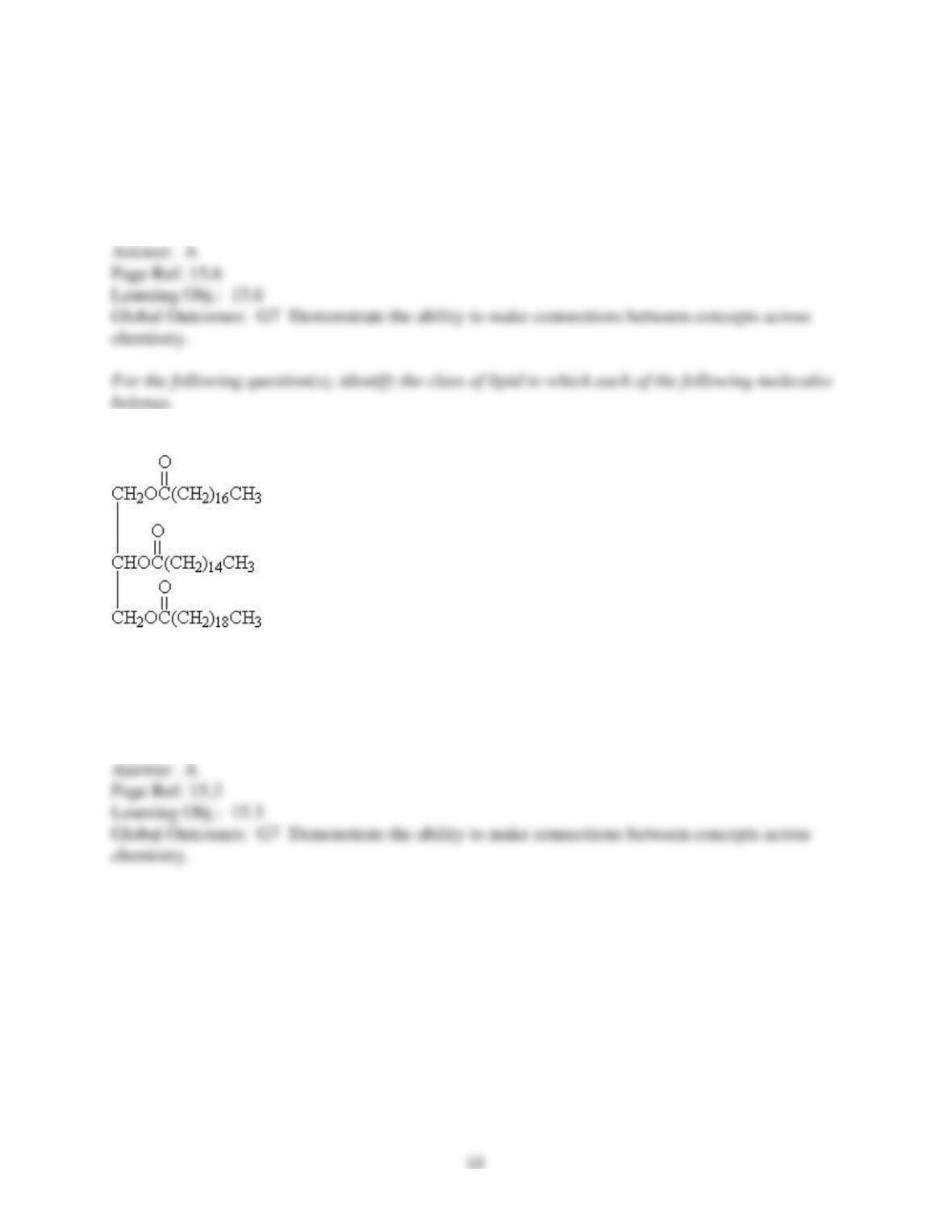
31)
A) triacylglycerol
B) wax
C) glycerophospholipid
D) fatty acid
E) steroid
32)
A) glycerophospholipid
B) triacylglycerol
C) fatty acid
D) steroid
E) wax
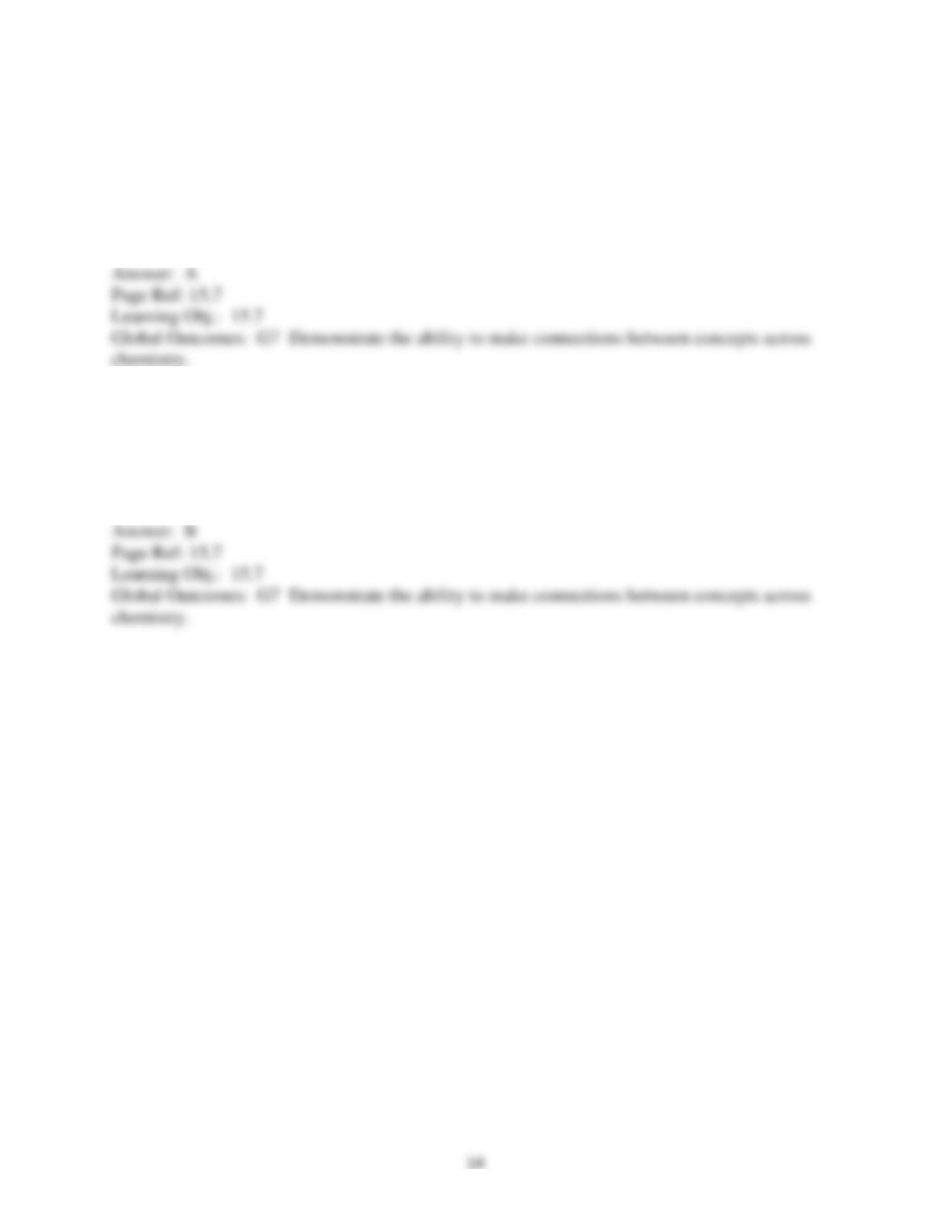
33)
A) steroid
B) glycerophospholipid
C) wax
D) triacylglycerol
E) prostaglandin
34) According to the fluid-mosaic model of a cell membrane, the main component of a
membrane is ________.
A) a lipid bilayer.
B) a membrane protein
C) fatty acid
D) a steroid
E) a prostaglandin
35) The type of lipid that gives a cell membrane its structure is a ________.
A) triacylglycerol
B) glycerophospholipid
C) prostaglandin
D) fatty acid
E) wax
Answer the following question(s) about the diagram shown below.
36) In this diagram of a cell membrane, the small branched object labeled (A) is part of a
________.
A) steroid
B) hydrophobic region
C) membrane protein
D) glycerophospholipid
E) carbohydrate side chain
37) In this diagram of a cell membrane, the objects labeled (E) are ________.
A) steroids
B) hydrophobic regions
C) proteins
D) glycerophospholipids
E) carbohydrate side chains
38) In this diagram of a cell membrane, the object labeled (C) is a ________.
A) steroid
B) protein
C) glycerophospholipid
D) mitochondrion
E) carbohydrate side chain
39) In this diagram of a cell membrane, the object labeled (B) is a ________.
A) steroid
B) hydrophobic region
C) membrane protein
D) phospholipid bilayer
E) carbohydrate side chain
40) In the fluid-mosaic model that describes cell membranes, ________.
A) there are three layers of phospholipid molecules
B) two layers of phospholipid molecules have their nonpolar sections oriented to the inside of the
membrane
C) two layers of phospholipid molecules have their nonpolar sections along the outer surface of
the membrane
D) A single row of phospholipid molecules forms a barrier between the inside and outside of the
cell
E) two layers of proteins separate the contents inside a cell from the surrounding fluids
15.2 Bimodal Questions
1) Which of the following is an unsaturated fatty acid?
A) oleic
B) palmitic
C) lauric
D) myristic
E) stearic
2) Which of the following is a saturated fatty acid?
A) oleic
B) palmitoleicic
C) linoleic
D) arachidonic
E) stearic
3) Prostaglandins are formed from ________ acid.
A) oleic
B) linoleic
C) arachidonic
D) tauric
E) palmitic
4) The name of the reaction that occurs when a fat reacts with sodium hydroxide and water is
________.
A) hydrogenation
B) reduction
C) hydration
D) oxidation
E) saponification
5) Cholesterol belongs to the ________ group of lipids.
A) glycerophospholipid
B) steroid
C) prostaglandin
D) triacylglycerol
E) wax
6) In a simple model of atherosclerosis and heart disease, the compound that forms plaques that
adhere to the walls of the blood vessels is ________.
A) cholesterol
B) carnauba wax
C) stearic acid
D) glycerol
E) oleic acid
19
15.3 True/False Questions
1) Cholesterol is a lipid.
2) Oleic acid is a saturated fatty acid.
3) Stearic acid is a saturated fatty acid.
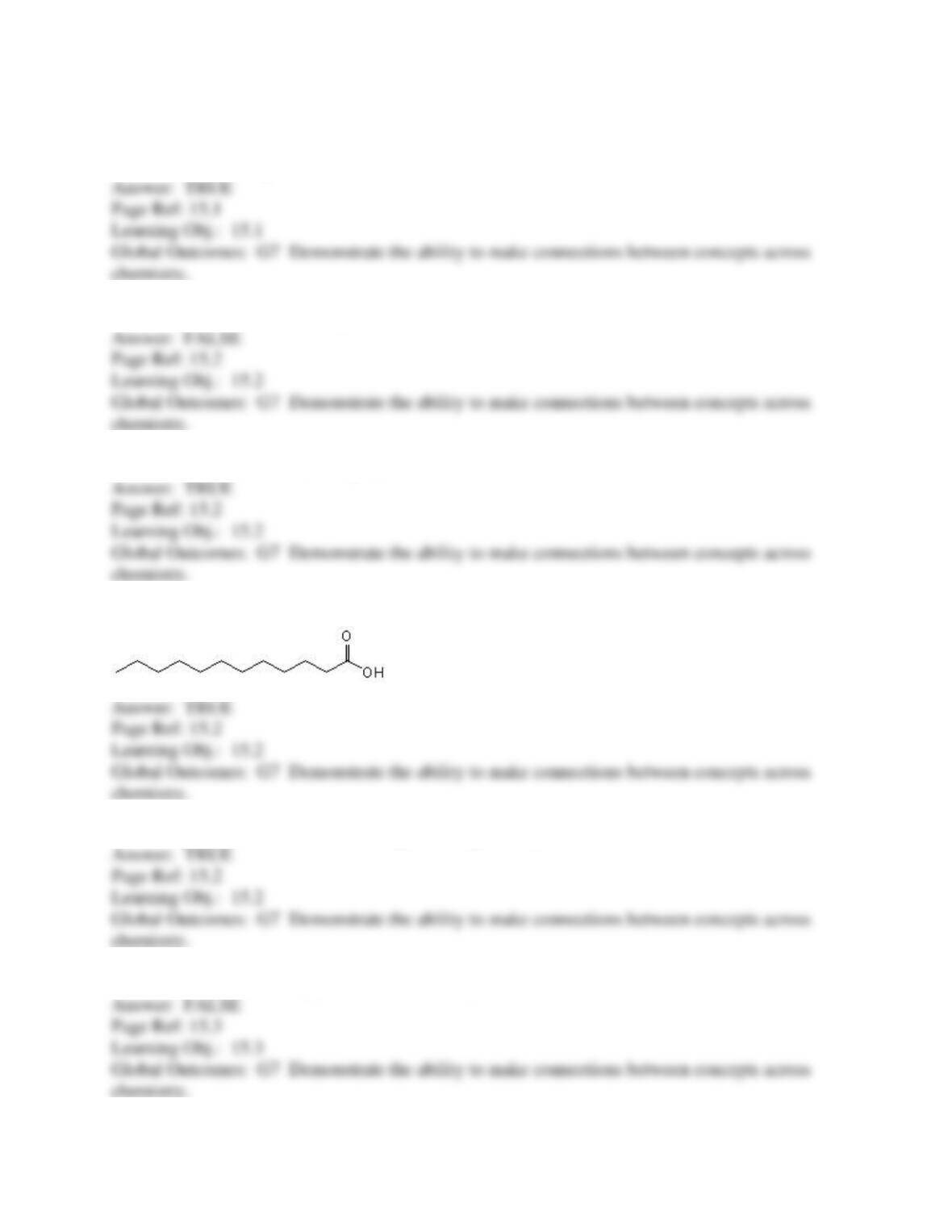
4) This skeletal structure represents a saturated fatty acid.
5) Fish such as salmon and tuna are high in omega-3 fatty acids.
6) A wax is composed of glycerol and three fatty acids.
7) Waxes do not contain fatty acids.
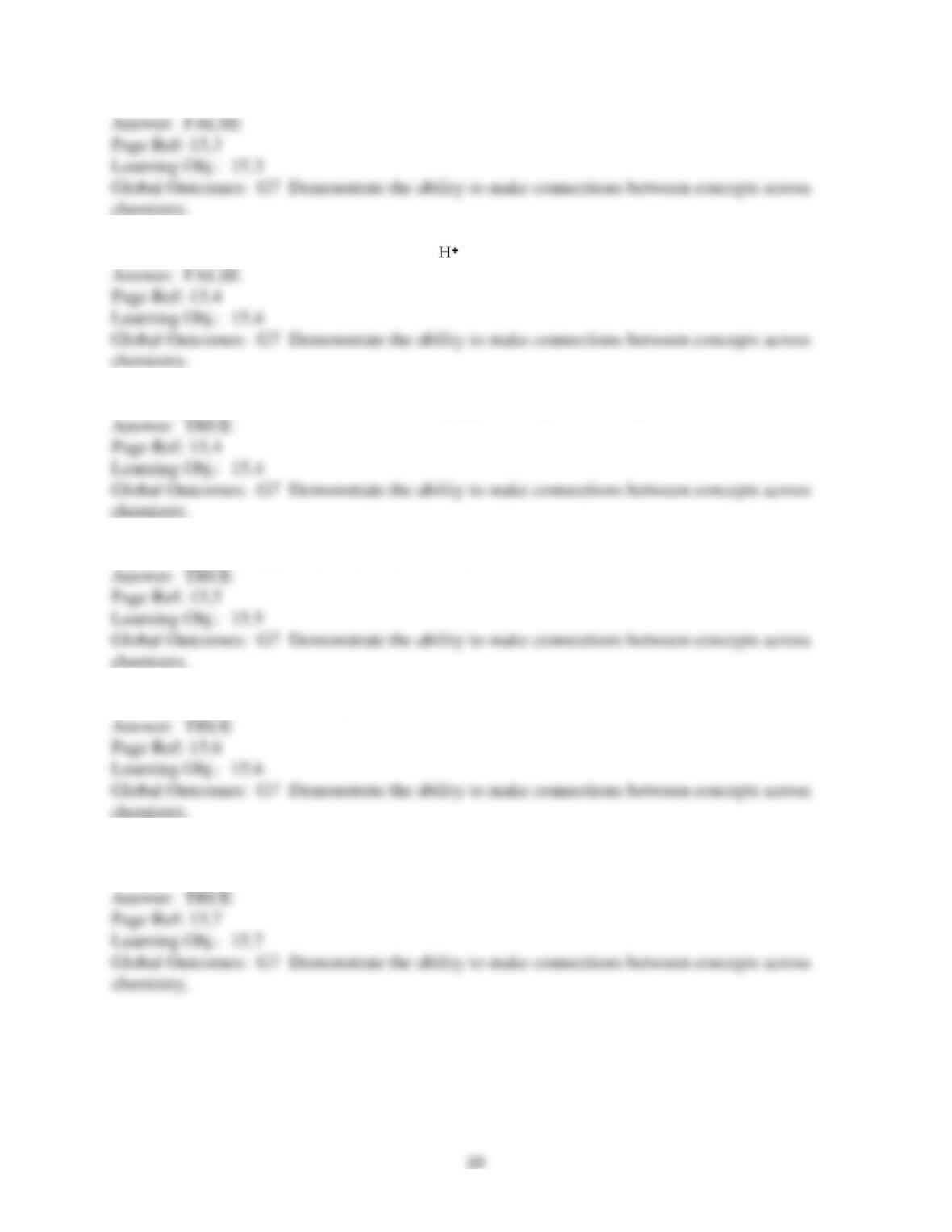
8) The catalyst needed for saponification is ion.
9) Hydrogenation of a double bond in a triacylglycerol requires a catalyst.
10) One function of glycerophospholipids is to provide structure to cell membranes.
11) Steroids do not contain fatty acids.
12) In the fluid-mosaic model of cell membranes, the phospholipid molecules are oriented with
their heads to the outside of the membrane.
21
13) Glycerophospholipids are components of cell membranes.
14) The interior of a lipid bilayer is the hydrophilic region.
15.4 Matching Questions
Match the following.
A) hydrogenation
B) glycerin
C) unsaturated
D) insoluble in water
E) plants
F) soap
G) cholesterol
H) fatty acids
I) ester
J) lower
K) hydrolysis
L) animals
M) higher
1) a characteristic common to most lipids
Page Ref: 15.1
Learning Obj.: 15.1
Global Outcomes: G7 Demonstrate the ability to make connections between concepts across
chemistry.
2) a fatty acid with at least one double bond
Page Ref: 15.2
Learning Obj.: 15.2
Global Outcomes: G7 Demonstrate the ability to make connections between concepts across
chemistry.

3) the melting points of saturated fats compared to unsaturated fats
Page Ref: 15.2
Learning Obj.: 15.2
Global Outcomes: G7 Demonstrate the ability to make connections between concepts across
chemistry.
4) form triacylglycerols when combined with glycerol
Page Ref: 15.3
Learning Obj.: 15.3
Global Outcomes: G7 Demonstrate the ability to make connections between concepts across
chemistry.
5) the functional group of triacylglycerols
Page Ref: 15.3
Learning Obj.: 15.3
Global Outcomes: G7 Demonstrate the ability to make connections between concepts across
chemistry.
6) a source of most saturated fats
Page Ref: 15.3
Learning Obj.: 15.3
Global Outcomes: G7 Demonstrate the ability to make connections between concepts across
chemistry.
7) the process of converting unsaturated fats into saturated fats
Page Ref: 15.4
Learning Obj.: 15.4
Global Outcomes: G7 Demonstrate the ability to make connections between concepts across
chemistry.
8) the product of reacting a triacylglycerol with a strong base and water
Page Ref: 15.4
Learning Obj.: 15.4
Global Outcomes: G7 Demonstrate the ability to make connections between concepts across
chemistry.
9) a lipid that cannot be hydrolyzed
Page Ref: 15.6
Learning Obj.: 15.6
Global Outcomes: G7 Demonstrate the ability to make connections between concepts across
chemistry.
Select the type of lipid that matches the description.
A) triacylglycerol
B) steroid
C) glycerophospholipid
D) fatty acid
10) oleic acid
Page Ref: 15.2
Learning Obj.: 15.2
Global Outcomes: G7 Demonstrate the ability to make connections between concepts across
chemistry.
11) triolein
Page Ref: 15.3
Learning Obj.: 15.3
Global Outcomes: G7 Demonstrate the ability to make connections between concepts across
chemistry.
12) cephalin
Page Ref: 15.5
Learning Obj.: 15.5
Global Outcomes: G7 Demonstrate the ability to make connections between concepts across
chemistry.
13) aldosterone
Page Ref: 15.6
Learning Obj.: 15.6
Global Outcomes: G7 Demonstrate the ability to make connections between concepts across
chemistry.
14) testosterone
Page Ref: 15.6
Learning Obj.: 15.6
Global Outcomes: G7 Demonstrate the ability to make connections between concepts across
chemistry.