Chapter 15 Managing Short-Term Assets 327
31. Which of the following statements is correct?
a.
Compensating balance requirements apply only to businesses, not to individuals.
b.
Compensating balances are essentially costless to most firms, because those firms would
normally have such funds on hand to meet transactions needs anyway.
c.
If the required compensating balance is larger than the transactions balance the firm would
ordinarily hold, then the effective cost of any loan requiring such a balance is increased.
d.
Banks are prohibited from earning interest on the funds they force businesses to keep as
compensating balances.
e.
All of the above statements are correct.
32. Which of the following statements is correct?
a.
Depreciation is included in the estimate of cash flows (Cash flow = Net income +
Depreciations), so depreciation is set forth on a separate line in the cash budget.
b.
If cash inflows and cash outflows occur on a regular basis, such as the situation where
inflows from collections occur in equal amounts each day and most payments are made
regularly on the 10th of each month, then it is not necessary to use a daily cash budget. A
cash budget prepared at the end of the month will suffice.
c.
Lockboxes are more important for fast food retailers such as McDonald’s which deal
primarily with cash than for manufacturers such as Xerox which are generally paid by
check.
d.
A concentration banking system should not be used by firms that collect customers’
payments using lockbox arrangements.
e.
Statements a, b, c, and d are all false.
33. Which of the following statements is correct?
a.
A firm which makes 90 percent of its sales on credit and 10 percent for cash is growing at
a rate of 10 percent annually. If the firm maintains stable growth it will also be able to
maintain its accounts receivable at its current level, since the 10 percent cash sales can be
used to manage the 10 percent growth rate.
b.
In managing a firm’s accounts receivable it is possible to increase credit sales per day yet
still keep accounts receivable fairly steady if the firm can shorten the length of its
collection period.
c.
If a firm has a large percentage of accounts over 30 days old, it is a sign that the firm’s
receivables management needs to be reviewed and improved.
d.
Since receivables and payables both result from sales transactions, a firm with a high
receivables-to–sales ratio should also have a high payables-to-sales ratio.
328 Chapter 15 Managing Short-Term Assets
34. Which of the following statements is correct?
a.
If a firm’s volume of credit sales declines then its DSO will also decline.
b.
If a firm changes its credit terms from 1/20, net 40 days, to 2/10, net 45 days, the impact
on sales can’t be determined because the increase in the discount is offset by the longer net
terms which tends to reduce sales.
c.
The DSO of a firm with seasonal sales can vary because while the sales per day figure is
usually based on the total annual sales, the accounts receivable balance will be high or low
depending on the season.
d.
An aging schedule is used to determine what portion of customers pay cash and what
portion buy on credit.
e.
Aging schedules can be constructed from the summary data provided in the firm’s
financial statements.
35. Which of the following statements is correct?
a.
Other things held constant, the higher a firm’s days sales outstanding (DSO), the better its
credit department.
b.
A firm will relax its credit standards only if it expects bad debts will not increase because
of the change.
c.
If a firm which sells on terms of “net 30″ changes its policy and begins offering all
customers terms of “2/10, net 30,” and if no change in sales volume occurs, then the firm’s
DSO will probably increase.
d.
If a firm sells on terms of 2/10, net 30, and its DSO is 30 days, then its aging schedule
would probably show some past due accounts.
e.
Statements a, b, c, and d are all false.
36. Which of the following would cause average inventory holdings to decrease, other things held
constant?
a.
Fixed order costs double.
b.
The purchase price of inventory items decreases by 50 percent.
c.
The carrying cost of an item decreases (as a percent of purchase price).
d.
The sales forecast is revised downward by 10 percent.
e.
None of the above (all would cause average inventory to increase).
37. Which of the following activities will increase the short-term net cash flow for a firm?
a.
Increase a cash bonus for employees.
b.
Increase the firm’s days sales outstanding ratio without an increase in sales.
c.
Write off old accounts receivable that are considered uncollectible.
d.
Increase the average amount of time the firm takes to pay accounts.
e.
Increase the time you allow the firm’s customers to pay for goods.
Chapter 15 Managing Short-Term Assets 329
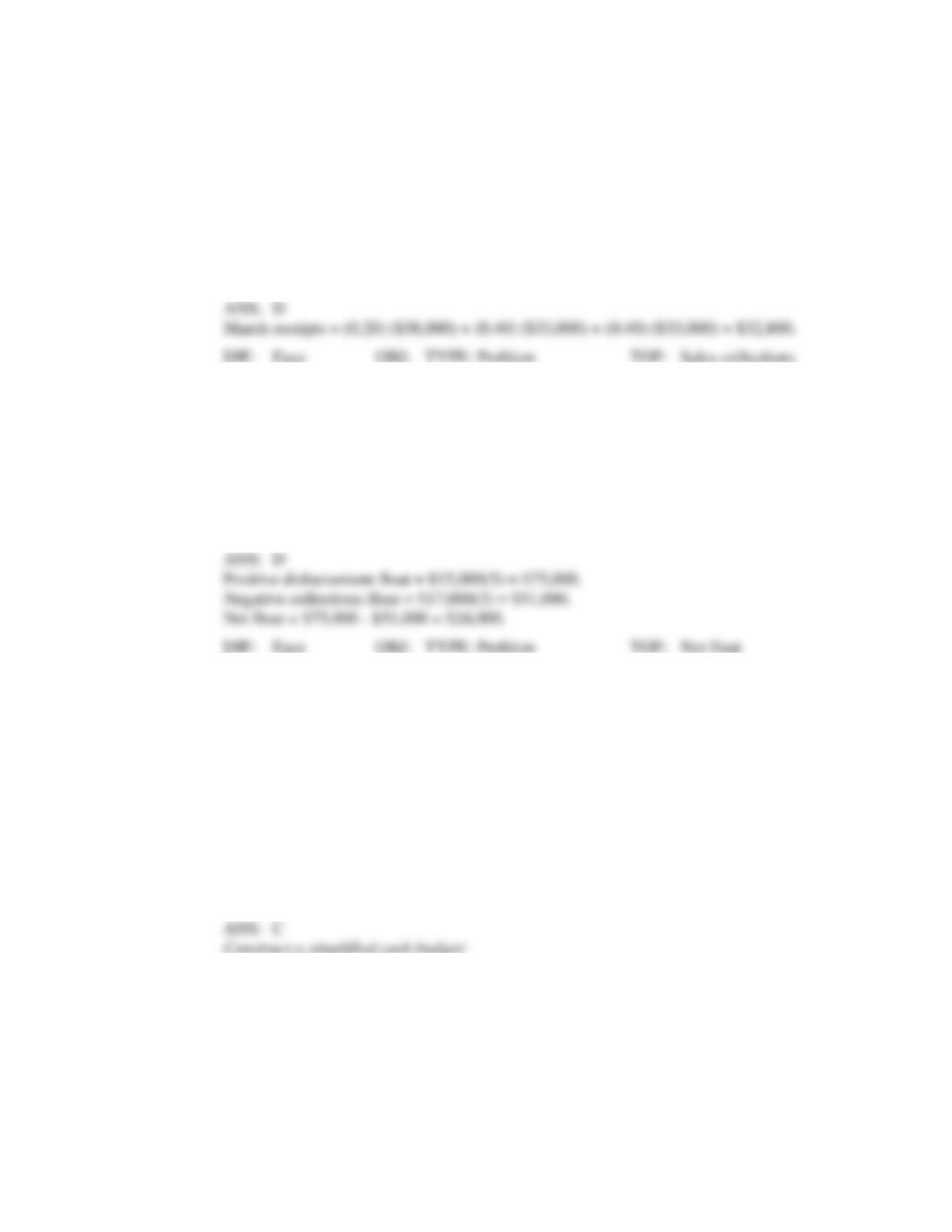
38. The Danser Company expects to have sales of $30,000 in January, $33,000 in February, and
$38,000 in March. If 20 percent of sales are for cash, 40 percent are credit sales paid in the month
following the sale, and 40 percent are credit sales paid 2 months following the sale, what are the
cash receipts from sales in March?
a.
$55,000
b.
$47,400
c.
$38,000
d.
$32,800
e.
$30,000
39. Jumpdisk Company writes checks averaging $15,000 a day, and it takes 5 days for these checks
to clear. The firm also receives checks in the amount of $17,000 per day, but the firm loses three
days while its receipts are being deposited and cleared. What is the firm’s net float in dollars?
a.
$126,000
b.
$75,000
c.
$32,000
d.
$24,000
e.
$16,000
40. Chadmark Corporation’s budgeted monthly sales are $3,000. Forty percent of its customers pay in
the first month and take the 2 percent discount. The remaining 60 percent pay in the month
following the sale and don’t receive a discount. Chadmark’s bad debts are very small and are
excluded from this analysis. Purchases for next month’s sales are constant each month at $1,500.
Other payments for wages, rent, and taxes are constant at $700 per month. Construct a single
month’s cash budget with the information given and determine the average cash gain or (loss)
during a typical month for Chadmark Corporation.
a.
$2,600
b.
$800
c.
$776
d.
$740
e.
$728
330 Chapter 15 Managing Short-Term Assets
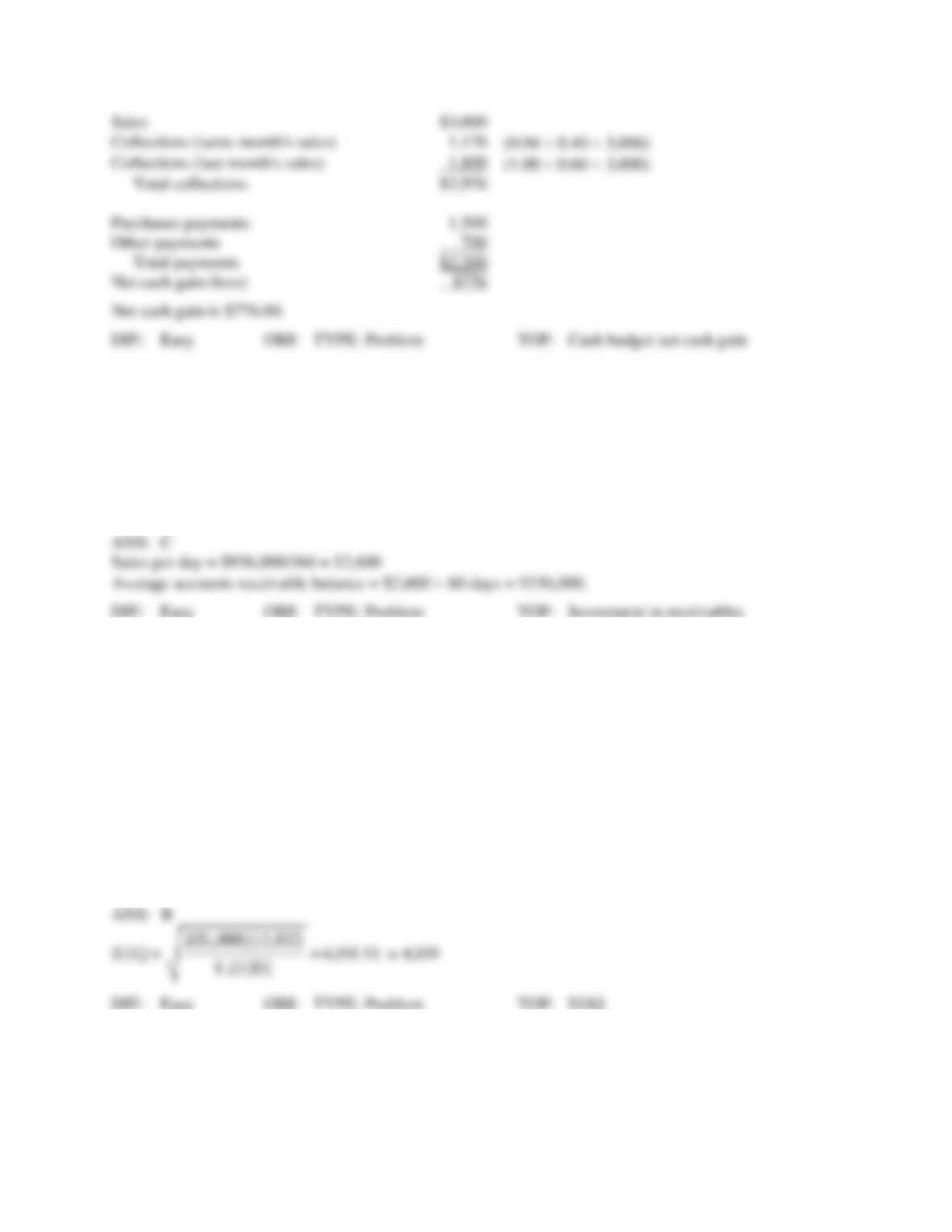
41. For the Prince Company, the average age of accounts receivable is 60 days, the average age of
accounts payable is 45 days, and the average age of inventory is 72 days. Assume a 360-day year.
If Prince’s annual sales are $936,000, what is the firm’s average accounts receivable balance?
a.
$104,000
b.
$118,000
c.
$156,000
d.
$212,000
e.
$260,000
42. Calculate the economic ordering quantity for Nashville Records Inc., given the following
information:
Sales = 15,000 units per year
Sales price = $10 per unit
Purchase price = $5
Carrying cost = 0.25 times inventory value
Fixed cost per order = $1,000
a.
3,464 units
b.
4,899 units
c.
346 units
d.
490 units
e.
1,549 units
43. Ace Hardware’s EOQ is 100 widgets, and it maintains a 50 unit safety stock. Which of the
following is Ace’s average inventory?
a.
100 units
b.
60 units
c.
57.07 units
d.
12.25 units
Chapter 15 Managing Short-Term Assets 331
e.
75 units
44. Cross Collectibles currently fills mail orders from all over the U.S. and receipts come in to
headquarters in Little Rock, Arkansas. The firm’s average accounts receivable (A/R) is $2.5
million and is financed by an 11 percent annual, simple interest bank loan. Cross is considering a
regional lockbox system to speed up collections which it believes will reduce A/R by 20 percent.
The annual cost of the system is $15,000. What is the estimated net annual savings to the firm
from implementing the lockbox system?
a.
$500,000
b.
$30,000
c.
$60,000
d.
$55,000
e.
$40,000
45. Fullerton Wine Company is a retailer which sells vintage wines. The company has established a
policy of reordering inventory every 30 days. A recently employed MBA has considered
Fullerton’s inventory problem from the EOQ model viewpoint. If the following constitute the
relevant data, how does the current policy compare with the optimal policy?
Ordering cost = $10 per order
Carrying cost = 20% of purchase price
Purchase price = $10 per unit
Total sales for year = 1,000 units
Safety stock = 0
a.
Total costs will be the same, since the current policy is optimal.
b.
Total costs under the current policy will be less than total costs under the EOQ by $10.
c.
Total costs under the current policy exceed those under the EOQ by $3.
d.
Total costs under the current policy exceed those under the EOQ by $10.
e.
Cannot be determined due to insufficient information.
332 Chapter 15 Managing Short-Term Assets
46. Bass Boats Inc. currently has sales of $1,000,000, and its days sales outstanding is 30 days. The
financial manager estimates that offering longer credit terms would (1) increase the days sales
outstanding to 50 days and (2) increase sales to $1,200,000. However, bad debt losses, which
were 2 percent on the old sales, would amount to 5 percent on the incremental sales only (bad
debts on the old sales would stay at 2 percent). Variable costs are 80 percent of sales, and Bass
has a 15 percent receivables financing cost. What would the annual incremental pre-tax profit be
if Bass extended its credit period?
a.
-$20,000
b.
-$10,000
c.
$0
d.
$10,000
e.
$20,000
Chapter 15 Managing Short-Term Assets 333
47. Reston Inc. has expected sales of $17,000,000. While 10 percent of its customers pay cash, the
remaining 90 percent pay on credit with 40 percent paying on Day 10, 30 percent paying on Day
20, 15 percent paying on Day 25, and 15 percent paying on Day 30. Assume that the cost of funds
invested in receivables is 10 percent. Suppose that the firm’s customers begin paying later, such
that the new DSO increases to 24 days, that the firm uses a 360-day year, and that the firm’s
variable cost ratio is 80 percent. What is the additional interest cost to Reston of the additional
investment in A/R caused by the delay in payment by its customers?
a.
$19,550
b.
$24,438
c.
$42,500
d.
$78,625
e.
$102,000
East Lansing Appliances
East Lansing Appliances (ELA) expects to have sales this year of $15 million under its current
credit policy. The present terms are net 30; the days sales outstanding (DSO) is 60 days; and the
bad debt loss percentage is 5 percent. Since ELA wants to improve its profitability, the treasurer
has proposed that the credit period be shortened to 15 days. This change would reduce expected
sales by $500,000, but it would also shorten the DSO on the remaining sales to 30 days. Expected
bad debt losses on the remaining sales would fall to 3 percent. The variable cost percentage is 60
percent, and the cost of capital is 15 percent.
48. Refer to East Lansing Appliances. What would be the incremental bad debt losses if the change
were made?
a.
$315,000
b.
$260,500
c.
-$260,500 (bad debt losses would decline)
d.
-$315,000 (bad debt losses would decline)
e.
$0 (no change would occur)
334 Chapter 15 Managing Short-Term Assets
49. Refer to East Lansing Appliances. What would be the incremental cost of carrying receivables if
this change were made?
a.
$108,750
b.
-$116,250 (carrying costs would decline)
c.
$157,900
d.
-$225,000 (carrying costs would decline)
e.
$260,500
50. Refer to East Lansing Appliances. What are the incremental pre-tax profits from this proposal?
a.
$181,250
b.
$271,750
c.
$256,250
d.
$206,500
e.
$231,250
Chapter 15 Managing Short-Term Assets 335
Aberwald Corporation
Aberwald Corporation expects to order 126,000 memory chips for inventory during the coming
year, and it will use this inventory at a constant rate. Fixed ordering costs are $200 per order; the
purchase price per chip is $25; and the firm’s inventory carrying cost is equal to 20 percent of the
purchase price. (Assume a 360-day year.)
51. Refer to Aberwald Corporation. What is the economic ordering quantity for chips?
a.
12,088
b.
3,175
c.
6,243
d.
13,675
e.
8,124
52. Refer to Aberwald Corporation. If Aberwald holds a safety stock equal to a 30-day supply of
chips, what is its average inventory level?
a.
12,088
b.
3,175
c.
15,750
d.
13,675
e.
8,124
53. Refer to Aberwald Corporation. Assume that Aberwald holds a safety stock equal to a 30-day
supply of chips. What is the maximum amount of inventory that Aberwald will have on hand at
any time; that is, what will be the inventory level right after a delivery is made?
a.
9,216
b.
3,175
c.
6,243
d.
13,675
e.
8,124
336 Chapter 15 Managing Short-Term Assets
54. Refer to Aberwald Corporation. How many orders should Aberwald place during the year?
a.
12
b.
25
c.
30
d.
40
e.
60
55. Refer to Aberwald Corporation. If the lead time for placing an order is 5 days, and Aberwald
holds a safety stock equal to a 30-day supply of chips, then at what inventory level should an
order be placed?
a.
15,570
b.
3,175
c.
12,250
d.
13,675
e.
8,124
56. Refer to Aberwald Corporation. If Aberwald holds a safety stock equal to a 30-day supply of
chips, what is Aberwald’s minimum cost of ordering and carrying inventory?
a.
$28,500
b.
$15,950
c.
$68,440
d.
$34,220
e.
$47,693
Fashion Clothiers Inc.
Assume that Fashion Clothiers Inc. uses 1,440,000 yards of material each year. Further, assume
that Fashion can order the material at a cost of $2 per yard, plus fixed ordering costs of $100 per
order. The firm’s carrying cost is 20 percent of the inventory value, at cost.
57. Refer to Fashion Clothiers Inc. What is the firm’s EOQ?
a.
26,833
b.
30,040
c.
43,987
d.
15,218
e.
21,456
Chapter 15 Managing Short-Term Assets 337
58. Refer to Fashion Clothiers Inc. What is Fashion Clothiers’ minimum cost of ordering and
holding inventory?
a.
$6,254
b.
$10,733
c.
$11,560
d.
$13,563
e.
$19,825
59. Refer to Fashion Clothiers Inc. Now, suppose the manufacturer offers a discount of 0.5 percent
for orders of at least 40,000 yards. Should Fashion Clothiers increase its ordering quantity to take
the discount?
a.
Yes; it will save $827 if it takes the discount.
b.
No; it will lose $827 if it takes the discount.
c.
Yes; it will save $14,400 if it takes the discount.
d.
Yes; it will save $13,573 if it takes the discount.
e.
No; it will lose $13,573 if it takes the discount.