Elements of Ecology, 9e (Smith)
Chapter 15 Parasitism and Mutualism
15.1 Short Answer Questions
1) A(n) ________ lives on or within the host organism for some period of its life.
2) A heavy load of parasites is termed a(n) ________.
3) The outcome of an infection is called a(n) ________.
4) Relatively large parasites, such as viruses, bacteria, and protozoans, are referred to as
________.
5) Parasites that live on the skin of their host are called ________.
6) ________ transmission occurs when a parasite is transferred from one host to another without
the involvement of an intermediate organism.
7) Some parasites are transmitted between hosts by an intermediate organism, or ________.
8) The host species in which a parasite becomes an adult and reaches maturity is referred to as
a(n) ________ host.
9) A host species that harbors a developmental stage of a parasite, but in which the parasite does
not reach maturity, is referred to as a(n) ________ host.
10) After infection occurs, the first line of defense for a host against a parasite is the ________
response.
11) Plants often react to attacks on their leaves, stems, fruit, or seeds by forming abnormal
structures called ________.
12) After infection occurs, the second line of defense for a host against a parasite, which is
elicited when a foreign object, such as a virus or bacterium, enters the bloodstream, is referred to
as a(n) ________ response.
13) A relationship between two species in which both species benefit is called ________.
14) The mutualistic fungi that can live within the roots of certain plants are called ________.
15) The mutualistic algae that live within the tissues of corals are called ________.
16) A lichen consists of a(n) ________ and an alga (or, in some cases, a cyanobacterium).
17) An animal that feeds upon nectar is referred to as a(n) ________.
18) Plants that rely on ants to disperse their seeds have an ant-attracting food body on the seed
coat referred to as a(n) ________.
15.2 Multiple-Choice Questions
1) The intimate and protracted association between two or more organisms of different species is
referred to as
A) mutualism.
B) parasitism.
C) commensalism.
D) symbiosis.
2) Microparasites are usually characterized by
A) a large body size.
B) a long generation time.
C) a long time of infection relative to the host’s expected life span.
D) direct transmission from one host to another.
3) Which of the following is a macroparasite?
A) virus
B) bacterium
C) tick
D) protozoan
4) Which of the following are always photosynthetic?
A) macroparasites
B) microparasites
C) hemiparasites
D) holoparasites
5) Which of the following is an endoparasite?
A) flea
B) tapeworm
C) tick
D) mosquito
6) Which of the following is an ectoparasite?
A) virus that inhabits the lymphatic system
B) bacterium that attacks the brain
C) tick that attaches to the skin
D) fluke that inhabits the bloodstream
7) The most debilitating external parasites of birds and mammals are spread by
A) a vector.
B) an intermediate host.
C) a definitive host.
D) direct contact.
8) How are fleas transmitted between hosts?
A) via direct transmission
B) via an intermediate vector
C) through multiple hosts
D) via water
9) Which of the following transmission modes is available for plants?
A) direct
B) intermediate vector
C) multiple hosts and stages
D) all of the above
10) Which of the following uses a mosquito as a vector?
A) Anopholes
B) Parelaphostrongylus
C) Plasmodium
D) Borrelia
11) Plant parasites that are photosynthetic but draw water and nutrients from their host plant are
referred to as
A) mycorrhizae.
B) vectors.
C) parasitoids.
D) hemiparasites.
12) While foraging on grass, white-tailed deer occasionally ingest snails or slugs that host larvae
of the meningeal worm. The worm larvae mature inside the deer and eventually are passed out
with the feces. The snails acquire the larvae as they come into contact with deer feces on the
ground. The snails are an example of a(n)
A) intermediate host.
B) direct host.
C) definitive host.
D) macrohost.
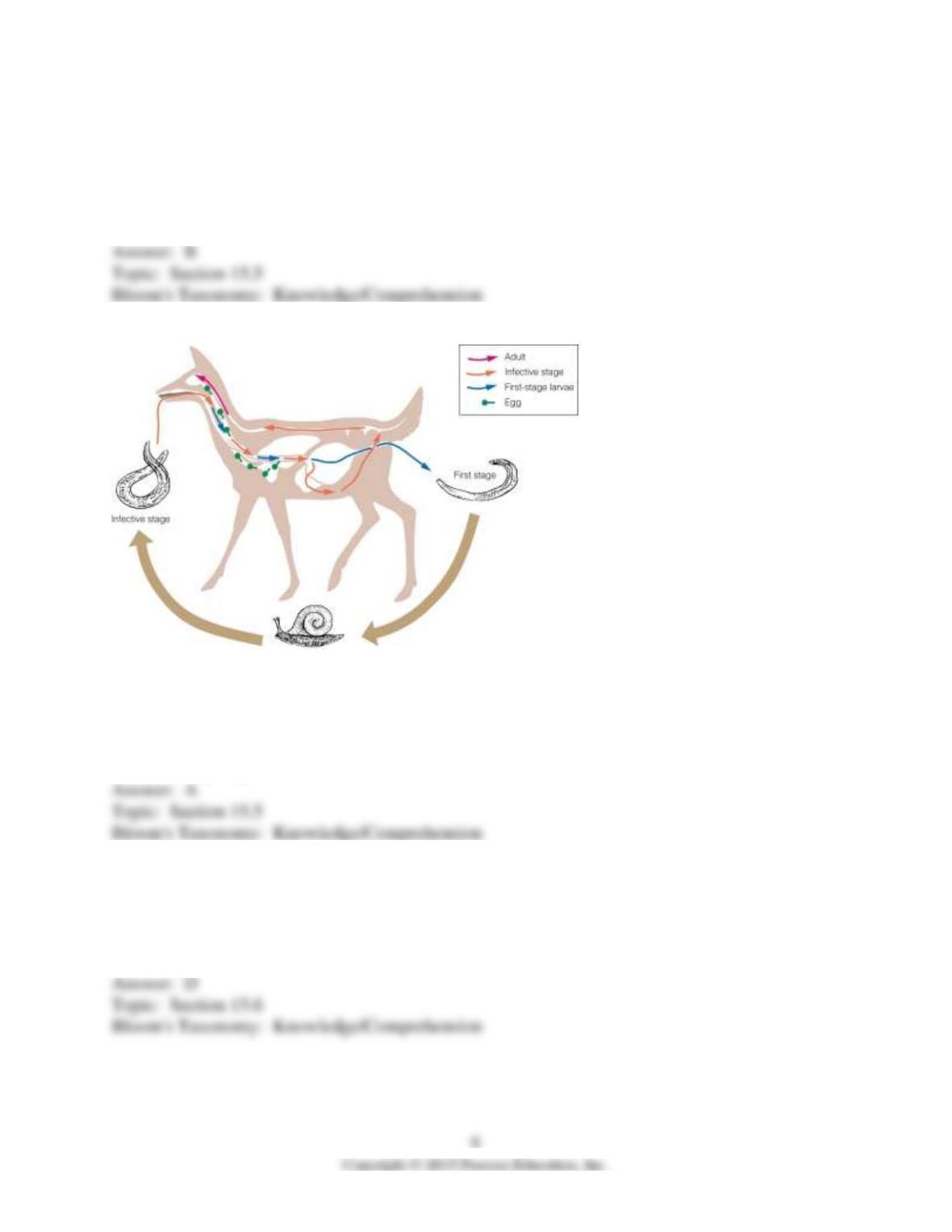
13) The meningeal worm matures into an adult in the white-tailed deer. The deer are referred to
as
A) an intermediate host.
B) a definitive host.
C) an intermediate vector.
D) a definitive vector.
14)
Which of the following is the definitive host?
A) deer
B) soil
C) snail
D) free living stage
15) Following infection, a typical first-line defense of the host’s immune system is
A) reduction in white blood cell count.
B) release of antibodies.
C) forming cysts.
D) inflammation.
16) Which of the following is a potential response by a plant host to a parasite?
A) formation of a gall
B) allelopathy
C) increased production of lymphocytes
D) more rapid growth of tissues
17) The production of antibodies that results from the entrance of a foreign object such as a virus
or bacterium, into the bloodstream of a host is referred to as
A) allelopathy.
B) a behavioral response.
C) an inflammatory response.
D) an immune response.
18) When infected by a parasite, an animal typically
A) grows more rapidly than a healthy individual.
B) produces fewer offspring than a healthy individual.
C) behaves less conspicuously than a healthy individual.
D) is less likely to be preyed on than a healthy individual.
19) You see a killifish jumping around on the surface before it is consumed by a bird. You
conclude the fish was
A) trying to scare off the predator.
B) hunting for flying insects.
C) infected with a trematode.
D) starving to death.
20)
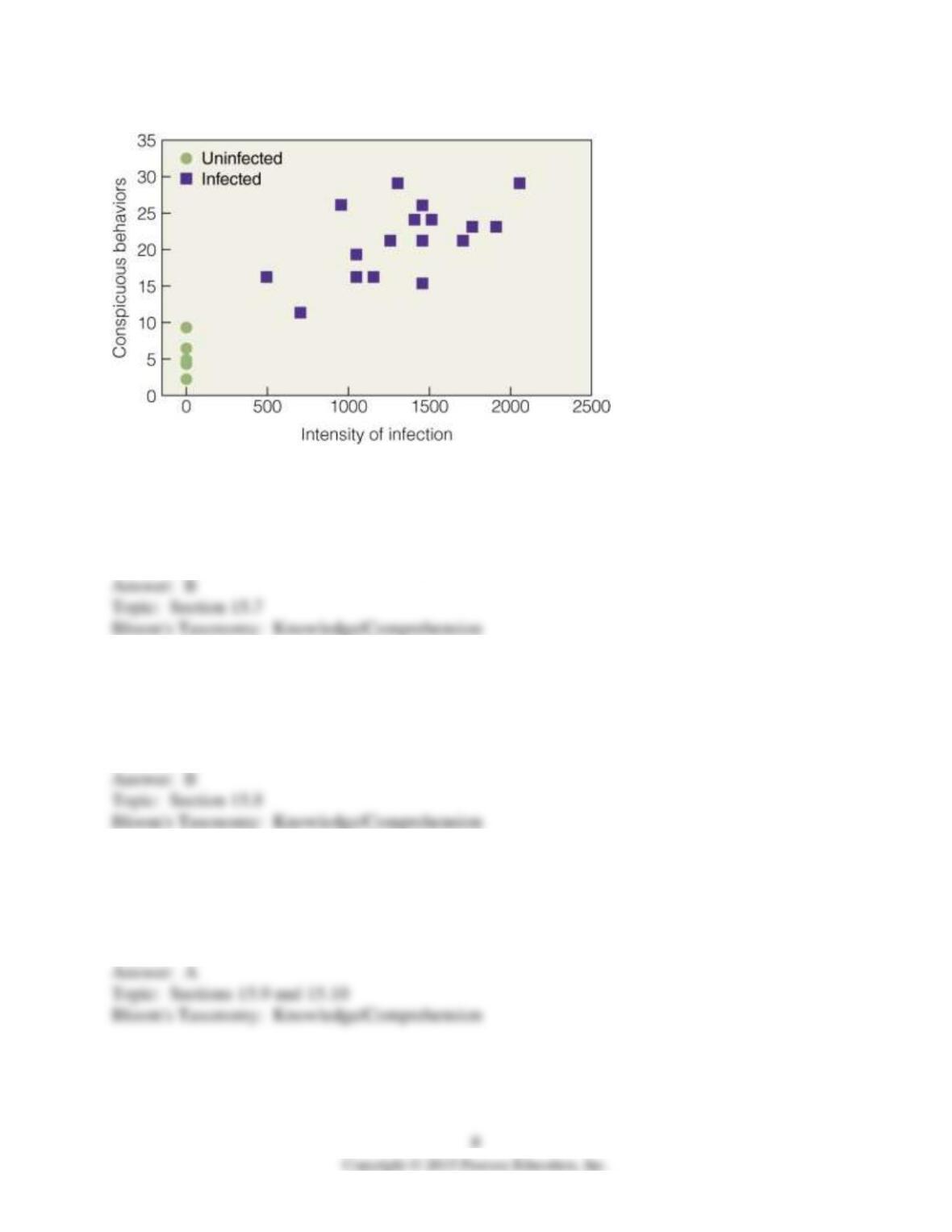
Which of the following best explains the figure?
A) Conspicuous behavior leads to high infection intensity.
B) High intensity infection leads to more conspicuous behavior.
C) There is no relationship between conspicuous behavior and infection intensity.
D) Only infected individuals exhibit conspicuous behavior.
21) Which form of transmission is typically characterized by low virulence?
A) horizontal transmission
B) vertical transmission
C) indirect transmission
D) direct transmission
22) Which of the following symbiotic mutualisms involves a fungus?
A) lichens
B) legume-Rhizobium interactions
C) corals and zooxanthellae
D) gut microbe-ruminant interactions
23) When the bacteria Wolbachia infects the wasp Nasonia vitripennis, what happens?
A) The wasp dies immediately.
B) Female wasps produce less offspring.
C) Females wasps produce more offspring.
D) Female wasps are unable to produce offspring.
24) Which of the following mutualists cannot survive without the mutualistic interaction?
A) facultative
B) subordinate
C) dependent
D) obligate
25) Which of the following are symbiotic with corals?
A) polyps
B) zooxanthellae
C) silica
D) clownfish
26) Which of the following mutualisms is a cleaning mutualism in which one species removes
ectoparasites from another?
A) corals and zooxanthellae
B) bees and flowers
C) ants and acacias
D) oxpeckers and large mammals
27) What would you predict would happen to a plant after being invaded by Rhizobium bacteria?
A) It would die.
B) It would grow better.
C) It would grow worse.
D) It would wilt.
28) How might ants on an acacia tree serve in a mutualistic relationship?
A) The ants fight off potential herbivores.
B) The ants carry disease.
C) The ants bring nitrogen to the tree.
D) The ants bring sugar to the tree.
29) What reward do many organisms receive for pollinating flowers?
A) protection from predators
B) no reward
C) nectar
D) fruit
30) Why might a pine seed not have a wing to disperse via air currents?
A) adapted to grow near parent tree
B) wing adapted to provide extra protection
C) lack of a seed coat on the pine seed
D) spread via birds instead
31) A mutualism in which two species benefit when living together but can survive when apart is
referred to as a(n)
A) obligatory mutualism.
B) trophic mutualism.
C) dispersive mutualism.
D) facultative mutualism.
32) Which of the following mutualistic relationships have the largest impact on population
dynamics?
A) obligate mutualists
B) generalist pollinators
C) nitrogen-fixing bacteria
D) seed-dispersing animals
33) If the competition coefficient α is positive, that likely means
A) that the two species are strong competitors.
B) that the two species are predator and prey.
C) that the species are mutualistic.
D) that only one of the species will survive.
34) The presence of a mutualist might allow what to happen in terms of population dynamics?
A) The species could surpass its carrying capacity.
B) The growth rate would decrease.
C) The competition coefficient would become negative.
D) N would go to 0.
35) Which of the following is associated with the increased incidence of Lyme disease?
A) decreased tick population
B) decreased deer population
C) decreased white-footed mouse population
D) decreased forest patch size
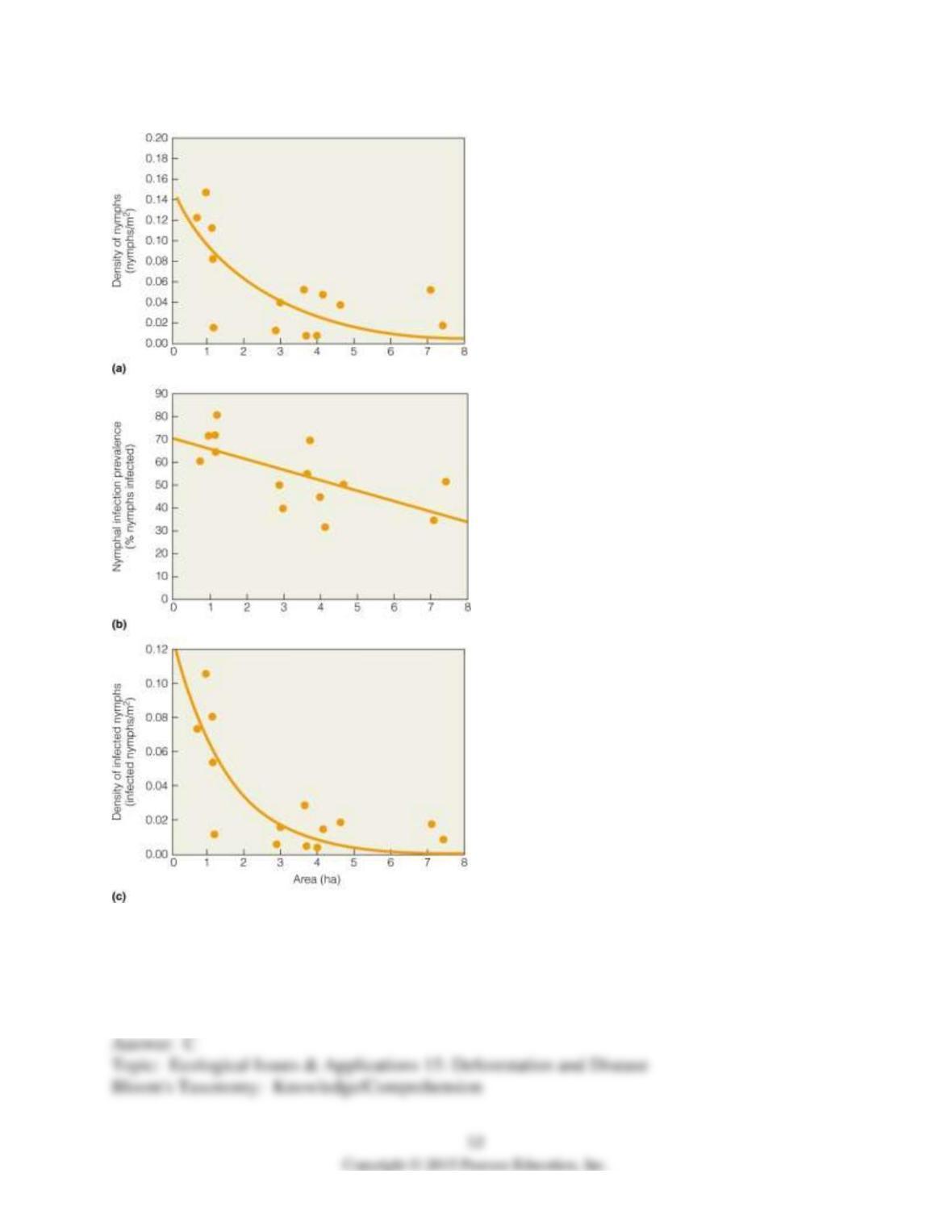
36)
Which of the following factors is most strongly reduced with increased forest size?
A) density of nymphs
B) percent nymphs infected
C) density of infected nymphs
D) density of deer infected
15.3 True/False Questions
1) Symbiosis is an interaction between two species that is beneficial to both species.
2) Holoparasites are plants that lack chlorophyll and are thus nonphotosynthetic, relying totally
on a host’s tissues for nutrition.
3) A major problem for parasites is gaining access to and escaping from the host.
4) Animal parasites can be either ecto- or endoparasites, whereas all plant parasites live inside
the plant tissue as endoparasites.
5) Parasites are always transmitted between hosts via an intermediate vector organism.
6) Microparasites are usually transmitted directly from one host to another.
7) Some parasitic plants are spread from one plant to another by direct transmission.
8) Parasites always complete their life cycle in a single host species.
9) Preening by birds is an example of an inflammatory response to infection.
10) The formation of scabs on the skin and cysts in the muscles of animals in response to a
parasite are examples of an inflammatory response.
11) Parasites typically impact host survival but not reproduction.
12) Parasites may regulate host populations.
13) The number of parasites per individual is relatively high in most individuals and low in a few
individuals.
14) In a commensalistic relationship between two species, only one species benefits without
significantly affecting the other.
15) In mutualism, the interaction between two species is more often a reciprocal exploitation
than a cooperative effort between individuals.
16) Zooxanthellae are photosynthetic algae living within the tissues of reef-forming corals.
17) A lichen is an example of a commensalistic relationship between a fungus and an alga.
18) Most nonsymbiotic mutualisms are obligatory.
19) Nitrogen is important in the mutualism between legume plants and Rhizobium bacteria.
20) Mycorrhizae are nitrogen-fixing bacteria living within the roots of certain tropical trees.
21) Some symbiotic mutualisms involve defense against herbivores.
22) The relationship between ants and acacias represents a defensive mutualism.
23) Plants do not benefit from insects that prey on their nectar.
24) Nectar is often produced by plants as an enticement or reward for pollinating animals.
25) Myrmechochores are ants that are attracted to the seeds of certain plants.
26) Plants benefit from frugivores, which aid in the dispersal of their seeds.
27) The Lotka-Volterra models used for competition may also be used to describe the dynamics
of a mutualism by replacing the competition coefficients with positive interaction coefficients.
15.4 Essay Questions
1) Explain how parasitism differs from mutualism and what the distinction is between an
infection and a disease.
2) Discuss the differences between direct and indirect transmission of a parasite.
3) Describe three types of responses by animal hosts to minimize the impact of parasites.
4) Discuss the inflammatory responses of plants to parasitic attacks.
5) Explain how parasites may impact the survival, reproduction, and population size of their
hosts.
6) Discuss the difference between mutualism and commensalism.
7) Describe two examples of mutualisms involving the transfer of nutrients.
8) Describe two examples of defensive mutualisms.
9) Describe the potential benefits of pollination between a plant and a pollinator.
10) Discuss how the production and dispersal of seeds by plants may represent a mutualism
between two species.
11) Explain how the consumption of seeds or fruit by an animal could result in either parasitism
or mutualism.
12) Give two reasons why it can be difficult to detect the effects of mutualism on the population
dynamics of species.
13) Draw a graph that illustrates the impact of one species on the carrying capacity of another
according to the Lotka-Volterra models of mutualism.