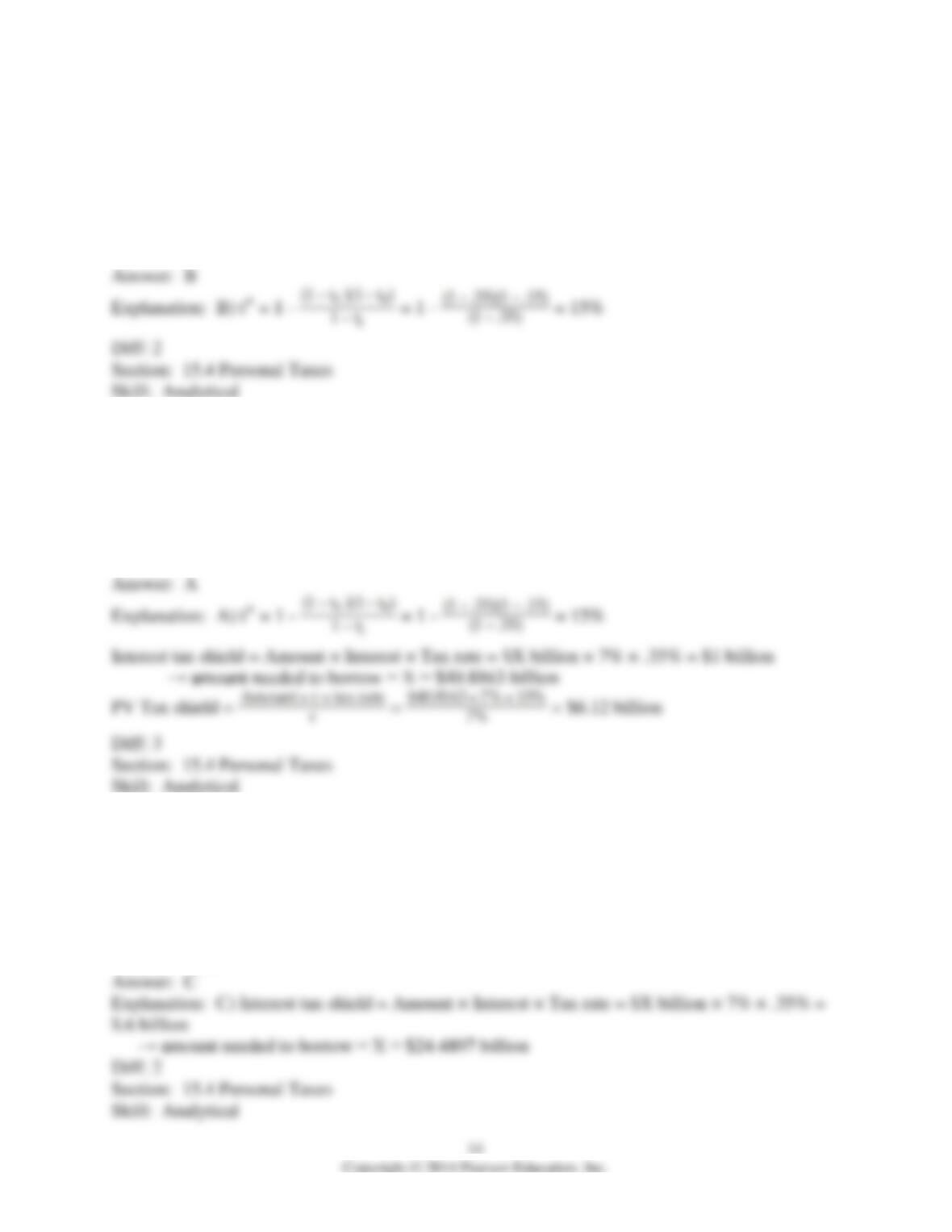
4) Assume that investors in Google pay a 15% tax rate on income from equity and a 35% tax rate
on interest income. If Google were to issue sufficient debt to reduce its taxes by $1 billion per
year permanently, then the effective tax advantage of this debt would be closest to:
A) 10%
B) 15%
C) 25%
D) 30%
5) Assume that investors in Google pay a 15% tax rate on income from equity and a 35% tax rate
on interest income. If Google were to issue sufficient debt to reduce its corporate taxes by $1
billion per year permanently, then the value that would be created is closest to:
A) $6.1 billion
B) $10.2 billion
C) $12.2 billion
D) $14.3 billion
6) Assume that investors hold Google stock in retirement accounts that are free from personal
taxes. If Google were to issue sufficient debt to reduce its taxes by $600 million per year
permanently, then the amount that Google needs to borrow is closest to:
A) $14.25 billion
B) $22.00 billion
C) $24.50 billion
D) $40.75 billion
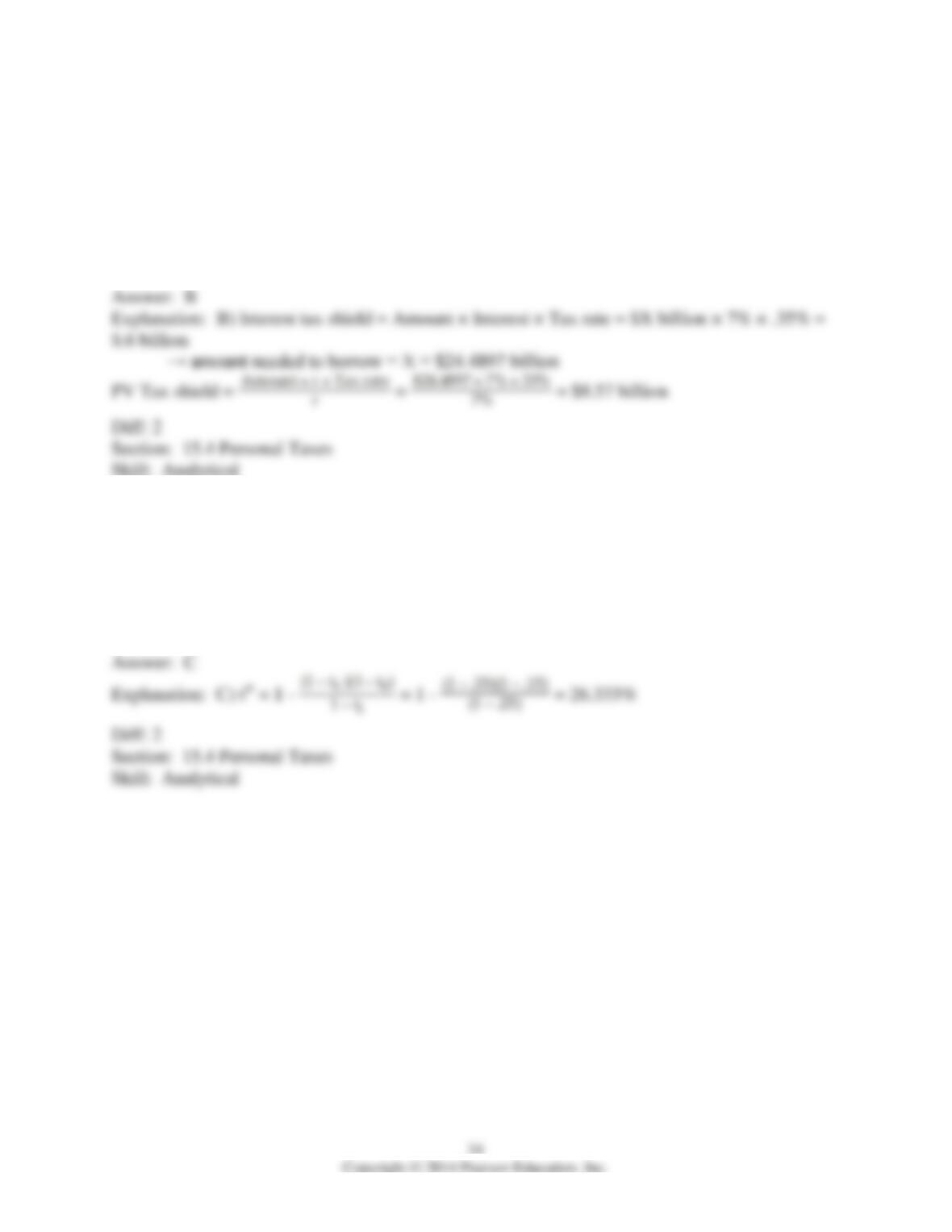
7) Assume that investors hold Google stock in retirement accounts that are free from personal
taxes. If Google were to issue sufficient debt to reduce its taxes by $600 million per year
permanently, then the value that would be created is closest to:
A) $6.4 billion
B) $8.6 billion
C) $9.8 billion
D) $14.3 billion
8) Assume that investors in Google pay a 15% tax rate on income from equity and a 25% tax rate
on interest income. If Google were to issue sufficient debt to reduce its taxes by $600 million per
year permanently, then the effective tax advantage of this debt would be closest to:
A) 10%
B) 15%
C) 25%
D) 30%
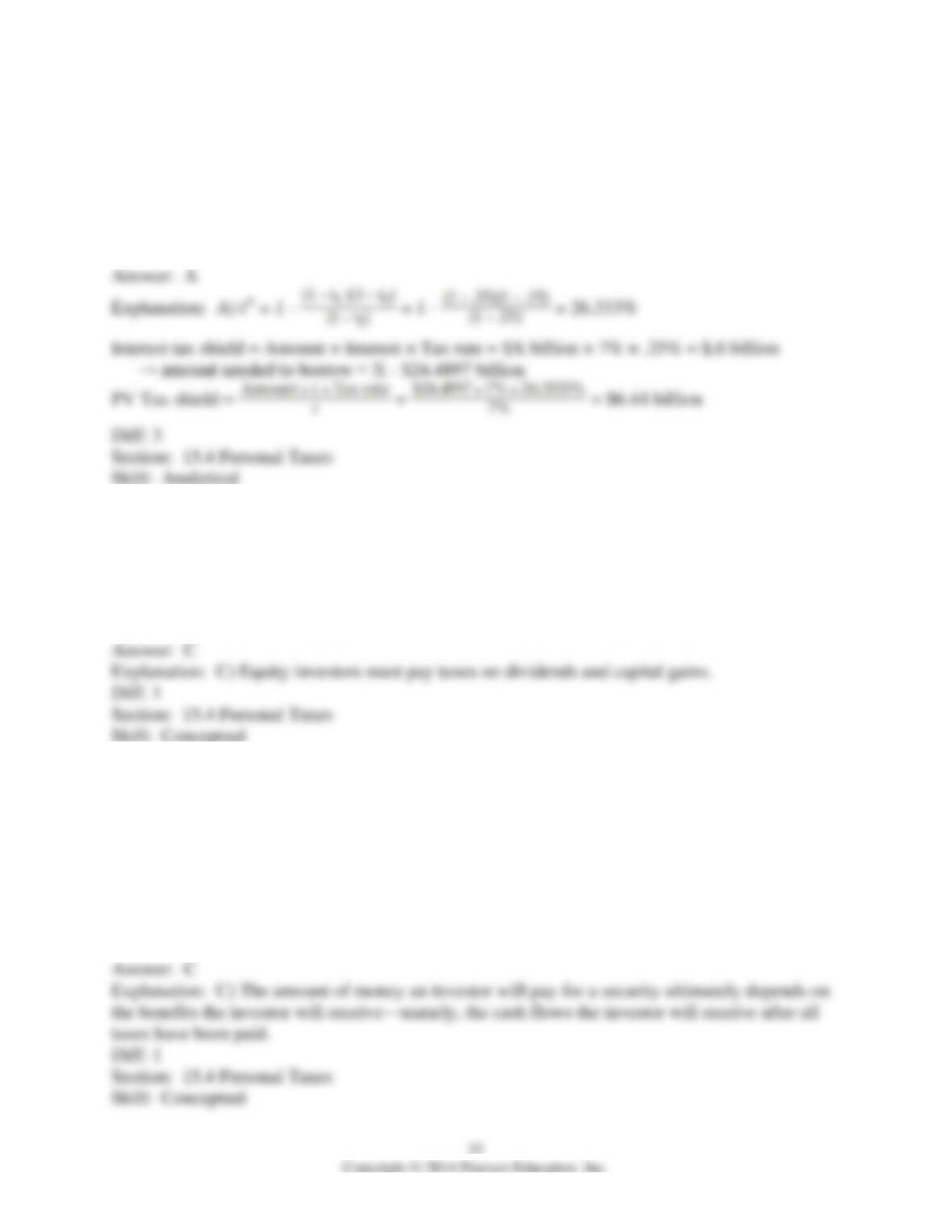
9) Assume that investors in Google pay a 15% tax rate on income from equity and a 35% tax rate
on interest income. If Google were to issue sufficient debt to reduce its corporate taxes by $1
billion per year permanently, then the value that would be created is closest to:
A) $6.4 billion
B) $8.6 billion
C) $9.8 billion
D) $14.3 billion
10) Which of the following statements is FALSE?
A) The value of a firm is equal to the amount of money the firm can raise by issuing securities.
B) By reducing a firm’s corporate tax liability, debt allows the firm to pay more of its cash flows
to investors.
C) Equity investors must pay taxes on dividends but not capital gains.
D) For individuals, interest payments received from debt are taxed as income.
11) Which of the following statements is FALSE?
A) Personal taxes have the potential to offset some of the corporate tax benefits of leverage.
B) The actual interest tax shield depends on the reduction in the total taxes (both corporate and
personal) that are paid.
C) The amount of money an investor will pay for a security ultimately depends on the benefits
the investor will receive—namely, the cash flows the investor will receive before all taxes have
been paid.
D) Just like corporate taxes, personal taxes reduce the cash flows to investors and diminish firm
value.

12) Which of the following statements is FALSE?
A) To determine the true tax benefit of leverage, we need to evaluate the combined effect of both
corporate and personal taxes.
B) A personal tax disadvantage for debt causes the WACC to decline more slowly with leverage
than it otherwise would.
C) Personal taxes have an indirect effect on the firm’s weighted average cost of capital.
D) In the United States and many other countries, capital gains from equity have historically
been taxed more heavily than interest income.
13) Which of the following statements is FALSE?
A) Unlike taxes on capital gains or interest income, which are paid annually, taxes on dividends
are paid only at the time the investor sells the stock.
B) Deferring the payment of capital gains taxes lowers the present value of the taxes, which can
be interpreted as a lower effective capital gains tax rate.
C) Investors with longer holding periods or with accrued losses face a lower tax rate on equity
income, decreasing the effective tax advantage of debt.
D) Investors with accrued losses that they can use to offset gains face a zero effective capital
gains tax rate.
14) Consider the following formula:
τ* =
The term τ* is:
A) the effective tax advantage of debt.
B) the effective personal tax rate on interest income.
C) the effective personal tax rate on equity.
D) the effective corporate tax rate on income.

15) Consider the following formula:
τ* =
The term τe is:
A) the effective personal tax rate on equity.
B) the effective tax advantage of debt.
C) the effective corporate tax rate on income.
D) the effective personal tax rate on interest income.
16) Consider the following formula:
τ* =
The term τi is:
A) the effective personal tax rate on interest income.
B) the effective personal tax rate on equity.
C) the effective corporate tax rate on income.
D) the effective tax advantage of debt.

Use the table for the question(s) below.
Consider the following top federal tax rates in the United States:
Personal Tax Rates
Year
Corporate
Tax Rate
Interest
Income
Dividends
Capital
Gains
2000
35%
40%
40%
20%
2005
35%
35%
15%
15%
17) In 2000, the effective tax rate for debt holders was closest to:
A) 61%
B) 52%
C) 64%
D) 40%
18) In 2000, assuming an average dividend payout ratio of 50%, the effective tax rate for equity
holders was closest to:
A) 69%
B) 65%
C) 55%
D) 30%
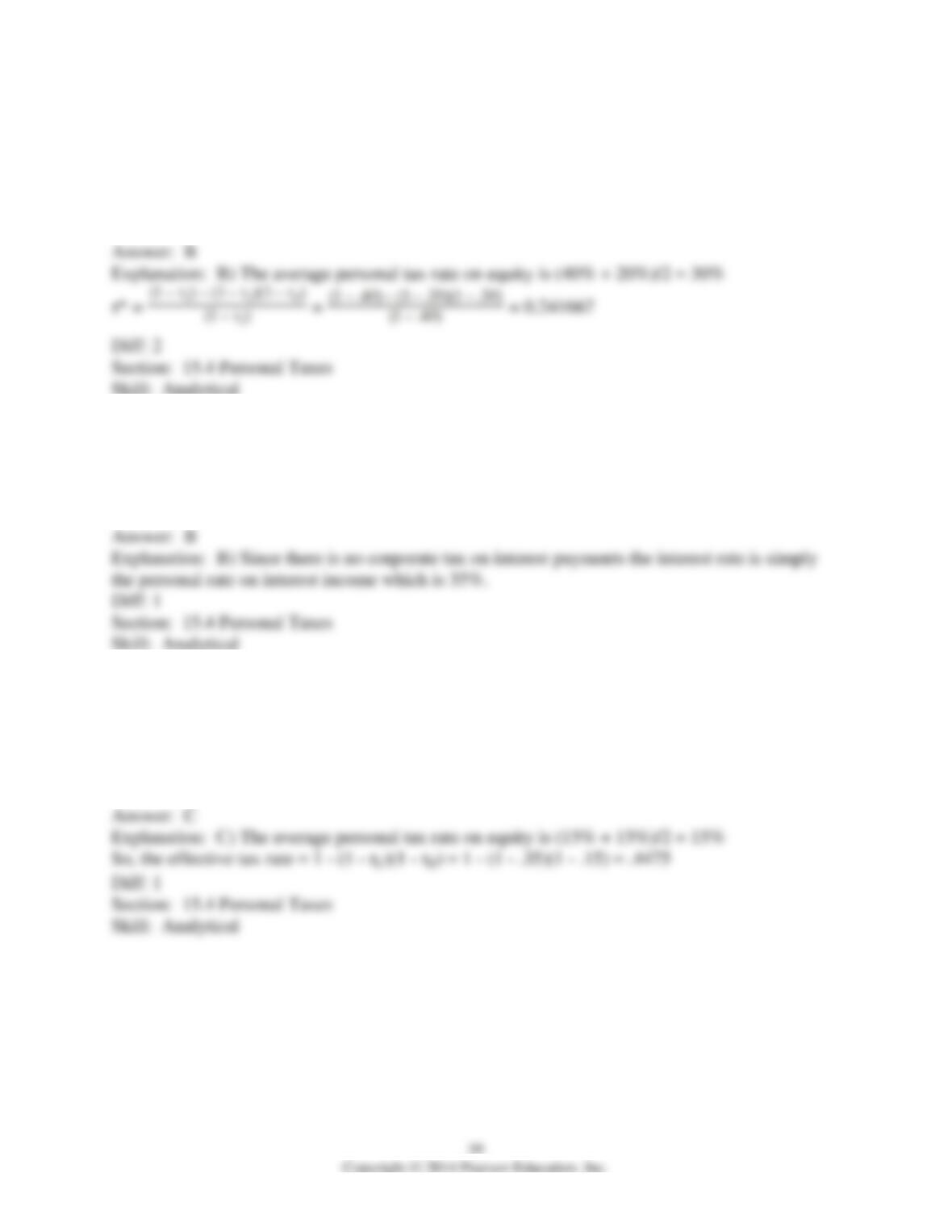
19) In 2000, assuming an average dividend payout ratio of 50%, the effective tax advantage for
debt (t*) was closest to:
A) 40%
B) 24%
C) 30%
D) 18%
20) In 2005, the effective tax rate for debt holders was closest to:
A) 58%
B) 35%
C) 40%
D) 65%
21) In 2005, assuming an average dividend payout ratio of 50%, the effective tax rate for equity
holders was closest to:
A) 30%
B) 55%
C) 45%
D) 50%

22) In 2005, assuming an average dividend payout ratio of 50%, the effective tax advantage for
debt (τ*) was closest to:
A) 24%
B) 18%
C) 35%
D) 15%
Use the information for the question(s) below.
KD Industries has 30 million shares outstanding with a market price of $20 per share and no
debt. KD has had consistently stable earnings, and pays a 35% tax rate. Management plans to
borrow $200 million on a permanent basis through a leveraged recapitalization in which they
would use the borrowed funds to repurchase outstanding shares.
23) Assume the following tax schedule:
Personal Tax Rates
Year
Corporate
Tax Rate
Interest
Income
Dividends
Capital
Gains
2000
35%
40%
40%
20%
2005
35%
35%
15%
15%
Considering the effect of personal taxes, calculate the PV of the interest tax shield provided by
KD’s recapitalization in 2005.
24) The Grant Corporation is considering permanently adding $500 million of debt to its capital
structure. Grant’s corporate tax rate is 35% and investors pay a tax rate of 40% on their interest
income and 20% on their income from capital gains and dividends. Calculate the present value
of the interest tax shield provided by this new debt.
15.5 Optimal Capital Structure with Taxes
1) Which of the following statements is FALSE?
A) Even after adjusting for personal taxes, the value of an unlevered firm exceeds the value of a
levered firm, and there is a tax advantage to using debt financing.
B) In Modigliani and Miller’s setting of perfect capital markets, firms could use any combination
of debt and equity to finance their investments without changing the value of the firm.
C) When firms raise new capital from investors, they do so primarily by issuing debt.
D) In most years aggregate equity issues are negative, meaning that firms are reducing the
amount of equity outstanding by buying shares.
2) Which of the following statements is FALSE?
A) The data show a clear preference for equity as a source of external financing for the total
population of U.S. firms.
B) Debt as a fraction of firm value has varied in a range from 30-45% for the average firm.
C) Capital expenditures greatly exceed firms’ external financing, implying that most investment
and growth is supported by internally generated funds, such as retained earnings.
D) Firms in growth industries like biotechnology or high technology carry very little debt,
whereas airlines, auto makers, utilities, and financial firms have high leverage ratios.
3) Which of the following statements is FALSE?
A) Even though firms have not issued new equity, the market value of equity has risen over time
as firms have grown.
B) While firms seem to prefer debt when raising external funds, not all investment is externally
funded.
C) To receive the full tax benefits of leverage a firm needs to use 100% debt financing.
D) If bankruptcy is costly, these costs might offset the tax advantages of debt financing.
4) Which of the following statements is FALSE?
A) Aside from taxes, another important difference between debt and equity financing is that debt
payments must be made to avoid bankruptcy, whereas firms have no similar obligation to pay
dividends or realize capital gains.
B) Increasing the level of debt increases the probability of bankruptcy.
C) A firm receives a tax benefit only if it is paying taxes in the first place.
D) To the extent that a firm has other tax shields, its taxable earnings will be increased and it will
rely more heavily on the interest tax shield.
5) Which of the following statements is FALSE?
A) A biotech firm might be developing drugs with tremendous potential, but it has yet to receive
any revenue from these drugs. Such a firm will not have taxable earnings. In that case, a tax-
optimal capital structure does not include debt.
B) No corporate tax benefit arises from incurring interest payments that regularly exceed EBIT.
C) The optimal level of leverage from a tax saving perspective is the level such that interest
equals EBIT.
D) In general, as a firm’s interest expense approaches its expected taxable earnings, the marginal
tax advantage of debt increases, limiting the amount of equity the firm should use.
6) Which of the following statements is FALSE?
A) If there is uncertainty regarding EBIT, then with a higher interest expense there is a greater
risk that interest will exceed EBIT.
B) Even for a firm with positive earnings, growth will affect the optimal leverage ratio.
C) From a tax perspective, the firm’s optimal level of debt is proportional to its current earnings.
D) The optimal proportion of debt in the firm’s capital structure will be higher, the higher the
firm’s growth rate.
7) With its current leverage, WELS Corporation will have Free Cash Flow of $4 million. If
WELS corporate tax rate is 35% and it pays 8% interest on its debt, how much additional debt
can WELS issue this year and still receive the benefit of the interest tax shield next year?
8) KAHR Incorporated will have EBIT this coming year of $45 million. It will also spend $18
million on total capital expenditures and increases in net working capital, and have $9 million in
depreciation expenses. KAHR is currently an all-equity firm with a corporate tax rate of 35%
and a cost of capital of 10%. If the interest rate on new KAHR debt is 8%, how much should
KAHR borrow today if they want to maximize there interest tax shield?