Corporate Finance, 3e (Berk/DeMarzo)
Chapter 15 Debt and Taxes
15.1 The Interest Tax Deduction
1) Which of the following statements is FALSE?
A) In general, the gain to investors from the tax deductibility of interest payments is referred to
as the interest tax shield.
B) The interest tax shield is the additional amount that a firm would have paid in taxes if it did
not have leverage.
C) Because Corporations pay taxes on their profits after interest payments are deducted, interest
expenses reduce the amount of corporate tax firms must pay.
D) As Modigliani and Miller made clear in their original work, capital structure matters in
perfect capital markets. Thus, if capital structure does not matter, then it must stem from a
market imperfection.
Use the table for the question(s) below.
Consider the following income statement for Kroger Inc. (all figures in $ Millions):
Year
2006
2005
2004
Total Sales
60,553
56,434
53,791
Cost of goods sold
45,565
42,140
39,637
Selling, general & admin expenses
11,688
12,191
11,575
Depreciation
1,265
1,256
1,209
Operating Income
2,035
847
1,370
Other Income
0
0
0
EBIT
2,035
847
1,370
Interest expense
510
557
604
Earnings before tax
1,525
290
766
Taxes (35%)
534
102
268
Net Income
991
189
498
2) The interest rate tax shield for Kroger in 2006 is closest to:
A) $187 million
B) $332 million
C) $534 million
D) $179 million
Year
2006
2005
2004
Total Sales
60,553
56,434
53,791
Cost of goods sold
45,565
42,140
39,637
Selling, general & admin expenses
11,688
12,191
11,575
Depreciation
1,265
1,256
1,209
Operating Income
2,035
847
1,370
Other Income
0
0
0
EBIT
2,035
847
1,370
Interest expense
510
557
604
Earnings before tax
1,525
290
766
Taxes (35%)
534
102
268
Net Income
991
189
498
Tax Shield = .35 × Interest Exp
178.5
194.95
211.4
3) The interest rate tax shield for Kroger in 2005 is closest to:
A) $362 million
B) $36 million
C) $102 million
D) $195 million
4) The interest rate tax shield for Kroger in 2004 is closest to:
A) $268 million
B) $393 million
C) $211 million
D) $94 million
5) The total amount available to payout to all the investors in Kroger in 2006 is closest to:
A) $990 million
B) $1,525 million
C) $1,500 million
D) $2,035 million
6) The total amount available to payout to all the investors in Kroger in 2005 is closest to:
A) $190 million
B) $847 million
C) $745 million
D) $290 million
7) The income that would be available to equity holders in 2006 if Kroger was not levered is
closest to:
A) $1,525 million
B) $2,035 million
C) $1,500 million
D) $1,325 million
8) The income that would be available to equity holders in 2005 if Kroger was not levered is
closest to:
A) $290 million
B) $745 million
C) $847 million
D) $550 million
Use the information for the question(s) below.
Rosewood Industries has EBIT of $450 million, interest expense of $175 million, and a corporate
tax rate of 35%.
9) Rosewood’s net income is closest to:
A) $450 million
B) $180 million
C) $290 million
D) $95 million
10) The total of Rosewood’s net income and interest payments is closest to:
A) $270 million
B) $355 million
C) $290 million
D) $450 million
11) If Rosewood had no interest expense, its net income would be closest to:
A) $405 million
B) $160 million
C) $450 million
D) $290 million
12) The amount of Rosewood’s interest tax shield is closest to:
A) $115 million
B) $290 million
C) $175 million
D) $60 million
Use the information for the question(s) below.
Fly by Night Aviation (FBNA) expects to have net income next year of $24 million and interest
expense of $3 million. FBNA’s marginal corporate tax rate is 40%.
13) FBNA’s EBIT is closest to:
A) $43 million
B) $40 Million
C) $45 million
D) $60 million
14) IF FBNA increases leverage so that its interest expense rises by $1 million, then the amount
its net income will change is closest to:
A) -$400,000
B) -$600,000
C) $400,000
D) $600,000
15) IF FBNA increases leverage so that its interest expense rises by $1 million, then the amount
its unlevered EBIT will change is closest to:
A) $0
B) -$400,000
C) $600,000
D) $400,000
Use the table for the question(s) below.
Consider the following income statement for Kroger Inc. (all figures in $ Millions):
Year
2006
2005
2004
Total Sales
60,553
56,434
53,791
Cost of goods sold
45,565
42,140
39,637
Selling, general & admin expenses
11,688
12,191
11,575
Depreciation
1,265
1,256
1,209
Operating Income
2,035
847
1,370
Other Income
0
0
0
EBIT
2,035
847
1,370
Interest expense
510
557
604
Earnings before tax
1,525
290
766
Taxes (35%)
534
102
268
Net Income
991
189
498
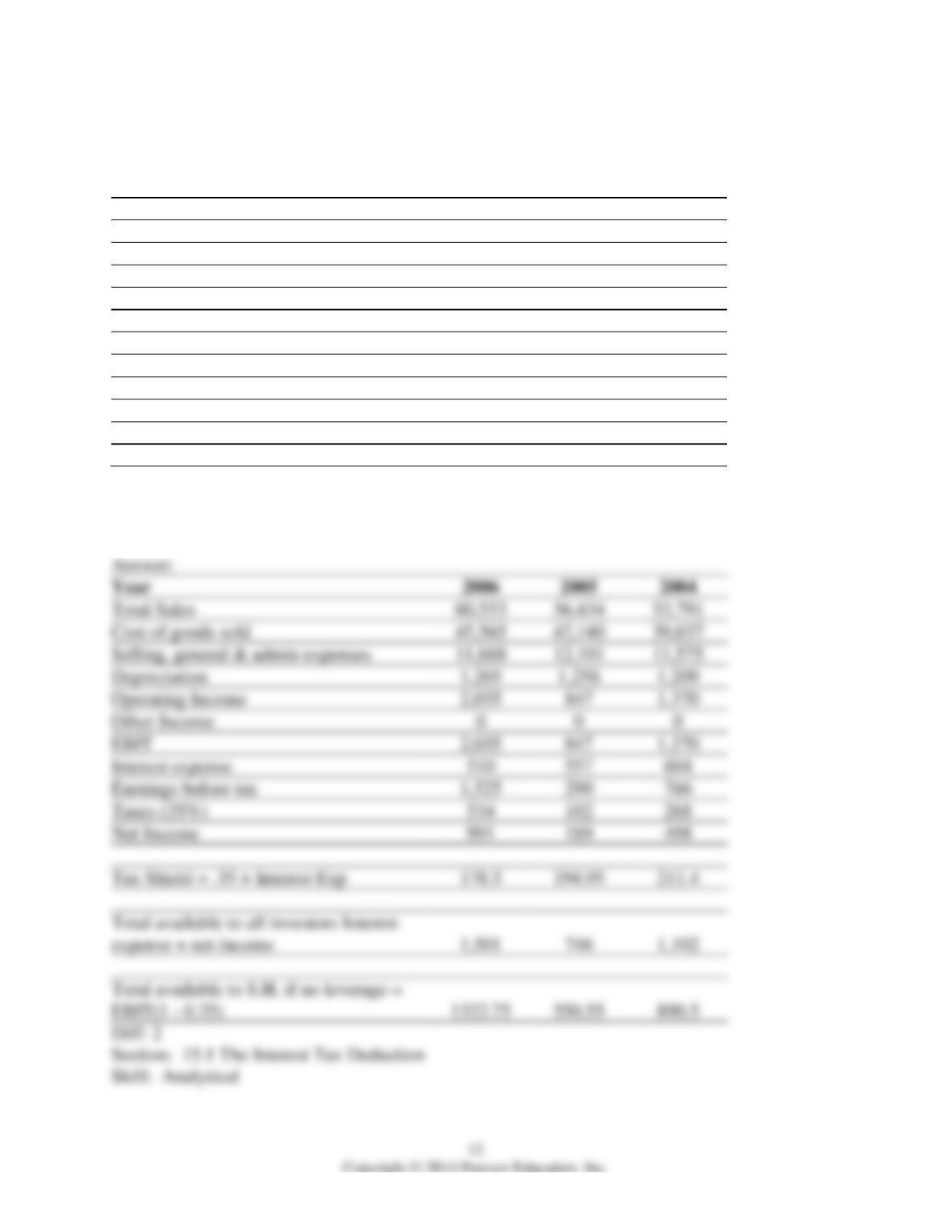
16) Calculate the interest tax shield, the total amount available to payout to all the investors, and
the income that would be available to equity holders if Kroger was not levered all for the year
2004.
Year
2006
2005
2004
Total Sales
60,553
56,434
53,791
Cost of goods sold
45,565
42,140
39,637
Selling, general & admin expenses
11,688
12,191
11,575
Depreciation
1,265
1,256
1,209
Operating Income
2,035
847
1,370
Other Income
0
0
0
EBIT
2,035
847
1,370
Interest expense
510
557
604
Earnings before tax
1,525
290
766
Taxes (35%)
534
102
268
Net Income
991
189
498
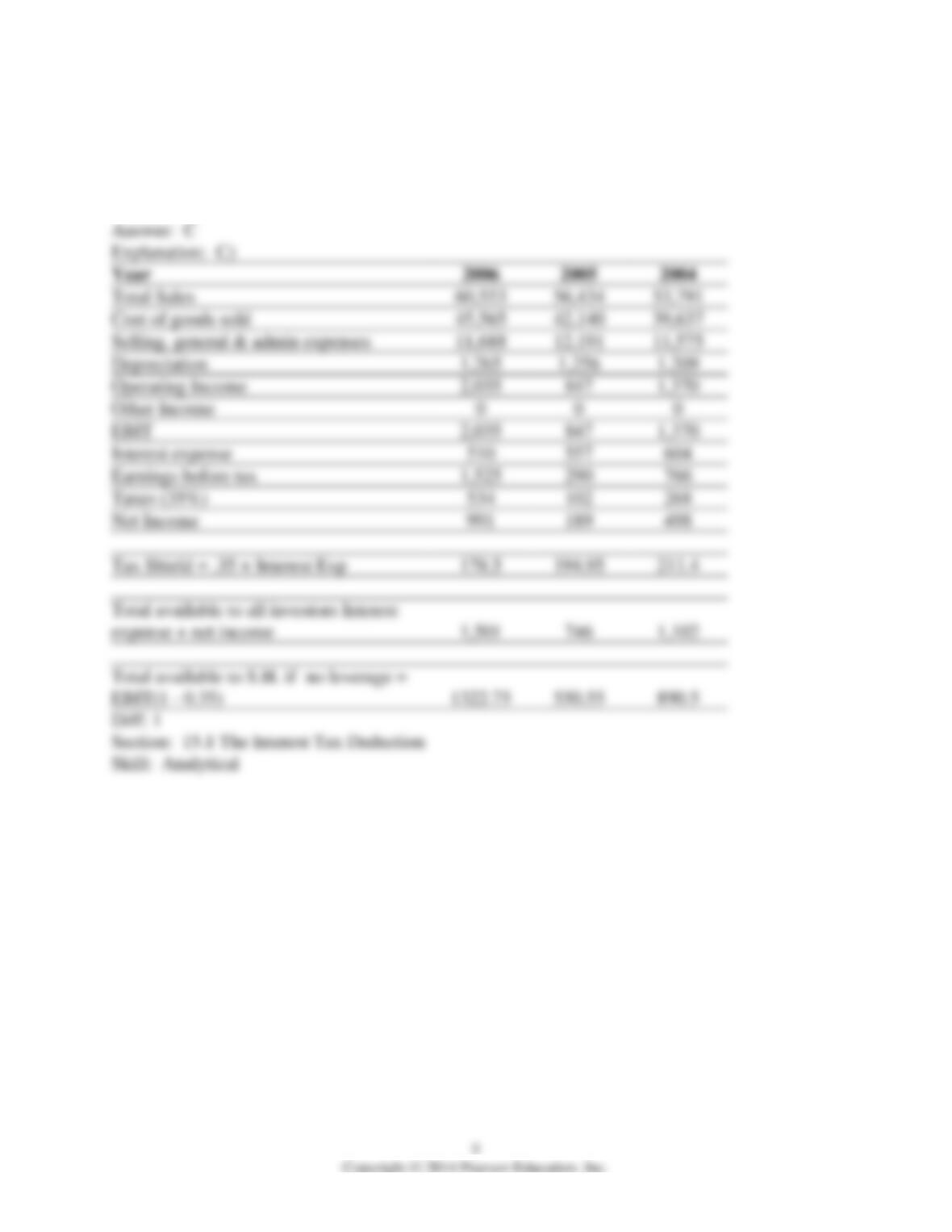
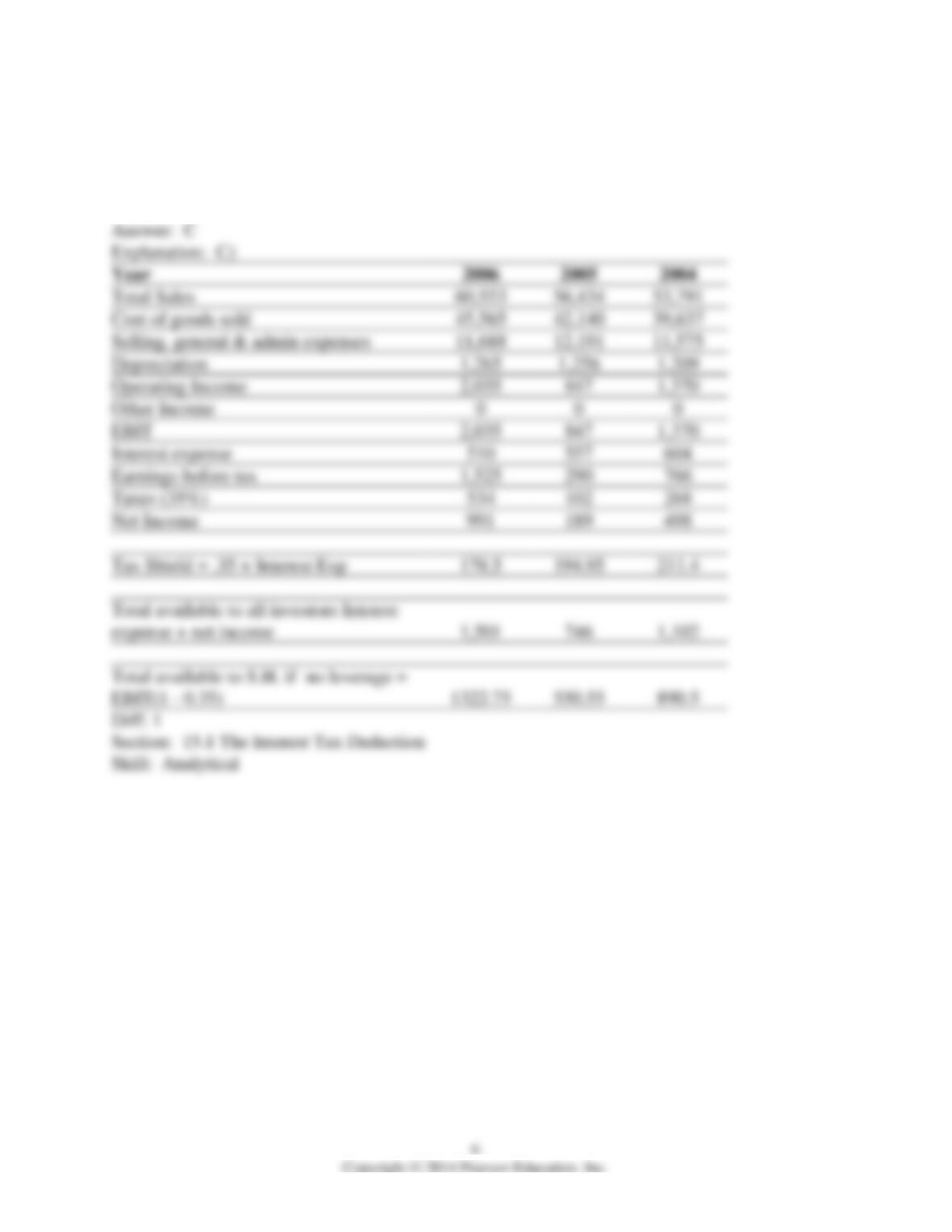
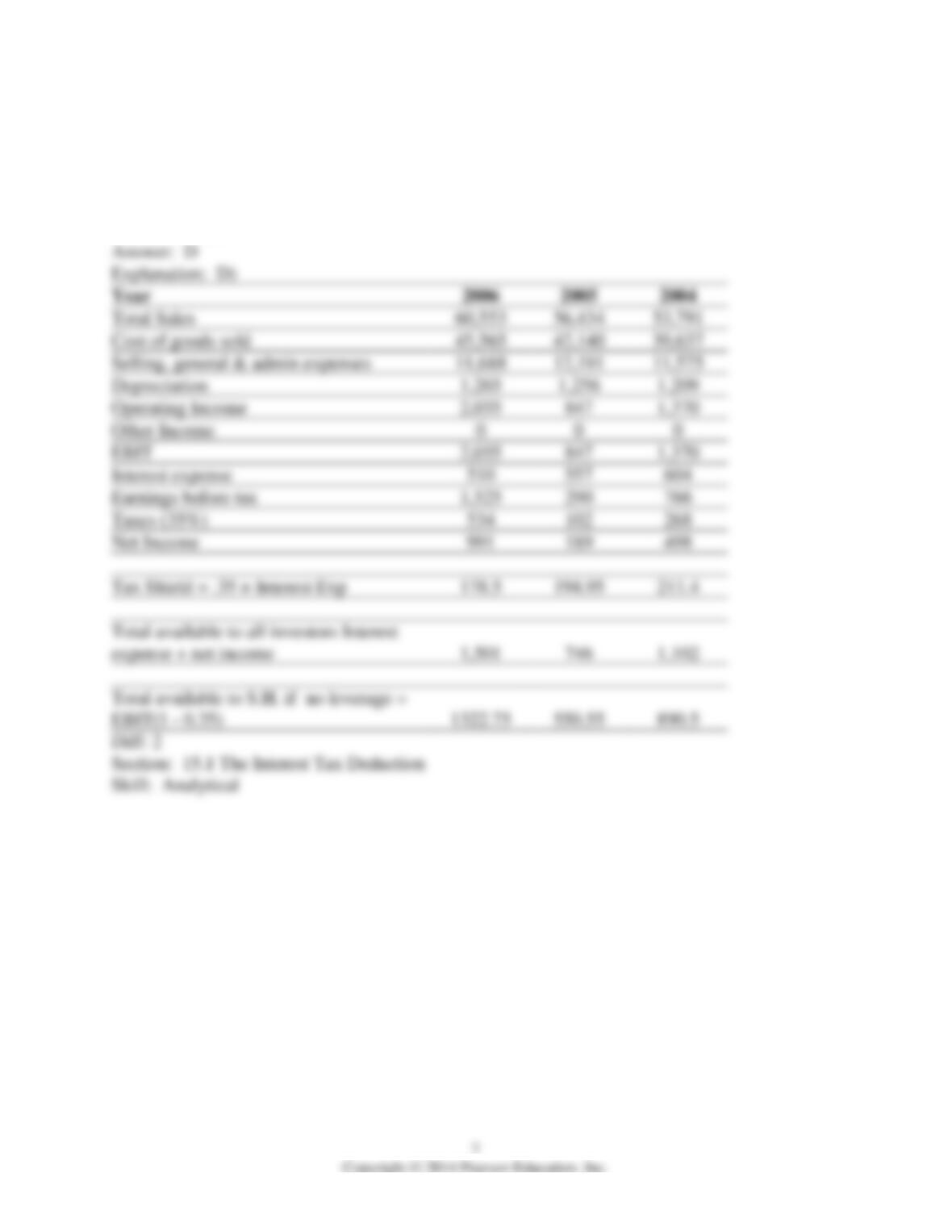
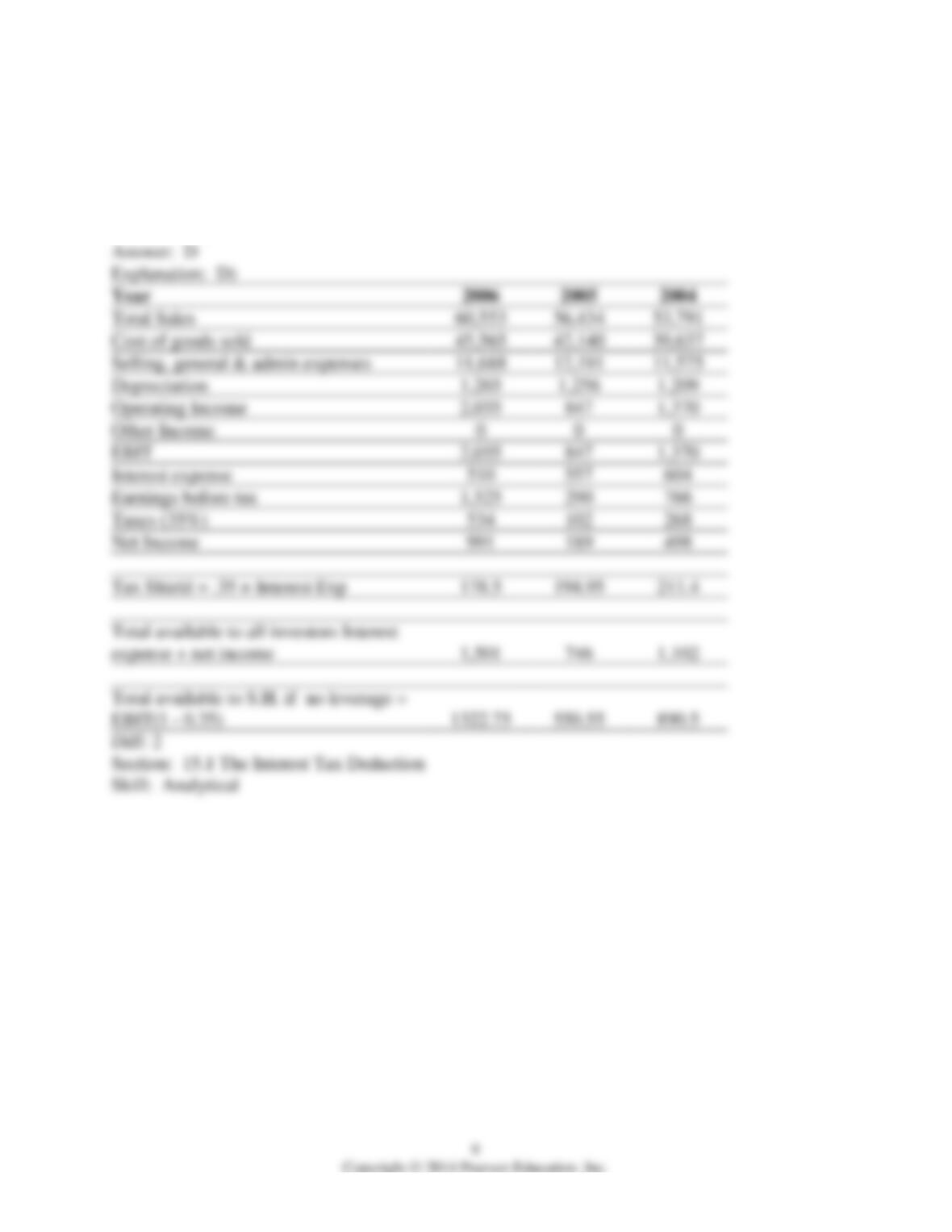
Tax Shield = .35 × Interest Exp
178.5
194.95
211.4
expense + net income
1,501
746
1,102
EBIT(1 – 0.35)
550.55
890.5
15.2 Valuing the Interest Tax Shield
1) Assume that investors hold Google stock in retirement accounts that are free from personal
taxes. Also assume that Google’s current pre-tax WACC is 14%. If Google were to issue
sufficient debt at a pre-tax cost of 7% to give them a debt to value ratio of 0.5, then the Google’s
after-tax WACC would be closest to:
A) 10.4%
B) 12.8%
C) 13.0%
D) 15.0%
E) 16.0%
Use the following information to answer the question(s) below.
Wyatt Oil issued $100 million in perpetual debt (at par) with an annual coupon of 7%. Wyatt will
pay interest only on this debt. Wyatt’s marginal tax rate is expected to be 40% for the foreseeable
future.
2) Wyatt’s annual interest tax shield is closest to:
A) $2.8 million
B) $4.2 million
C) $7.0 million
D) $40 million
3) The present value of Wyatt’s annual interest tax shield is closest to:
A) $4.2 million
B) $7.0 million
C) $40 million
D) $60 million
4) Assume that five years have passed since Wyatt issued this debt. While tax rates have
remained at 40%, interest rates have dropped so that Wyatt’s current cost of debt capital is now
only 4%. Wyatt’s annual interest tax shield is now closest to:
A) $2.8 million
B) $4.2 million
C) $40.0 million
D) $60.0 million
5) Assume that five years have passed since Wyatt issued this debt. While tax rates have
remained at 40%, interest rates have dropped so that Wyatt’s current cost of debt capital is now
only 4%. The present value of Wyatt’s annual interest tax shield is now closest to:
A) $2.8 million
B) $40.0 million
C) $60.0 million
D) $70.0 million
6) Rearden Metal has no debt, and maintains a policy of holding $50 million in excess cash
reserves, invested in risk free treasury securities currently yielding 4%. If Rearden is in the 40%
marginal tax bracket, the cost of permanently maintaining this $50 million reserve is closest to:
A) $0.8 million
B) $1.2 million
C) $20.0 million
D) $30.0 million
7) Nielson Motors has no debt, and maintains a policy of holding $80 million in excess cash
reserves, invested in risk free treasury securities currently yielding 3%. If Nielson is in the 35%
marginal tax bracket, the cost of permanently maintaining this $80 million reserve is closest to:
A) $0.85 million
B) $1.6 million
C) $24.0 million
D) $28.0 million
8) Taggart Transcontinental currently has no debt and an equity cost of capital of 16%. Suppose
that Taggart decides to increase its leverage and maintain a market debt-to-value ratio of 1/3.
Suppose Taggart’s debt cost of capital is 9% and its corporate tax rate is 35%. Assuming that
Taggart’s pre-tax WACC remains constant, then with the addition of leverage its effective after-
tax WACC will be closest to:
A) 12.9%
B) 13.0%
C) 15.0%
D) 16.0%
9) Rearden Metal currently has no debt and an equity cost of capital of 14%. Suppose that
Rearden decides to increase its leverage and maintain a market debt–to-value ratio of 1/2.
Suppose Rearden’s debt cost of capital is 8% and its corporate tax rate is 40%. Assuming that
Rearden’s pre-tax WACC remains constant, then with the addition of leverage its effective after-
tax WACC will be closest to:
A) 10.8%
B) 12.4%
C) 12.8%
D) 13.4%
10) Which of the following statements is FALSE?
A) To determine the benefit of leverage for the value of the firm, we must compute the present
value of the stream of future interest tax shields the firm will receive.
B) Because the cash flows of the levered firm are equal to the sum of the cash flows from the
unlevered firm plus the interest tax shield, by the Law of One Price the same must be true for the
present values of these cash flows.
C) By increasing the amount paid to debt holders through interest payments, the amount of the
pre-tax cash flows that must be paid as taxes increases.
D) When a firm uses debt, the interest tax shield provides a corporate tax benefit each year.
11) Which of the following statements is FALSE?
A) Given a forecast of future interest payments, we can determine the interest tax shield and
compute its present value by discounting it at a rate that corresponds to its risk.
B) The total value of the unlevered firm exceeds the value of the firm with leverage due to the
present value of the tax savings from debt.
C) To compute the increase in the firm’s total value associated with the interest tax shield, we
need to forecast how a firm’s debt—and therefore its interest payments.
D) There is an important tax advantage to the use of debt financing.
12) Which of the following statements is FALSE?
A) Given a 35% corporate tax rate, for every $1 in new permanent debt that the firm issues, the
value of the firm increases by $0.65.
B) The firm’s marginal tax rate may fluctuate due to changes in the tax code and changes in the
firm’s income bracket.
C) Many large firms have a policy of maintaining a certain amount of debt on their balance
sheets.
D) Typically, the level of future interest payments varies due to changes the firm makes in the
amount of debt outstanding, changes in the interest rate on that debt, and the risk that the firm
may default and fail to make an interest payment.
13) Which of the following statements is FALSE?
A) The tax deductibility of interest lowers the effective cost of debt financing for the firm.
B) When a firm uses debt financing, the cost of the interest it must pay is offset to some extent
by the tax savings from the interest tax shield.
C) With tax-deductible interest, the effective after-tax borrowing rate is r(τC).
D) The WACC represents the cost of capital for the free cash flow generated by the firm’s assets.
14) Which of the following statements is FALSE?
A) The higher the firm’s leverage, the more the firm exploits the tax advantage of debt, and the
lower its WACC.
B) Corporate taxes lower the effective cost of debt financing, which translates into a reduction in
the weighted average cost of capital.
C) Because the firm’s free cash flow is computed without considering the firm’s leverage, we
account for the benefit of the interest tax shield by calculating the WACC using the before tax
cost of debt.
D) The reduction in the WACC increases with the amount of debt financing.
15) Which of the following equations is INCORRECT?
A) VL = VU +
B) VL = VU + τcD
C) rwacc = rE + rD – rDτc
D) rwacc = rE + rD(1 + τc)
16) Consider the following formula:
VL = VU +
The term represents:
A) the value of firm with leverage.
B) the present value of the interest tax shield.
C) the preset value of the future interest payments.
D) the interest tax shield each year.
17) Consider the following formula:
VL = VU + τcD
The term τcD represents:
A) the present value of the interest tax shield.
B) the value of firm with leverage.
C) the preset value of the future interest payments.
D) the interest tax shield each year.
18) Consider the following formula:
rwacc = rE + rD – rDτc
The term rDτc represents:
A) the reduction due to the interest tax shield.
B) the present value of the interest tax shield.
C) the preset value of the future interest payments.
D) the interest tax shield each year.
19) Consider the following formula:
rwacc = rE + rD – rDτc
The terms rE + rD represent:
A) the after tax wacc.
B) the reduction due to equity financing.
C) the before tax wacc.
D) the reduction due to the interest tax shield.
Use the information for the question(s) below.
Flagstaff Enterprises expected to have free cash flow in the coming year of $8 million, and this
free cash flow is expected to grow at a rate of 3% per year thereafter. Flagstaff has an equity
cost of capital of 13%, a debt cost of capital of 7%, and it is in the 35% corporate tax bracket.
20) If Flagstaff maintains a .5 debt to equity ratio, then Flagstaff’s pre-tax WACC is closest to:
A) 10.5%
B) 11.0%
C) 9.0%
D) 10.0%