Exam
Name___________________________________
MULTIPLE CHOICE. Choose the one alternative that best completes the statement or answers the question.
1)
The ________ of the geologic time scale represents the time of the most recent “Ice Age.”
1)
A)
Pleistocene era
B)
Pliocene era
C)
Pleistocene epoch
D)
Pliocene epoch
2)
________ are erosional features produced by valley/alpine glaciers.
2)
A)
Cirques
B)
Moraines
C)
Drumlins
D)
Eskers
3)
Which one of the following could not have significantly affected climatic variations and advances
and retreats of ice sheets during the Pleistocene epoch?
3)
A)
movements of Earth’s tectonic plates
B)
precession of Earth’s orbit
C)
variations in the Sun‘s energy output
D)
wobbling of Earth‘s rotational axis
4)
A(n) ________ would logically be situated next to a large end moraine or terminal moraine.
4)
A)
outwash plain
B)
pluvial lake
C)
cirque
D)
fiord
5)
Which type of glacial drift is deposited by glacial meltwater?
5)
A)
unsorted sediment
B)
stratified drift
C)
basaltic flows
D)
till
6)
Which of the following best describes the term glacial drift?
6)
A)
the slow, southward advance of the continental ice sheets over Canada and North America
during the Pleistocene
B)
the sedimentary materials outwash and till
C)
floating of icebergs southward from the north polar seas
D)
slow, plastic flow movement in the brittle zone of a glacier
7)
________ was a very large, pluvial lake in Utah during the Pleistocene Epoch.
7)
A)
Lake Caspian
B)
Lake Bonneville
C)
Lake Mead
D)
Lake Aral
B
8)
The great, Southern Hemisphere glaciation that affected parts of Africa, South America, India,
Australia, and Antarctica occurred ________.
8)
A)
in late Paleozoic time
B)
in early Cenozoic time
C)
in middle Mesozoic time
D)
in late Proterozoic time
A
9)
Which of the following factors did not contribute to climate change?
9)
A)
circulation of ocean currents
B)
variations in the chemical composition of the atmosphere
C)
changes in solar flares
D)
variations of the Earth’s orbit
C
10)
Which process occurs where a glacier enters the sea?
10)
A)
calving
B)
surging
C)
drowning
D)
kaming
A
B
11)
A(n) ________ is likely to host a waterfall or steep rapids today.
11)
A)
hanging valley
B)
horn peak
C)
striated drumlin
D)
outwash plain
12)
What type of moraine is formed by the merging of two lateral moraines at a junction of two valley
glaciers?
12)
A)
medial
B)
ground
C)
kettle
D)
recessional
13)
A ________ forms when stagnant, glacial ice melts after being buried by drift.
13)
A)
pluvial delta
B)
tarn
C)
drumlin
D)
kettle
14)
Where is the world’s largest ice sheet located today?
14)
A)
Iceland
B)
Antarctica
C)
Russia, Siberia
D)
Greenland
15)
Who performed the extensive fieldwork that supported the 1821 hypothesis put forth by I. Venetz?
15)
A)
L. Agassiz
B)
I Venetz
C)
J. D. Hays
D)
M. Milankovitch
16)
Where are the largest kettles located?
16)
A)
Massachusetts
B)
Iowa
C)
Michigan
D)
Minnesota
17)
________ first developed the theory that small variations in the Earth–Sun distance were
responsible for short–term, climatic oscillations (1000 to 100,000 years).
17)
A)
M. Milankovitch
B)
H. Marcee
C)
G. Zukhov
D)
H. Goering
18)
A fiord is ________.
18)
A)
a large, kettle–pocked moraine left as an island when sea level rises following melting of the
ice
B)
a glacier–cut valley that is dammed by an end moraine and a large lake is formed
C)
a glacier–cut valley which sinks below sea level due to glacial rebound after the ice melts
D)
a stream valley, deepened by glacial erosion, that floods as sea level rises
19)
A(n) ________ is similar in appearance to a sinkhole of a karst area.
19)
A)
cirque
B)
kettle
C)
moraine
D)
esker
20)
How do icebergs in the North Atlantic Ocean originate?
20)
A)
as calved blocks of glacial ice that float northward from Antarctica
B)
as large masses of sea ice that float northward from Antarctica
C)
as masses of sea ice that float southward from the Arctic Ocean
D)
by calving of large piedmont glaciers in Greenland
21)
All of the following descriptions apply to stratified drift (not glacial till) EXCEPT for ________.
21)
A)
deposited by glacial meltwater streams
B)
deposits are often layered and well–sorted
C)
deposits of sand and gravel
D)
depositions of streamlined asymmetrical hills
22)
Which of the following glacial features would typically be found in close proximity to each other?
22)
A)
outwash plain and horn
B)
hanging valley and truncated spur
C)
cirque and terminal moraine
D)
drumlin and fiord
23)
________ is an irregular, usually thin till layer laid down by a retreating glacier.
23)
A)
Ground moraine
B)
Kame sheet
C)
Outwash blanket
D)
Terminal moraine
24)
Which is the only continent without glaciers?
24)
A)
Australia
B)
South America
C)
Europe
D)
Africa
25)
A drumlin is a ________.
25)
A)
smooth, striated, bedrock ridge shaped and polished by a glacier
B)
bowl–shaped depression eroded largely by frost action and glacial plucking
C)
smooth, tapering ridge of till; formed and shaped beneath a continental ice sheet
D)
till mound of outwash deposited by meltwater streams at the snout of a glacier
26)
Which one of the following statements concerning glaciers is NOT true?
26)
A)
Ice sheets are larger than ice caps.
B)
Long, extended, alpine glaciers occupied valleys in most high, mountainous areas in the
United States, Canada, and Europe at one or more times during the past two million years.
C)
Piedmont glaciers form on lowlands at the base of mountainous terrain.
D)
The volume of water tied up in the Antarctic ice sheet is about the same as the total discharge
of the Amazon River in one year.
27)
________ are both deposited by meltwater streams.
27)
A)
Terminal moraines and cirques
B)
Outwash plains and valley trains
C)
Recessional kettles and erratics
D)
Valley moraines and ice sheet trains
28)
The ________ was the most recent Pleistocene glacial episode in North America.
28)
A)
Kansan
B)
Dakotan
C)
Indianan
D)
Wisconsinan
29)
Which of the following is often associated with a cirque basin in high, mountainous terrain?
29)
A)
tarn lake
B)
arête pond
C)
kettle pond
D)
loon lake
30)
Which one of the following prominent landforms, located from the Wasatch Range, Utah,
westward to the Sierra Nevada, California, formed during the Pleistocene glacial episodes?
30)
A)
old shorelines of large, pluvial lakes
B)
terminal moraines of continental ice sheets that moved south from Canada
C)
erosional features produced by continental glaciation
D)
subaerial deltas submerged by the post–glacial rise in sea level
31)
Where is the world’s second largest continental ice sheet?
31)
A)
Antarctica
B)
Iceland
C)
Siberian Russia
D)
Greenland
32)
A(n) ________ is a depositional feature composed of till and only associated with continental
glaciation, not with alpine glaciers.
32)
A)
outwash deposit
B)
cirque
C)
moraine
D)
drumlin
33)
A ________ is an erosional feature specifically produced by alpine glaciation.
33)
A)
U–shaped valley
B)
drumlin
C)
lateral moraine
D)
crevasse spur
A
34)
All of the following are thought to possibly contribute to the formation of glaciers EXCEPT for
________.
34)
A)
plate tectonics
B)
eccentricity
C)
comets
D)
precession
C
35)
Where are the only present–day continental ice sheets?
35)
A)
Antarctica and Northern Canada
B)
Iceland and Antarctica
C)
Greenland and Iceland
D)
Greenland and Antarctica
D
36)
Abrasion and plucking generally involve what part of a glacier?
36)
A)
the internal, flowage zone
B)
the surface, brittle zone
C)
the snout zone
D)
the basal, sliding zone
D
D
37)
A(n) ________ represents a former meltwater channel or tunnel in glacial ice that was filled with
sand and gravel.
37)
A)
kettle
B)
esker
C)
yazoo ridge
D)
valley plain
38)
Which one of the following applies to a valley glacier that lengthens (extends its terminus
downslope) over a period of many years?
38)
A)
Accumulation exceeds wastage.
B)
Wastage exceeds accumulation.
C)
Accumulation and wastage are about equal.
A
39)
The bottom or downward tip of a crevasse marks the ________.
39)
A)
boundary between parts of the glacier moving by basal sliding and crevassal slip
B)
bottom of the basal sliding zone
C)
boundary between the basal sliding and external flowage zones
D)
top of the internal deformation and flowage zone
D
40)
________ is the best explanation for a glacial surge.
40)
A)
The climate cools suddenly and a retreating glacier begins to advance
B)
Heavy snowfalls resulting in avalanches in the zone of accumulation
C)
Crevasses opening suddenly near the snout of a glacier
D)
Melting at the base of the glacier resulting in increased rates of basal slip
D
41)
________ is one of the two major flow mechanisms in a glacier.
41)
A)
Morainal sliding
B)
Crevassal slip
C)
Frost heaving
D)
Basal slip
D
B
42)
Which one of the following statements concerning glacial deposits is NOT true?
42)
A)
Outwash is mainly stratified sand and gravel.
B)
Tills are poorly sorted and the fragments are mostly angular.
C)
Till is deposited directly from the ice; outwash is deposited by meltwater streams.
D)
Glacial erratics are blocks of rock that are too large for the glacier to move.
SHORT ANSWER. Write the word or phrase that best completes each statement or answers the question.
43)
Valleys deeply eroded by alpine glaciers have what characteristic, cross–valley profile?
43)
Word Analysis. Examine the words and/or phrases for each question below and determine the relationship among the
majority of words/phrases. Choose the option that does not fit the pattern.
44)
a. drumlin b. cirque c. esker d. moraine
44)
45)
List the two, major mechanisms of glacial flow.
45)
46)
Bowl–shaped depressions in bedrock at upstream ends of alpine glacial valleys are called
________.
46)
47)
What is the name for the very large, pluvial lake that once existed in northwestern Utah?
47)
48)
What is the oldest, Pleistocene, glacial stage in North America?
48)
49)
Bridal Veil Falls in Yosemite National Park is an example of a(n) ________.
49)
50)
What term describes open fissures in the brittle, surface ice of a glacier?
50)
51)
A(n) ________ is a narrow, winding ridge composed of outwash deposited in a tunnel or
channel cut into stagnant, glacial ice.
51)
52)
What term denotes a glacial valley that was partly flooded as sea level rose?
52)
53)
________ are smoothly tapered, elongated hills of till shaped by an overriding, continental
ice sheet.
53)
54)
The upper 40 meters or so of a glacier is known as the zone of ________.
54)
55)
A(n) ________ is a closed depression formed by melting of an ice block buried in a moraine
or outwash plain.
55)
Word Analysis. Examine the words and/or phrases for each question below and determine the relationship among the
majority of words/phrases. Choose the option that does not fit the pattern.
56)
a. truncated spur b. glacial trough c. hanging valley d. pater noster
lake
56)
57)
What general term denotes wastage of a glacier?
57)
58)
During the Pleistocene glacial epoch, pluvial lakes were common in valley regions of what
part of the United States?
58)
Word Analysis. Examine the words and/or phrases for each question below and determine the relationship among the
majority of words/phrases. Choose the option that does not fit the pattern.
59)
a. calving b. zone of accumulation c. melting d. zone of
wastage
59)
60)
Unusually rapid, forward movements of glaciers are called ________.
60)
61)
The wobbling motion of a spinning object is known as ________.
61)
TRUE/FALSE. Write ‘T’ if the statement is true and ‘F’ if the statement is false.
62)
Melting and evaporation are two forms of ablative calving.
62)
63)
A cirque represents an erosional feature formed in what was an important accumulation zone for
snow and ice at the upstream head of a glacier.
63)
64)
Till is an unsorted sediment deposited directly from the melting glacial ice; stream action is not
involved.
64)
65)
Rapid surge movements of the Earth’s tectonic plates offer a convincing explanation for the
advances and retreats of the Pleistocene ice sheets.
65)
66)
Fiords are glacier–cut valleys that flooded as sea level rose in post–glacial times.
66)
67)
Crevasses are short, narrow cracks in the plastic flow zone of a glacier that alternately open and
close as the ice flows along.
67)
68)
When a glacier is retreating, the upstream ice is still moving forward toward the downstream
terminus of the glacier.
68)
69)
Surges in glacial movement are probably related to unusually fast rates of basal sliding.
69)
70)
Rock flour consists of silt–sized, rock and mineral particles produced by glacial abrasion.
70)
71)
Eccentricity, obliquity, and precession are three factors involved in the Milankovitch astronomical
explanation of why the Pleistocene continental ice sheets alternately grew and shrank in size.
71)
72)
The Pleistocene epoch of geological time began about 6 million years ago.
72)
73)
Great Salt Lake in Utah is the shrunken, salty remnant of a much larger, Pleistocene, pluvial lake
called Lake Bonneville.
73)
74)
The recessional moraine is the largest of many terminal moraines laid down by a retreating glacier.
74)
75)
Drumlins are believed to represent deltas built into pluvial lakes by meltwater streams.
75)
76)
The downstream end or snout of a glacier advances over periods of time during which ablation
exceeds accumulation.
76)
77)
Because ice floats on seawater, coastal piedmont glaciers seldom erode much below the elevation of
sea level at the times the glaciers are active.
77)
78)
Arêtes, horns, and U–shaped valleys are erosional features carved from bedrock by glaciers.
78)
79)
Eskers and kames are deposited by meltwater streams; they are composed of stratified sand and
gravel.
79)
80)
In the north–central United States, much of the land north of the Ohio and Missouri Rivers was
covered by one or more of the Pleistocene ice sheets.
80)
81)
Sand and gravel deposited by glacial meltwater streams are known as outwash till or stratified till.
81)
82)
The great, Southern Hemisphere glaciation left Jurassic tills on parts of South America, India, and
South Africa.
82)
83)
The volume of the Antarctic ice sheet is about equal to the total volume of ice in all alpine glaciers
of the world.
83)
MATCHING. Choose the item in column 2 that best matches each item in column 1.
Match the feature with the appropriate material.
84)
erratic
85)
cirque
86)
drumlin
87)
horn
88)
esker
89)
moraine
A)
outwash
84)
85)
86)
87)
88)
89)
ESSAY. Write your answer in the space provided or on a separate sheet of paper.
Critical thinking and discussion questions. Use complete sentences, correct spelling, and the information presented in
chapter 15 to answer the questions below.
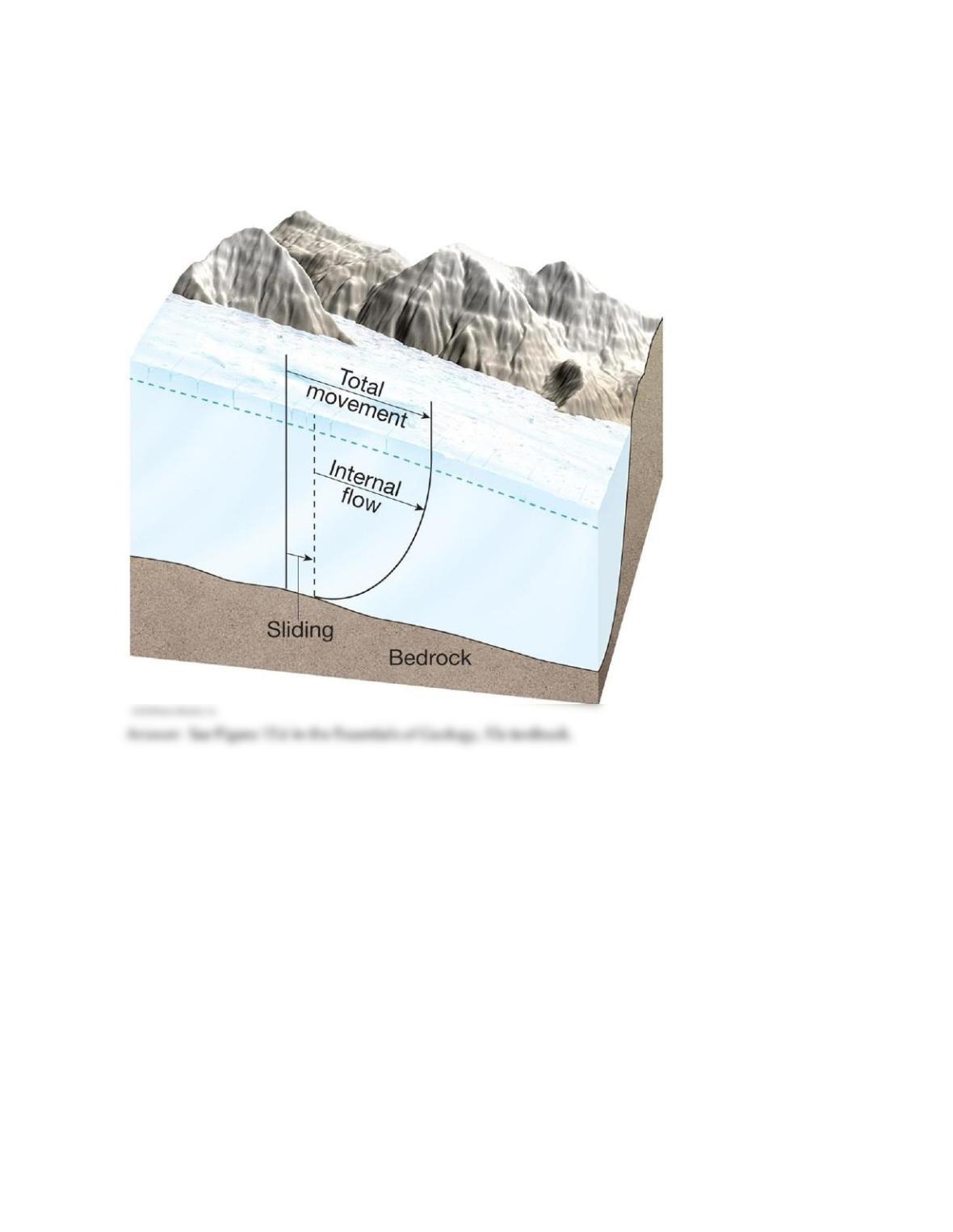
90)
Label the zones of ice movement on the glacier in the diagram below.
14
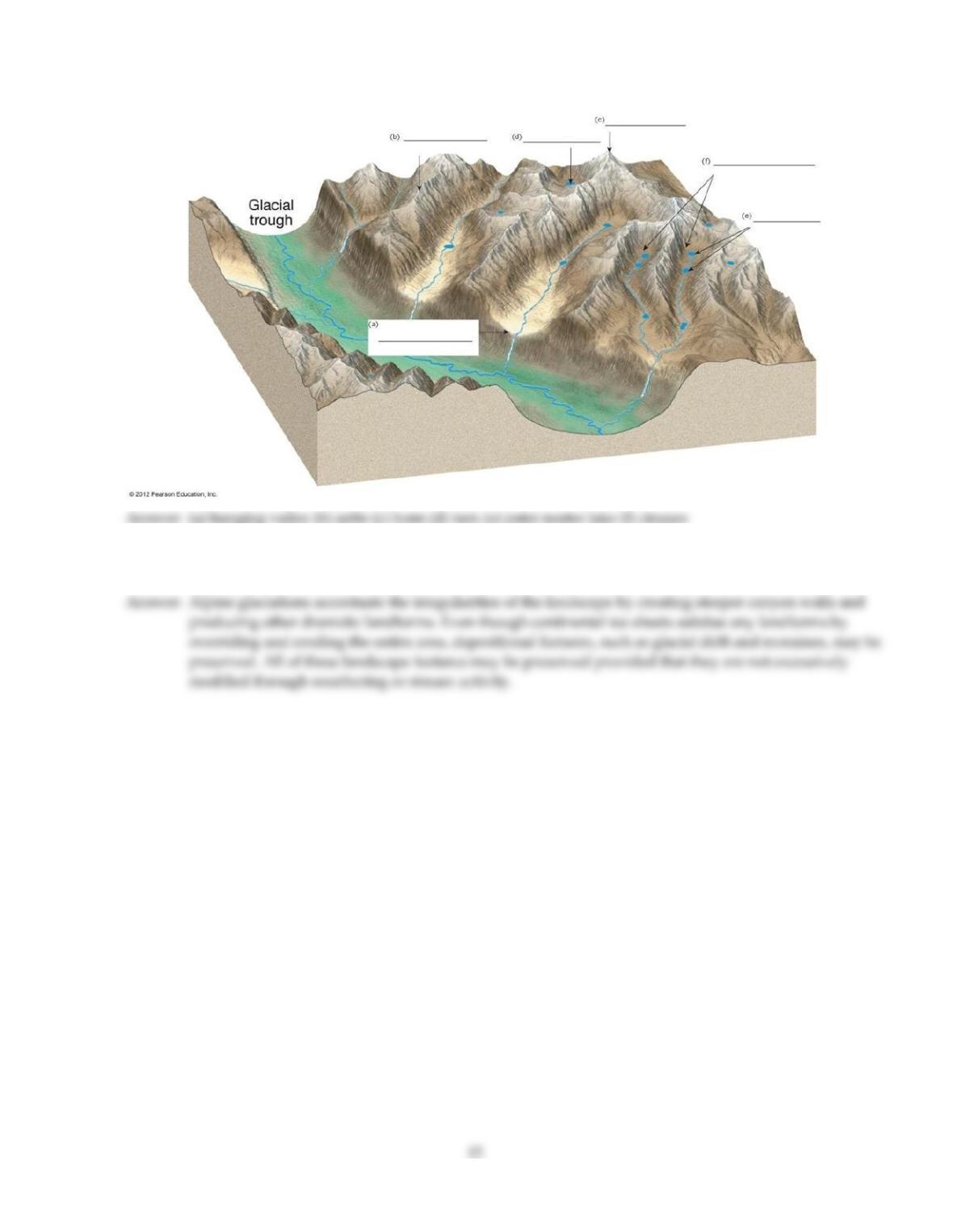
91)
On the blanks provided below, fill in the name of the labeled features that formed as a product of alpine
glaciation.
92)
Would most features of alpine glaciation be preserved in the geologic record? Why or why not? What about
continental glaciation?
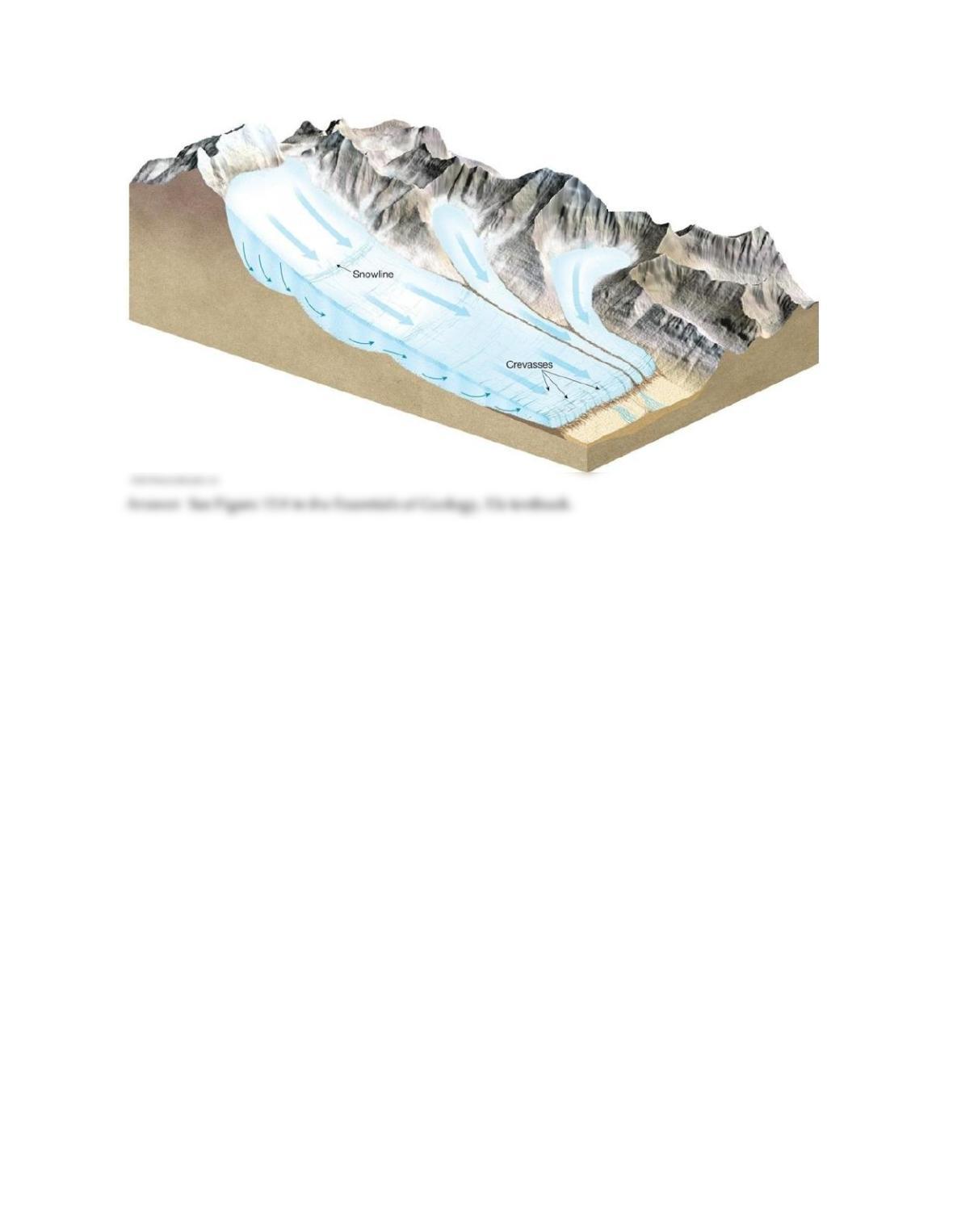
93)
Label the zone of accumulation and the zone of wastage on the diagram below.
16
Answer Key
Testname: C15
17
Answer Key
Testname: C15