Chapter 15: Investments and Fair Value Accounting
137.
Skyline, Inc. purchased a portfolio of trading securities during the current fiscal year. The cost and fair value
of
this portfolio on December 31, was as follows:
Name
Number of Shares
Total Cost
Total Fair Value
Alcon, Inc.
1,200
$16,000
$15,000
Easton Company
700
23,000
21,500
Panther Company
300
9,000
9,200
Total
$48,000
$45,700
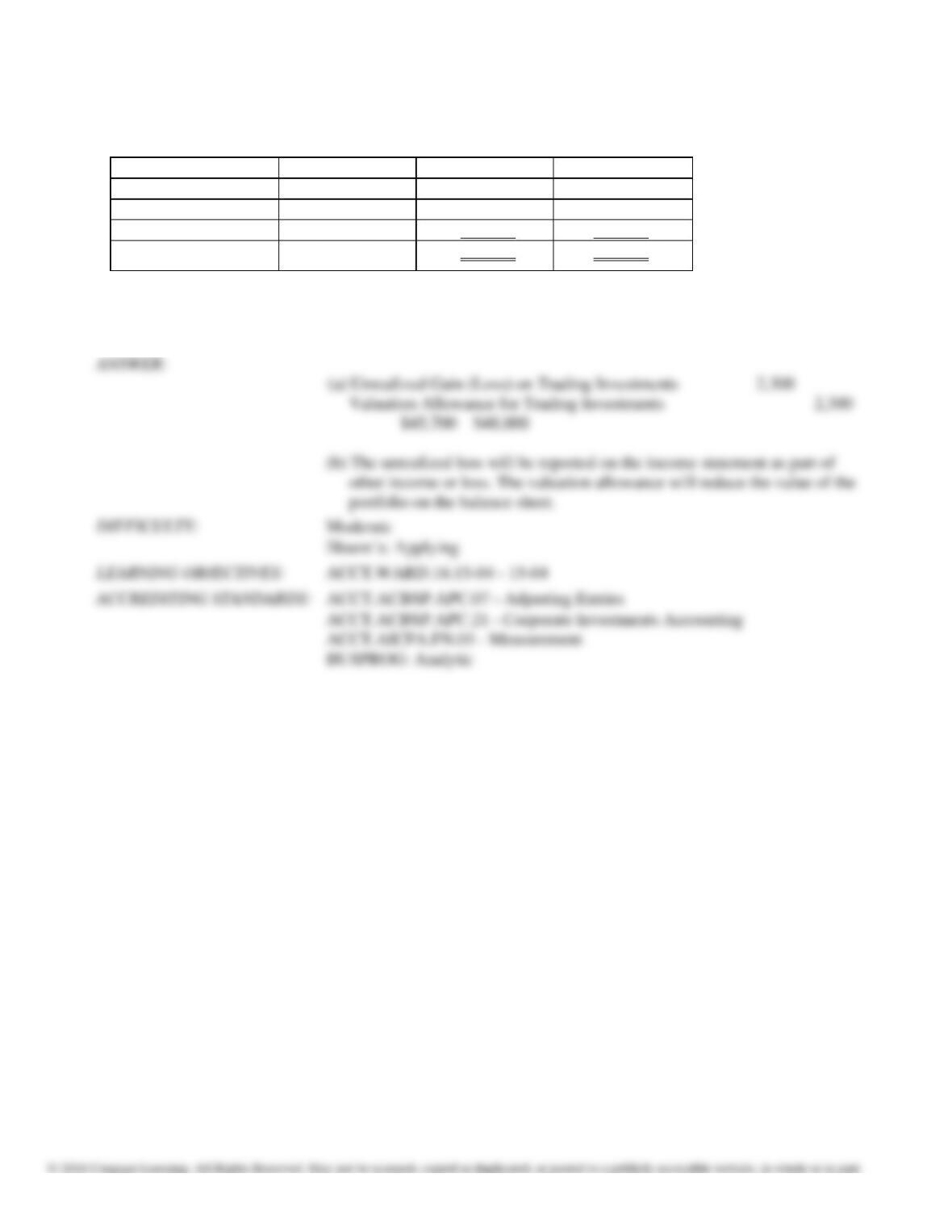
(a)
Provide the journal entry to record the adjustment of the trading security portfolio to fair value on December 31.
(b)
Where will the information from the journal entry be reported on the financial statements?
(a) Unrealized Gain (Loss) on Trading Investments
Valuation Allowance for Trading Investments
Chapter 15: Investments and Fair Value Accounting
138.
Skyline, Inc. purchased a portfolio of available-for-sale securities during the current fiscal year. The cost and
fair
value of this portfolio on December 31, was as follows:
Name
Number of Shares
Total Cost
Total Fair Value
Blackstone, Inc.
400
$ 4,000
$ 5,200
Flagler Company
200
3,000
2,700
Patterson Corporation
600
7,500
9,800
Total
$14,500
$17,700
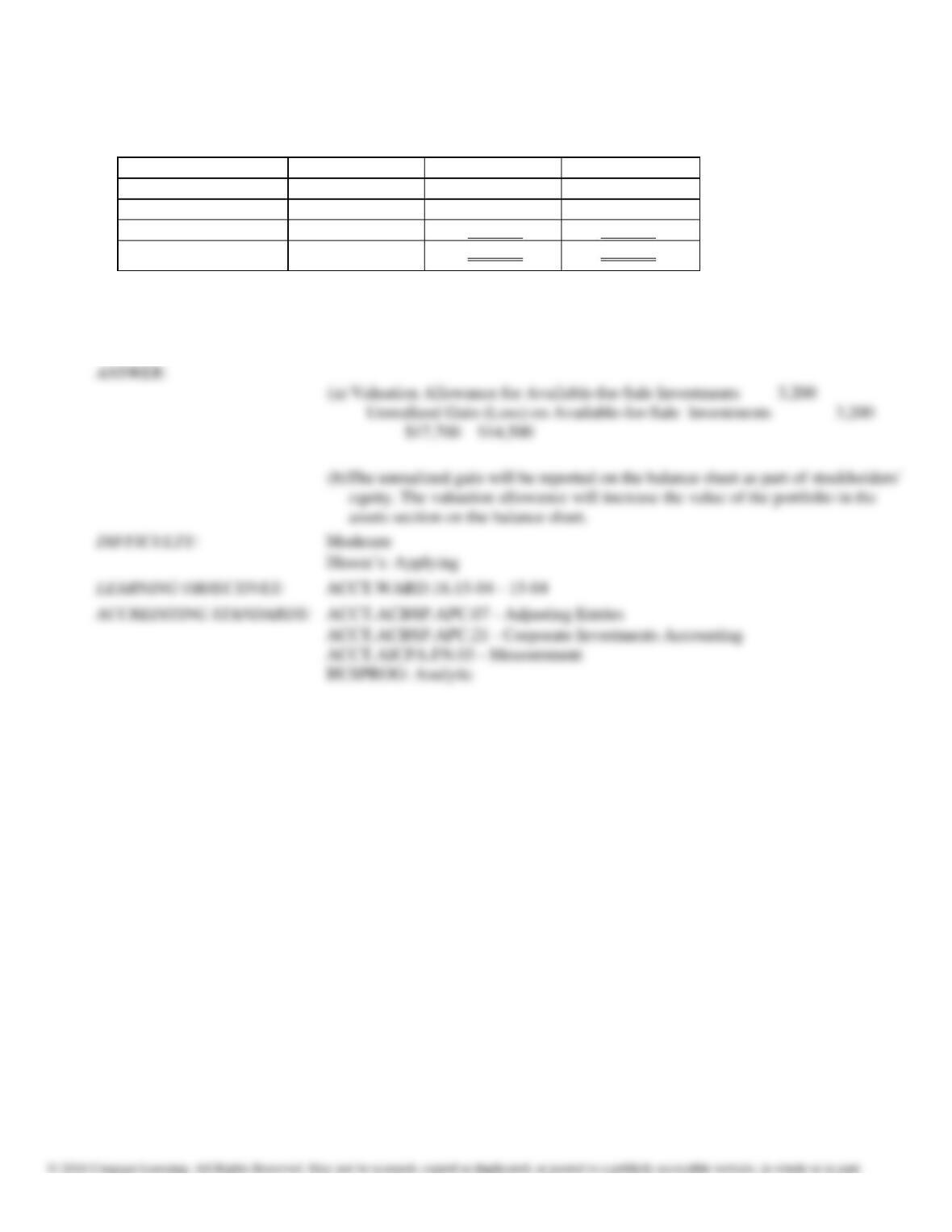
(a)
Provide the journal entry to record the adjustment of the available-for-sale security portfolio to fair value
on
December 31.
(b)
Where will the information from the journal entry be reported on the financial statements?
(a) Valuation Allowance for Available-for-Sale Investments
Unrealized Gain (Loss) on Available-for-Sale Investments
$17,700 – $14,500
Chapter 15: Investments and Fair Value Accounting
139.
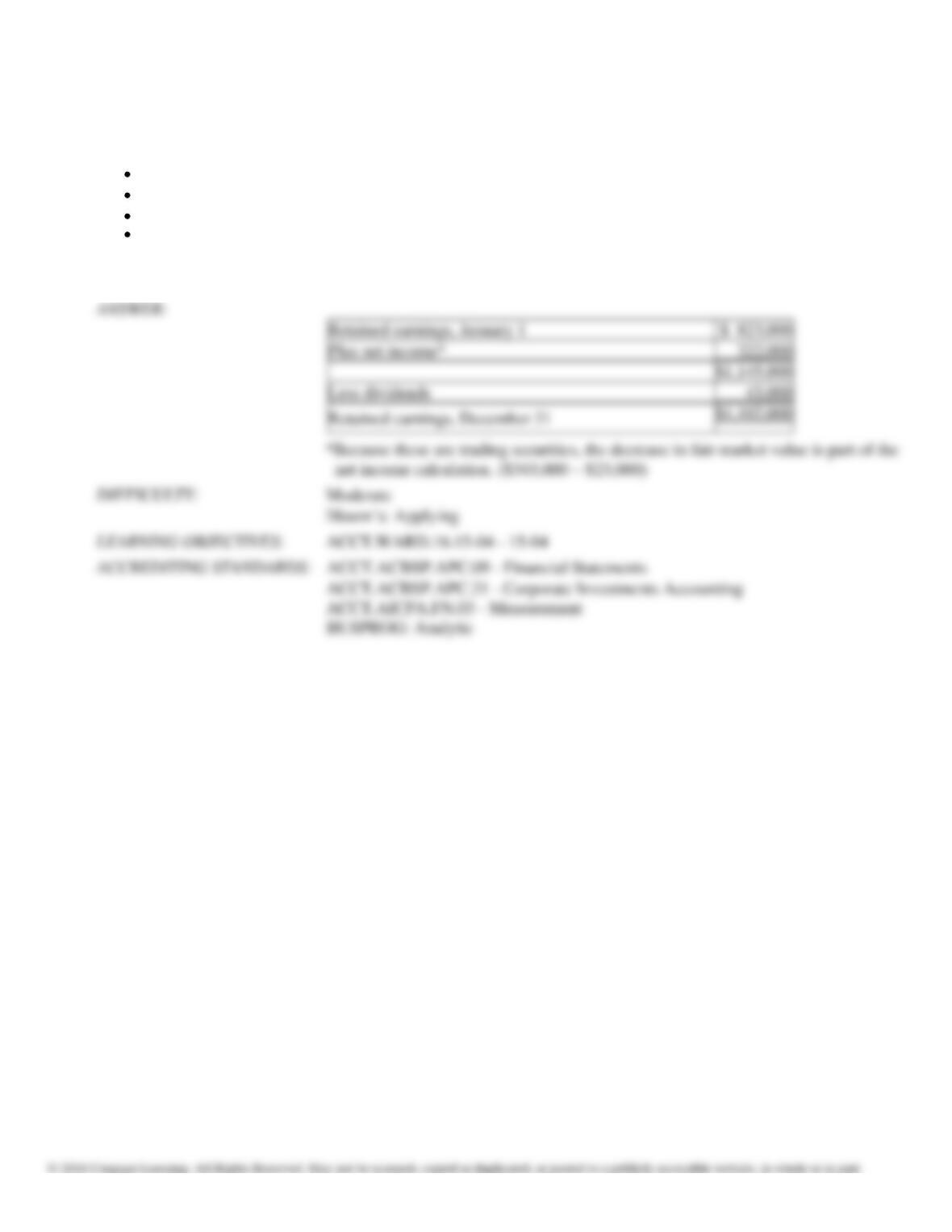
The income statement for Hudson Company reported net income of $345,000 for the year ended December
31
before considering the following:
During the year the company purchased trading securities.
At year end, the fair value of the investment portfolio was $23,000 less than cost.
The balance of Retained Earnings was $823,000 on January 1.
Hudson Company paid $43,000 in cash dividends during the year.
Calculate the balance of Retained Earnings on December 31.
Chapter 15: Investments and Fair Value Accounting
140.
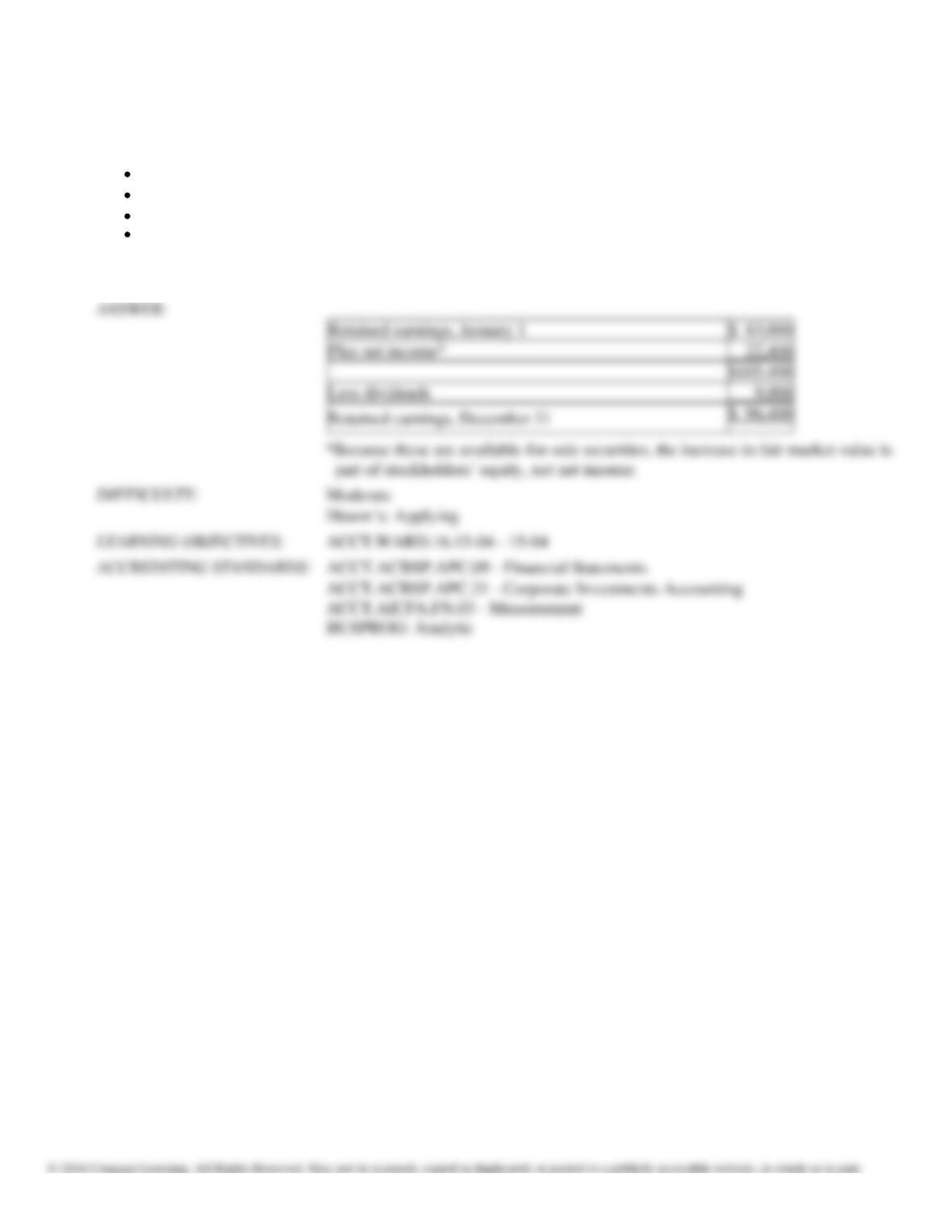
The income statement for Dodson Corporation reported net income of $22,400 for the year ended December
31
before considering the following:
During the year the company purchased available-for-sale securities.
At year end, the fair value of the investment portfolio was $2,100 more than cost.
The balance of Retained Earnings was $83,000 on January 1.
Dobson Corporation paid $9,000 in cash dividends during the year.
Calculate the balance of Retained Earnings on December 31.
Chapter 15: Investments and Fair Value Accounting
141.
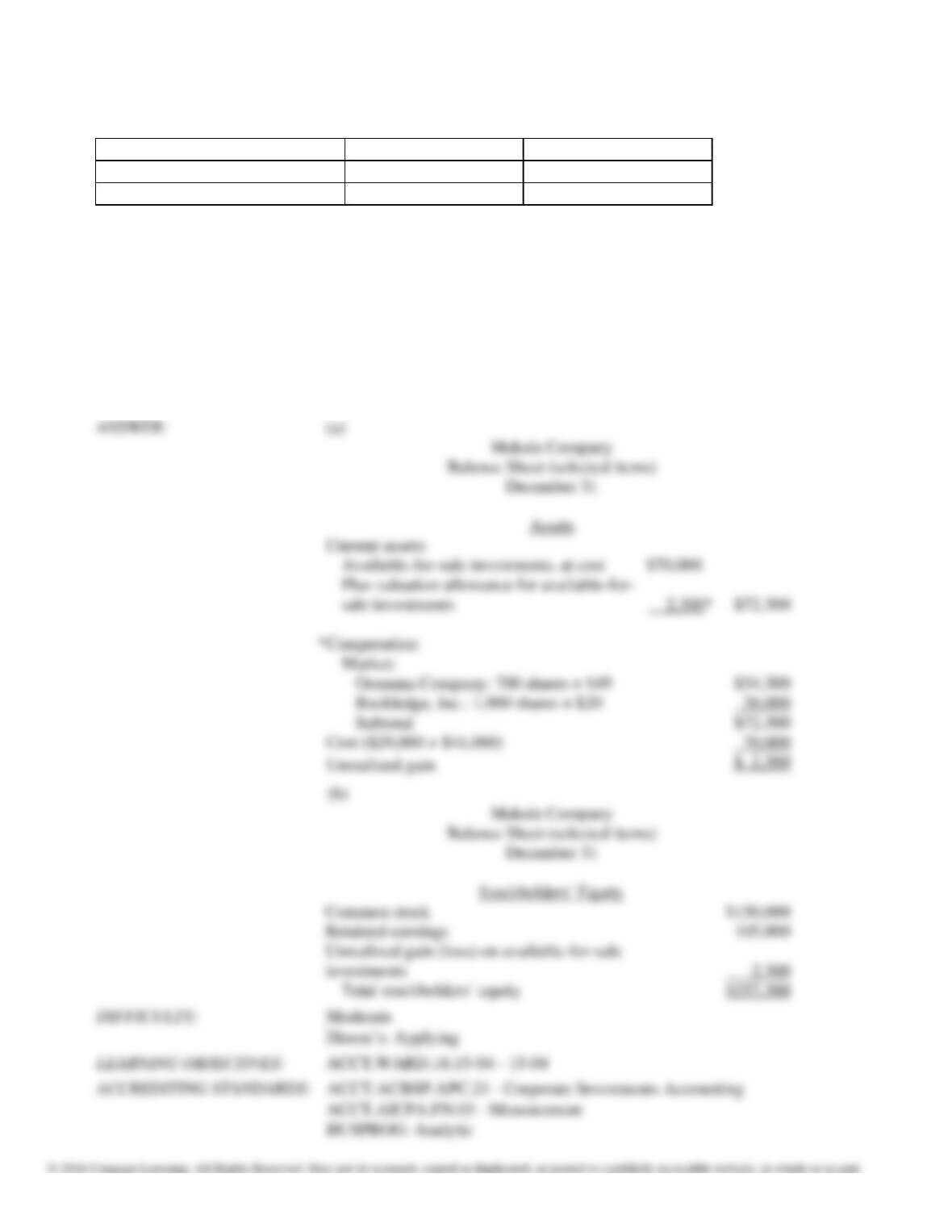
During the first year of operations, Makala Company purchased two available-for-sale investments as follows:
Security
Shares Purchased
Cost
Oceanna Company
700
$29,000
Rockledge, Inc.
1,900
41,000
Assume that as of December 31, the Oceanna Company stock had a market value of $49 per share and
Rockledge, Inc. stock had a market value of $20 per share. Makala had 10,000 shares of no par stock
outstanding
that was issued for $150,000. For the year ending December 31, Makala had a net income of
$105,000. No
dividends were paid.
(a)
Prepare the current assets section of the balance sheet presentation for the available-for sale
securities as of December 31.
(b)
Prepare the stockholders’ equity section of the balance sheet as of December 31.
Chapter 15: Investments and Fair Value Accounting
142.
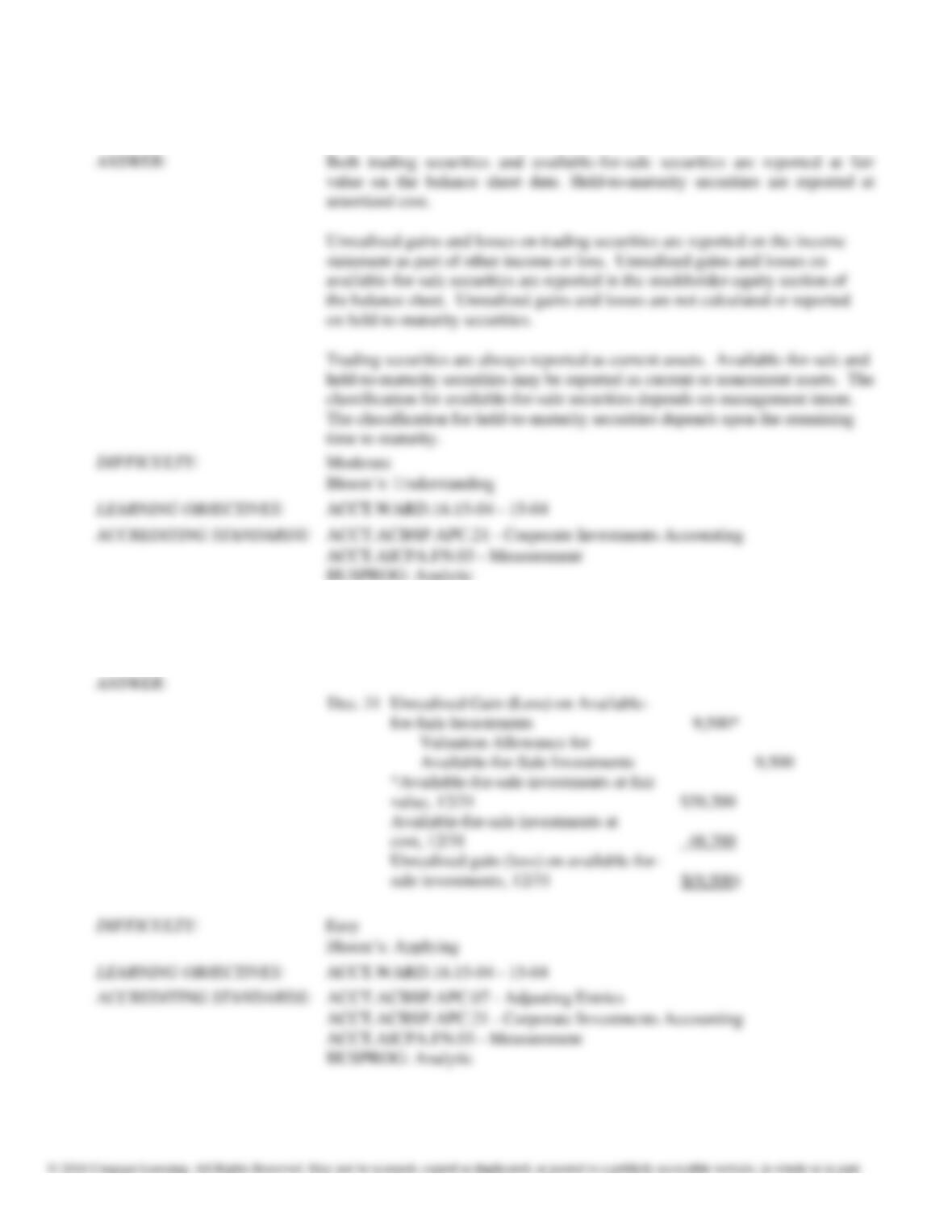
Discuss the similarities and differences in reporting trading securities, available-for-sale securities and held–
to-maturity securities.
143.
On January 1, the Valuation Allowance for Available-for-Sale Investments account had a zero balance. On
December 31, the cost of the available-for-sale securities was $48,700, and the fair value was $39,200. Prepare the
adjusting entry to record the unrealized gain or loss for available-for-sale investments on December 31.
Chapter 15: Investments and Fair Value Accounting
144.
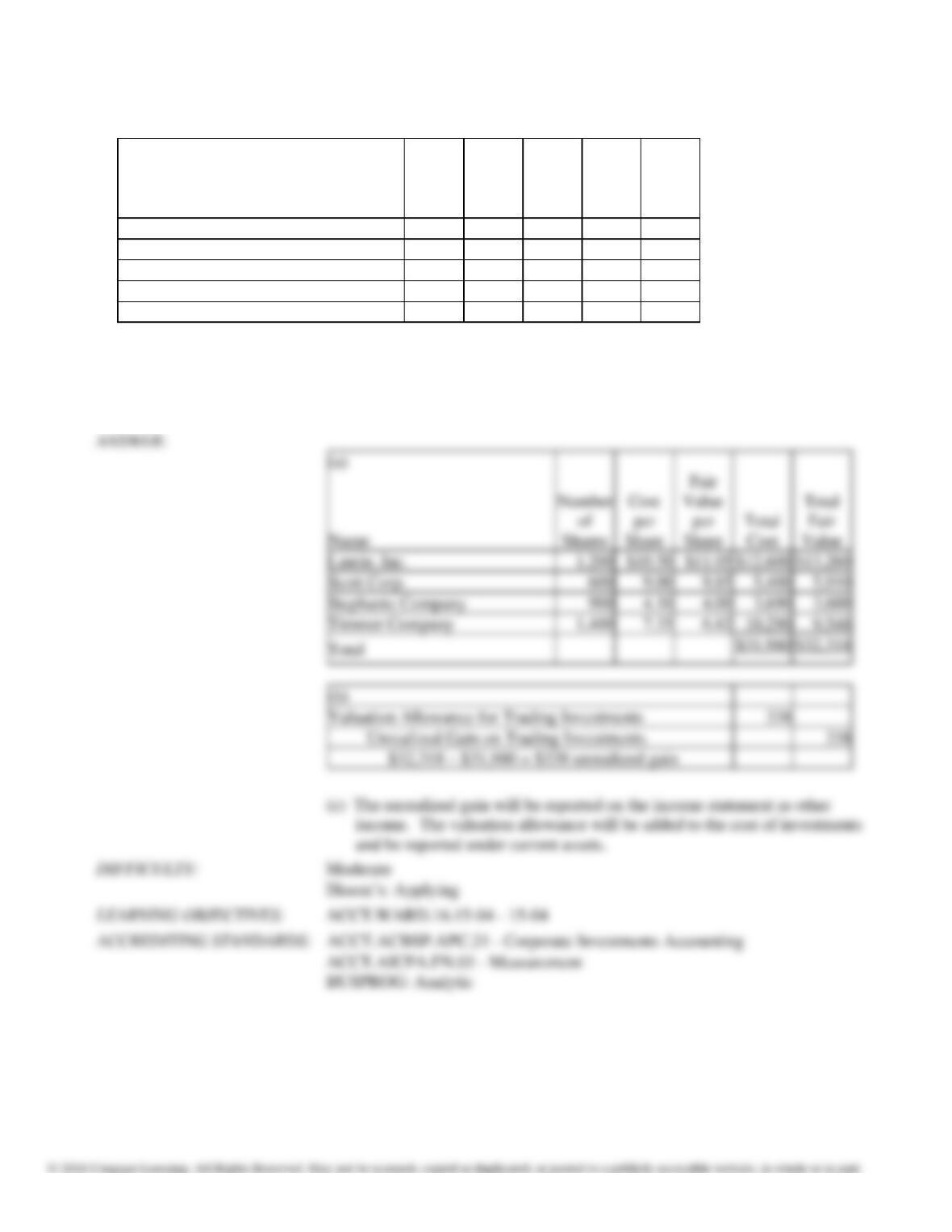
The cost and fair value of the trading securities held by Lindy Company as of December 31 are as follows:
Name
Number
of
Shares
Cost
per
Share
Fair
Value
per
Share
Total
Cost
Total
Fair
Value
Laurie, Inc.
1,200
$10.50
$11.05
Scott Corp.
600
9.00
9.85
Stephanie Company
900
4.10
4.00
Timmer Company
1,400
7.35
6.82
Total
(a) Complete the table above to find the total cost and fair value for the company’s trading securities portfolio.
(b) Calculate and record the required December 31 adjustment.
(c) Explain how the adjustment from step (b) is reported on Lindy’s financial statements.
Laurie, Inc.
1,200
$10.50
$11.05
Scott Corp.
600
9.00
9.85
5,400
5,910
Stephanie Company
900
4.10
4.00
3,690
3,600
Timmer Company
1,400
7.35
6.82
(b)
Valuation Allowance for Trading Investments
338
338
$32,318 – $31,980 = $338 unrealized gain
Chapter 15: Investments and Fair Value Accounting
145.
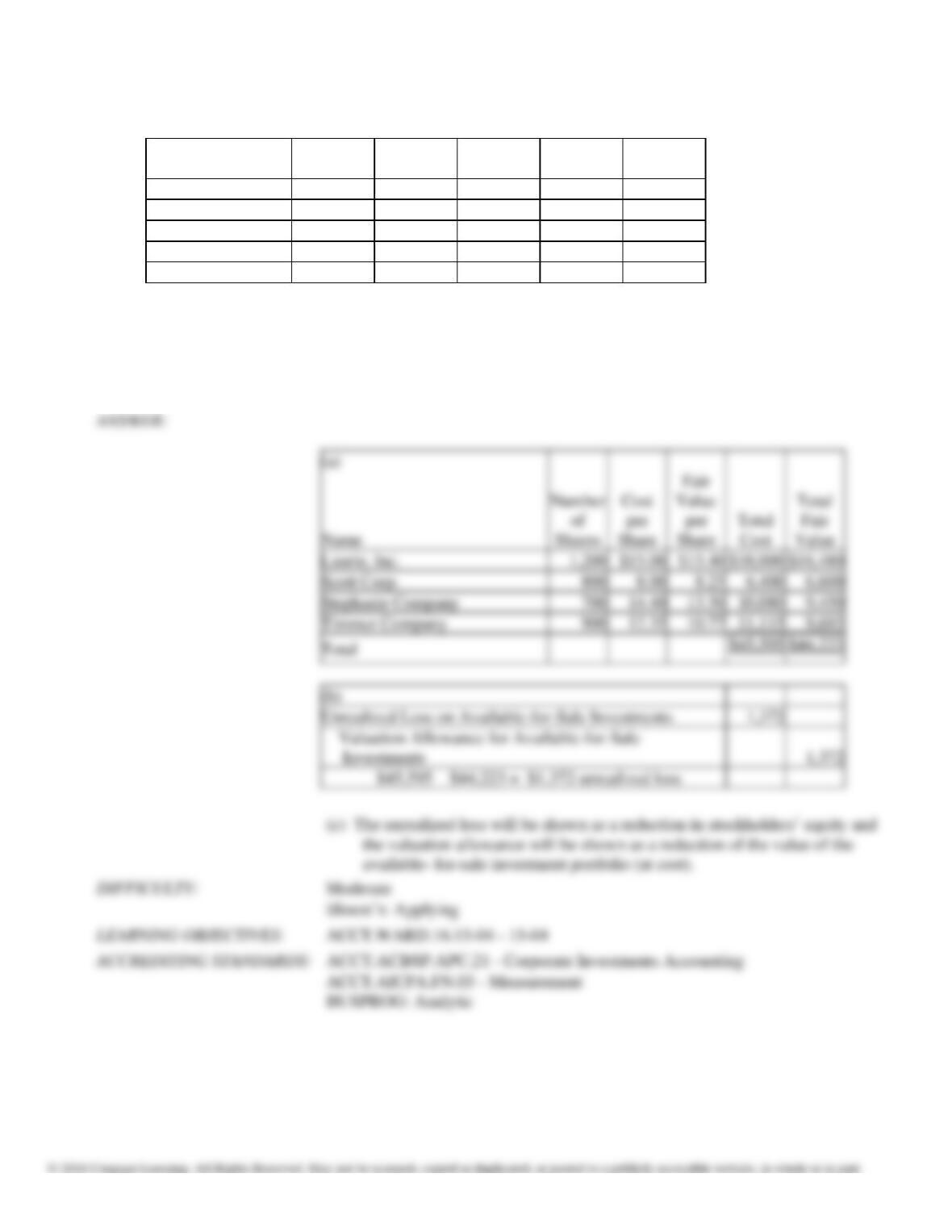
Following is data for the available-for-sale securities held by Lindy Company as of December 31:
Name
Number of
Shares
Cost
per Share
Fair Value
per Share
Total Cost
Total
Fair Value
Laurie, Inc.
1,200
$15.00
$15.40
Scott Corp.
800
8.00
8.25
Stephanie Company
700
14.40
13.50
Timmer Company
900
12.35
10.77
Total
(a) Complete the table above to find the total cost and fair value for the company’s availableforsale securities
portfolio.
(b) Calculate and record the required December 31 adjustment.
(c) Explain how the adjustment from step (2) is reported on Lindy’s financial statements.
Laurie, Inc.
Scott Corp.
Stephanie Company
Timmer Company
(b)
Unrealized Loss on Available-for-Sale Investments
Chapter 15: Investments and Fair Value Accounting
146.
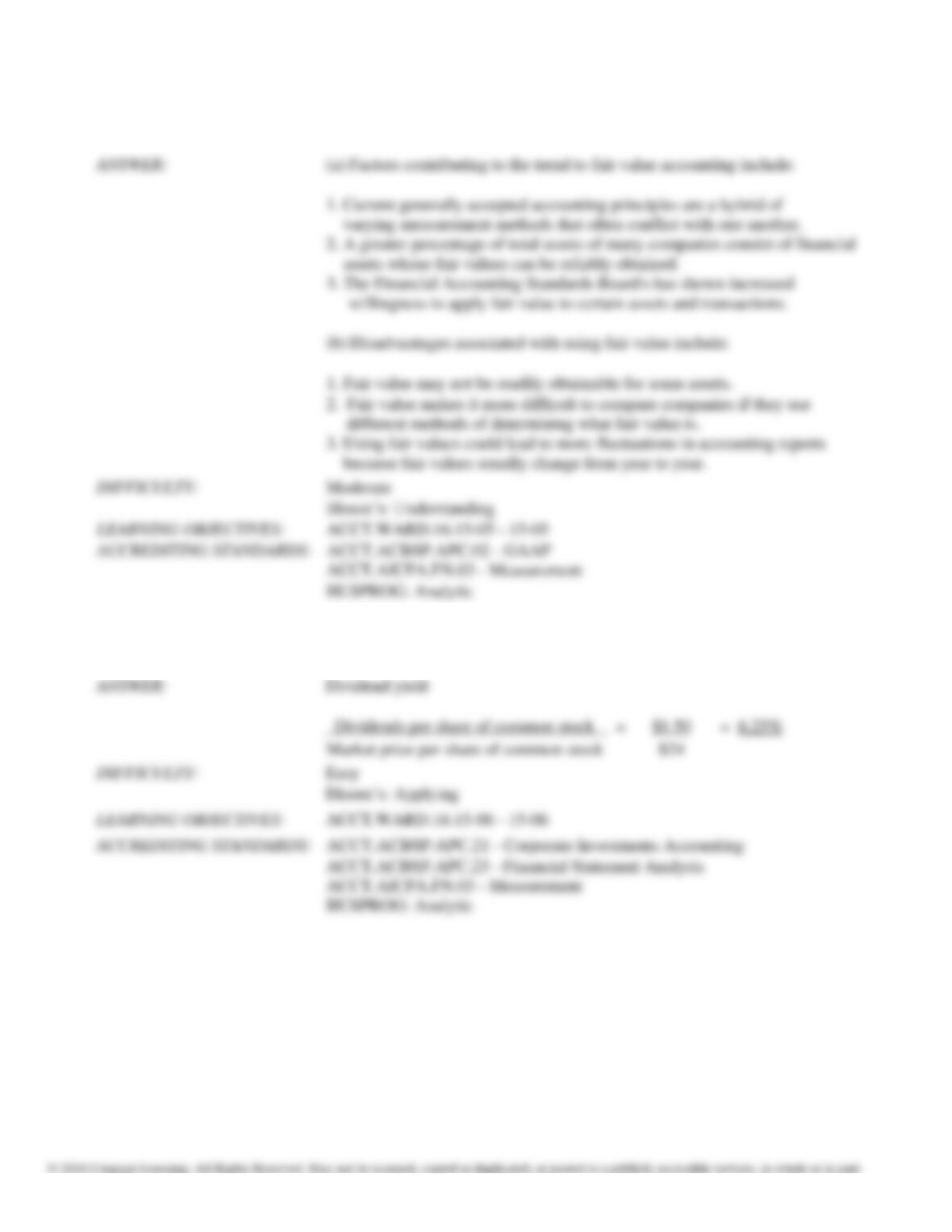
(a) Discuss factors contributing to the trend to fair value accounting.
(b)
What are some of the disadvantages associated with using fair value?
147.
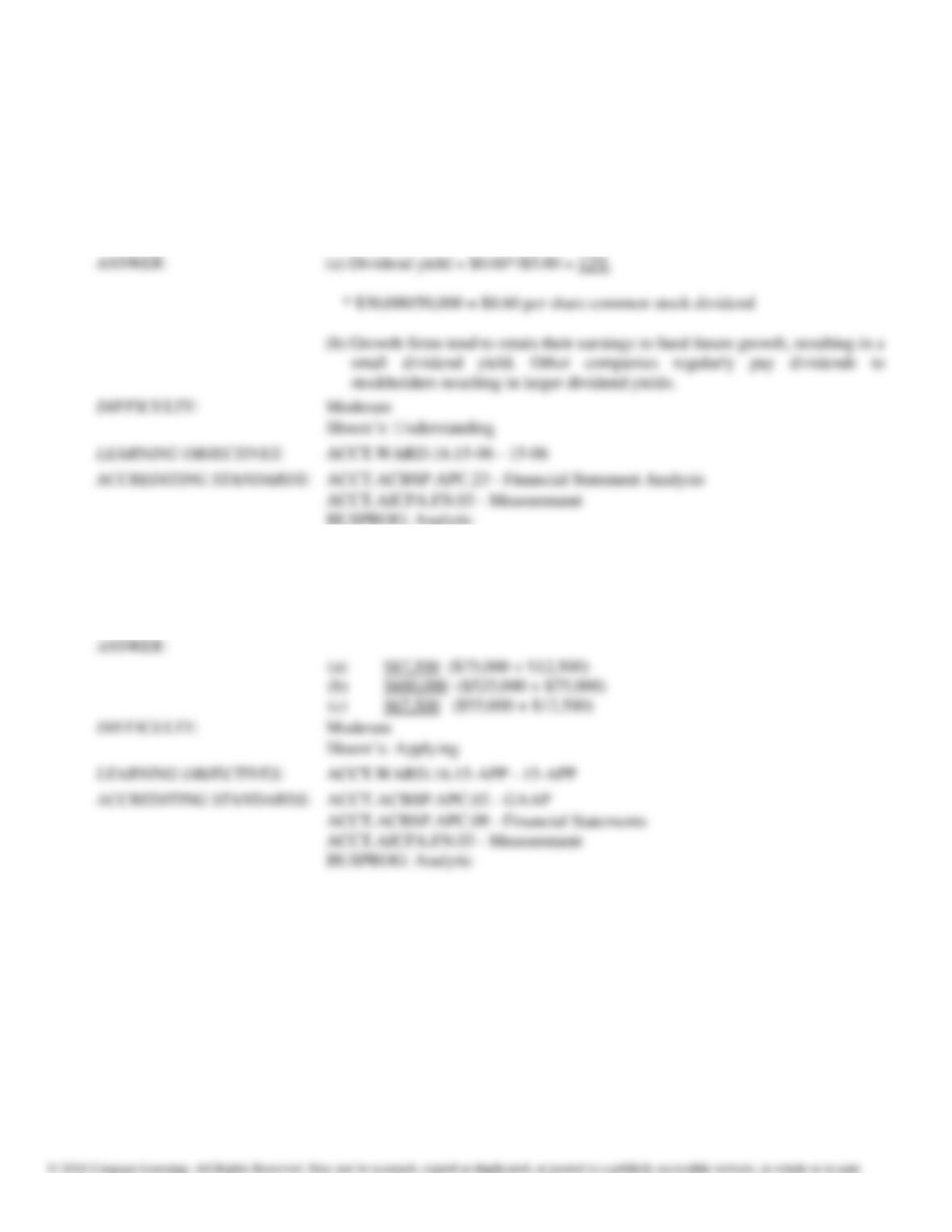
On April 1, ValueTime, Inc. had a market price per common share of $24. For the previous year, ValueTime paid a
dividend of $1.50 per share.
Compute the dividend yield for ValueTime, Inc.
Chapter 15: Investments and Fair Value Accounting
148.
Nicer Corporation reported net income of $50,000 in the current year. There are 10,000 shares of $100 par, 6%
preferred stock and 50,000 shares of $2 par common stock outstanding. During the year, Nicer paid the preferred
stockholders a $6 per share dividend and also paid $30,000 to common shareholders. The market value of Nicer’s
stock is preferred stock, $95, and common stock, $5.00.
(a) Calculate Nicer’s dividend yield.
(b) Why does the dividend yield vary widely across firms?
149.
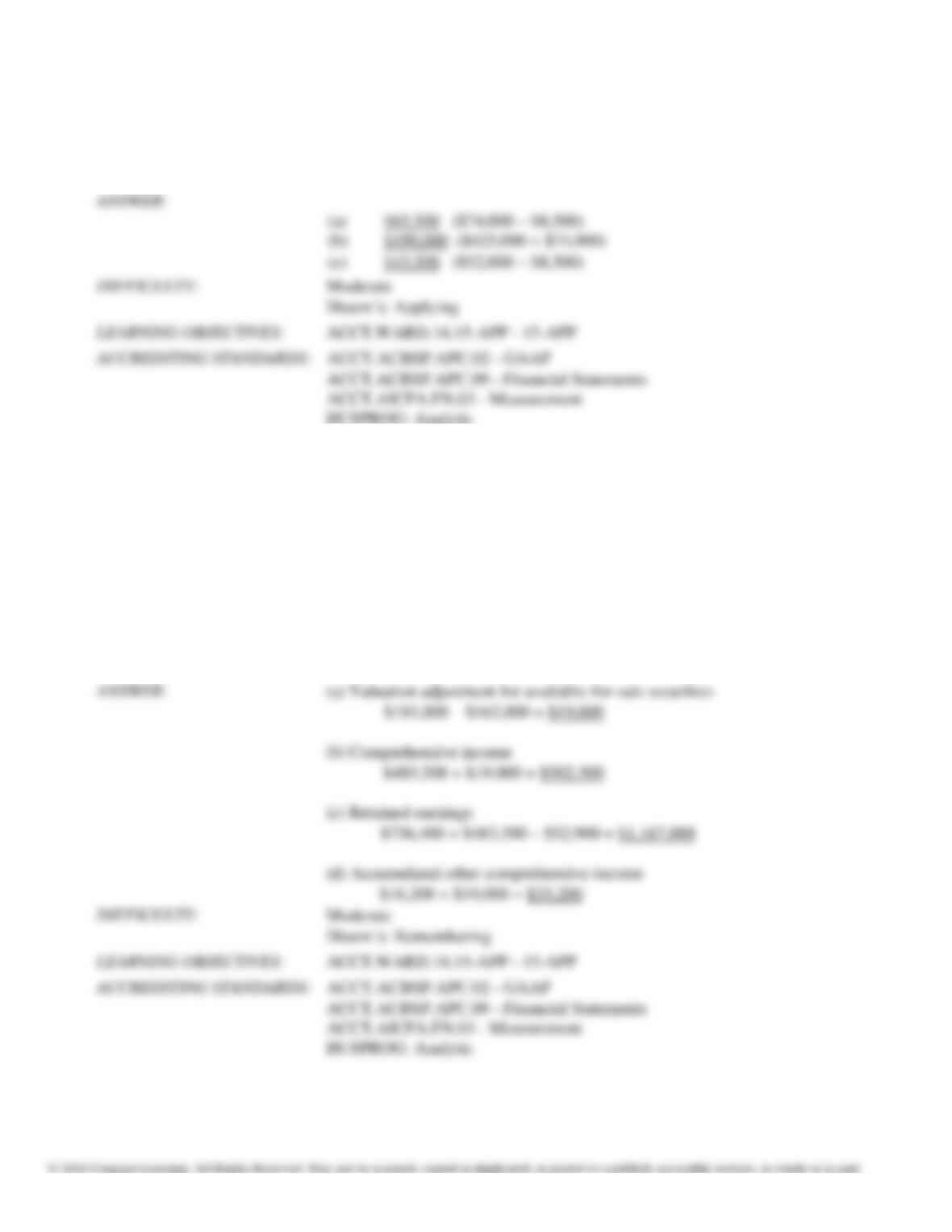
Gerardo Company had a net income of $75,000 and other comprehensive income of $12,500 for the year. On
January 1, the retained earnings balance was $525,000 and the accumulated other comprehensive income
balance
was $55,000. Determine the (a) comprehensive income for the year, (b) retained earnings balance on
December
31, and (c) the accumulated other comprehensive income on December 31.
Chapter 15: Investments and Fair Value Accounting
150.
Herberto Company had a net income of $74,000 and other comprehensive loss of $8,500 for the year. On
January
1, the retained earnings balance was $425,000 and the accumulated other comprehensive income
balance was $52,000. Determine the (a) comprehensive income for the year, (b) retained earnings balance on
December 31,
and (c) the accumulated other comprehensive income on December 31.
151.
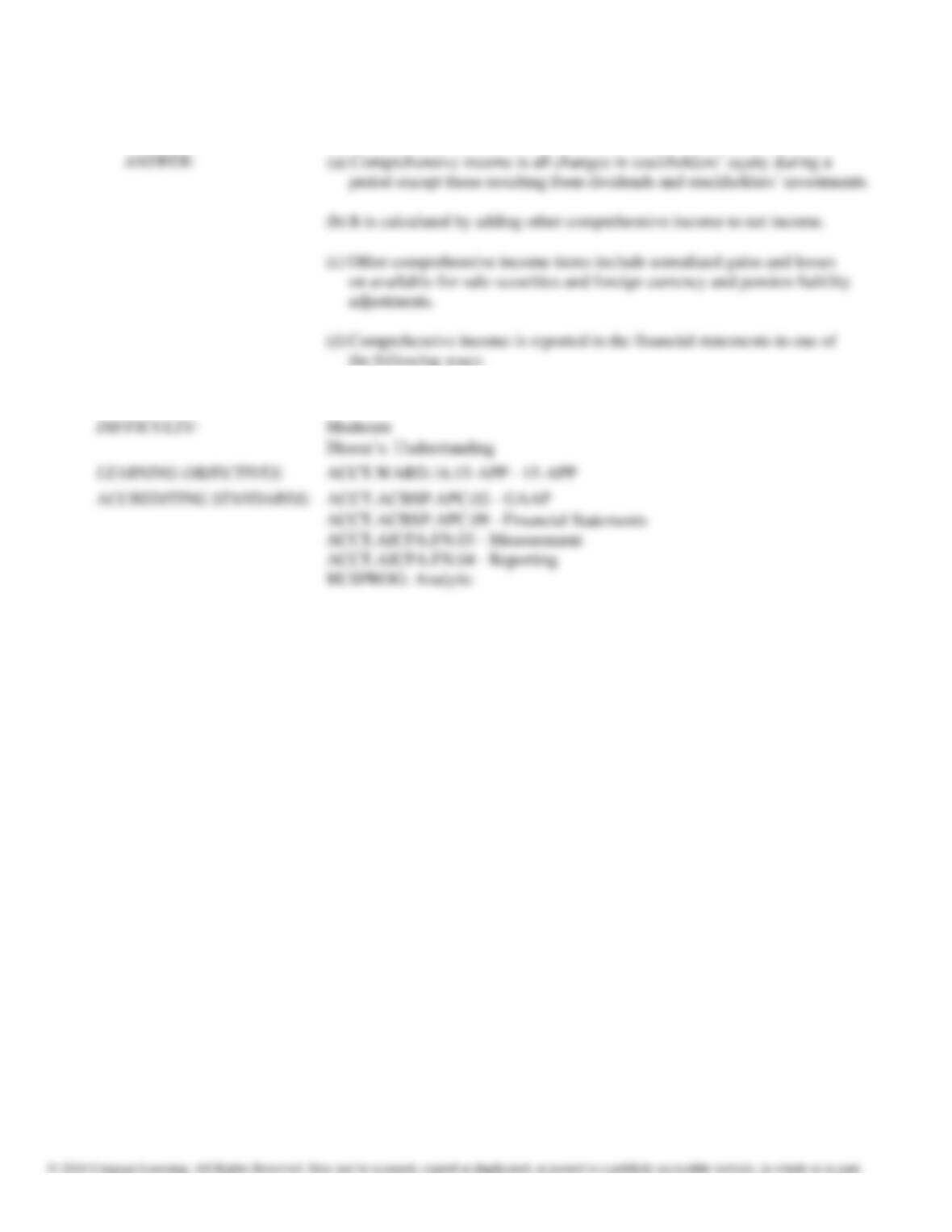
LM’s, Inc. reported net income for the year ending December 31 of $483,500. Dividends paid during the year
totaled $52,900. The company holds available-for-sale securities with an original cost of $162,000 and a fair
value
of $181,000 at the end of the year. They also hold trading securities with an original cost of $150,000 and
a fair
value of $147,000. Retained earnings on January 1 was $736,400 and accumulated other comprehensive
income
on January 1 as $16,200.
Calculate the following balances to be reported in the financial statements dated December 31.
(a)
Valuation allowance for available-for-sale securities
(b)
Comprehensive income
(c)
Retained earnings
(d)
Accumulated other comprehensive income
Chapter 15: Investments and Fair Value Accounting
152.
(a) What is comprehensive income? (b) How is it calculated? (c) What are some examples of items included in
other comprehensive income? (d) Where is comprehensive income reported?
the
1.
On the income statement
2.
In a separate statement of comprehensive income

Chapter 15: Investments and Fair Value Accounting
Match each of the definitions that follow with the appropriate investment term (a–j).
a.
debt securities
b.
equity securities
c.
investor
d.
investee
e.
cost method
f.
trading securities
g.
available-for-sale securities
h.
held-to-maturity securities
i.
equity method
j.
business combination
DIFFICULTY: Easy
Bloom’s: Remembering
LEARNING OBJECTIVES: ACCT.WARD.16.15-01 – 15–01
ACCT.WARD.16.15-03 – 15–03
ACCT.WARD.16.15-04 – 15–04
ACCREDITING STANDARDS: ACCT.ACBSP.APC.21 – Corporate Investments Accounting
ACCT.AICPA.FN.03 – Measurement
BUSPROG: Analytic
153.
debt and equity securities purchased and sold to earn short-term profits from changes in the market price
154.
preferred and common stock that represent ownership in a company and do not have a fixed maturity date
155.
the method of reporting an investment that represents less than 20% of the voting stock of another company
156.
when using this, dividends are treated as a reduction of the investment
157.
notes and bonds that pay interest and have a fixed maturity
158.
debt investments that a company intends to keep until their maturity date

Chapter 15: Investments and Fair Value Accounting
159.
securities not held for trading or to maturity or other strategic reasons
160.
the company investing in another company’s stock
161.
what occurs when a company purchases 50% or more of another company’s stock
162.
the company whose stock is purchased by another entity
Match each of the definitions that follow with the appropriate investment term (a–j).
a.
equity method
b.
parent company
c.
subsidiary company
d.
consolidated financial statements
e.
fair value
f.
unrealized gain or loss on investments.
g.
valuation allowance for investments
h.
dividend yield
i.
amortized cost
j.
cost method
DIFFICULTY: Easy
Bloom’s: Remembering
LEARNING OBJECTIVES: ACCT.WARD.16.15-03 – 15–03
ACCT.WARD.16.15-04 – 15–04
ACCT.WARD.16.15-06 – 15–06
ACCREDITING STANDARDS: ACCT.ACBSP.APC.21 – Corporate Investments Accounting
ACCT.ACBSP.APC.23 – Financial Statement Analysis
ACCT.AICPA.FN.03 – Measurement
ACCT.AICPA.FN.04 – Reporting
BUSPROG: Analytic
163.
a corporation owning all or the majority of the voting stock of another corporation

Chapter 15: Investments and Fair Value Accounting
164.
a balance sheet account where the fair value adjustment for investments is reported
165.
a corporation controlled by another corporation that owns all or the majority of its voting stock
166.
the method for accounting for investments of 20–50% in another company’s stock
167.
the market price that would be received if an investment were sold
168.
measurement of the rate of return to stockholders based on cash dividends
169.
combined reporting of a corporation and other corporations it controls
170.
recognition of changes in the fair value of short-term investments
171.
the value assigned to held–to-maturity securities
172.
appropriate method for accounting for small stock investments