21) Which of the following is an advantage of the FCFS dispatching rule when used in services?
A) FCFS maximizes utilization.
B) FCFS minimizes the average number of jobs in the system.
C) FCFS minimizes the average lateness of all jobs.
D) FCFS maximizes the number of jobs completed on time.
E) FCFS seems fair to customers.
22) What does the use of the shortest processing time sequencing rule generally produce?
A) maximum average lateness
B) maximum utilization
C) maximum effectiveness
D) minimum average flow time
E) B and D
23) When a set of jobs must pass through two workstations whose sequence is fixed, ________ is the
sequencing rule most commonly applied.
A) critical ratio
B) earliest due date
C) first come, first served
D) slack time remaining
E) Johnson’s rule
24) Five jobs are waiting for processing through two work centers. Their processing time (in minutes) at
each work center is contained in the table below. Each job requires work center Alpha before work center
Beta. According to Johnson’s rule, which job should be scheduled first in the sequence?
Job Alpha Beta
R 20 10
S 25 35
T 50 20
U 15 35
V 55 75
A) R
B) S
C) T
D) U
E) V
25) Five jobs are waiting for processing through two work centers. Their processing time (in minutes) at
each work center is contained in the table below. Each job requires work center Sigma before work center
Delta. According to Johnson’s rule, what sequence of jobs will minimize the completion time for all jobs?
Job Sigma Delta
R 40 10
S 25 30
T 50 20
U 35 35
V 55 15
A) R-S-T-U-V
B) S-V-T-R-U
C) S-U-T-V-R
D) V-R-U-S-T
E) R-V-T-S-U
26) Which of the following is a limitation of rules-based dispatching systems?
A) Rules need to be revised to adjust to changes in orders, product mix, and so forth.
B) Rules may not recognize idle resources.
C) Rules may not recognize bottleneck resources
D) Rules may not be able to prioritize two jobs with identical due dates.
E) All of the above are limitations.
27) Five jobs are waiting for processing through two work centers. Their processing time (in minutes) at
each work center is contained in the table below. Each job requires work center Alpha before work center
Beta. According to Johnson’s rule, what is the optimum sequence of jobs and the minimum time for
completion of all jobs?
Job Alpha Beta
R 20 10
S 25 35
T 50 20
U 15 35
V 55 75
A) V-T-S-U-R; 225
B) U-R-T-S-V; 175
C) R-S-T-U-V; 240
D) U-S-V-T-R; 200
E) R-U-T-S-V; 175
28) ________ determines the order in which jobs should be done at each work center.
29) ________ determine the sequence of jobs in process-oriented facilities.
30) The priority rule that appears fair to customers in service systems is ________.
31) An approach to sequencing that can handle the situation where jobs must pass through two or more
work centers in a fixed sequence is ________.
32) What does Johnson’s rule do?
33) In retail outlets, customers are usually processed on a first come, first served basis. Why? Is the
express lane in the supermarket an exception? Craft a sequencing rule to explain express lane behavior.
34) What is the primary disadvantage of the shortest processing time dispatch rule? Is this a problem if
there can be no new jobs arriving after the sequence is set?
35) Consider the arrival of patients into a public health clinic. Some patients are ill; some are injured;
some are elderly; and some are very young. Some cases may be life-threatening, while others are
inconsequential. How do the basic dispatch rules fall short in this situation? Design a dispatch rule for
scheduling these patients.
36) What are four main criteria by which we evaluate sequencing rules?
37) What are some limitations of rule-based scheduling systems?
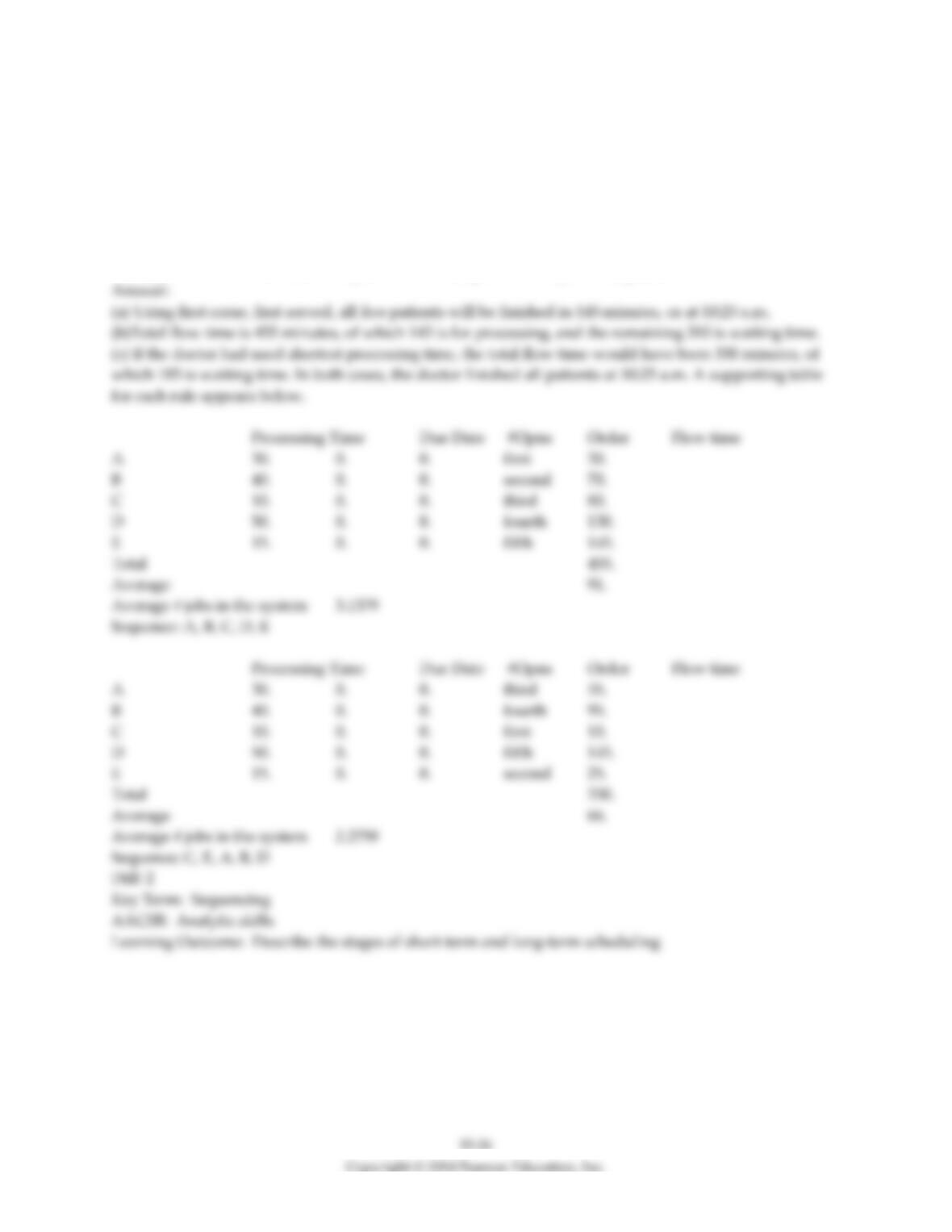
38) A practitioner of family medicine begins her day with five patients needing urgent care. She does a
very brief assessment of what each patient appears to need and estimates the time required of each. None
of the cases is life-threatening, and so she determines to take the five in the order that they arrived at the
clinic. The processing-time data for these patients, in the order they arrived, are: Patient A, 30 minutes;
Patient B, 40 minutes; Patient C, 10 minutes; Patient D, 50 minutes; and Patient E, 15 minutes.(a) If it is
now 8:00 a.m., at what time will the doctor be finished with all five of these emergencies?(b) How much
time will the five patients have collectively spent waiting?(c) How much less time would have been spent
waiting if the doctor had taken the patients according to shortest processing time?
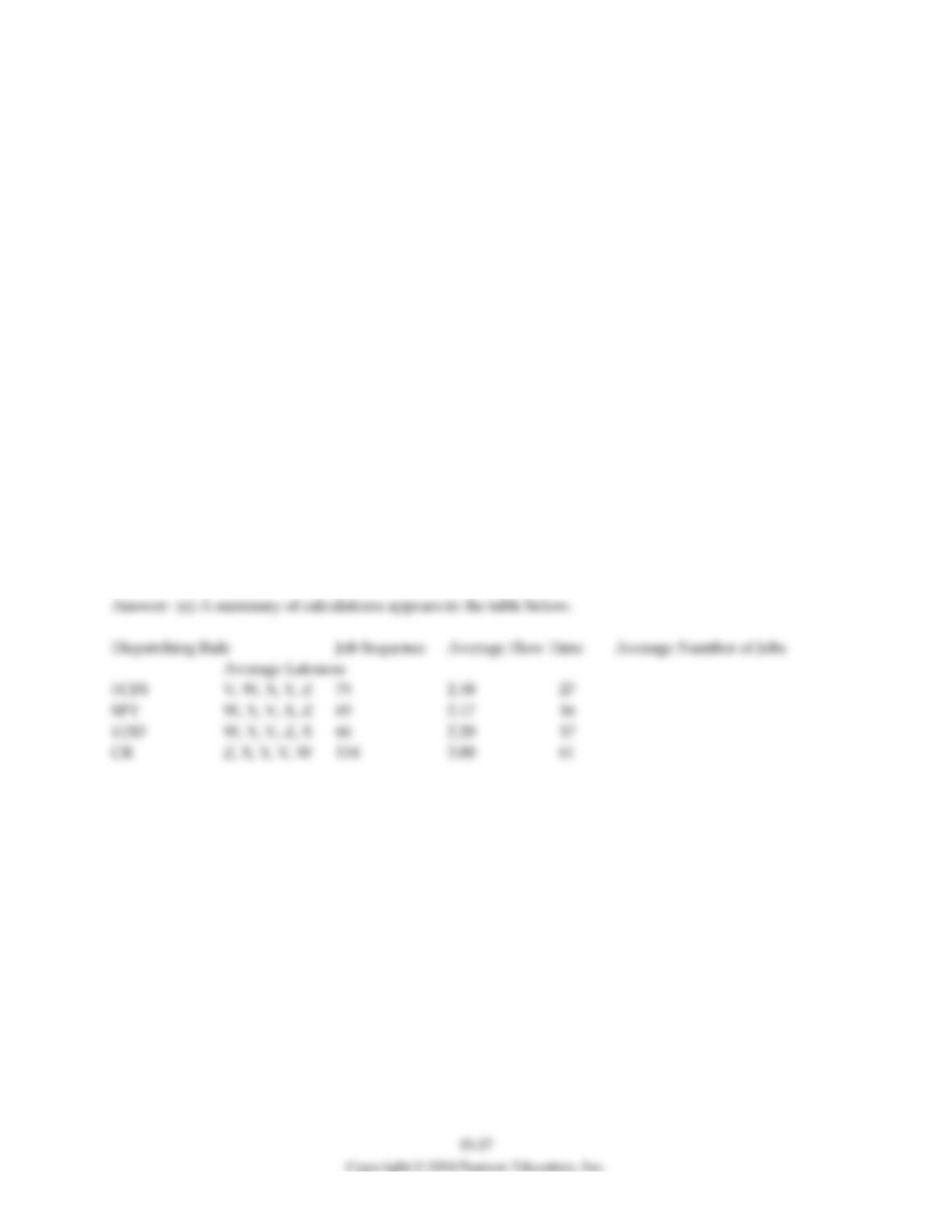
39) Jack’s Refrigeration Repair is under contract to repair, recondition, and/or refurbish commercial and
industrial icemakers from restaurants, seafood processors, and similar organizations. Jack currently has
five jobs to be scheduled, shown in the order in which they arrived.
Job Processing Time (hours) Due (hours)
V 20 50
W 10 35
X 50 90
Y 15 35
Z 55 75
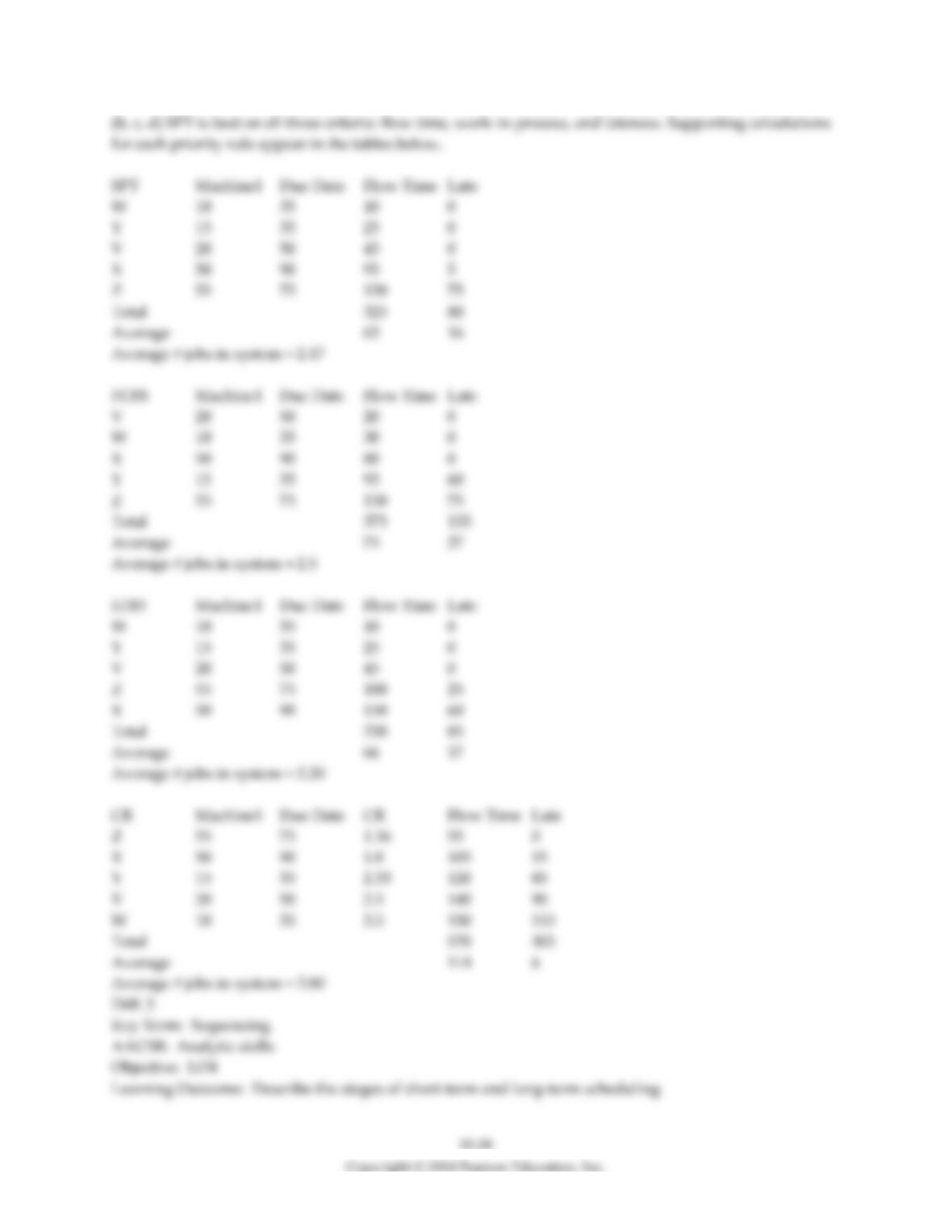
(a) Complete the following table. (Show your supporting calculations below).
(b) Which dispatching rule has the best score for flow time?
(c) Which dispatching rule has the best score for work–in-process (jobs in the system)?
(d) Which dispatching rule has the best score for lateness?
Dispatching Rule Job Sequence Average Flow Time Average Number of Jobs
Average Lateness
FCFS
SPT
EDD
CR
40) The operations manager of a body and paint shop has five cars to schedule for repair. He would like
to minimize the throughput time (makespan) to complete all work on these cars. Each car requires body
work prior to painting. The estimates of the times required to do the body and paint work on each are as
follows:
Car Body Work (Hours) Paint (Hours)
A 8 7
B 9 4
C 7 9
D 3 4
E 12 5
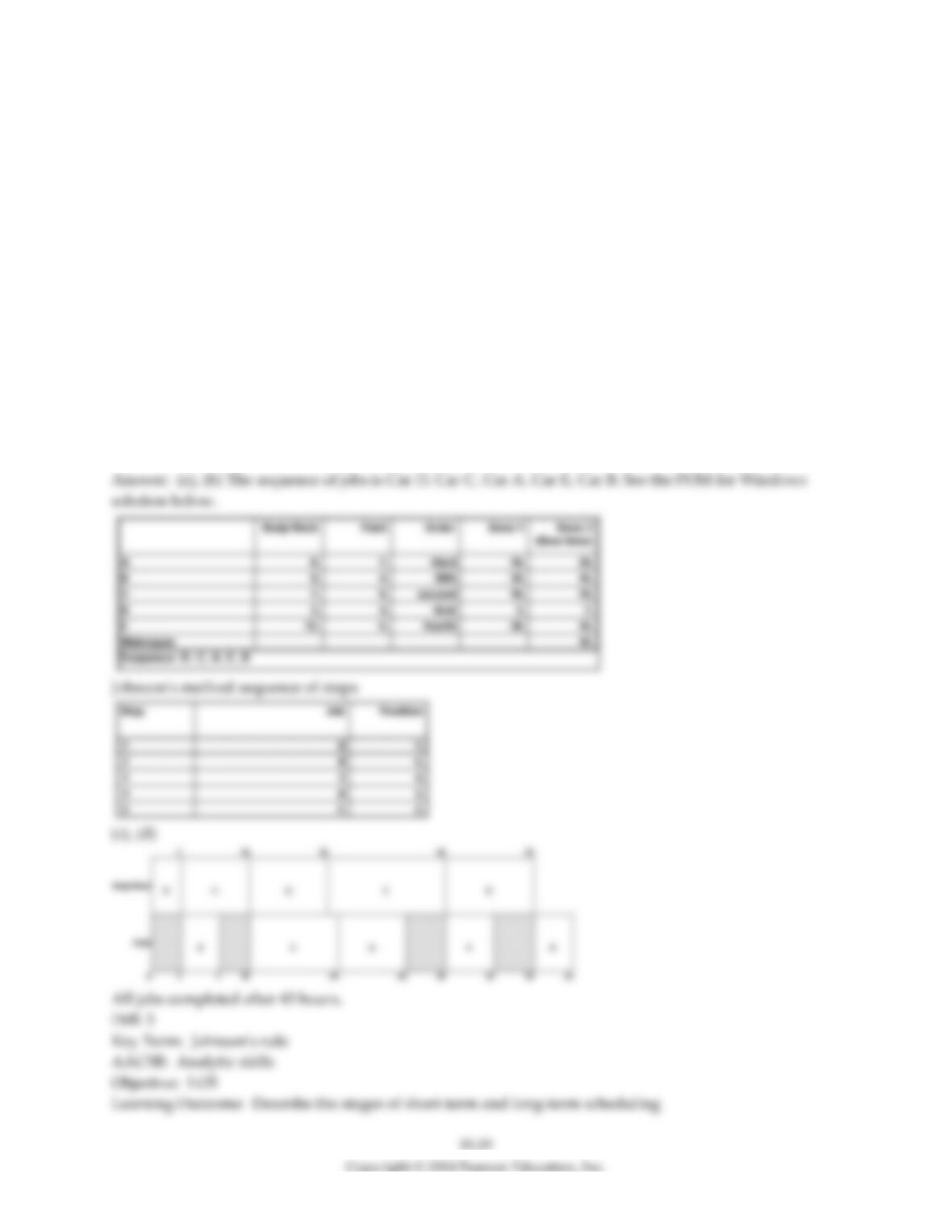
(a) Use Johnson’s rule to sequence these five jobs for minimum total duration. Show your work in
determining the job sequence.
(b) The optimal sequence is ________.
(c) Chart the progress of the five jobs in this optimal sequence.
(d) After how many hours will all jobs be completed?
41) The following jobs are waiting to be processed at your work center, which cleans valve body castings.
Job numbers are assigned sequentially upon arrival in the facility (a missing number means that job does
not require your work center). All dates are specified as days from today.
Job Due Date Duration (days)
101 43 10
102 34 12
104 37 11
107 32 7
108 37 15
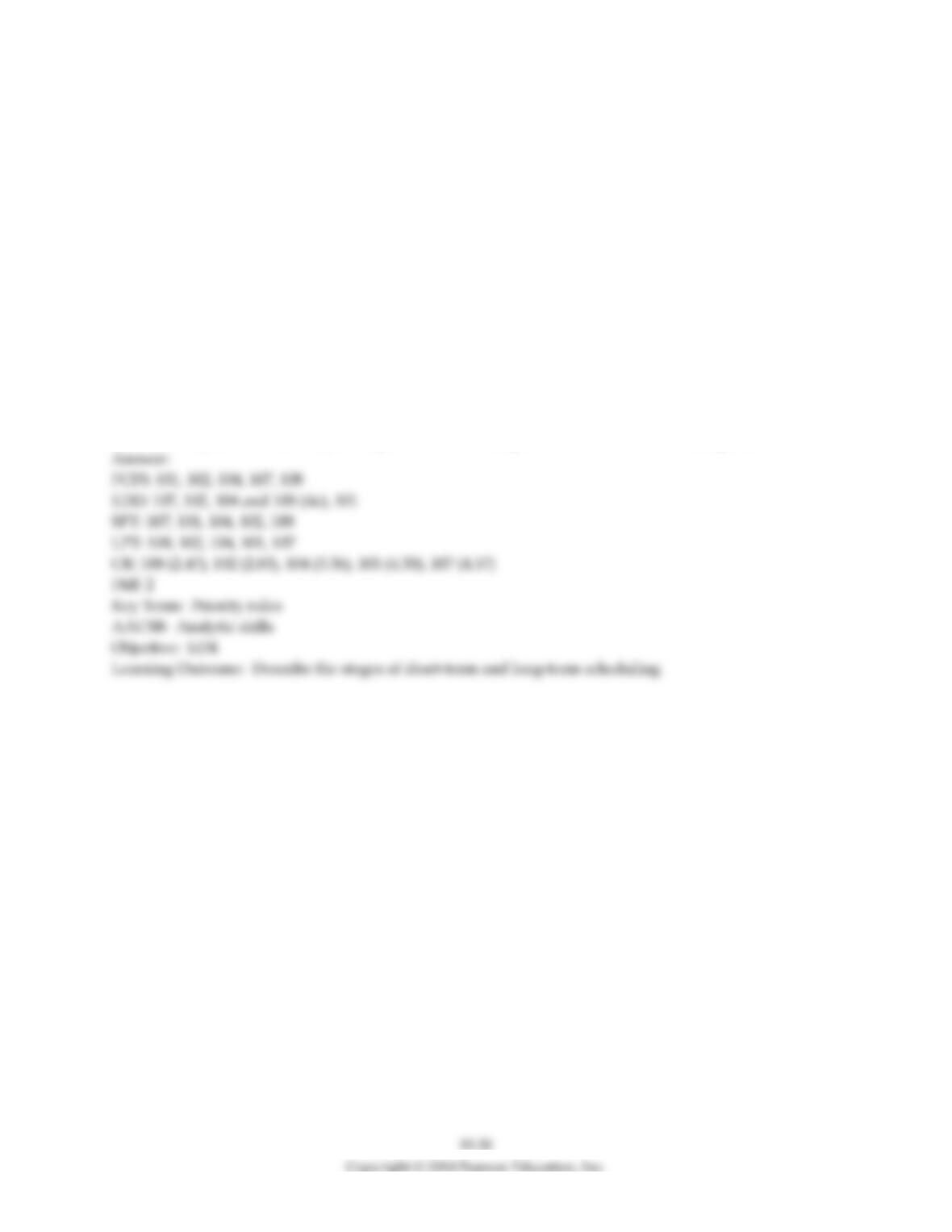
a. In what sequence should the jobs be processed according to the FCFS scheduling rule?
b. In what sequence should the jobs be processed according to the EDD scheduling rule?
c. In what sequence should the jobs be processed according to the SPT scheduling rule?
d. In what sequence should the jobs be processed according to the LPT scheduling rule?
e. In what sequence should the jobs be processed according to the critical ratio scheduling rule?
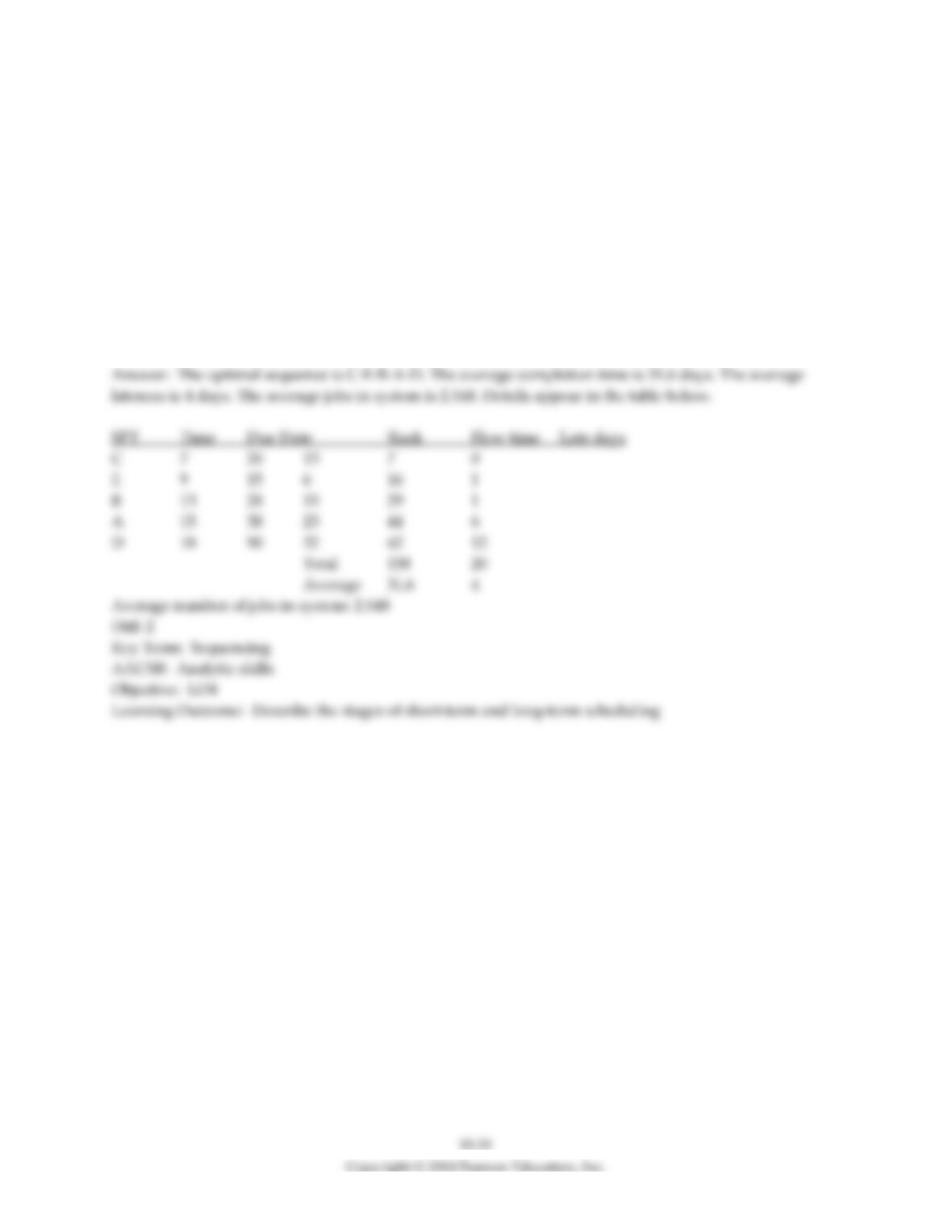
42) At Morgan’s Transformer Rebuilding, a set of five jobs is ready for dispatching to a machine center.
The processing times and due dates for the jobs are given in the table below. Use shortest processing time
to sequence the jobs, and calculate the average completion time, the average job lateness, and the average
number of jobs in the machine center.
Job Work Time (days) Due Date (days)
A 15 38
B 13 28
C 7 20
D 18 50
E 9 15
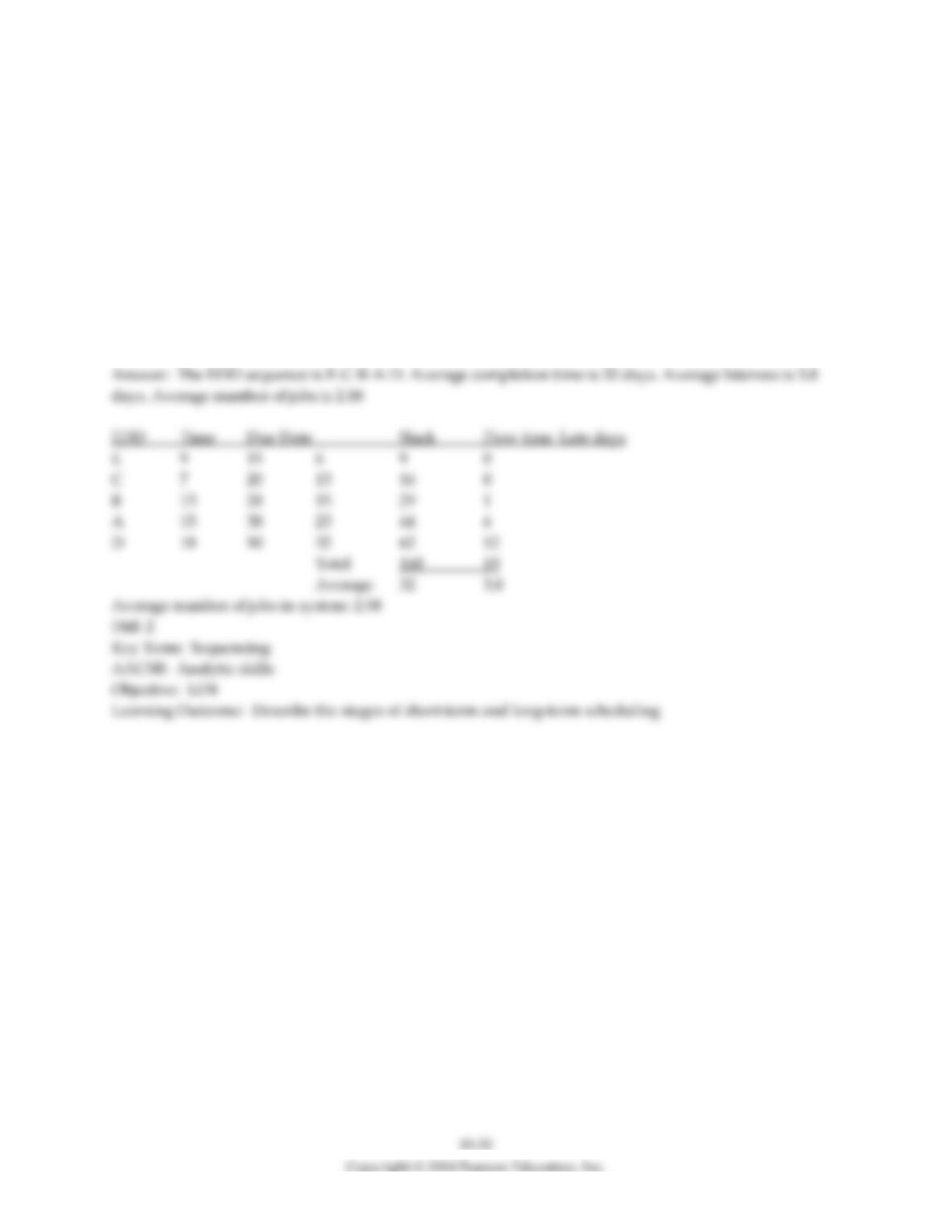
43) At Morgan’s Transformer Rebuilding, five jobs are ready now for dispatching to a machine center.
The processing times and due dates for the jobs are given below. Use earliest due date to sequence the
jobs, and calculate the average completion time, the average job lateness, and the average number of jobs
in the machine center.
Job Work Time (days) Due Date (days)
A 15 38
B 13 28
C 7 20
D 18 50
E 9 15
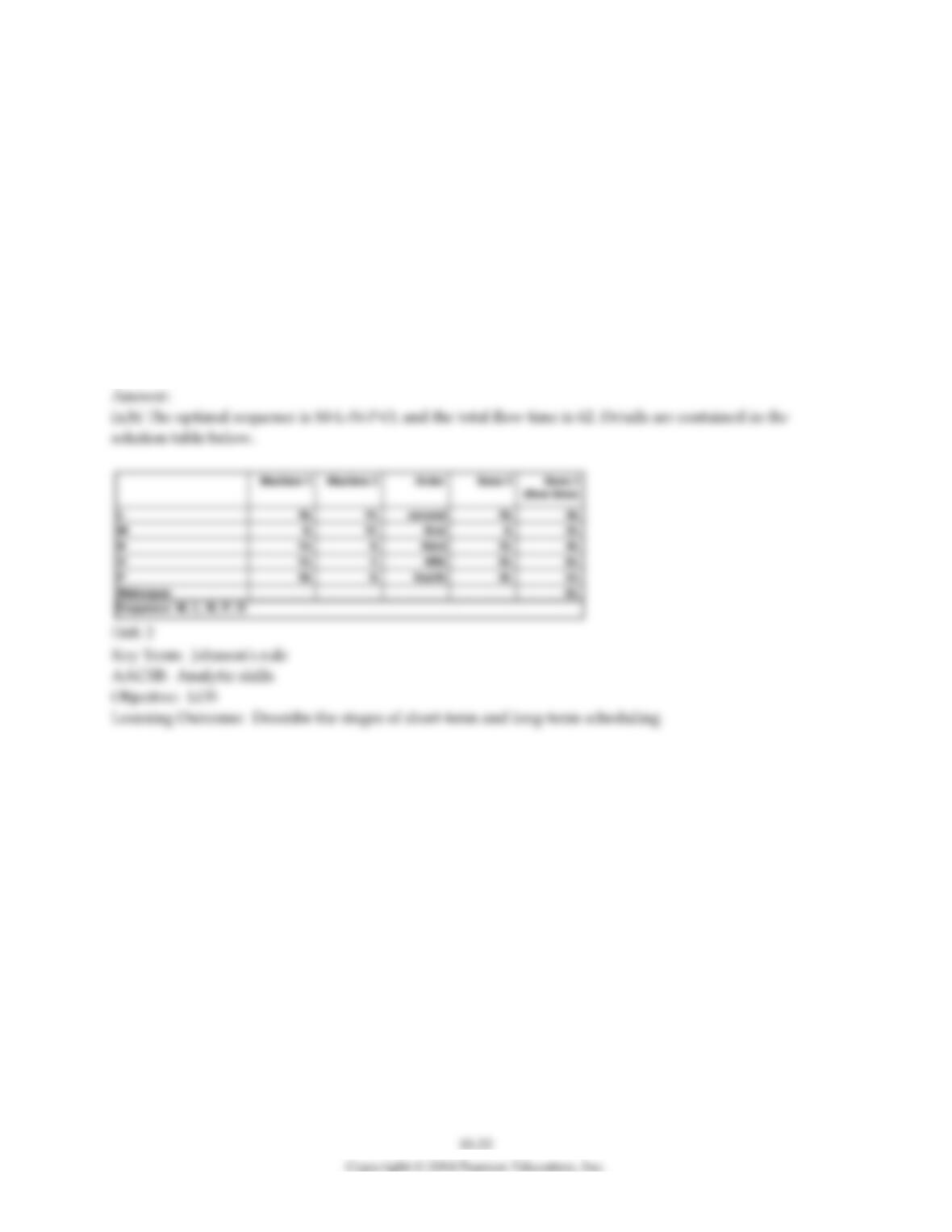
44) Use Johnson’s rule to determine the optimal sequencing for the five jobs to be processed on two
machines in a fixed order (Machine 1 before Machine 2). The processing times are given in the table
below.
a. What is the optimal sequence?
b. What is the total flow time for this sequence?
Job Machine 1 Machine 2
L 10 11
M 8 17
N 14 9
O 13 7
P 10 8