Chapter 15—Testing For Differences Between Groups and For Relationships Among
Variables
TRUE/FALSE
1. Tests are bivariate tests of differences when they involve only two variables: a variable that acts like a
dependent variable and a variable that acts as a classification variable.
2. If a researcher is interested in whether adult males purchase a product more frequently than adult
females, this is an example of univariate statistics.
3. The type of measurement, the nature of the comparison, and the number of groups to be compared
influence the statistical choice.
4. A cross-tabulation is a simple way to describe the relationships between two groups.
5. One way to test the significance of contingency tables is by means of the t-test.
6. The chi-square test requires the researcher to compare the observed frequencies of the groups with the
expected frequencies of the groups.
7. To use the chi-square test, both variables in a 2 x 2 contingency table must be measured on a ratio
scale.
8. The chi-square test requires that the expected frequency in each cell of the contingency table be at least
30.
9. The independent samples t-test tests the differences between means taken from two independent
samples or groups.
10. The t–test for comparing the means of two groups assumes that the data are in nominal scales.
11. A pooled estimate of the standard error is a better estimate of the standard error than one based on the
variance from either sample.
12. The degrees of freedom are calculated as d.f. = n
−
1 when using the t-test for comparing two means.
13. In practice, computer software is used to compute the t-test results.
14. When no direction of a relationship is stated in the hypothesis, a one-tailed test is appropriate.
15. The first basic step in interpreting t–test results is to find the p-value associated with a particular t and
the corresponding degrees of freedom.
16. The t–test assumes that the two population means are equal.
17. The reason that means that appear to be not so close could be concluded to be statistically the same is
due to the variance.
18. A t–test is not appropriate and should not be used when the sample size is greater than 30.
19. A paired-sample t-test is an appropriate test for comparing the scores of two interval variables drawn
from related populations.
20. A Z–test for differences of proportions requires a sample size greater than 100.
21. The null hypothesis for an ANOVA test comparing the means of three groups is: 1 2 3.
22. The total mean is the mean of a variable over all observations.
23. The F-test partitions the total variance into within-group variance and between-group variance.
24. The business spreadsheet software, Excel, is capable of running statistical analyses.
25. The general linear model is a way of explaining and predicting a dependent variable based on
fluctuations (variation) from its mean, with the fluctuations due to changes in independent variables.
26. Multiple regression analysis includes a single independent variable but several dependent variables.
27. In most business research, the estimate of in a regression equation is most important.
28. In regression, the standardized Y-intercept term is always 1.
29. If the purpose of the regression analysis is forecasting, then standardized regression estimates must be
used.
30. Multicollinearity in regression analysis refers to the extent to which the independent variables are
redundant.
MULTIPLE CHOICE
1. A _____ is an investigation of a hypothesis stating that two (or more) groups differ with respect to
measures on a variable.
a.
statistical conclusions
b.
descriptive analysis
c.
paired comparison
d.
test of differences
2. A researcher hypothesizes that males and females differ with respect to attitude toward sports
sponsorships. To investigate this hypothesis that these two groups’ attitudes differ, he will use a
_____.
a.
bivariate test of differences
b.
univariate test of differences
c.
multivariate test of differences
d.
cluster analysis
3. All of the following are true regarding cross-tabulation EXCEPT _____.
a.
The 2 distribution provides a means for testing the statistical significance of a
contingency table.
b.
The 2 for a contingency table compares two means that are not from independent
samples.
c.
Cross-tabulations are much like tallying.
d.
The 2 test for a contingency table involves comparing the observed frequencies with the
expected frequencies in each cell of the table.
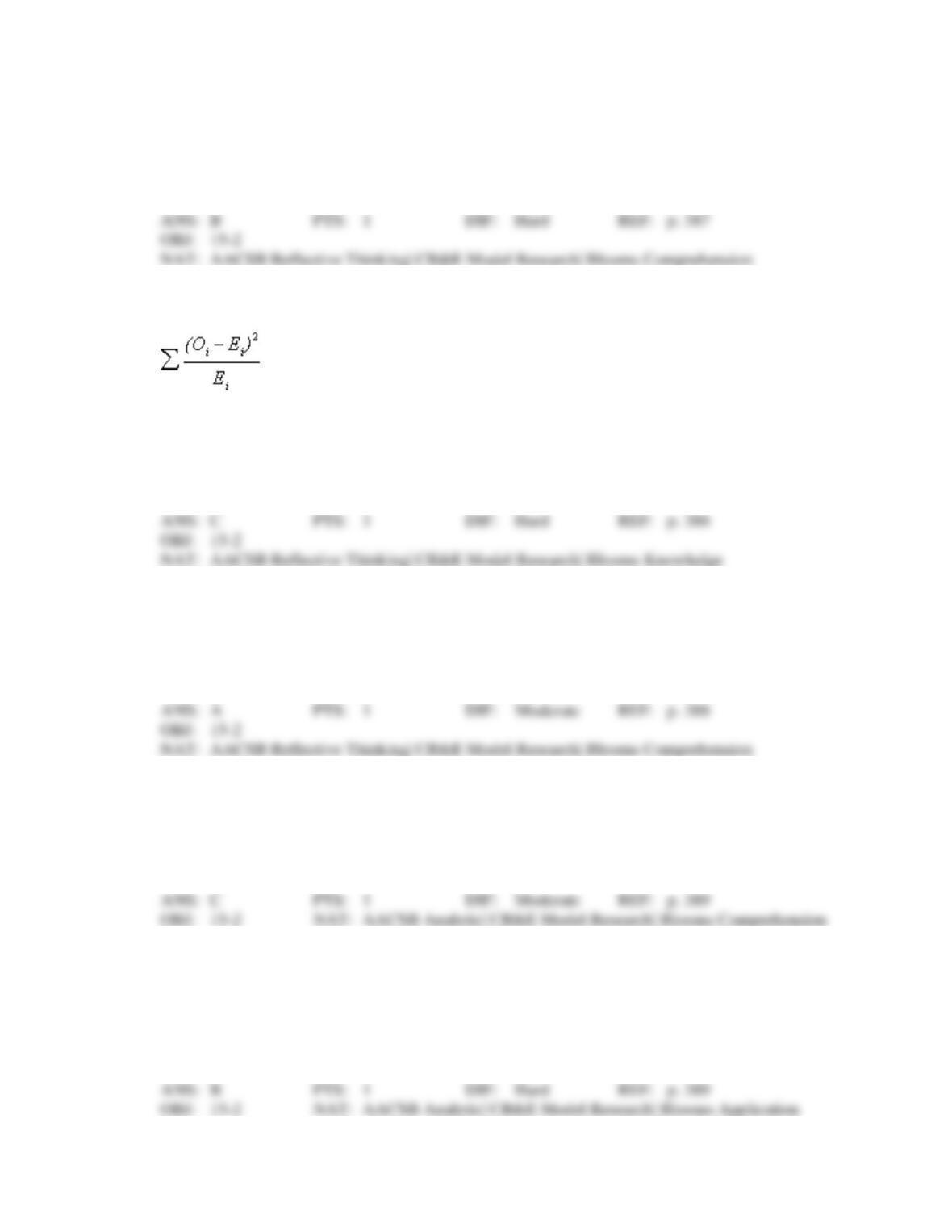
4. The formula given below represents the method for calculating the _____.
a.
Z-test
b.
F-test
c.
2 test
d.
5. The formula for the chi-square test uses _____.
a.
observed and expected frequencies
b.
observed and expected percentages
c.
the two sample means
d.
the two sample standard deviations
6. how do you determine the degrees of freedom in a four-cell chi-square test?
a.
(R + 1)
b.
(R – 1)
c.
(R – 1)(C – 1)
d.
R(C – 1)
7. If 25 of the 35 females in a research study agree with a statement, and 15 of the 35 males agree with
this statement, the expected value for males-agree is _____.
a.
15
b.
20
c.
25
d.
35
8. In a brand awareness study, if 25 of a group of 35 males identify the brand correctly and 15 of a group
of 35 females identify this brand correctly, the chi-square value for this study is approximately _____.
a.
3.26
b.
4.15
c.
5.84
d.
2.92
9. In order to use the chi-square test, the expected frequency in each of the cells of the contingency table
should be at least _____.
a.
2
b.
5
c.
30
d.
40
10. When a researcher needs to compare means for a variable grouped into two categories based on some
less-than interval variable, a(n) _____ is appropriate.
a.
p-test
b.
t-test
c.
2 test
d.
univariate test
11. A(n) _____ is a test for hypotheses stating that the mean scores from some interval- or ratio-scaled
variable group based on some less-than interval classificatory variable are not the same.
a.
regression
b.
cluster analysis
c.
2 test
d.
independent samples t-test
12. Supposed you used a 10-point rating scale to measure intention-to-buy (1 = definitely would not buy
and 10 = definitely would buy). If a group of 40 males had a mean of 7 and a standard deviation of
2.5, while a group of 35 females had a mean of 5 and a standard deviation of 1.4, the standard error of
the difference between the means would be approximately _____.
a.
0.48
b.
1.36
c.
2.45
d.
not enough information to determine
13. Suppose that you used a 9-point rating scale and that you wanted to compare men who had an annual
income over $50,000 (Group 1) with men who had an annual income less than or equal to $50,000
(Group 2) on their liking of a new product. If you studied 40 men in Group 1 and they have a mean of
7 and a standard deviation of 2.5, while the 35 men in Group 2 have a mean of 5 and a standard
deviation of 1.4, what is the approximate value of t using the t-test?
a.
3.43
b.
4.19
c.
2.64
d.
not enough information to determine
14. In using the t-test to compare the means of two groups, the degrees of freedom are calculated as
_____.
a.
n1 – n2 – 2
b.
n1 + n2 – 2
c.
n1 x n2 -2
d.
n1 / n2 – 2
15. In a study comparing the means of two groups in which there are 45 males in Group 1 and 37 females
in Group 2, the degrees of freedom for this study when using the t-test for the difference between
means is:
a.
84
b.
80
c.
82
d.
160
16. In practice, what is the first step in interpreting the t-test when comparing two means?
a.
compute the t-test value
b.
find the p-value associated with the t and the corresponding degrees of freedom
c.
examine the difference in means to find the “direction” of any difference
d.
examine if there is a difference at the 50 percent confidence interval before examining the
95 percent confidence interval
17. Which test is appropriate for comparing the scores of two interval variables drawn from related
populations?
a.
ANOVA
b.
relative t-test
c.
relative 2 test
d.
pair-samples t-test
18. Which of the following is a requirement for using the Z-test for differences of proportions?
a.
common sample
b.
degrees of freedom of at least 50
c.
sample size greater than 30
d.
ratio measurement of all variables
19. The Z-test for comparing two proportions is appropriate with which null hypothesis (H0)?
a.
1 = 2.
b.
1 2.
c.
1 x 2 = 1
d.
1 – 2 = 1
20. _____ involves the investigation of the effects of one treatment variable on an interval-scaled
dependent variable and determines whether statistically significant differences in means occur between
two or more groups.
a.
Analysis of variance (ANOVA)
b.
Regression analysis
c.
Cross-tabulation
d.
2
21. In an ANOVA test of the differences between the means of three groups, the null hypothesis is _____.
a.
1 = 2 = 3
b.
1 2 3
c.
1 – 2 – 3 = 0
d.
1 + 2 + 3 = 1
22. Which should be used when comparing the means of three groups to see if they are significantly
different from one another?
a.
One-group t-test
b.
ANOVA
c.
Three-group t-test
d.
Chi-square test
23. The mean of a variable over all observations is called the _____.
a.
master mean
b.
average mean
c.
grand mean
d.
ANOVA mean
24. Which of the following is the sum of differences between the group mean and the grand mean summed
over all groups for a given set of observations?
a.
between-groups variance
b.
total error variance
c.
F-statistic
d.
2 value
25. The sum of the differences between observed values and the group mean for a given set of
observations is known as the _____.
a.
within-group error
b.
between-groups variance
c.
F-ratio
d.
statistic
26. The key statistical test for an ANOVA model is the _____.
a.
2 test
b.
t-test
c.
F-test
d.
Z-test
27. The F-distribution is a function of _____.
a.
SSB – SSE
b.
SSE – SSB
c.
SSB/SSE
d.
SSE/SSB
28. Practically speaking, what is the first thing a researcher should do when interpreting ANOVA results?
a.
examine the actual means for each group
b.
determine the between-groups variance
c.
examine the total variance
d.
check whether or not the overall model F is significant
29. All of the following are software that researchers can use to perform statistical calculations EXCEPT
_____.
a.
Excel
b.
SAS
c.
ANOVA
d.
JMP
30. Multivariate dependence techniques are variants of the _____, which is a way of modeling some
process based on how different variables cause fluctuations from the average dependent variable.
a.
ordinary linear model (OLM)
b.
weighted average model (WAM)
c.
general linear model (GLM)
d.
metric scaling model (MSM)
31. When a researcher is attempting to predict sales volume by using building permits, amount of
advertising, and the income levels of residents, the researcher is using _____.
a.
univariate analysis
b.
a chi-square analysis
c.
multiple regression analysis
d.
factor analysis
32. In regression analysis, the symbol X is commonly used for the ______ variable, and the symbol Y is
commonly used for the ______ variable.
a.
dependent; moderating
b.
independent; dependent
c.
dependent; independent
d.
independent; moderating
33. In the regression equation, Y =
+
X, Y is the _____.
a.
dependent variable
b.
slope
c.
independent variable
d.
y-intercept
34. In the regression equation, Y =
+
X , is the _____.
a.
y-intercept
b.
independent variable
c.
slope of the regression line
d.
dependent variable
35. In the regression equation, Y =
+
X,
is the symbol for the _____.
a.
slope of the regression line
b.
y-intercept of the regression line
c.
dependent variable
d.
independent variable
36. If the regression equation is: Y = 24.35 – 14.2 X , then 24.35 is the ______ , while -14.2 is the
______.
a.
slope; y-intercept
b.
independent variable; slope
c.
dependent variable; y-intercept
d.
y-intercept; slope
37. Which of the following provides a common metric allowing regression results to be compared to one
another no matter what the original scale range may have been?
a.
standardized regression coefficient ()
b.
2
c.
coefficient of determination (R2)
d.
raw parameter estimates
38. Which of the following is most appropriate if the purpose of the regression analysis is forecasting?
a.
standardized regression coefficient ()
b.
Y-intercept
c.
coefficient of determination (R2)
d.
raw parameter estimates
39. Lance is studying the relationship between sales training of the sales force and customer satisfaction
and loyalty. When researchers like Lance are focused on explanation rather than prediction, then
which of the following is most appropriate when using simple regression?
a.
standardized regression coefficient ()
b.
Y-intercept
c.
2
d.
raw parameter estimates
40. The statistical significance of a regression model is determined using which test?
a.
t-test
b.
2
c.
F-test
d.
Z-test
COMPLETION
1. A test of a hypothesis to determine if two groups differ with respect to the scores on one variable is
called a(n) ______.
2. The ______ test studies the significance of a contingency table.
3. The formula for determining the degrees of freedom for a chi-square test is ______.
4. When a researcher needs to compare means for a variable grouped into two categories based on some
less-than interval variable, a(n) _____ test is appropriate.
5. In using the t-test to compare the difference between the means of two groups, the formula for
determining the degrees of freedom is ______.
6. One way to interpret the meaning of the results of the t-test is to focus on the ________ and the group
means.
7. An appropriate test for comparing the scores of two interval variables drawn from related populations
is the _____.
8. _____ is the appropriate statistical tool to use when comparing the means of three or more groups to
see if they are significantly different from one another.
9. The _____ is the mean of a variable over all observations.
10. The sum of differences between the group mean and the grand mean summed over all groups for a
given set of observations is called _____ variance.
11. The statistical test for an ANOVA model is the ______.
12. The F-test partitions total variance into ______ variance and ______ variance.
13. SPSS and SAS are examples of _____.
14. Multivariate dependence techniques are variants of the _____.
15. The regression parameter that represents the height of the regression line relative to horizontal is
_____.
16. In a regression equation, the slope of the regression line is denoted by the symbol ______.
17. Researchers who want to compare regression results should use _____.
18. Researchers how want to make forecasts should use _____ regression coefficients.
19. The test for the statistical significance of the regression model is the ____ test.
20. The first step in interpreting a multiple regression model is to examine the _____.
ESSAY
1. Discuss the factors that influence the statistical choice. If a researcher is examining factors that
influence an automobile’s gas mileage, which statistical tool (or tools) is appropriate?
2. A researcher has data on viewers’ responses regarding what company sponsored the Super Bowl
half-time show for the past two years and has coded it “1” if the response was correct and “0” if not.
He would like to examine if there is a statistical difference in correct answers between the two years.
Explain what statistical test is appropriate to address this research question.
ANS:
3. Explain what an independent samples t-test is and the null hypothesis examine.
4. List the practical steps for interpreting t-test results.
5. Discuss when a paired-samples t–test is appropriate and give an example of when it should be used.
6. Explain what a Z-test for comparing two proportions is and the appropriate hypothesis.
7. What is ANOVA and when is it the appropriate statistical technique? What test is used to determine
significance? Give an example of a research question that can be analyzed using ANOVA.
8. List at least three software programs discussed in the chapter that can be used to conduct statistical
analyses.
9. Discuss the pros and cons of raw regression estimates and standardized regression estimates and
discuss when each is appropriate.
10. List the steps in interpreting a multiple regression model.