Stewart – Calculus ET 8e Chapter 15 Form A
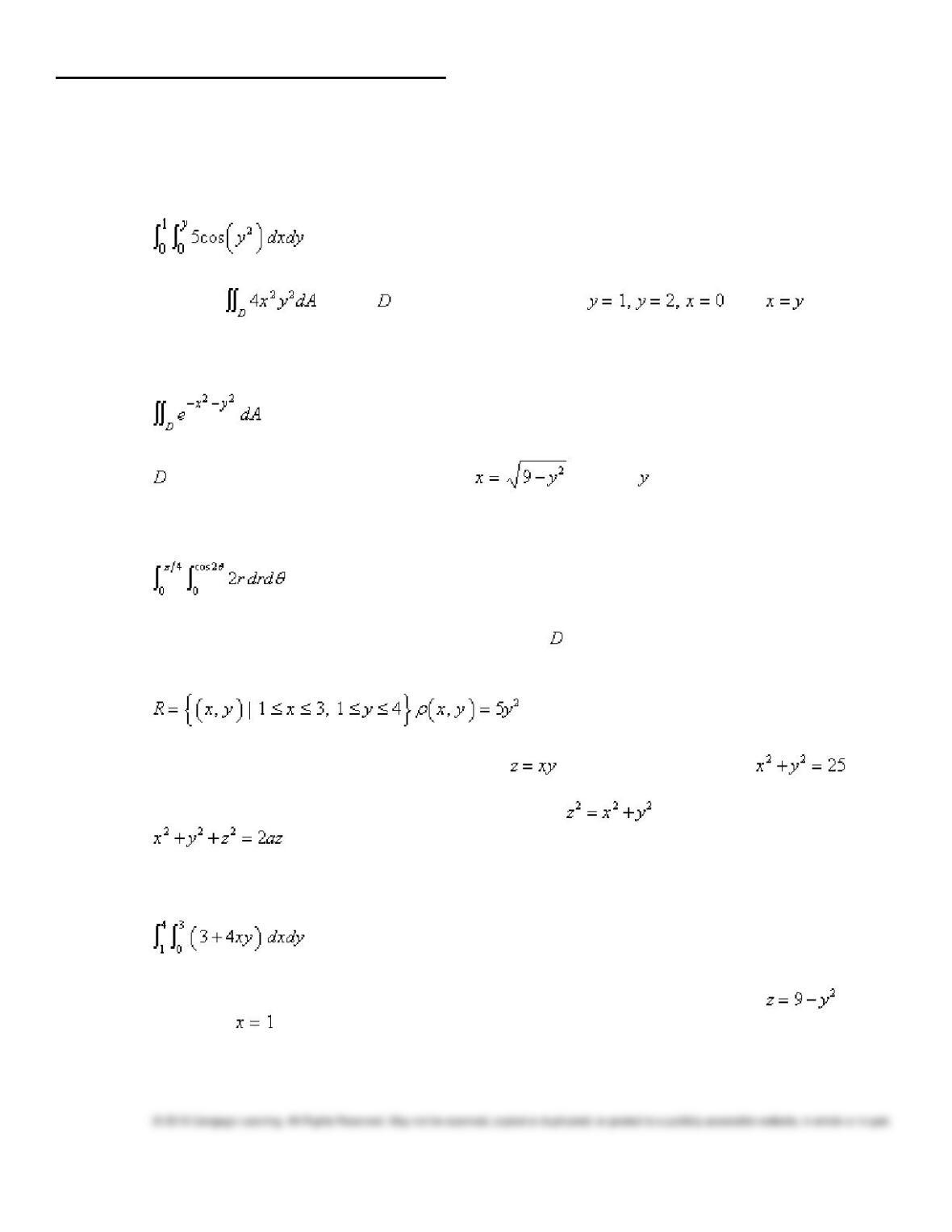
1. Calculate the iterated integral.
2. Evaluate where is the figure bounded by and .
3. Evaluate the integral by changing to polar coordinates.
is the region bounded by the semicircle and the -axis.
4. Describe the region whose area is given by the integral.
5. Find the mass of the lamina that occupies the region and has the given density function. Round
your answer to two decimal places.
6. Find the area of the surface. The part of the surface that lies within the cylinder .
7. Use spherical coordinate to find the volume above the cone and inside sphere
.
8. Calculate the iterated integral.
9. Find the volume of the solid bounded in the first octanat bounded by the cylinder and
the planes .
Stewart – Calculus ET 8e Chapter 15 Form A
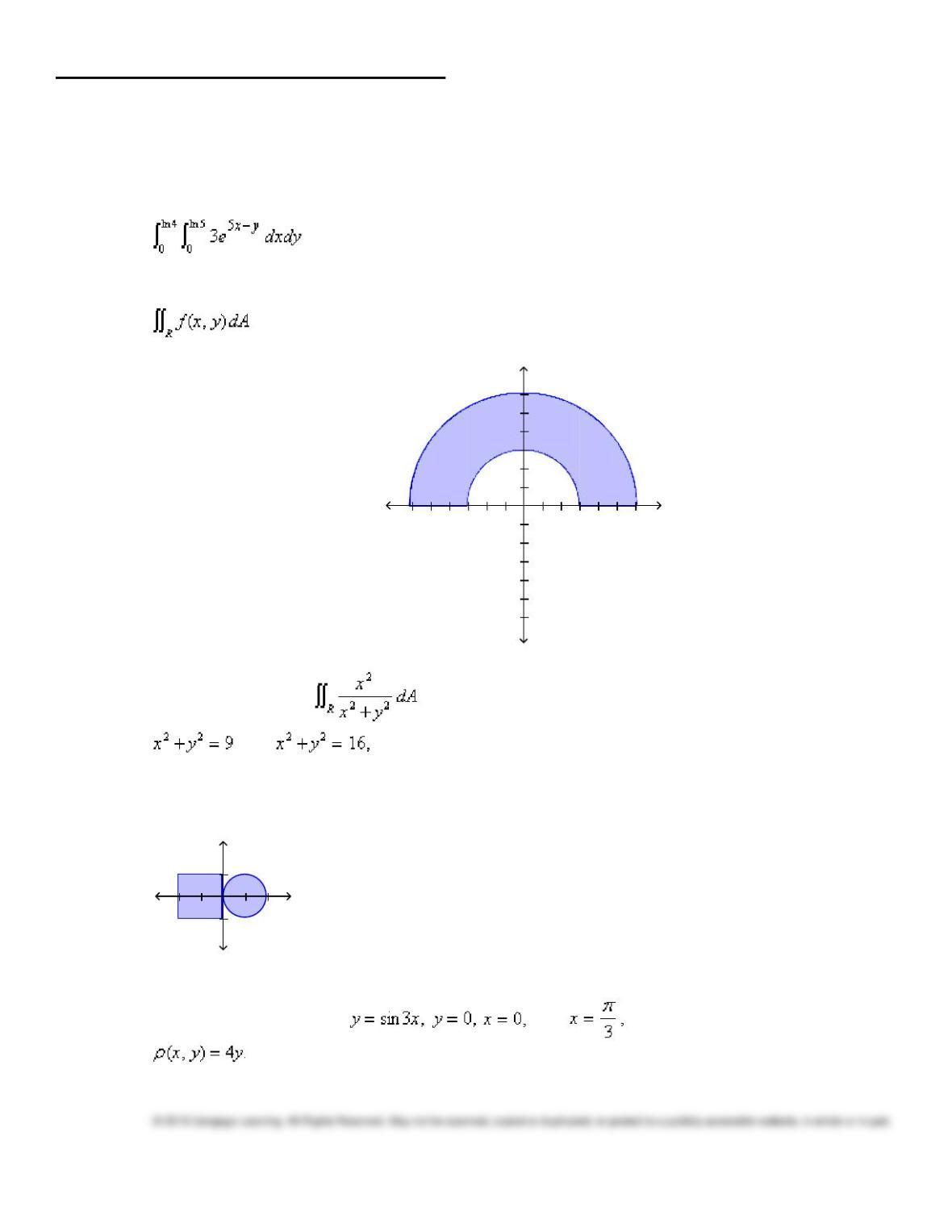
10. Calculate the iterated integral.
11. Determine whether to use polar coordinates or rectangular coordinates to evaluate the integral
, where f is a continuous function. Then write an expression for the (iterated)
integral.
123456–1–2–3–4–5–6 x
1
2
3
4
5
6
–1
–2
–3
–4
–5
–6
y
12. Evaluate the integral , where R is the annular region bounded by the circles
and by changing to polar coordinates.
13. Find the center of mass of the lamina of the region shown if the density of the circular lamina is
four times that of the rectangular lamina.
2–2 x
1
–1
y
14. Find the mass and the center of mass of the lamina occupying the region R, where R is the region
bounded by the graphs of and and having the mass density
Stewart – Calculus ET 8e Chapter 15 Form A
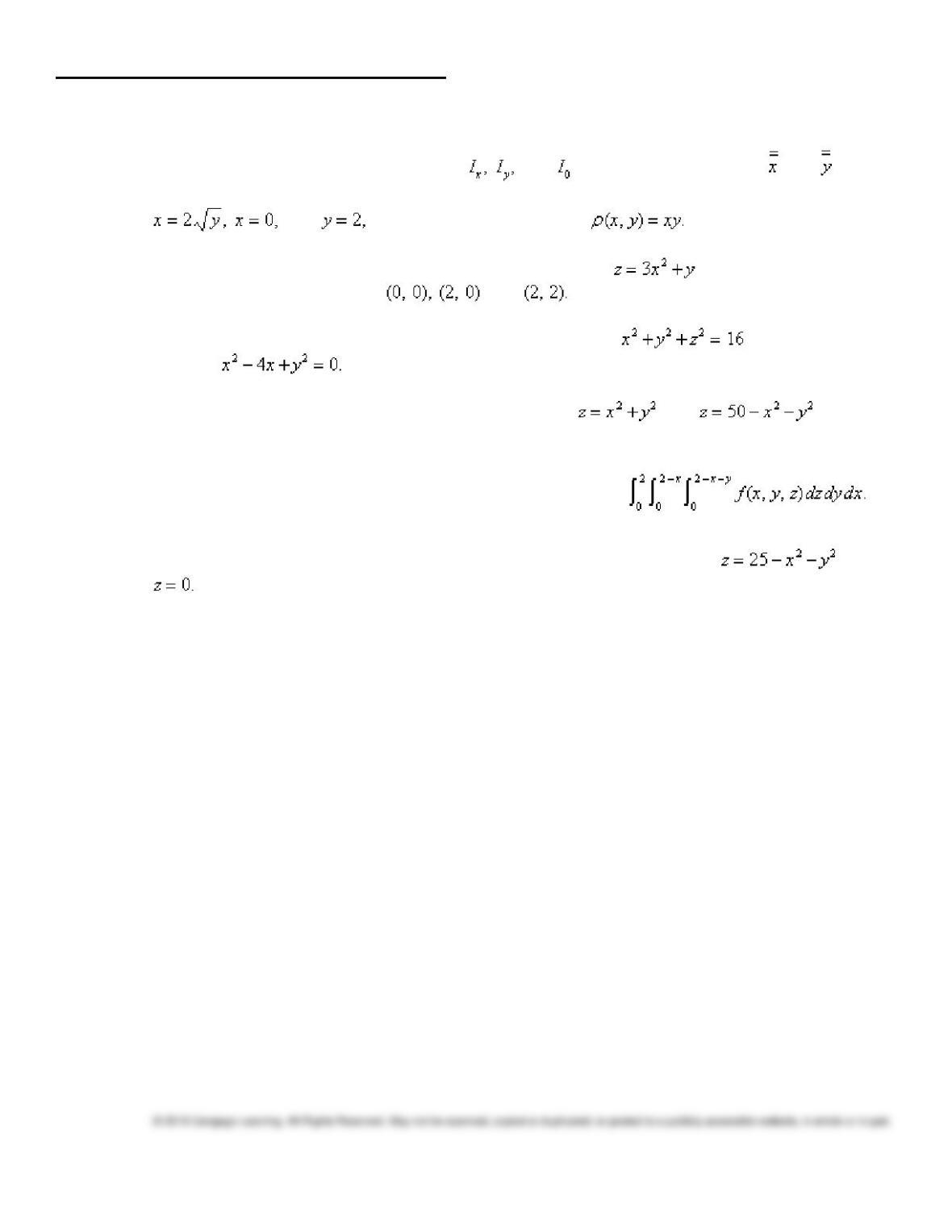
15. Find the mass and the moments of inertia and and the radii of gyration and for the
lamina occupying the region R, where R is the region bounded by the graphs of the equations
and and having the mass density
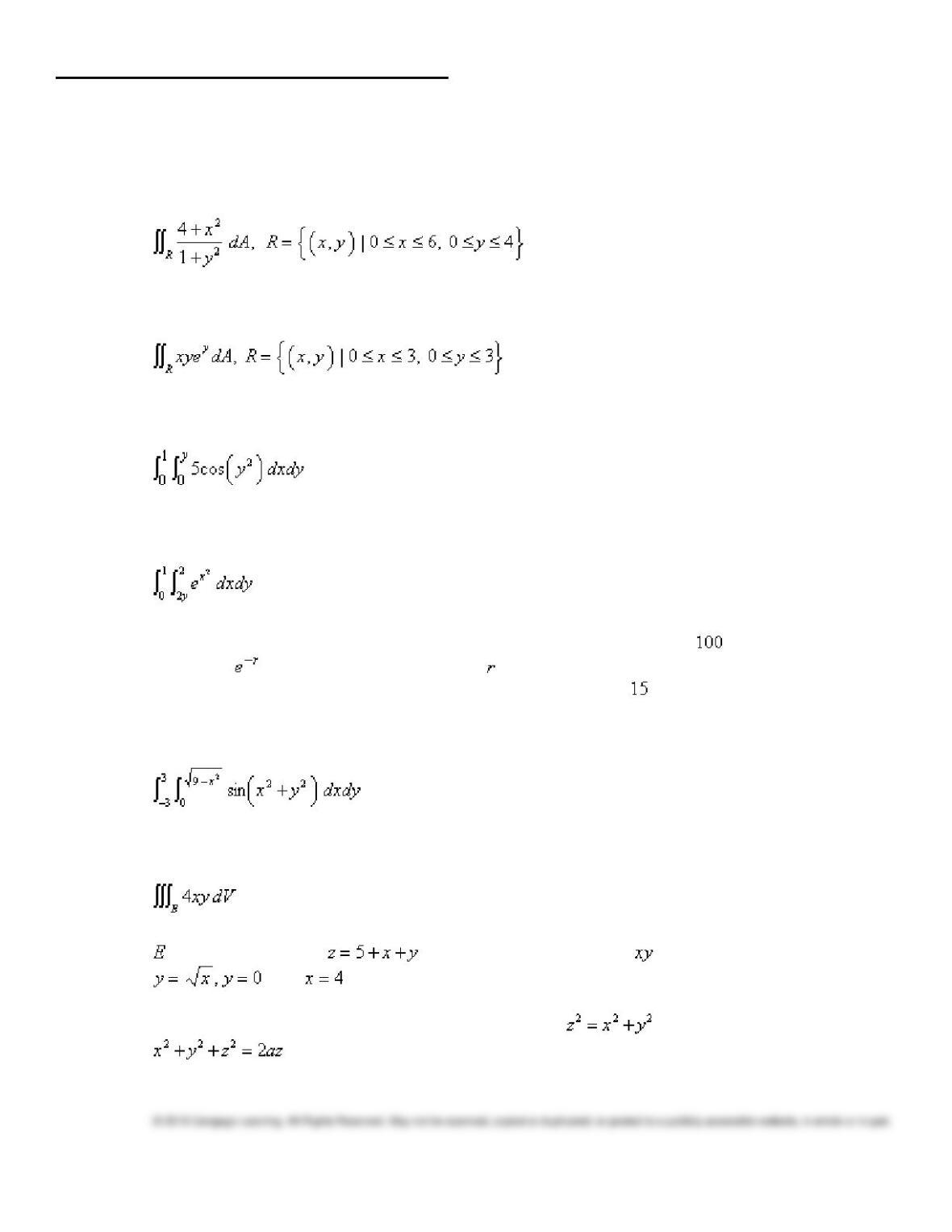
16. Find the area of the surface S where S is the part of the plane that lies above the
triangular region with vertices , and
17. Find the area of the surface S where S is the part of the sphere that lies inside the
cylinder
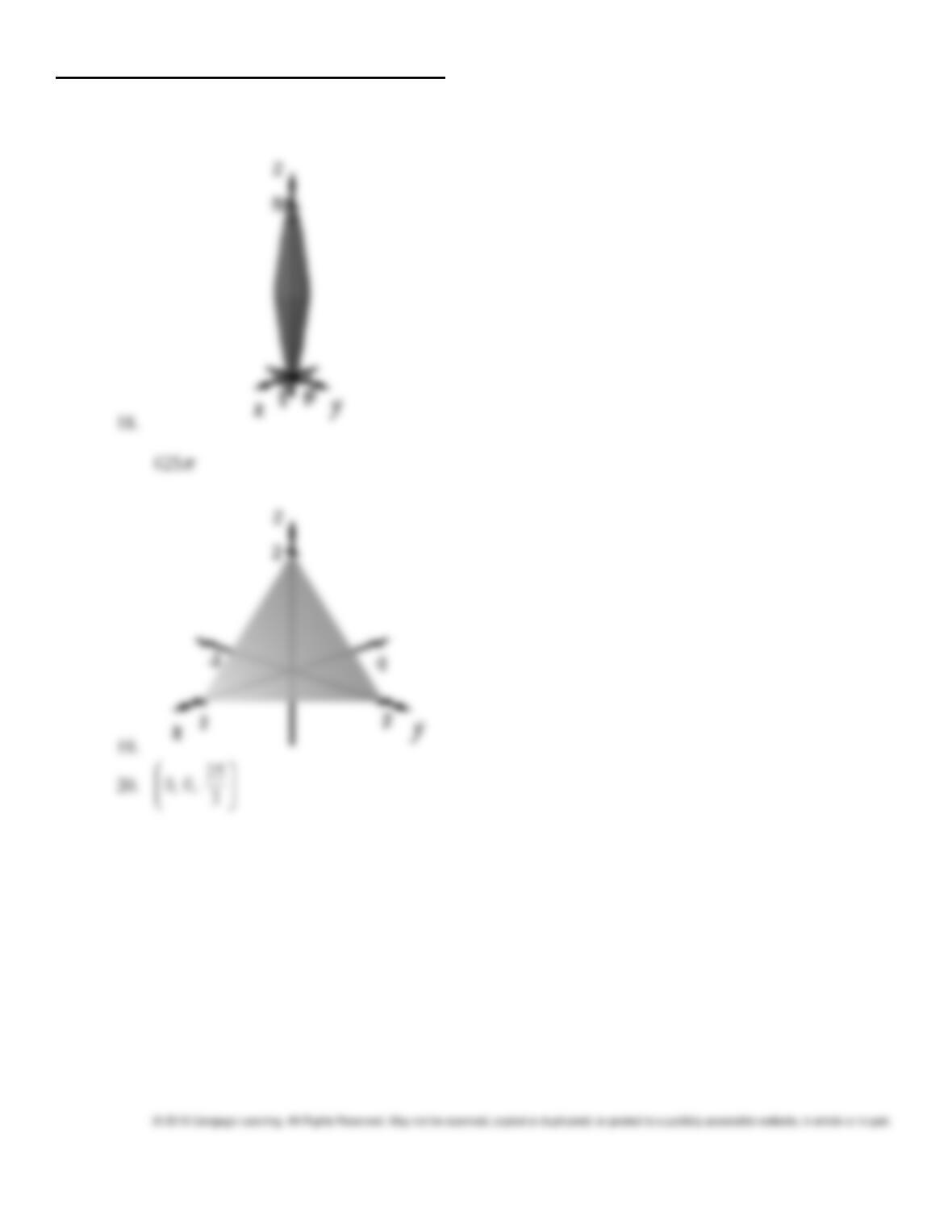
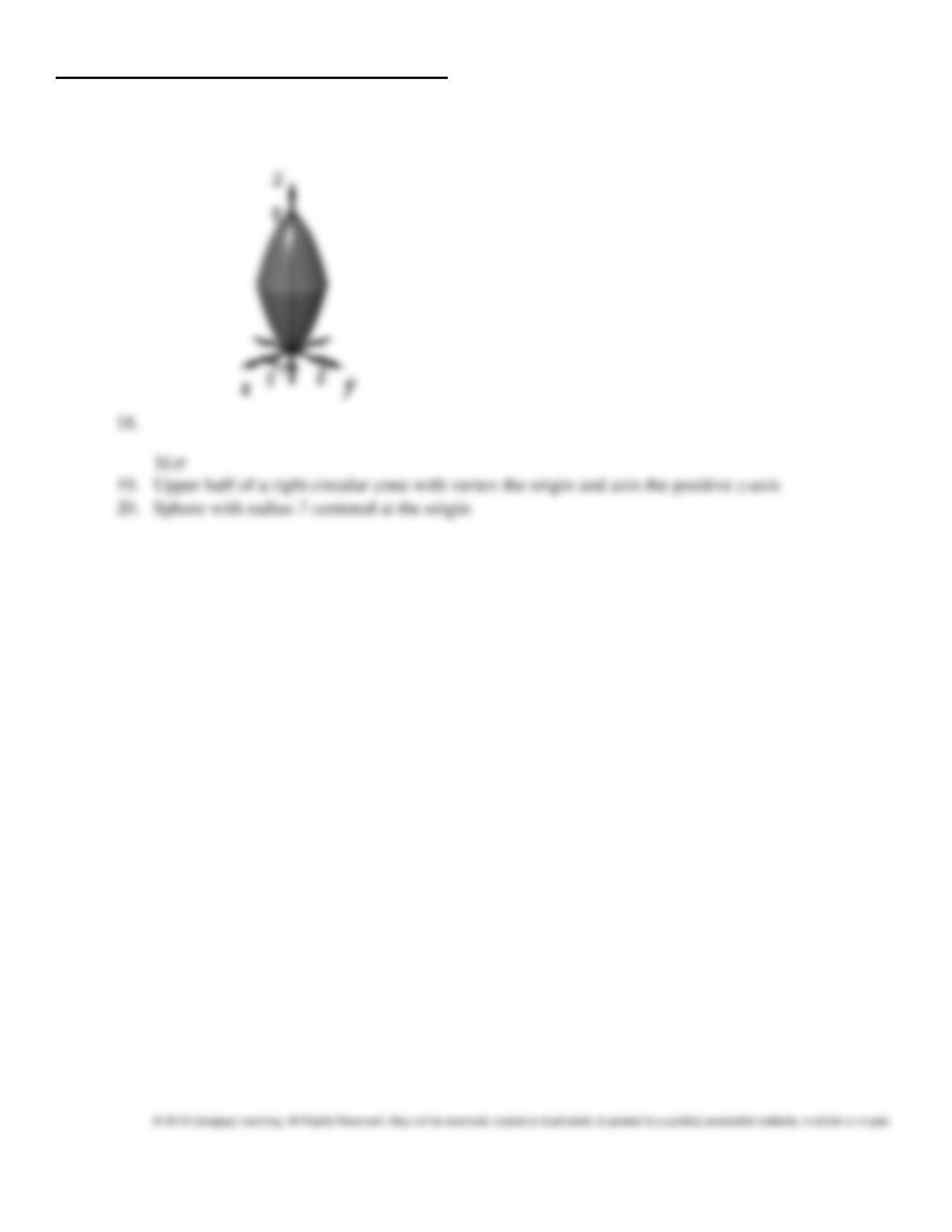
18. Sketch the solid bounded by the graphs of the equations and , and then
use a triple integral to find the volume of the solid.
19. Sketch the solid whose volume is given by the iterated integral
20. Find the center of mass of a homogeneous solid bounded by the paraboloid and
Stewart – Calculus ET 8e Chapter 15 Form A
Answer Key
Stewart – Calculus ET 8e Chapter 15 Form A
Stewart – Calculus ET 8e Chapter 15 Form B
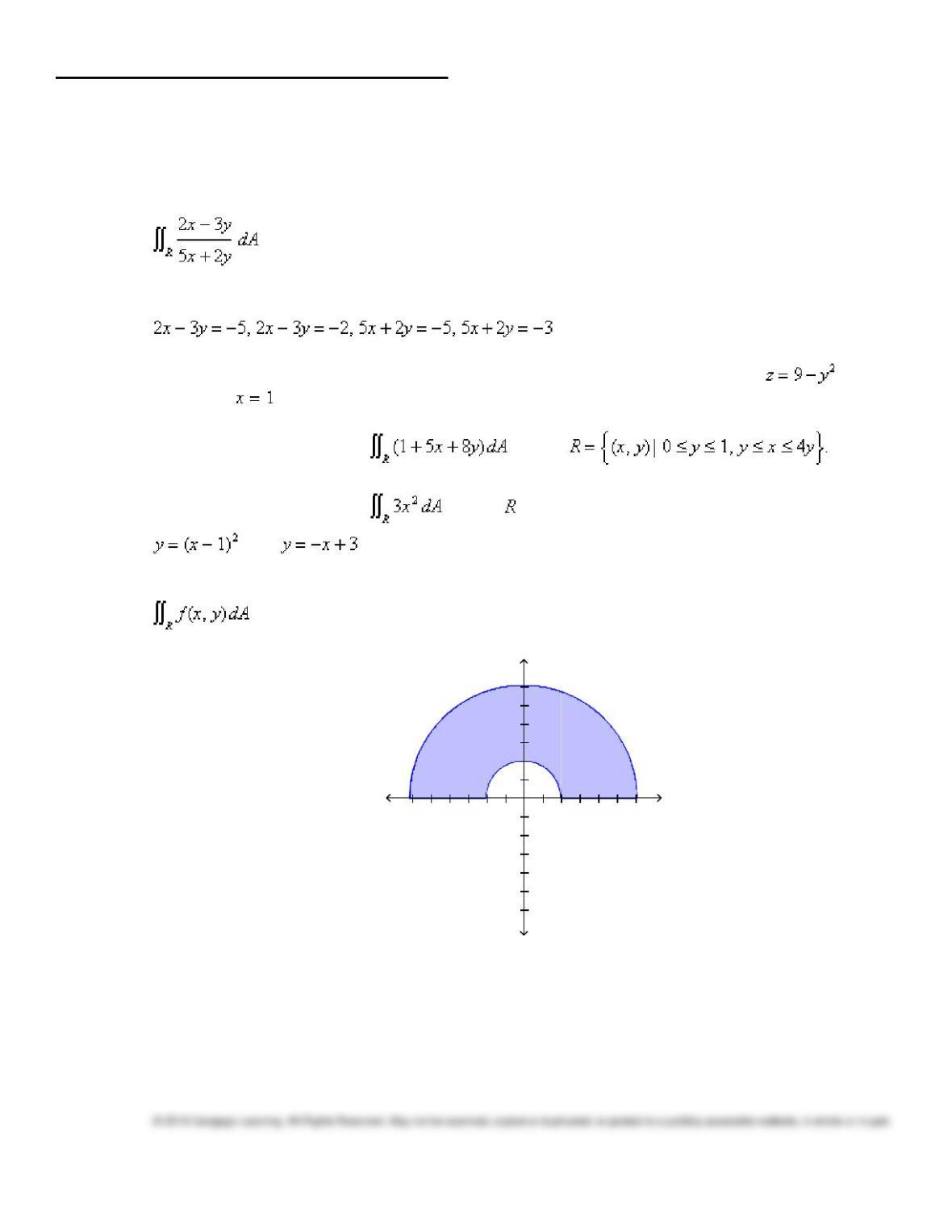
1. Calculate the double integral. Round your answer to two decimal places.
2. Calculate the double integral. Round your answer to two decimal places.
3. Calculate the iterated integral.
4. Evaluate the integral by reversing the order of integration.
5. An agricultural sprinkler distributes water in a circular pattern of radius ft. It supplies water to
a depth of feet per hour at a distance of feet from the sprinkler. What is the total amount of
water supplied per hour to the region inside the circle of radius feet centered at the sprinkler?
6. Use polar coordinates to evaluate.
7. Evaluate the triple integral. Round your answer to one decimal place.
lies under the plane and above the region in the -plane bounded by the curves
, and .
8. Use spherical coordinate to find the volume above the cone and inside sphere
.
Stewart – Calculus ET 8e Chapter 15 Form B
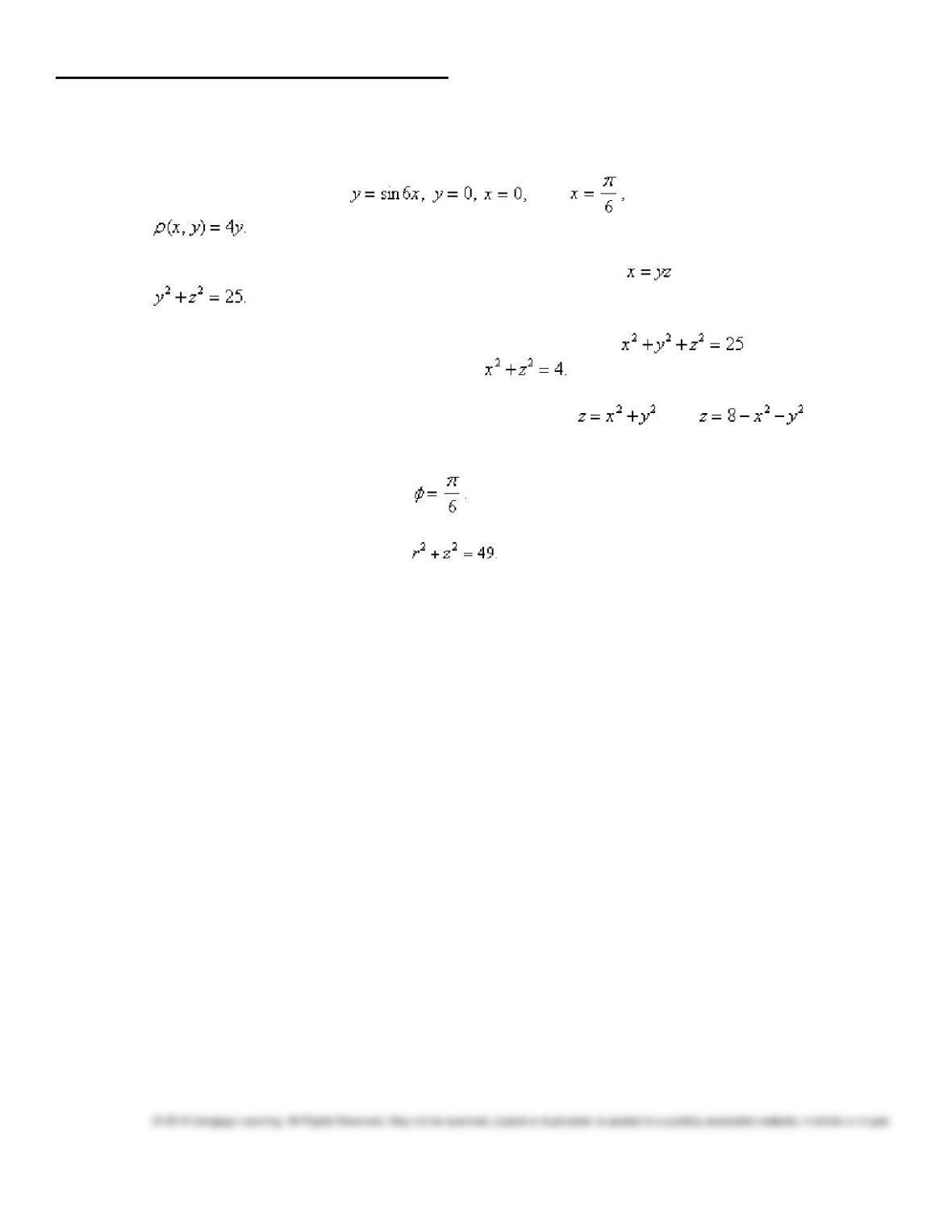
9. Evaluate the integral by making an appropriate change of variables. Round your answer to two
decimal places.
R is the parallelogram bounded by the lines
.
10. Find the volume of the solid bounded in the first octanat bounded by the cylinder and
the planes .
11. Evaluate the double integral , where
12. Evaluate the double integral , where is the region bounded by the graphs of
and .
13. Determine whether to use polar coordinates or rectangular coordinates to evaluate the integral
, where f is a continuous function. Then write an expression for the (iterated)
integral.
123456–1–2–3–4–5–6 x
1
2
3
4
5
6
–1
–2
–3
–4
–5
–6
y
14. Find the center of mass of the system comprising masses mk located at the points Pk in a coordinate
plane. Assume that mass is measured in grams and distance is measured in centimeters.
m1 = 4, m2 = 3, m3 = 1
P1(3, –3), P2(5, –1), P3(2, –5)
Stewart – Calculus ET 8e Chapter 15 Form B
15. Find the mass and the center of mass of the lamina occupying the region R, where R is the region
bounded by the graphs of and and having the mass density
16. Find the area of the surface S where S is the part of the surface that lies inside the cylinder
17. Find the area of the surface S where S is the part of the sphere that lies to the
right of the xz-plane and inside the cylinder
18. Sketch the solid bounded by the graphs of the equations and , and then
use a triple integral to find the volume of the solid.
19. Identify the surface with equation
20. Identify the surface with equation
Stewart – Calculus ET 8e Chapter 15 Form B
Answer Key
Stewart – Calculus ET 8e Chapter 15 Form B
Stewart – Calculus ET 8e Chapter 15 Form C
Select the correct answer for each question.
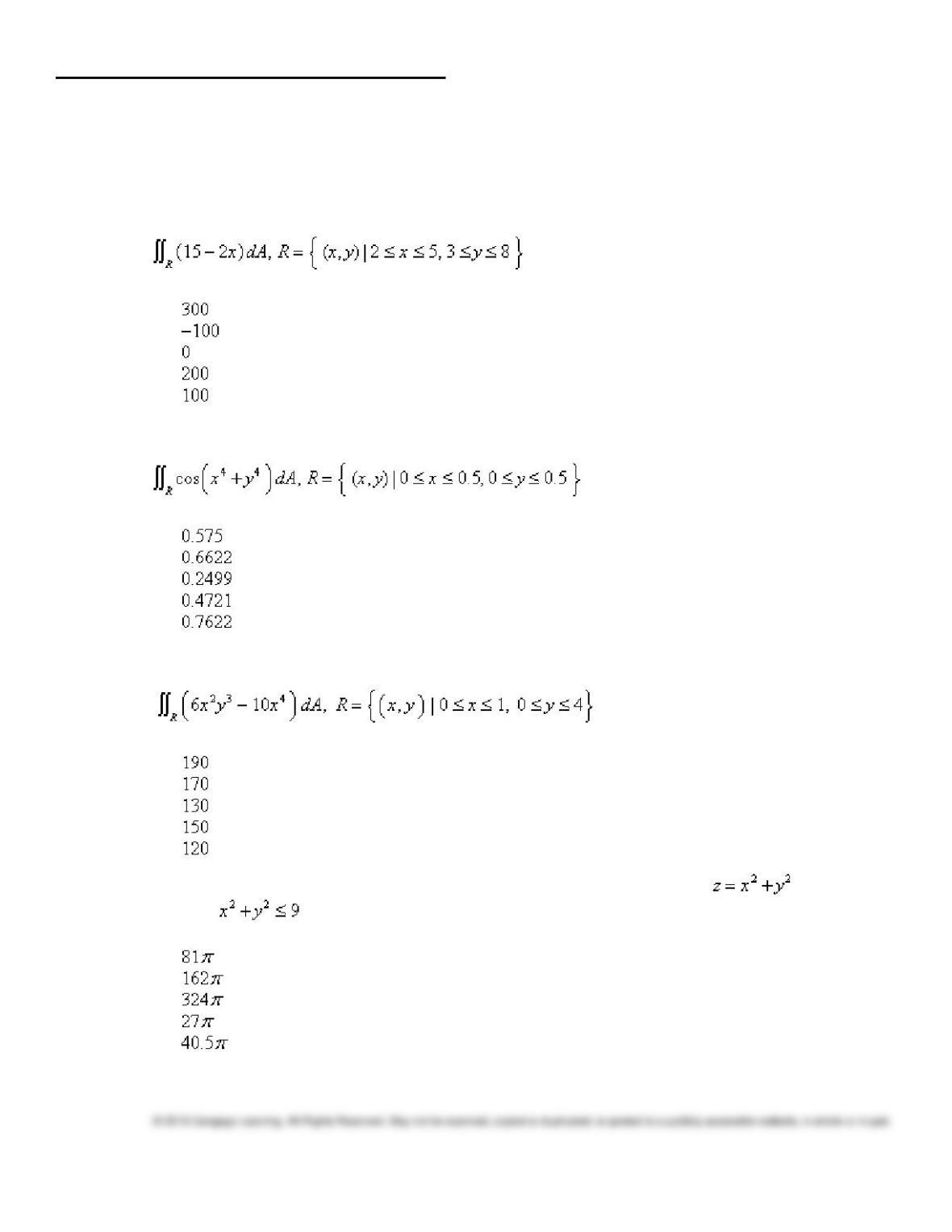
____ 1. Evaluate the double integral by first identifying it as the volume of a solid.
a.
b.
c.
d.
e.
____ 2. Use the Midpoint Rule with four squares of equal size to estimate the double integral.
a.
b.
c.
d.
e.
____ 3. Calculate the double integral.
a.
b.
c.
d.
e.
____ 4. Use polar coordinates to find the volume of the solid under the paraboloid and above
the disk .
a.
b.
c.
d.
e.
Stewart – Calculus ET 8e Chapter 15 Form C
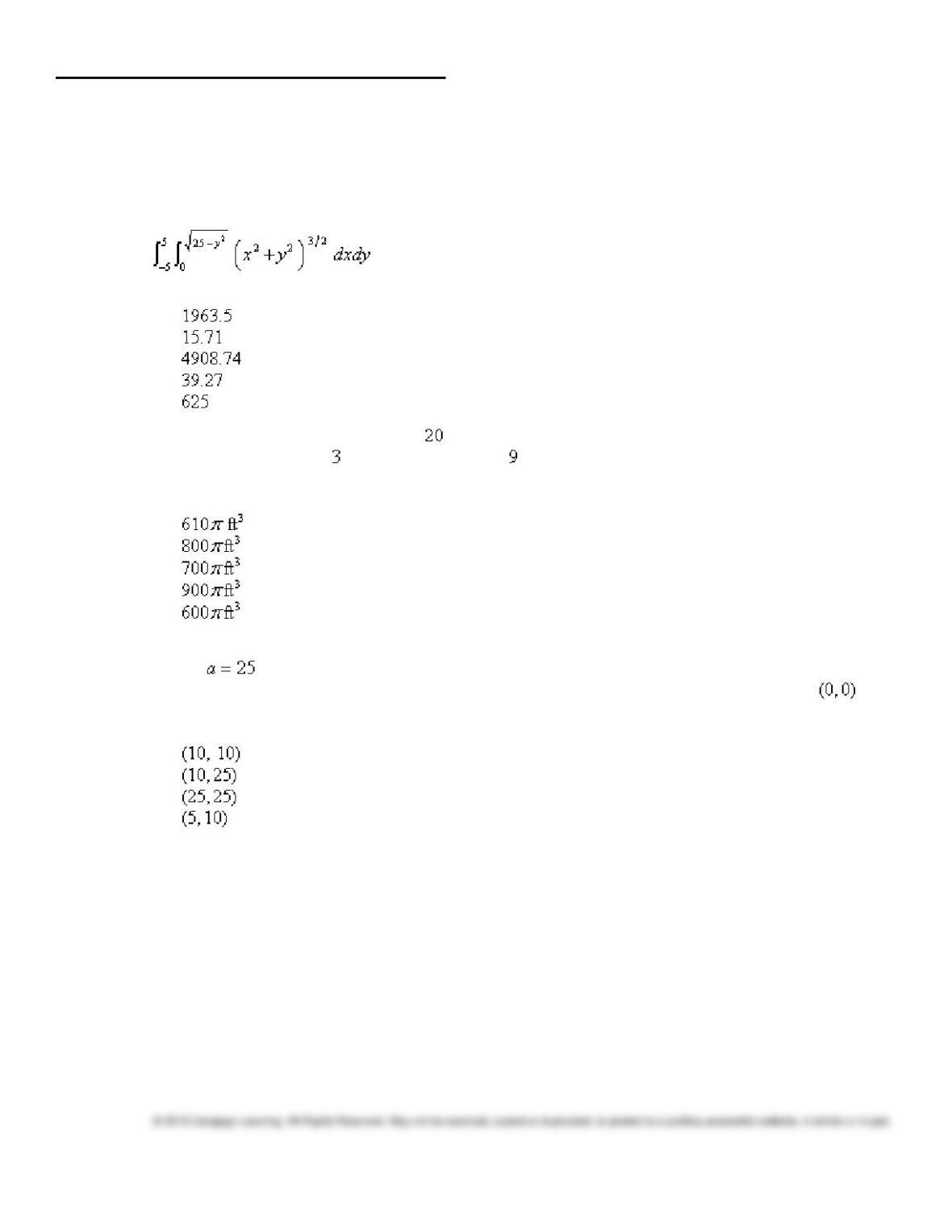
____ 5. Evaluate the iterated integral by converting to polar coordinates. Round the answer to two decimal
places.
.
a.
b.
c.
d.
e.
____ 6. A swimming pool is circular with a -ft diameter. The depth is constant along east-west lines and
increases linearly from ft at the south end to ft at the north end. Find the volume of water in
the pool.
a.
b.
c.
d.
e.
____ 7. Find the center of mass of a lamina in the shape of an isosceles right triangle with equal sides of
length if the density at any point is proportional to the square of the distance from the
vertex opposite the hypotenuse. Assume the vertex opposite the hypotenuse is located at , and
that the sides are along the positive axes.
a.
b.
c.
d.
e. None of these
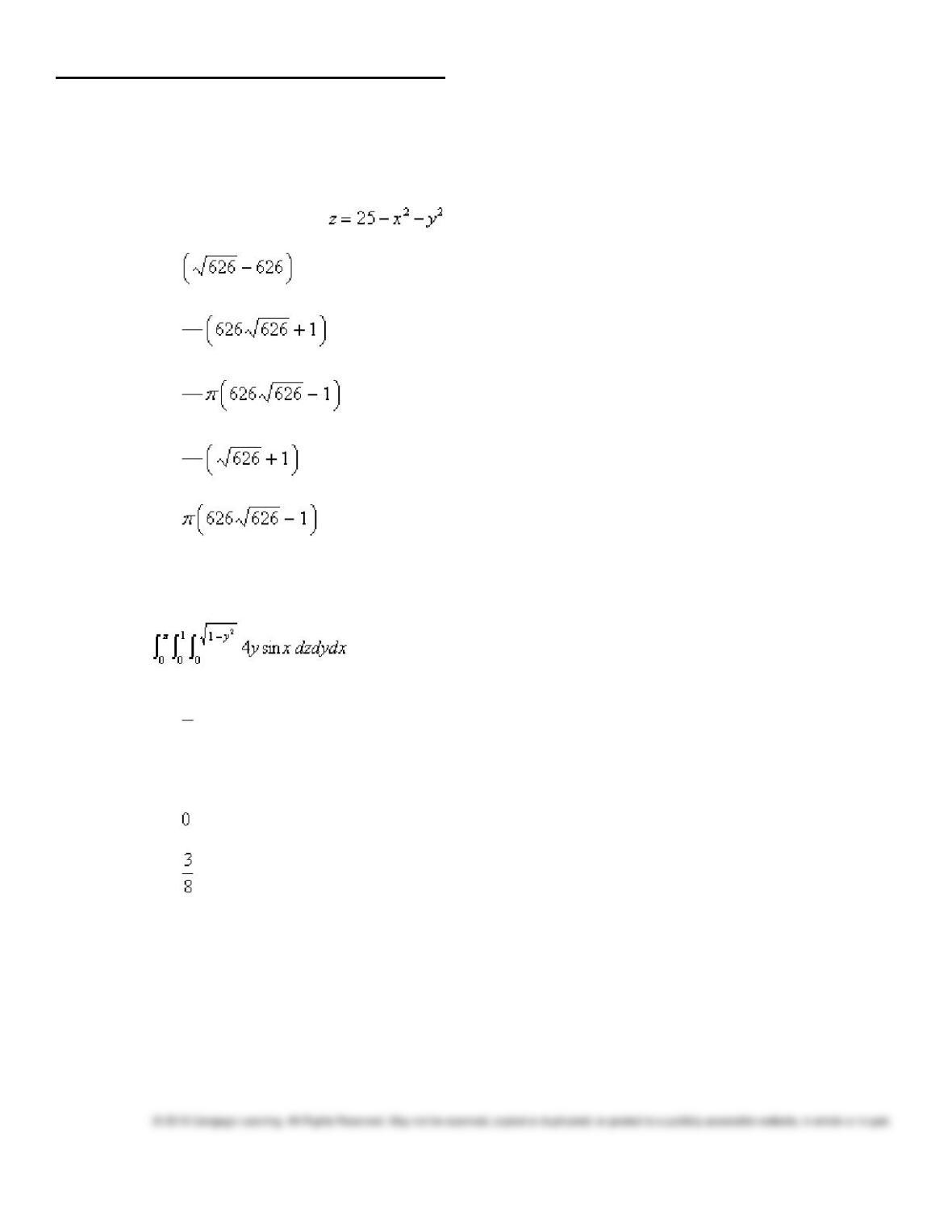
Stewart – Calculus ET 8e Chapter 15 Form C
____ 8. Find the area of the surface.
The part of the surface that lies above the xy-plane.
a.
b.
2
75
c.
2
75
d.
2
75
e.
____ 9. Calculate the iterated integral.
a.
8
3
b. 4
c.
d.
e. None of these
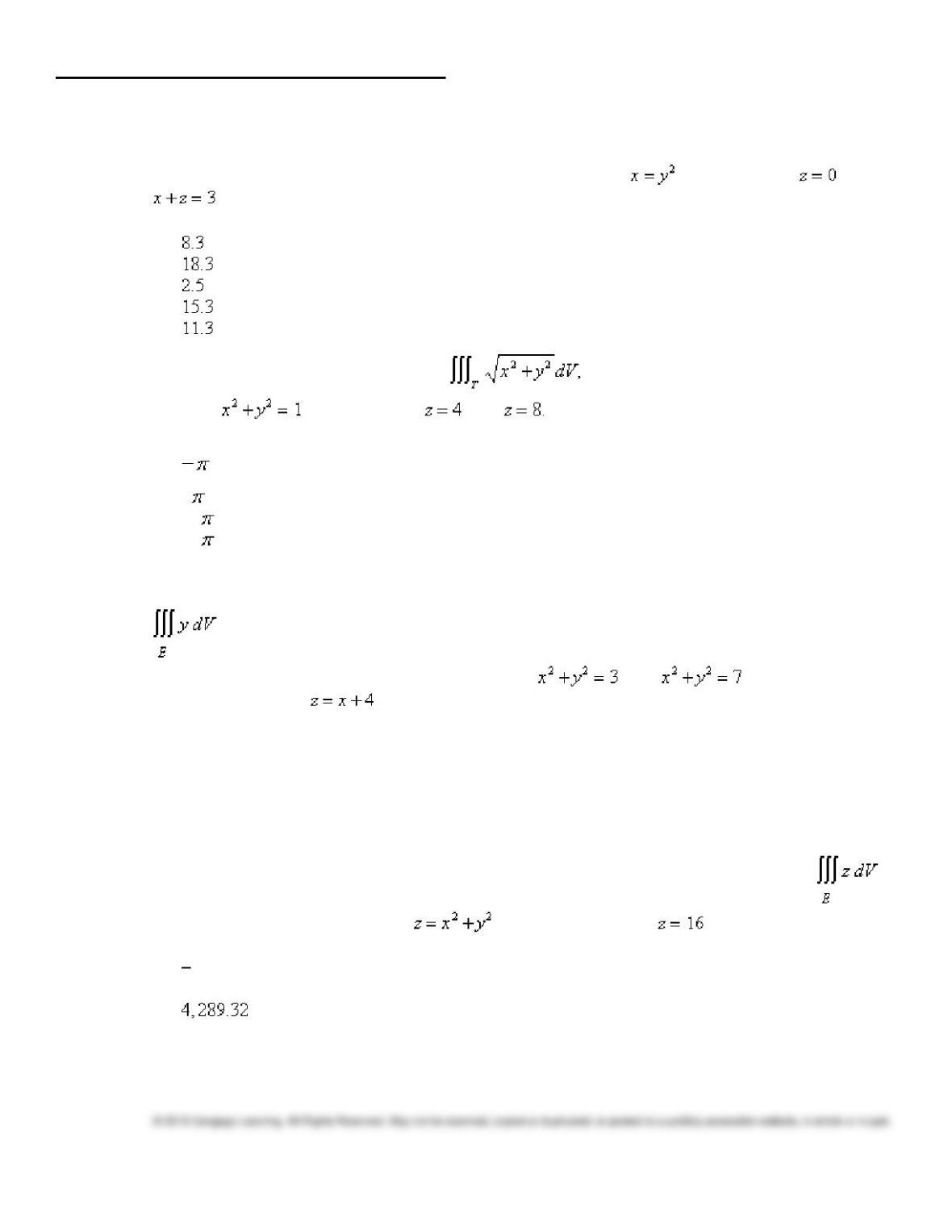
Stewart – Calculus ET 8e Chapter 15 Form C
____ 10. Use a triple integral to find the volume of the solid bounded by and the planes and
.
a.
b.
c.
d.
e.
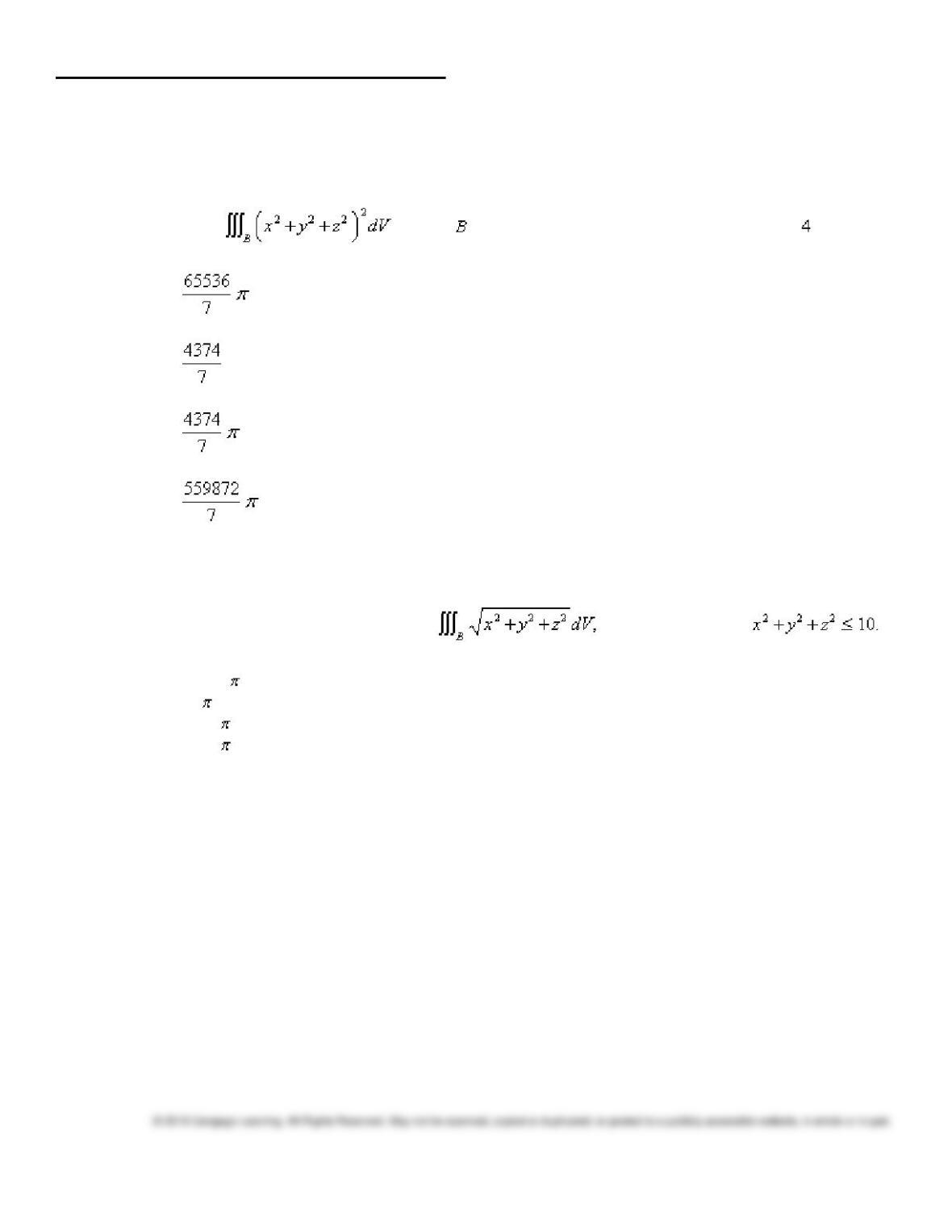
____ 11. Use cylindrical coordinates to evaluate where T is the solid bounded by the
cylinder and the planes and
a.
8
3
b.
4
c.
32
d.
48
____ 12. Use cylindrical coordinates to evaluate the triple integral
where E is the solid that lies between the cylinders and above the xy-plane
and below the plane .
a. 8.57
b. 0
c. 3.4
d. 9.19
e. 0.54
____ 13. Use cylindrical or spherical coordinates, whichever seems more appropriate, to evaluate
where E lies above the paraboloid and below the plane .
a. 160.28
b. 176.38
c.
d. 175.93
e. 175.37
Stewart – Calculus ET 8e Chapter 15 Form C
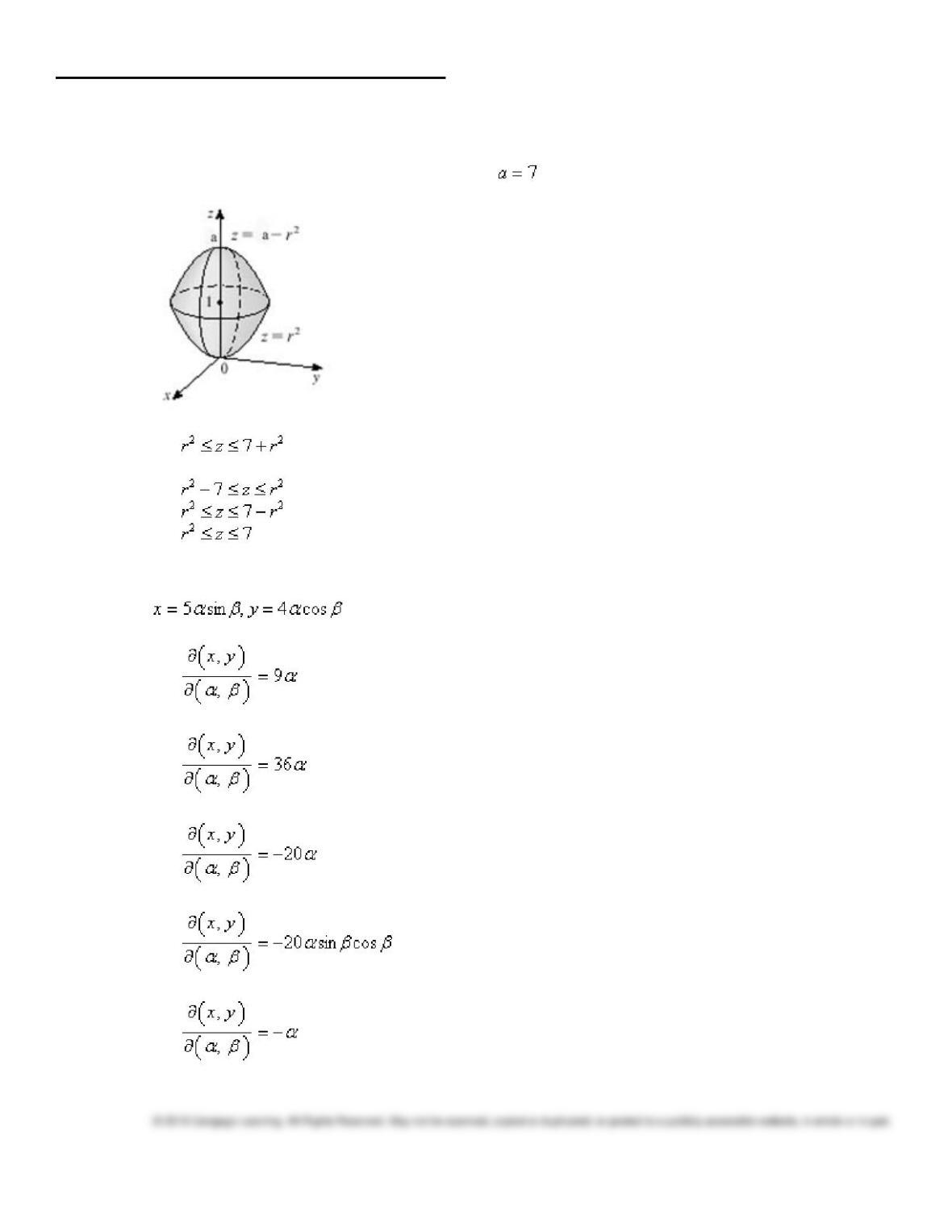
____ 14. Use spherical coordinates.
Evaluate , where is the ball with center the origin and radius .
a.
b.
c.
d.
e. None of these
____ 15. Use spherical coordinates to evaluate where B is the ball
a. 10000
b. 10
c. 1000
d. 2000
Stewart – Calculus ET 8e Chapter 15 Form C
____ 16. The sketch of the solid is given below. Given , write the inequalities that describe it.
a.
b. None of these
c.
d.
e.
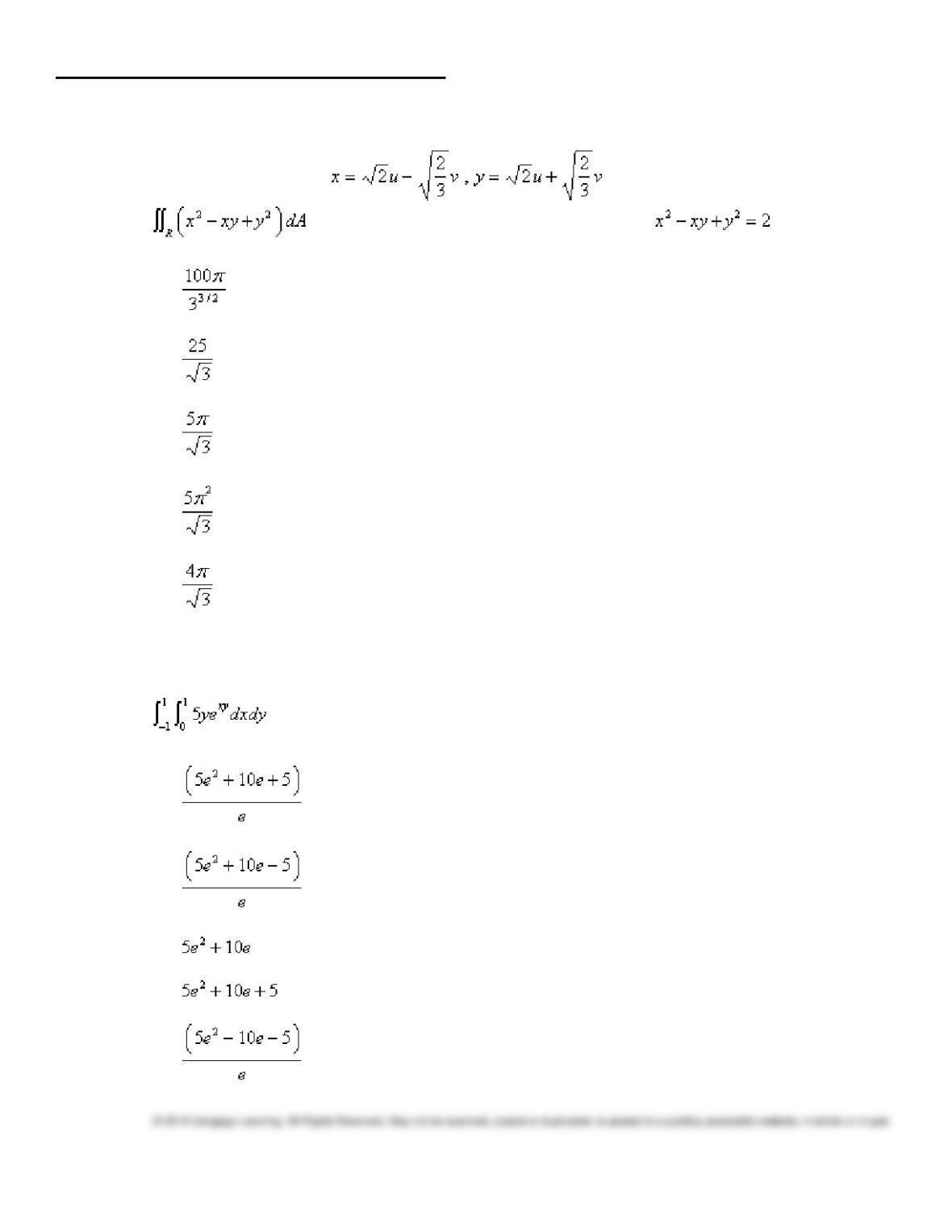
____ 17. Find the Jacobian of the transformation.
a.
b.
c.
d.
e.
Stewart – Calculus ET 8e Chapter 15 Form C
____ 18. Use the transformation to evaluate the integral
, where R is the region bounded by the ellipse .
a.
b.
c.
d.
e.
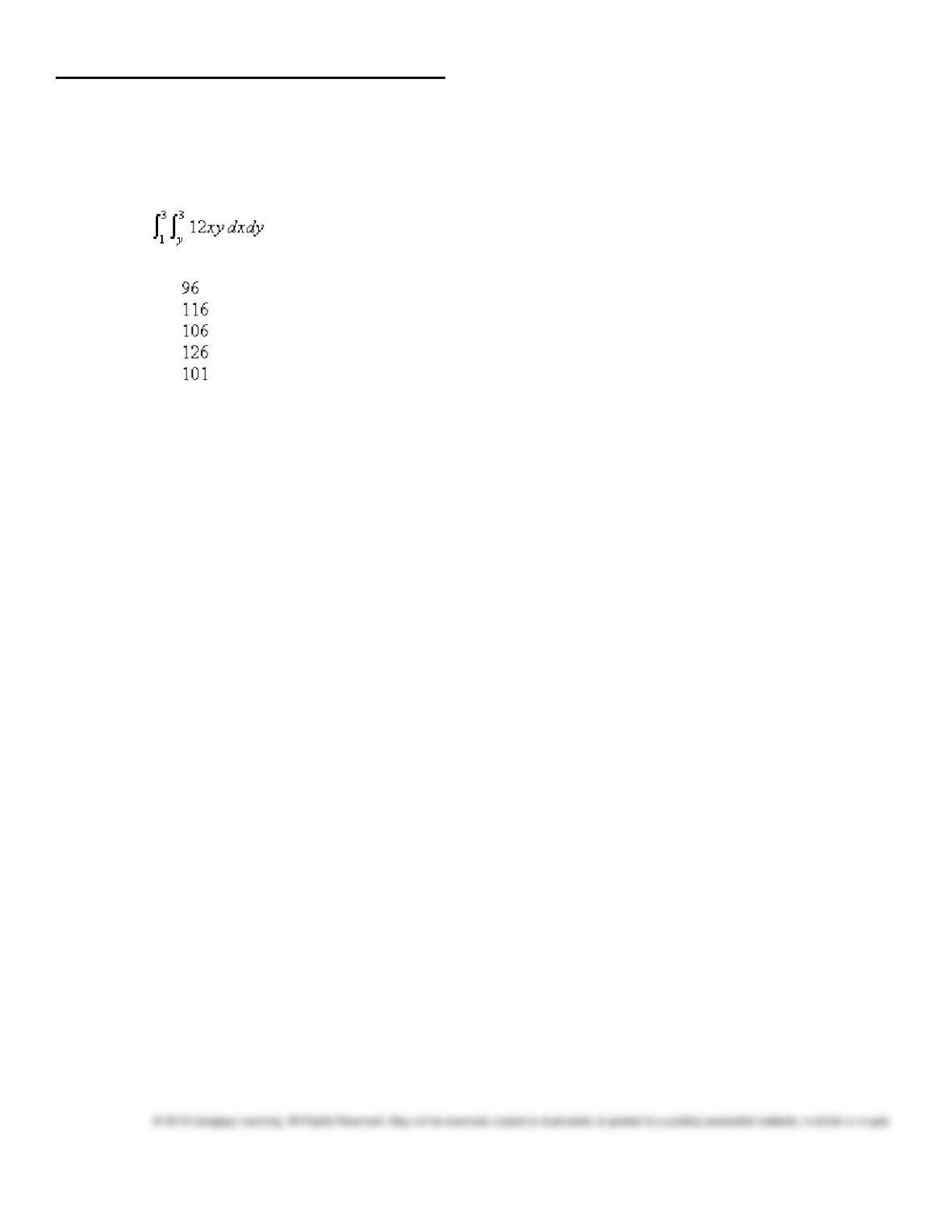
____ 19. Calculate the iterated integral.
a.
b.
c.
d.
e.
Stewart – Calculus ET 8e Chapter 15 Form C
____ 20. Evaluate the iterated integral.
a.
b.
c.
d.
e.
Stewart – Calculus ET 8e Chapter 15 Form C
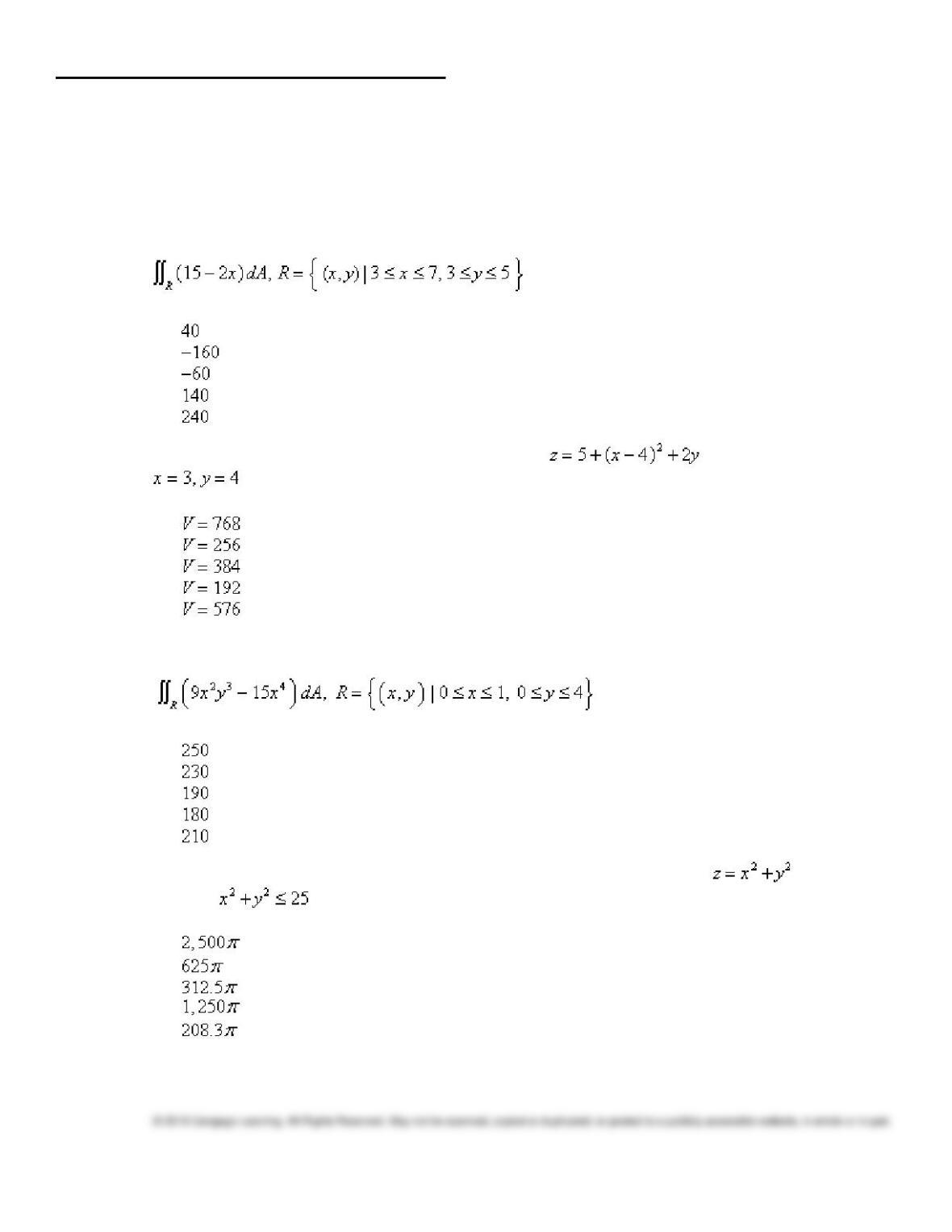
Answer Key
Stewart – Calculus ET 8e Chapter 15 Form D
Select the correct answer for each question.
____ 1. Evaluate the double integral by first identifying it as the volume of a solid.
a.
b.
c.
d.
e.
____ 2. Find the volume of the solid bounded by the surface and the planes
and coordinate planes.
a.
b.
c.
d.
e.
____ 3. Calculate the double integral.
a.
b.
c.
d.
e.
____ 4. Use polar coordinates to find the volume of the solid under the paraboloid and above
the disk .
a.
b.
c.
d.
e.