1. The exchange-rate system that best characterizes the present international monetary arrangement used by industrialized
countries is:
a.
Freely fluctuating exchange rates
b.
Adjustable pegged exchange rates
c.
Managed floating exchange rates
d.
Pegged or fixed exchange rates
2. Which exchange-rate mechanism is intended to insulate the balance of payments from short-term capital movements
while providing exchange rate stability for commercial transactions?
a.
Dual exchange rates
b.
Managed floating exchange rates
c.
Adjustable pegged exchange rates
d.
Crawling pegged exchange rates
United States – BPROG: Reflective Thinking – BPROG: Analysis
United States – PA – DISC: International trade and fi – DISC: International trade and finance
Exchange Rate Practices
BLOOM’S: Comprehension
3. Which exchange-rate mechanism calls for frequent redefining of the par value by small amounts to remove a payments
disequilibrium?
a.
Dual exchange rates
b.
Adjustable pegged exchange rates
c.
Managed floating exchange rates
d.
Crawling pegged exchange rates
United States – BPROG: Reflective Thinking – BPROG: Analysis
United States – PA – DISC: International trade and fi – DISC: International trade and finance
The Crawling Peg
BLOOM’S: Knowledge
4. Under managed floating exchange rates, if the rate of inflation in the United States is less than the rate of inflation of its
trading partners, the dollar will likely:
a.
Appreciate against foreign currencies
b.
Depreciate against foreign currencies
c.
Be officially revalued by the government
United States – BPROG: Reflective Thinking – BPROG: Analysis
United States – PA – DISC: International trade and fi – DISC: International trade and finance
Managed Floating Rates
BLOOM’S: Knowledge
d.
Be officially devalued by the government
5. Under adjustable pegged exchange rates, if the rate of inflation in the United States exceeds the rate of inflation of its
trading partners:
a.
U.S. exports tend to rise and imports tend to fall
b.
U.S. imports tend to rise and exports tend to fall
c.
U.S. foreign exchange reserves tend to rise
d.
U.S. foreign exchange reserves remain constant
United States – BPROG: Reflective Thinking – BPROG: Analysis
United States – PA – DISC: International trade and fi – DISC: International trade and finance
The Crawling Peg
BLOOM’S: Comprehension
6. Under a pegged exchange-rate system, which does not explain why a country would have a balance-of-payments
deficit?
a.
Very high rates of inflation occur domestically
b.
Foreigners discriminate against domestic products
c.
Technological advance is superior abroad
d.
The domestic currency is undervalued relative to other currencies
United States – BPROG: Reflective Thinking – BPROG: Analysis
United States – PA – DISC: International trade and fi – DISC: International trade and finance
The Crawling Peg
BLOOM’S: Comprehension
7. Which exchange-rate system does not require monetary reserves for official exchange-rate intervention?
a.
Floating exchange rates
b.
Pegged exchange rates
c.
Managed floating exchange rates
d.
Dual exchange rates
United States – BPROG: Reflective Thinking – BPROG: Analysis
United States – BPROG: Reflective Thinking – BPROG: Analysis
United States – PA – DISC: International trade and fi – DISC: International trade and finance
Managed Floating Rates
BLOOM’S: Comprehension
8. A primary objective of dual exchange rates is to allow a country the ability to insulate its balance of payments from net:
a.
Current account transactions
b.
Unilateral transfers
c.
Merchandise trade transactions
d.
Capital account transactions
United States – BPROG: Reflective Thinking – BPROG: Analysis
United States – PA – DISC: International trade and fi – DISC: International trade and finance
Choosing an Exchange Rate System: Constraints Imposed by Free Capital Flows
BLOOM’S: Comprehension
9. During the 1970s, the European Union, in its quest for monetary union, adopted what came to be referred to as the
“Community Snake.” This device was a:
a.
Adjustable pegged exchange rate system
b.
Dual exchange rate system
c.
Jointly floating exchange rate system
d.
Freely floating exchange rate system
United States – BPROG: Reflective Thinking – BPROG: Analysis
United States – PA – DISC: International trade and fi – DISC: International trade and finance
Floating Exchange Rates
BLOOM’S: Comprehension
10. Under the historic adjustable pegged exchange-rate system, member countries were permitted to correct persistent and
sizable payment deficits (i.e., fundamental disequilibrium) by:
a.
Officially revaluing their currencies
b.
Officially devaluing their currencies
c.
Allowing their currencies to depreciate in the free market
d.
Allowing their currencies to appreciate in the free market
United States – BPROG: Reflective Thinking – BPROG: Analysis
United States – PA – DISC: International trade and fi – DISC: International trade and finance
BLOOM’S: Knowledge
11. Which exchange-rate system involves a “leaning against the wind” strategy in which short-term fluctuations in
United States – PA – DISC: International trade and fi – DISC: International trade and finance
Floating Exchange Rates
BLOOM’S: Comprehension
exchange rates are reduced without adhering to any particular exchange rate over the long run?
a.
Pegged or fixed exchange rates
b.
Adjustable pegged exchange rates
c.
Managed floating exchange rates
d.
Freely floating exchange rates
12. In 1973, the reform of the international monetary system resulted in the change from:
a.
Adjustable pegged rates to managed floating rates
b.
Managed floating rates to adjustable pegged rates
c.
Crawling pegged rates to freely floating rates
d.
Freely floating rates to crawling pegged rates
United States – BPROG: Reflective Thinking – BPROG: Analysis
United States – PA – DISC: International trade and fi – DISC: International trade and finance
Managed Floating Rates
BLOOM’S: Knowledge
13. The Bretton Woods Agreement of 1944 established a monetary system based on:
a.
Gold and managed floating exchange rates
b.
Gold and adjustable pegged exchange rates
c.
Special Drawing Rights and managed floating exchange rates
d.
Special Drawing Rights and adjustable pegged exchange rates
United States – BPROG: Reflective Thinking – BPROG: Analysis
United States – PA – DISC: International trade and fi – DISC: International trade and finance
Fixed Exchange-Rate System
BLOOM’S: Knowledge
14. Rather than constructing their own currency baskets, many nations peg the value of their currencies to a currency
basket defined by the International Monetary Fund. Which of the following illustrates this basket?
a.
IMF tranche
b.
Special Drawing Rights
c.
Primary reserve asset
d.
Swap facility
United States – BPROG: Reflective Thinking – BPROG: Analysis
United States – PA – DISC: International trade and fi – DISC: International trade and finance
Managed Floating Rates
BLOOM’S: Comprehension
15. Small nations (e.g., the Ivory Coast) whose trade and financial relationships are mainly with a single partner tend to
utilize:
a.
Pegged exchange rates
b.
Freely floating exchange rates
c.
Managed floating exchange rates
d.
Crawling pegged exchange rates
a
Moderate
United States – BPROG: Reflective Thinking – BPROG: Analysis
United States – PA – DISC: International trade and fi – DISC: International trade and finance
The Crawling Peg
BLOOM’S: Knowledge
16. Small nations (e.g., Tanzania) with more than one major trading partner tend to peg the value of their currencies to:
a.
Gold
b.
Silver
c.
A single currency
d.
A basket of currencies
Moderate
United States – BPROG: Reflective Thinking – BPROG: Analysis
United States – PA – DISC: International trade and fi – DISC: International trade and finance
The Crawling Peg
BLOOM’S: Knowledge
17. Under a floating exchange-rate system, if American exports increase and American imports fall, the value of the dollar
will:
a.
Appreciate
b.
Depreciate
c.
Be officially revalued
d.
Be officially devalued
a
United States – BPROG: Reflective Thinking – BPROG: Analysis
United States – PA – DISC: International trade and fi – DISC: International trade and finance
Floating Exchange Rates
Moderate
United States – BPROG: Reflective Thinking – BPROG: Analysis
United States – PA – DISC: International trade and fi – DISC: International trade and finance
Fixed Exchange-Rate System
BLOOM’S: Knowledge
18. Under a floating exchange-rate system, if American exports decrease and American imports rise, the value of the
dollar will:
a.
Appreciate
b.
Depreciate
c.
Be officially revalued
d.
Be officially devalued
Challenging
United States – BPROG: Reflective Thinking – BPROG: Analysis
United States – PA – DISC: International trade and fi – DISC: International trade and finance
Floating Exchange Rates
BLOOM’S: Comprehension
19. Under a floating exchange rate system, an increase in U.S. imports of Japanese goods will cause the demand schedule
for Japanese yen to:
a.
Increase, inducing a depreciation in the yen
b.
Decrease, inducing a depreciation in the yen
c.
Increase, inducing an appreciation in the yen
d.
Decrease, inducing an appreciation in the yen
c
Challenging
United States – BPROG: Reflective Thinking – BPROG: Analysis
United States – PA – DISC: International trade and fi – DISC: International trade and finance
Floating Exchange Rates
BLOOM’S: Comprehension
20. Given an initial equilibrium in the money market and foreign exchange market, suppose the Federal Reserve increases
the money supply of the United States. Under a floating exchange-rate system, the dollar would:
a.
Appreciate in value relative to other currencies
b.
Depreciate in value relative to other currencies
c.
Be officially devalued by the government
d.
Be officially revalued by the government
Challenging
United States – BPROG: Reflective Thinking – BPROG: Analysis
United States – PA – DISC: International trade and fi – DISC: International trade and finance
Floating Exchange Rates
BLOOM’S: Comprehension
21. Given an initial equilibrium in the money market and foreign exchange market, suppose the Federal Reserve decreases
the money supply of the United States. Under a floating exchange rate system, the dollar would:
a.
Appreciate in value relative to other currencies
BLOOM’S: Comprehension
b.
Depreciate in value relative to other currencies
c.
Be officially devalued by the government
d.
Be officially revalued by the government
22. Under a floating exchange-rate system, if the U.S. dollar depreciates against the Swiss franc:
a.
American exports to Switzerland will be cheaper in francs
b.
American exports to Switzerland will be more expensive in francs
c.
American imports from Switzerland will be cheaper in dollars
d.
None of the above
United States – BPROG: Reflective Thinking – BPROG: Analysis
United States – PA – DISC: International trade and fi – DISC: International trade and finance
Floating Exchange Rates
BLOOM’S: Comprehension
23. If the Japanese yen depreciates against other currencies in the exchange markets, this will:
a.
Have no effect on the Japanese balance of trade
b.
Tend to worsen the Japanese balance of trade
c.
Tend to improve the Japanese balance of trade
d.
None of the above
United States – BPROG: Reflective Thinking – BPROG: Analysis
United States – PA – DISC: International trade and fi – DISC: International trade and finance
Floating Exchange Rates
BLOOM’S: Comprehension
24. If the Japanese yen appreciates against other currencies in the exchange markets, this will:
a.
Have no effect on the Japanese balance of trade
b.
Tend to improve the Japanese balance of trade
c.
Tend to worsen the Japanese balance of trade
d.
None of the above
United States – BPROG: Reflective Thinking – BPROG: Analysis
United States – BPROG: Reflective Thinking – BPROG: Analysis
United States – PA – DISC: International trade and fi – DISC: International trade and finance
Floating Exchange Rates
BLOOM’S: Comprehension
25. Suppose Sweden’s inflation rate is less than that of its trading partner. Under a floating exchange rate system, Sweden
would experience a:
a.
Appreciation in its currency
b.
Depreciation in its currency
c.
Fall in the level of its exports
d.
Rise in the level of its imports
United States – BPROG: Reflective Thinking – BPROG: Analysis
United States – PA – DISC: International trade and fi – DISC: International trade and finance
Floating Exchange Rates
BLOOM’S: Comprehension
26. Assume that interest rates in London rise relative to those in Switzerland. Under a floating exchange-rate system, one
would expect the pound (relative to the franc) to:
a.
Depreciate due to the increased demand for pounds
b.
Depreciate due to the increased demand for francs
c.
Appreciate due to the increased demand for francs
d.
Appreciate due to the increased demand for pounds
United States – BPROG: Reflective Thinking – BPROG: Analysis
United States – PA – DISC: International trade and fi – DISC: International trade and finance
Floating Exchange Rates
BLOOM’S: Comprehension
27. Under a floating exchange-rate system, which of the following best leads to a depreciation in the value of the
Canadian dollar?
a.
A decrease in the Canadian money supply
b.
A fall in the Canadian interest rate
c.
An increase in national income overseas
d.
Rising inflation overseas
United States – BPROG: Reflective Thinking – BPROG: Analysis
United States – PA – DISC: International trade and fi – DISC: International trade and finance
Floating Exchange Rates
BLOOM’S: Comprehension
United States – PA – DISC: International trade and fi – DISC: International trade and finance
Floating Exchange Rates
BLOOM’S: Knowledge
28. A market-determined increase in the dollar price of the pound is associated with:
a.
Revaluation of the dollar
b.
Devaluation of the dollar
c.
Appreciation of the dollar
d.
Depreciation of the dollar
29. A market-determined decrease in the dollar price of the pound is associated with:
a.
Revaluation of the dollar
b.
Devaluation of the dollar
c.
Appreciation of the dollar
d.
Depreciation of the dollar
United States – BPROG: Reflective Thinking – BPROG: Analysis
United States – PA – DISC: International trade and fi – DISC: International trade and finance
Floating Exchange Rates
BLOOM’S: Comprehension
30. Which of the following is not a potential disadvantage of freely floating exchange rates?
a.
They require larger amounts of international reserves than other exchange systems
b.
Demand schedules for imports and exports may be price speculation
c.
There may occur large amounts of destabilizing speculation
d.
Capital movements among nations may be hindered via exchange rate fluctuations
United States – BPROG: Reflective Thinking – BPROG: Analysis
United States – PA – DISC: International trade and fi – DISC: International trade and finance
Floating Exchange Rates
BLOOM’S: Comprehension
31. Proponents of freely floating exchange rates maintain that:
a.
Central banks can easily modify fluctuations in exchange rates
b.
The system allows policy makers freedom in pursuing domestic economic goals
c.
Inelastic demand schedules prevent large fluctuations in exchange rates
d.
Inelastic supply schedules prevent large fluctuations in exchange rates
United States – BPROG: Reflective Thinking – BPROG: Analysis
United States – PA – DISC: International trade and fi – DISC: International trade and finance
Floating Exchange Rates
BLOOM’S: Comprehension
32. A potential disadvantage of freely floating exchange rates is that there would:
a.
Exist excessive amounts of hedging in the foreign exchange markets
b.
Be a lack of incentive to initiate exchange arbitrage
c.
Be excessive amounts of destabilizing speculation
d.
Exist a devaluation bias in the exchange markets
United States – BPROG: Reflective Thinking – BPROG: Analysis
United States – PA – DISC: International trade and fi – DISC: International trade and finance
Floating Exchange Rates
BLOOM’S: Comprehension
33. Under a floating exchange rate system, if there occurs a fall in the dollar price of the franc:
a.
American exports to France will be cheaper in francs
b.
American exports to France will be more expensive in francs
c.
American imports from France will be more expensive in dollars
d.
None of the above
United States – BPROG: Reflective Thinking – BPROG: Analysis
United States – PA – DISC: International trade and fi – DISC: International trade and finance
Floating Exchange Rates
BLOOM’S: Comprehension
34. Under a system of floating exchange rates, a U.S. trade deficit with Japan will cause:
a.
A flow of gold from the United States to Japan
b.
The U.S. government to ration yen to U.S. importers
c.
An increase in the dollar price of yen
d.
A decrease in the dollar price of yen
United States – BPROG: Reflective Thinking – BPROG: Analysis
United States – PA – DISC: International trade and fi – DISC: International trade and finance
Floating Exchange Rates
BLOOM’S: Comprehension
35. A potential limitation of freely floating exchange rates is that:
United States – BPROG: Reflective Thinking – BPROG: Analysis
United States – PA – DISC: International trade and fi – DISC: International trade and finance
Floating Exchange Rates
BLOOM’S: Comprehension
a.
Countries require a larger amount of international reserves than otherwise
b.
Countries are unable to initiate economic policies to combat unemployment
c.
Exchange rates may experience wide and frequent fluctuations
d.
Demand tends to be highly sensitive to price movements
36. To temporarily offset an appreciation in the dollar’s exchange value, the Federal Reserve could ____ the U.S. money
supply which would promote a (an) ____ in U.S. interest rates and a ____ in investment flows to the United States.
a.
Increase, decrease, decrease
b.
Increase, increase, decrease
c.
Decrease, decrease, decrease
d.
Decrease, increase, decrease
United States – BPROG: Reflective Thinking – BPROG: Analysis
United States – PA – DISC: International trade and fi – DISC: International trade and finance
Floating Exchange Rates
BLOOM’S: Comprehension
37. To temporarily offset a depreciation in the dollar’s exchange value, the Federal Reserve could ____ the U.S. money
supply which would promote a (an) ____ in U.S. interest rates and a (an) ____ in investment flows to the United States.
a.
Increase, decrease, decrease
b.
Increase, increase, increase
c.
Decrease, decrease, increase
d.
Decrease, increase, increase
United States – BPROG: Reflective Thinking – BPROG: Analysis
United States – PA – DISC: International trade and fi – DISC: International trade and finance
Floating Exchange Rates
BLOOM’S: Comprehension
38. In a managed floating exchange-rate system, temporary stabilization of the dollar’s exchange value requires the
Federal Reserve to adopt a (an) ____ monetary policy when the dollar is appreciating and a (an) ____ policy when the
dollar is depreciating.
a.
Expansionary, expansionary
b.
Expansionary, contractionary
c.
Contractionary, expansionary
United States – BPROG: Reflective Thinking – BPROG: Analysis
United States – PA – DISC: International trade and fi – DISC: International trade and finance
Floating Exchange Rates
BLOOM’S: Comprehension
d.
Contractionary, contractionary
39. The central bank of the United Kingdom could prevent the pound from appreciating by:
a.
Selling pounds on the foreign exchange market
b.
Buying pounds on the foreign exchange market
c.
Reducing its inflation rate relative to its trading partners
d.
Promoting domestic investment and technological development
United States – BPROG: Reflective Thinking – BPROG: Analysis
United States – PA – DISC: International trade and fi – DISC: International trade and finance
Managed Floating Rates
BLOOM’S: Comprehension
40. A surplus nation can reduce its payments imbalance by:
a.
Applying tariffs and trade restrictions on imports
b.
Revaluing its national currency
c.
Increasing its labor productivity
d.
Setting higher interest rates than its trading partners
United States – BPROG: Reflective Thinking – BPROG: Analysis
United States – PA – DISC: International trade and fi – DISC: International trade and finance
Managed Floating Rates
BLOOM’S: Comprehension
41. A main purpose of exchange stabilization funds is to:
a.
Permit a country to overvalue its currency in the exchange markets
b.
Permit a country to undervalue its currency in the exchange markets
c.
Increase the supply of foreign currency when imports exceed exports
d.
Decrease the supply of foreign currency when imports exceed exports
United States – BPROG: Reflective Thinking – BPROG: Analysis
United States – PA – DISC: International trade and fi – DISC: International trade and finance
Managed Floating Rates
United States – BPROG: Reflective Thinking – BPROG: Analysis
United States – PA – DISC: International trade and fi – DISC: International trade and finance
Managed Floating Rates
BLOOM’S: Comprehension
42. As a policy instrument, currency devaluation may be controversial since it:
a.
Imposes hardships on the exporters of foreign countries
b.
Imposes hardships on exporters of the devaluing country
c.
Is generally followed by unemployment in the devaluing country
d.
Is generally followed by price deflation in the devaluing country
United States – BPROG: Reflective Thinking – BPROG: Analysis
United States – PA – DISC: International trade and fi – DISC: International trade and finance
Managed Floating Rates
BLOOM’S: Comprehension
43. Given a two-country world, assume Canada and Sweden devalue their currencies by 20 percent. This would result in:
a.
An appreciation in the Canadian currency
b.
An appreciation in the Swedish currency
c.
An appreciation in both currencies
d.
An appreciation in neither currency
United States – BPROG: Reflective Thinking – BPROG: Analysis
United States – PA – DISC: International trade and fi – DISC: International trade and finance
Managed Floating Rates
BLOOM’S: Comprehension
44. Suppose that Japan maintains a pegged exchange rate that overvalues the yen. This would likely result in:
a.
Japanese exports becoming cheaper in world markets
b.
Imports becoming expensive in the Japanese market
c.
Unemployment for Japanese workers
d.
Full employment for Japanese workers
United States – BPROG: Reflective Thinking – BPROG: Analysis
United States – PA – DISC: International trade and fi – DISC: International trade and finance
Managed Floating Rates
BLOOM’S: Comprehension
45. To defend a pegged exchange rate that overvalues its currency, a country could:
a.
Discourage commodity exports
b.
Encourage commodity imports
c.
Purchase its own currency in international markets
d.
Sell its own currency in international markets
BLOOM’S: Comprehension
46. Given a two-country world, suppose Japan devalues the yen by 20 percent and South Korea devalues the won by 15
percent. This results in:
a.
An appreciation in the value of both currencies
b.
A depreciation in the value of both currencies
c.
An appreciation in the value of the yen against the won
d.
A depreciation in the value of the yen against the won
United States – BPROG: Reflective Thinking – BPROG: Analysis
United States – PA – DISC: International trade and fi – DISC: International trade and finance
The Crawling Peg
BLOOM’S: Comprehension
47. Given a two-country world, suppose Japan revalues the yen by 15 percent and South Korea revalues the won by 12
percent. This results in:
a.
An appreciation in the value of both currencies
b.
A depreciation in the value of both currencies
c.
An appreciation in the value of the yen against the won
d.
A depreciation in the value of the yen against the won
United States – BPROG: Reflective Thinking – BPROG: Analysis
United States – PA – DISC: International trade and fi – DISC: International trade and finance
The Crawling Peg
BLOOM’S: Comprehension
Figure 15.1 shows the market for the Swiss franc. In the figure, the initial demand for marks and supply of marks are
depicted by D0 and S0 respectively.
Figure 15.1. The Market for the Swiss Franc
United States – BPROG: Reflective Thinking – BPROG: Analysis
United States – PA – DISC: International trade and fi – DISC: International trade and finance
The Crawling Peg
BLOOM’S: Comprehension
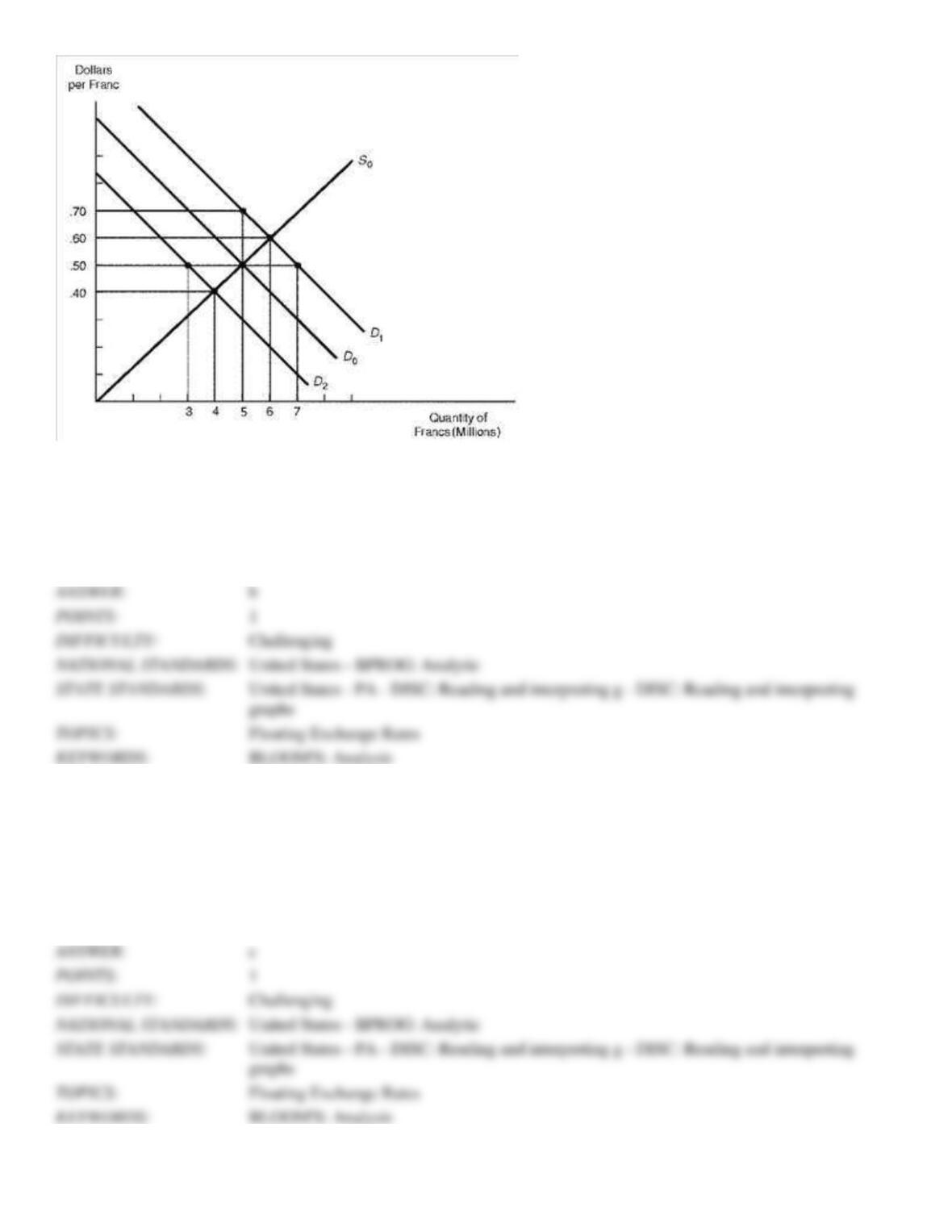
48. Refer to Figure 15.1. With a system of floating exchange rates, the equilibrium exchange rate is:
a.
$0.40 per franc
b.
$0.50 per franc
c.
$0.60 per franc
d.
$0.70 per franc
49. Refer to Figure 15.1. Suppose that the United States increases its imports from Switzerland, resulting in a rise in the
demand for francs from D0 to D1. Under a floating exchange rate system, the new equilibrium exchange rate would be:
a.
$0.40 per franc
b.
$0.50 per franc
c.
$0.60 per franc
d.
$0.70 per franc
United States – BPROG: Analytic
Floating Exchange Rates
BLOOM’S: Analysis
United States – BPROG: Analytic
Floating Exchange Rates
BLOOM’S: Analysis
50. Refer to Figure 15.1. Suppose the United States decreases investment spending in Switzerland, thus reducing the
demand for francs from D0 to D2. Under a floating exchange rate system, the new equilibrium exchange rate would be:
a.
$0.40 per franc
b.
$0.50 per franc
c.
$0.60 per franc
d.
$0.70 per franc
51. Refer to Figure 15.1. Suppose the demand for francs increases from D0 to D1. Under a fixed exchange rate system, the
U.S. exchange stabilization fund could maintain a fixed exchange rate of $0.50 per franc by:
a.
Selling francs for dollars on the foreign exchange market
b.
Selling dollars for francs on the foreign exchange market
c.
Decreasing U.S. exports, thus decreasing the supply of francs
d.
Stimulating U.S. imports, thus increasing the demand for francs
a
Challenging
Floating Exchange Rates
BLOOM’S: Analysis
Table 15.1. The Market for Francs
Quantity of
Dollar price
Quantity of
francs demanded
of francs
francs supplied
600
$0.05
0
500
0.10
100
400
0.15
200
300
0.20
300
200
0.25
400
100
0.30
500
0
0.35
600
52. Refer to Table 15.1. Under a system of floating exchange rates, the equilibrium exchange rate equals:
a.
$0.15 per franc
b.
$0.20 per franc
c.
$0.25 per franc
d.
$0.30 per franc
Challenging
United States – BPROG: Analytic
Floating Exchange Rates
BLOOM’S: Analysis