Chapter 15: Contributed Capital
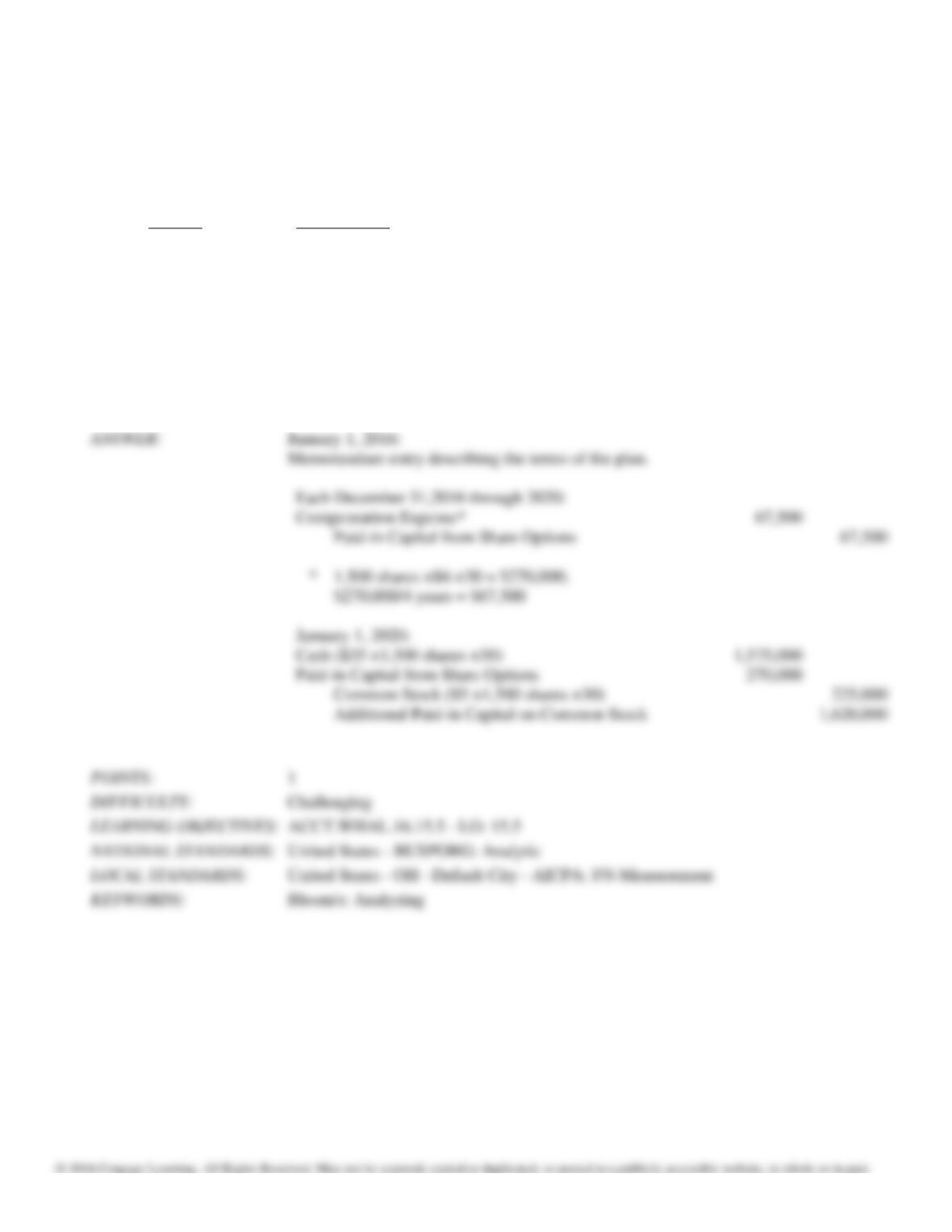
125. On January 1, 2016, Asquith Company adopts a performance-based stock option plan with a four-year vesting and
service period, a $35 exercise price, and a $6 per option fair value. The plan grants a maximum of 2,000 shares of $5
par common stock to each of the company’s 30 executives. The number of shares that vest depends on the increase in
sales during the service period, based on the following scale:
Sales Increase
at Least
No. of Shares
5%
1,000
10%
1,500
15%
2,000
Asquith estimates that sales will increase by 12% during the service period. The estimate is achieved and all options
are exercised on January 1, 2020.
Required:
Assuming Asquith uses the fair value method to account for its stock option plan, prepare all of the journal entries
over the life of Asquith’s stock option plan (2016 through 2020).
Chapter 15: Contributed Capital
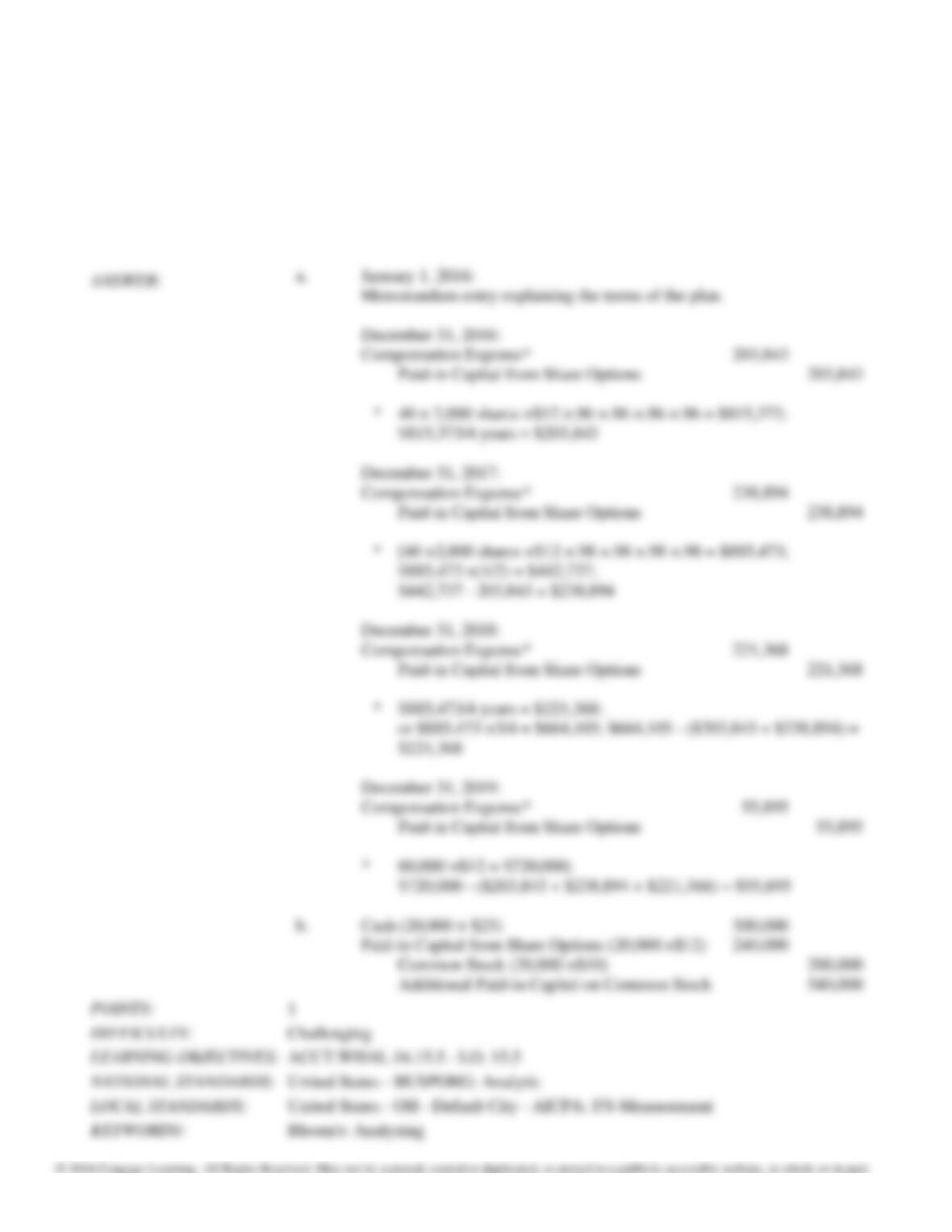
126. On January 1, 2016, Microprocessing Inc. awarded a fixed compensation stock option plan to 40 executives. The
plan allows each executive to buy 2,000 shares of the company’s $10 par common stock for $25 a share after a four-
year service period. The fair value of each option on the grant date is $12. The company expects an annual executive
turnover rate of 4%. In 2017, the rate changed to 2% for the entire service period. On December 31, 2019, 60,000
options vest and the rest are forfeited. On January 5, 2020, 10 executives of Microprocessing exercised their options.
Required:
a.
Prepare the journal entries for 2016 through 2019.
b.
Prepare the journal entry for January 5, 2020.
1
Challenging
ACCT.WHAL.16.15.5 – LO: 15.5
United States – OH – Default City – AICPA: FN-Measurement
Chapter 15: Contributed Capital
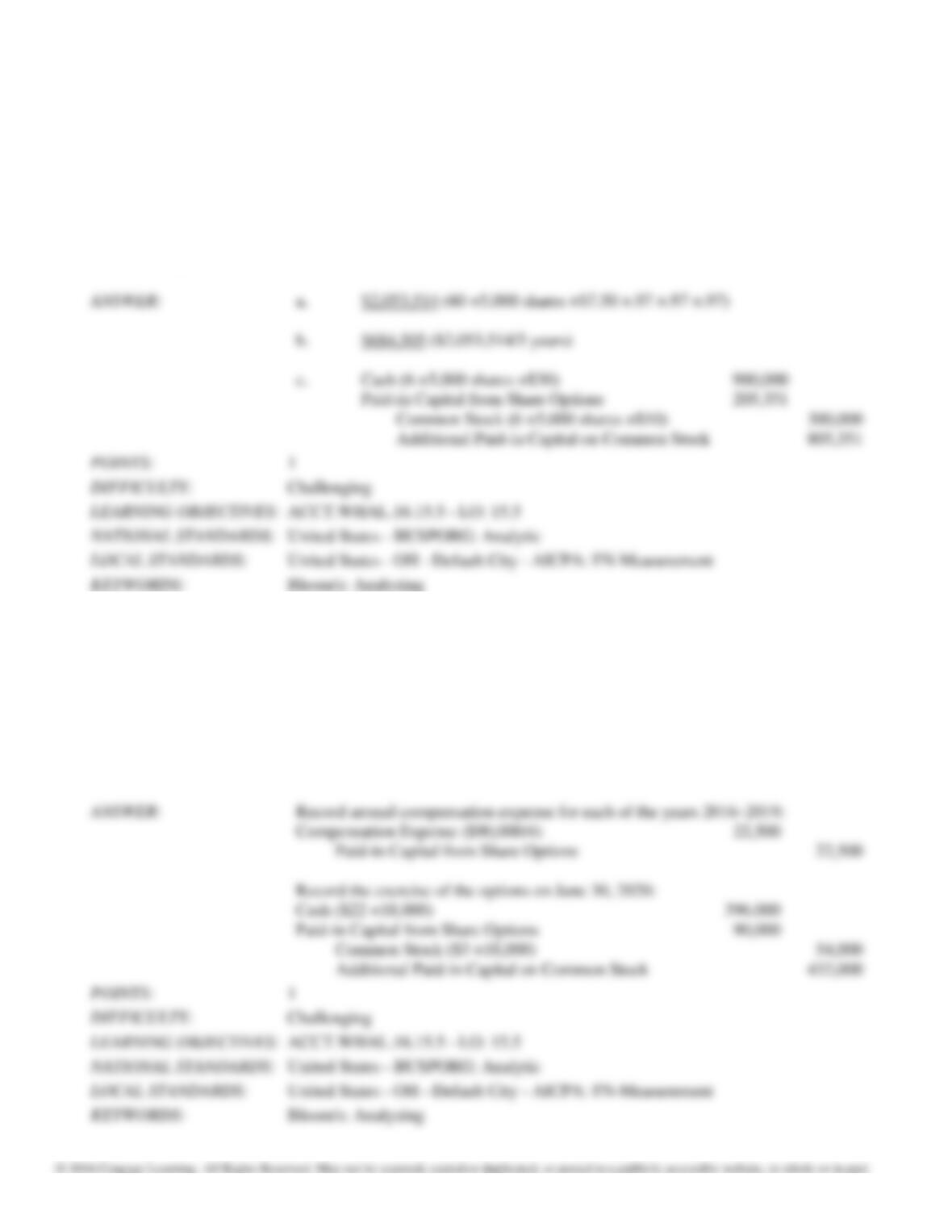
127. On January 1, 2016, sixty executives are offered a fixed compensatory stock option plan in which each of them will
receive options to buy 5,000 shares of $10 par common stock at $30 a share. On the grant date, the fair value per
option is $7.50. There is a three-year service period and an estimated annual employee turnover rate of 3%.
Required:
a.
Compute the expected total compensation cost.
b.
Compute the compensation expense for 2016.
c.
1
Challenging
ACCT.WHAL.16.15.5 – LO: 15.5
United States – BUSPORG: Analytic
United States – OH – Default City – AICPA: FN-Measurement
Bloom’s: Analyzing
Prepare the journal entry to record the exercise of options by six of the executives on
January 1, 2019.
1
Challenging
ACCT.WHAL.16.15.5 – LO: 15.5
United States – BUSPORG: Analytic
United States – OH – Default City – AICPA: FN-Measurement
Bloom’s: Analyzing
128. On January 1, 2016, Robertson Company created a fixed compensatory stock option plan for employees to acquire
18,000 shares of $3 par common stock for $22 a share. The options vest after four years of employment, and
therefore, they cannot be exercised until January 1, 2020. On the grant date, the fair value of the options was $5 per
option. All options were exercised on June 30, 2020. Robertson Company accounts for this plan using the fair value
method.
Required:
Record all entries relating to this stock option plan over the life of the plan.
Chapter 15: Contributed Capital
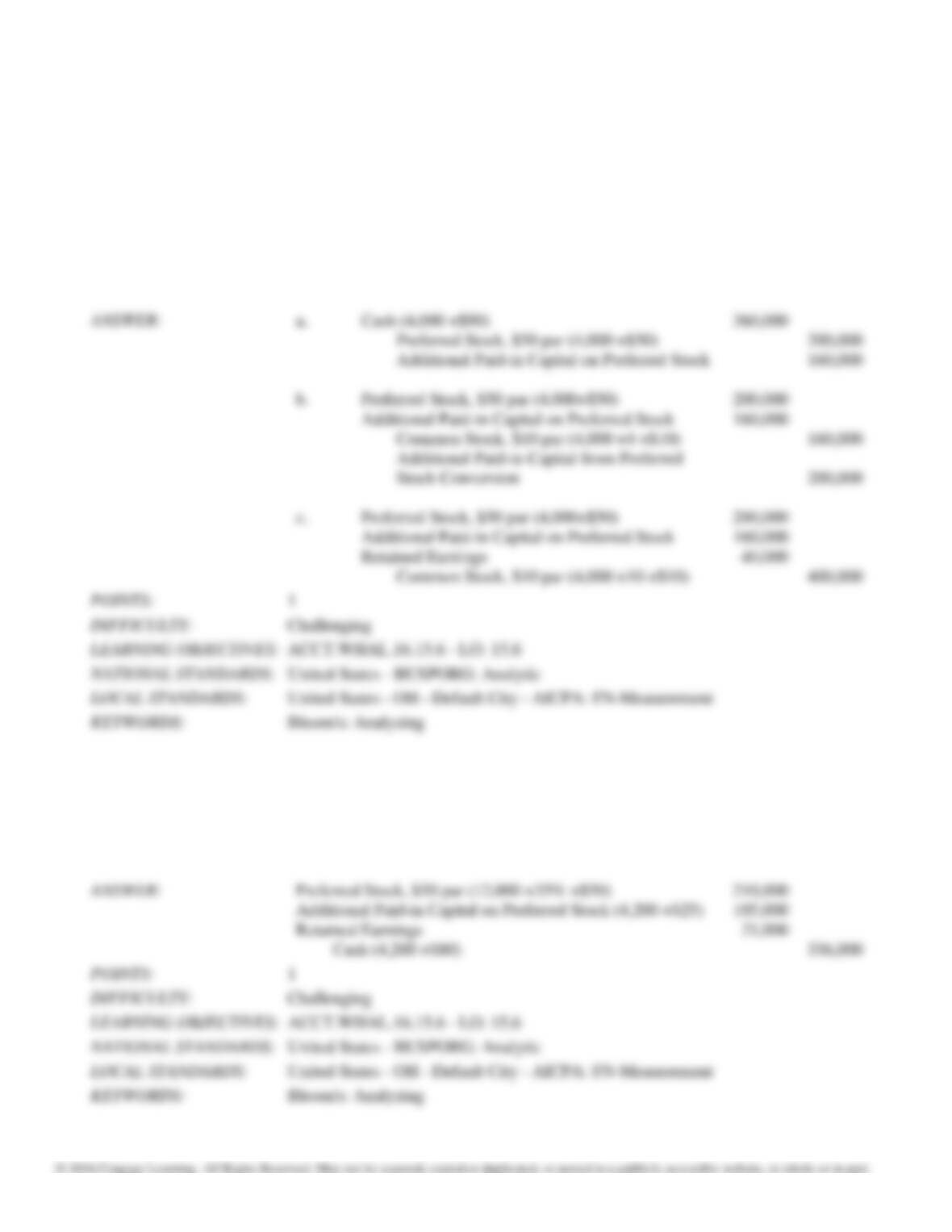
129. On January 3, 2016, Maris Corporation issued 4,000 shares of $50 par convertible preferred stock at $90 per share.
Each share is convertible into four shares of $10 par common stock.
Required:
a.
Prepare the journal entry to record the issuance of the stock on January 3, 2016.
b.
On March 5, 2018, each share of preferred was converted. Prepare the journal entry to
record this conversion.
c.
1
ACCT.WHAL.16.15.6 – LO: 15.6
Bloom’s: Analyzing
Assume that instead of the above circumstances regarding conversion, the company agrees
to convert each share of preferred into ten shares of $10 par common stock on March 5,
2018. Prepare the journal entry to record this conversion.
ACCT.WHAL.16.15.6 – LO: 15.6
130. Baltimore Bike had outstanding 12,000 shares of $50 par callable preferred stock. The corporation called 35% of the
shares (originally issued at $75 per share) at a call price of $80 per share.
Required:
Record the journal entry for the call of this preferred stock.
Chapter 15: Contributed Capital
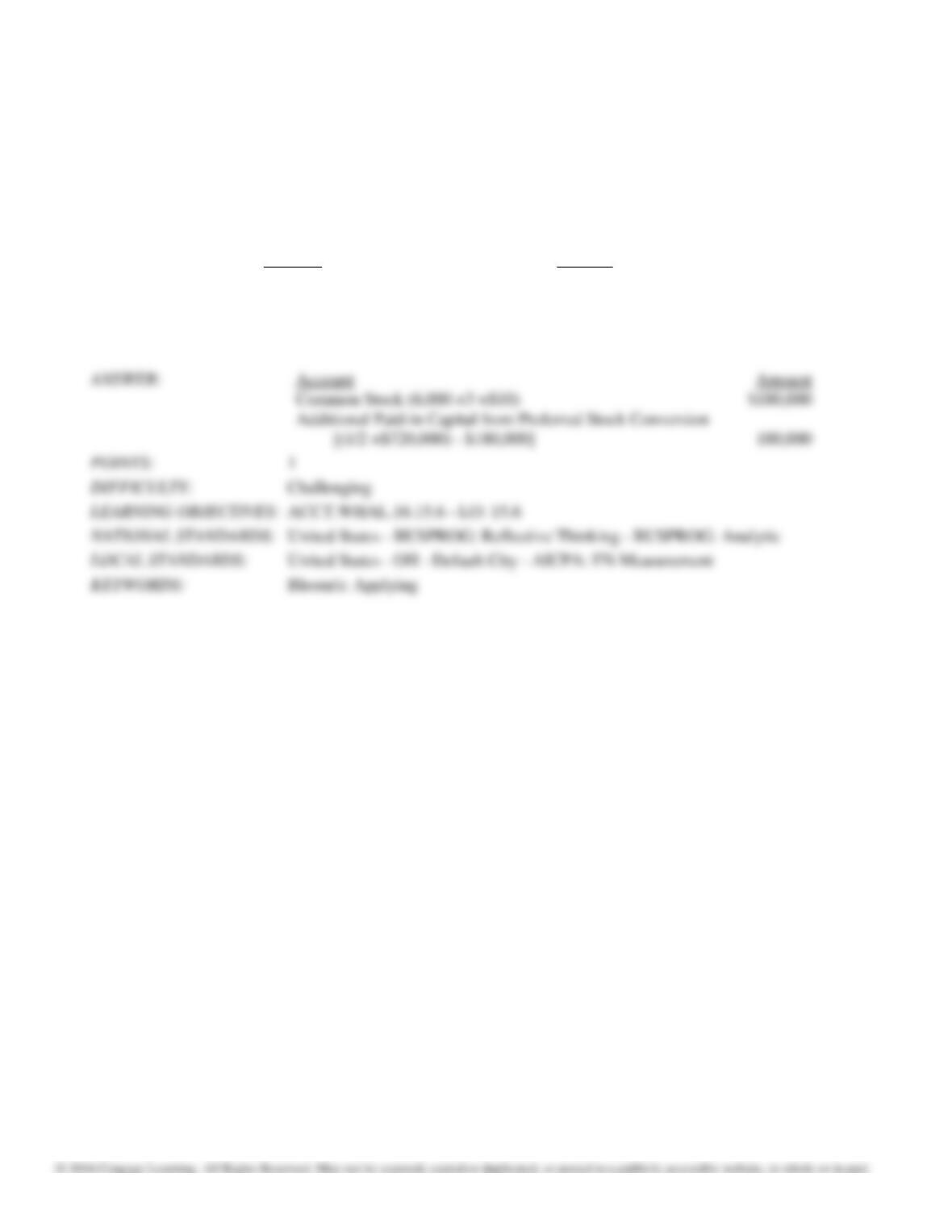
131. Several years ago, Walther, Inc. issued 12,000 shares of $40 par preferred stock at $60. Each share of preferred was
convertible into three shares of $10 par common stock. On January 10, 2016, one-half of the preferred stock was
converted.
Required:
Indicate the credits that should be made in the entry to record this conversion.
Account
Amount
______________________________________________
_____________________
______________________________________________
_____________________
Challenging
United States – BUSPROG: Reflective Thinking – BUSPROG: Analytic
Bloom’s: Applying
Chapter 15: Contributed Capital
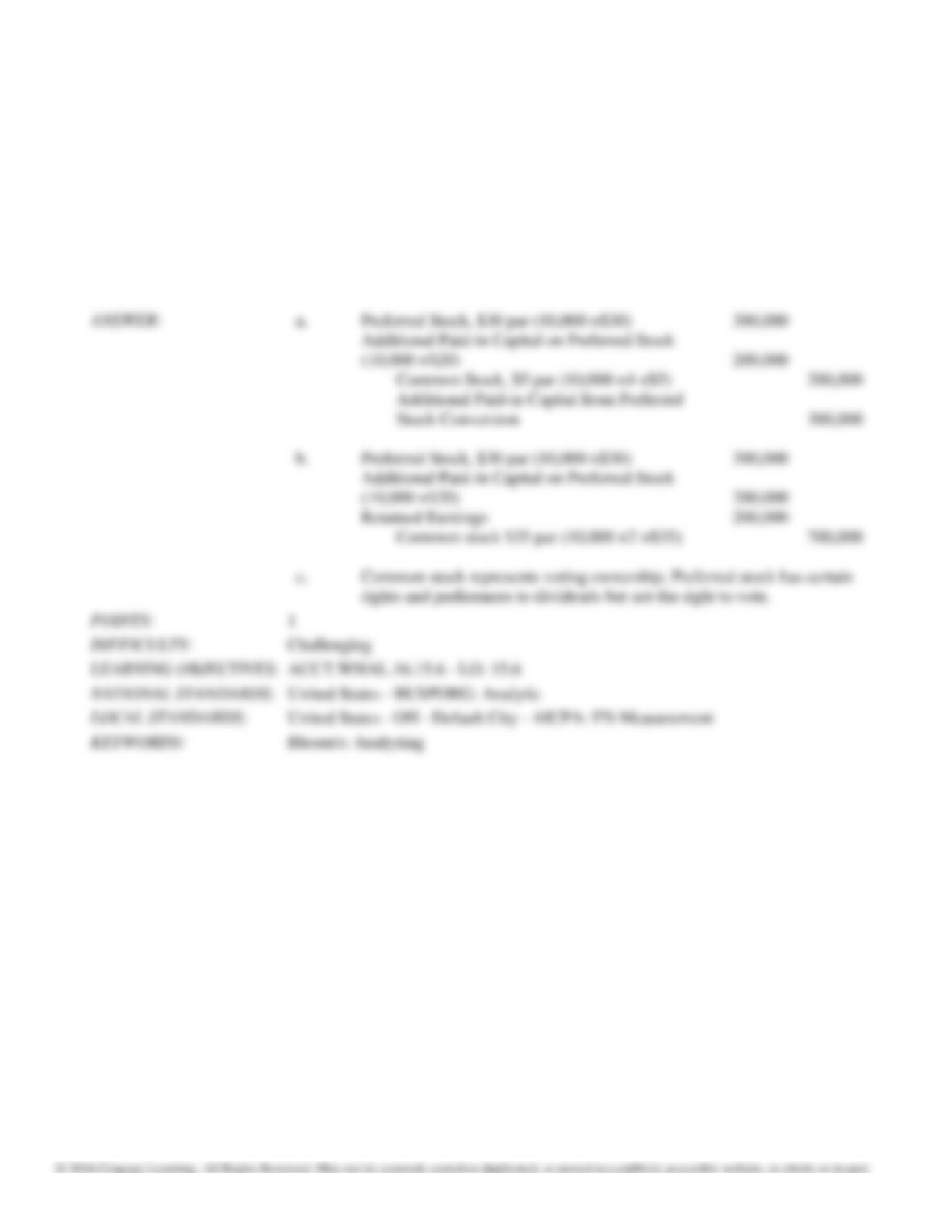
132. Trevor had outstanding 40,000 shares of $30 par convertible preferred stock that had been sold at $50 a share. One-
fourth of these shares were converted into common stock at the stated ratio of four shares of $5 par common stock
(now selling at $15 a share) for each share of preferred stock.
Required:
a.
Record the conversion of preferred into common stock.
b.
Use the same information as in requirement (a)except assume that each share of preferred
stock is convertible into two shares of $35 par common stock (now selling at $40 a share).
Record this conversion of preferred into common stock.
c.
1
ACCT.WHAL.16.15.6 – LO: 15.6
United States – BUSPORG: Analytic
Bloom’s: Analyzing
Why did Trevor not have common stock converted into preferred stock?
Chapter 15: Contributed Capital
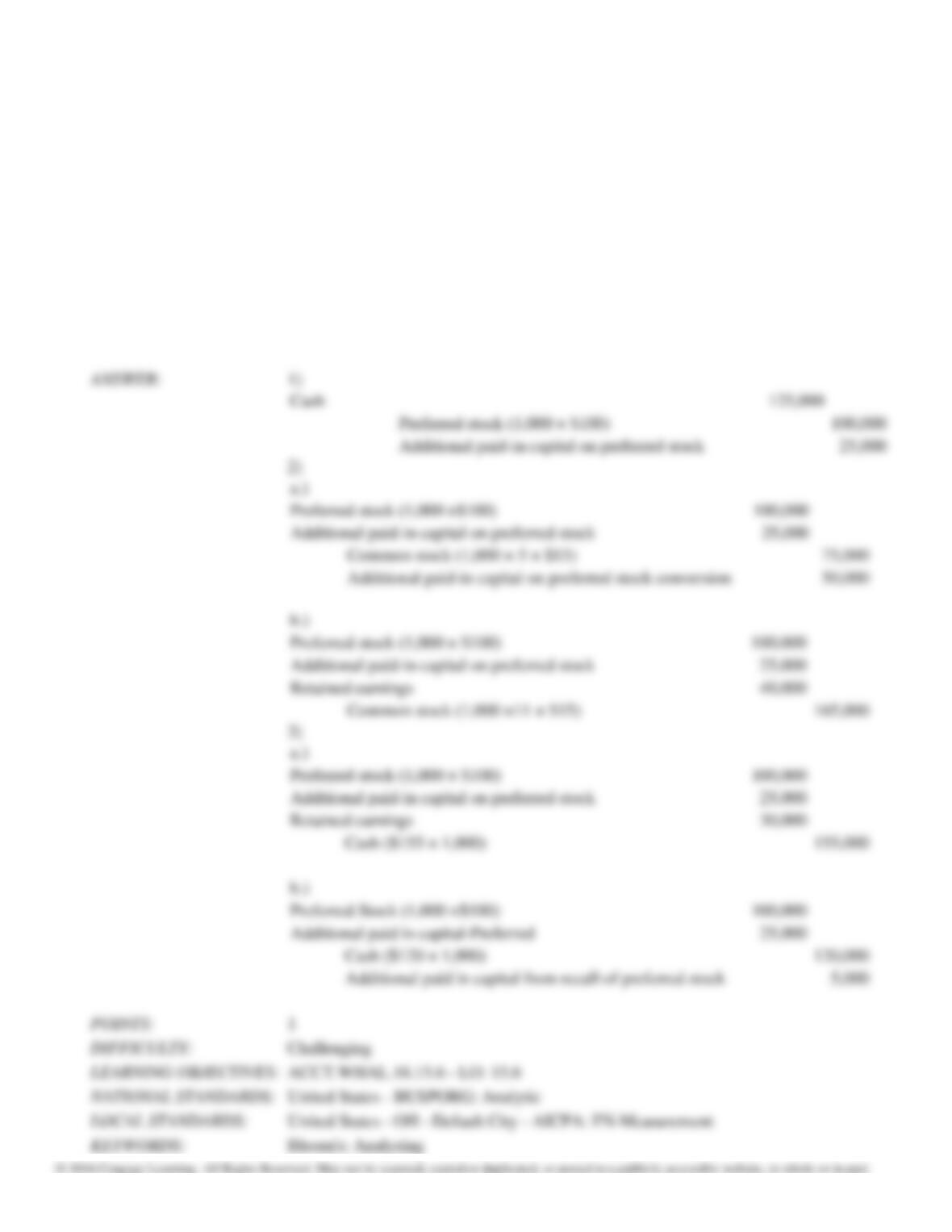
133. On January 1, 2016 Howard Corporation issued 1,000 shares of $100 par convertible preferred stock for $125 per
share. On January 15, 2018 all shares are converted to common stock.
Required:
1) Record the January 1, 2016 issuance of the preferred stock.
2) Record the January 15, 2018 to convert the preferred stock to common based upon the following stated contract
information:
a.) each share is convertible into 5 shares of $15 par common stock.
b.) each share is convertible into 11 shares of $15 par common stock.
3) What if the preferred stock was callable instead of convertible. Prepare the journal entries to recall the stock:
a.) at a price of $155 per share
b.) at a price of $120 per share
Chapter 15: Contributed Capital
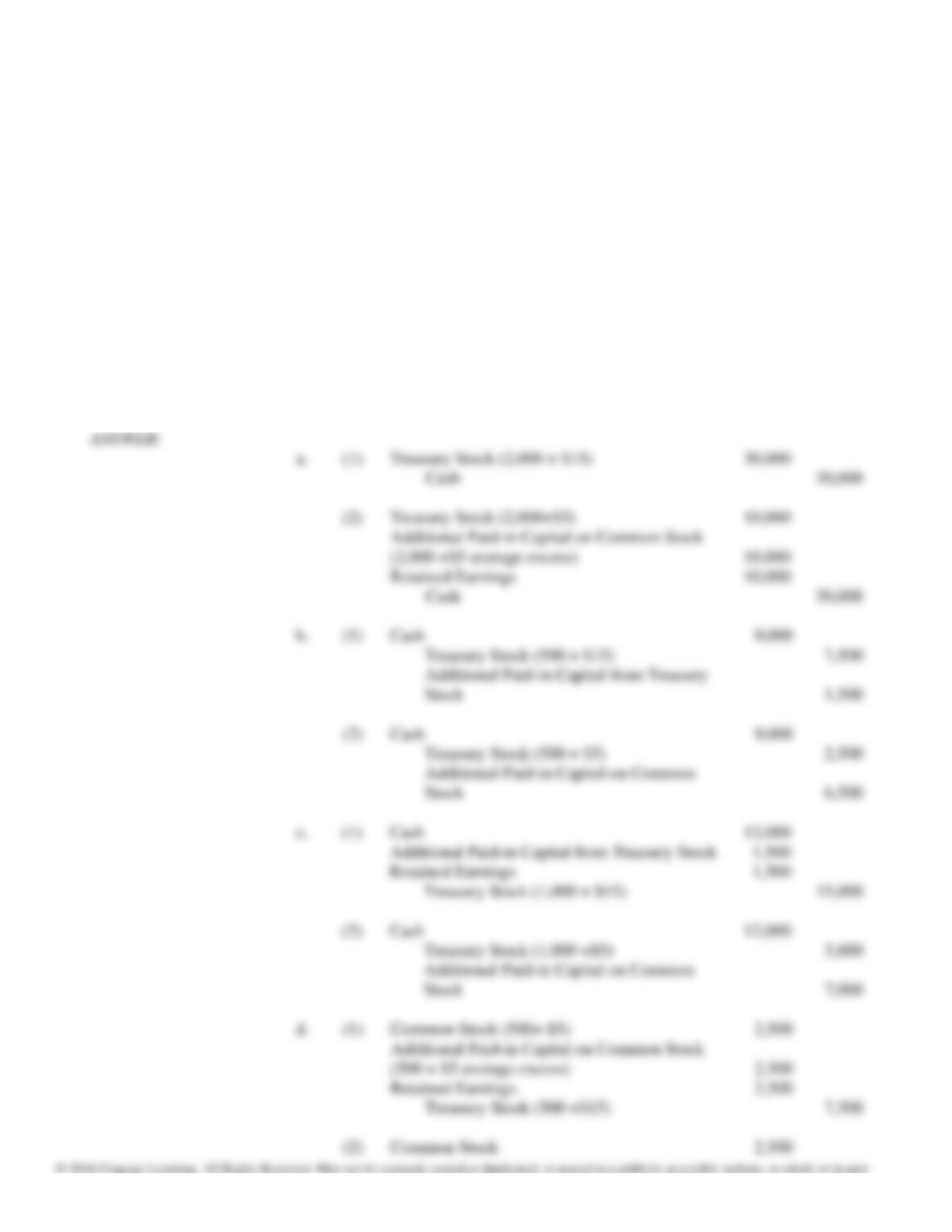
134. Advance Medical Imaging, Inc. reacquired 2,000 shares of its $5 par common stock at $15 a share. The stock
originally sold for $10 a share.
Required:
a.
Prepare the journal entry to record the reacquisition under the
(1)
cost method
(2)
par value method
b.
Prepare the journal entry to record the reissuance of 500 shares at $18 a share under the
(1)
cost method
(2)
par value method
c.
Prepare the journal entry to record the reissuance of 1,000 shares at $12 a share under the
(1)
cost method
(2)
par value method
d.
Prepare the journal entry to record the retirement of the remaining 500 shares under the
(1)
cost method
(2)
par value method
Chapter 15: Contributed Capital
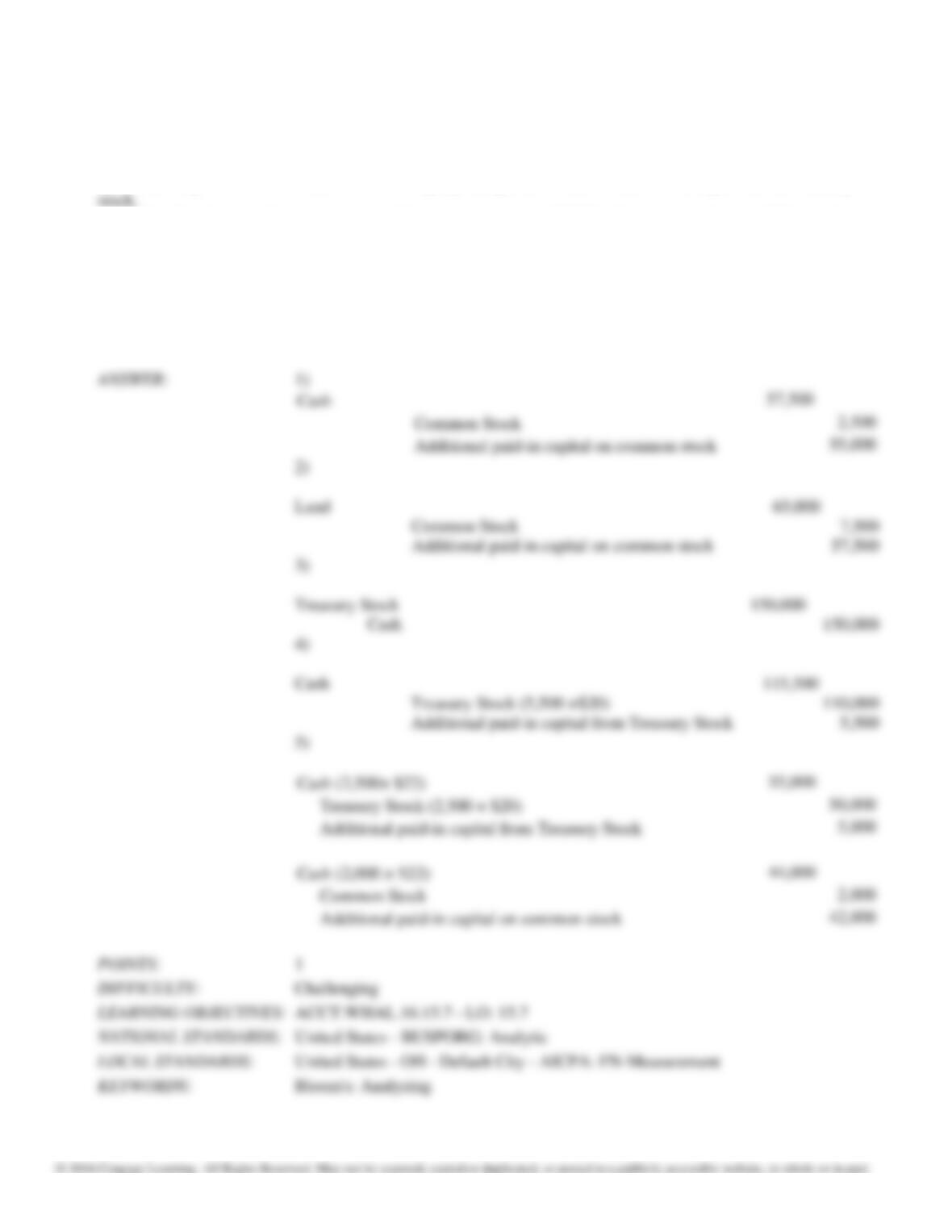
135. The following information is provided from the Forza Corporation’s accounting records.
1) Issued 2,500 shares of $1 par common stock at $23 a share.
2) Issued 7,500 shares of $1 par common stock in exchange for land valued at $65,000.
3) In order to prevent a hostile takeover the company reacquired the 7,500 shares for $20 per share as treasury
4) The hostile takeover did not succeed, and the company reissued 5,500 of the treasury shares of $21 per share.
5) The remaining treasury shares were reissued for $22 per share and an additional 2,000 shares were issued at the
same price.
Required:
Prepare the journal entries for the stock transactions, using the cost method assumption to account for the treasury
stock.
Chapter 15: Contributed Capital
136. A partial listing of accounts and ending balances for Carver, Inc., on December 31, 2016, is shown below:
Investments in long-term notes receivable
$ 40,000
Bonds payable
300,000
Temporary investment in equity securities available for sale
120,000
Premium on bonds payable
26,000
Common stock
180,000
Subscriptions receivable: common stock
120,000
Additional paid-in capital from preferred stock conversion
24,000
Retained earnings
650,000
Preferred stock
300,000
Long-term investment in equity securities available for sale
150,000
Additional paid-in capital on common stock
910,000
Common stock subscribed
20,000
Goodwill
46,000
Donated capital
35,000
Preferred stock subscribed
50,000
Additional paid-in capital on preferred stock
45,000
Following is additional information relative to the above accounts:
·
The preferred stock is 8% cumulative with par value of $50. For the preferred stock,
10,000 shares have been authorized, 6,000 shares are issued and outstanding, and 1,000
shares have been subscribed at a price of $65 per share. Each share of preferred stock is
convertible into four shares of common.
·
Bonds payable mature on September 30, 2020. They have a stated interest rate of 10%,
payable semiannually. The straight-line method is used to amortize the premium.
·
Common stock has a par value of $4 per share. For the common stock, 60,000 shares have
been authorized, 45,000 shares are issued and outstanding, and 5,000 shares have been
subscribed at $32 per share.
Required:
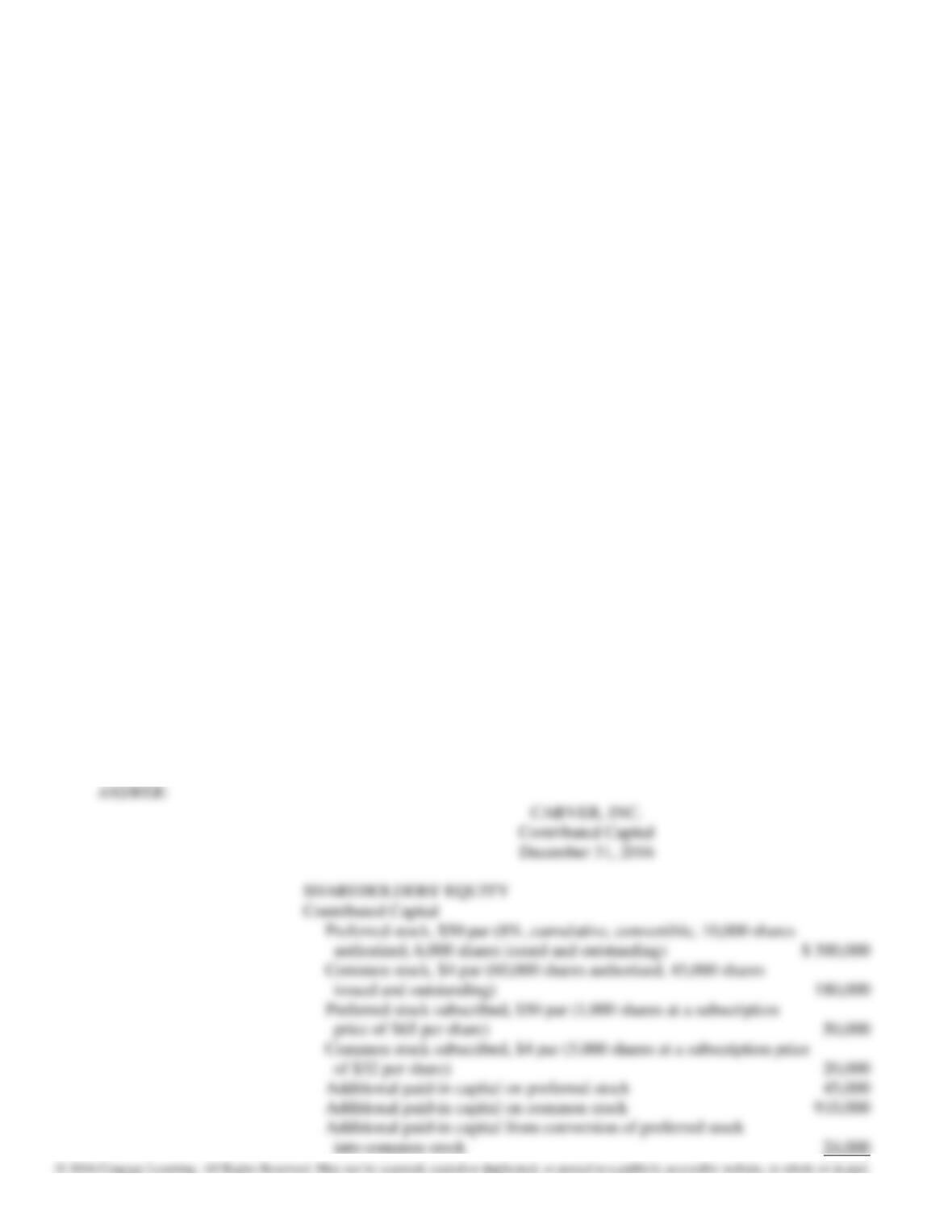
Prepare the contributed capital section of the December 31, 2016 balance sheet for Carver, Inc. Include appropriate
parenthetical notes for the common and preferred stock.
SHAREHOLDERS’ EQUITY
Contributed Capital
Preferred stock, $50 par (8%, cumulative, convertible, 10,000 shares
authorized, 6,000 shares issued and outstanding)
Common stock, $4 par (60,000 shares authorized, 45,000 shares
issued and outstanding)
Preferred stock subscribed, $50 par (1,000 shares at a subscription
price of $65 per share)
Common stock subscribed, $4 par (5,000 shares at a subscription price
Additional paid-in capital on preferred stock
Additional paid-in capital on common stock
into common stock