Chapter 15: Contributed Capital
100. If a company does not maintain its treasury stock records on a specific identification basis, which of the following
approaches may be used to record a reduction in the treasury stock account when the stock is reissued?
a.
FIFO or average costing
b.
FIFO or LIFO costing
c.
LIFO or average costing
d.
none of these
a
1
Easy
ACCT.WHAL.16.15.7 – LO: 15.7
United States – BUSPROG: Reflective Thinking – BUSPROG: Analytic
Bloom’s: Remembering
101. When a company reacquires its own stock, the entry to record the reacquisition could include an entry to Additional
Paid-in Capital under which of the following methods?
Cost Method
Par Value Method
I.
Yes
Yes
II.
Yes
No
III.
No
No
IV.
No
Yes
a.
I
b.
II
c.
III
d.
IV
d
1
Easy
ACCT.WHAL.16.15.7 – LO: 15.7
United States – BUSPROG: Reflective Thinking – BUSPROG: Analytic
United States – OH – Default City – AICPA: FN-Decision Modeling
Bloom’s: Remembering
Chapter 15: Contributed Capital
102. Under the cost method of accounting for treasury stock transactions, when the proceeds from a sale are greater than
the cost, the excess over cost is treated as a(n)
a.
increase in Other Expenses from Treasury Stock Sales.
b.
increase in Additional Paid–in Capital from Treasury Stock.
c.
increase in a contra-shareholders’ equity account.
d.
None of these choices.
b
1
Easy
ACCT.WHAL.16.15.7 – LO: 15.7
United States – BUSPORG: Analytic
Bloom’s: Analyzing
103. When a company acquires treasury stock, what effect does this transaction have on earnings per share and legal
capital, respectively?
a.
decrease, increase
b.
increase, decrease
c.
decrease, decrease
d.
increase, none
d
1
Moderate
ACCT.WHAL.16.15.7 – LO: 15.7
United States – BUSPORG: Analytic
United States – OH – Default City – AICPA: FN-Decision Modeling
Bloom’s: Applying
104. Under the par value method of accounting for treasury stock, the treasury stock is reported on the balance sheet as a
deduction from
a.
the sum of contributed capital, other comprehensive income, and retained earnings.
b.
retained earnings.
c.
capital stock.
d.
contributed capital.
c
1
Easy
ACCT.WHAL.16.15.7 – LO: 15.7
United States – BUSPORG: Analytic
United States – OH – Default City – AICPA: FN-Decision Modeling
Chapter 15: Contributed Capital
105. When retiring treasury stock, retained earnings could be affected under which of the following methods?
Cost Method
Par Value Method
I.
No
No
II.
No
Yes
III.
Yes
No
IV.
Yes
Yes
a.
I
b.
II
c.
III
d.
IV
c
1
Moderate
ACCT.WHAL.16.15.7 – LO: 15.7
United States – BUSPROG: Reflective Thinking – BUSPROG: Analytic
United States – OH – Default City – AICPA: FN-Decision Modeling
Bloom’s: Understanding
106. Which one of the following statements is not true?
a.
Treasury stock transactions do not result in gains or losses on the income statement.
b.
The treasury stock account is treated as a contra-shareholders’ equity account
c.
The total amount of shareholders’ equity is unaffected by the method used to account for treasury stock.
d.
Treasury stock transactions may result in an increase to retained earnings.
d
1
Moderate
ACCT.WHAL.16.15.7 – LO: 15.7
United States – BUSPROG: Reflective Thinking – BUSPROG: Analytic
United States – OH – Default City – AICPA: FN-Decision Modeling
Bloom’s: Understanding
Chapter 15: Contributed Capital
Exhibit 15-9
Groundcover, Inc. had never had a treasury stock transaction prior to 2016. It experienced the following treasury
stock transactions during 2016:
4/1/2016:
Reacquired 1,000 shares of its own $5 par common stock, originally
sold at $12 a share, for $10 a share. This was the first time that
Groundcover had reacquired its own stock.
4/8/2016:
Reissued 400 shares at $8 a share.
5/2/2016:
Reissued 500 shares at $13 a share.
5/10/2016:
Retired the remaining 100 shares.
Assume the cost method is used.
107. Refer to Exhibit 15-9. The entry to record the reissuance of 400 shares on 4/8/2016 would include a
a.
credit to Treasury Stock for $3,200.
b.
debit to Additional Paid-in Capital from Treasury Stock for $800.
c.
debit to Retained Earnings for $800.
d.
credit to Additional Paid-in Capital on Common Stock for $800.
c
1
Moderate
ACCT.WHAL.16.15.7 – LO: 15.7
United States – BUSPROG: Reflective Thinking – BUSPROG: Analytic
United States – OH – Default City – AICPA: FN-Measurement
Bloom’s: Applying
108. Refer to Exhibit 15-9. The entry to record the retirement of 100 shares on 5/10/2016 would include a
a.
credit to Additional Paid-in Capital from Treasury Stock for $200.
b.
debit to Treasury Stock for $1,000.
c.
debit to Additional Paid-in Capital on Common Stock for $1,200.
d.
debit to Common Stock for $1,200.
a
1
Moderate
ACCT.WHAL.16.15.7 – LO: 15.7
United States – BUSPROG: Reflective Thinking – BUSPROG: Analytic
United States – OH – Default City – AICPA: FN-Decision Modeling
Bloom’s: Applying
109. All of the following would appear in the contributed capital section of shareholders’ equity on the balance sheet
except
a.
additional paid-in capital from stock conversions.
b.
bonds payable.
c.
share rights and options.
d.
preferred stock.
b
1
Easy
ACCT.WHAL.16.15.8 – LO: 15.8
United States – BUSPROG: Reflective Thinking – BUSPROG: Analytic
Bloom’s: Remembering
110. The following information is provided for Miller Corporation:
Common stock, $10 par
$340,000
Bonds payable
28,000
Additional paid-in capital from preferred stock conversion
3,000
Retained earnings
100,000
Additional paid-in capital on preferred stock
10,000
Common stock subscribed
30,000
Accumulated other comprehensive income
5,600
Premium on bonds payable
2,000
Preferred stock, 6%, $100 par
80,000
What is the amount of contributed capital for Miller Corporation?
a.
$430,000
b.
$433,000
c.
$463,000
d.
$468,600
c
1
Moderate
United States – BUSPORG: Analytic
United States – OH – Default City – AICPA: FN-Measurement
Bloom’s: Analyzing
111. The following information is provided for Wolf Company:
Retained earnings
$445,000
Preferred stock, 5%, $50 par
100,000
Organization expense
2,500
Additional paid-in capital on common stock
?
Additional paid-in capital from recall of preferred stock
2,500
Premium on bonds payable
5,700
Common stock, $10 par
350,000
If total contributed capital is $506,000, what is the amount of additional paid-in capital on common stock for Wolf
Company?
a.
$52,500
b.
$51,000
c.
$53,500
d.
$56,700
c
1
Moderate
ACCT.WHAL.16.15.8 – LO: 15.8
United States – BUSPORG: Analytic
United States – OH – Default City – AICPA: FN-Measurement
Bloom’s: Analyzing
112. Listed below are various classifications of corporations. Following the list is a series of descriptive statements.
a.
public corporations
e.
stock companies
b.
open corporations
f.
foreign corporations
c.
domestic corporations
g.
closed corporations
d.
nonstock companies
____
1.
Companies that do not issue stock or operate for profit.
____
2.
As viewed by a state, companies operating within that state that are incorporated in
another state.
____
3.
Companies that do not allow the sale of their stock to the general public.
____
4.
Companies owned or operated by governmental units.
____
5.
Companies that issue stock and operate for profit.
____
6.
As viewed by that state, companies that are incorporated in the state.
____
7.
Companies whose stock is available for purchase by the public.
1.
d
5.
2.
f
6.
3.
g
7.
4.
a
Required:
Match the corporate classifications to the descriptive statements that best describe them.
113. The following are a list of terms.
______
1)
Additional paid in capital
______
2)
Authorized capital stock
______
3)
Legal capital
______
4)
Preemptive right
______
5)
Registrar
______
6)
Stated value
______
7)
Subscribed capital stock
______
8)
Transfer agent
______
9)
Treasury stock
______
10)
Voting right
Required:
Match the following definition with the terms listed above.
a)
Installment purchase contract with an investor.
b)
An independent party hired to handle the stock issuance.
c)
Maintains the shareholders records.
d)
The ability to elect directors.
e)
Maintains a proportionate share of ownership.
f)
Shares authorized by state charter.
g)
Stocks that were issued and reacquired by the corporation.
h)
To protect the corporations creditors.
i)
No-par value
j)
The excess received is recorded in this account.
1)
j
2)
f
3)
h
4)
e
5)
c
6)
i
7)
a
8)
b
9)
g
10)
d
1
Moderate
ACCT.WHAL.16.15.3 – LO: 15.2
United States – BUSPROG: Reflective Thinking – BUSPROG: Analytic
United States – OH – Default City – AICPA: FN-Decision Modeling
Bloom’s: Understanding
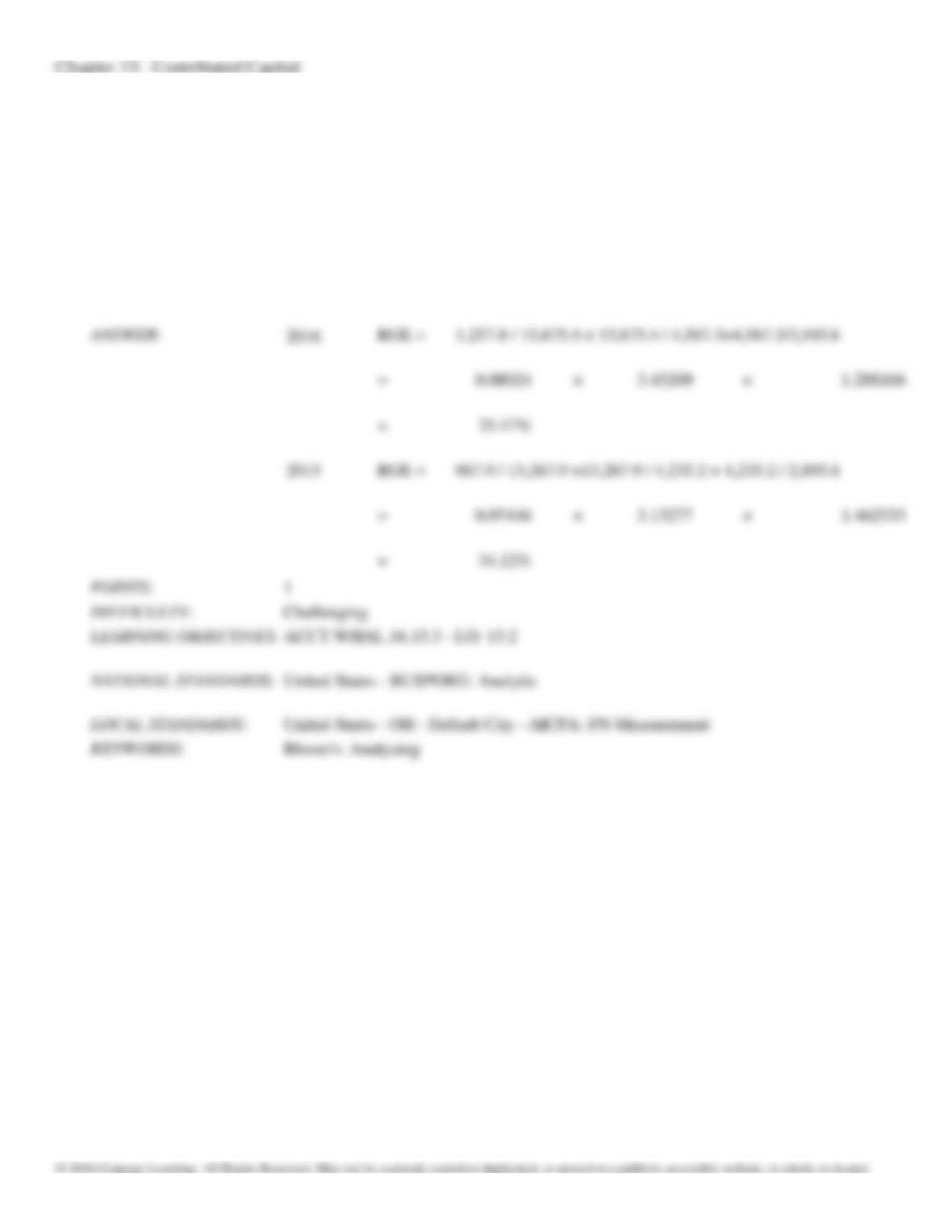
114. Below is information obtained from Carver’s 2016 annual report:
2016
2015
Average Assets
$4,567.3
$4,235.2
Average shareholder’s equity
3,545.6
2,895.8
Net sales
15,675.4
13,267.9
Net income
1,257.8
987.9
1,257.8 / 15,675.4 × 15,675.4 / 4,567.3×4,567.3/3,545.6
=
35.47%
2015
987.9 / 13,267.9 ×13,267.9 / 4,235.2 × 4,235.2 / 2,895.8
=
×
=
34.12%
Required:
Compute the ROE for 2015 and 2016 using the DuPont model.
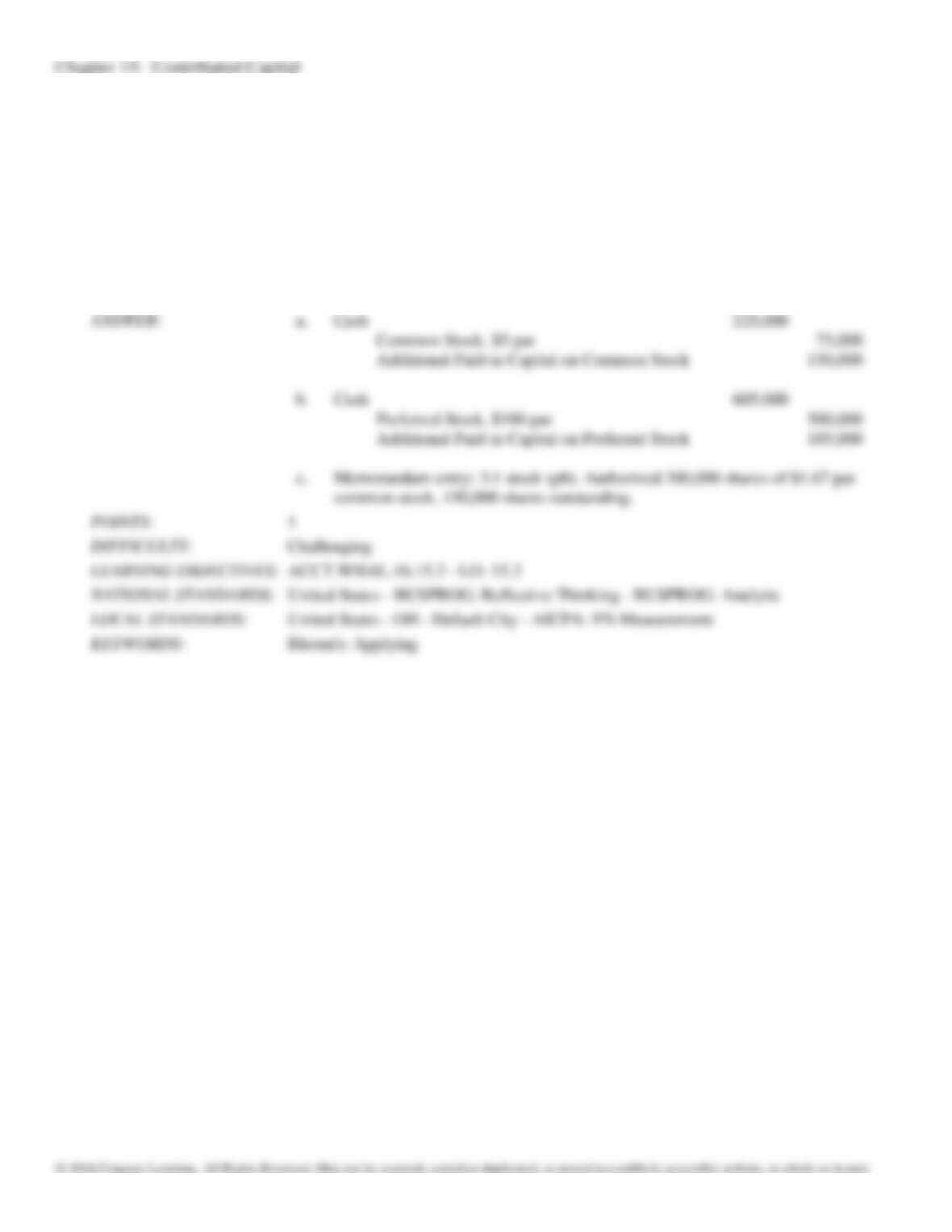
115. During 2016, Goodfellow has the following transactions involving its common and preferred stock:
a.
Issued 15,000 shares of $5 par common stock for $15 a share. This brings total shares
outstanding to 50,000 shares and 100,000 shares are authorized.
b.
Issued 5,000 shares of $100 par, 6%, cumulative preferred stock for $121 per share.
c.
When the market value of the common stock reached $15 a share, Goodfellow declared a
3-for-1 stock split, reducing the par value to $1.67 per share.
Required:
Prepare a journal entry for each transaction.
1
Challenging
ACCT.WHAL.16.15.2 – LO: 15.3
United States – BUSPROG: Reflective Thinking – BUSPROG: Analytic
United States – OH – Default City – AICPA: FN-Measurement
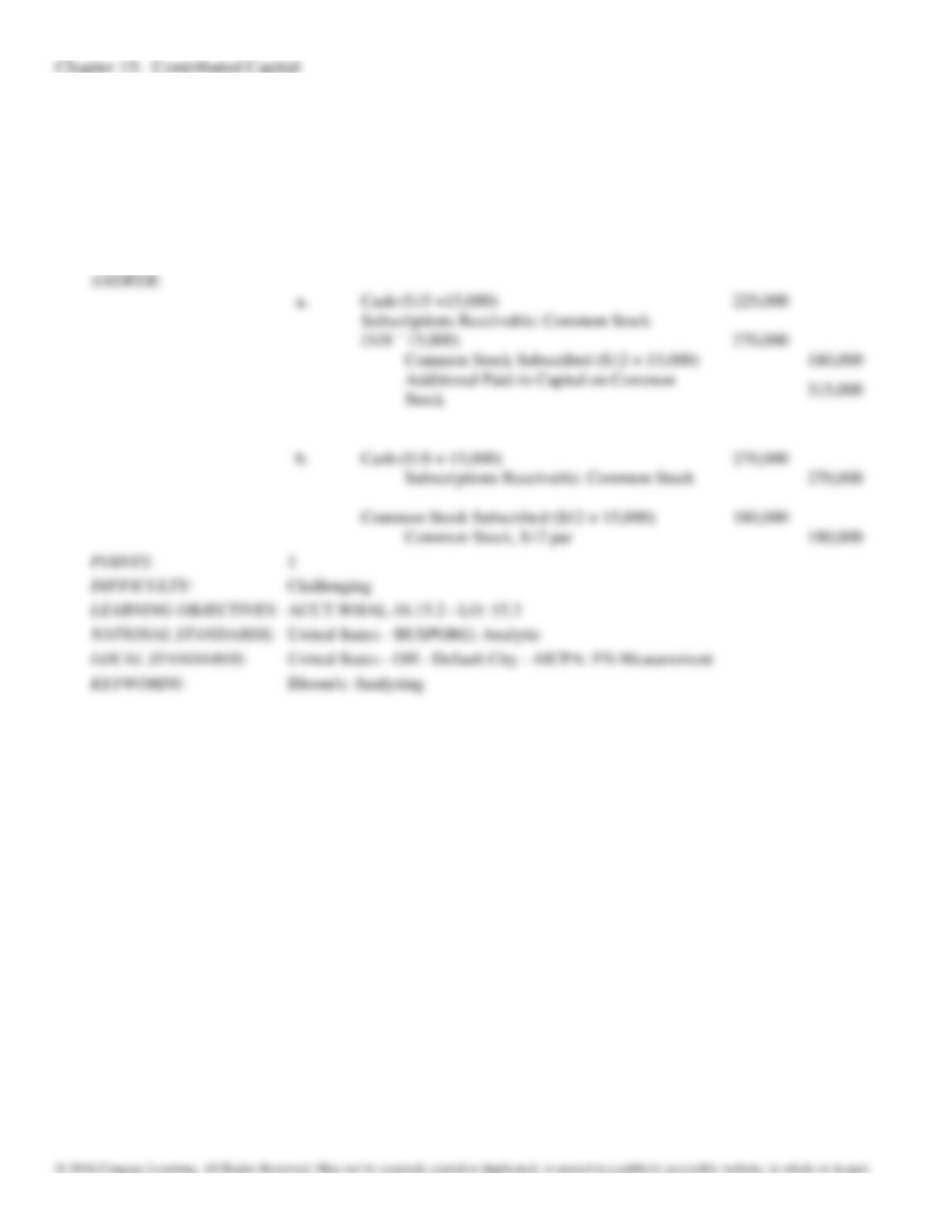
116. Righty, Inc., entered into a stock subscription contract that called for the purchase by investors of 15,000 shares of
$12 par common stock at a price of $33 per share. The contract required a down payment of $15 per share, with the
remaining $18 per share collectible at the end of three months.
Required:
a.
Prepare the journal entry to record the stock subscription and down payment.
b.
The subscribers paid the remainder at the end of three months. Prepare the journal
entry(ies) to record the final payment and the issuance of the shares of stock.
1
Challenging
United States – BUSPORG: Analytic
Bloom’s: Analyzing
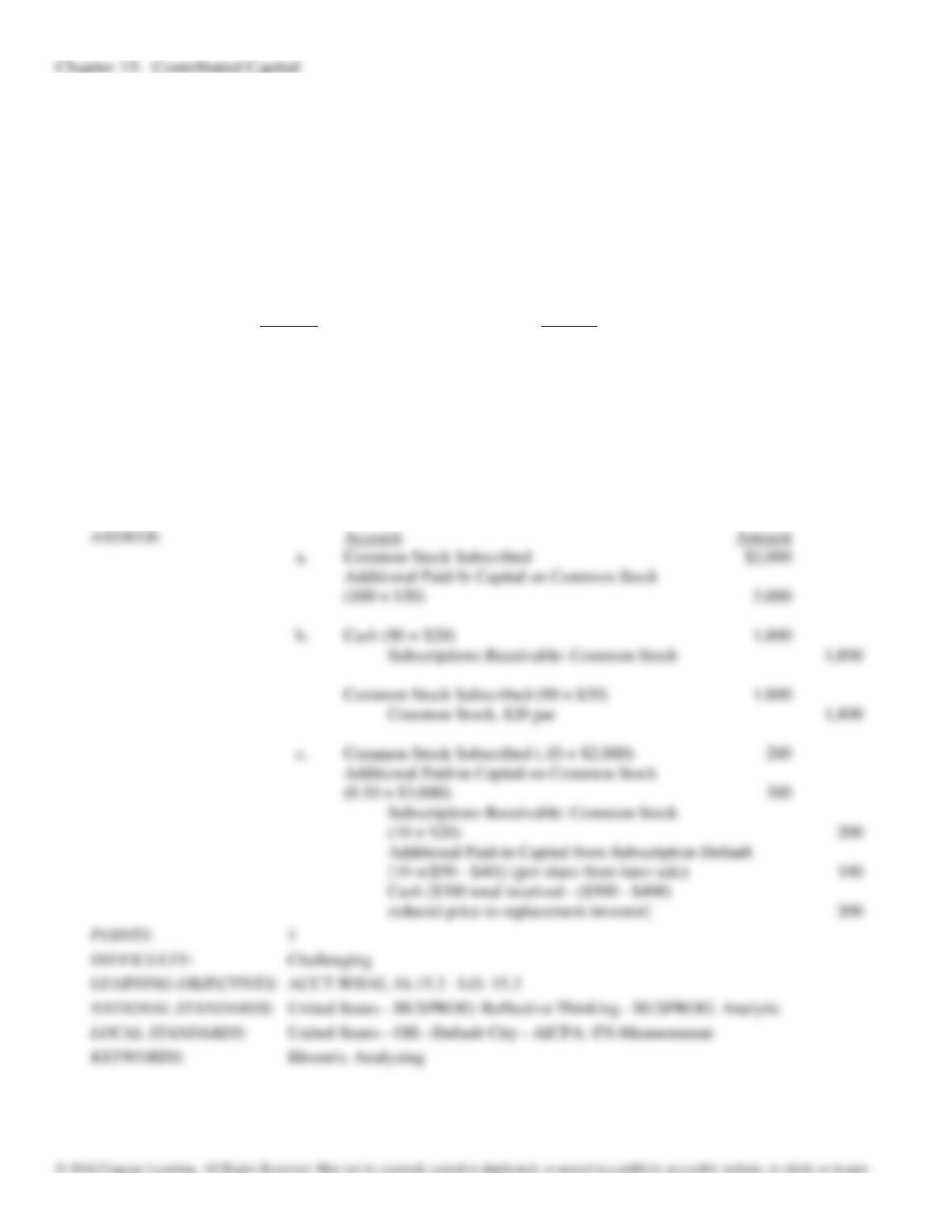
117. On January 1, Maxine Corp. entered into a subscription contract for 100 shares of its $20 par common stock at a
price of $50 per share. The contract required each subscriber to make an immediate down payment of $10 and two
$20 payments on February 1 and March 1. All the down payments were received on January 1 and all the
installments due on February 1 were received on February 1. On March 1, the rest of the payments were received
except the payment from one subscriber of ten shares, who defaulted. These shares were later sold for $40 per share.
An amount necessary to bring the proceeds up to the total subscription price was retained and the balance of the
payments received from the defaulted subscriber was returned.
Required:
a.
List the two shareholders’ equity credits in the January 1 journal entry.
Account
Amount
_________________________________________
___________________
_________________________________________
___________________
b.
Prepare the journal entries for the receipt of cash and the issuance of stock on
March 1.
c.
Prepare the journal entry completing the transaction with the defaulted
subscriber, after the defaulted shares were sold.
1
Challenging
ACCT.WHAL.16.15.2 – LO: 15.3
United States – BUSPROG: Reflective Thinking – BUSPROG: Analytic
United States – OH – Default City – AICPA: FN-Measurement
Bloom’s: Analyzing
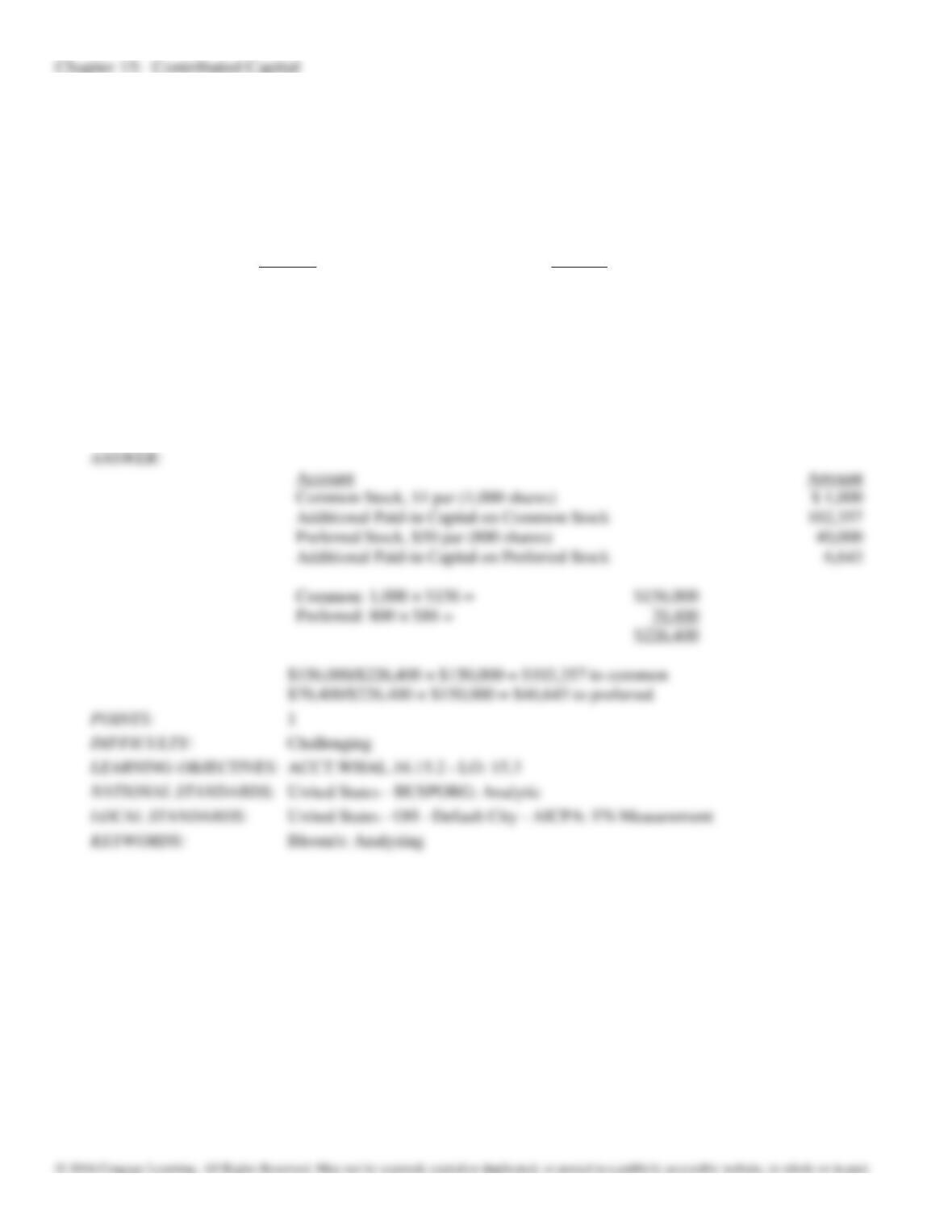
118. Martian Magic issued 800 shares of $50 par preferred stock and 1000 shares of $1 par common stock in a “package”
sale for $150,000. The preferred stock market value was $88 per share, and the common stock market value was
$156 per share.
Required:
Fill in the lines below to indicate the accounts and amounts credited in the entry to record the issuance of the stock.
Account
Amount
______________________________________________
_____________________
______________________________________________
_____________________
______________________________________________
_____________________
______________________________________________
_____________________
$70,400/$226,400 × $150,000 = $46,643 to preferred
1
Challenging
ACCT.WHAL.16.15.2 – LO: 15.3
United States – BUSPORG: Analytic
United States – OH – Default City – AICPA: FN-Measurement
Bloom’s: Analyzing
119. Consider each situation for Kathy, Inc. below independently.
·
Kathy, Inc. issued 10,000 shares of its $25 par common stock (current fair value of
common is $35 per share) for a large tract of land. The land was appraised at $400,000.
Kathy already had 500,000 shares of common stock outstanding.
·
Kathy, Inc. issued 2,000 shares of $10 par Class A common stock at $12 and 100 shares of
no-par Class B common stock at $20.
Required:
a.
At what amount should land be recorded?
b.
What is the total amount that should be recorded for additional paid-in capital from
the second situation?
120. Sully Sports Cars Co. entered into a subscription contract with various investors. The terms were as follows:
·
2,000 shares of $5 par common at $24.
·
$10 down payment per share; two subsequent payments of $7 each.
Required:
a.
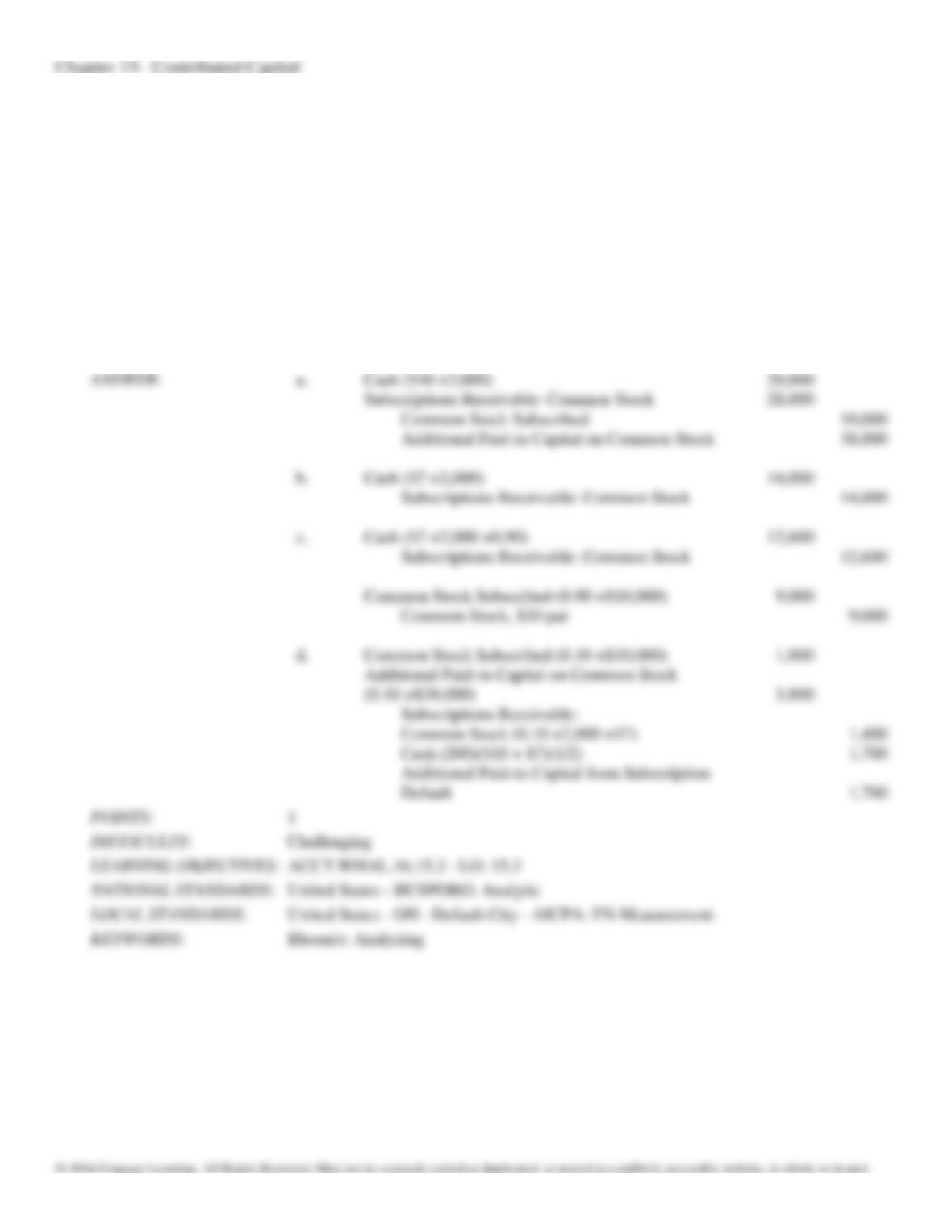
Record the subscription and the receipt of the down payment.
b.
The first subsequent $7 payment was received from all subscribers.
c.
When the final $7 payment was due, 90% of the final total amount due was received and
stock was issued. Record this receipt and stock issuance.
d.
The remaining 10% of the final payment was not received. According to contract
provisions, half of any previous payments should be returned to the subscriber with the
remaining half forfeited by the subscriber. Record the entry related to the default.
Cash ($10 ×2,000)
Subscriptions Receivable: Common Stock
Common Stock Subscribed
Additional Paid-in Capital on Common Stock
b.
Cash ($7 ×2,000)
Subscriptions Receivable: Common Stock
Cash ($7 ×2,000 ×0.90)
Subscriptions Receivable: Common Stock
Common Stock Subscribed (0.90 ×$10,000)
Common Stock, $10 par
d.
Common Stock Subscribed (0.10 ×$10,000)
Additional Paid-in Capital on Common Stock
(0.10 ×$38,000)
Subscriptions Receivable:
Common Stock (0.10 ×2,000 ×$7)
Cash (200)($10 + $7)(1/2)
Additional Paid-in Capital from Subscription
Default
1
Challenging
ACCT.WHAL.16.15.2 – LO: 15.3
United States – BUSPORG: Analytic
United States – OH – Default City – AICPA: FN-Measurement
Bloom’s: Analyzing
121. Toronto, Inc. issued 4,000 shares of $100 par preferred stock at $155 a share. Each share of stock has a warrant
attached to it that allows the holder to purchase one share of $20 par value common stock at $50. Shortly after the
preferred stock was issued, the stock sold for $150 ex-rights and the warrants sold for $10 each.
Required:
a.
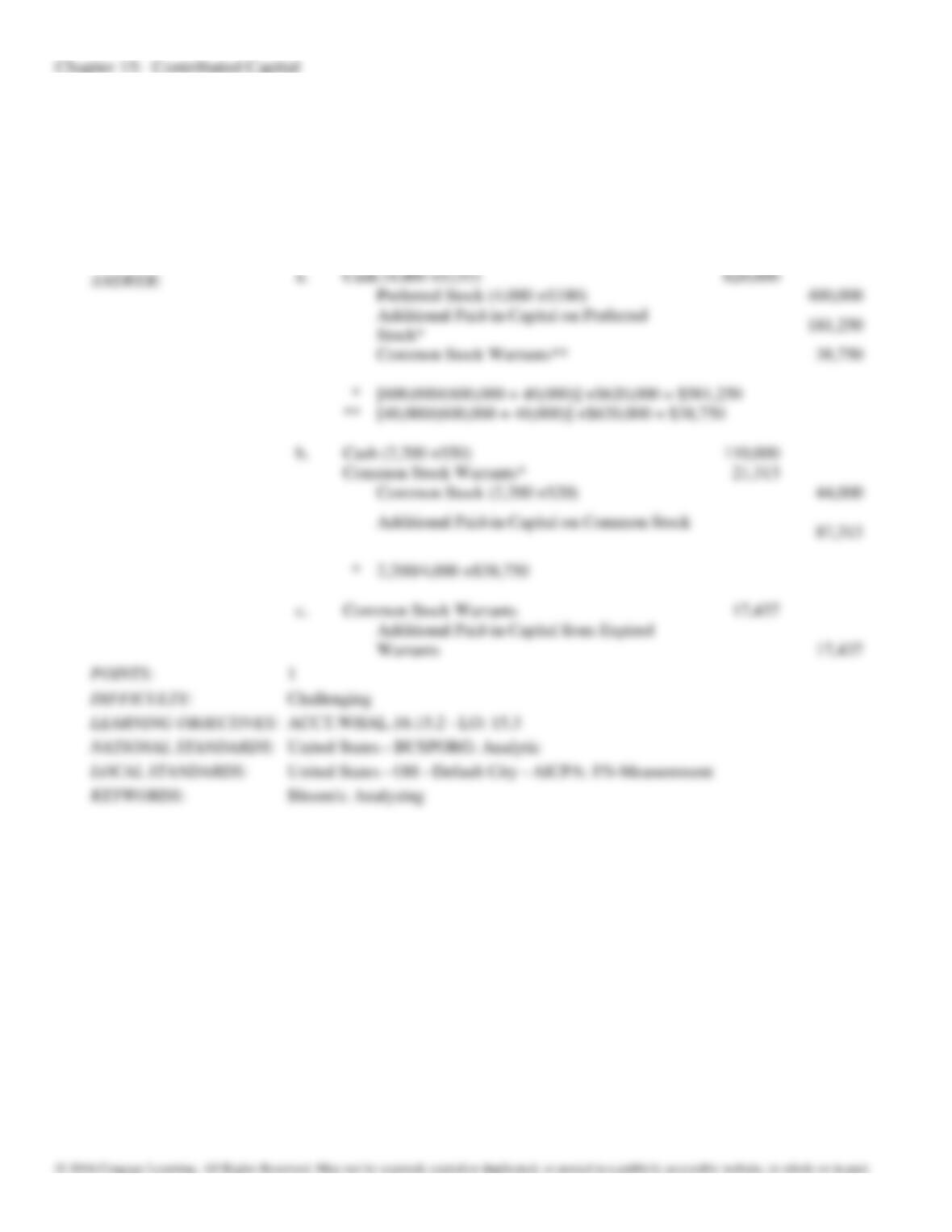
Prepare the journal entry to record the issuance of the preferred stock.
b.
Prepare the journal entry to record the exercise of 2,200 of the warrants.
c.
Prepare the journal entry to record the expiration of the remaining 1,800 warrants.
1
Challenging
ACCT.WHAL.16.15.2 – LO: 15.3
United States – BUSPORG: Analytic
United States – OH – Default City – AICPA: FN-Measurement
Bloom’s: Analyzing
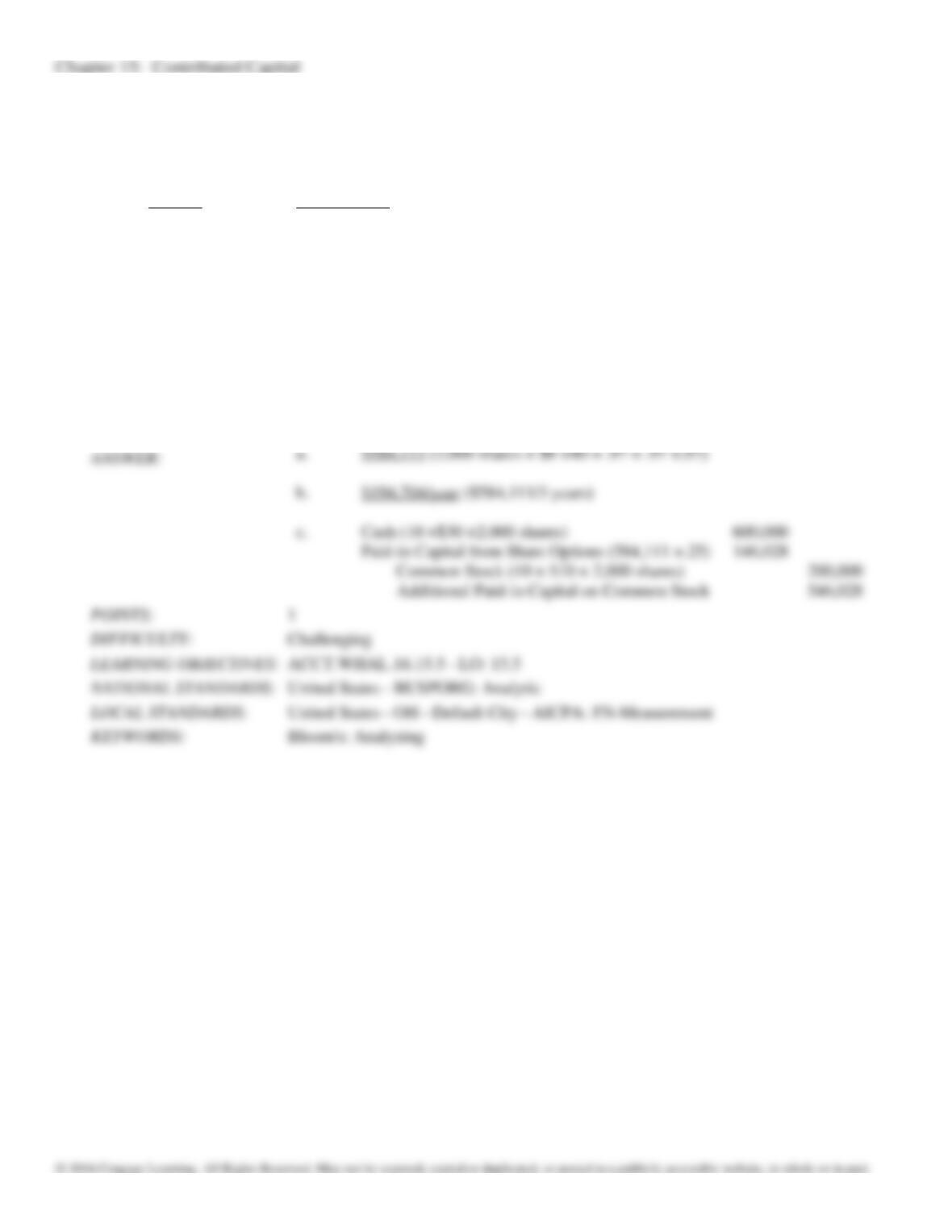
122. On January 1, 2016, Biggs Company granted a performance-based stock option plan to 40 executives to buy a
maximum of 3,000 shares each of its $10 par common stock at $30 a share. The fair value per option is $8. The terms
of the plan, which has a three-year service and vesting period, are based on the following scale:
Sales Increase
at Least
No. of Shares
10%
1,000
15%
2,000
20%
3,000
Biggs expects an annual employee turnover rate of 3%, and the company initially anticipates an increase in sales
during the service period of 18%. By the end of 2019, the actual sales increase is 17%.
Required:
a.
Compute the estimated total compensation cost.
b.
Compute the annual compensation expense for each of the three years.
c.
Prepare the January 1, 2016, entry when 10 executives exercise their options.
1
Challenging
ACCT.WHAL.16.15.5 – LO: 15.5
United States – BUSPORG: Analytic
United States – OH – Default City – AICPA: FN-Measurement
Bloom’s: Analyzing
123. On January 1, 2016, the Jim Corporation granted 50,000 stock appreciation rights (SARs) to the company’s president,
Jim Darling. Jim will be entitled to receive cash or common stock or some combination of cash and common stock
for the difference between the quoted market price at the date of exercise and a $20 option price per SAR. It is
assumed that Jim will elect to receive cash when he exercises his SARs. The service period is three years, and he
may exercise his SARs during the period January 1, 2019, through December 31, 2020. The market prices per share
of Jim Corporation’s common stock are as follows:
January 1, 2016
$22.00
December 31, 2016
26.00
December 31, 2017
29.00
December 31, 2018
27.50
December 31, 2019
27.00
December 31, 2020
29.00
On December 31, 2020, Jim Darling exercises his 5,000 SARs and elects to receive cash.
Required:
a.
Prepare the journal entries to record each year’s compensation expense related to the
SARs.
b.
Prepare the December 31, 2020 entry to record the exercise of the 50,000 SARs.
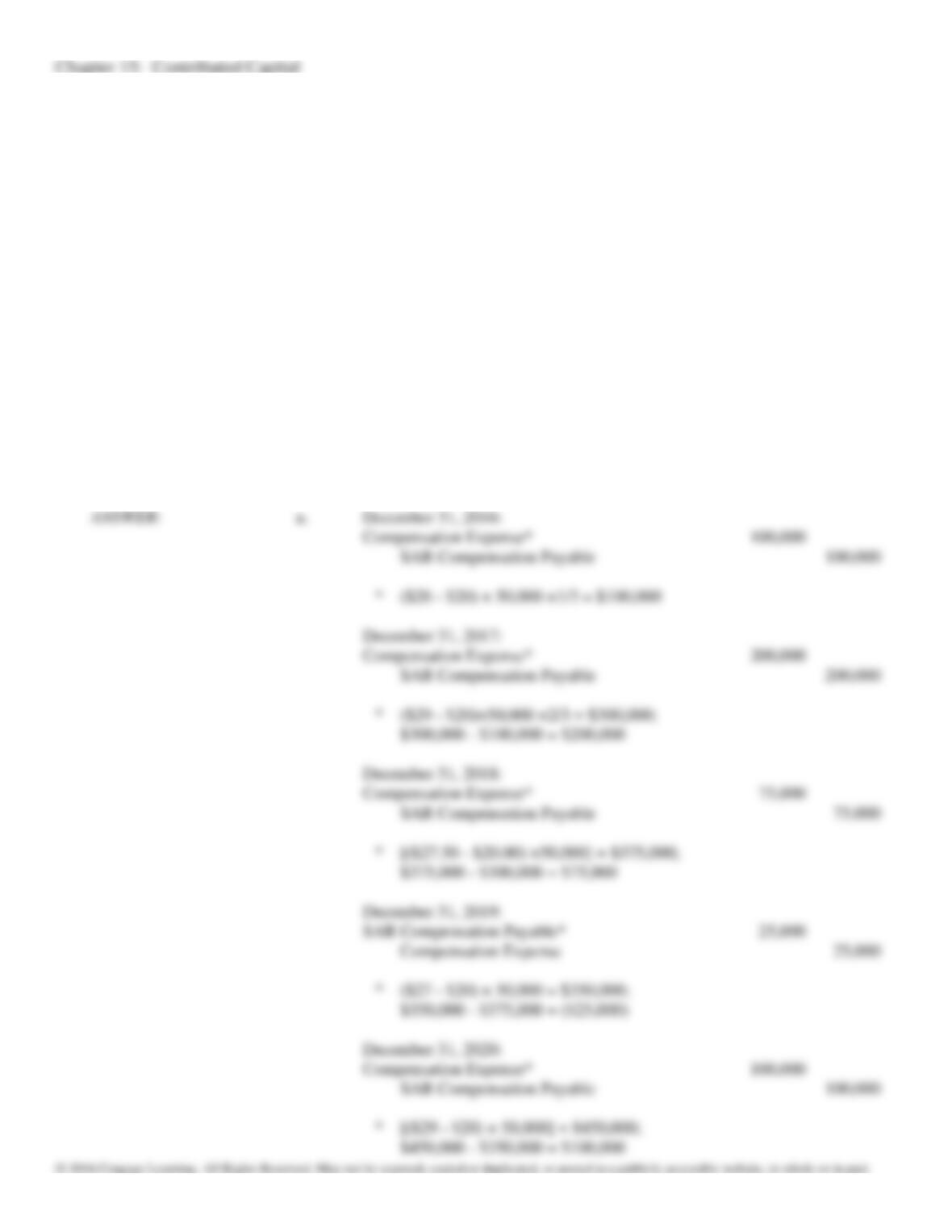
December 31, 2016:
Compensation Expense*
SAR Compensation Payable
December 31, 2017:
Compensation Expense*
SAR Compensation Payable
($29 – $20)×50,000 ×2/3 = $300,000;
$300,000 – $100,000 = $200,000
December 31, 2018:
Compensation Expense*
SAR Compensation Payable
[($27.50 – $20.00) ×50,000] = $375,000;
$375,000 – $300,000 = $75,000
December 31, 2019:
SAR Compensation Payable*
Compensation Expense
($27 – $20) × 50,000 = $350,000;
$350,000 – $375,000 = ($25,000)
December 31, 2020:
SAR Compensation Payable
$450,000 – $350,000 = $100,000
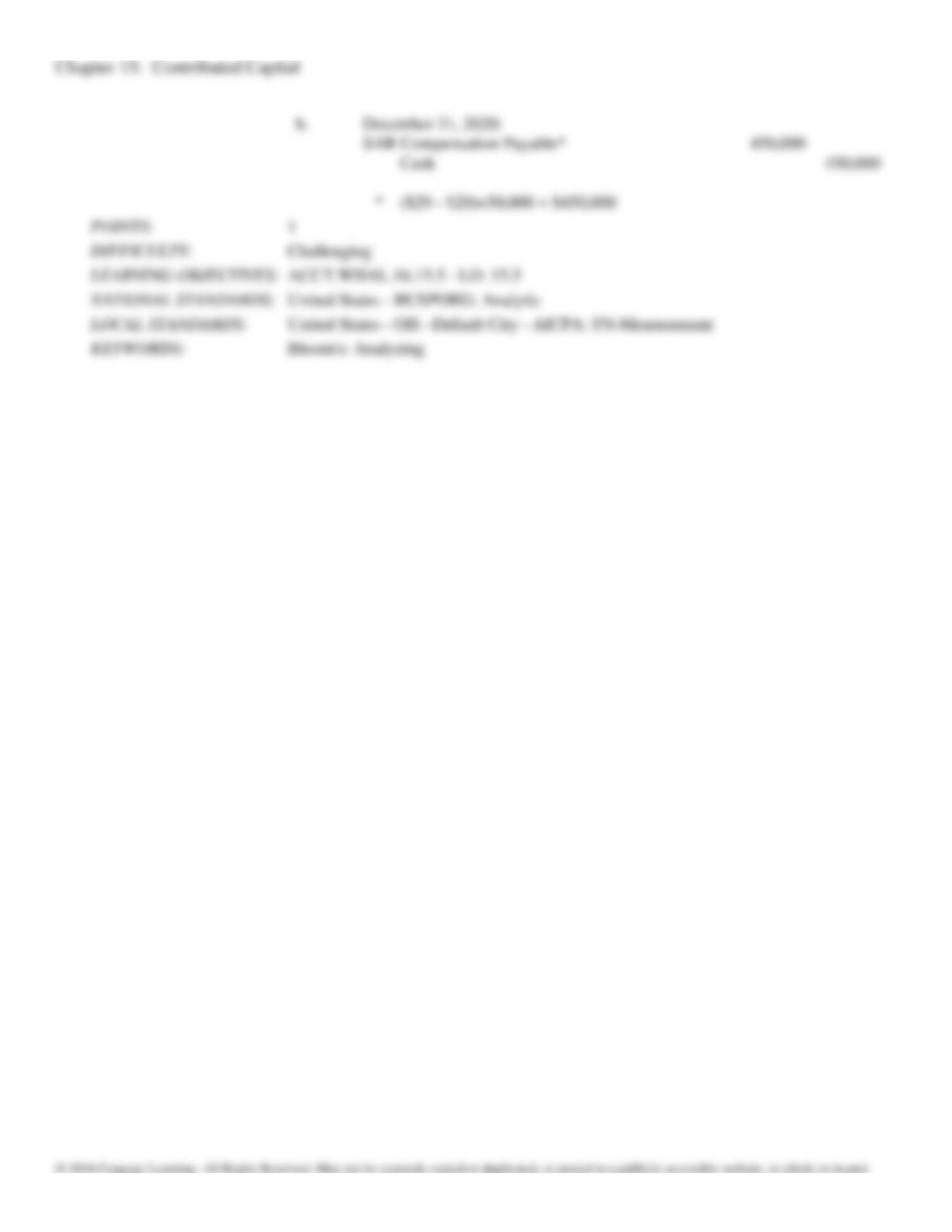
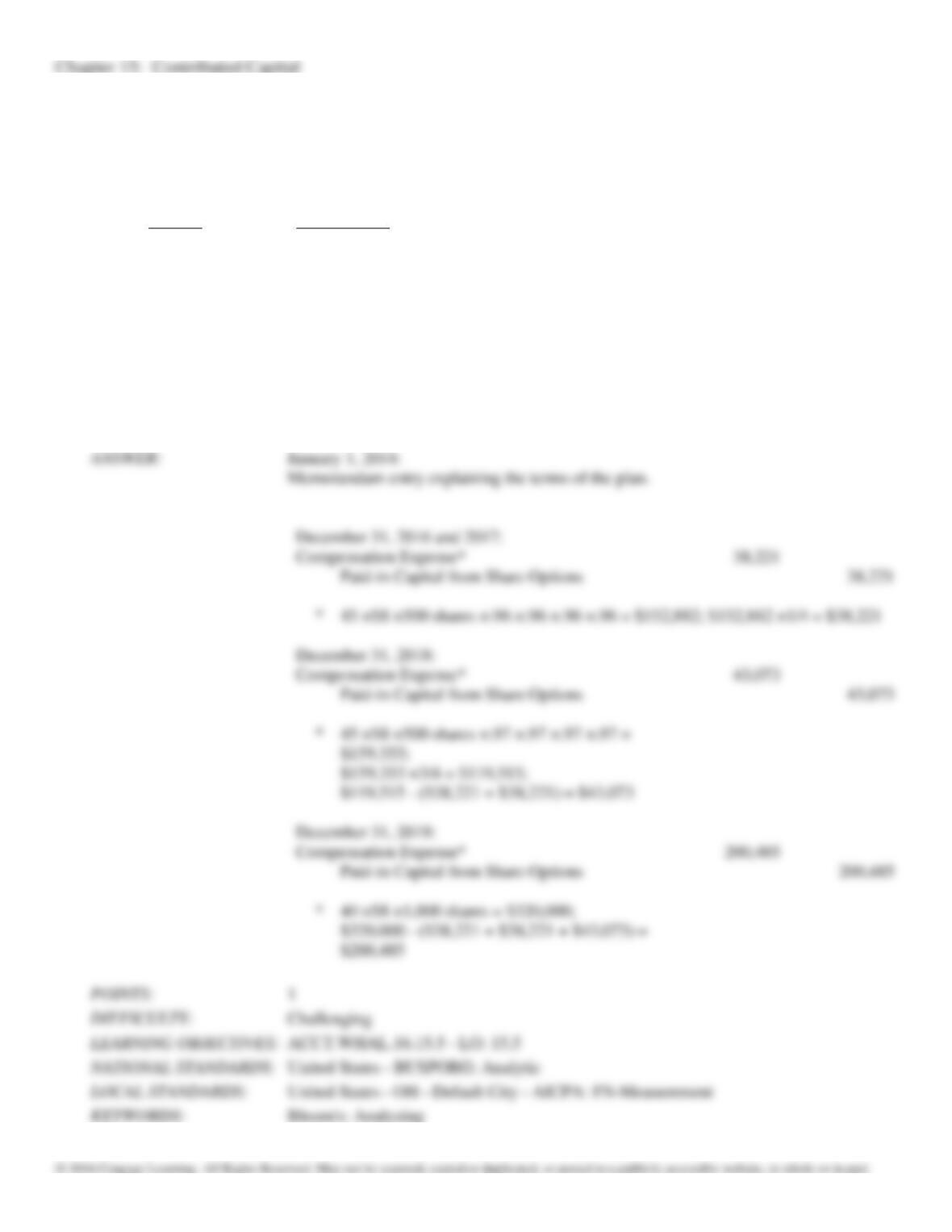
124. On January 1, 2016, Nelson Company gave 45 executives a performance-based stock option plan that allowed them
to buy a maximum of 2,000 shares each of the company’s $5 par common stock at $15 a share. On the grant date, the
fair value per option was $8. The shares will be awarded based on the increase in sales over a four-year service and
vesting period as follows:
Sales Increase
at Least
No. of Shares
5%
500
10%
1,000
15%
2,000
The company estimates sales will increase by 8% during the service period and that the annual employee turnover
rate will be 4%. During 2018, the estimated annual employee turnover rate was changed to 3% for the entire service
period. At the end of the four-year period, options vested for the remaining 40 executives and sales actually increased
by 12%.
Required:
Prepare the journal entries to reflect the events affecting Nelson’s plan for the four-year service period.