Chapter 15 – Statement of Cash Flows
Accounts payable
1,000
Accrued liabilities
(5,000)
Taxes payable
10,000
Bonds payable
(60,000)
Common stock
40,000
Retained earnings
28,000
111. Refer to Figure 15–1. The net cash flows from operating activities last year was
a.
$181,000.
b.
$150,000.
c.
$88,000.
d.
$161,000.
$88,000 + $11,000 – $6,000 + $62,000 + $1,000 – $5,000 + $10,000
112. Refer to Figure 15–1. The net cash flows from investing activities last year was
a.
$45,000.
b.
$(45,000).
c.
$85,000.
d.
$(85,000).
$(50,000) + $(35,000)
113. Refer to Figure 15–1. The net cash flows from financing activities last year was
a.
$80,000.
b.
$(80,000).
c.
$20,000.
d.
$(20,000).
$(60,000) + $40,000 + $(60,000)
Figure 15–2.
Chandler Company’s net income last year was $98,000 and cash dividends declared and paid to the company stockholders
was $13,000. Changes in selected balance sheet accounts for the year appear below:
Increases
(Decreases)
Debit balances:
Cash
$ (3,000)
Accounts receivable
1,000
Inventory
(1,000)
Prepaid expenses
13,000
Long-term investments
70,000
Plant and equipment
45,000
Credit balances:
Accumulated depreciation
61,000
Accounts payable
(11,000)
Accrued liabilities
(9,000)
Chapter 15 – Statement of Cash Flows
Taxes payable
9,000
Bonds payable
(50,000)
Common stock
40,000
Retained earnings
85,000
114. Refer to Figure 15–2. The net cash flows from operating activities to be reported in a statement of cash flows is
a.
$135,000.
b.
$98,000.
c.
$159,000.
d.
$74,000.
$98,000 – $1,000 + $1,000 – $13,000 + $61,000 – $11,000 – $9,000 + $9,000
115. Refer to Figure 15–2. The net cash flows from investing activities to be reported in a statement of cash flows is
a.
$(75,000).
b.
$75,000.
c.
$(115,000).
d.
$115,000.
$70,000 + $45,000
116. Refer to Figure 15–2. The net cash flows from financing activities to be reported in a statement of cash flows is
a.
$10,000.
b.
$(10,000).
c.
$23,000.
d.
$(23,000).
$(50,000) + $40,000 – $13,000
117. The net income reported on the income statement for the current year was $635,000. Depreciation recorded on plant
assets was $29,000. Accounts receivable and inventories increased by $1,200 and $3,600, respectively. Prepaid expenses
and accounts payable decreased by $800 and $16,000 respectively. How much cash was provided by operating activities?
a.
$642,400
b.
$644,000
c.
$652,000
d.
$685,600
$635,000 + $29,000 – $1,200 – $3,600 + $800 – $16,000
118. The net income reported on the income statement for the current year was $79,000. Depreciation was $6,000.
Account receivable and inventories decreased by $1,100 and $2,700, respectively. Prepaid expenses and accounts payable
increased, respectively, by $950 and $3,000. How much cash was provided by operating activities?
a.
$86,750
b.
$90,850
c.
$85,150
d.
$83,250
Chapter 15 – Statement of Cash Flows
$79,000 + $6,000 + $1,100 + $2,700 – $950 + $3,000
119. If a gain of $30,000 is incurred in selling (for cash) long-term investments having a book value of $180,000, the total
amount reported in the cash flows from investing activities section of the statement of cash flows is
a.
$30,000.
b.
$210,000.
c.
$180,000.
d.
$150,000.
120. If a loss of $9,200 is incurred in selling (for cash) a patent having a book value of $80,000, the total amount reported
in the cash flows from investing activities section of the statement of cash flows is
a.
$70,800.
b.
$89,200.
c.
$9,200.
d.
$80,000.
a
121. Harbor Company reported net income of $60,000 for the year ended December 31, 20X1. During the year,
inventories decreased by $12,000, accounts payable decreased by $18,000, depreciation expense was $20,000 and a gain
on disposal of equipment of $9,000 was recorded. Net cash provided by operating activities in 20X1 using the indirect
method was
a.
$119,000.
b.
$65,000.
c.
$77,000.
d.
$55,000.
$60,000 + $12,000 – $18,000 + $20,000 – $9,000
122. In calculating cash flows from operating activities using the indirect method, a gain on the sale of equipment is
a.
added to net income.
b.
deducted from net income.
c.
ignored because it does not affect cash.
d.
not reported on a statement of cash flows.
123. Last year Snyder Company reported sales of $125,000 on its income statement. During the year, accounts receivable
increased by $30,000 and accounts payable increased by $10,000. The company uses the direct method to determine the
net cash flows from operating activities on the statement of cash flows. The sales revenue adjusted to a cash basis would
be
a.
$105,000.
b.
$115,000.
c.
$95,000.
d.
$145,000.
Chapter 15 – Statement of Cash Flows
124. Which of the following statement concerning the statement of cash flows is true?
a.
The statement of cash flows is usually more accurate when using the indirect method.
b.
If the direct method is used, a supplementary schedule reconciling the net income to net cash from operating
activities must still be provided.
c.
The statement of cash flows reflects both earnings per share and cash per share.
d.
The statement of cash flows is an optional financial statement for an SEC registered firm.
125. Last year Simpson Company reported cost of goods sold of $105,000. Inventories decreased by $10,000 during the
year, and accounts payable increased by $25,000. The company uses the direct method to determine the net cash flows
from operating activities on the statement of cash flows. The cost of goods sold adjusted to a cash basis would be
a.
$140,000.
b.
$95,000.
c.
$70,000.
d.
$80,000.
$105,000 – $25,000 – $10,000
126. Last year Emmons Company reported cost of goods sold of $115,000. Inventories decreased by $20,000 during the
year, and accounts payable decreased by $15,000. The company uses the direct method to determine the net cash flows
from operating activities on the statement of cash flows. The cost of goods sold adjusted to a cash basis would be
a.
$120,000.
b.
$110,000.
c.
$95,000.
d.
$130,000.
$115,000 – $20,000 + $15,000
127. Last year Maine Company reported cost of goods sold of $110,000. Inventories increased by $30,000 during the
year, and accounts payable decreased by $15,000. The company uses the direct method to determine the net cash flows
from operating activities on the statement of cash flows. The cost of goods sold adjusted to a cash basis would be
a.
$140,000.
b.
$65,000.
c.
$155,000.
d.
$125,000.
$110,000 + $30,000 + $15,000
128. Last year Lawson Company reported sales of $150,000 on its income statement. During the year, accounts receivable
decreased by $15,000 and accounts payable decreased by $35,000. The company uses the direct method to determine the
net cash flows from operating activities on the statement of cash flows. The sales revenue adjusted to a cash basis would
be
a.
$165,000.
b.
$185,000.
c.
$170,000.
$125,000 – $30,000
Chapter 15 – Statement of Cash Flows
d.
$130,000.
$150,000 + $15,000
129. Total operating expenses on Tucker Company’s income statement for last year totaled $215,000. During the year the
accounts payable stayed the same, the accrued liabilities stayed the same, and prepaid expenses stayed the same.
Depreciation expense for the year was $11,000. Based on this information, operating expenses adjusted to cash basis
under the direct method on the statement of cash flows would be
a.
$215,000.
b.
$204,000.
c.
$226,000.
d.
none of these.
Expenses = $215,000 − $11,000 = $204,000
130. Total operating expenses on Legg Company‘s income statement for last year totaled $260,000. During the year the
accrued liabilities decreased by $12,000, and prepaid expenses increased by $18,000. Depreciation expense for the year
was $25,000. Based on this information, operating expenses adjusted to cash basis under the direct method on the
statement of cash flows would be
a.
$255,000.
b.
$315,000.
c.
$205,000.
d.
$265,000.
131. If accounts payable have increased during a period,
a.
revenues on an accrual basis are less than revenues on a cash basis.
b.
expenses on an accrual basis are less than expenses on a cash basis.
c.
expenses on an accrual basis are greater than expenses on a cash basis.
d.
expenses on an accrual basis are the same as expenses on a cash basis.
c
132. If accounts receivable have increased during the period,
a.
revenues on an accrual basis are less than revenues on a cash basis.
b.
revenues on an accrual basis are greater than revenues on a cash basis.
c.
revenues on an accrual basis are the same as revenues on a cash basis.
d.
expenses on an accrual basis are greater than expenses on a cash basis.
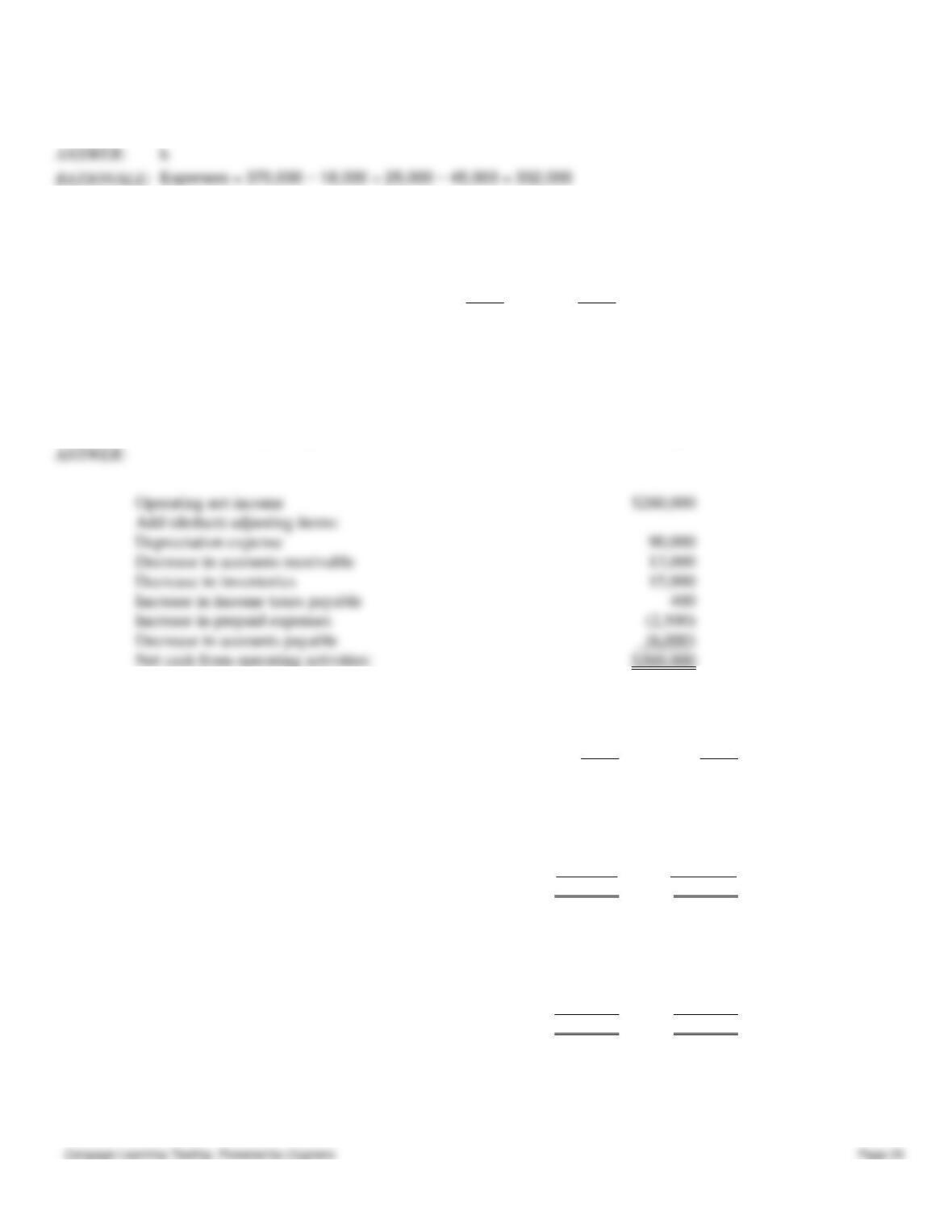
133. Total operating expenses on Harmon Company‘s income statement for last year totaled $370,000. During the year
accrued liabilities increased by $18,000, and prepaid expenses increased by $25,000. Depreciation expense for the year
was $45,000. Based on this information, operating expenses adjusted to cash basis under the direct method on the
statement of cash flows would be
a.
$318,000.
b.
$332,000.
Chapter 15 – Statement of Cash Flows
c.
$422,000.
d.
$408,000.
134. The Prince Company reported net income of $260,000 for the current year. Depreciation recorded on buildings and
equipment amounted to $90,000 for the year. Balances of the current asset and current liability accounts for 20X0 and
20X1 are as follows:
20X1
20X0
Cash
$20,000
$15,000
Accounts receivable
19,000
32,000
Inventories
50,000
65,000
Prepaid expenses
7,500
5,000
Accounts payable
12,000
18,000
Income taxes payable
1,600
1,200
Prepare the cash flows from operating activities section of the statement of cash flows using the indirect method.
Operating net income
Add (deduct) adjusting items:
Depreciation expense
90,000
Decrease in accounts receivable
13,000
Decrease in inventories
15,000
Increase in income taxes payable
Increase in prepaid expenses
Decrease in accounts payable
Net cash from operating activities:
135. The balance sheets of Dolan Company, for December 31, 20X1 and 20X0, are as follows:
20X1
20X0
Cash
$ 68,000
$ 42,500
Accounts receivable (net)
61,000
70,200
Inventories
121,000
105,000
Investments
—
100,000
Equipment
515,000
425,000
Accumulated depreciation—equipment
(153,000)
(175,000)
$612,000
$567,700
Accounts payable
$ 59,750
$ 47,250
Bonds payable, due 20X1
—
75,000
Common stock, $20 par
375,000
325,000
Premium on common stock
50,000
25,000
Retained earnings
127,250
95,450
$612,000
$567,700
Additional information:
(a)
Net income, $71,800.
(b)
Depreciation reported on income statement, $38,000.
(c)
Fully depreciated equipment costing $60,000 was scrapped, no salvage, and equipment was
Chapter 15 – Statement of Cash Flows
purchased for $150,000.
(d)
Bonds payable for $75,000 were retired by payment at their face amount.
(e)
2,500 shares of common stock were issued at $30 for cash.
(f)
Cash dividends declared and paid, $40,000.
(g)
Investments of $100,000 were sold for $125,000.
Required: Prepare a statement of cash flows using the indirect method.
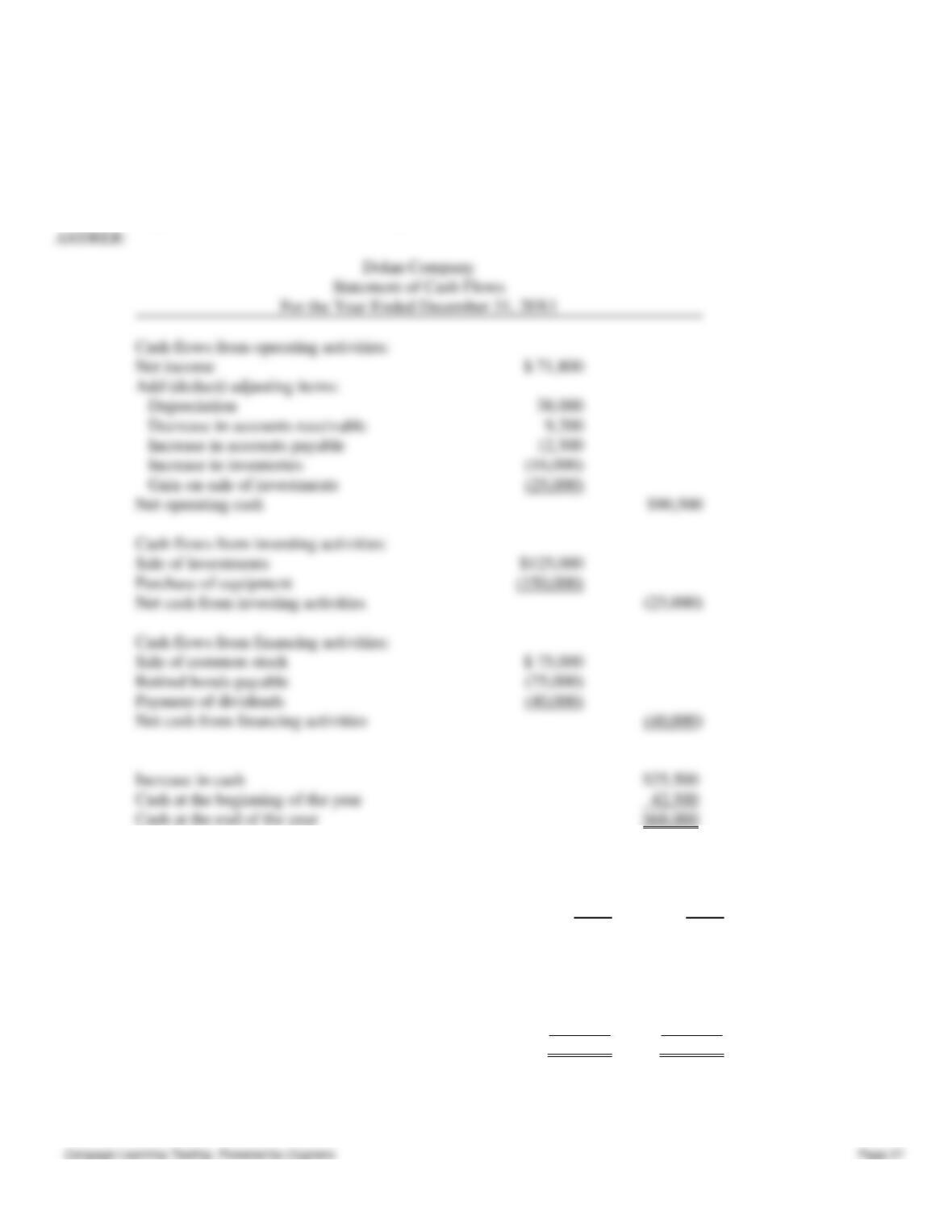
Cash flows from operating activities:
$ 71,800
Add (deduct) adjusting items:
Depreciation
Decrease in accounts receivable
Increase in accounts payable
Increase in inventories
Gain on sale of investments
Cash flows from investing activities:
Sale of investments
Purchase of equipment
(150,000)
Sale of common stock
$ 75,000
Retired bonds payable
Payment of dividends
Increase in cash
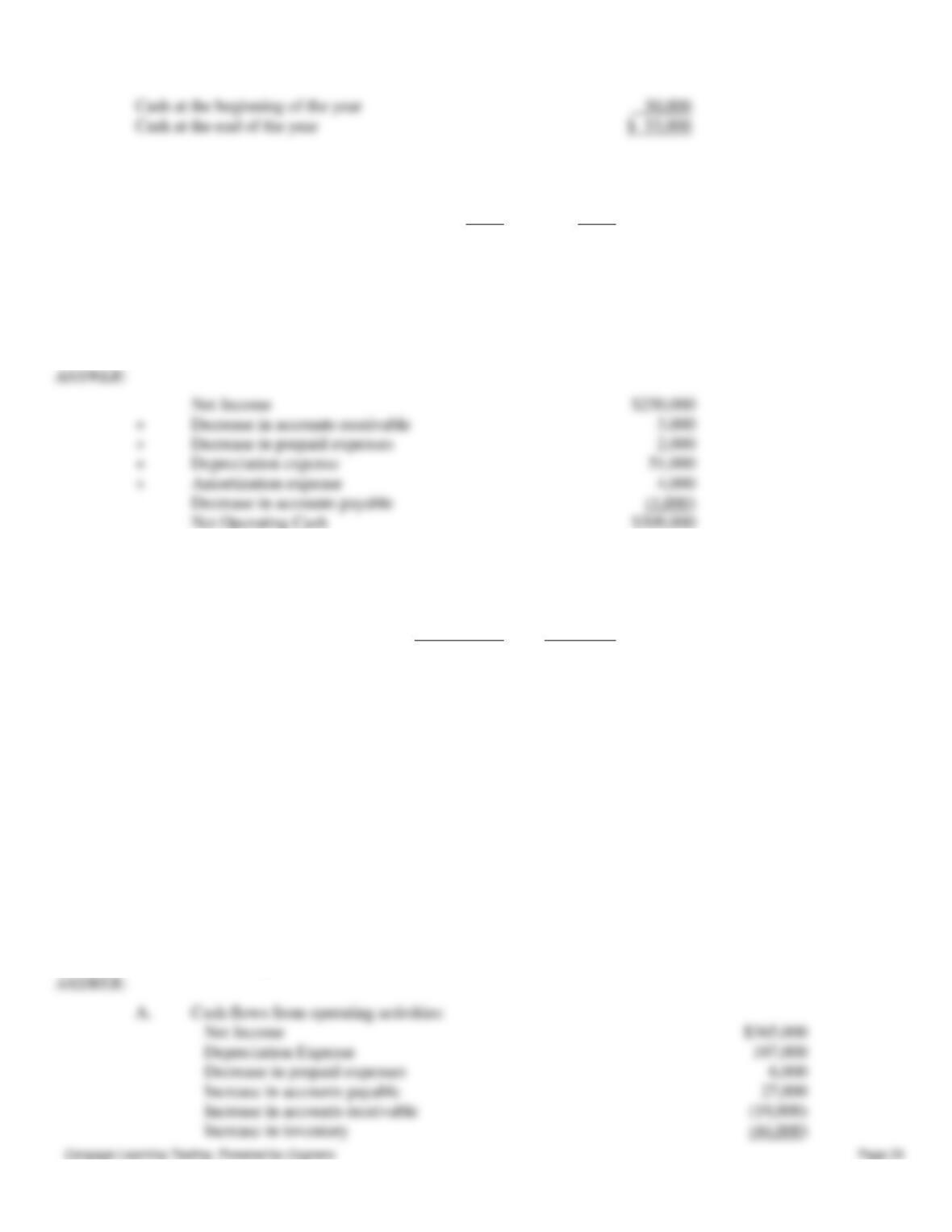
Cash at the beginning of the year
Cash at the end of the year
136. The balance sheets for Jenson Company, for the years ended December 31, 20X1 and 20X0, are as follows:
20X1
20X0
Cash
$ 53,000
$ 50,000
Accounts receivable (net)
37,000
48,000
Inventories
108,500
100,000
Investments
—
70,000
Equipment
573,200
450,000
Accumulated depreciation—equipment
(142,000)
(176,000)
$629,700
$542,000
Accounts payable
$ 62,500
$ 43,800
Bonds payable, due 20X1
—
100,000
Common stock, $10 par
325,000
285,000
Chapter 15 – Statement of Cash Flows
Paid-in capital in excess of par—common stock
80,000
55,000
Retained earnings
162,200
58,200
$629,700
$542,000
The income statement for the current year is as follows:
Sales
$625,700
Cost of merchandise sold
340,000
Gross profit
$285,700
Operating expenses:
Depreciation expense
$26,000
Other operating expenses
68,000
94,000
Income from operations
$191,700
Other income:
Gain on sale of investment
$ 4,000
Other expense:
Interest expense
6,000
(2,000)
Income before income tax
$189,700
Income tax
60,700
Net income
$129,000
Additional information:
(a)
Fully depreciated equipment costing $60,000 was scrapped, no salvage, and equipment was
purchased for $183,200.
(b)
Bonds payable for $100,000 were retired by payment at their face amount.
(c)
5,000 shares of common stock were issued at $13 for cash.
(d)
Cash dividends declared and paid, $25,000.
Required: Prepare a statement of cash flows, using the indirect method.
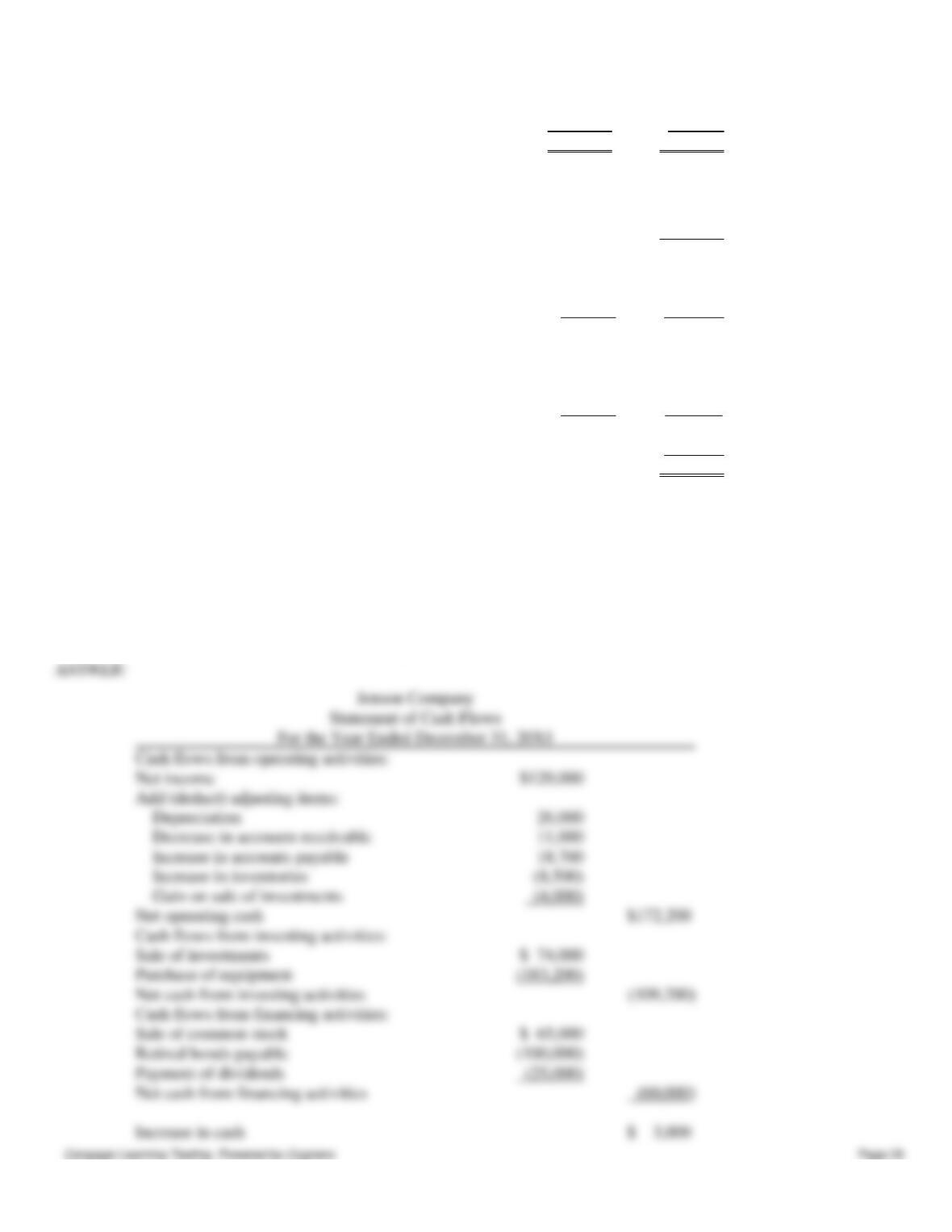
Cash flows from operating activities:
Net income
$129,000
Add (deduct) adjusting items:
Depreciation
Increase in inventories
Gain on sale of investments
Net operating cash
$172,200
Cash flows from investing activities:
Sale of investments
Purchase of equipment
Net cash from investing activities
Cash flows from financing activities:
Sale of common stock
Retired bonds payable
Payment of dividends
Net cash from financing activities
Increase in cash
Chapter 15 – Statement of Cash Flows
Cash at the beginning of the year
Cash at the end of the year
137. Using the indirect method, calculate the amount of net cash flows from operating activities from the following data:
20X1
20X0
Net Income
$250,000
Accounts receivable
22,000
$25,000
Prepaid expenses
3,000
5,000
Accounts payable
14,000
15,000
Depreciation expense
51,000
Amortization expense (Patent)
4,000
Dividends declared and paid
11,000
Net Income
$250,000
+
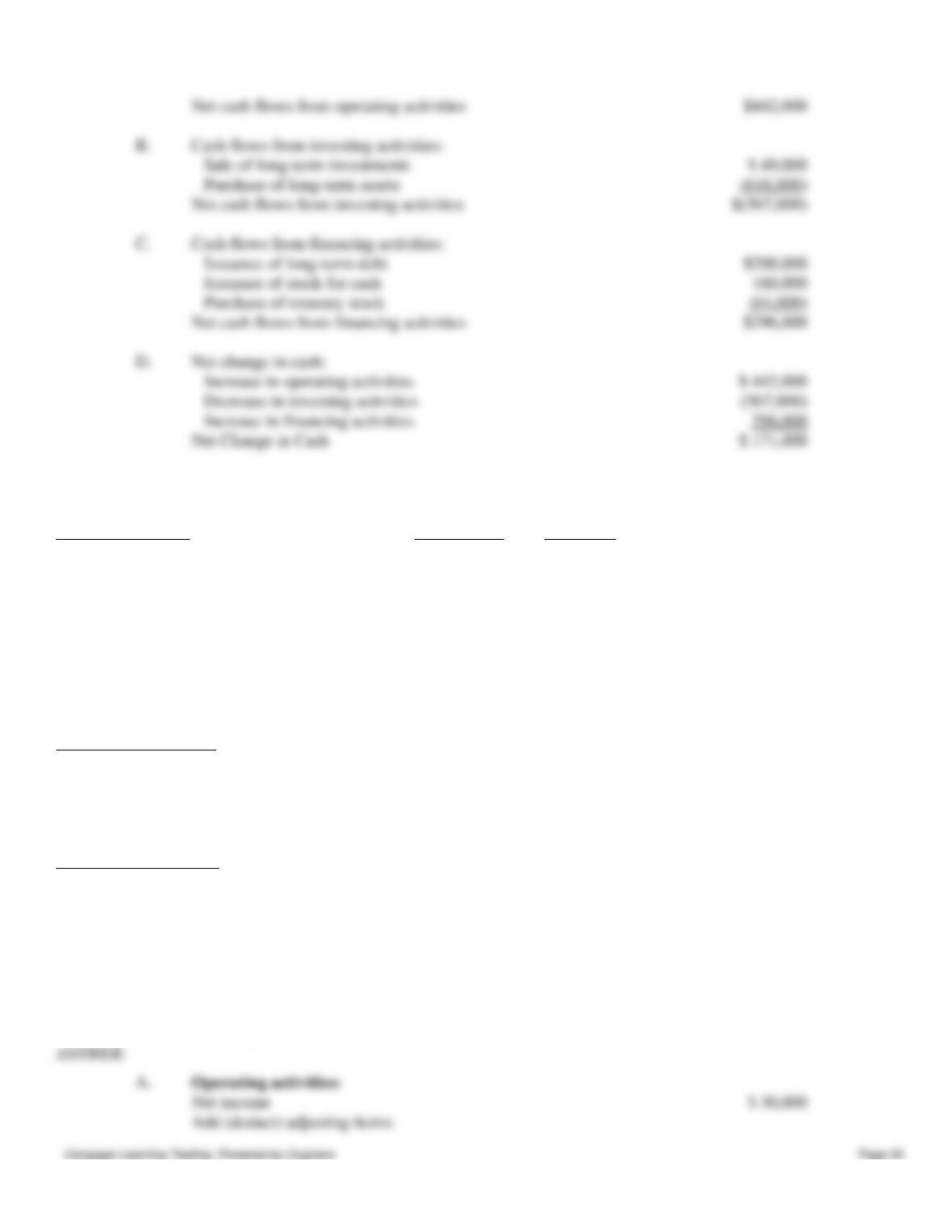
Decrease in accounts receivable
3,000
+
Decrease in prepaid expenses
2,000
+
Depreciation expense
51,000
+
Amortization expense
4,000
Decrease in accounts payable
Net Operating Cash
$309,000
138. Use the following information to perform the calculations below, using the indirect method. Show and clearly label
your calculations:
Current Year
Prior Year
Net Income
$365,000
Accounts receivable
439,000
$420,000
Inventory
560,000
516,000
Prepaid expenses
42,000
48,000
Accounts payable
146,000
119,000
Depreciation expense
107,000
Purchase of long-term assets
616,000
Issuance of long-term debt
200,000
Issuance of stock for cash
160,000
Issuance of stock for long-term assets
110,000
Purchase of treasury stock
64,000
Sale of long-term investments at cost
49,000
A.
Calculate the amount of the net cash flows from operating activities.
B.
Calculate the amount of the net cash flows from investing activities.
C.
Calculate the amount of the net cash flows from financing activities.
D.
Calculate the net change in cash.
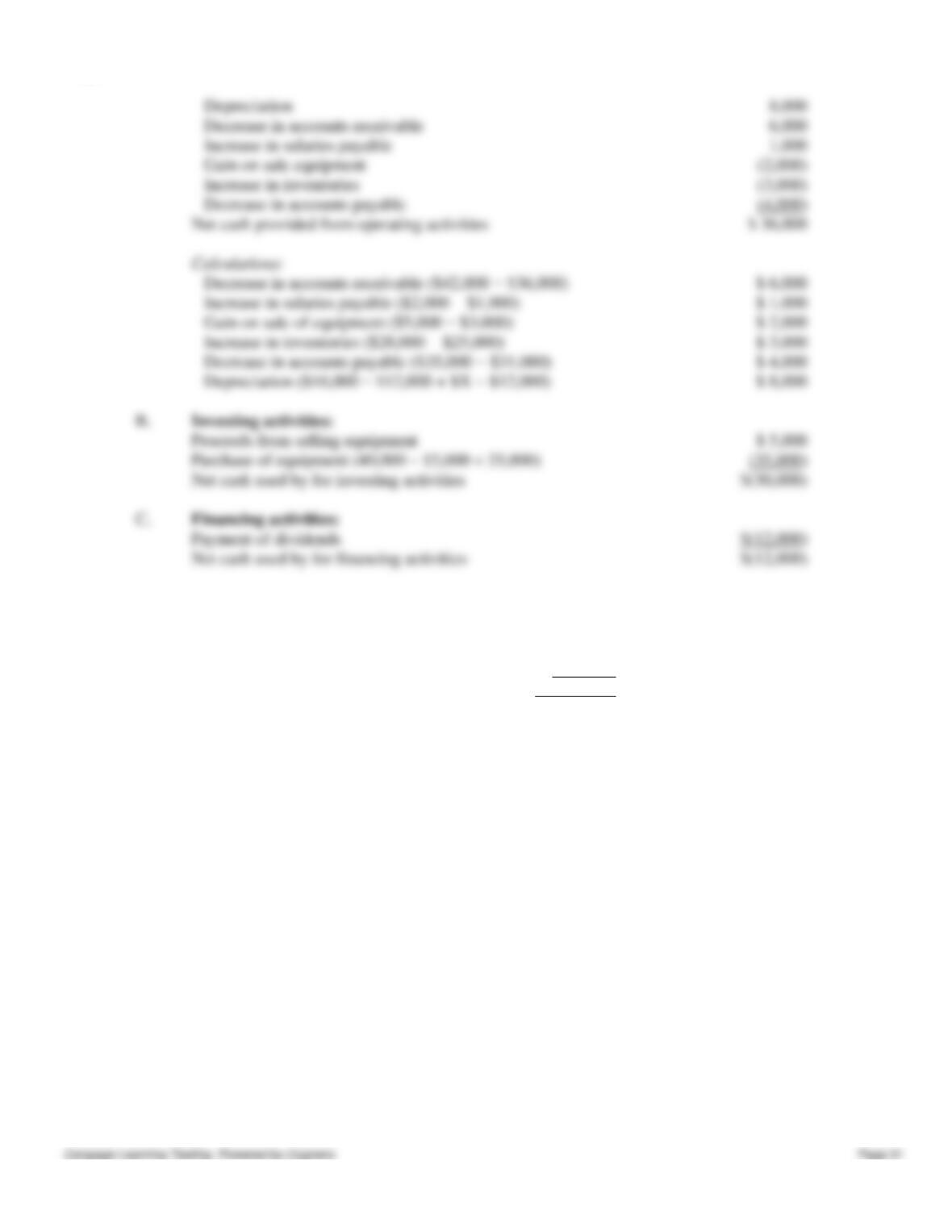
A.
Cash flows from operating activities:
Net Income
$365,000
Depreciation Expense
107,000
Decrease in prepaid expenses
6,000
Increase in accounts payable
27,000
Increase in accounts receivable
Increase in inventory
Chapter 15 – Statement of Cash Flows
139. Use the following selected data and additional information to answer the questions that follow:
Balance Sheet Data
Current Year
Prior Year
Accounts receivable
$ 36,000
$ 42,000
Inventories
28,000
25,000
Accounts payable
31,000
35,000
Salaries payable
2,000
1,000
Equipment
60,000
40,000
Accumulated depreciation
12,000
16,000
Bonds payable
50,000
100,000
Common stock
150,000
100,000
Retained earnings
38,000
20,000
Income Statement Data
Current Year
Net sales
$420,000
Cost of goods sold
300,000
Operating expenses (excluding depreciation expense)
84,000
Net income
30,000
Gain on sale of equipment (included in net income above)
2,000
Additional information:
1.
Equipment with a cost of $15,000 and a book value of $3,000 was sold for $5,000 during the
current year.
2.
Common stock was issued to retire bonds payable during the current year.
3.
Dividends declared and paid during the current year were $12,000.
A.
Prepare the operating activities section of a statement of cash flows for the current year
using the indirect method.
B.
Prepare the investing activities section of a statement of cash flows for the current year.
C.
Prepare the financing activities section of a statement of cash flows for the current year.
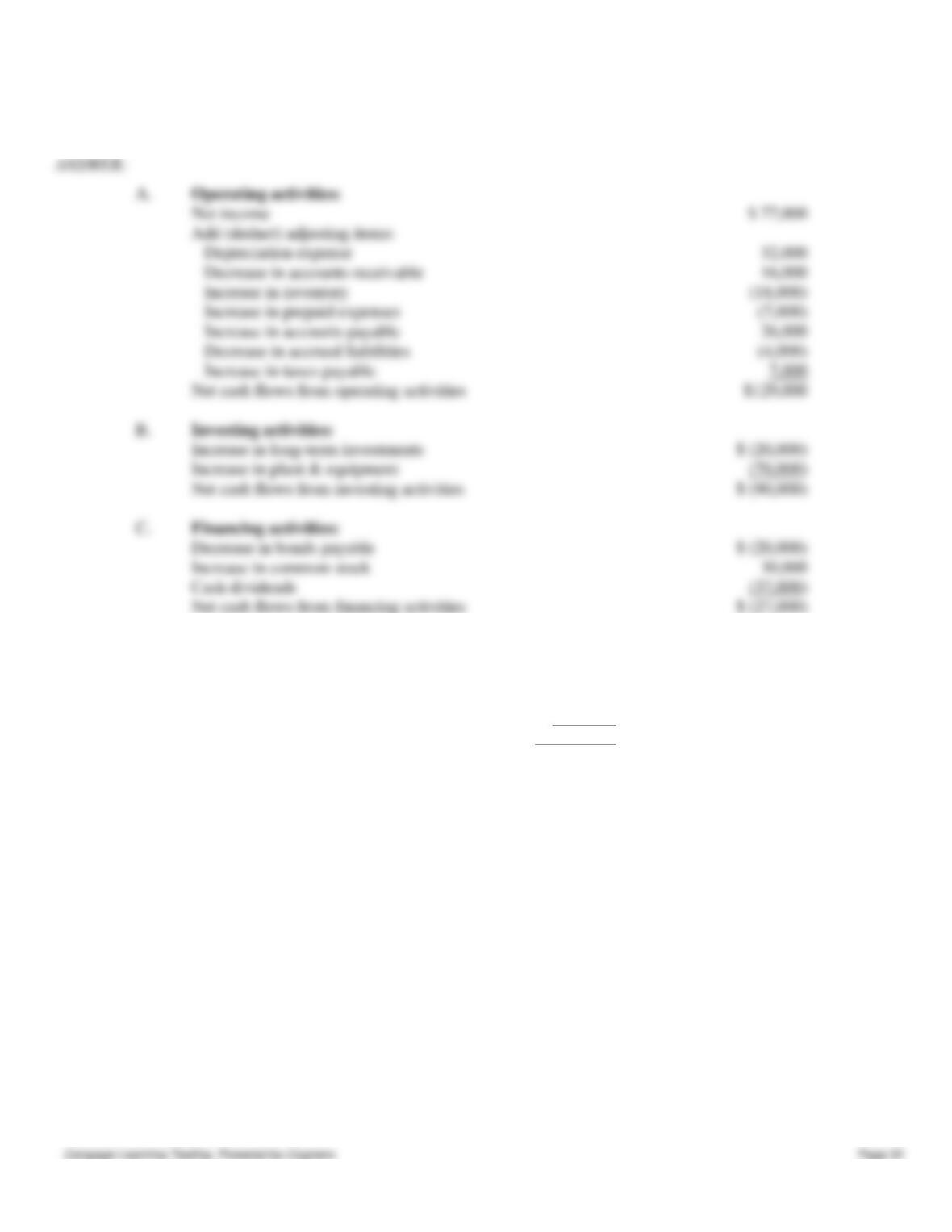
A.
Net income
$ 30,000
Add (deduct) adjusting items:
Net cash flows from operating activities
$442,000
B.
Cash flows from investing activities:
Sale of long-term investments
$ 49,000
Purchase of long-term assets
Net cash flows from investing activities
C.
Cash flows from financing activities:
Issuance of long-term debt
$200,000
Issuance of stock for cash
160,000
Purchase of treasury stock
Net cash flows from financing activities
D.
Net change in cash:
Increase in operating activities
Decrease in investing activities
Increase in financing activities
296,000
Net Change in Cash
Chapter 15 – Statement of Cash Flows
140. Bradley Company’s net income last year was $77,000. Changes in the company’s balance sheet accounts for the year
appear below:
Increases
(Decreases)
Debit balances:
Cash
$12,000
Accounts receivable
(16,000)
Inventory
18,000
Prepaid expenses
7,000
Long-term investments
20,000
Plant and equipment
70,000
Credit balances:
Accumulated depreciation
32,000
Accounts payable
26,000
Accrued liabilities
(4,000)
Taxes payable
7,000
Bonds payable
(20,000)
Common stock
30,000
Retained earnings
40,000
The company declared and paid cash dividends of $37,000 last year.
Required:
A.
Prepare the operating activities section of the company’s statement of cash flows for the
year. (Use the indirect method.)
B.
Prepare the investing activities section of the company’s statement of cash flows for the
Depreciation
8,000
Decrease in accounts receivable
6,000
Increase in salaries payable
1,000
Gain on sale equipment
(2,000)
Increase in inventories
(3,000)
Decrease in accounts payable
(4,000)
Decrease in accounts receivable ($42,000 − $36,000)
Increase in salaries payable ($2,000 − $1,000)
Gain on sale of equipment ($5,000 − $3,000)
Increase in inventories ($28,000 − $25,000)
Decrease in accounts payable ($35,000 − $31,000)
Depreciation ($16,000 − $12,000 + $X = $12,000)
B.
Proceeds from selling equipment
Purchase of equipment (40,000 – 15,000 + 35,000)
(35,000)
C.
Payment of dividends
Chapter 15 – Statement of Cash Flows
year.
C.
Prepare the financing activities section of the company’s statement of cash flows for the
year.
A.
Net income
Add (deduct) adjusting items:
Depreciation expense
32,000
Decrease in accounts receivable
16,000
Increase in inventory
(18,000)
Increase in prepaid expenses
(7,000)
Increase in accounts payable
26,000
Decrease in accrued liabilities
(4,000)
Increase in taxes payable
7,000
Net cash flows from operating activities
$129,000
Increase in long-term investments
Increase in plant & equipment
(70,000)
Net cash flows from investing activities
Decrease in bonds payable
Increase in common stock
30,000
Cash dividends
(37,000)
Net cash flows from financing activities
141. Baskin Company’s net income last year was $98,000. Changes in the company’s balance sheet accounts for the year
appear below:
Increases
(Decreases)
Debit balances:
Cash
$24,000
Accounts receivable
15,000
Inventory
(18,000)
Prepaid expenses
(6,000)
Long-term investments
10,000
Plant and equipment
40,000
Credit balances:
Accumulated depreciation
32,000
Accounts payable
(14,000)
Accrued liabilities
11,000
Taxes payable
4,000
Bonds payable
(40,000)
Common stock
10,000
Retained earnings
62,000
The company declared and paid cash dividends of $36,000 last year.
Required:
A.
Prepare the operating activities section of the company’s statement of cash flows for the
Chapter 15 – Statement of Cash Flows
year. (Use the indirect method.)
B.
Prepare the investing activities section of the company’s statement of cash flows for the
year.
C.
Prepare the financing activities section of the company’s statement of cash flows for the
year.
Add (deduct) adjusting items:
Depreciation expense
32,000
Increase in accounts receivable
(15,000)
Decrease in inventory
18,000
Decrease in prepaid expenses
Decrease in accounts payable
(14,000)
Increase in accrued liabilities
11,000
Increase in taxes payable
$140,000
Increase in long-term investments
Increase in plant & equipment
(40,000)
Decrease in bonds payable
Increase in common stock
10,000
Cash dividends
(36,000)
142. Black Company’s net income last year was $84,000. Changes in the company’s balance sheet accounts for the year
appear below:
Increases
(Decreases)
Debit balances:
Cash
$(12,000)
Accounts receivable
13,000
Inventory
(15,000)
Prepaid expenses
(9,000)
Long-term investments
20,000
Plant and equipment
60,000
Credit balances:
Accumulated depreciation
26,000
Accounts payable
(15,000)
Accrued liabilities
(8,000)
Taxes payable
19,000
Bonds payable
(30,000)
Common stock
40,000
Retained earnings
25,000
The company declared and paid cash dividends of $59,000 last year.
Chapter 15 – Statement of Cash Flows
Required:
A.
Prepare the operating activities section of the company’s statement of cash flows for the
year. (Use the indirect method.)
B.
Prepare the investing activities section of the company’s statement of cash flows for the
year.
C.
Prepare the financing activities section of the company’s statement of cash flows for the
year.
Add (deduct) adjusting items:
Depreciation expense
26,000
Increase in accounts receivable
Decrease in inventory
15,000
Decrease in prepaid expenses
9,000
Decrease in accounts payable
Decrease in accrued liabilities
(8,000)
Increase in taxes payable
19,000
$117,000
Increase in long-term investments
Increase in plant & equipment
Decrease in bonds payable
Increase in common stock
40,000
Cash dividends
143. Daniels Company’s comparative balance sheet and income statement for last year appear below:
Balance Sheet
Ending
Beginning
Balance
Balance
Cash
$ 62,000
$ 38,000
Accounts receivable
85,000
66,000
Inventory
31,000
44,000
Prepaid expenses
0
4,000
Long-term investments
260,000
210,000
Plant and equipment
450,000
450,000
Accumulated depreciation
(255,000)
(219,000)
Total assets
$633,000
$593,000
Accounts payable
$ 33,000
$ 45,000
Accrued liabilities
36,000
18,000
Taxes payable
17,000
24,000
Deferred taxes payable
41,000
24,000
Bonds payable
150,000
190,000
Common stock
130,000
100,000
Retained earnings
226,000
192,000
Chapter 15 – Statement of Cash Flows
Total liabilities and stockholders’ equity
$633,000
$593,000
Income Statement
Sales
$610,000
Less cost of goods sold
330,000
Gross margin
280,000
Less operating expenses
180,000
Net operating income
100,000
Less income taxes
30,000
Net income
$ 70,000
The company declared and paid $36,000 in cash dividends during the year.
Required: Using the indirect method, prepare each of the following activities sections of the company’s statement of cash
flows for the year:
A.
Operating activities section.
B.
Investing activities section.
C.
Financing activities section.
A.
Net income
$ 70,000
Add (deduct) Adjusting Items:
Depreciation expense
36,000
Increase in accounts receivable
Decrease in inventory
13,000
Decrease in prepaid expenses
Decrease in accounts payable
Increase in accrued liabilities
18,000
Increase in deferred taxes
17,000
Net cash flows from operating activities
$120,000
B.
Increase in long-term investments
Net cash flows from investing activities
C.
Decrease in bonds payable
Increase in common stock
30,000
Cash dividends paid
Net cash flows from financing activities
144. Trueblood Company’s comparative balance sheet and income statement for last year appear below:
Balance Sheet
Ending
Beginning
Balance
Balance
Cash
$ 60,000
$ 25,000
Accounts receivable
48,000
61,000
Inventory
56,000
48,000
Prepaid expenses
13,000
19,000
Long-term investments
300,000
210,000
Plant and equipment
470,000
470,000
Chapter 15 – Statement of Cash Flows
Accumulated depreciation
(222,000)
(188,000)
Total assets
$725,000
$645,000
Accounts payable
$ 59,000
$ 36,000
Accrued liabilities
42,000
24,000
Taxes payable
7,000
14,000
Deferred taxes payable
38,000
23,000
Bonds payable
80,000
140,000
Common stock
110,000
70,000
Retained earnings
389,000
338,000
Total liabilities and stockholders’ equity
$725,000
$645,000
Income Statement
Sales
$540,000
Less cost of goods sold
300,000
Gross margin
$240,000
Less operating expenses
150,000
Net operating income
90,000
Less income taxes
27,000
Net income
$ 63,000
The company declared and paid $12,000 in cash dividends during the year.
Required: Using the indirect method, prepare each of the following activities sections of the company’s statement of cash
flows for the year:
A.
Operating activities section.
B.
Investing activities section.
C.
Financing activities section.
A.
Net income
Add (deduct) adjusting items:
Depreciation expense
34,000
Decrease in accounts receivable
13,000
Increase in inventory
Decrease in prepaid expenses
6,000
Increase in accounts payable
23,000
Increase in accrued liabilities
18,000
Decrease in taxes payable
Increase in deferred taxes payable
15,000
Net cash flows from operating activities
$157,000
B.
Increase in long-term investments
Net cash flows from investing activities
C.
Decrease in bonds payable
Increase in common stock
40,000
Cash dividends
145. The comparative balance sheets for Bessler Company appear below: