Chapter 15—Payout Policy
MULTIPLE CHOICE
1. Introuble Co. announced that it would cut its quarterly dividend from $0.15 per share to $0.05 per
share. This news resulted in an immediate share price reduction of 4%. When the ex-dividend date
arrived, Introuble shares fell by $0.13. An explanation of Introuble’s stock price movement would
suggest that investors:
a.
believed the dividend reduction signaled decreased profitability for the firm
b.
became aware of additional negative news on the ex-dividend date
c.
would prefer to receive cash distributions in the form of capital gains or interest income
rather than dividends
d.
a and b
e.
all of the above
2. Anne is a well-diversified investor and would therefore always prefer a company which employs a:
a.
constant payout ratio dividend policy
b.
constant nominal payment policy for dividends
c.
target dividend payout ratio
d.
low-regular-and-extra policy for dividends
e.
none of the above
3. Almost-gone is on the verge of being delisted from Nasdaq because its share price has dropped below
the $1 per share minimum. Management would most likely undertake:
a.
a 2-for-1 split
b.
a 1-for-2 split
c.
a share repurchase program
d.
a stock dividend program
e.
the payment of an extra dividend
4. When compared with cash dividends, share repurchases provide tax advantages to shareholders in that:
a.
only the shareholders who choose to sell could be subject to taxes
b.
shareholders choosing to sell will only pay taxes on capital gains proceeds, which are
taxed at a lower rate than dividends
c.
if the repurchase results in a stock price increase, shareholders who do not sell can defer
tax payments indefinitely
d.
b and c
e.
all of the above
5. In a rapidly growing industry characterized by __________ regulation and a __________ degree of
intangible assets, empirical evidence would suggest that dividend payouts would be low.
a.
low; low
b.
low; high
c.
high; low
d.
high; high
e.
irregular; unpredictable
6. Given that the firm needs to finance its ongoing investment projects in a frictionless market, investors
would:
a.
be indifferent if firms either increase the level of payout compared to retention or increase
the return provided to shareholders
b.
be indifferent if firms either change the proportional stake in the firm for initial investors
or change the required return on equity in a given period
c.
be indifferent if firms either retain corporate profits to fund positive-NPV investments or
pay out cash dividends and fund projects with new share issues
d.
prefer firms to retain corporate profits and increase stock price in order to benefit from
capital gains
e.
prefer firms to pay out all profits in the form of dividends since tax payments are
irrelevant
7. If a country’s tax laws change such that capital gains and dividends are taxed at the same rate each and
every period (and if paid-in-capital as a capital gains basis were very small), then:
a.
corporate dividend payout ratios will fall
b.
firms will payout all earnings in dividends rather than retain earnings
c.
corporate dividend payout ratios will be irrelevant
d.
firms will retain all earnings rather than pay dividends
e.
firms will increase the usage of share repurchase programs
8. Janice believes her firm needs to send a signal to investors. Recent projects have provided a significant
increase in cash flows for the firm, and Janice suggests increasing dividend payments. Supporters for
the informational role of dividends would claim __________, while opponents would claim
__________.
a.
stock price should be unchanged with increased dividend payments; stock price should
decrease with increased dividend payments
b.
Janice is deviating from target payout ratios and the firm’s stock price will fall; Janice is
applying a partial adjustment strategy
c.
Janice is finding the “tax efficient” level of dividend payment; Janice is enticing investors
with claims of lower taxes
d.
Janice believes the increase in earnings is a permanent change; Janice is only responding
to recent earnings increases, with no consideration of the future.
e.
Janice believes she is less informed than shareholders about the firm’s prospects;
shareholders only need to know about net income levels
9. According to the agency cost model of dividend policy, a firm with large amounts of free-cash flow,
few positive-NPV investment opportunities, and numerous shareholders would be expected to have:
a.
a constant payout ratio dividend policy
b.
a low-regular-and-extra dividend policy
c.
a high dividend payout level
d.
a low dividend payout level
e.
an undeterminable dividend payout level
10. The __________ is the actual date on which the firm mails the dividend payment to the holder of
record.
a.
announcement date
b.
payment date
c.
record date
d.
ex-dividend date
e.
shareholders of record date
11. Which of the following is a practical factor involved in formulating a value-maximizing policy
affecting dividend policy?
a.
legal constraints
b.
contractual constraints
c.
firm’s growth prospects
d.
owner considerations
e.
all of the above
12. Dividend payout policies have pronounced __________ patterns, and these are the same worldwide.
a.
national
b.
growth rate
c.
required rate of return
d.
industry
e.
none of the above
13. One of the most persuasive explanations for the continued existence of dividend payments in modern
capital markets is provided by the __________.
a.
constant nominal payment policy.
b.
transactions cost of dividends
c.
free cash flow hypothesis
d.
share repurchase program
e.
target dividend payout ratio
14. With a constant payout ratio dividend policy:
a.
Shareholders receive a constant dollar dividend amount each payment period.
b.
Shareholders receive a set dollar dividend with a certain extra ratio of earnings paid out as
a bonus.
c.
Clientele needing a set fixed income are attracted to invest in firms following this policy.
d.
Shareholders receive a dividend that fluctuates with earnings each time dividends are paid.
e.
Shareholders receive a constant percent of earnings only after a firm finances profitable
projects.
15. One reason financial managers of a firm would use a reverse stock split is:
a.
To increase the firm’s shares outstanding.
b.
To reverse an increasing price trend with the firm’s stock to bring it back to an affordable
range for most investors.
c.
To reduce the cost of capital with fewer shares outstanding.
d.
To increase the stock price to keep the stock eligible for continued exchange trading.
e.
To purchase additional shares to have in-house to use in a merger.
16. For a typical cash dividend, which is correct chronological order?
a.
Payment date; record date; ex-dividend date
b.
Ex-dividend date; record date; payment date
c.
Record date; ex-dividend date; payment date
d.
Record date; payment date; ex-dividend date
17. The agency cost model predicts that firms with __________ will have relatively lower payout ratios.
a.
Higher growth rates
b.
More diffuse ownership
c.
Higher free cash flow
d.
None of the above
18. __________ is the most commonly observed dividend policy
a.
Constant payout ratio policy
b.
Constant nominal payment policy
c.
Sinusoidal payout policy
d.
Low-regular-and-extra policy
e.
Stock dividend with bonus policy
19. Tax considerations have tended to favor
a.
Dividends over share repurchases because of corporate tax issues
b.
Dividends over share repurchases because of personal tax issues
c.
Share repurchases over dividends because of corporate tax issues
d.
Share repurchases over dividends because of personal tax issues
e.
Dividends over retained earnings because of corporate tax issues
20. Suppose there is an informational role for dividends, but there are no taxes. Ferndale Equipment Corp.
has decided to raise its dividends. The stock price is likely to __________ on __________.
a.
Drop, the payment date
b.
Rise, the ex-dividend date
c.
Drop, the date of record
d.
Rise, the announcement date
e.
Remain unchanged due to dividend irrelevance, all dates
21. Three years ago, the common stock of Makkeny Corp. sold for $p1 on the NYSE. Today, the current
share price for the firm is $p2. The firm paid no dividends over this period of time and Makkeny
executed a two for one stock split two years ago. What is the annualized return an investor would
realize today if she purchased Makkeny three years ago?
a.
ans1%
b.
r%
c.
ans2%
d.
ans4%
22. Suppose an investor in the firm Diamax International is unhappy about its dividend policy. She
currently owns w% of Diamax and it currently pays no dividends. The investor would like to create a
dividend of $div per share. She has decided to sell shares of Diamax in order to accomplish this. What
number of shares must she sell if Diamax’s common stock is currently trading at $p and there are one
million shares outstanding?
a.
n
b.
18,275
c.
9,867
d.
11,010
23. EXCON Inc. has a current common stock price of $32.89. The firm has just announced a dividend of
$1.50 per share. What effect will this have on the firm’s share price on the ex-dividend date? Assume
no taxes or transactions costs.
a.
Price will fall by $1.50 per share
b.
Price will fall by less than $1.50
c.
Will not affect stock price
d.
Don’t have enough information
24. You own a stock today that currently sells for $p1. You purchased that stock six months ago at $p2.
The stock will pay a dividend of $div per share in a few days, and the ex-dividend date is tomorrow.
Suppose you face a capital gains tax of tc% and a dividend tax of td%. You expect that the stock price
will fall by $dp on the ex date. You should
a.
Sell tomorrow, since your after-tax profit is higher.
b.
Sell today, since your after-tax return is higher
c.
Sell tomorrow, since your after-tax return is lower
d.
Sell today, since your after-tax profit is lower
25. You own a stock that will pay a dividend of $div. The stock currently sells for $p2. You purchased this
security 3 months ago for $p1. If you sell this security on the ex-dividend date, tomorrow, what is your
annualized (quarterly compounded) after-tax return if you expect the stock price to drop by $dp?
Assume a capital gains tax of tc% and dividend tax rate of td%.
a.
ans1%
b.
ans2%
c.
ans3%
d.
ans4%
26. Logically stock splits ________ create value, empirically stock splits________ do create value.
a.
Should; do
b.
Should; do not
c.
Should not; do
d.
Should not; do not
27. Paying dividends when investors assign a premium to dividend paying stocks is associated with
a.
The dividend premium theory
b.
The catering theory
c.
The signaling model
d.
The agency/contracting model
28. The dividend theory that best explains the initiation of dividends for public companies is
a.
The M&M Irrelevancy theory
b.
The catering theory
c.
The signaling model
d.
The agency/contracting model
29. Which of the following best describes the empirical evidence regarding dividends?
a.
Taxes influence dividends, firms manage dividends, and most firms do not pay dividends
b.
Taxes influence dividends, dividends are residual, most firms pay dividends
c.
Taxes influence dividends, firms manage dividends, most firms pay dividends
d.
Taxes influence dividends, dividends are residual, and most firms do not pay dividends
30. The agency theory that best explains the dividend behavior or large mature firms generating
substantial free cash flow
a.
The M&M Irrelevancy theory
b.
The catering theory
c.
The signaling model
d.
The agency/contracting model
MATCHING
Match the firm-level variable with the appropriate impact of an increase in it on dividend payouts:
a.
reduce
b.
increase
1. asset growth rate
2. capital intensity of the production process
3. positive-NPV investment opportunities
4. free cash flow generated
5. relative tightness of ownership coalition
6. number of individual shareholders
7. size of largest block holder
Match the following terms with their best descriptions:
a.
release to the public the dividend record date
b.
release to the public the dividend record date and payment date
c.
receive declared dividend if a stockholder on that date
d.
do not receive current dividend if purchasing stock on this date
e.
date dividend checks mailed
f.
date shareholders receives dividend check
8. announcement date
9. date of record
10. ex-dividend
11. payment date
Match the following terms with their best descriptions:
a.
stock dividend
b.
constant nominal payment policy
c.
low-regular-and-extra policy
d.
stock repurchases
e.
constant payout ratio policy
12. historically tax-advantaged method of distributing corporate cash to shareholders
13. use “extra” designation to signify a temporary positive earning shift
14. dividend payment to existing owners in the form of additional shares
15. a certain percentage of earnings is paid out as dividends each period
16. the firm pays a fixed dollar dividend each period
SHORT ANSWER
1. Why would a firm conduct a reverse stock split?
2. What are the national patterns of dividend payout policies?
3. What are the industry patterns of dividend payout policies?
4. What is the best dividend policy given frictionless markets and perfect certainty?
5. What is the problem with substituting a share repurchase program for dividend payments?
6. How do dividend payments serve to reduce agency costs between corporate managers and external
investors?
7. Under what circumstances might a firm borrow money to make its dividend payments?
8. The D Corporation has the following stockholders’ equity.
Common stock at par
$ par
Paid in capital in excess of par
$excap
Retained Earnings
$re
Total
$total
a.
What is the maximum amount of dividends D Corporation can pay in states where the firm’s
legal capital is defined as the par value of its common stock?
b.
How does your answer change if the firm is in a state where legal capital includes all paid-in
capital? What other circumstances might limit or tend to reduce D Corporation’s dividends?
$ans1 maximum dividends is retained earnings plus paid in capital.
limiting dividends would be the need for liquidity, lack of cash to pay dividends, restriction
rapid growth requiring all funds for expansion. Shareholders may have specific preferences
for a certain dividend payout or retention of earnings.
9. The HD Corporation has EBIT of $ebit, annual interest of $i, and annual depreciation of $dep. The
firm is taxed at t%, and bonds require the payment of $sink per year into a sinking fund.
a.
Can HD Corporation pay a $div dividend on its outstanding n shares of common stock if a
bond restriction prohibits the payment of dividends unless the cash flow before dividends and
sinking fund payments is greater than the total dividends, interest, and sinking fund
requirement?
b.
What is the maximum dividend per share that HD Corporation can pay and still satisfy the
bond restriction?
EBT
T @ t%
EAT
Cash flow before dividends and sinking fund payments
10. You are considering an investment in a stock that pays a constant dividend of $div per year beginning
one year from now. At the end of the sixth year (after receiving the sixth year payment of $div),
dividends are expected to begin growing. Assuming the required rate of return on this stock is r%,
what is the fair value of this stock assuming dividends after year 6 grow at a rate of
a.
g1 percent
b.
g2 percent
Discount rate
a.
= $pv1
b.
= $pv2
11. You are considering an investment in a firm that is expected to pay annual dividends of $d per year for
the next 14 years. Assuming a required rate of return of r percent, how much are these shares worth
now assuming a tax rate of
a.
0 percent
b.
tb percent
c.
tc percent
d.
Discuss why, in a world with no imperfection except taxes, an investor would prefer retained
earnings to dividends.
12. Constancash, Inc. is expected to pay dividends of $d per year for the next ten years, with the first cash
flow occurring immediately. (That is, there will be a total of eleven cash flows over the next ten years.)
The fair rate of return on Constancash’s stock is r percent. Ignore all market imperfections except
personal taxes on dividends.
a.
What is the value of one share of Constancash assuming a tax rate of 0 percent?
b.
How much would you expect the value of a share of this stock to fall on the day it goes ex-
dividend, assuming all investors face a tax rate of 0 percent?
Discount rate
d.
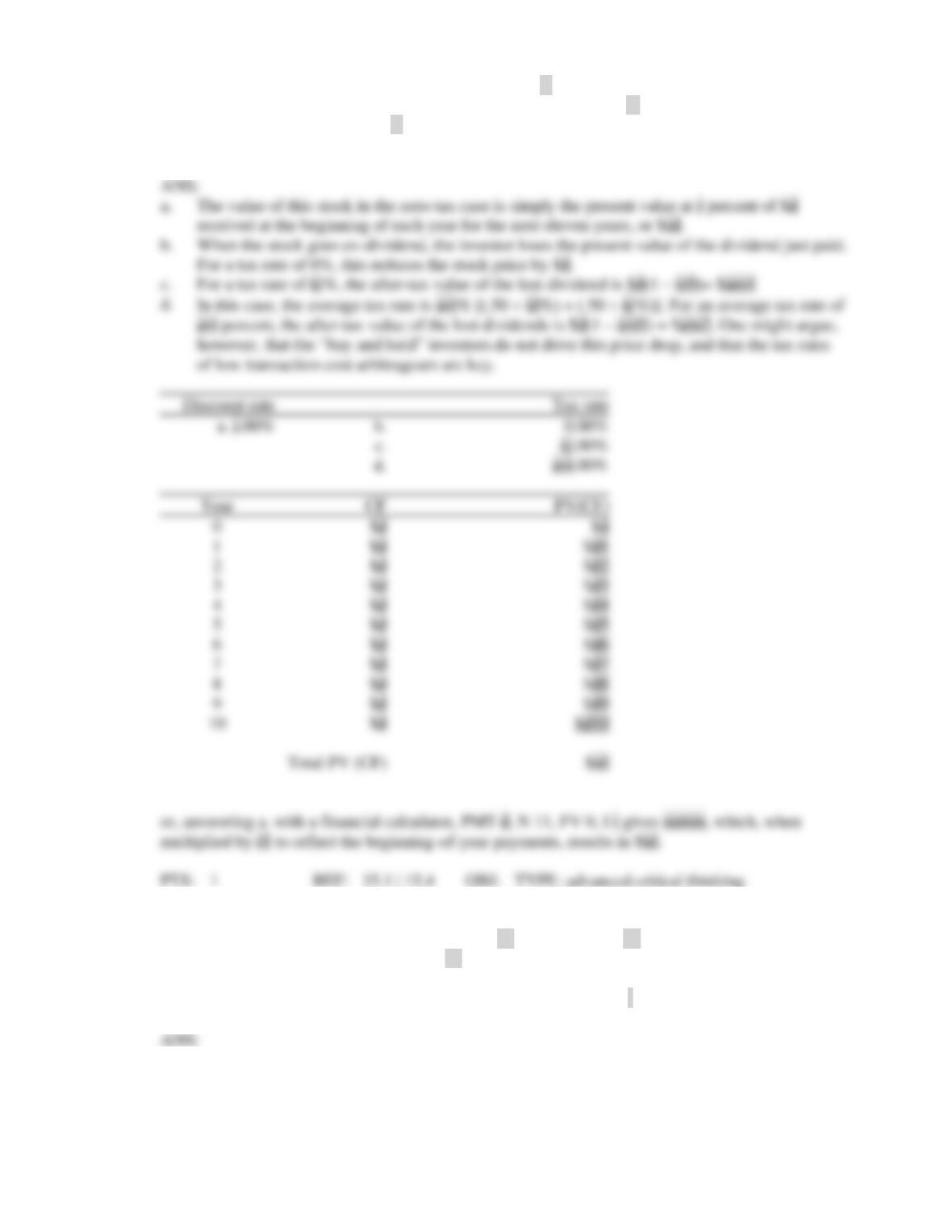
If our only concern is taxation, investors would clearly prefer to have earnings accumulate tax
free in the corporation rather than receiving after-tax cash flows from the firm.
c.
How much would you expect the value of a share of this stock to fall on the day it goes ex-
dividend, assuming all investors face a tax rate of tc percent?
d.
Suppose half of the investors in Constancash face a tax rate of td percent, and half of the
investors face a tax rate of tc percent. How much would you expect stock price to fall on the
day the share goes ex-dividend?
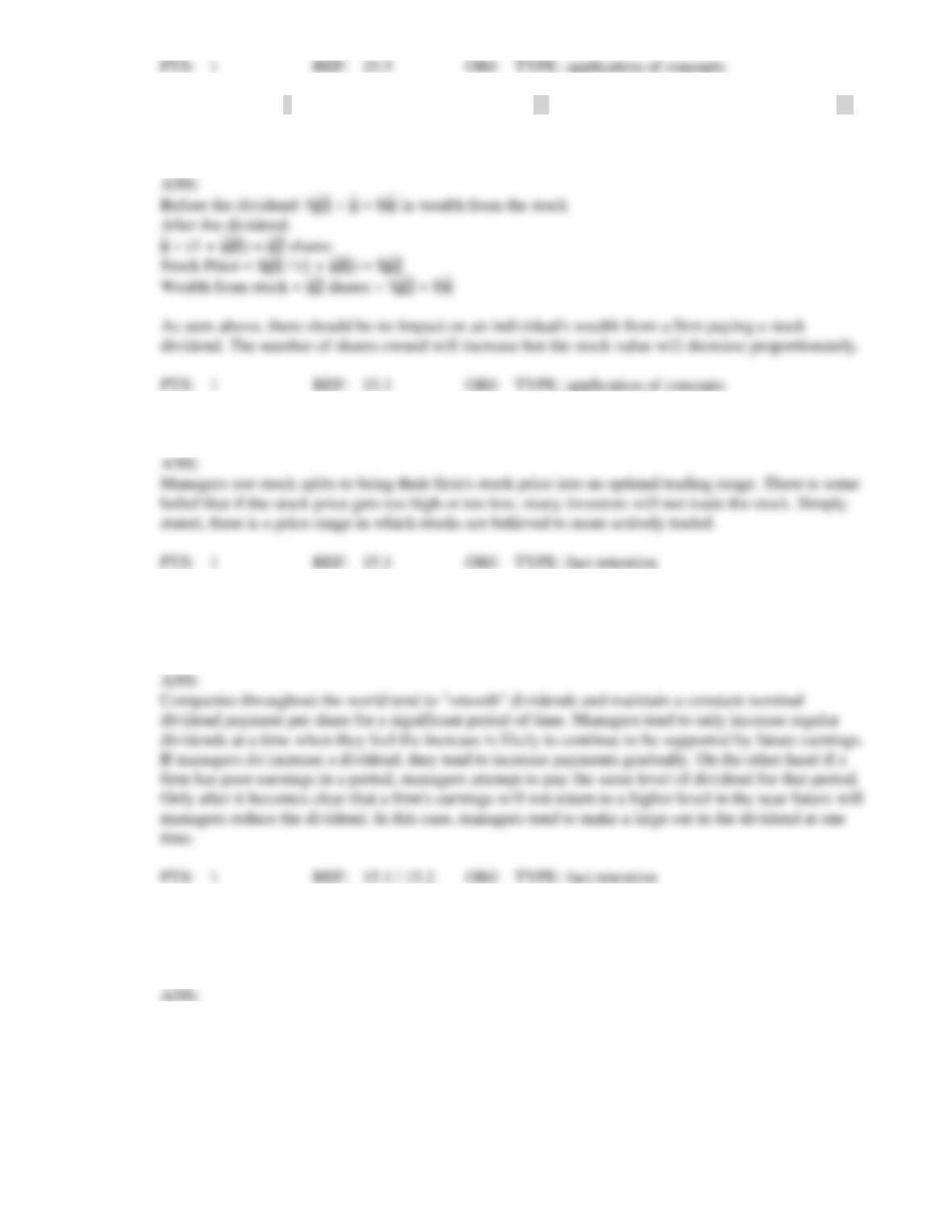
13. You have been watching ABR Electronics stock carefully for the last three years. Two months ago the
company announced a dividend reduction from $d1 per quarter to $d2 per quarter. On the very next
ex-dividend date, the stock price fell by $dp. There is no capital gains tax.
a.
Interpret this price change given all investors face a tax rate of 0 percent on dividends.
b.
Interpret this price change given all investors face a tax rate of t percent on dividends.
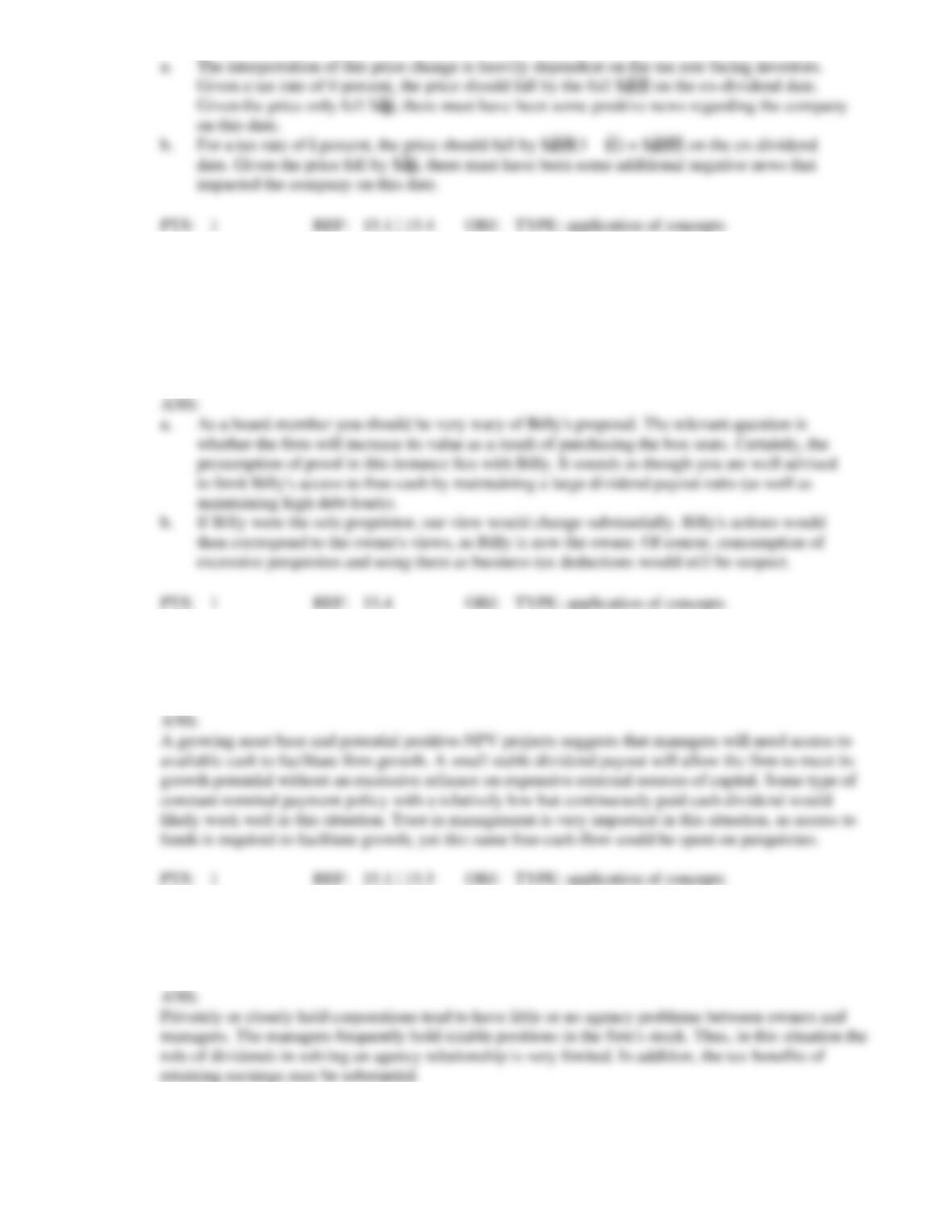
a.
The value of this stock in the zero-tax case is simply the present value at r percent of $d
received at the beginning of each year for the next eleven years, or $sd.
For a tax rate of 0%, this reduces the stock price by $d.
For a tax rate of tc%, the after-tax value of the lost dividend is $d(1 – tc0)= $ans1
of low transaction cost arbitrageurs are key.
14. You are a member of the Board of Directors of Cement-to-Go, a well established firm in the local
community. The CEO, Billy, has requested a special meeting to reconsider the firm’s dividend payout
policy. In particular, Billy argues that the firm really should do more for the community and nation. He
suggests the purchase of box seats for all regional professional sports teams as a good beginning point.
a.
Discuss Billy’s strategy in terms of the free-cash flow hypothesis.
b.
Is your position unchanged if Billy were the sole proprietor of this firm?
maintaining high debt loads).
excessive perquisites and using them as business tax deductions would still be suspect.
15. If you were devising an optimal dividend policy for a firm with many potential positive-NPV
investment opportunities and a growing asset base, what type of policy would you lean toward? Is trust
in management more or less important in this situation?
16. In most financial markets we observe that privately or closely held corporations tend to make very
small dividend payments, in contrast to publicly held corporations. Provide a rationalization for this
stylized fact in terms of the agency relationship between owners and managers.
on this date.
impacted the company on this date.
17. Assume you own n shares of a corporation that pays a sd% stock dividend when its stock price is $p1
per share. Assuming no personal taxes, show and discuss the theoretical impact on your wealth from
this dividend.
18. What is the primary reason managers tend to use stock splits?
19. Research has shown that firms tend to maintain constant nominal dividend payments per share for
significant periods of time. Discuss the rationale behind this and how managers approach dividend
changes.
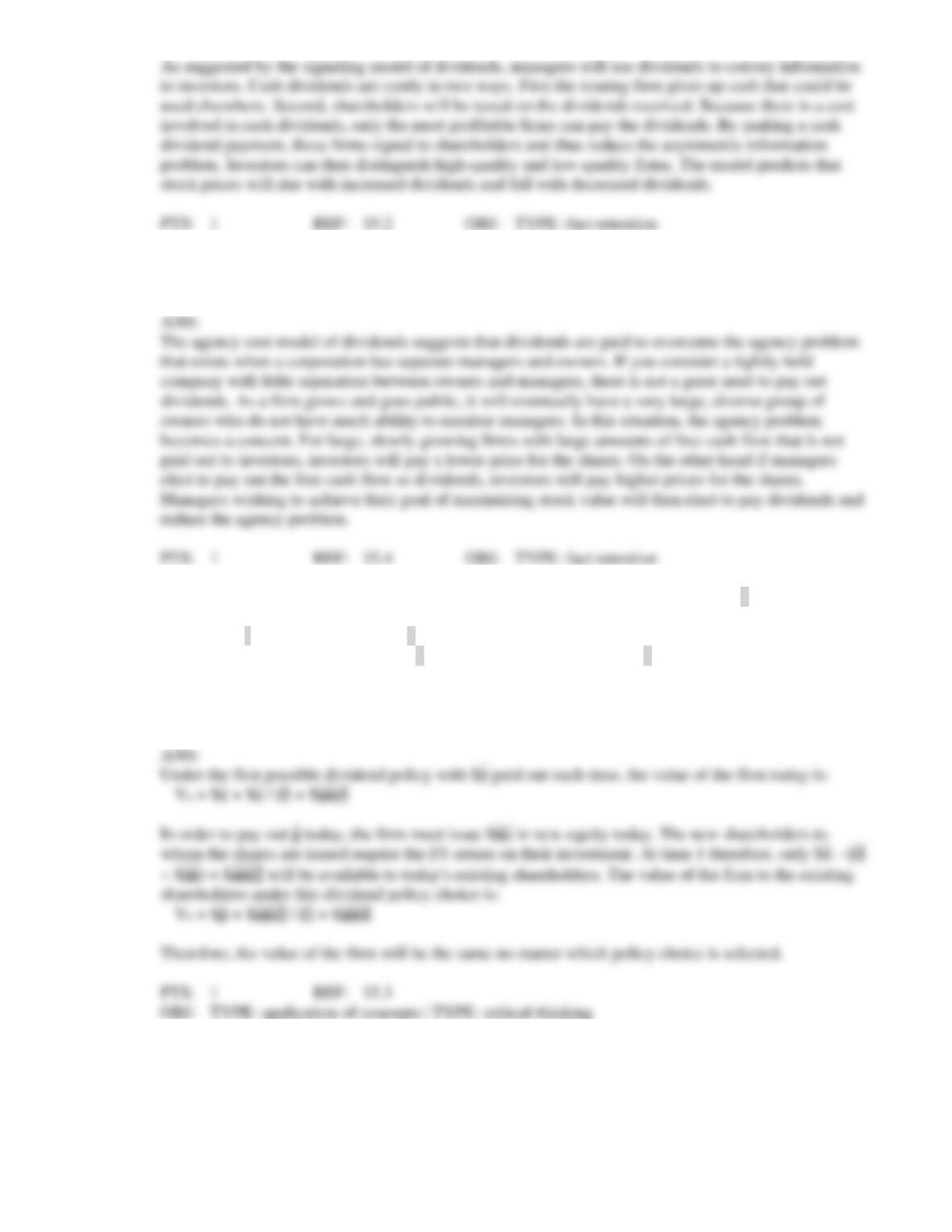
20. The signaling model of dividends assumes that managers use dividends to convey information to
poorly informed shareholders. Explain the signaling model of dividends and stock price reactions to
dividend changes.
21. There have been several theoretical models developed to explain dividend policies. One model is the
agency cost model of dividends. Explain the rationale behind this model.
22. You manage an all-equity firm that will operate for one year. The firm will receive $v today and at the
end of year 1. Your firm has no positive net present value projects. The stockholders’ required return
on equity is r%. Currently there are n shares outstanding. You are trying to decide between (1) paying
out all receipts today and at time 1 ($v each time) and (2) paying out $p today and an alternative
amount at time 1. You ask your financial analyst to show the impact on the value of the firm to your
current shareholders for these two alternative dividend policies. Show what results your financial
analyst should present to indicate that the policy choice is irrelevant in perfect capital markets.
23. An investor has invested in N shares in an all-equity firm that will operate for one year. The firm will
receive $v today and at the end of year 1. The firm has no positive net present value projects. The
stockholder’s required return on equity for this firm is r%. Currently there are So shares outstanding.
The firm’s managers have a choice between two dividend policies: (1) paying out all receipts today and
at time 1 ($v each time) or (2) paying out $p today and $ans2 at time 1. The first policy will result in
dividends of $div1 per share today and at time 1. The second policy results in per share dividends of
$div2a today and $div2b at time 1. Assume the corporation elects to pay the second dividend policy.
An investor holding N shares, however, prefers to receive the first policy set of dividends ($div1 per
share today and at time 1). Describe and show necessary calculations for how the investor could make
his or her own dividends (homemade dividends) and achieve the cash flows associated with the second
policy thereby indicating the dividend policy choice is irrelevant in perfect capital markets.
24. There are no taxes. Firm A currently has n million shares with per-share value $mv. The next
dividend, $div/share, will be paid 1 year from now. Then dividends will rise by g% the following year.
Firm B has identical operations and will always have the same total $ amount of earnings. It also has
the same number of shares. Also, firm B intends to pay out the same amount of cash (in total, not per–
share) as firm A, but will pay out half of the cash as a repurchase, and half as a dividend that occurs
just before the repurchase (i.e., the repurchase is ex-dividend). B will again distribute the same total
amount of cash as A in the second year, again using half repurchase and half dividend. A and B both
have r% required return.
a) What is the per share dividend for firm B the first year?
b) How many shares will firm B repurchase at what price the first year?
c) What is the per-share dividend for firm B the second year?
25. Respond to the following: “I want companies that pay dividends. Once a dollar is paid out I have it for
sure, whereas I face a lot of risk when dividends are not paid.”
ESSAY
1. Split Corporation just announced a stock split of s to 1 for its shares of common stock with a current
market value of $mv a share. If its current dividend is $d1 a share and the dividends after the split are
$d2 a share, what is the effect on the common stockholders and market value of the common stock
assuming no other changes?
2. SP Corporation has the following information:
Net earnings
$ne
Shares outstanding
n
EPS
$ eps
Market price per share ex dividends
$ p1
Expected dividends per share
$ d
Ignoring taxes, what is the impact on the shareholder’s investment in common stock of a dividend
payment or shareholders repurchase plan if SP Corporation is considering a $d dividend to
stockholders or a $rep repurchase of common stock? Either action would occur today.
3. Translucent Inc. has a constant dividend payout ratio policy. Sally and Joe, two mid-level managers,
are arguing over the relative merits of a constant dividend payout ratio policy in terms of the
importance of dividends as transmitters of information. Sally suggests that the constant dividend
payout policy is poor because it does not allow the firm to convey meaningful information to investors
regarding future prospects for the firm. Joe counters that other policies, such as a constant nominal
dividend policy or the low-regular-and-extra policy, simply obscure what is actually occurring with
company cash flows. You have been asked to arbitrate Sally’s and Joe’s disagreement in a discussion
with a senior manager. Your comments should be framed solely in terms of dividends as a transmitter
of information.