53. Refer to Table 15.1. If monetary authorities fix the exchange rate at $0.10 per franc, there would be a:
a.
Shortage of 200 francs
b.
Shortage of 400 francs
c.
Surplus of 200 francs
d.
Surplus of 400 francs
United States – BPROG: Analytic
United States – PA – DISC: International trade and fi – DISC: International trade and finance
Floating Exchange Rates
BLOOM’S: Analysis
54. Refer to Table 15.1. If monetary authorities fix the exchange rate at $0.30 per franc, there will be a:
a.
Shortage of 200 francs
b.
Shortage of 400 francs
c.
Surplus of 200 francs
d.
Surplus of 400 francs
United States – BPROG: Analytic
United States – PA – DISC: International trade and fi – DISC: International trade and finance
Floating Exchange Rates
BLOOM’S: Analysis
55. Under managed floating exchange rates, the Federal Reserve could offset an appreciation of the dollar against the yen
by:
a.
Increasing the money supply which promotes falling interest rates and net investment outflows
b.
Increasing the money supply which promotes rising interest rates and net investment inflows
c.
Decreasing the money supply which promotes falling interest rates and net investment outflows
d.
Decreasing the money supply which promotes rising interest rates and net investment inflows
United States – BPROG: Reflective Thinking – BPROG: Analysis
United States – PA – DISC: International trade and fi – DISC: International trade and finance
Managed Floating Rates
United States – BPROG: Analytic
United States – PA – DISC: International trade and fi – DISC: International trade and finance
Floating Exchange Rates
BLOOM’S: Analysis
56. Under managed floating exchange rates, a central bank would initiate:
a.
Contractionary monetary policy to offset a depreciation of its currency
b.
Contractionary monetary policy to offset an appreciation of its currency
c.
Expansionary monetary policy to offset a depreciation of its currency
d.
None of the above
United States – BPROG: Reflective Thinking – BPROG: Analysis
United States – PA – DISC: International trade and fi – DISC: International trade and finance
Managed Floating Rates
BLOOM’S: Comprehension
57. To offset an appreciation of the dollar against the yen, the Federal Reserve would:
a.
Sell dollars on the foreign exchange market and lower domestic interest rates
b.
Sell dollars on the foreign exchange market and raise domestic interest rates
c.
Buy dollars on the foreign exchange market and lower domestic interest rates
d.
Buy dollars on the foreign exchange market and raise domestic interest rates
United States – BPROG: Reflective Thinking – BPROG: Analysis
United States – PA – DISC: International trade and fi – DISC: International trade and finance
Managed Floating Rates
BLOOM’S: Comprehension
58. To help insulate their economies from inflation, currency depreciation, and capital flight, developing countries have
implemented:
a.
Regional trading blocs
b.
Currency boards
c.
Central banks
d.
Regional fiscal policies
United States – BPROG: Reflective Thinking – BPROG: Analysis
United States – PA – DISC: International trade and fi – DISC: International trade and finance
Increasing the Credibility of Fixed Exchange Rates
BLOOM’S: Comprehension
59. If Mexico dollarizes its economy, it essentially
a.
Allows the Federal Reserve to be its lender of last resort
b.
Accepts the monetary policy of the Federal Reserve
c.
Ensures that its business cycle was identical to that of the U.S.
BLOOM’S: Comprehension
d.
Abandons its ability to run governmental balanced budgets
60. If Mexico fully dollarizes its economy, it agrees to
a.
Print pesos only to finance deficits of its national government
b.
Use the U.S. dollar alongside its peso to finance transactions
c.
Have the U.S. Treasury be in charge of its tax collections
d.
Replace pesos with U.S. dollars in its economy
United States – BPROG: Reflective Thinking – BPROG: Analysis
United States – PA – DISC: International trade and fi – DISC: International trade and finance
Increasing the Credibility of Fixed Exchange Rates
BLOOM’S: Comprehension
61. An objective of the dollarization of the Mexican economy would be to:
a.
Shield its economy from hyperinflation, currency depreciation, and capital flight
b.
Allow the Federal Reserve to be its lender of last resort
c.
Ensure that its monetary policy is independent of the Federal Reserve
d.
Permit it to benefit from tariffs and subsidies imposed by the U.S. government
United States – BPROG: Reflective Thinking – BPROG: Analysis
United States – PA – DISC: International trade and fi – DISC: International trade and finance
Increasing the Credibility of Fixed Exchange Rates
BLOOM’S: Comprehension
62. In order to stabilize a currency, the central bank will need to adopt
a.
An expansionary monetary policy to offset currency depreciation
b.
An expansionary monetary policy to offset currency appreciation
c.
A contractionary policy to offset currency appreciation
d.
Both b and c
United States – BPROG: Reflective Thinking – BPROG: Analysis
United States – PA – DISC: International trade and fi – DISC: International trade and finance
Increasing the Credibility of Fixed Exchange Rates
United States – BPROG: Reflective Thinking – BPROG: Analysis
United States – PA – DISC: International trade and fi – DISC: International trade and finance
Increasing the Credibility of Fixed Exchange Rates
BLOOM’S: Comprehension
63. The crawling peg is a
a.
Fixed exchange rate system
b.
Floating exchange rate system
c.
Compromise between fixed and floating exchange rates
d.
Exchange rate system used by nations experiencing no inflation
NATIONAL STANDARDS:
United States – BPROG: Reflective Thinking – BPROG: Analysis
STATE STANDARDS:
United States – PA – DISC: International trade and fi – DISC: International trade and finance
The Crawling Peg
BLOOM’S: Comprehension
64. Exchange rate controls
a.
Achieved prominence during the economic crises of the late 1930’s
b.
Were popular immediately after World War II
c.
Are widely used by the developing nations
d.
All of the above
NATIONAL STANDARDS:
United States – BPROG: Reflective Thinking – BPROG: Analysis
STATE STANDARDS:
United States – PA – DISC: International trade and fi – DISC: International trade and finance
Increasing the Credibility of Fixed Exchange Rates
BLOOM’S: Knowledge
65. The flexibility of floating rates may generate the problem of
a.
Inflationary bias
b.
Deflationary bias
c.
Continuous depreciation
d.
Both a and c
NATIONAL STANDARDS:
United States – BPROG: Reflective Thinking – BPROG: Analysis
STATE STANDARDS:
United States – PA – DISC: International trade and fi – DISC: International trade and finance
Floating Exchange Rates
BLOOM’S: Comprehension
Figure 15.2 Market for the British Pound
BLOOM’S: Comprehension
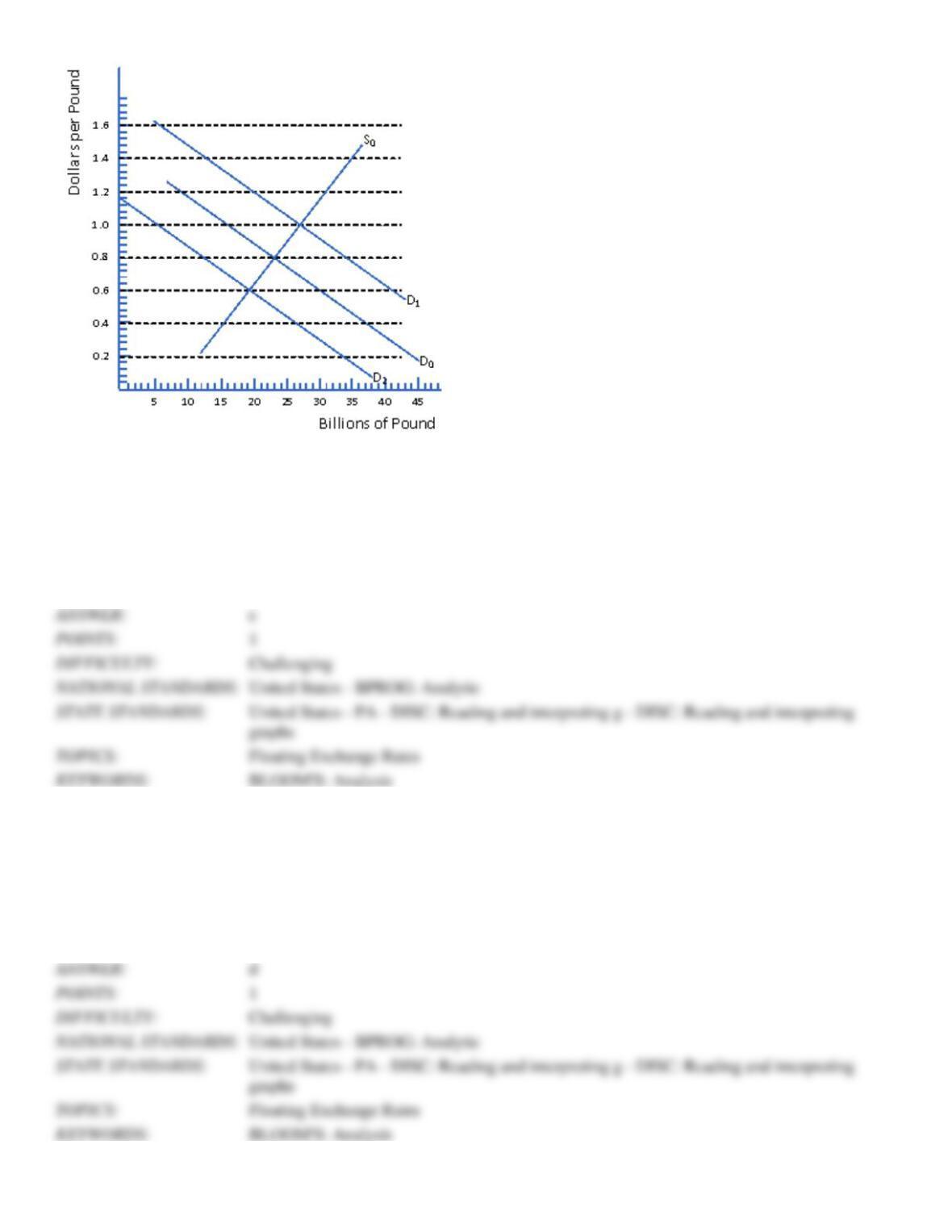
66. Refer to Figure 15.2. Demand and supply of British Pounds is initially D0 and S0. With a system of floating exchange
rates, the equilibrium exchange rate is:
a.
$0.40 per pound
b.
$0.60 per pound
c.
$0.80 per pound
d.
$1.00 per pound
67. Refer to Figure 15.2. Suppose that the United States increases its imports from England. Under a floating exchange
rate system, the new equilibrium exchange rate would be:
a.
$0.40 per pound
b.
$0.60 per pound
c.
$0.80 per pound
d.
$1.00 per pound
United States – BPROG: Analytic
Floating Exchange Rates
BLOOM’S: Analysis
United States – BPROG: Analytic
Floating Exchange Rates
BLOOM’S: Analysis
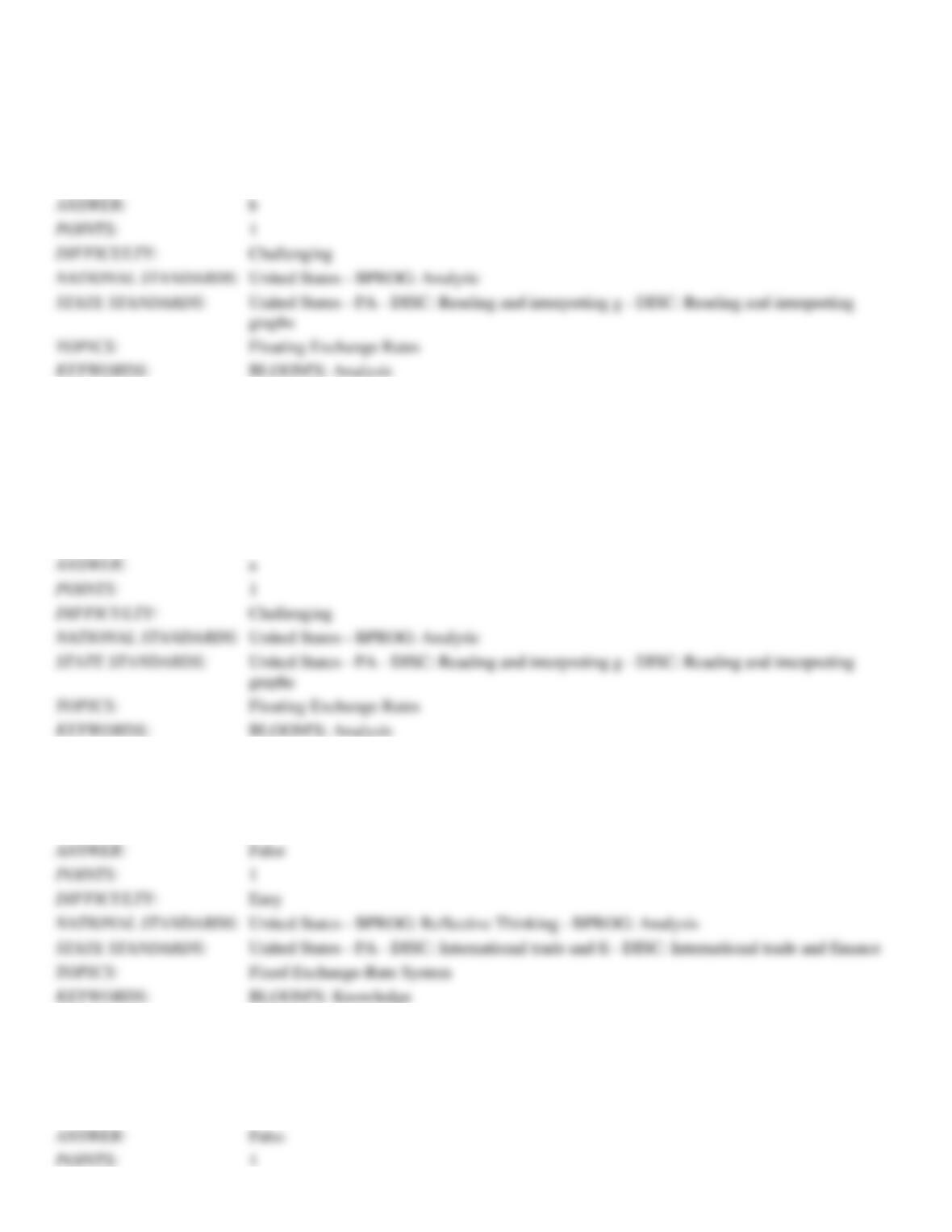
68. Refer to Figure 15.2. Suppose the United States decreases investment spending in England. Under a floating exchange
rate system, the new equilibrium exchange rate would be:
a.
$0.40 per franc
b.
$0.60 per franc
c.
$0.80 per franc
d.
$1.00 per franc
69. Refer to Figure 15.2. Suppose the demand for pounds increases from D0 to D1. Under a fixed exchange rate system,
the U.S. exchange stabilization fund could maintain a fixed exchange rate of $0.80 per pound by:
a.
Selling pounds for dollars on the foreign exchange market
b.
Selling dollars for pounds on the foreign exchange market
c.
Decreasing U.S. exports, thus decreasing the supply of pounds
d.
Stimulating U.S. imports, thus increasing the demand for pounds
a
Challenging
United States – BPROG: Analytic
Floating Exchange Rates
BLOOM’S: Analysis
70. By the early 1970s, gold had been phased out of the international monetary system.
a.
True
b.
False
False
Easy
United States – BPROG: Reflective Thinking – BPROG: Analysis
United States – PA – DISC: International trade and fi – DISC: International trade and finance
Fixed Exchange-Rate System
BLOOM’S: Knowledge
71. Since 1974, the major industrial countries have operated under a system of fixed exchange rates based on the gold
standard.
a.
True
b.
False
False
Challenging
United States – BPROG: Analytic
Floating Exchange Rates
BLOOM’S: Analysis
72. Today, fixed exchange rates are used primarily by small, developing countries that tie their currencies to a key
currency such as the U.S. dollar.
a.
True
b.
False
True
Easy
73. Smaller nations with relatively undiversified economies and large trade sectors tend to peg their currencies to one of
the world’s key currencies.
a.
True
b.
False
True
Easy
74. Large industrial nations with diversified economies and small trade sectors have generally pegged their currencies to
one of the world’s key currencies.
a.
True
b.
False
False
Easy
75. Small nations, such as Angola and Barbados, peg their currencies to the U.S. dollar since the prices of many of their
traded goods are determined in markets in which the dollar is the key currency.
a.
True
b.
False
True
Easy
76. Many developing nations with low inflation rates have pegged their currencies to the U.S. dollar as a way of allowing
modest increases in domestic inflation rates.
a.
True
b.
False
False
Moderate
77. Pegging to a single currency is generally done by developing nations whose trade and financial relationships are
mainly with a single industrial-country partner.
a.
True
b.
False
True
Moderate
78. Developing countries with more than one major trading partner often peg their currencies to a group or basket of those
trading partner currencies.
a.
True
b.
False
True
Moderate
79. Most developing countries have chosen to allow their currencies to float independently in the foreign exchange
market.
a.
True
b.
False
Moderate
80. Today, special drawing rights (SDRs) represent the most important currency basket against which developing
countries maintain pegged exchange rates.
a.
True
b.
False
False
Moderate
81. The special drawing right is a currency basket of five major industrial country currencies.
a.
True
b.
False
True
Moderate
82. The Australian dollar is currently regarded is the key currency of the international monetary system.
a.
True
b.
False
False
Moderate
83. A “key currency” is one that is widely traded on world money markets, has demonstrated relative stable values over
time, and has widely been accepted as a means of international settlement.
a.
True
b.
False
False
Moderate
84. The U.S. dollar is generally regarded as the major “key currency” of the international monetary system.
a.
True
b.
False
True
Moderate
85. Most nations currently allow their currencies’ exchange values to be determined solely by the forces of supply and
demand in a free market.
a.
True
b.
False
False
Easy
86. Under the gold standard, the official exchange rate would be $2.80 per pound as long as the United States bought and
sold gold at a fixed price of $35 per ounce and Britain bought and sold gold at 12.5 pounds per ounce.
a.
True
b.
False
True
Moderate
87. The par values of most developing-country currencies are currently defined in terms of gold.
a.
True
b.
False
True
Moderate
88. The purpose of an exchange stabilization fund is to ensure that the market exchange rate does not deviate beyond
unacceptable levels from the official exchange rate.
a.
True
b.
False
True
Moderate
89. To keep the pound’s exchange value from depreciating against the franc, the British exchange stabilization fund would
sell pounds for francs on the foreign exchange market.
a.
True
b.
False
False
Moderate
90. To keep the yen’s exchange value from appreciating against the dollar, Japan’s exchange stabilization fund would buy
yen for dollars on the foreign exchange market.
a.
True
b.
False
False
Moderate
91. The purpose of currency devaluation is to cause the home country’s exchange value to appreciate, thus reducing a
balance of trade surplus.
a.
True
False
Moderate
b.
False
92. If Uganda devalues its shilling by 10 percent and Burundi devalues its franc by 5 percent, the shilling’s exchange value
appreciates 10 percent against the franc.
a.
True
b.
False
False
Moderate
93. If Uganda sets its par value at 400 shillings per SDR and Burundi sets its par value at 200 francs per SDR, the official
exchange rate is 1 franc = o.5 shillings.
a.
True
b.
False
True
Moderate
94. If Uganda revalues its shilling by 20 percent and Burundi devalues its franc by 5 percent, the shillings exchange value
will appreciate by 25 percent against the franc.
a.
True
b.
False
True
Moderate
95. Unlike floating exchange rates, fixed exchange rates are not characterized by par values and central bank intervention
in the foreign exchange market.
False
Moderate
a.
True
b.
False
96. Because there is no exchange stabilization fund under floating exchange rates, any holdings of international reserves
serve as working balances rather than to maintain a given exchange rate for any currency.
a.
True
b.
False
True
Moderate
97. Under an adjustable-pegged system, market exchange rates are intended to be maintained within a narrow band around
a currency’s official exchange rate. In the case of fundamental disequilibrium, the currency can be devalued or revalued to
promote current-account equilibrium.
a.
True
b.
False
True
Moderate
98. In 1973 the major industrial countries terminated managed-floating exchange rates and adopted an adjustable-pegged
exchange rates.
a.
True
b.
False
False
Moderate
False
Moderate
99. A “dirty float” occurs when a nation used central bank intervention in the foreign exchange market to promote a
depreciation of its currency’s exchange value, thus gaining a competitive advantage compared to its trading partners.
a.
True
b.
False
100. Under managed-floating exchange rates, market forces are allowed to determine exchange rates in the short run while
central bank intervention is used to stabilize exchange rates in the long run.
a.
True
b.
False
False
Moderate
101. Under managed floating exchange rates, central bank intervention is used to offset temporary fluctuations in
exchange rates that contribute to uncertainty in carrying out transactions in international trade and finance.
a.
True
b.
False
True
Moderate
102. To offset an appreciation in the dollar’s exchange value, the Federal Reserve can nudge interest rates down in the
United States which results in net investment outflows.
a.
True
b.
False
True
Moderate
True
Moderate
103. When pursued over the long run, a policy of increasing the domestic money supply to offset an appreciation of the
home country’s currency results in inflation and a decrease in home-country competitiveness in key industries.
a.
True
b.
False
104. Which nations use multiple exchange rates the most and why?
Moderate
105. What is an SDR?
Moderate
106. What is the difference between the crawling peg and adjustable pegged exchange rates?
Moderate
107. How can currency boards and dollarization prevent currency crises?
True
Moderate