Chapter 15 – Air Pollution – Climate Change – and Ozone Depletion
56. What important form of natural capital has allowed human civilization to grow over the past 10,000 years?
a.
fossil fuels
b.
agriculture
c.
technology
d.
increasingly warmer climate
e.
relatively stable climate
e
ENVS.MLSP.16.15.4.2 – Explain why climate change is not a new phenomenon.
57. What value do the oceans have in moderating climate change?
a.
Oceans remove about 25% of the atmospheric carbon dioxide produced by humans.
b.
Oceans reflect sunlight back into space before the ultraviolet wavelengths are converted into infrared radiation.
c.
Oceans absorb about 40% of the methane out of the atmosphere that has been produced by rice paddies and
livestock.
d.
Oceans help to reduce the level of water vapor in the atmosphere through condensation and transpiration.
e.
Oceans serve as a layer of insulation between the atmosphere and magma deep with the earth.
a
ENVS.MLSP.16.15.4.4 – Discuss the role played by carbon dioxide emissions, the sun, and
58. The average concentration of ____ has risen by approximately 40% between 1880 and 2012.
a.
carbon monoxide
b.
sulfur dioxide
c.
ozone
d.
carbon dioxide
e.
nitrous oxide
ENVS.MLSP.16.15.4.4 – Discuss the role played by carbon dioxide emissions, the sun, and
59. Which of the following would make a greater contribution to rising sea levels?
a.
Melting sea ice
b.
Melting land-based ice
c.
Increased levels of precipitation in some areas
d.
Increased levels of atmospheric water vapor
e.
Increased levels of global evaporation and transpiration
60. A warmer world is least likely to result in ____.
a.
decreased food production
b.
reductions in biodiversity
c.
a rise in sea level
d.
more moderate weather
e.
spread of tropical diseases
15.5 What are some possible effects of a warmer atmosphere?
61. The latest scientific research indicates that the net global effect of ____ cover changes is likely to increase
atmospheric warming.
a.
ice
b.
water
c.
soot
d.
aerosol
e.
cloud
e
62. What is a major problem with carbon capture and storage strategies?
a.
They are extremely expensive.
b.
They create other kinds of pollution.
c.
They require large amounts of water.
d.
They decrease the efficiency of automobiles.
e.
Huge amounts of biochar are required.
a
15.6 How have we depleted ozone in the stratosphere and what can we do about it?
63. Satellite data and other measurements and models indicate that 75–85% of the observed ozone losses in the
stratosphere since 1976 resulted from people releasing ____ and other ozone-depleting chemicals into the troposphere
beginning in the 1950s.
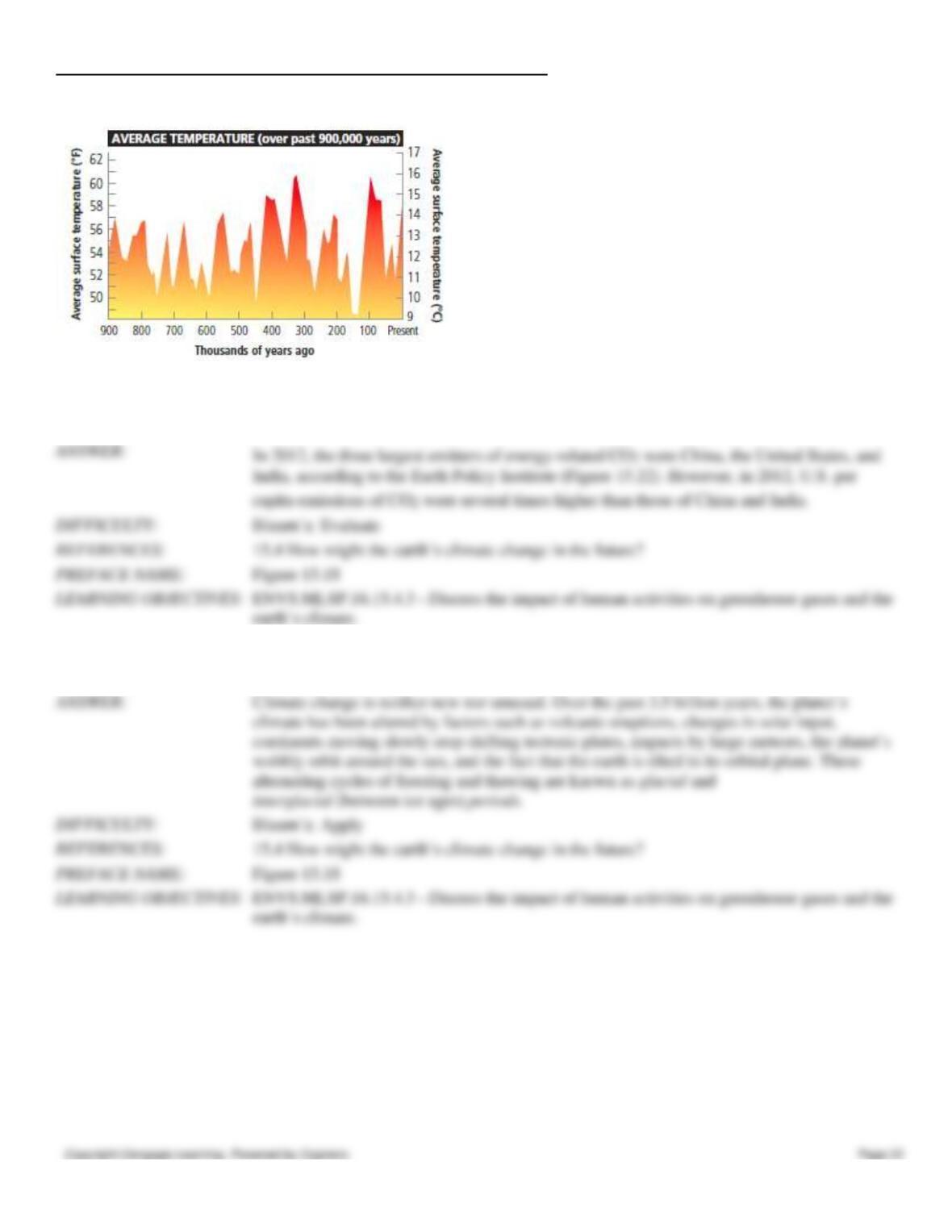
a.
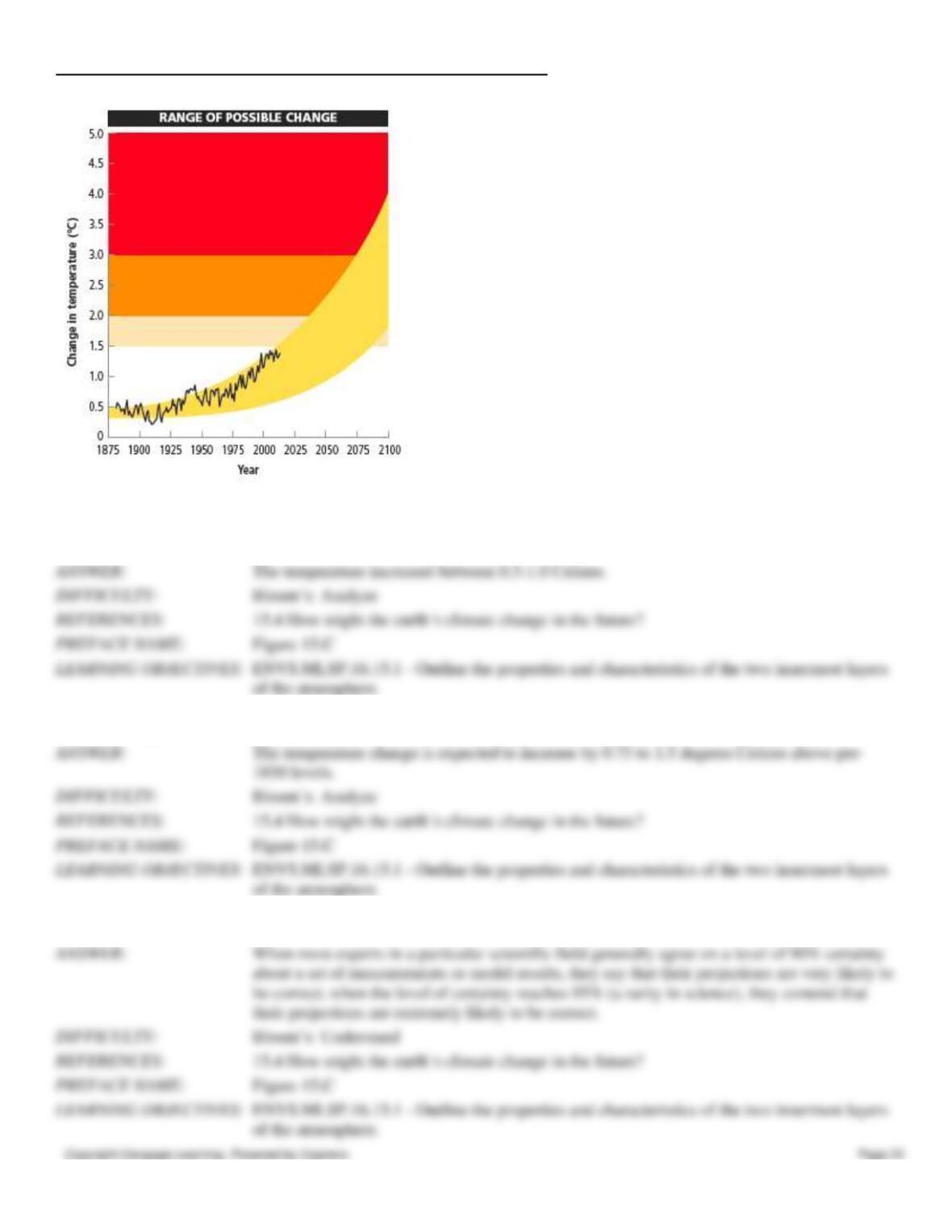
CO2
b.
CO
15.5 What are some possible effects of a warmer atmosphere?
Chapter 15 – Air Pollution – Climate Change – and Ozone Depletion
c.
NOx
d.
CFCs
e.
UVB
15.7 How have we depleted ozone in the stratosphere and what can we do about it?
64. Avoiding the use of tanning parlors or sunlamps is one of the best ways to ____.
a.
decrease your carbon footprint
b.
limit the amount of CFC pollution
c.
reduce your exposure to UV radiation
d.
prevent exposure to harmful photochemical reactions
e.
save energy
c
15.7 How have we depleted ozone in the stratosphere and what can we do about it?
65. The progress in reducing the ozone depletion problem could be set back by the projected ____.
a.
growth of developing countries
b.
increased use in manufacturing
c.
rising use of CFCs
d.
climate change
e.
increased cloud cover in the troposphere
15.7 How have we depleted ozone in the stratosphere and what can we do about it?
ENVS.MLSP.16.15.7.2 – Explain how stratospheric ozone depletion can be reversed.
66. In 1987, 36 nations meeting in Montreal, Canada, developed the Montreal Protocol to reduce production of ____.
a.
carbon dioxide
b.
nitrous oxide
c.
CFCs
d.
toxic wastes
e.
halons
c
15.7 How have we depleted ozone in the stratosphere and what can we do about it?
ENVS.MLSP.16.15.7.2 – Explain how stratospheric ozone depletion can be reversed.
67. What is a disadvantage of cap-and-trade policies?
a.
There is no clear legal limit on emissions.
Chapter 15 – Air Pollution – Climate Change – and Ozone Depletion
b.
There are no rewards to cut emissions.
c.
There is no record of success.
d.
The expense to consumers is very high.
e.
The revenues are not predictable.
15.6 How have we depleted ozone in the stratosphere and what can we do about it?
68. What is an advantage to placing taxes and fees on carbon and energy usage?
a.
Tax laws are typically very simple and straightforward.
b.
Tax laws tend to have few, if any, loopholes.
c.
Lower emissions are nearly guaranteed.
d.
Tax laws and fees tend to be politically popular.
e.
The administration is simple and revenues are predicable.
15.6 How have we depleted ozone in the stratosphere and what can we do about it?
Completion
69. ____________________ are manmade compounds that have been widely used as refrigerants and in spray propellants
and foam blowing.
15.7 How have we depleted ozone in the stratosphere and what can we do about it?
70. The ____________________ is the layer of the atmosphere that contains the protective ozone layer.
15.1 What is the nature of the atmosphere?
ENVS.MLSP.16.15.1.1 – Discuss the importance of the ozone layer.
71. ____________________ are harmful chemicals emitted directly into the air from natural processes and human
activities.
Primary pollutants
ENVS.MLSP.16.15.2.1 – Differentiate between primary and secondary outdoor air pollutants.
72. ____________________ is a mixture of primary and secondary pollutants formed under the influence of UV radiation
from the sun.
73. In comparing CO2 emissions sources, scientists use the concept of a(n) ____________________, which is the amount
of CO2 generated by an individual, an organization, a country, or any other entity over a given period of time.
74. ____________________ is a colorless gas used in foam insulation and can cause irritation of the eyes, throat, skin,
and lungs.
75. Life as we know it could not exist without the protective layer of ____________________ in the stratosphere.
76. The emission of ____________________ from certain trees and plants in urban areas can promote the formation of
photochemical smog.
77. When a cool layer of air is below a warm layer of air, this is called a(n) ____________________.
78. Compounds that can react and help neutralize acid deposition are called _________________________.
79. The term ___________________ is misleading because it does not mean that all areas of the earth are getting warmer
every year.
80. The estimated tipping point of carbon dioxide levels in the atmosphere is ____________________ ppm.
450
81. If the climate change tipping point is reached in the next few decades, it is expected that the
____________________ice sheet will collapse and melt.
82. _____________________ is a source of methane that if melted, would accelerate the projected atmospheric warming
by creating a positive feedback loop.
83. The manipulation of certain natural conditions to help counter our enhancement of the greenhouse effect is known as
____________________.
84. Eating less or no meat could help reduce ____________________ emissions.
Chapter 15 – Air Pollution – Climate Change – and Ozone Depletion
85. Calculating your ____________________ can help you understand how to reduce your own personal carbon dioxide
emissions.
86. Of all the fossil fuels, reducing our consumption of ____________________ would best help with slowing climate
change.
87. The increased use of ____________________ automobiles could help reduce our carbon footprint.
88. Most experts call for a combination of mitigation and ____________________ approaches to help deal with the
projected harmful effects of global climate change.
Subjective Short Answer
Chapter 15 – Air Pollution – Climate Change – and Ozone Depletion
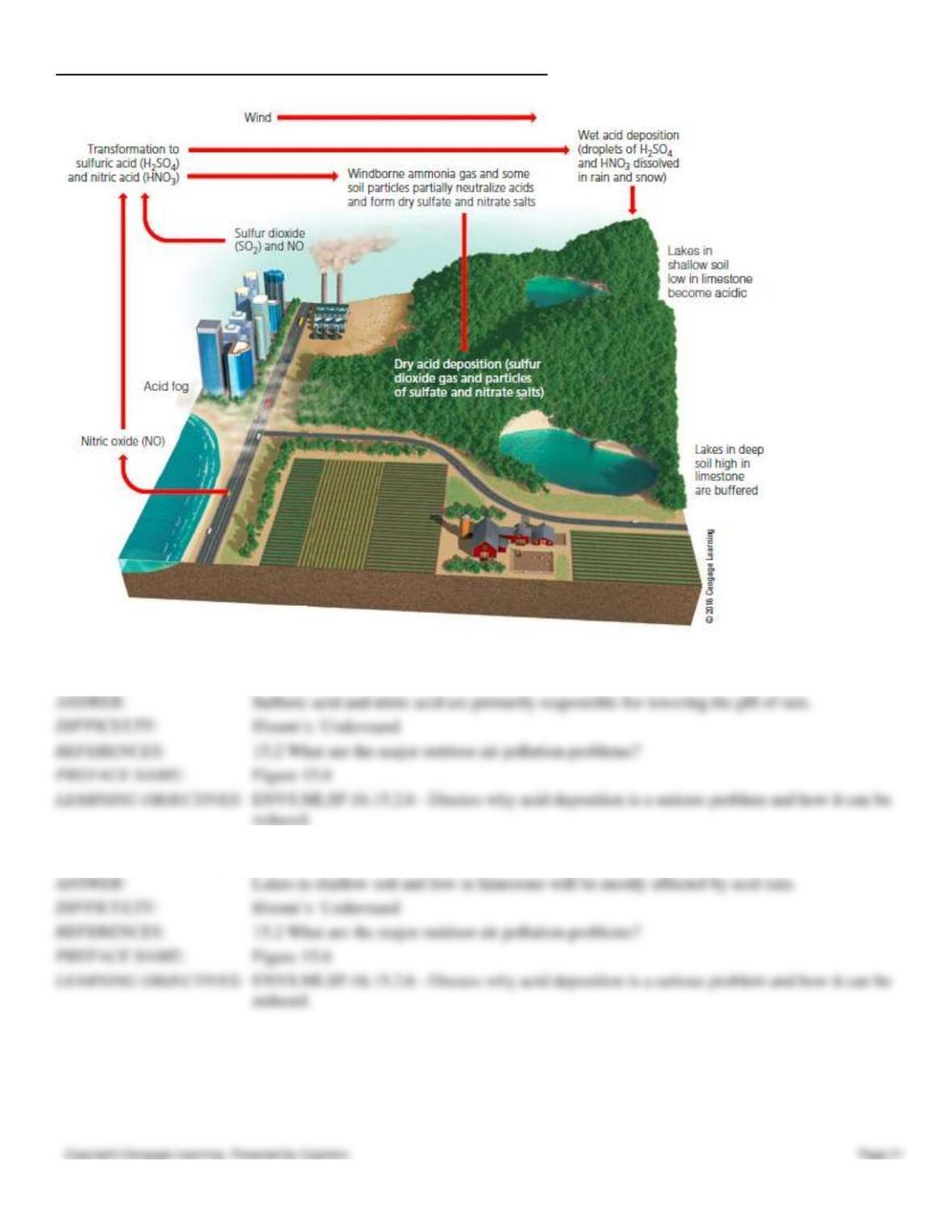
Figure 15.6
89. Based on the accompanying image, which chemicals are primarily responsible for lowering the pH of rain?
90. Based on the accompanying figure, which lakes will be mostly affected by acid rain?
Chapter 15 – Air Pollution – Climate Change – and Ozone Depletion
Figure 15.18
91. According to the 2012 data in the accompanying figure, which three countries are the largest emitters of energy-
related carbon dioxide?
92. In the accompanying chart showing temperature for the past 900,000 years, describe the natural phenomena that may
have caused the temperature fluctuations shown.
Chapter 15 – Air Pollution – Climate Change – and Ozone Depletion
Figure 15.C
93. According to the accompanying figure, how much did the average surface temperature of the earth change from 1950
to 2004?
94. According to the accompanying figure, what is the projected range of surface temperature increase for 2025?
95. What does it mean when scientist make predictions that are stated to have a 90% and 95% probability of happening?
96. Please describe the mechanisms by which “acid rain” is produced and why this is harmful to the environment.
97. Clearly describe a positive feedback loop associated with global warming.
98. Explain why some experts consider indoor air pollution to be one of the most serious air pollution problems. In your
answer, utilize some facts about indoor air pollution.
99. Explain the two basic approaches for dealing with the projected harmful effects of global warming.
100. Explain how we can prevent and reduce the emission of greenhouse gases.