Test Bank Chapter 15
Chapter 15—Contracting, Governance, and Organizational Form
MULTIPLE CHOICE
1. Non-redeployable durable assets that are dependent upon unique complementary and perfectly
redeployable assets to achieve substantial value-added will typically be organized as
a.
an export trading company
b.
a spot market contract
c.
a vertically integrated firm
d.
an on-going relational contract
e.
a joint stock company.
2. Vertical integration may be motivated by all of the following except:
a.
Upstream market power
b.
Economies of ever wider spans of managerial control
c.
Technological interdependencies
d.
Reduced search and bargaining cost
e.
The hold-up problem.
3. Contracts are distinguished from tactical alliances by which of the following characteristics:
a.
involve sequential responses
b.
require third-party enforcement
c.
raise shareholder value
d.
elicit diminished reactions from competitors
4. When manufacturers and distributors establish credible commitments to one another, they often
employ
a.
vertical requirements contracts
b.
third-party monitoring
c.
credible threat mechanisms
d.
non-price tactics
5. Which of the following is not among the functions of contract?
a.
to provide incentives for efficient reliance
b.
to reduce transaction costs
c.
to discourage the development of asymmetric information
d.
to provide risk allocation mechanisms
6. Buying electricity off the freewheeling grid at one quarter ’til the hour for delivery on the hour
illustrates:
a.
relational contracts with distributors
b.
vertical requirements contracts
c.
spot market transactions
d.
variable price agreements
7. When someone contracts to do a task but fails to put full effort into the performance of an agreement,
yet the lack of effort is not independently verifiable, this lack of effort constitutes a
a.
breach of contractual obligations
b.
denial of good guarantee
c.
loss of reputation
d.
moral hazard
8. When retail bicycle dealers advertise and perform warranty repairs but do not deliver the personal
selling message that Schwinn has designed as part of the marketing plan but cannot observe at less
than prohibitive cost, the manufacturer has encountered a problem of ____.
a.
reliance relationships
b.
uncertainty
c.
moral hazard
d.
creative ingenuity
e.
insurance reliance
9. Which of the following are not approaches to resolving the principal-agent problem?
a.
ex ante incentive alignment
b.
deferred stock options
c.
ex post governance mechanism
d.
straight salary contracts
e.
monitoring by independent outside directors
10. To accomplish its purpose a linear profit-sharing contract must
a.
induce the employee to moonlight
b.
communicate a code of conduct that will be monitored and enforced
c.
meet either the participation or the incentive compatibility constraint
d.
establish a separating equilibrium
e.
not realign incentives
11. Mac trucks and their dealers would likely have an organizational form of
a.
fixed profit sharing franchise contracts
b.
spot market recontracting
c.
alliances
d.
vertical integration
12. Reliant assets are always all of the following except:
a.
durable
b.
have substantially less value in second best use
c.
dependent on unique complementary inputs
d.
pivotal in designing strategy
13. Governance mechanisms are designed
a.
to increase contracting costs
b.
to resolve post-contractual opportunism
c.
to enhance the flexibility of restrictive covenants
d.
to replace insurance
e.
none of the above
14. When borrowers who do not intend to repay are able to hide their bad credit histories, a lender’s well-
intentioned borrowers should
a.
complain to regulatory authorities
b.
withdraw their loan applications
c.
offer more collateral in exchange for lower interest charges
d.
divulge still more information on their loan applications
e.
hope for a pooling equilibrium
15. Each of the following is an example of moral hazard in which people modify their behavior in an
opportunistic way, often frustrating the intent of governmental or management policies. Which is
NOT an example of moral hazard?
a. After a firm gets a loan from a bank to purchase inventory, the borrower instead decides to use it
to invest in call options on stocks.
b. Based on motorcycle accident data, a state passes a law requiring motorcyclists to wear helmet, but
then the motorcyclist wearing helmets start to drive faster and more recklessly.
c. Bank and nonbank mortgage lenders make money granting loans. But the Government through
Freddie Mac and Fannie Mae decides to purchase these loans. The mortgage lenders find that they
earn a fee for each mortgage that they grant and then sell to Freddie Mac or Fannie Mae. Since
they never intended on holding on to the mortgage, the mortgage granters are not too particular on
whether the customer can really pay it back. The lowest quality loans are sold to the Government.
d. A fellow buys a $1 million life insurance policy and then travels to Nepal to climb Mount Everest.
e. A student learns that if he or she reads the chapter and studies lecture notes, the student does better
on the next test.
16. Agency problems appear in many settings within a firm. All of the following are examples, except
which is NOT a good example of this problem?
a. Diversified stockholders are more enthusiastic on accepting business risks than are firm managers.
b. Firm managers receive cash bonuses based on the performance of the firm.
c. Employees sometime take items from the store in which they work.
d. Lenders to firms want the managers to invest in safe projects to protect their collateral in the
project but managers want to invest in projects that will make a name for them and warrant
promotion.
e. Firm managers sometime want to relax on the job.
PROBLEMS
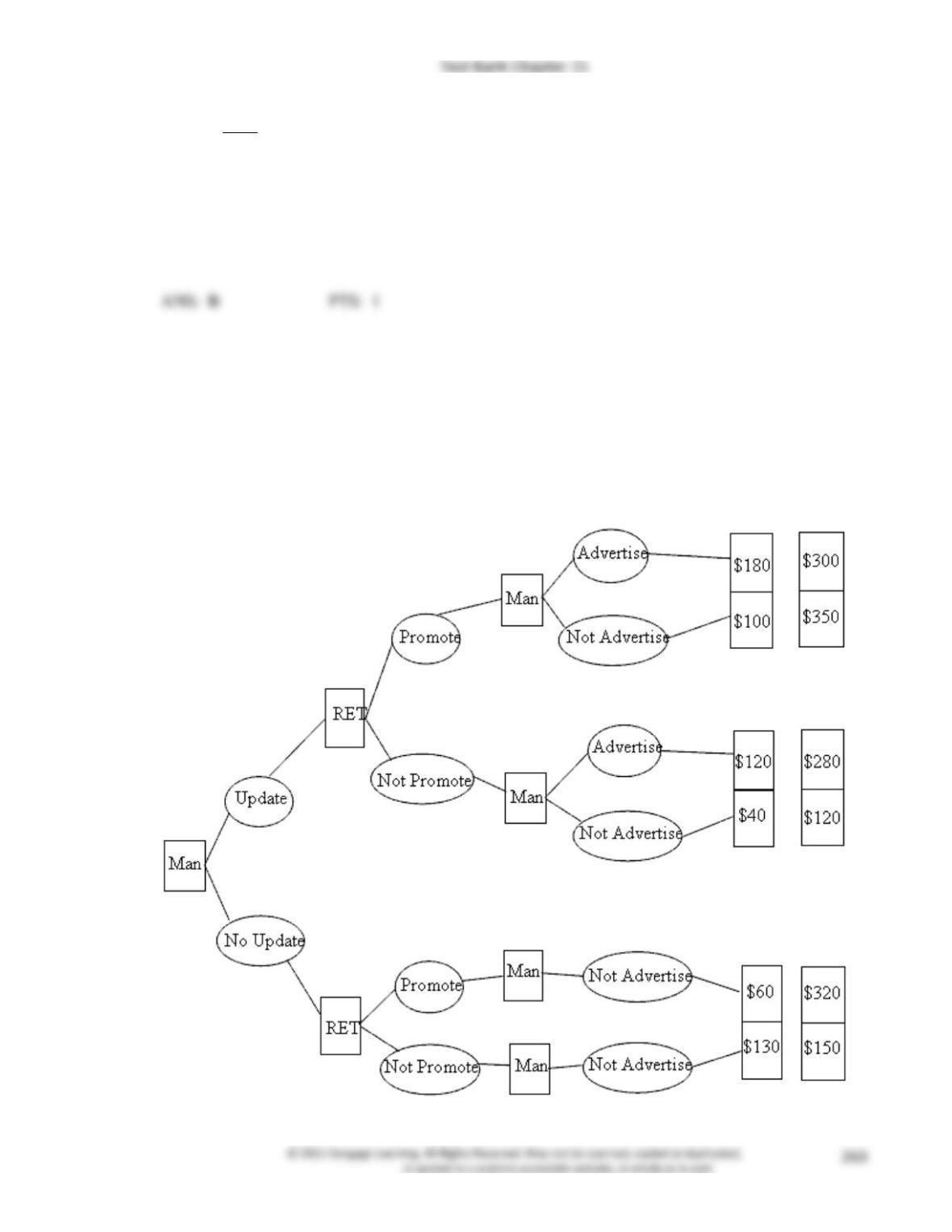
1. Cooperative agreements between manufacturers and retailers concerning retail promotion and
manufacturer advertising are often the key to the success of new products. Analyze the following
sequential product promotion game, and then predict 1) whether the product will be updated by the
manufacturer (Man), 2) whether the retail distributor (RET) will promote the product, and 3) whether
the manufacturer will advertise the product. No explanation necessary.
Test Bank Chapter 15
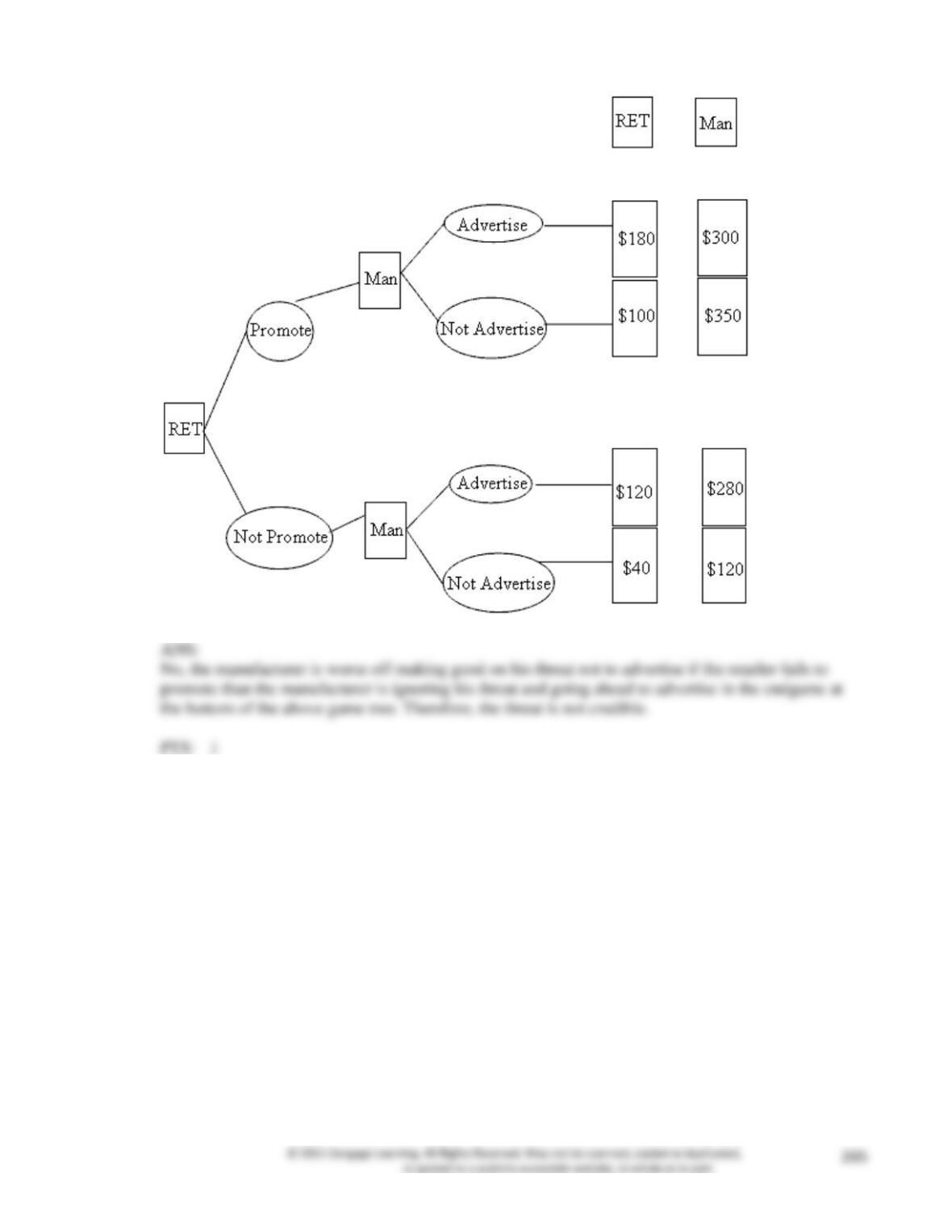
2. In the following sequential marketing game, is a threat by the manufacturer (Man) not to advertise a
newly updated product unless the retailer (RET) promotes it a credible threat?
Test Bank Chapter 15