45) A manufacturer has the following jobs waiting on a single work center. The firm has not decided
which dispatching rule to apply in order to prioritize the jobs and fix them into the schedule. Processing
time in 15-minute time blocks and due date for each job are in the table below.
Time Due Date
Job 1 5 17
Job 2 4 20
Job 3 3 16
Job 4 7 9
Job 5 3 6
Job 6 5 7
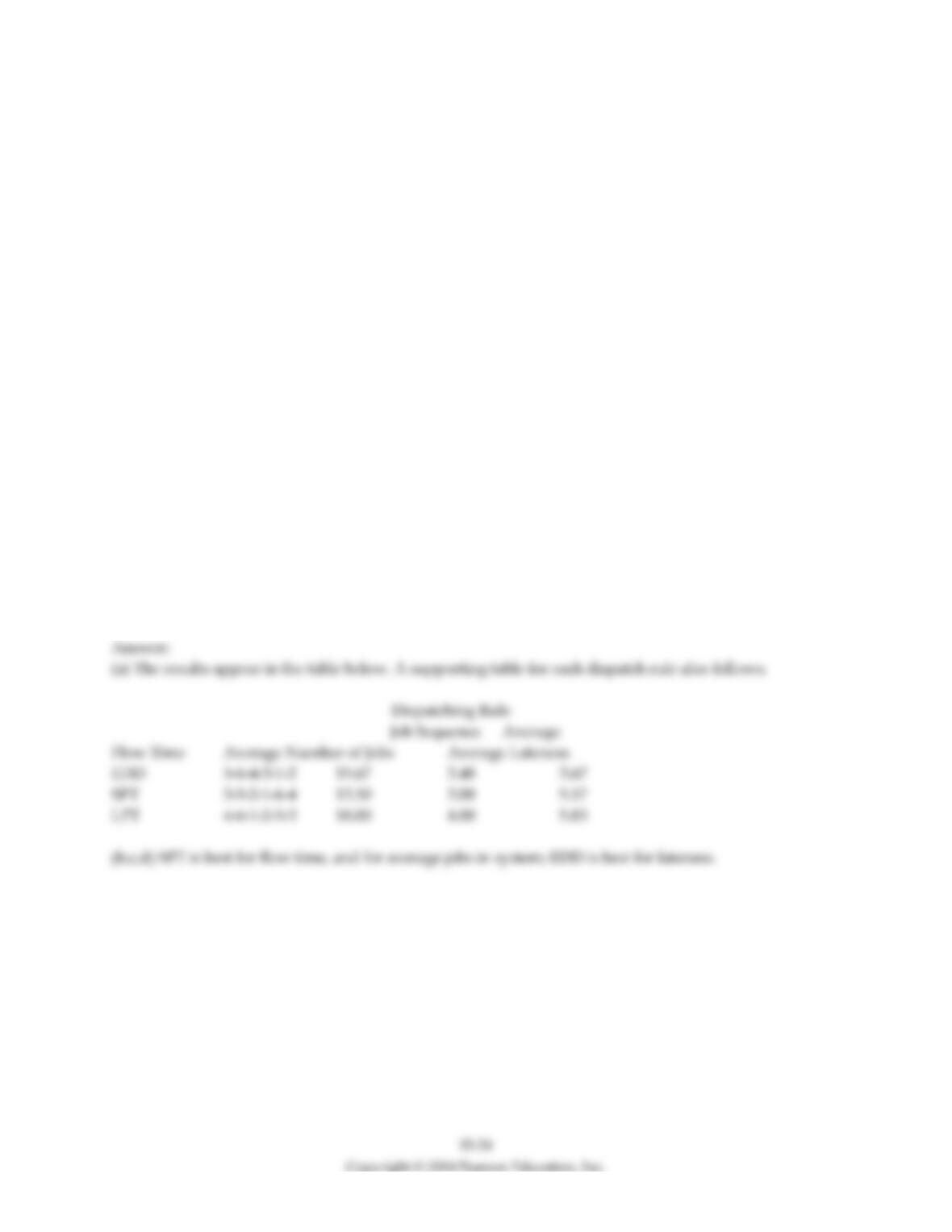
a. Complete the following table. Show your supporting calculations below.
b. Which dispatching rule has the best score for flow time? for work in process (jobs in the system)? for
lateness?
c. Is there ANY sequence that can avoid all lateness? Explain or provide an example.
Dispatching Rule
Job Sequence Average
Flow Time Average Number of Jobs
Average Lateness
EDD
SPT
LPT
46) Bob Dresser operates a major appliance warranty service center. His operation has two check stations
that are required at the end of every repair task performed by his appliance repair staff. These are the
Functionality Review (FR) and the Overall Scan (OS). The FR must be performed successfully before the
OS is begun. On Friday morning, six repair jobs are completed, awaiting these two inspection activities.
Processing times are given in minutes.
Job FR OS
A 50 30
B 35 55
C 25 20
D 20 35
E 15 10
F 10 25
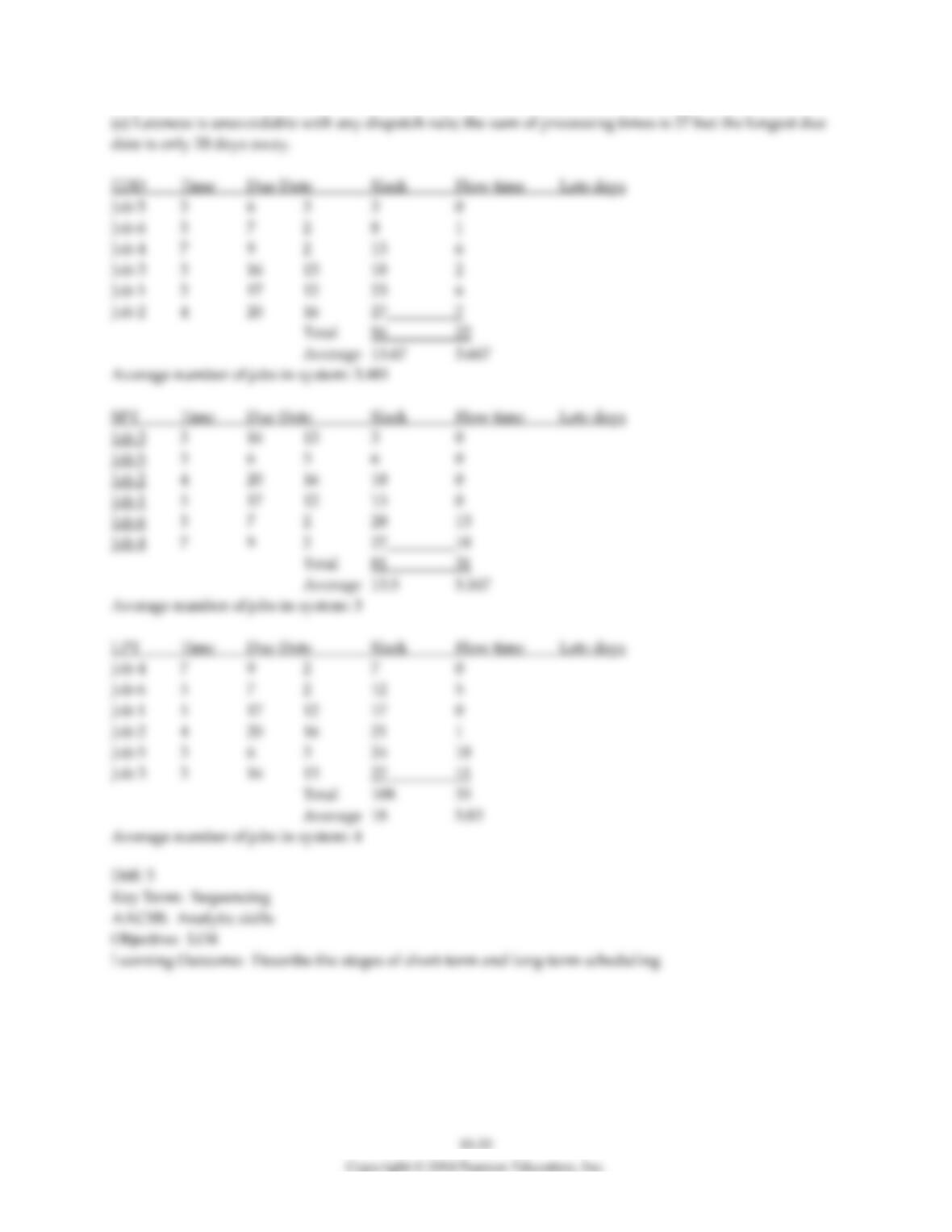
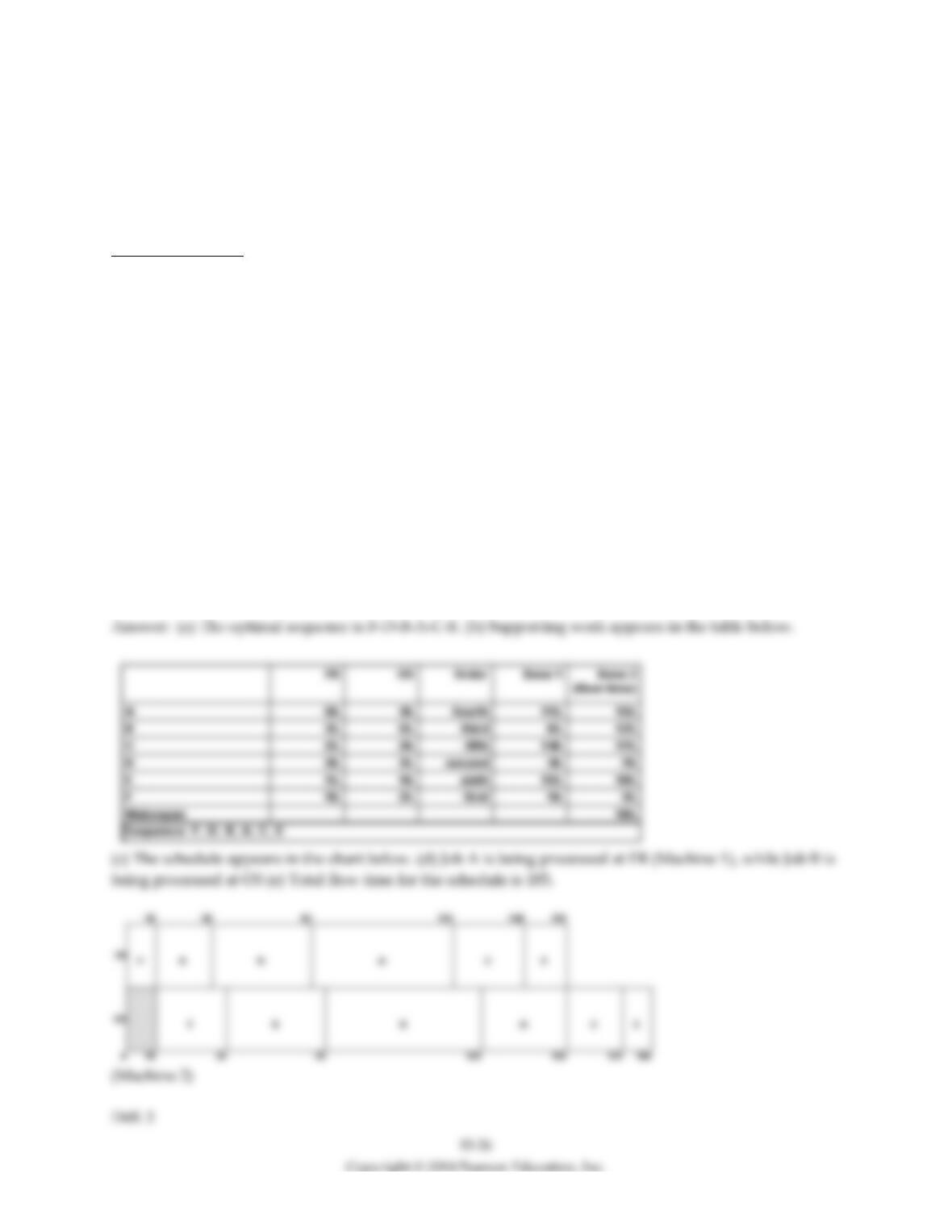
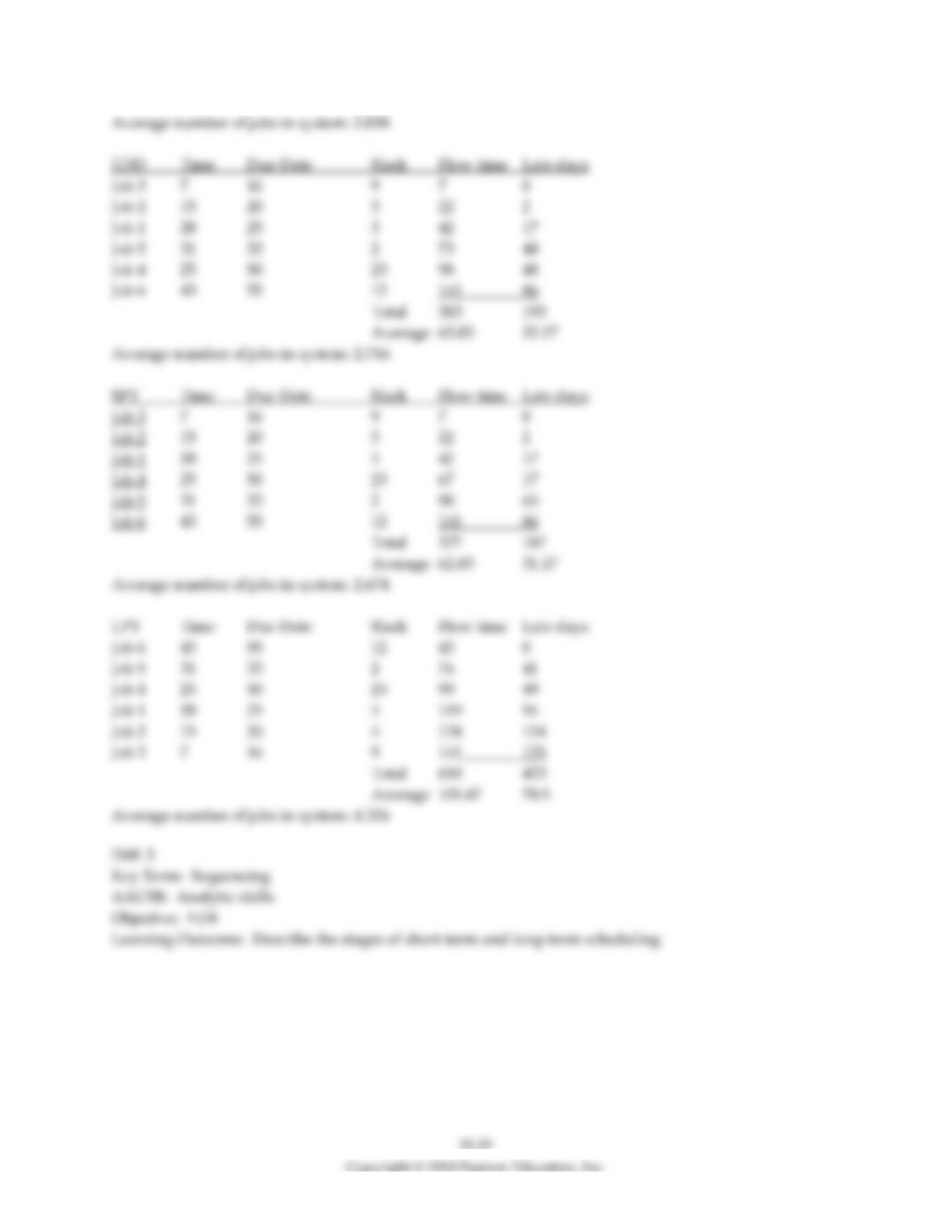
a. What is the optimal sequence of jobs for the objective of minimizing the total flow time?
b. Show your work, and document the sequence.
c. Chart the solution to this problem.
d. What jobs are being processed at time period 90?
e. What is the total flow time of this problem?
FR
OS
20 40 60 80 100 120 140 160 180 200

47) A firm that specializes in desktop publishing for local charities has agreed to take on the following
jobs. The firm has not decided which dispatching rule to apply in order to prioritize the jobs and fix them
into the schedule. All dates are specified as days from today.
Time Due Date
Job 1 20 25
Job 2 15 20
Job 3 7 16
Job 4 25 50
Job 5 31 33
Job 6 43 55
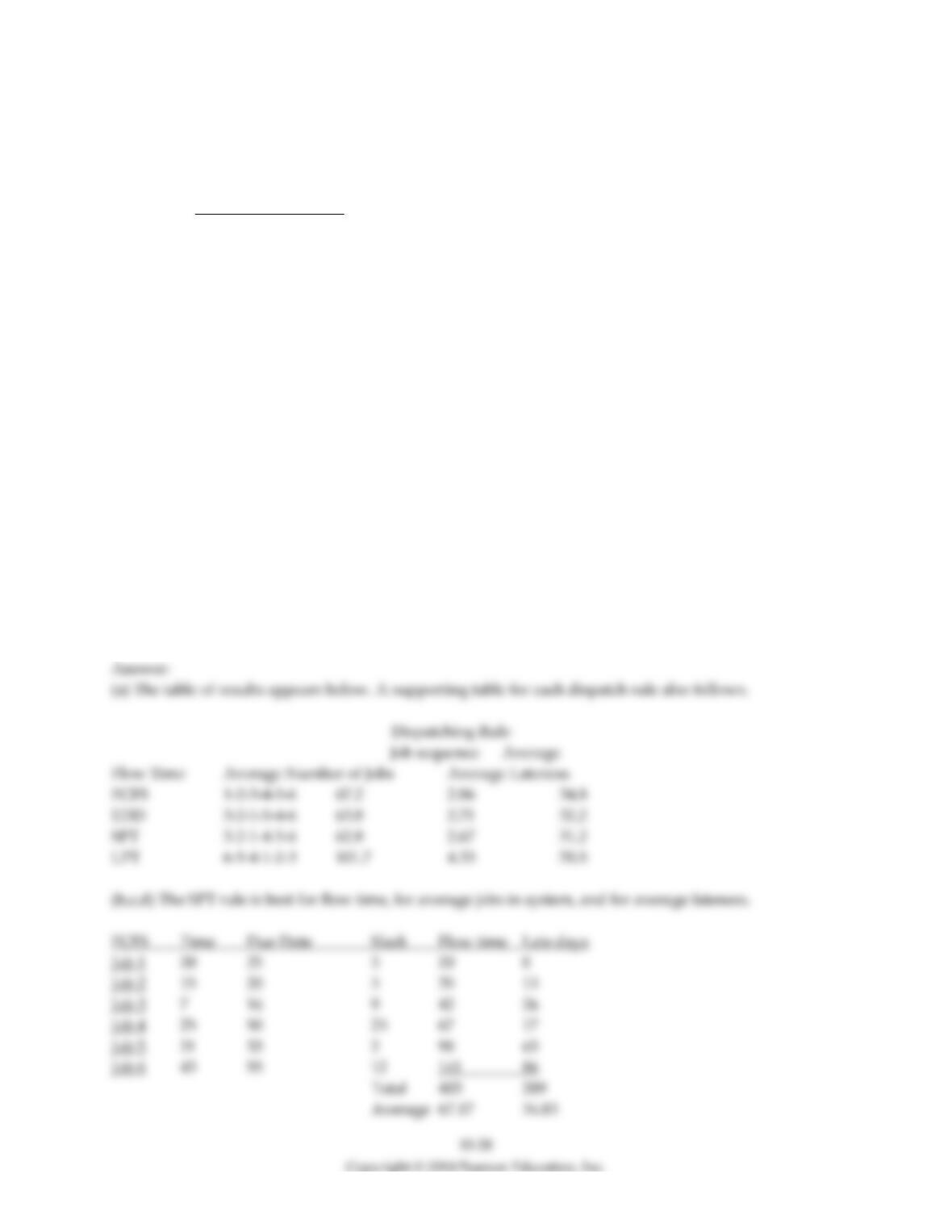
a. Complete the following table. Show your supporting calculations below.
b. Which dispatching rule has the best score for flow time?
c. Which dispatching rule has the best score for work-in-process (jobs in the system)?
d. Which dispatching rule has the best score for lateness?
Dispatching Rule
Job Sequence Average
Flow Time Average Number of Jobs
Average Lateness
FCFS
EDD
SPT
LPT
48) Use Johnson’s rule to determine the optimal sequencing for the five jobs to be processed on two
machines in a fixed order (Machine 1 before Machine 2). The processing times in hours are given in the
table below.
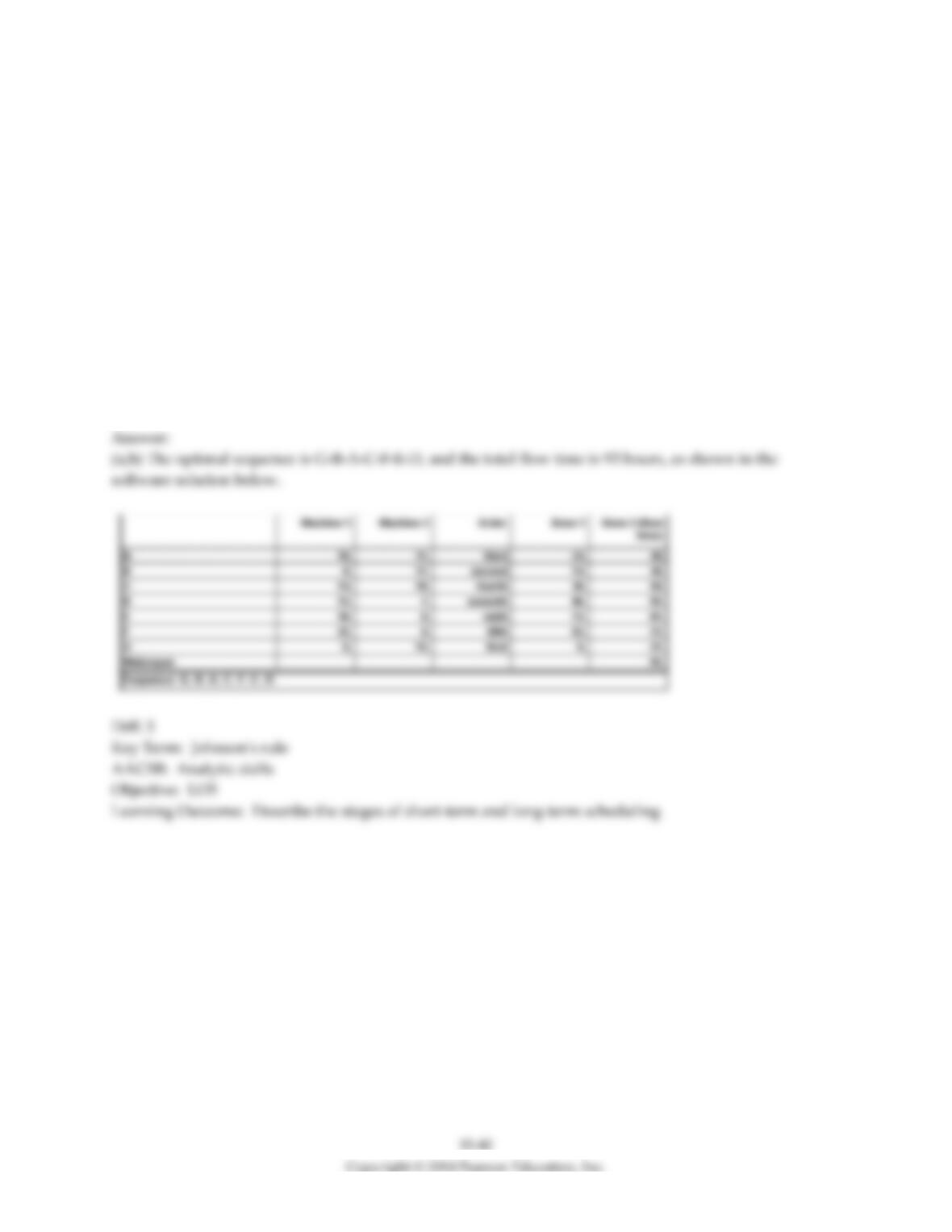
a. What is the optimal sequence?
b. What is the total flow time for this sequence?
Job Machine 1 Machine 2
A 10 11
B 8 17
C 14 10
D 13 7
E 10 8
F 25 9
G 6 15
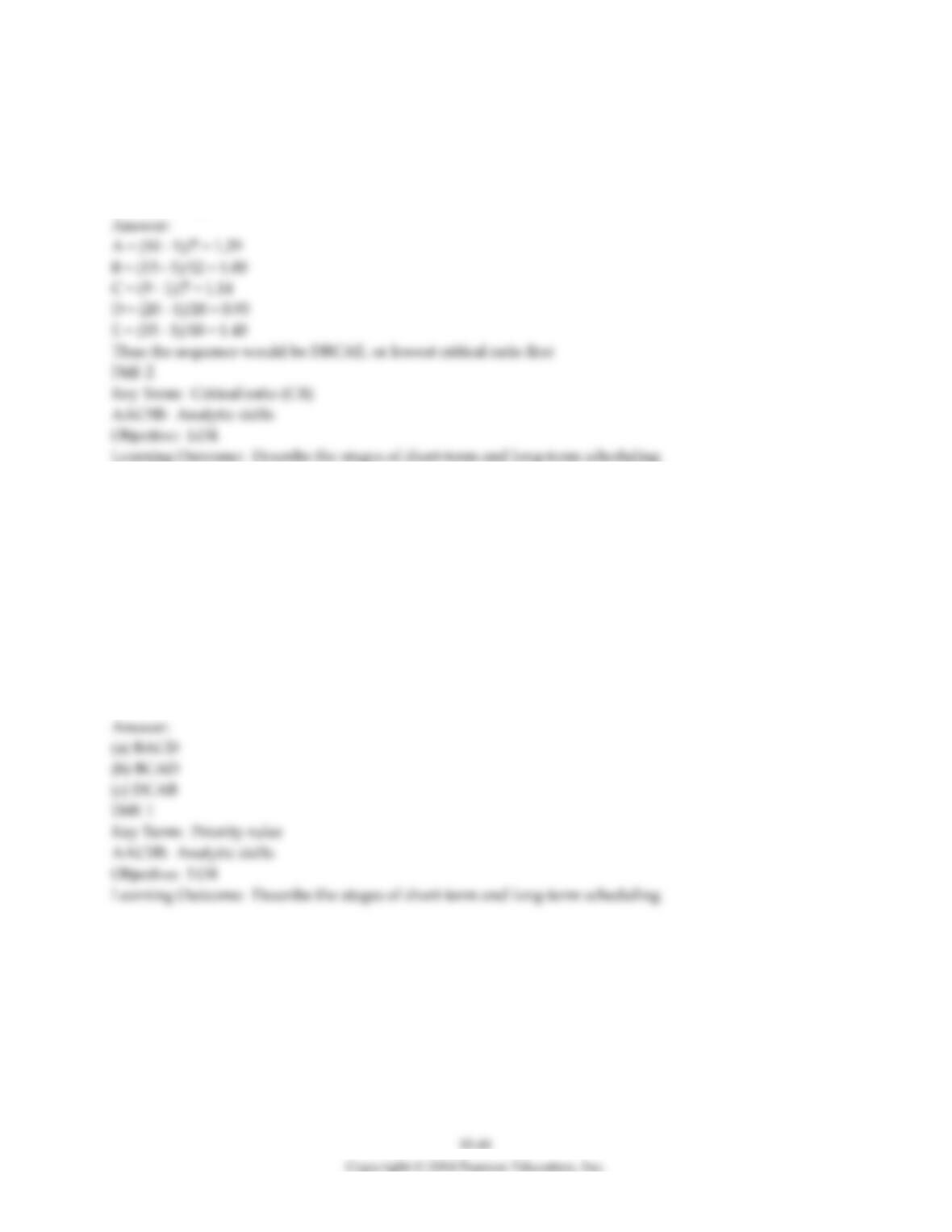
49) There are 5 jobs (A, B, C, D, E) that need to be completed in a work center. The due dates are the 10th,
13th, 9th, 20th, and 15th respectively with process times of 7, 12, 7, 20, and 10 respectively as well. If
today is the 1st of the month calculate the critical ratio for each and use this value to sequence the jobs in
the order they should be started.
50) Given the table below, find the sequence for the following priority rules:
(a) SPT
(b) EDD
(c) LPT
Job Process Time Due Date
A 6 10
B 4 2
C 8 5
D 9 16
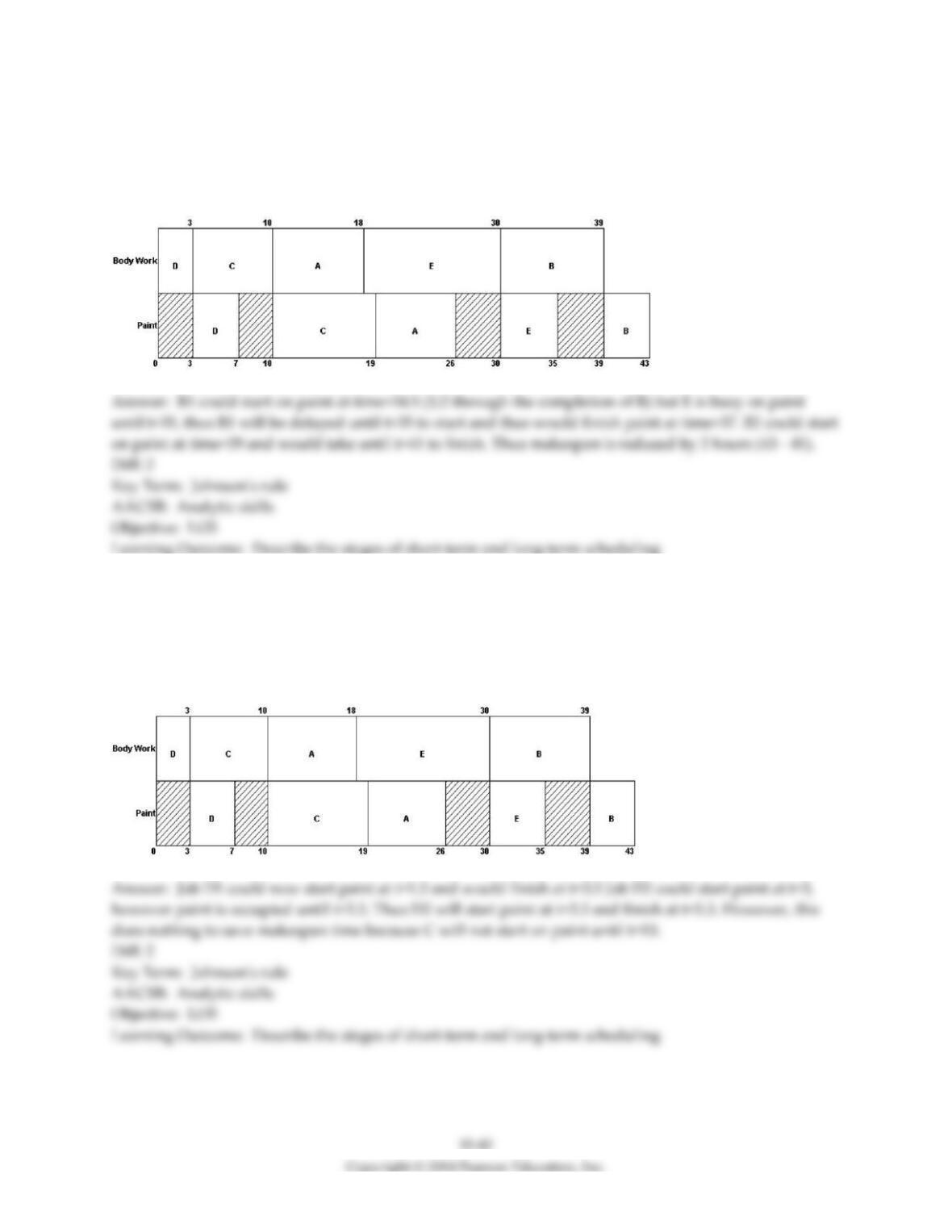
51) Given the following chart of jobs assigned with Johnson’s rule, suppose that all the jobs (A, B, C, etc)
could be evenly divided into two tasks (such as A1 and A2, B1 and B2, etc). Suppose job B is divided into
jobs B1 and B2, each with a body work time of 4.5 hours and a paint time of 2 hours. How much is
makespan reduced by this splitting of B?
52) Given the following chart of jobs assigned with Johnson’s rule, suppose that all the jobs (A, B, C, etc)
could be evenly divided into two tasks (such as A1 and A2, B1 and B2, etc). Suppose job D is split into
two equivalently sized sections, D1 and D2, each with a body work time of 1.5 hours and a paint time of 2
hours (D1 and D2 sum to 3 hours of body work and 4 hours of paint which is equivalent to D). How
much is makespan reduced by this splitting of D?
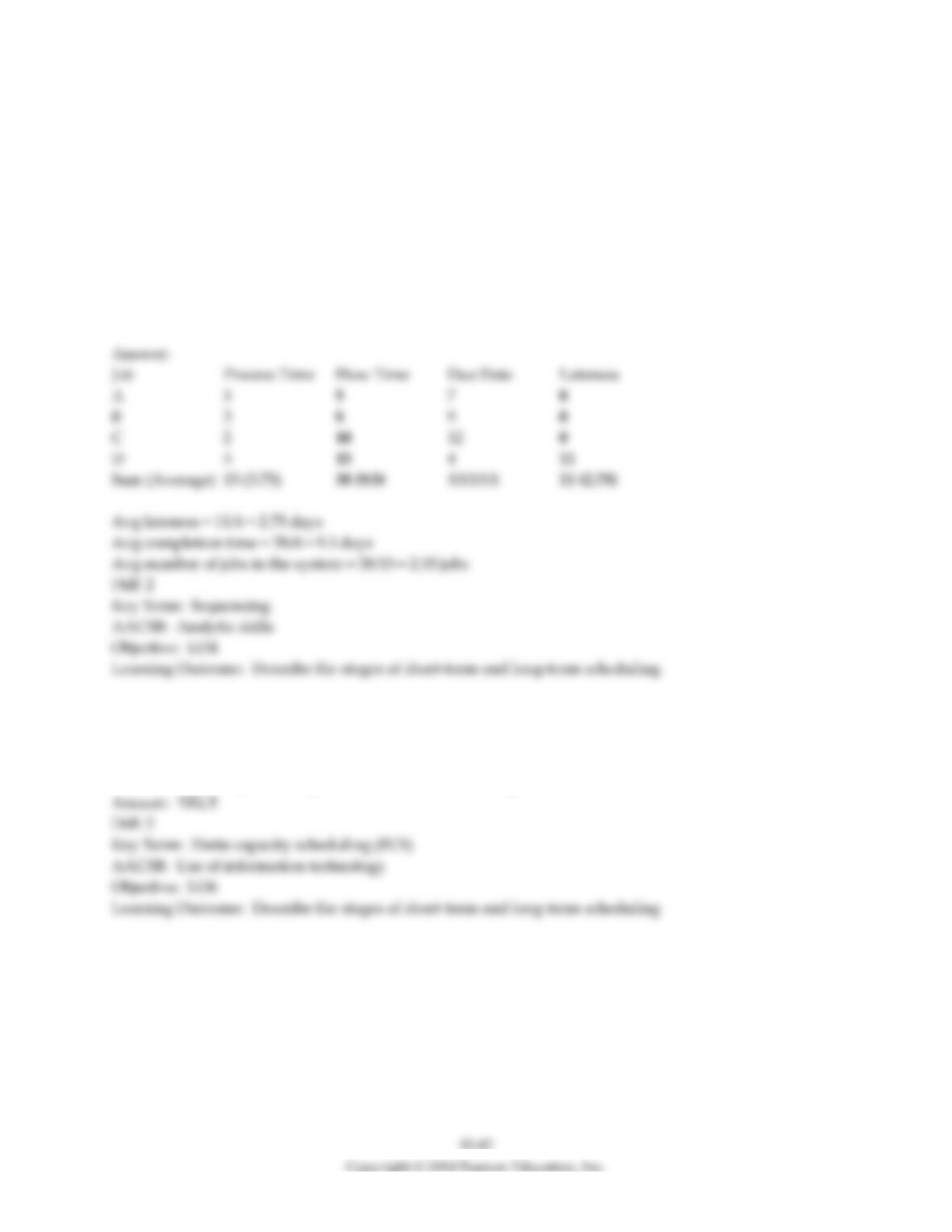
53) Complete the table; find average lateness, average completion time, and average number of jobs in the
system. Assume all durations are in days and that the jobs are processed at the shop in the order that they
arrive (A then B then C then D).
Job Process Time Flow Time Due Date Lateness
A 5 7
B 3 9
C 2 12
D 5 4
Sum (Average) 15 (3.75) XXXXX
Section 6 Finite Capacity Scheduling (FCS)
1) Finite capacity scheduling provides the user with graphical interactive computing, which is the
technique’s primary advantage over rule-based scheduling.
2) A recent advance in short-term scheduling that makes use of expert systems and simulation in solving
dynamic scheduling problems is:
A) forward scheduling.
B) backward scheduling.
C) infinite scheduling.
D) finite capacity scheduling.
E) progressive scheduling.
3) ________ uses computerized short-term scheduling to overcome the disadvantages of rule-based
systems by providing the user with interactive computing and graphical output.
4) What is finite capacity scheduling (FCS)?
Section 7 Scheduling Services
1) Scheduling optimization systems used in retail stores typically track customer traffic in 4-hour time
increments.
2) In services, the scheduling emphasis is usually on staffing levels, not materials.
3) Because of the significance of labor in the scheduling of services, behavioral and social issues, wage
and hour laws, and union contracts all complicate the scheduling process.
4) In manufacturing scheduling, physical inventories of goods can buffer variations in demand, but
service scheduling normally lacks that buffer because services are generally consumed at the same time
they are delivered.
5) Which of the following is NOT tracked by scheduling optimization systems used in retail stores?
A) cars parked in the parking lot
B) individual store sales
C) transactions
D) units sold
E) customer traffic
6) Which of the following is TRUE regarding services scheduling?
A) The critical ratio sequencing rule is widely used for fairness to customers.
B) The emphasis is on staffing levels, not materials.
C) Reservations and appointments are often used to manipulate the supply of services.
D) Labor use can be intensive, and labor demand is usually stable.
E) All of the above are true.
7) In what five ways does the problem of scheduling service systems differ from that of scheduling
manufacturing systems?
8) Identify some scheduling optimization systems that are used at retail stores. Describe what these
systems do.
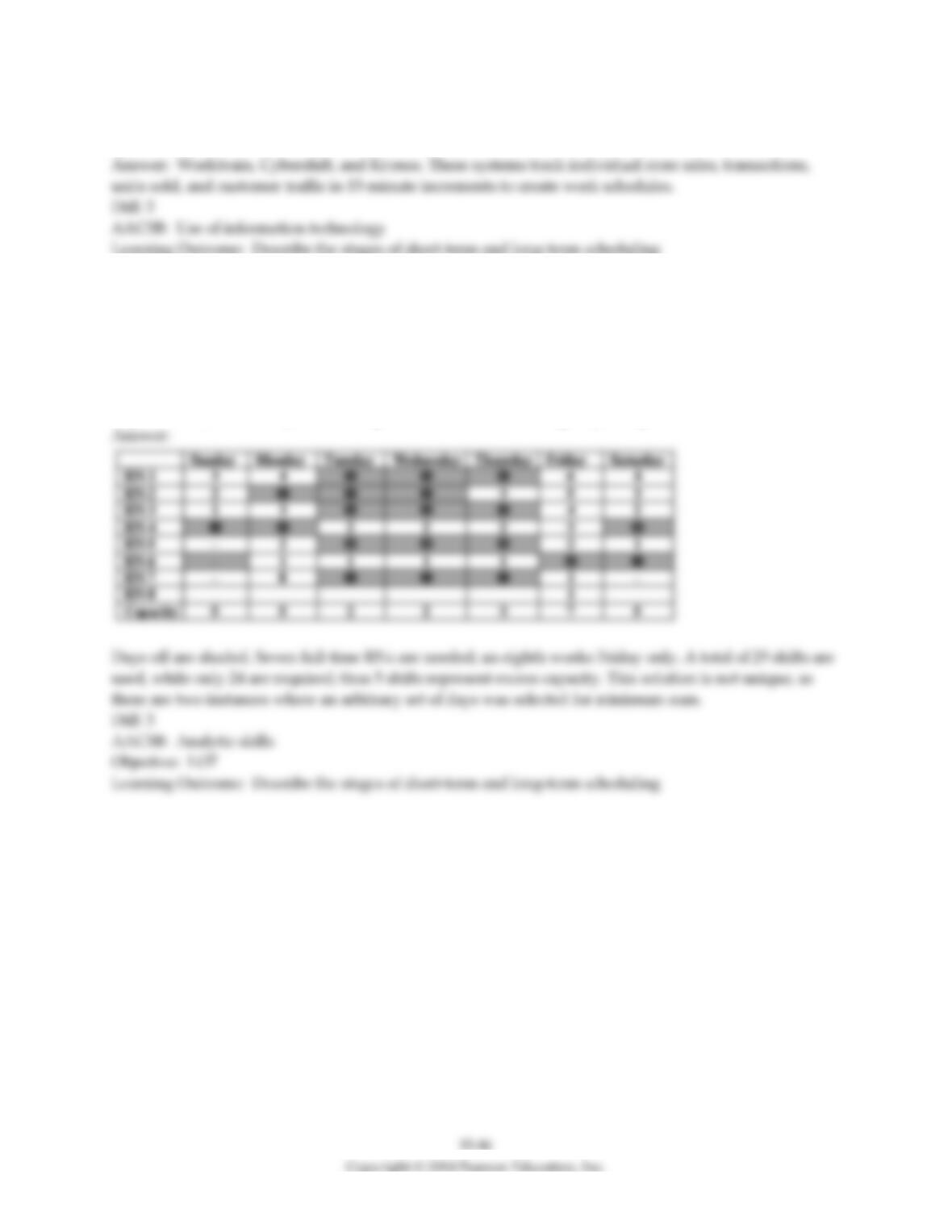
9) The emergency room at a hospital estimates the following requirements for registered nurses (RNs) for
the late night shift each week. Nurses work four consecutive days, then have off three days.
Sunday Monday Tuesday Wednesday Thursday Friday Saturday
3 4 2 2 3 6 4
Perform cyclical scheduling on the data. (Note that you must identify three-day patterns of minimum
requirements). How many RNs are required? How much extra capacity is required?