73. The __________ position points to the impact of the drug trade, especially crack cocaine, and the related increase in
gun use and possession by youths as the cause of increases in youth crime.
a. cohort
b. super predators
c. environmental
d. lowering divorce rates
e. gangs
74. Critics of which approach say that the group of youth that peaked during the early 1990s was not at all
exceptional with respect to involvement in violence in their younger years?
a. cohort
b. economic determinism
c. environmental
d. lowering divorce rates
e. gangs
75. Youth crime is tracked by the:
a. UCR.
b. NCAA.
c. Youth Index of Crimes.
d. National Crime Index.
76. During which period did a series of significant precedents by the U.S. Supreme Court set out basic
constitutional protections for juveniles?
a. Puritan
b. refuge
c. juvenile court
d. juvenile rights
e. due process
77. During which period did punishments became harsher for juvenile repeat offenders?
a. “kids are different”
b. refuge
c. juvenile court
d. juvenile rights
e. crime control
78. The use of waiver to adult court was reduced sharply during this period.
a. “kids are different”
b. refuge
c. juvenile court
d. juvenile rights
e. crime control
79. During which period did the Supreme Court rule that people who commit a murder while under the age of 18 cannot
be executed for the crime?
a. “kids are different”
b. refuge
c. juvenile court
d. juvenile rights
e. crime control
80. Which is the most recent period in juvenile justice?
a. “kids are different”
b. refuge
c. juvenile court
d. juvenile rights
e. crime control
81. The House of Refuge was created in New York in 1825 during this period.
a. “kids are different”
b. refuge
c. juvenile court
d. juvenile rights
e. crime control
82. A child who is receiving inadequate care because of some action or inaction of parents would be a:
a. dependent child.
b. delinquent child.
c. neglected child.
d. status child.
e. ward of the court.
83. A child who has no parent or guardian or whose parents cannot give proper care would be a:
a. dependent child.
b. delinquent child.
c. neglected child.
d. status child.
e. ward of the court.
84. Based on the preface, Jerry will be charged with a:
a. judicial delinquency offense.
b. mala juvenilia.
c. statutory crime.
d. status offense.
e. juvenile crime.
85. The decision to take Jerry into custody, detain him following apprehension, or refer him to court is called:
a. intake.
b. diversion.
c. screening.
d. pretrial hearing.
e. police interface.
86. Given the nature of Jerry’s offenses, he will definitely NOT be given _____ as a penalty.
a. restitution
b. a fine
c. a warning
d. a prison sentence
e. community service
Completion
87. The most significant factor related to gang violence is ____ activity.
88. Youth gangs are another factor explaining ______ youth crime.
89. The ______ ______ ______ _____ estimates that there are more than 27,900 gangs.
90. The doctrine of _________________ means the state is the parent and guardian of all citizens who are unable to
protect themselves.
91. The idea that children should be treated differently from adults originated in the common law court of _______.
92. The _________ period of juvenile justice viewed delinquent juveniles as evil.
93. During the _________ period children were to learn good work and study habits, and live in a disciplined and healthy
environment.
94. The first law pertaining to juveniles in the United States was called the Massachusetts _______________________
law.
95. _____ ___ _______ extended due process rights to juveniles.
96. _____ ___ ______ ruled that the standard of proof in juvenile cases is proof beyond a responsible doubt.
97. _________ __ ________ (1971) ruled that juveniles do not have a constitutional right to a jury trial.
98. The first reform school in the United States opened in 1848 and was called the ______ School for Boys.
99. The term criminal behavior was replaced with _______ behavior during the juvenile court period.
100. A _______________ is any act committed by a juvenile that is considered unacceptable for a child but is not
considered a crime for an adult.
101. The punitive era of juvenile justice, which lasted from 1980 to 2005, is known as the __________________ period.
102. _______ __ _______ ruled that juveniles may be held in preventative detention if they may commit additional crimes
while awaiting their court date.
103. In _______ ___ _______ , the Court ruled that those individuals under 18 during the commission of the crime could
not be sentenced to death.
104. A child who committed an act that if committed by an adult would be criminal is considered a(n) ___________.
105. A child who is not receiving proper care because of action or inaction by his or her parent is considered a(n)
___________ child.
106. The process of screening children out of the juvenile justice system without a court decision is called __________.
107. A __________ hearing is a hearing by the juvenile court to determine if a juvenile should be detained or released
prior to adjudication.
108. When court officials ________ jurisdiction, they transfer the juvenile case to the adult court.
109. __________ facilities for juveniles include foster homes, group homes, camps, ranches, and schools.
110. The juvenile equivalent of parole is _________.
111. The phenomenon of ______ ______ involves the use of computer, cell phones, and other electronic devices by youth
to mistreat and harm their peers.
112. Exceptionally violent individuals are called ______.
113. The ________ cause for the increase in youth crime points to the impact of the drug trade, especially crack cocaine,
and the related increase in gun use and possession by youths.
114. During the ______ period, the state began to step into the place of parents who would not or could not.
115. During the juvenile court period, an influential class of people referred to as ____ _____ sought major
reforms for juveniles.
116. During the _____ ____ period, juvenile justice officials seemed to have too much discretion at times.
Subjective Short Answer
Mary Elizabeth is a recent college graduate and has begun a new position as a juvenile court counselor. She is extremely
motivated to make a difference in the lives she will come in contact with, and has pictured this for the last two years of her
college career.
118. Based upon Mary Elizabeth’s philosophy of wanting to make a difference in her client’s life, she would most likely
be considered a:
a. child saver.
b. social worker.
c. problem finder.
d. solution finder.
e. none of these.
119. Mary suspects that several of the juveniles she counsels are not receiving inadequate care at home. Mary would
classify this type of juvenile as a:
a. dependent child.
b. neglected child.
c. deviant child.
d. delinquent child.
e. destitute child.
120. Mary Elizabeth was pleasantly surprised that several of her clients had committed curfew violations and other similar
offenses called:
a. status.
b. felonies.
c. misdemeanors.
d. infractions.
e. offenses.
121. Mary Elizabeth did have a client who was 14 and committed an especially heinous and brutal rape. His case was sent
to the adult courts by a:
a. motion.
b. legal document.
c. waiver.
d. continuance.
e. objection.
Judge Elaine Smith is assigned to the Department of Juvenile Justice. She has been in her position for eight years. She has
recently seen a change in the attitude of many of the juveniles who come through her courtroom. She loves her position,
but sometimes gets weighed down by the assembly-line system of justice we offer our juveniles.
122. On Tuesday morning, Judge Smith had a 15-year-old who had numerous truancy charges against her. Even though
the girl has missed several days of school, she still has a 4.0 GPA. Which of the following would Not be an option
for Judge Smith?
a. detention hearing
b. transfer to criminal adult court
c. release
d. dismiss
e. counsel and release to parents
123. On Thursday morning, Judge Smith had a known gang banger who is responsible for running drugs throughout the
county. He is being charged for grand theft auto. He is very intelligent and instead of sentencing him to prison, Judge
Smith wants to sentence him to some type of custodial supervision with:
a. probation.
b. alternate disposition.
c. adult prisoncommunity treatment.
d. boot camp.
124. On Monday morning, Judge Smith’s first case was a 13-year-old who had shoplifted a pair of sunglasses from a local
Walmart. Which of the following would NOT be an option for Judge Smith?
a. detention or shelter prior to court appearance
b. release or referral to community resources
c. release to parents prior to court appearance
d. citation and referral to juvenile intake, release to parents
125. On Wednesday morning, Judge Smith finds that the police have transported to her court a 14-year-old male who
was being adjudicated for his tenth charge of arson. Of the actions listed below, what option was available to the
police officer?
a. detention hearing
b. transfer to criminal adult court
c. release
d. dismiss
e. counsel and release to parents
Social media sites such as Facebook, Twitter, and Tumbler have become go–to sites for many juveniles. These sites allow
for kids to socialize with anyone and everyone from wherever they are at the moment. These sites have also become
difficult for those in authority to control.
126. Suzanne Kenny had been bullied for the last several months of school. She finally could not endure the punishment
anymore after receiving a Facebook post saying such was fat, ugly, and friendless. This would be considered what type of
crime?
a. harassment
b. bullying
c. cyber bullying
d. school violence
e. rite of passage
127. Suzanne Kenny is not alone in the pain she has endured. It is estimated that ____ percent of juveniles have
committed cyber bullying.
a. 10
b. 20
c. 30
d. 40
e. 50
Essay
128. Explain why criminologists had difficulty explaining the rise in youth crime that peaked in 1993.
129. What is the role of the police in handling juvenile cases? How do the police handle juveniles differently than adults?
130. The terms used to refer to juvenile offenders have been changed (from arrest warrant to petition; from sentence to
disposition, etc.) from those used to refer to adult offenders. What philosophical perspective provided the impetus for this
change? Discuss the purpose of this change and explain how it helped to change the way juveniles were treated by the
criminal justice system.
131. In theory, the major goal of the juvenile court is to protect juveniles and “act as parent.” How might you justify the
movement toward punitiveness from 1980 to 2005 if parens patriae was the overriding philosophy of the juvenile court?
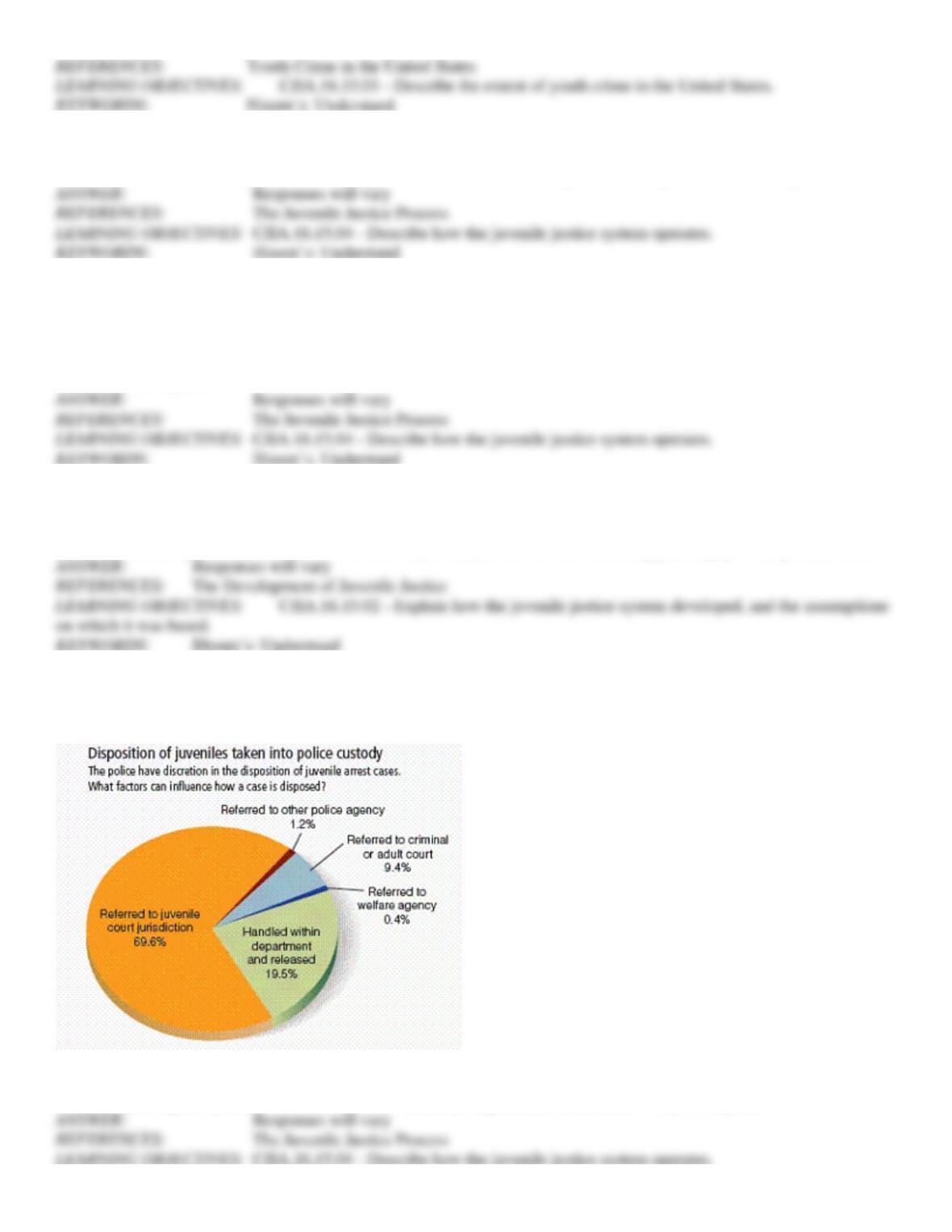
132. Consider the information presented in this pie chart:
Why do you think such a large percentage of juveniles who come to police attention are formally referred to court?
Wouldn’t you expect that most would be handled within the department and released? Why or why not?
133. Technology is imploding around the juvenile population. There is instant access to friends, family, enemies, and
victims. How can we grasp and control cyber crime and cyber bullying? What impact will this have on future generations?
134. Gang violence has escalated all over the country from cities to rural areas. How can we make gangs less attractive
especially to those in fatherless homes? Should this be left to law enforcement? How can other community groups fight
gangs?
135. This chapter discussed important constitutional law cases pertinent to the juvenile justice system. What case would
you consider to be the single most important to the system as an individual right? Why that case? Explain.
136. Roper v. Simmons (2005) ruled that capital punishment cannot be carried out on juveniles who commit their crime
while under 18. Is this a valid ruling? Why do you feel that society has a difficult time processing juveniles being
executed? Do we still maintain that save the child mentality? Are there offenders who will never be corrected that should
be executed?
137. Are neglected and dependent children more likely to become delinquent juveniles? Why would this be so? Can this
be prevented?
138. Describe the extent of youth crime in the United States.
139. Explain how the juvenile justice system developed, and the assumptions on which it was based.
140. Identify what determines the jurisdiction of the juvenile justice system.
141. Name some of the issues facing the American system of juvenile justice.